
- Home
- »
- Next Generation Technologies
- »
-
Facility Management Services Market Report, 2026 - 2033GVR Report cover
![Facility Management Services Market (2026 - 2033)Report]()
Facility Management Services Market (2026 - 2033)
Size, Share & Trends Analysis Report By Service Type (Hard Services, Soft Services), By Organization Size (Large Enterprises, Small & Medium Enterprises), By End Use, By Region, And Segment Forecasts
Market Size, 2025
$45.9BMarket Estimate, 2026
$49.0BMarket Forecast, 2033
$82.9BCAGR, 2026–2033
7.8%Facility Management Services Market Summary
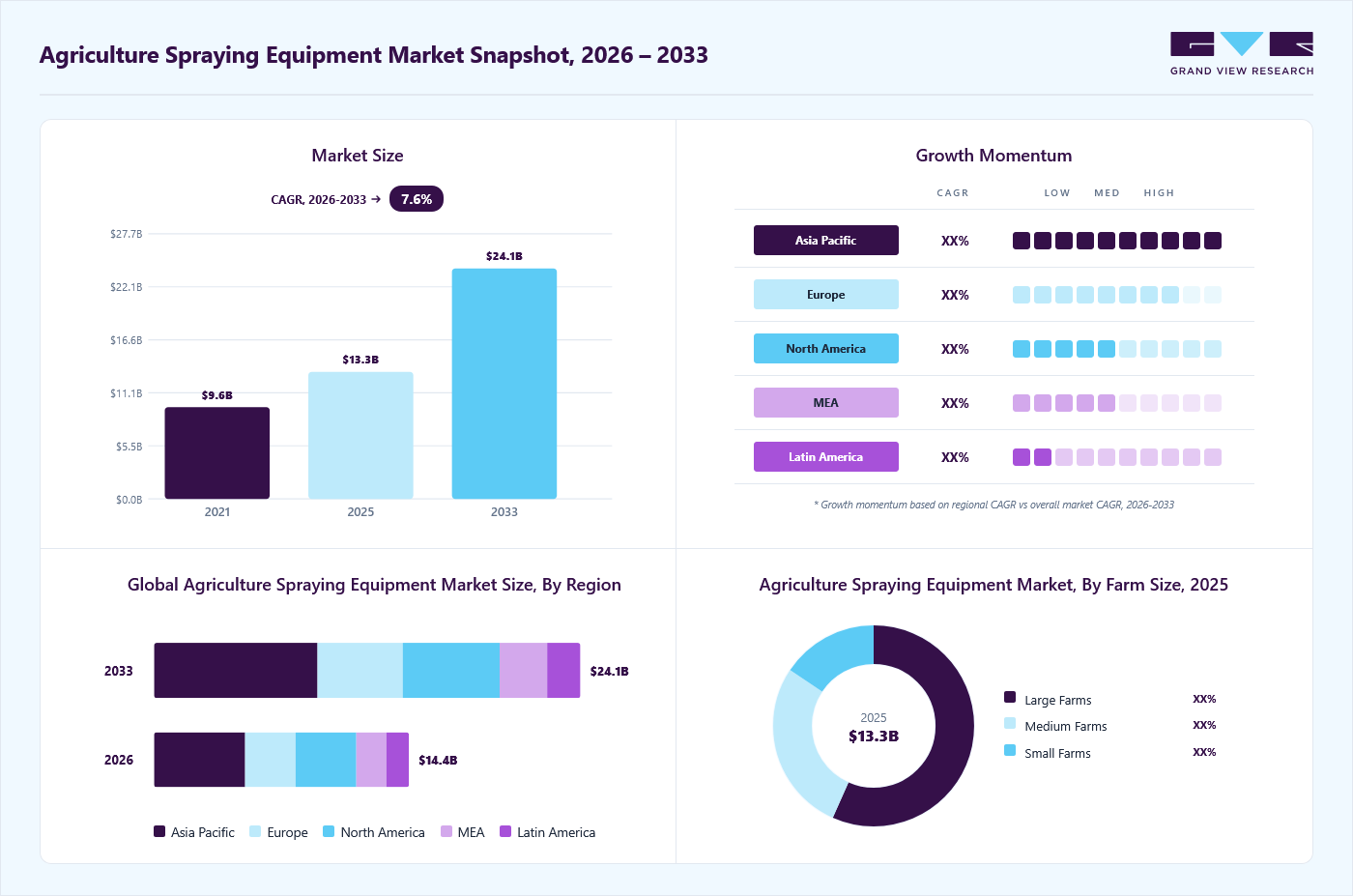
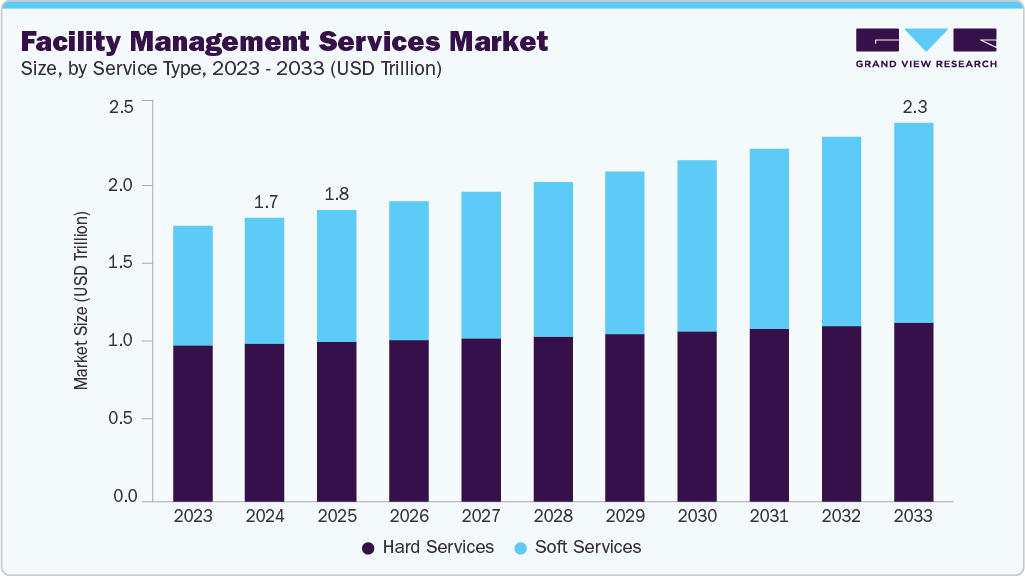
The global facility management services market size was valued at USD 45.9 billion in 2025 and is projected to grow from USD 49.0 billion in 2026 to USD 82.9 billion by 2033, growing at a CAGR of 7.8% from 2026 to 2033. North America dominated the global market, accounting for the largest revenue share of 32.5% in 2025. The facility management services market is primarily driven by the increasing demand for efficient building operations, cost optimization, and enhanced workplace experiences across commercial, industrial, healthcare, and institutional facilities.
Key Market Trends & Insights
- By service type: Hard services segment dominated the market, with a share of 55.0% in 2025.
- By organization size: Large enterprises segment dominated the market in 2025.
- By end use: Business & corporate segment accounted for the largest market share in 2025.
Regional Highlights
- Largest regional market: North America (32.5% revenue share in 2025)
- Fastest growing regional market: Asia Pacific (fastest CAGR 10.4%, 2026-2033)
- By Country: The U.S. held the largest market share in 2025
Market Size & Forecast
- Market size in 2025: USD 45.9 Billion
- Estimated market size in 2026: USD 49.0 Billion
- Projected market size by 2033: USD 82.9 Billion
- CAGR (2026-2033): 7.8%
Three ways to get this report
Buy it, customize it, or ask a question.Get the Full Report
What the study covers
- FormatsPDF · Excel · Dashboard
- Timeline2026–2033 annual, 2025 base
- Coverage20+ countries, 5 regions
- Companies10+ key players profiled
Customize the Report
20% free customization
- IncludeCountries, segments, points
- TailorTo your product definition
- ExtendDeeper competitor detail
- OrA fully bespoke study
- Turnaround5–10 working days
Ask Prism AI
A cited answer in seconds
- Corpus30K studies, 1.2M points
- ScopeAll markets, not just this
- CitationTraced to report & table
- HonestySays "not covered" if so
- SpeedSeconds, not days
Additionally, the growing adoption of smart building technologies, rising emphasis on sustainability and energy management, and the expansion of commercial real estate and infrastructure projects are further accelerating market growth worldwide. The market is growing rapidly, driven by a surge in demand for integrated, tech-enabled solutions that enhance operational efficiency, workplace safety, and sustainability. As businesses and industries integrate digital technologies into their physical environments, the demand for smarter and more efficient facility operations is accelerating. Organizations are prioritizing cost-effective, predictive, and data-driven facility management solutions to enhance performance and occupant experience. The widespread adoption of IoT, automation, and AI is enabling real-time monitoring, preventive maintenance, and resource optimization. There is also a strong push toward integrated service models and sustainable practices aligned with ESG goals. These evolving needs and innovations are driving significant growth in the facility management services industry.
The growing demand for smart building technologies is transforming facility management across industries such as corporate, healthcare, and education. Organizations are investing in IoT sensors, AI-driven analytics, and automation systems to enable real-time monitoring and predictive maintenance of their assets. These technologies help reduce operational costs, improve energy efficiency, and enhance occupant comfort and safety. Cloud-based platforms are increasingly being integrated to support seamless data management and operational control. Furthermore, regulatory emphasis on sustainability is driving the adoption of energy-efficient solutions. These combined factors are expected to substantially boost the growth of the facility management services industry over the forecast period.
The growing demand for enhanced workplace experience and employee well-being is redefining the role of facility management. Organizations are incorporating wellness programs, flexible space designs, and technology-enabled amenities to foster productivity and engagement. The shift to hybrid and remote work models is increasing the need for adaptable and health-conscious facility solutions. Facility management providers are leveraging smart access systems, indoor air quality monitoring, and mobile engagement tools to improve user satisfaction. As talent retention emerges as a significant challenge, companies are making substantial investments in enhancing workplace environments. This shift in focus is expected to propel ongoing growth in the facility management services sector.
Market Dynamics
The facility management services market is experiencing rapid growth, supported by the increasing complexity of modern building infrastructure and the need for integrated management of diverse assets and services. Furthermore, the growing trend toward digital transformation, including the use of IoT-enabled monitoring, predictive maintenance, and data-driven decision-making, is encouraging businesses to invest in professional facility management services that enhance operational resilience and long-term asset value.
The increasing adoption of Integrated Facility Management (IFM) solutions is a major driver of the facility management services market. Organizations across commercial, industrial, healthcare, and educational sectors are seeking to consolidate multiple facility-related functions, such as maintenance, security, cleaning, space management, and energy management, under a single service provider. This approach enables businesses to streamline operations, improve service consistency, and reduce administrative complexity.
In addition, IFM solutions provide enhanced visibility into facility performance through centralized reporting and analytics. By leveraging integrated service models, organizations can optimize resource utilization, reduce operational costs, and improve workplace efficiency. As enterprises continue to focus on operational excellence and cost control, demand for comprehensive facility management services is expected to increase significantly in the coming years.
The facility management services market faces challenges due to its heavy reliance on a skilled workforce to manage diverse facility operations. Services such as technical maintenance, HVAC management, energy optimization, and building automation require trained personnel with specialized expertise. Shortages of qualified workers can affect service quality and operational efficiency, particularly in regions experiencing labor constraints.
Moreover, maintaining consistent service standards across multiple locations and facility types remains a significant challenge for service providers. Variations in workforce skills, employee turnover, and training requirements can increase operational costs and impact customer satisfaction. These factors may limit market growth, especially for providers seeking to scale their operations across large geographic areas.
The rapid emergence of smart buildings presents a substantial opportunity for the facility management services market. Building owners and occupiers are increasingly investing in connected technologies, including IoT sensors, intelligent energy systems, digital twins, and automated building controls to improve operational efficiency and occupant comfort. These technologies generate valuable data that require specialized management and analysis, creating demand for advanced facility management services.
Facility management providers are well-positioned to capitalize on this trend by offering technology-enabled solutions such as predictive maintenance, remote monitoring, energy optimization, and real-time asset management. As organizations prioritize sustainability, operational resilience, and data-driven facility operations, the integration of digital technologies into facility management services is expected to present new revenue streams and drive long-term market expansion.
Market Concentration & Characteristics
The facility management services market is moderately fragmented, with a mix of integrated global service providers and regional players competing on breadth of services, technological capabilities, and contract scalability. The market is characterized by a high degree of innovation, supported by advancements in smart building solutions, predictive maintenance, energy management systems, and cloud-based facility management software. The industry is also evolving through long-term outsourcing contracts and strategic partnerships between facility management providers, real estate developers, and corporate occupiers, enabling integrated service delivery across complex infrastructure portfolios.
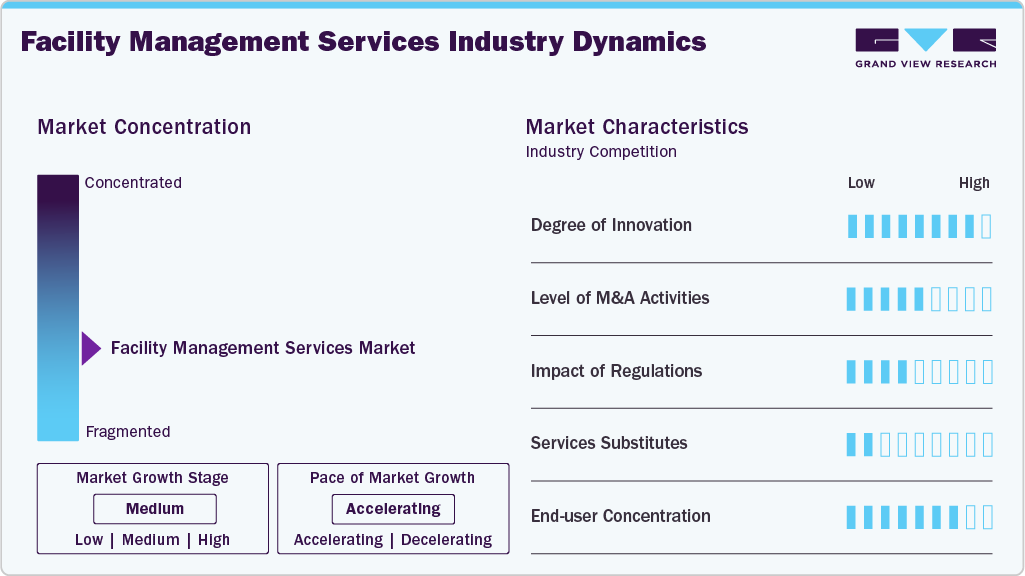
Sustainability regulations, green building certifications, and energy efficiency mandates significantly influence market operations, while compliance with labor laws, safety standards, and environmental regulations adds operational complexity. The threat of substitutes remains low to moderate, as in-house facility management is still preferred in certain large organizations, but is gradually declining due to cost pressures and efficiency gains from outsourcing. Demand is driven primarily by rapid urbanization, the expansion of commercial real estate, infrastructure development, and an increasing focus on workplace experience and operational resilience across global markets.
Analyst Perspective
The facility management services market is gaining significant momentum, driven by the growing shift toward outsourced facility operations, the rising adoption of integrated and technology-enabled service models, and a growing emphasis on cost optimization, sustainability, and workplace efficiency across commercial, industrial, and institutional sectors globally. Moreover, the market is witnessing accelerated adoption of smart building technologies, predictive maintenance solutions, and data-driven facility management platforms, which are enabling real-time monitoring, improved asset utilization, and enhanced operational resilience.
Service Type Insights
Based on service type, the hard services segment led the market with the largest revenue share of 55.0% in 2025 and is expected to grow at a considerable CAGR over the forecast period, owing to the increasing emphasis on infrastructure efficiency, regulatory compliance, and safety, the hard services segment in facility management is gaining significant traction. Organizations are prioritizing the upkeep of critical systems such as HVAC, MEP, fire safety, and water management to ensure operational continuity and occupant well-being. The rise of smart building solutions and IoT-enabled maintenance enables predictive servicing, reduces downtime, and lowers lifecycle costs. Furthermore, sustainability goals are pushing demand for energy-optimized systems, driving innovation and investment in advanced hard service capabilities.
The soft services segment is predicted to foresee significant growth in the forecast period. The increasing demand for enhanced workplace hygiene, employee well-being, and operational support is driving growth in the soft services segment of facility management. Organizations are emphasizing on services such as cleaning, catering, security, and front-office management to create safe, efficient, and welcoming environments. This trend is further fueled by the shift toward hybrid work models, which require flexible and responsive service delivery. Moreover, the adoption of smart technologies is optimizing soft service operations, enabling real-time monitoring, automation, and improved service quality.
Organization Size Insights
Based on organization size, the large enterprises segment dominated the market with the largest revenue share of 65.9% in 2025. The increasing demand for scalable, integrated, and cost-efficient facility management solutions is driving the segment growth. These organizations often operate across multiple locations and require standardized service delivery, regulatory compliance, and strategic asset management. As a result, they are investing in advanced FM technologies such as CAFM, IoT-enabled monitoring, and predictive maintenance to streamline operations. Additionally, large enterprises are increasingly partnering with global FM providers to leverage bundled services, reduce overheads, and enhance overall workplace experience.
The small & medium enterprises segment is predicted to foresee significant growth in the forecast period, owing to the rise of digital transformation and remote work models, SMEs are leveraging technology-driven facility management tools to enhance operational visibility and reduce manual oversight. Cloud-based CMMS platforms, mobile apps, and sensor-enabled systems allow small businesses to manage assets, maintenance schedules, and vendor coordination more efficiently. This has significantly reduced dependency on large-scale infrastructure and enabled data-driven decision-making. The result is improved uptime, reduced facility costs, and a more agile business environment for SMEs.
End Use Insights
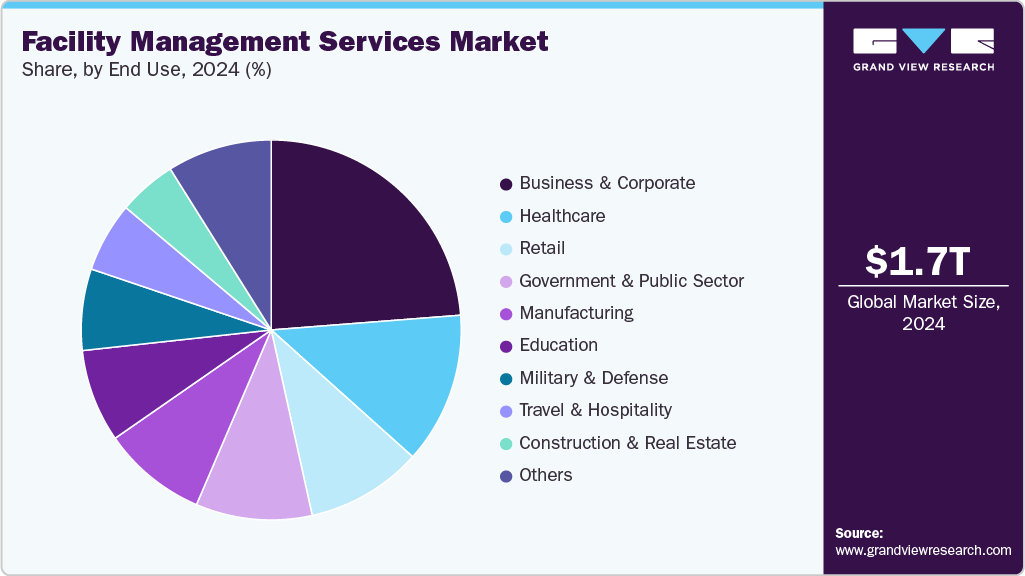
Based on end use, the business & corporate segment dominated the market with the largest revenue share of 24.5% in 2025, driven by rising pressure to achieve sustainability and ESG compliance, businesses are embedding green practices into their facility management strategies. Organizations are investing in energy-efficient systems, sustainable materials, and waste-reduction initiatives to meet environmental goals. Facility management providers are increasingly being selected based on their ability to deliver measurable impact in these areas. This trend is positioning FM partners as key enablers of corporate sustainability agendas.
The construction & real estate segment is projected to grow significantly over the forecast period, owing to rising expectations for tenant experience and asset performance, real estate developers are leveraging advanced facility management services to deliver premium, tech-enabled environments. From smart building systems and automated maintenance to concierge and digital support platforms, FM is central to delivering value in both residential and commercial spaces. This has led to stronger collaboration between developers and FM firms to create service-rich, responsive, and secure environments. The trend underscores FM's growing role in enhancing occupancy, retention, and real estate value.
Regional Insights
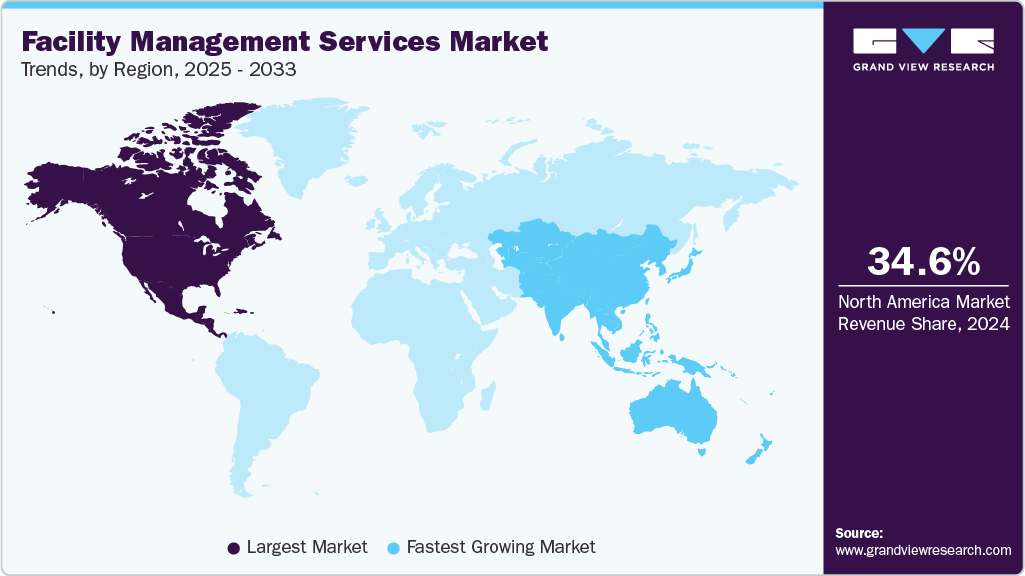
North America dominated the facility management services market, accounting for the largest revenue share of 32.5% in 2025, primarily driven by stringent government regulations focused on energy efficiency and carbon reduction, companies are adopting greener facility management solutions. The push for sustainable practices is encouraging the deployment of renewable energy sources and waste management programs in commercial and industrial buildings. Additionally, the rise of remote and hybrid work models requires flexible space management and advanced technology adoption. This regulatory and operational environment is accelerating the modernization of facility management services across the region.
U.S. Facility Management Services Market Trends
The facility management services market in the U.S. held the largest share in the North America region in 2025. The increasing demand for outsourced facility management services is reshaping the U.S. market landscape as companies seek cost efficiencies and expert resource access. Multi-site enterprises benefit from standardized contracts and consolidated vendor relationships, improving service delivery and accountability. The rapid growth of sectors such as healthcare and retail is further boosting demand for specialized facility management solutions. This outsourcing trend is expected to remain a key market driver in the coming years.
Europe Facility Management Services Market Trends
Europe facility management services market is expected to grow at a CAGR of 6.9% from 2026 to 2033, owing to evolving workplace dynamics and flexible working patterns, there is a rising need for adaptive facility services in Europe. Facility managers are implementing modular space designs and digital booking systems to accommodate hybrid work environments. The focus on employee well-being is also driving investments in indoor environment quality and ergonomic workplace solutions. These factors collectively stimulate demand for innovative facility management offerings across the region.
Germany facility management services market is expected to grow at a significant rate in the coming years, driven by the growing demand for energy-efficient and sustainable buildings. Germany’s market is expanding steadily due to the increasing investments in green building certifications and smart infrastructure are pushing service providers are being pushed to adopt innovative FM solutions. The country also benefits from strong public-private collaboration in modernizing public facility assets.
The facility management services market in the UK is expected to grow at a significant rate in the coming years, primarily driven by the increasing outsourcing of non-core operations by corporate clients. The UK market is evolving with a strong focus on integrated service models. There is a growing preference for bundled services, especially among large enterprises and government bodies. Additionally, ESG compliance and workplace wellness are becoming central themes in FM contracts.
Asia Pacific Facility Management Services Trends
Asia Pacific facility management services market is anticipated to register the fastest CAGR of over 10.4% from 2026 to 2033. The increasing demand for sustainability and energy-efficient building solutions is gaining momentum in Asia Pacific, especially in manufacturing and hospitality sectors. Facility managers are adopting green certifications and energy monitoring systems to comply with regional environmental policies and customer expectations. Rising awareness of health and safety standards of post-pandemic further encourages the integration of advanced air filtration and cleaning services. These drivers are accelerating the adoption of modern facility management practices across the region.
China facility management services market is Owing to rapid urbanization and the massive growth in commercial real estate; China’s facility management services market is experiencing significant growth. The rise of smart cities and government-led infrastructure initiatives has created strong demand for technology-driven FM solutions. Furthermore, local and multinational companies are increasingly seeking professionalized services to meet international operational standards.
The facility management services market in Japan is rapidly driven by an aging infrastructure base and a declining workforce. Thereby, Japan is focusing on automation and robotics in facility management. The market is shifting toward predictive maintenance, AI-based monitoring, and energy management to improve operational efficiency. Demand is also growing in healthcare and elderly care facilities, prompting FM firms to offer specialized solutions.
Key Facility Management Services Company Insights
Some of the key players operating in the market include Aramark Corporation and CBRE Group Inc., and among others.
-
AramarkCorporation is a global leader in food services, facilities management, and uniform services, operating across industries like education, healthcare, and business. In the facility management space, it specializes in operational efficiency, janitorial services, and workplace experience solutions. The company is known for integrating hospitality-driven approaches into day-to-day facilities services, enhancing employee and customer satisfaction.
-
CBRE Group Inc. is one of the world’s largest commercial real estate services firms, offering integrated facilities management services globally. The company specializes in hard and soft FM services, energy optimization, and workplace strategy for large enterprises. CBRE combines technology with deep property management expertise to help clients reduce operating costs and improve building performance.
SILA Group and EFS Facilities Services Group are some of the emerging market participants in the facility management services market.
-
SILA Group is an India-based facility management company that provides integrated services across real estate, infrastructure, and corporate sectors. It focuses on smart FM solutions using IoT and analytics, especially in cleaning, security, and technical maintenance. SILA stands out for its agility and tech-enabled approach tailored for fast-growing markets in Asia.
-
EFS Facilities Services Group is a UAE-headquartered facilities management firm operating across the Middle East, Africa, South Asia, and Turkey. The company specializes in end-to-end integrated FM solutions including MEP, energy management, and specialized cleaning for corporate, retail, and government clients. EFS is gaining traction for its quality standards, regional customization, and multi-sector experience.
Key Facility Management Services Companies:
The following key companies have been profiled for this study on the facility management services market.
-
Aramark Corporation
-
CBRE Group Inc.
-
Jones Lang LaSalle Incorporated (JLL)
-
Compass Group
-
SAP SE
-
SILA Group.
-
EFS Facilities Services Group
-
EMCOR Group, Inc.
-
ISS Facility Services (ISS AS)
-
Sodexo SA.
Competitive Benchmarking
Category
Operating Strategies
Competitive Edge
Weakness
Established Global Players (ISS A/S, Sodexo, CBRE Group, JLL, Cushman & Wakefield, Aramark, Compass Group, Honeywell Building Solutions, etc.)
- Focus on large-scale integrated facility management (IFM) contracts across multinational clients, offering bundled hard and soft services under long-term agreements.
- Strong emphasis on digital transformation through smart building solutions, IoT-enabled monitoring, energy optimization, ESG compliance, and multi-site outsourcing models across industries.
- Strong global footprint, diversified service portfolios, deep enterprise client relationships, high financial stability, advanced technology adoption, and strong capability to manage complex, large-scale facilities across regions.
- High operational complexity, significant exposure to economic and real estate cycles, high labor dependency, and margin pressure due to competitive bidding and cost-sensitive long-term contracts.
Emerging & Specialized Players (SILA Group, Mitie Group)
- Focus on cost-efficient, region-specific, and sector-focused facility management services such as healthcare FM, retail FM, education FM, and industrial maintenance.
- Increasing adoption of mobile workforce tools, modular service contracts, subcontracting models, and selective digital integration.
- Strong local market knowledge, pricing flexibility, faster execution, ability to customize services for niche client needs, and strong presence in mid-sized and regional contracts.
- Limited global scalability, weaker brand recognition, lower capital availability, slower adoption of advanced smart building technologies, and constrained ability to serve large multinational clients.
Recent Developments
-
In April 2025, ServiceChannel launched a new Partner Ecosystem designed to enhance the facility management services industry by streamlining procurement and service delivery for multi-site clients. The ecosystem features a carefully vetted network of strategic partners providing solutions in remote monitoring (IoT), field service management, asset collection, consulting, payments, and technology implementation. This initiative underscores ServiceChannel’s commitment to driving operational efficiency and fostering innovation within facilities management.
-
In February 2025, Shore Capital Partners announced a partnership with TCG Services, LLC, an asset-lite facility management provider based in El Dorado, Kansas. This collaboration aims to accelerate TCG’s growth by investing in its team, technology, and infrastructure while expanding service lines and vendor partnerships, leveraging Shore’s capital and operational expertise. Both parties are committed to maintaining TCG’s strong customer-centric culture and market reputation, with plans to drive organic growth and strategic acquisitions to solidify TCG’s position as a leading vendor-managed facility management company.
-
In January 2025, Ocus Group partnered with CBRE to manage facility operations for Ocus Medley, a flagship mixed-use development on Gurugram’s Dwarka Expressway. Spanning 4.14 acres and comprising premium offices, retail, multiplex, food courts, and entertainment zones, the project is strategically located near IGI Airport and NH-48. This collaboration aims to elevate service quality and operational efficiency, positioning the development as a world-class business and lifestyle destination.
-
In November 2024, ScottOMAN joined forces with India’s Beyond Squarefeet to launch Mall-IQ, a mall-management venture in Oman focused on retail real estate. The partnership leverages ScottOMAN’s local expertise and Beyond Squarefeet’s international consultancy experience to deliver advanced asset management, operational efficiency, and customized solutions for Omani retail properties. Mall-IQ addresses growing demand in Oman’s retail sector by enhancing tenant experience, enabling data-driven optimization, and supporting sustainable asset growth.
Facility Management Services Market Report Scope
Report Attribute
Details
Market size value in 2025
USD 45.9 billion
Market size value in 2026
USD 49.0 billion
Revenue forecast in 2033
USD 82.9 billion
Growth rate
CAGR of 7.8% from 2026 to 2033
Base year for estimation
2025
Historical data
2021 - 2024
Forecast period
2026 - 2033
Quantitative units
Revenue in USD billion and CAGR from 2026 to 2033
Report coverage
Revenue forecast, company ranking, competitive landscape, growth factors, and trends
Segments covered
Service type, organization size, end use, region
Regional scope
North America; Europe; Asia Pacific; Latin America; MEA
Country scope
U.S.; Canada; Mexico; Germany; UK; France; China; Japan; India; South Korea; Australia; Brazil; UAE; Saudi Arabia; South Africa
Key companies profiled
Aramark Corporation; CBRE Group Inc.; Jones Lang LaSalle Incorporated (JLL); Compass Group; SAP SE; SILA Group; EFS Facilities Services Group; EMCOR Group Inc.; ISS Facility Services (ISS AS); Sodexo SA.
Customization scope
Free report customization (equivalent up to 8 analysts' working days) with purchase. Addition or alteration to country, regional & segment scope.
Pricing and purchase options
Avail customized purchase options to meet your exact research needs. Explore purchase options
Global Facility Management Services Market Report Segmentation
This report forecasts revenue growth at global, regional, and country levels and provides an analysis of the latest industry trends in each of the sub-segments from 2021 to 2033. For this study, Grand View Research has segmented the global facility management services market report based on offering type, service type, organization size, end use, and region.
-
Offering Type Outlook (Revenue, USD Billion, 2021 - 2033)
-
Outsourced
-
In-house
-
-
Service Type Outlook (Revenue, USD Billion, 2021 - 2033)
-
Hard Services
-
MEP Services
-
HVAC Services
-
Fire Safety Systems
-
Water Management Systems
-
Energy Management Systems
-
Others
-
-
Soft Services
-
Office Support and Security Services
-
Cleaning Services
-
Catering Services
-
Other
-
-
-
Organization Size Outlook (Revenue, USD Billion, 2021 - 2033)
-
Large Enterprises
-
Small & Medium Enterprises
-
-
End Use Outlook (Revenue, USD Billion, 2021 - 2033)
-
Business & Corporate
-
Healthcare
-
Retail
-
Education
-
Travel & Hospitality
-
Construction & Real Estate
-
Government & Public Sector
-
Manufacturing
-
Military & Defense
-
Others
-
-
Regional Outlook (Revenue, USD Billion, 2021 - 2033)
-
North America
-
U.S.
-
Canada
-
Mexico
-
-
Europe
-
UK
-
Germany
-
France
-
-
Asia Pacific
-
China
-
Japan
-
India
-
South Korea
-
Australia
-
-
Latin America
-
Brazil
-
-
Middle East and Africa (MEA)
-
KSA
-
UAE
-
South Africa
-
-
Research Methodology
The facility management services market figures in this report are based on a proven research process that combines executive interviews with secondary research from proprietary databases, company filings, and recognized regulatory and institutional sources. Market size is built through value-chain sizing - reconciling supply-side and demand-side estimates - and triangulated with bottom-up and top-down approaches. Every estimate passes multiple levels of expert validation before publication, with each facility management services segment quantified using the revenue-capture definitions in the table below.
Segment Definition
Segment - Service Type
Revenue capture definition
Hard Services
Hard services generate revenue from the maintenance and management of core building systems, including MEP Services, HVAC Services, Fire Safety Systems, Water Management Systems, Energy Management Systems, and Other Services. This segment is driven by technical, compliance-based, and infrastructure-critical services ensuring building functionality and safety.
Soft Services
Soft services generate revenue from non-technical facility support functions, including Office Support and Security Services, Cleaning Services, Catering Services, and Other Services. This segment focuses on improving workplace hygiene, safety, and occupant experience through recurring, labor-intensive contracts.
Segment - Organization Size
Revenue capture definition
Large Enterprises
This segment captures revenue from comprehensive facility management contracts with large organizations, covering hard services and soft services across multiple sites.
Small & Medium Enterprises (SMEs)
This segment includes revenue from SMEs outsourcing selected facility services such as cleaning, HVAC maintenance, security, and basic energy and water management. Contracts are smaller, cost-sensitive, and focused on essential facility needs.
Segment - End Use
Revenue capture definition
Business & Corporate
Revenue is generated through facility management services provided to corporate offices and business establishments, including MEP, HVAC, fire safety, energy management, security, and cleaning services to support efficient workplace operations.
Healthcare
Revenue is generated through mission-critical facility upkeep, focusing on maintaining sterile environments, uninterrupted utility operations, and compliance with strict healthcare infrastructure standards essential to patient safety.
Retail
Revenue is generated through customer-facing facility operations that enhance store ambiance, ensure safety compliance, and support uninterrupted retail operations in high-footfall commercial spaces.
Education
Revenue is generated through facility management services for schools, colleges, and universities, including cleaning, HVAC maintenance, security, water management, and general upkeep services for safe learning environments.
Travel & Hospitality
Revenue is generated through experience-centric facility operations that ensure high standards of comfort, cleanliness, and service continuity across hospitality properties and tourism infrastructure.
Construction & Real Estate
Revenue is generated through lifecycle-based facility support spanning construction phases to operational occupancy, enabling asset readiness, functionality, and long-term property value enhancement.
Government & Public Sector
Revenue is generated through large-scale management of public infrastructure assets, with a focus on operational continuity, public service efficiency, and compliance with regulatory and safety frameworks.
Manufacturing
Revenue is generated through production-support facility operations that minimize downtime, maintain equipment reliability, and ensure uninterrupted industrial workflow efficiency.
Military & Defense
Revenue is generated through highly secure and mission-critical facility operations that ensure operational readiness, infrastructure resilience, and strict safety compliance across defense installations.
Others
Revenue is generated through facility management services for niche and specialized facilities.
Estimation Model
Layer Name
Key Question
Description
Addressable End-User Layer
Who are the potential users of facility management services?
Represents the total addressable base of organizations and institutions that utilize facility management services. This includes commercial offices, residential complexes, industrial facilities, healthcare institutions, educational campuses, retail spaces, government buildings, and infrastructure assets across developed and emerging regions such as North America, Europe, Asia Pacific, Latin America, and MEA.
Technology & Infrastructure Layer
What technologies enable facility management services capabilities?
Includes enabling technologies such as IoT-based building sensors, smart building management systems (BMS), cloud-based facility management platforms, digital twins, AI/ML-driven predictive maintenance tools, energy management systems, CAFM (Computer-Aided Facility Management) software, mobile workforce management apps, cybersecurity systems, and integrated ERP solutions supporting real-time monitoring, automation, and data-driven facility operations.
Application & Deployment Layer
How are facility management services utilized?
Covers key application areas including hard services (MEP maintenance, HVAC operations, fire safety systems, water and energy management) and soft services (cleaning, security, catering, office support). These services are deployed across residential, commercial, industrial, healthcare, education, retail, hospitality, and public infrastructure facilities to ensure operational continuity, safety compliance, asset optimization, and enhanced occupant experience.
Revenue Generation Layer
How is revenue generated?
Revenue is generated through long-term outsourcing contracts, integrated facility management (IFM) agreements, recurring service fees, project-based maintenance contracts, and managed service agreements. Additional revenue streams include value-added services such as energy optimization consulting, predictive maintenance solutions, smart building integration services, sustainability compliance services, and performance-based contracts tied to cost savings and operational efficiency improvements.
Delivered Customizations
This report has been delivered with the following In-depth customizations
Client Request
Customization Delivered
Value Adds
Market Sizing, Competitive Landscape & Growth Opportunity Assessment
Assessed global facility management services market size, growth trends, segmentation by service type (hard services, soft services), organization size, and end-use sectors, along with competitive landscape and key player positioning across established global providers and emerging regional players.
Supports market entry strategy, identifies high-growth service segments and end-use industries, improves investment prioritization, and strengthens competitive positioning.
Technology Roadmap & Innovation Opportunity Assessment
Evaluated key enabling technologies, including IoT-based smart building systems, AI/ML-driven predictive maintenance, cloud-based CAFM platforms, digital twins, energy management systems, and mobile workforce solutions, shaping facility management services delivery models.
Enables innovation planning, improves operational efficiency and asset utilization, supports digital transformation of facility operations, and enhances service quality and cost optimization.
Regional Market Demand & Deployment Opportunity Analysis
Analyzed regional adoption trends, outsourcing maturity, regulatory frameworks, infrastructure development, and sustainability requirements across key global regions, including North America, Europe, Asia Pacific, Latin America, and MEA.
Supports geographic expansion strategies, improves compliance and regulatory planning, enables targeted client acquisition, and identifies high-growth regional facility outsourcing opportunities.
Frequently Asked Questions About This Report
North America dominated the facility management services market with a share of 32.5% in 2025.
Some key players operating in the facility management services market include primarily driven by stringent government regulations focused on energy efficiency and carbon reduction, companies are adopting greener facility management solutions. The push for sustainable practices is encouraging the deployment of renewable energy sources and waste management programs in commercial and industrial buildings. Aramark Corporation, CBRE Group Inc., Jones Lang LaSalle Incorporated (JLL), Compass Group, SAP SE, SILA Group, EFS Facilities Services Group, EMCOR Group, Inc., ISS Facility Services (ISS AS), and Sodexo SA.
Key factors that are driving the market growth include rising demand for energy-efficient and sustainable building solutions, increasing adoption of integrated facility management services, and rapid urbanization coupled with infrastructure development.
Asia Pacific is expected to grow at the highest CAGR of over 10.4% from 2026 to 2033.
The hard services segment dominated the market, with a share of 55.0% in 2025.
The large enterprises segment dominated the market in 2025.
The business & corporate segment accounted for the largest market share in 2025.
The global facility management services market size was estimated at USD 45.9 billion in 2025 and is expected to reach USD 49.0 billion in 2026.
The global facility management services market is expected to grow at a compound annual growth rate of 7.8% from 2026 to 2033 to reach USD 82.9 billion by 2033.
About the Author(s)
Next Generation Technologies Research Team
Technology · Next Generation TechnologiesThis report was authored by the next generation technologies research team at Grand View Research - comprising two research analysts, one senior research analyst, and one industry expert - with specialized expertise in the next generation technologies segment of the technology industry. All findings are based on proprietary technology databases, executive interviews, and regulatory analysis, subject to internal peer review prior to publication.
Last Updated:
Speak to Analyst


Customize this report to your needs - add regions, segments, or data points, with 20% free customization.
Or view our licence options:


ISO 9001:2015 & 27001:2022 Certified
We are GDPR and CCPA compliant! Your transaction & personal information is safe and secure. For more details, please read our privacy policy.


