
- Home
- »
- Next Generation Technologies
- »
-
Fault-tolerant Servers Market Size Report, 2026-2033GVR Report cover
![Fault-tolerant Servers Market (2026 - 2033)Report]()
Fault-tolerant Servers Market (2026 - 2033)
Size, Share & Trends Analysis By Component, By Deployment (Hardware, Software), By Enterprise Size (On-Premise, Cloud-based), By End Use (BFSI, IT & Telecom, Healthcare), By Region, And Segment Forecasts
Market Size, 2025
$9.7BMarket Estimate, 2026
$10.2BMarket Forecast, 2033
$14.8BCAGR, 2026–2033
5.5%Fault-tolerant Servers Market Summary
The global fault-tolerant servers market size was valued at USD 9.7 billion in 2025 and is projected to grow from USD 10.2 billion in 2026 to USD 14.8 billion by 2033, at a CAGR of 5.5% from 2026 to 2033. The market in North America dominated with a revenue share of 35.8% in 2025. Growth is driven by increasing digitalization, rising data center investments, and the need for uninterrupted services across sectors such as BFSI, IT & telecom, healthcare, and government.

Key Market Trends & Insights
- By Component: The hardware segment held the largest revenue share of 62.6% in 2025.
- By enterprise size: The large enterprises segment held the largest revenue share in 2025.
Regional Highlights
- Largest regional market: North America (35.8% revenue share, 2025)
- Fastest-growing regional market: Asia Pacific (highest CAGR, 2026-2033)
- The fault-tolerant servers industry in the U.S. held the largest revenue share in 2025.
Market Size & Forecast
- Market size in 2025: USD 9.7 Billion
- Estimated market size in 2026: USD 10.2 Billion
- Projected market size by 2033: USD 14.8 Billion
- CAGR (2026-2033): 5.5%
These systems are designed to handle hardware failures, software glitches, and other disruptions by incorporating redundancy and automatic failover mechanisms. Over the years, the fault-tolerant servers industry has evolved from niche applications in finance and telecommunications to broader adoption across manufacturing and healthcare, driven by the need for high availability in data-intensive environments. Major players in the market, such as IBM and Hewlett Packard Enterprise, continue to innovate with hardware and software solutions that enhance reliability and scalability.In the fault-tolerant servers industry, key growth factors include the rise of cloud computing, Internet of Things integrations, and big data analytics, which demand robust infrastructure to manage increasing workloads. Organizations are shifting toward hybrid deployments that combine on-premise and cloud-based fault-tolerant servers to balance cost and performance. This market also benefits from advancements in virtualization and AI-driven predictive maintenance, allowing for proactive issue resolution. However, the market faces competition from high-availability alternatives, yet its specialized focus on zero-downtime operations keeps it essential for mission-critical applications. For instance, in January 2026, Horizon Quantum Computing Pte. Ltd. and Alice & Bob announced a collaboration integrating emulators with the Triple Alpha platform to advance fault-tolerant quantum computing software and hardware readiness. This partnership is expected to strengthen the emerging market by improving reliability and accelerating commercial adoption.
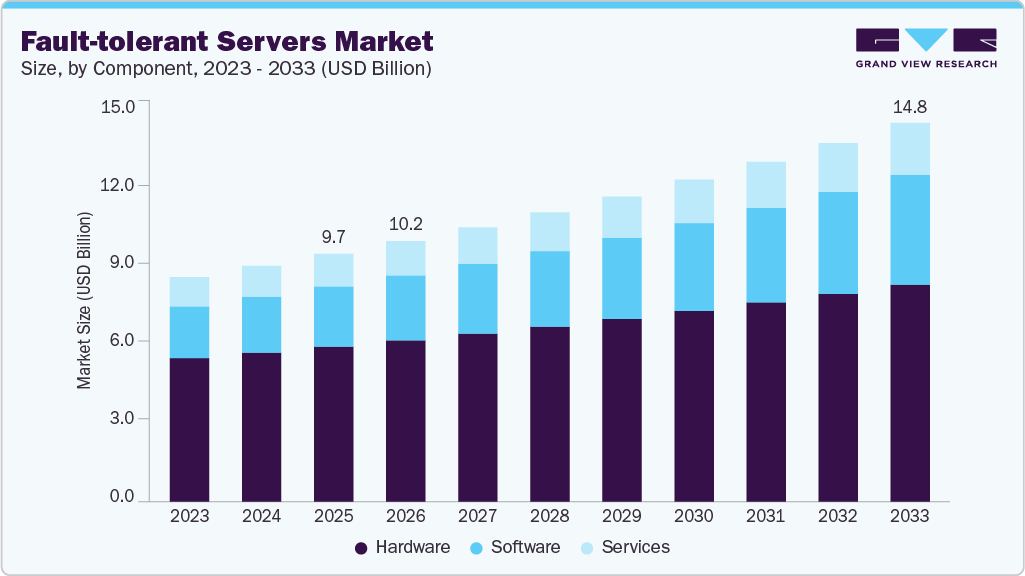
Looking ahead, the market is set for steady expansion as digital transformation accelerates globally, with emerging trends like edge computing further boosting demand. Challenges such as high initial costs and complexity in implementation persist, but ongoing investments in research are addressing these. Overall, the fault-tolerant servers industry remains a cornerstone for enterprises prioritizing resilience in an increasingly connected world.
Component Insights
The hardware segment accounted for the largest revenue share of 62.6% in 2025. It relies heavily on redundant physical elements-such as duplicate processors, mirrored memory modules, backup power supplies, and resilient storage drives that allow the server to keep running smoothly even if one part fails without any manual intervention. Companies in sectors such as banking, healthcare, and manufacturing turn to these robust hardware setups because they prioritize zero downtime over cost savings from less specialized options. For instance, in January 2025, Hewlett Packard Enterprise introduced the HPE Nonstop Compute NS5 X5 and NS9 X5, delivering higher performance, expanded memory, stronger networking, and industry-leading uptime for mission-critical enterprise workloads across financial services and manufacturing sectors. This launch strengthens competition and innovation within the market, supporting growing demand for high-availability infrastructure. As businesses handle larger data volumes and more complex operations, demand for advanced hardware configurations has stayed strong, pushing manufacturers to refine designs with better modularity and real-time fault monitoring to meet evolving market reliability needs.
The software segment is expected to register the fastest CAGR during the forecast period. This segment within the market focuses on solutions that deliver resilience through intelligent error detection, automatic recovery mechanisms, and seamless failover processes without relying solely on duplicated hardware. These programs often include clustering tools, virtualization layers, and operating system enhancements that monitor system health in real time and redirect workloads instantly when issues arise, helping companies maintain uninterrupted service in demanding environments like banking transactions or healthcare records management. As organizations increasingly adopt cloud and hybrid setups, demand for this software grows because it offers more flexibility and lower upfront costs compared to pure hardware approaches, while still providing strong protection against disruptions from software bugs or unexpected failures.
Deployment Insights
The on-premises segment accounted for the largest share in the global market in 2025. Sectors such as banking, financial services, healthcare, and government often favor on-premises deployments because they allow full ownership of hardware and software, reducing risks tied to external providers while ensuring seamless integration with existing legacy systems. Although cloud and hybrid options are gaining ground for their flexibility and lower upfront costs, many organizations in regulated fields stick with on-premises fault-tolerant servers to meet requirements around data sovereignty and security, where even brief interruptions can carry heavy financial or legal consequences. This approach supports high-availability needs through built-in redundancy and failover features, keeping critical operations running without relying on internet connectivity or shared infrastructure. As digital demands grow, the on-premises portion of the fault-tolerant servers industry remains essential for enterprises seeking maximum reliability in mission-critical environments, even as hybrid models bridge the gap toward broader adoption.
The cloud-based segment is expected to grow at the fastest CAGR during the forecast period. Providers now integrate built-in redundancy, automatic failover, and virtualization features directly into cloud environments, making it easier for businesses in finance, healthcare, and e-commerce to maintain uninterrupted operations even during hardware issues or spikes in demand. This shift appeals particularly to mid-sized firms that want the benefits of fault tolerance, such as near-zero downtime and quick recovery, while avoiding the complexity and cost of managing on-premises setups. Growth in this area stems from wider cloud adoption, rising use of hybrid models, and the push for always-on services in data-heavy applications, positioning the cloud-based portion of the fault-tolerant servers industry as a key driver of overall market expansion in the coming years.
Enterprise Size Insights
The large enterprises segment accounted for the largest market share in 2025. These organizations rely heavily on uninterrupted systems to protect revenue streams, maintain customer trust, and meet strict regulatory standards. With complex IT setups handling massive transaction volumes and real-time data processing, large enterprises view fault-tolerant servers as essential for avoiding costly outages where even brief downtime can run into hundreds of thousands or millions of dollars. As digital operations expand and hybrid cloud setups become more common, large enterprises continue to lead the Fault-Tolerant Servers industry by pushing vendors to deliver scalable, high-availability solutions tailored to mission-critical needs.
The SMEs segment is projected to register the fastest CAGR over the forecast period. The SMEs segment is showing promising signs of growth as smaller businesses increasingly depend on reliable IT systems to support their digital operations and customer-facing activities. While large enterprises have long dominated adoption due to their ability to absorb higher costs for dedicated hardware redundancy, many SMEs now turn to more accessible options like cloud-based fault-tolerant solutions that deliver strong uptime without requiring heavy upfront investments or in-house expertise. This shift helps these companies avoid costly disruptions in areas such as e-commerce, online payments, or inventory management, where even short outages can hurt revenue and reputation. As providers roll out scalable, pay-as-you-go models and integrate better security features, the fault-tolerant servers industry sees SMEs contributing to broader market expansion, though challenges like budget limits and limited technical know-how still slow full uptake in some regions.
End Use Insights
The BFSI segment accounted for the largest market share in 2025. In this segment, banks, insurance companies, and other financial institutions rely on these systems to keep operations running without any breaks. Even a short outage in transaction processing, payment systems, or customer data access can lead to heavy losses, damaged trust, and regulatory trouble, so organizations in this space prioritize servers built with redundancy and automatic recovery features. As digital banking grows, real-time payments expand, and cyber threats increase, the need for reliable infrastructure has pushed many BFSI players to adopt fault-tolerant solutions from vendors like IBM, HPE, and NEC, helping them meet strict rules on data security and continuous service while handling rising transaction volumes smoothly.
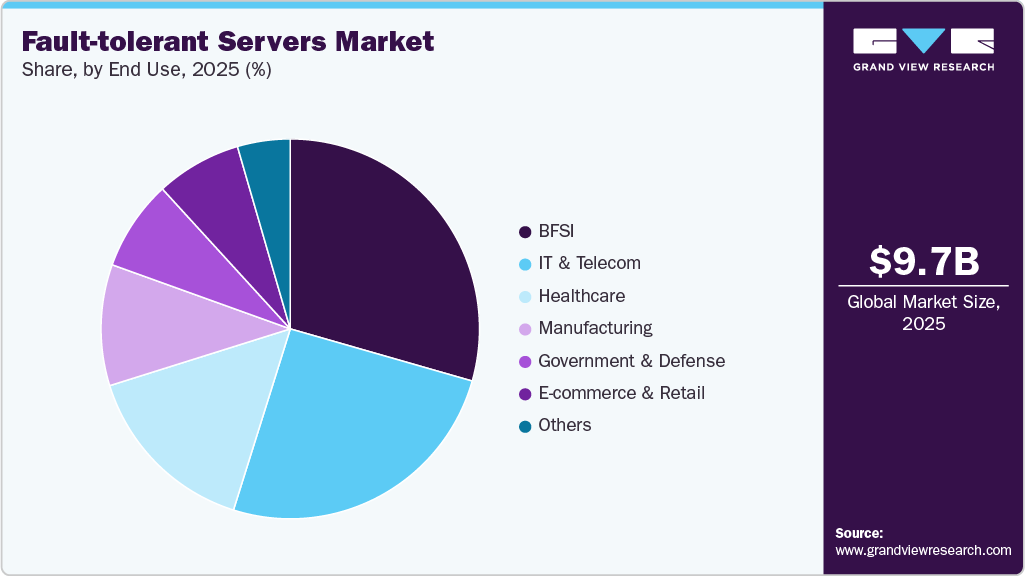
The IT & telecom segment accounted for the largest market share in 2025. In this segment, service providers and network operators depend on continuous system uptime to deliver reliable voice, data, and emerging 5G services without interruption. Any downtime in this area can disrupt millions of users, cause revenue shortfalls, and damage customer trust, so companies invest in these robust servers with built-in redundancy and automatic recovery features to keep core networks, billing systems, and edge computing setups running smoothly. As digital transformation picks up speed, with more cloud-based services, IoT deployments, and real-time applications coming online, the Fault-Tolerant Servers industry sees steady demand from telecom firms that prioritize high availability over cost in mission-critical operations, helping them meet strict service level agreements and handle growing traffic loads effectively.
Regional Insights
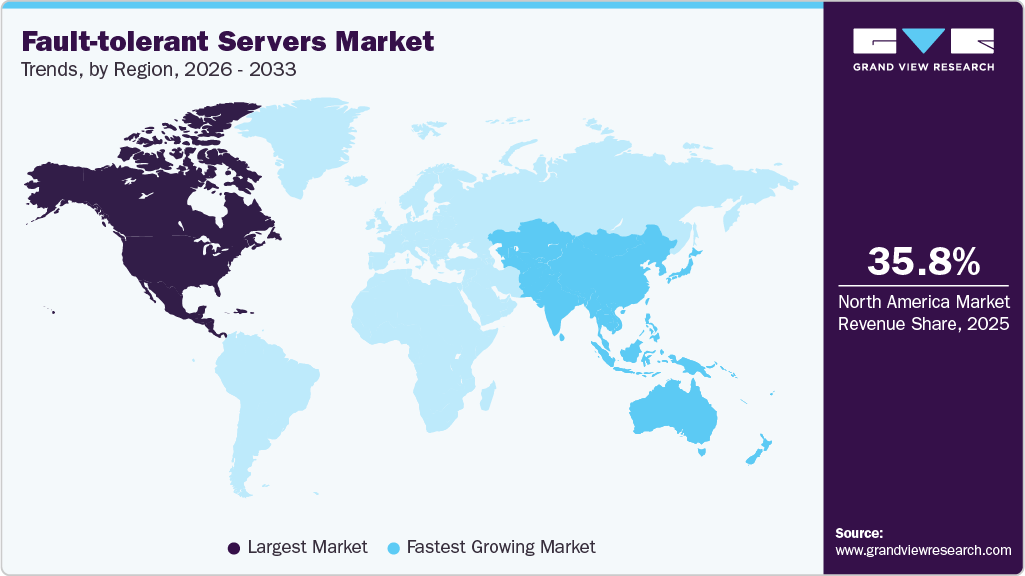
North America accounted for the largest market share of 35.8% in 2025 in the global fault-tolerant servers market. Businesses here place a high priority on zero-downtime solutions, pushing steady demand for these robust systems that automatically handle hardware or software issues without interrupting service. Growth in the North American market continues at a healthy pace, supported by rising needs for mission-critical applications and the shift toward hybrid setups that blend on-premise and cloud environments. Moreover, challenges such as upfront costs remain, but major vendors such as IBM, Hewlett Packard Enterprise, and Dell keep innovating to make these solutions more accessible and efficient.
U.S. Fault-tolerant Servers Market Trends
The fault-tolerant servers market in the U.S. is experiencing strong growth, fueled by strong demand from finance, healthcare, government, and large enterprises that cannot afford any system downtime. Companies rely on these specialized servers to deliver near-zero interruptions through built-in redundancy, automatic failover, and advanced error-handling features, which prove essential amid rising AI workloads, expanding data centers, and stricter compliance rules. With major vendors like IBM and Hewlett Packard Enterprise leading the way, the market benefits from ongoing investments in hybrid cloud setups and edge computing, helping organizations maintain continuous operations even during hardware issues or unexpected failures.
Europe Fault-tolerant Servers Market Trends
The fault-tolerant servers market in Europe is anticipated to register significant growth from 2026 to 2033, fueled by strict data protection rules like GDPR and the push for reliable systems in key sectors. Countries such as Germany lead with strong manufacturing needs, while the United Kingdom relies heavily on these solutions for its active financial services industry. France focuses on digital sovereignty and compliance, and places such as Switzerland and the Nordic region see steady uptake in banking and smart infrastructure projects. This steady expansion in the market across Europe stems from the need to avoid costly downtime in mission-critical areas, alongside growing investments in hybrid setups that blend on-site and cloud resources.
The UK fault-tolerant servers market is experiencing strong growth. Banks in the City of London and major insurers need these servers to process transactions and maintain data integrity without any breaks, especially as cyber threats grow and strict regulations like GDPR push for better resilience. The mature IT landscape in the United Kingdom, combined with ongoing investments in cloud and hybrid setups, supports steady demand for fault-tolerant solutions from established suppliers.
The fault-tolerant servers market in Germany is witnessing robust growth, fueled by the country's strong industrial base, advanced manufacturing sector, and Frankfurt's position as a major financial and data hub in Europe. Businesses here place high priority on systems that deliver uninterrupted performance, especially in banking, automotive production, and critical public services, where even brief interruptions carry high costs. With growing reliance on AI workloads, cloud integrations, and Industry 4.0 applications, many organizations turn to these robust servers to maintain high availability and meet strict data protection rules like GDPR.
France fault-tolerant servers market is growing significantly at a CAGR from 2026 to 2033, where demand stems from strict data protection rules like GDPR and the push for digital sovereignty. Businesses in banking, government services, and manufacturing rely heavily on these systems to keep operations running without any breaks, especially as cloud adoption and AI workloads grow. This segment benefits from France's strong focus on secure, high-uptime computing for critical applications, even as costs and integration challenges remain points to watch.
Asia Pacific Fault-tolerant Servers Market Trends
The fault-tolerant servers market in the Asia Pacific is expected to register the fastest CAGR from 2026 to 2033, fueled by rapid digital transformation, expanding data centers, and heavy investments in cloud computing across countries like China, India, Japan, and South Korea. Businesses in banking, telecom, manufacturing, and healthcare increasingly rely on these reliable systems to avoid costly downtime and maintain smooth operations amid rising data volumes and mission-critical applications. With governments pushing digitization initiatives and companies adopting advanced technologies such as AI and big data, the Fault-Tolerant Servers industry here benefits from strong demand for high-availability infrastructure that supports uninterrupted service delivery.
India fault-tolerant servers market is poised for robust growth from 2026 to 2033. With growing reliance on cloud services, data centers, and mission-critical applications, companies increasingly turn to these specialized systems that deliver near-zero downtime through built-in redundancy and automatic recovery features. Key players like Stratus Technologies, along with established names such as IBM and HPE, maintain a solid presence by catering to high-stakes environments where even brief interruptions carry high financial or regulatory costs.
The fault-tolerant servers market in China is witnessing rapid growth, fueled by the country's rapid push toward digital infrastructure, massive data center builds, and strict requirements for uninterrupted operations in key sectors like banking, telecommunications, and government services. Local companies such as Huawei and Inspur lead much of the activity, offering reliable systems that align with national goals for self-reliant technology and sovereign computing. Demand stays strong because businesses and public institutions cannot afford even brief interruptions, especially with the quick rise of AI workloads, cloud services, and edge applications that need consistent uptime. While the overall server market in China grows fast due to these trends, fault-tolerant solutions hold a specialized spot by focusing on hardware and software redundancy that keeps critical processes running smoothly.
Key Fault-tolerant Servers Company Insights
Key players operating in the market are Aqua Security, Check Point Software Technologies Ltd., CrowdStrike, and others. Companies are focusing on various strategic initiatives, including new product development, partnerships & collaborations, and agreements to gain a competitive advantage over their rivals. The following are some instances of such initiatives:
-
In November 2025, IBM and Cisco announced plans to collaborate on distributed, networked quantum computing to scale fault-tolerant systems and enable high-performance, multi-machine quantum operations by the early 2030s. This initiative is expected to expand opportunities in the market by advancing scalable, network-ready computing architectures.
-
In June 2025, Hewlett Packard Enterprise introduced HPE Nonstop Compute NS5 X5 and NS9 X5, featuring Intel Xeon processors, expanded memory, faster interconnects, and improved networking to support high-volume, mission-critical workloads with continuous availability and secure enterprise compliance. This launch reinforces market growth by meeting rising demand for resilient, high-performance infrastructure.
-
In November 2024, Stratus Technologies Ireland Ltd., a brand of Penguin Softwares, Inc., announced ztC Endurance support for Microsoft Windows Server 2022, delivering 99.99% availability, bare-metal performance, and enhanced networking for mission-critical Windows workloads. This development strengthens the market by expanding high-availability options for Windows-based enterprise and edge environments.
Key Fault-tolerant Servers Companies:
The following key companies have been profiled for this study on the fault-tolerant servers market.
- Bull (Atos)
- Cisco Systems
- Dell Technologies
- Fujitsu
- Hitachi
- Hewlett Packard Enterprise (HPE)
- Huawei
- IBM
- Inspur
- Lenovo
- NEC Corporation
- Oracle
- Stratus Technologies
- Supermicro
- Unisys
Fault-tolerant Servers Market Report Scope
Report Attribute
Details
Market size in 2025
USD 9.7 billion
Estimated market size in 2026
USD 10.2 billion
Projected market size by 2033
USD 14.8 billion
Growth rate
CAGR of 5.5% from 2026 to 2033
Actual data
2021 - 2025
Forecast period
2026 - 2033
Quantitative units
Revenue in USD million/billion and CAGR from 2026 to 2033
Report Coverage
Revenue forecast, company share, competitive landscape, growth factors, and trends
Segments covered
Component, deployment, enterprise size, end use, region
Regional scope
North America; Europe; Asia Pacific; Latin America; MEA
Country scope
U.S.; Canada; Mexico; UK; Germany; France; China; India; Japan; Australia; South Korea; Brazil; UAE; Saudi Arabia; South Africa
Key companies profiled
Bull (Atos); Cisco Systems; Dell Technologies; Fujitsu; Hitachi; Hewlett Packard Enterprise (HPE); Huawei; IBM; Inspur; Lenovo; NEC Corporation; Oracle; Stratus Technologies; Supermicro; Unisys
Customization scope
Free report customization (equivalent to 8 analysts working days) with purchase. Addition or alteration to country, regional & segment scope.
Pricing and purchase options
Avail customized purchase options to meet your exact research needs. Explore purchase options
Global Fault-tolerant Servers Market Report Segmentation
This report forecasts revenue growth at global, regional, and country levels and provides an analysis of the latest industry trends in each of the sub-segments from 2021 to 2033. For this study, Grand View Research has segmented the global fault-tolerant servers market report based on component, deployment, enterprise size, end use, and region:
-
Component Outlook (Revenue, USD Billion, 2021 - 2033)
-
Hardware
-
Software
-
Services
-
-
Deployment Outlook (Revenue, USD Billion, 2021 - 2033)
-
On-Premise
-
Cloud-based
-
-
Enterprise Size Outlook (Revenue, USD Billion, 2021 - 2033)
-
Large Enterprises
-
SMEs
-
-
End Use Outlook (Revenue, USD Billion, 2021 - 2033)
-
BFSI
-
IT & Telecom
-
Healthcare
-
Manufacturing
-
Government & Defense
-
E-commerce & Retail
-
Others
-
-
Regional Outlook (Revenue, USD Billion, 2021 - 2033)
-
North America
-
U.S.
-
Canada
-
Mexico
-
-
Europe
-
UK
-
Germany
-
France
-
-
Asia Pacific
-
China
-
India
-
Japan
-
South Korea
-
Australia
-
-
Latin America
-
Brazil
-
-
Middle East & Africa
-
UAE
-
Saudi Arabia
-
South Africa
-
-
Frequently Asked Questions About This Report
The hardware segment led with a 62.6% revenue share in 2025.
Large enterprises held the largest revenue share in 2025.
Asia Pacific is the fastest-growing region over the forecast period.
The global fault-tolerant servers market size was estimated at USD 9.7 billion in 2025 and is expected to reach USD 10.2 billion in 2026.
The global fault-tolerant servers market is expected to grow at a compound annual growth rate of 5.5% from 2026 to 2033 to reach USD 14.8 billion by 2033.
North America dominated with a 35.8% revenue share in 2025.
Some key players operating in the market include Bull (Atos), Cisco Systems, Dell Technologies, Fujitsu, Hitachi, Hewlett Packard Enterprise (HPE), Huawei, IBM, Inspur, Lenovo, NEC Corporation, Oracle, Stratus Technologies, Supermicro, and Unisys.
Factors such as increasing digitalization, rising data center investments, and the need for uninterrupted services across sectors such as BFSI, IT & telecom, healthcare, and government play a key role in accelerating the fault-tolerant servers market.
About the Author(s)
Next Generation Technologies Research Team
Technology · Next Generation TechnologiesThis report was authored by the next generation technologies research team at Grand View Research - comprising two research analysts, one senior research analyst, and one industry expert - with specialized expertise in the next generation technologies segment of the technology industry. All findings are based on proprietary technology databases, executive interviews, and regulatory analysis, subject to internal peer review prior to publication.
Last Updated:
Speak to Analyst

Need a Tailored Report?
Customize this report to your needs — add regions, segments, or data points, with 20% free customization.
Or view our licence options:


ISO 9001:2015 & 27001:2022 Certified
We are GDPR and CCPA compliant! Your transaction & personal information is safe and secure. For more details, please read our privacy policy.












