
- Home
- »
- Next Generation Technologies
- »
-
Feed Software Market Size And Share Report, 2026-2033GVR Report cover

Feed Software Market (2026 - 2033)
Size, Share & Trends Analysis Report By Type (Feed Formulation Software, Feed Management Software), By Livestock Type (Poultry, Swine, Aquaculture), By Deployment, By Enterprise Size, By End-use, By Region, And Segment Forecasts
Market Size, 2025
$317.3MMarket Estimate, 2026
$332.9MMarket Forecast, 2033
$517.4MCAGR, 2026–2033
6.5%Feed Software Market Summary
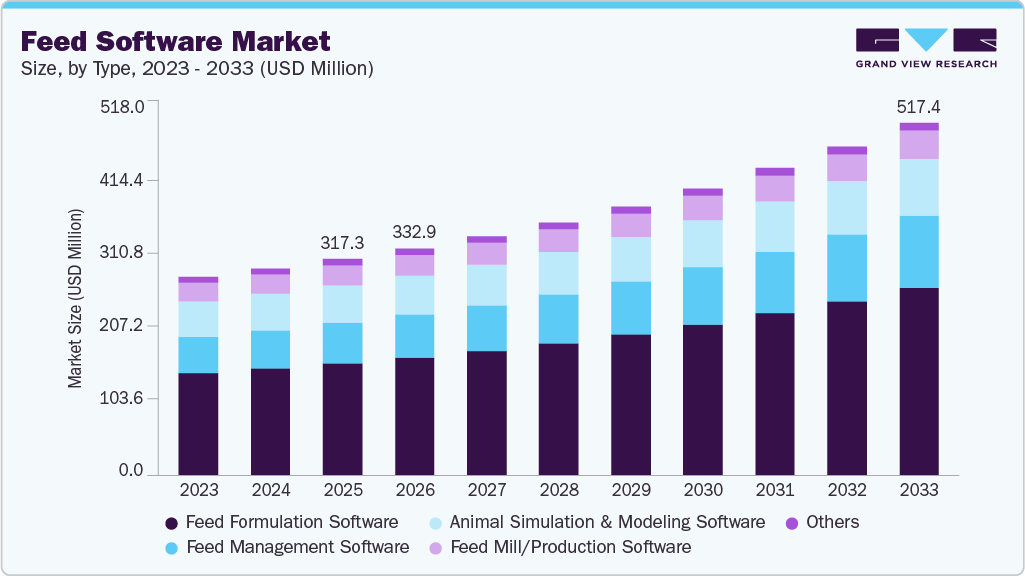
The global feed software market size was valued at USD 317.3 million in 2025 and is projected to grow from USD 332.9 million in 2026 to USD 517.4 million by 2033, at a CAGR of 6.5% from 2026 to 2033. The market in North America dominated with a revenue share of 39.7% in 2025. The digital transformation of livestock production and the growing need for efficient feed management systems are driving market growth.
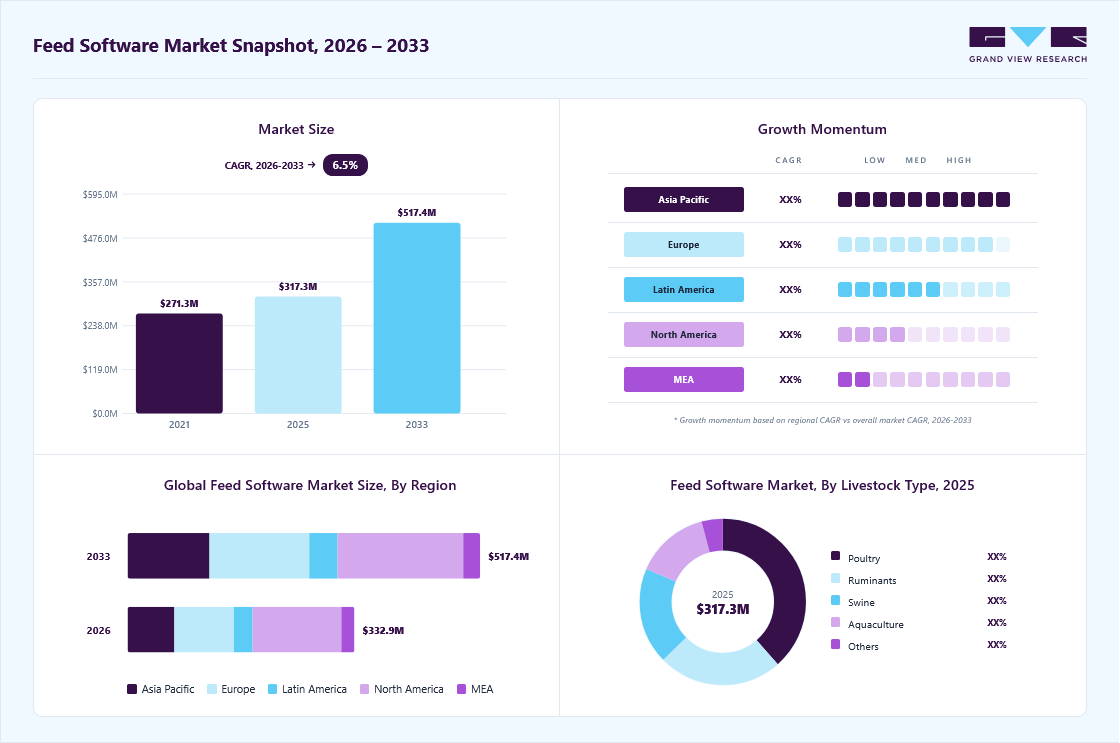 Source: Grand View Research, IR Documents, Primary Interviews, Paid DatabasesTo learn more about this report,
 Download Free Sample Report
 Key Market Trends & Insights
- By type: Feed formulation software segment held the largest market share of 51.9% in 2025.
- By livestock type: Poultry segment held the largest market share in 2025.
- By deployment: Cloud segment held the largest market share in 2025.
- By enterprise size: Large enterprises segment held the largest market share in 2025.
Regional Highlights
- Largest regional market: North America (39.7% revenue share, 2025)
- Fastest-growing regional market: Asia Pacific (highest CAGR, 2026-2033)
- By country: U.S. held the largest market share in 2025
Market Size & Forecast
- Market size in 2025: USD 317.3 Million
- Estimated market size in 2026: USD 332.9 Million
- Projected market size by 2033: USD 517.4 Million
- CAGR (2026-2033): 6.5%
Three ways to get this report
Buy it, customize it, or ask a question.Ask an Analyst
Analyst response in 1 business day
- AccessReport author, directly
- Reply timeWithin 1 working day
- No sales callDirect answer only
- FormatEmail reply
- CostFree, no cost
Get the Full Report
What the study covers
- FormatsPDF · Excel · Dashboard
- Timeline2026–2033 annual, 2025 base
- Coverage20+ countries, 5 regions
- Companies10+ key players profiled
Customize the Report
20% free customization
- IncludeCountries, segments, points
- TailorTo your product definition
- ExtendDeeper competitor detail
- OrA fully bespoke study
- Turnaround5–10 working days
The increasing adoption of data-driven decision-making in agriculture and livestock management is also significantly driving the feed software market. Farmers and feed producers are increasingly relying on data analytics to improve productivity and profitability. Feed software collects and processes large volumes of operational data, including feed intake, animal performance, growth rates, and cost inputs. This data is then used to generate actionable insights that help improve feed efficiency and production outcomes. The shift from experience-based decisions to analytics-driven strategies is transforming traditional farming practices into modern, technology-enabled systems. As businesses become more competitive, the ability to make faster, more accurate decisions with software tools is becoming a major advantage.The growing importance of risk management in livestock production is also contributing to the demand for feed software. Livestock farming is exposed to various risks, including disease outbreaks, feed contamination, price volatility of raw materials, and environmental changes. Feed software helps mitigate these risks by enabling better planning, monitoring, and traceability of feed production processes. For instance, if a contamination issue arises, software systems can quickly trace affected batches and identify the source of ingredients. This improves response time and minimizes potential losses. Additionally, predictive analytics within feed software can help anticipate market fluctuations and adjust feed strategies accordingly. As risk awareness among producers increases, digital tools are becoming essential for maintaining operational stability.
 To learn more about this report, Download Free Sample Report
 Another driver is the rising adoption of cloud computing and software-as-a-service (SaaS) models in agriculture-related industries. Cloud-based feed software enables users to access data and manage operations from anywhere, making it particularly useful for large farms and multinational feed companies. This model reduces the need for heavy IT infrastructure investments and enables easier software updates and scalability. It also facilitates better collaboration among nutritionists, veterinarians, farm managers, and suppliers by enabling centralized data sharing. Furthermore, SaaS platforms often come with subscription-based pricing, making them more accessible to small and medium-sized enterprises. The flexibility and cost-effectiveness of cloud deployment are therefore accelerating market penetration across different segments.
The expansion of global trade in animal feed and feed ingredients is acting as a significant market driver. As supply chains become more international, feed producers must comply with varying standards, regulations, and quality requirements across different regions. Feed software supports this complexity by maintaining standardized records and ensuring compliance with multiple regulatory frameworks. It also helps manage multi-location operations, allowing companies to coordinate production and distribution across countries efficiently. Furthermore, globalization increases competition, pushing companies to improve efficiency and reduce costs through technology adoption. The need for consistent quality, transparency, and operational control across borders is therefore strongly encouraging the use of feed software solutions.
Type Insights
The feed formulation software segment dominated the market with a share of 51.9% in 2025. The expansion of commercial aquaculture and intensive livestock farming is accelerating demand for feed formulation software. Aquaculture, in particular, requires highly specialized feed formulations tailored to species such as shrimp, salmon, and tilapia, each with unique dietary needs. Similarly, intensive poultry and swine farming operations require precise nutrient control to achieve consistent growth performance. Feed formulation software allows producers to manage these complex requirements at scale while ensuring consistency and quality across batches. It also supports multi-species formulation capabilities, which is increasingly important for diversified farming operations. As industrial farming systems expand globally, the need for scalable, efficient formulation tools grows.
The feed management software segment is projected to be the fastest-growing segment from 2026 to 2033. The adoption of data analytics and performance optimization tools within livestock operations is driving the feed management software segment. Modern feed management systems collect large volumes of operational data, including feed consumption rates, production efficiency, and cost metrics. This data is analyzed to identify inefficiencies, reduce waste, and improve overall productivity. Operators can use insights generated by the software to adjust feeding schedules, optimize logistics, and reduce operational costs. The shift toward data-driven farm management is transforming traditional practices into more scientific and measurable processes. As organizations seek continuous performance improvement, feed management software is becoming a key enabler of decision intelligence.
Livestock Type Insights
The poultry segment dominated the market in 2025. The increasing industrialization and vertical integration of poultry farming are major drivers of feed software adoption. Large poultry companies often control multiple stages of production, including feed mills, hatcheries, farms, and processing units, which requires highly coordinated feed management systems. Feed software enables centralized planning and control of feed production and distribution across multiple facilities, ensuring consistency in bird nutrition and performance. This integration reduces variability in feed quality, which is crucial for maintaining uniform growth rates across large flocks. It also improves operational transparency and reduces inefficiencies caused by disconnected systems. As poultry farming becomes more industrial and consolidated, digital feed management becomes a necessary infrastructure component.
The aquaculture segment is projected to be the fastest-growing segment from 2026 to 2033. The growing integration of aquaculture operations with digital monitoring technologies is driving demand for feed software. Modern fish farms increasingly use IoT sensors, underwater cameras, and automated feeders to track fish behavior, feeding activity, and water conditions. Feed software integrates this data to create adaptive feeding models that respond dynamically to real-time environmental changes. This reduces feed waste and improves growth performance by ensuring that feed is provided only when fish are actively feeding. It also enables predictive analytics that help farmers anticipate growth trends and optimize harvest timing. As digital aquaculture ecosystems expand, feed software becomes a central intelligence layer for decision-making.
Deployment Insights
The cloud segment dominated the market in 2025. The expansion of mobile and IoT-enabled agriculture is significantly accelerating cloud adoption in the feed software market. Many modern farms rely on mobile devices, sensors, and connected equipment to monitor livestock health, feed levels, and environmental conditions. Cloud-based systems act as the central hub that integrates all this data and makes it accessible through mobile applications. This enables farmers and managers to make real-time decisions even while working in the field or away from central offices. It also supports automation and remote control of feeding systems, improving efficiency and reducing labor dependency. As agriculture becomes increasingly connected and automated, cloud-based feed software is emerging as the backbone of digital farm ecosystems.
The on-premise segment is projected to grow at a significant CAGR from 2026 to 2033. The growing requirement for customized reporting and analytics frameworks is driving the adoption of on-premise feed software solutions. Many enterprises require highly specific reporting formats tailored to internal KPIs, regulatory audits, and financial evaluations. On-premises systems offer greater flexibility to modify database structures and reporting engines to meet organizational needs. This allows companies to build proprietary analytics models that may not be easily achievable in standardized cloud platforms. Additionally, organizations can integrate on-premise systems with internal business intelligence tools for deeper analysis. As decision-making becomes more data-driven and customized, the demand for flexible reporting capabilities continues to increase.
Enterprise Size Insights
The large enterprises segment dominated the market in 2025. The increasing focus on cost optimization and margin management is a key driver for large enterprises adopting feed software. In large-scale livestock operations, feed costs account for a substantial share of total expenses, often making profitability highly sensitive to even small inefficiencies. Feed software enables enterprises to optimize ingredient usage, reduce wastage, and identify cost-saving opportunities across procurement and production. It also supports scenario modeling, allowing companies to evaluate how changes in raw material prices or feed composition impact overall margins. This financial control is particularly important for publicly listed agribusiness companies that must maintain stable profitability. As competitive pressures intensify, cost efficiency remains a critical growth driver for software adoption.
The small & medium enterprises (SMEs) segment is projected to be the fastest-growing segment from 2026 to 2033. The expansion of mobile technology and cloud-based platforms is significantly driving adoption among SMEs. Many small feed producers and farmers use smartphones and tablets to manage day-to-day operations, making mobile-compatible feed software highly attractive. Cloud deployment enables SMEs to access advanced functionality without maintaining expensive on-premises servers or IT teams. It also enables remote monitoring and management, which is especially useful for small businesses operating across multiple small farms or production units. The flexibility and ease of use offered by these platforms make them highly suitable for non-technical users. As mobile-first solutions continue to expand, SMEs are increasingly integrating them into their operational workflows.
End-use Insights
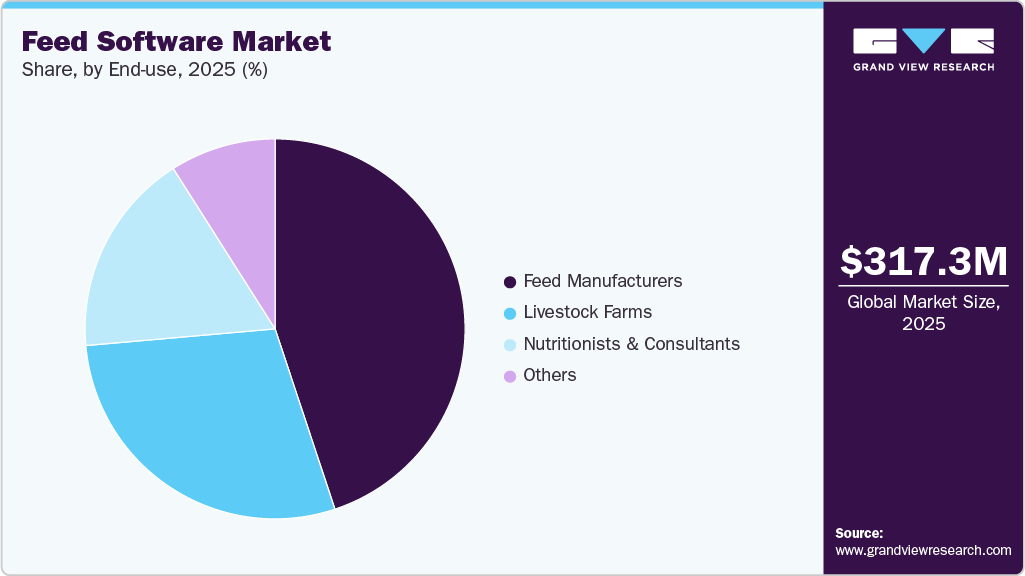
The feed manufacturers segment dominated the market in 2025. The increasing adoption of automation and digital manufacturing technologies is accelerating the use of feed software among feed manufacturers. Modern feed production facilities are increasingly integrating automated batching systems, IoT sensors, and AI-driven analytics tools into their operations. Feed software acts as the central control system that connects these technologies and enables seamless coordination across production processes. It enhances operational efficiency by reducing manual intervention and improving decision-making accuracy. It also enables predictive maintenance and performance optimization of production equipment. As manufacturing processes become increasingly automated and intelligent, feed software plays a central role in enabling this transformation.
 To learn more about this report, Download Free Sample Report
 The retail and e-commerce segment is projected to be the fastest-growing segment from 2026 to 2033. The need for better farm management and decision-making support is driving the adoption of feed software in livestock operations. Many farms are transitioning from traditional experience-based decision-making to data-driven management practices. Feed software provides actionable insights into feed consumption patterns, production efficiency, and cost distribution across livestock groups. This helps farmers make informed decisions about feed sourcing, ration adjustments, and herd management strategies. It also simplifies record-keeping and operational planning, reducing administrative workload. As farming becomes more complex and competitive, data-supported decision-making is becoming essential for long-term sustainability.
Regional Insights
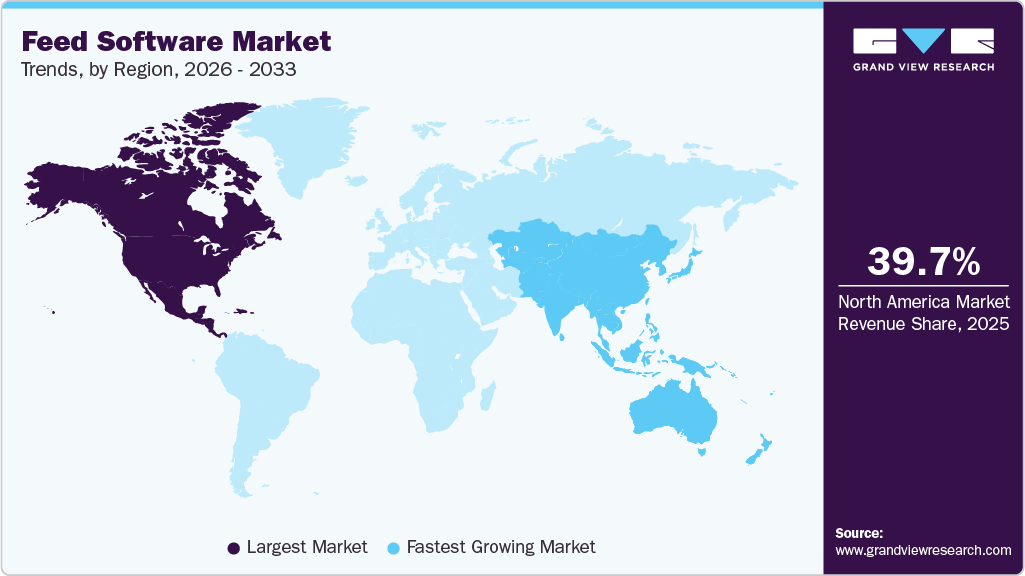
North America feed software market dominated with a share of 39.7% in 2025. The high level of technological adoption and digital maturity across the region’s agricultural and livestock sectors is driving market growth. Farmers, feed manufacturers, and agribusiness companies in North America are generally early adopters of advanced software solutions compared to many other regions. This strong digital readiness encourages the integration of feed software into daily operations such as formulation, inventory management, and production planning. The availability of robust IT infrastructure and high-speed internet also supports the widespread adoption of cloud- and hybrid-based feed management systems. Additionally, companies in this region are more open to investing in automation and data analytics to improve productivity. As a result, technological advancement remains one of the strongest drivers of feed software adoption in North America.
 To learn more about this report, Download Free Sample Report
 U.S. Feed Software Market Trends
The feed software market in the U.S. is projected to grow during the forecast period. The increasing regulatory focus on food safety, traceability, and compliance in the U.S. is a significant driver of feed software adoption. Regulatory frameworks require detailed documentation of feed ingredients, production processes, and distribution channels to ensure safety and accountability. Feed software supports compliance by maintaining structured, auditable records that track every stage of the feed lifecycle. This is particularly important in preventing and managing risks such as contamination or feed-related disease outbreaks. The ability to quickly trace and isolate issues reduces financial losses and protects brand reputation. As regulatory oversight becomes increasingly stringent, the importance of digital compliance tools is growing significantly.
Asia Pacific Feed Software Market Trends
The feed software market in Asia Pacific is expected to be the fastest growing segment, with a CAGR of 8.3% over the forecast period. The growing importance of aquaculture in the Asia Pacific is a significant driver of the feed software market. The region is the global leader in aquaculture production, with a large share of fish and shrimp farming operations. Aquaculture requires highly precise feed management because aquatic species are extremely sensitive to feed quality and environmental conditions. Feed software helps optimize feed formulations, reduce waste, and maintain water quality by controlling nutrient discharge. It also enables real-time adjustments based on temperature, oxygen levels, and growth patterns. As aquaculture continues to expand to meet global seafood demand, reliance on advanced feed management systems is increasing.
China feed software market is projected to grow during the forecast period. The growing adoption of digital agriculture and smart farming technologies in China is another major driver. The government has been actively promoting digital transformation in agriculture through initiatives focused on smart farming, IoT integration, and data-driven decision-making. Feed software integrates with these technologies to provide real-time insights into animal health, feed consumption, and production performance. This enables farmers and enterprises to improve efficiency and reduce operational risks. The increasing use of mobile applications and cloud-based platforms also makes feed software more accessible to a wider range of users. As digital agriculture initiatives continue to expand, feed software adoption is accelerating.
Europe Feed Software Market Trends
The feed software market in Europe is expected to grow during the forecast period. The increasing adoption of precision livestock farming and advanced digital agriculture technologies is a significant driver in Europe. Many farms across the region are integrating IoT devices, automated feeding systems, and data analytics platforms to improve operational efficiency. Feed software is a core component of these systems, processing real-time data on animal health, feed intake, and growth performance. It enables dynamic adjustments in feeding strategies to optimize productivity and reduce costs. This transition from traditional farming to data-driven livestock management is accelerating across both large and mid-sized farms. As digital agriculture becomes more mainstream, the demand for intelligent feed management solutions is rising steadily.
The UK feed software market is expected to grow during the forecast period. The strong presence of integrated supply chains and organized livestock production systems is also driving feed software adoption in the UK. Many producers operate within coordinated networks that include feed manufacturers, farms, processors, and retailers. Feed software enables better coordination across these stakeholders by providing centralized visibility into feed production, inventory levels, and distribution schedules. This ensures consistency in feed quality and supply across the entire value chain. It also supports better planning and reduces inefficiencies caused by fragmented operations. As supply chains become more interconnected, the need for integrated digital management systems continues to grow.
Key Feed Software Company Insights
Some of the key companies operating in the market, including Topcon and Datacor, Inc., among others, are some of the key participants in the feed software market.
-
Topcon is a Japan-based technology company specializing in precision measurement, positioning systems, and digital agriculture solutions. Topcon provides digital solutions that support livestock and feed management through data-driven farm optimization tools. Its feed software offerings are designed to help farmers and livestock operators monitor, plan, and optimize feed distribution, nutritional balance, and herd performance. These systems integrate data from sensors, farm equipment, and operational inputs to provide real-time insights into feed consumption patterns, inventory levels, and animal health indicators. By using precision data management, Topcon enables farmers to improve feed efficiency, reduce waste, and enhance livestock productivity.
-
Datacor, Inc. is a software company specializing in enterprise solutions for process manufacturing industries. Datacor provides specialized solutions tailored for animal nutrition and feed manufacturing businesses. Its software enables feed producers to manage formulation, production planning, inventory control, and regulatory compliance within a unified digital environment. The platform supports precise feed formulation by enabling users to balance nutritional requirements, ingredient costs, and availability while maintaining consistent product quality.
Key Feed Software Companies:
The following key companies have been profiled for this study on the feed software market.
- Amelicor
- A‑Systems
- Behamics
- BESTMIX
- Datacor, Inc.
- Ever.Ag
- HYBRIMIN
- iRely
- Productsup
- Topcon
- VAS
- VersaFeed
Recent Developments
-
In January 2026, Keriton, acquired by Natus Sensory, will be integrated into Natus Sensory’s Newborn Care portfolio, maintaining its emphasis on innovation, clinical collaboration, and strong customer support. Leveraging Natus’ global footprint and resources, the company aims to further strengthen its ability to deliver advanced technology and services to patients and healthcare partners. This acquisition enhances the Newborn Care portfolio and reinforces Natus Sensory’s position as a long-term partner for hospitals and care teams.
-
In May 2025, dsm-firmenich Animal Nutrition & Health signed a strategic partnership with Allix, a global feed formulation software company developed by A-Systems, to support the measurement and management of the environmental footprint of animal feed. Under this collaboration, the companies will integrate dsm-firmenich’s Sustell lifecycle assessment platform with Allix’s feed formulation software to help reduce the environmental impact of feed production. Leveraging Sustell, Allix is developing a dedicated sustainability module that will allow users to gain insights into the environmental footprint of their feed formulations. This integration will also enable users to automatically transfer their formulation data into Sustell directly from the Allix platform.
-
In January 2024, Ever.Ag acquired PrairiE Systems to enhance value across the global food supply chain through its solutions spanning multiple agribusiness sectors, with a strong focus on animal protein production. Ever.Ag aims to build on this legacy by further investing in the platform to deliver greater value to pork producers and the wider pork value chain. Together, the companies plan to strengthen and advance the efficiency and capabilities of pork producers through innovative, technology-driven solutions.
Feed Software Market Report Scope
Report Attribute
Details
Market size in 2025
USD 313.3 million
Estimated Market size in 2026
USD 332.9 million
Projected Market size by 2033
USD 517.4 million
Growth rate
CAGR of 6.5% from 2026 to 2033
Actual data
2021 - 2025
Forecast period
2026 - 2033
Quantitative units
Revenue in USD million/billion and CAGR from 2026 to 2033
Report coverage
Revenue forecast, company share, competitive landscape, growth factors, and trends
Segments covered
Type, livestock type, deployment, enterprise size, end-use, region
Regional scope
North America; Europe; Asia Pacific; Latin America; MEA
Country scope
U.S.; Canada; Mexico; UK; Germany; France; China; India; Japan; Australia; South Korea; Brazil; UAE; Saudi Arabia; South Africa
Key companies profiled
Amelicor; A‑Systems; Behamics; BESTMIX; Datacor, Inc.; Ever.Ag; HYBRIMIN; iRely; Productsup; Topcon; VAS; VersaFeed
Customization scope
Free report customization (equivalent to 8 analysts working days) with purchase. Addition or alteration to country, regional & segment scope.
Pricing and purchase options
Avail customized purchase options to meet your exact research needs. Explore purchase options
Global Feed Software Market Report Segmentation
This report forecasts revenue growth at global, regional, and country levels and provides an analysis of the latest industry trends in each of the sub-segments from 2021 to 2033. For this study, Grand View Research has segmented the global feed software market report based on type, livestock type, deployment, enterprise size, end-use, and region:
-
Type Outlook (Revenue, USD Million, 2021 - 2033)
-
Feed Formulation Software
-
Feed Management Software
-
Animal Simulation & Modeling Software
-
Feed Mill/Production Software
-
Others
-
-
Livestock Type Outlook (Revenue, USD Million, 2021 - 2033)
-
Poultry
-
Ruminants
-
Swine
-
Aquaculture
-
Others
-
-
Deployment Outlook (Revenue, USD Million, 2021 - 2033)
-
Cloud
-
On-Premise
-
-
Enterprise Size Outlook (Revenue, USD Million, 2021 - 2033)
-
Small & Medium Enterprises
-
Large Enterprises
-
-
End-use Outlook (Revenue, USD Million, 2021 - 2033)
-
Feed Manufacturers
-
Livestock Farms
-
Nutritionists & Consultants
-
Others
-
-
Regional Outlook (Revenue, USD Million, 2021 - 2033)
-
North America
-
U.S.
-
Canada
-
Mexico
-
-
Europe
-
Germany
-
UK
-
France
-
-
Asia Pacific
-
China
-
India
-
Japan
-
South Korea
-
Australia
-
-
Latin America
-
Brazil
-
-
Middle East & Africa
-
UAE
-
Saudi Arabia
-
South Africa
-
-
Frequently Asked Questions About This Report
North America dominated with a 39.7% revenue share in 2025.
The poultry segment held the largest revenue share in 2025, while the aquaculture segment is the fastest-growing.
The cloud segment held the largest revenue share in 2025, while the on-premise segment is projected to grow at a significant CAGR from 2026 to 2033.
Large enterprises segment held the largest share in 2025, while the small & medium enterprises segment is the fastest-growing.
The feed formulation software segment dominated the feed software market with a market share of 51.9% in 2025. The expansion of commercial aquaculture and intensive livestock farming is accelerating demand for feed formulation software.
Some key players operating in the market include Amelicor, A‑Systems, Behamics, BESTMIX, Datacor, Inc., Ever.Ag, HYBRIMIN, iRely, Productsup, Topcon, VAS, VersaFeed
Factors such as the digital transformation of livestock production and the growing need for efficient feed management systems is driving feed software market growth.
The global feed software market size was estimated at USD 317.3 million in 2025 and is expected to reach USD 332.9 million in 2026.
The global feed software market is expected to grow at a compound annual growth rate of 6.5% from 2026 to 2033 to reach USD 517.4 billion by 2033.
About the Author(s)
Next Generation Technologies Research Team
Technology · Next Generation TechnologiesThis report was authored by the next generation technologies research team at Grand View Research - comprising two research analysts, one senior research analyst, and one industry expert - with specialized expertise in the next generation technologies segment of the technology industry. All findings are based on proprietary technology databases, executive interviews, and regulatory analysis, subject to internal peer review prior to publication.
Last Updated:
Speak to Analyst

Customize this report to your needs - add regions, segments, or data points, with 20% free customization.
Or view our licence options:


ISO 9001:2015 & 27001:2022 Certified
We are GDPR and CCPA compliant! Your transaction & personal information is safe and secure. For more details, please read our privacy policy.


