
- Home
- »
- Advanced Interior Materials
- »
-
Ferrite Magnet Market Size And Share Report, 2026-2033GVR Report cover

Ferrite Magnet Market (2026 - 2033)
Size, Share & Trends Analysis Report, By Application (Automotive, Consumer Goods & Electronics, Industrial, Energy, Aerospace & Defense), By Region (North America, Europe, Asia Pacific, Latin America, MEA), And Segment Forecasts
Market Size, 2025
$6.4BMarket Estimate, 2026
$6.8BMarket Forecast, 2033
$10.5BCAGR, 2026–2033
6.5%Ferrite Magnet Market Summary
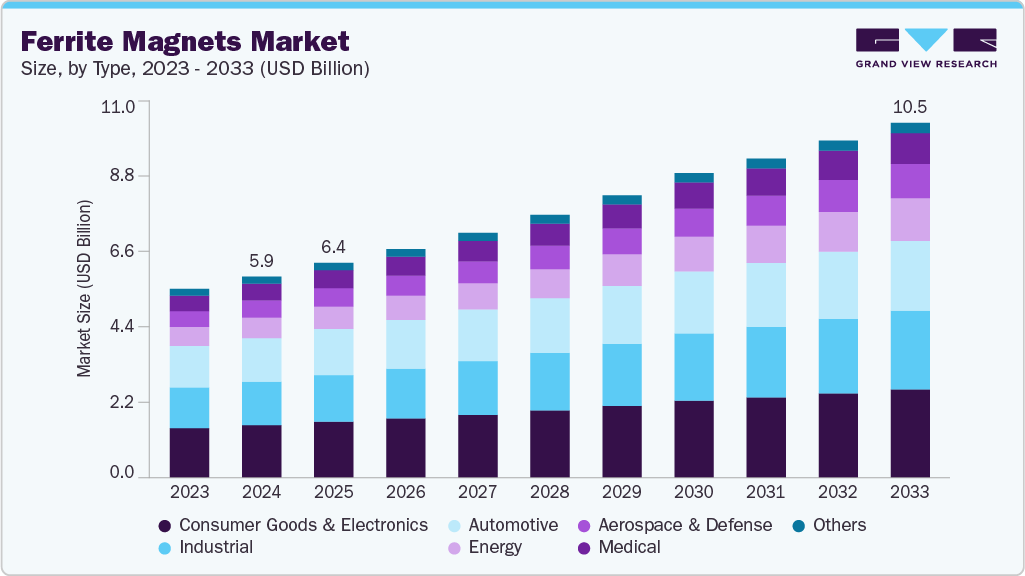
The global ferrite magnet market size was valued at USD 6.4 billion in 2025 and is projected to grow from USD 6.8 billion in 2026 to USD 10.5 billion by 2033, at a CAGR of 6.5% from 2026 to 2033. The market in Asia Pacific dominated with a revenue share of 75.6% in 2025. The increasing demand for cost-effective, high-performance permanent magnets across automotive, consumer electronics, and industrial machinery applications is a significant factor driving market growth.
 Source: Grand View Research, IR Documents, Primary Interviews, Paid DatabasesTo learn more about this report,
 Download Free Sample Report
 Key Market Trends & Insights
- By application: Consumer goods & electronics segment held the largest market share of 26.1% in 2025.
- The energy segment is expected to register the fastest CAGR over the forecast period.
Regional Highlights
- Largest regional market: Asia Pacific (75.6% revenue share, 2025)
- By country: China held the largest market share in 2025.
Market Size & Forecast
- Market size in 2025: USD 6.4 Billion
- Estimated market size in 2026: USD 6.8 Billion
- Projected market size by 2033: USD 10.5 Billion
- CAGR (2026-2033): 6.5%
Three ways to get this report
Buy it, customize it, or ask a question.Ask an Analyst
Analyst response in 1 business day
- AccessReport author, directly
- Reply timeWithin 1 working day
- No sales callDirect answer only
- FormatEmail reply
- CostFree, no cost
Get the Full Report
What the study covers
- FormatsPDF · Excel · Dashboard
- Timeline2026–2033 annual, 2025 base
- Coverage20+ countries, 5 regions
- Companies10+ key players profiled
Customize the Report
20% free customization
- IncludeCountries, segments, points
- TailorTo your product definition
- ExtendDeeper competitor detail
- OrA fully bespoke study
- Turnaround5–10 working days
Ferrite magnets continue to gain preference due to their strong magnetic properties, excellent corrosion resistance, and lower production costs compared to rare-earth magnets, making them well-suited for mass-production environments. Sustainability has emerged as a significant catalyst for the growth of the ferrite magnets industry, as industries increasingly shift toward environmentally responsible materials. Unlike rare-earth magnets, which rely on resource-intensive mining and processing, ferrite magnets are produced using abundant raw materials such as iron oxide and strontium carbonate, resulting in a lower environmental impact and reduced supply-chain risks. Their long service life, corrosion resistance, and recyclability further strengthen their appeal in applications where durability and circular economy principles are prioritized. As governments and corporations intensify efforts to decarbonize industrial operations and improve energy efficiency, ferrite magnets are steadily becoming a preferred alternative for high-volume applications in electric motors, appliances, and power tools.
 To learn more about this report, Download Free Sample Report
 On the technology front, ongoing advancements in material science and manufacturing techniques are significantly enhancing the performance potential of ferrite magnets. Innovations in powder metallurgy, grain boundary optimization, and sintering processes have led to higher magnetic anisotropy and improved heat resistance, enabling ferrite magnets to penetrate more demanding applications that were previously dominated by neodymium-based magnets. The integration of automation and digital monitoring in production lines is also improving dimensional precision and consistency, reducing defect rates and enabling mass customization for OEMs. With rapid progress in electric drivetrain engineering, robotics, and innovative consumer devices, technology-driven improvements are expected to expand the application scope of ferrite magnets over the next decade.
Market Dynamics
The ferrite magnet market is experiencing steady growth due to increasing demand from the automotive, consumer electronics, home appliances, industrial equipment, and renewable energy sectors. Ferrite magnets are widely used in electric motors, loudspeakers, sensors, magnetic separators, and household appliances because of their low cost, corrosion resistance, and reliable magnetic performance. Growing adoption of energy-efficient motors, rising vehicle electrification, expanding industrial automation, and increasing production of electrical appliances are supporting market growth worldwide.
The global shift toward energy efficiency and electrification is a major factor driving the ferrite magnet market. Ferrite magnets are extensively used in electric motors, generators, pumps, fans, compressors, and various electromechanical devices because they offer a cost-effective combination of stable magnetic performance, corrosion resistance, and durability. Their widespread application in household appliances such as air conditioners, refrigerators, washing machines, and vacuum cleaners has grown steadily as manufacturers focus on improving energy efficiency while maintaining affordable production costs. Increasing industrial automation and the expansion of energy-efficient motor installations across manufacturing facilities are further contributing to market growth.
In the automotive sector, rising vehicle production and the rapid adoption of electric and hybrid vehicles are significantly increasing the demand for ferrite magnets. Although high-performance traction motors often utilize rare-earth magnets, ferrite magnets are widely employed in auxiliary automotive systems, including windshield wipers, power windows, cooling fans, fuel pumps, seat adjustment motors, and HVAC systems. Additionally, the growing deployment of renewable energy technologies, including wind turbines and small generators, along with government initiatives promoting electrification and energy conservation, is creating sustained demand for ferrite magnets across both developed and emerging economies.
Lower magnetic strength compared to rare-earth magnets remains a major challenge for the ferrite magnets market. Ferrite magnets have lower energy density and magnetic performance, making them unsuitable for applications requiring compact size, high power output, or superior efficiency. In sectors such as advanced electric vehicle traction motors, aerospace, robotics, and high-performance industrial equipment, manufacturers increasingly prefer neodymium and samarium-cobalt magnets. These performance limitations restrict the adoption of ferrite magnets in premium applications despite their lower cost and excellent corrosion resistance.
The increasing industrialization and manufacturing growth across emerging economies present significant opportunities for the ferrite magnets market. Rising production of consumer electronics, home appliances, electric motors, industrial machinery, and automotive components is driving demand for affordable permanent magnets. Furthermore, manufacturers are increasingly adopting ferrite magnets to reduce dependence on expensive rare-earth materials amid supply chain uncertainties and price volatility. Continuous advancements in ferrite magnet manufacturing processes and material formulations are also improving product performance, creating new growth opportunities across industrial, automotive, and renewable energy applications.
Analyst Perspective
The ferrite magnet market is expected to witness steady growth, driven by increasing demand from automotive, consumer electronics, industrial equipment, home appliances, and renewable energy applications. Rising adoption of energy-efficient electric motors, growing industrial automation, expanding vehicle electrification, and increasing investments in electrical infrastructure are supporting market expansion. Additionally, the cost-effectiveness, corrosion resistance, and stable magnetic performance of ferrite magnets continue to strengthen their adoption across high-volume applications, ensuring sustained market growth over the forecast period.
Application Insights & Trends
By application, the consumer goods & electronics segment led the market with the largest revenue share of 26.1% in 2025, as continues to hold the leading position, surpassing all other areas of demand. Its dominance is supported by the widespread integration of ferrite materials into everyday electronic products ranging from personal gadgets and audio systems to household appliances and IT peripherals. This space benefits from the high-volume nature of electronics manufacturing, rapid product refresh cycles, and strong consumption patterns across both developed and emerging markets. In addition, manufacturers favor ferrites for their cost-effectiveness, magnetic stability, and suitability for large-scale production, which helps this segment retain its leadership even as other sectors gradually expand.
The energy segment is expected to register the fastest CAGR over the forecast period, driven by the growing use of ferrite magnets in renewable energy systems, electric motors, generators, and other energy-related applications. Increasing deployment of wind and solar power infrastructure, along with the adoption of energy-efficient motors and electrification technologies, is supporting demand for cost-effective permanent magnets. Ferrite magnets are particularly suitable for these applications due to their good magnetic stability, corrosion resistance, and relatively low cost compared with rare-earth magnets.
Regional Insights
The ferrite magnets market in North America is driven by the rising demand for electric drivetrain components, HVAC motors, and renewable energy hardware. Automotive suppliers and appliance manufacturers are increasingly exploring ferrite magnets as a cost-efficient option to reduce reliance on rare-earth materials, especially as EV platforms expand. The region has also seen growing investment in localized magnetic-component manufacturing to strengthen supply chain resilience, which is encouraging the greater adoption of ferrites in motors, pumps, loudspeakers, and industrial automation equipment.
 To learn more about this report, Download Free Sample Report
 U.S. Ferrite Magnet Market Trends
The ferrite magnets market in the U.S. remains the largest consumer in North America due to the scale of its automotive, home appliance, and consumer electronics industries. Demand has been robust from manufacturers of small motors, compressors, ventilation systems, and audio components, where high magnetic performance is not the primary requirement, but durability, temperature stability, and cost efficiency are. In addition, federal initiatives encouraging the reshoring of component manufacturing and reducing dependence on imported rare-earth materials have increased OEM interest in ferrite-based magnet solutions.
Asia Pacific Ferrite Magnet Market Trends
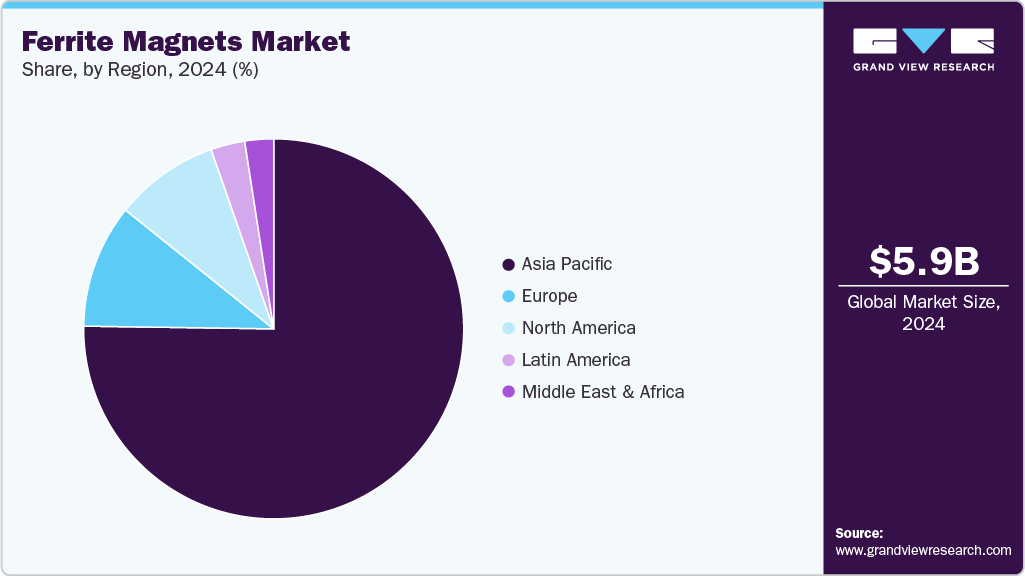
Asia Pacific dominated the ferrite magnet market with the largest revenue share of 75.6% in 2025, due to its vast electronics, home appliance, and automotive manufacturing base. The region benefits from large-scale ceramic material processing, an extensive supply of iron-oxide raw materials, and a high demand for cost-efficient magnets across mass-market products. Ferrite magnets are widely used in motors for refrigerators, washing machines, fans, air conditioners, speakers, water pumps, and EV auxiliary systems, all sectors that have been rapidly expanding across the Asia Pacific over the last few years, ensuring strong and steady demand.
The ferrite magnet market in China held the largest share in the Asia Pacific region in 2025. The ferrite magnet market in China is the unquestioned leader in the due to its enormous ceramic-magnet manufacturing infrastructure and vertically integrated supply chain for iron-oxide-based materials. The country produces ferrite magnets across the entire value chain, from raw material calcination to anisotropic sintered ferrite assemblies for motors and electronics, enabling unmatched scale and very low unit manufacturing costs. China’s leadership is reinforced by its role as the global center of home-appliance and consumer-electronics production, both of which are major users of ferrite magnets.
Europe Ferrite Magnet Market Trends
The ferrite magnets market in Europe demand is increasing gradually as industries seek cleaner, more cost-efficient, and sustainable material alternatives for motors and energy-efficient appliances. The region’s industrial-automation and machinery manufacturers have continued to integrate ferrite magnets into pumps, conveyors, and HVAC systems, where corrosion resistance and thermal stability are favored over maximum magnetic strength. At the same time, EV suppliers and Tier 1 automotive component manufacturers are evaluating ferrites for specific motor platforms to reduce their exposure to volatile rare-earth supply chains.
Key Ferrite Magnet Company Insights
Some of the key players operating in the market include TDK Corporation, Arnold Magnetic Technologies, Proterial, Ltd., and others.
-
TDK Corporation, founded in 1935 in Japan, operates as a leading global manufacturer of electronic components and magnetic materials, including ferrite magnets and cores. The company supplies ferrite magnets for automotive, consumer electronics, industrial, and energy applications, focusing on cost-effective, thermally stable, and corrosion-resistant solutions. TDK leverages advanced ceramic processing, precision manufacturing, and rigorous quality control systems to deliver reliable magnetic components for high-volume and specialized applications worldwide.
-
Arnold Magnetic Technologies, established in 1923 in the United States, functions as a diversified supplier of permanent magnets, soft magnetic materials, and precision assemblies. The company produces ferrite magnets used in automotive, industrial, medical, and aerospace systems, offering both standard and custom-designed solutions. Arnold integrates automated manufacturing, advanced material science, and assembly expertise to provide high-performance magnets and assemblies for industrial and technological applications globally.
-
Proterial Ltd., headquartered in Japan, specializes in the production of permanent magnets, ferrite materials, and related magnetic components for industrial, automotive, and consumer electronics markets. The company delivers high-quality ferrite magnets optimized for performance, durability, and cost efficiency. Proterial employs state-of-the-art sintering techniques, precision engineering, and strict quality management to support large-scale manufacturing and specialized applications across Asia, Europe, and North America.
Key Ferrite Magnet Companies:
The following key companies have been profiled for this study on the ferrite magnet market.
-
Arnold Magnetic Technologies
-
Electron Energy Corporation (EEC)
-
Magengine Co., Ltd.
-
Ningbo Yunsheng Co., Ltd.
-
Proterial Ltd.
-
Shin-Etsu Chemical Co., Ltd.
-
Sinosteel New Materials
-
TDK Corporation
-
Tianshui Hengtong Group
-
XHMAG
Competitive Benchmarking
Category
Operating Strategies
Competitive Edge
Weakness
Established Players (Proterial, Ltd.; Shin-Etsu Chemical Co., Ltd.; TDK Corporation; Ningbo Yunsheng Co., Ltd.; Sinosteel New Materials; Arnold Magnetic Technologies)
- Focus on large-scale manufacturing of permanent magnets with diversified product portfolios serving automotive, industrial, electronics, and renewable energy sectors.
- Invest in advanced magnet processing technologies, automation, product innovation, and capacity expansion to improve manufacturing efficiency and product performance.
- Strengthening global presence through long-term supply agreements, strategic partnerships with OEMs, and expansion of regional manufacturing and distribution networks.
- Strong manufacturing capabilities with extensive product portfolios across multiple permanent magnet technologies.
- Established relationships with global OEMs and Tier-1 suppliers in automotive, electronics, and industrial equipment.
- Robust R&D capabilities, strong brand recognition, and global sales and distribution networks.
- Exposure to fluctuations in raw material prices and manufacturing costs.
- High capital investment requirements for production expansion, quality control, and technology upgrades.
- Increasing competition from low-cost regional manufacturers and evolving customer performance requirements.
Emerging & Regional Players (Electron Energy Corporation (EEC); Magengine Co., Ltd.; Tianshui Hengtong Group; XHMAG)
- Focus on cost-competitive production of ferrite magnets for industrial motors, consumer electronics, home appliances, and automotive components.
- Expand production capacity while improving manufacturing efficiency and product quality to address regional demand.
- Develop customized magnetic solutions and strengthen relationships with regional equipment manufacturers and distributors.
- Efficient manufacturing operations and regional supply chains support competitive pricing.
- Flexibility in producing customized ferrite magnet solutions for specific customer applications.
- Strong presence in domestic and regional markets with growing manufacturing capabilities.
- Limited global brand recognition and international distribution networks.
- Smaller production capacities and comparatively lower investment in research and advanced manufacturing technologies.
- Greater dependence on regional demand and intense price competition from larger global manufacturers.
Recent Developments
-
In March 2025, TDK Corporation announced the expansion of its ferrite magnet production line at its Japan facility to meet growing demand from the automotive and consumer electronics sectors. The upgrade features advanced sintering equipment and automated quality inspection systems, designed to enhance magnetic consistency and reduce production cycle times. The company highlighted that the expansion would improve its ability to supply high-volume orders while maintaining stable product performance for temperature-sensitive and high-reliability applications.
-
In January 2025, Arnold Magnetic Technologies unveiled a new precision ferrite assembly line at its U.S. headquarters aimed at increasing output for industrial automation and medical device markets. The project incorporates real-time monitoring and robotic handling systems to maintain dimensional accuracy and reduce defect rates. Arnold stated that the new line will strengthen operational flexibility and accelerate delivery times for large-scale industrial and custom magnet orders.
-
In February 2025, Proterial Ltd completed the modernization of its ferrite magnet manufacturing process at its Japanese plant to enhance energy efficiency and reduce environmental impact. The upgrade features optimized kiln controls, advanced material handling, and automated inspection tools to ensure consistent magnetic properties. Proterial indicated that the improvements will support rising global demand, particularly for automotive motors and electronics components, while maintaining compliance with evolving sustainability standards.
Ferrite Magnet Market Report Scope
Report Attribute
Details
Market definition
The market size represents the annual value of the apparent consumption of ferrite magnets across various applications during a particular year.
Market size in 2025
USD 6.4 billion
Estimated market size in 2026
USD 6.8 billion
Projected market size by 2033
USD 10.5 billion
Growth rate
CAGR of 6.5% from 2026 to 2033
Base year for estimation
2025
Historical data
2021 - 2024
Forecast period
2026 - 2033
Quantitative units
Revenue in USD million, Volume in Kilotons, and CAGR from 2026 to 2033
Report coverage
Revenue forecast, volume forecast, company ranking, competitive landscape, growth factors, and trends
Segments covered
Application, region
Regional scope
North America; Europe; Asia Pacific; Latin America; Middle East & Africa
Country scope
U.S.; Canada; Mexico; Germany; UK; France; Russia; China; India; Japan; Australia; Brazil; South Africa; Iran
Key companies profiled
Arnold Magnetic Technologies; Electron Energy Corporation (EEC); Magengine Co., Ltd.; Ningbo Yunsheng Co., Ltd.; Proterial, Ltd.; Shin-Etsu Chemical Co., Ltd.; Sinosteel New Materials; TDK Corporation; Tianshui Hengtong Group; XHMAG
Customization scope
Free report customization (equivalent up to 8 analysts' working days) with purchase addition or alteration to country, regional & segment scope.
Pricing and purchase options
Avail customized purchase options to meet your exact research needs. Explore purchase options
Global Ferrite Magnet Market Report Segmentation
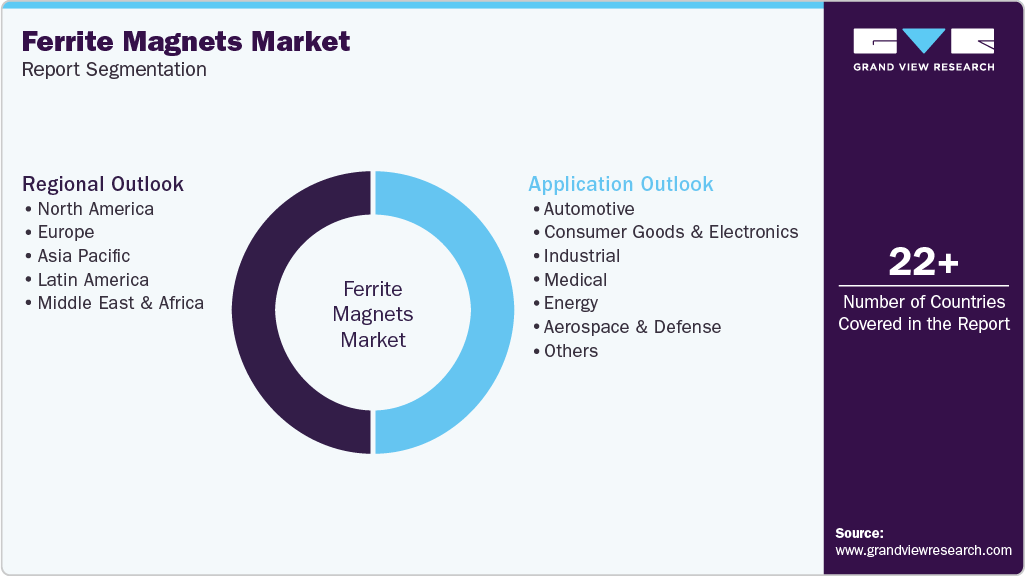
This report forecasts global, country, and regional revenue growth and analyzes the latest trends in each sub-segment from 2021 to 2033. For this study, Grand View Research has segmented the global ferrite magnet market report based on the application and region:
 To learn more about this report, Download Free Sample Report
 -
Application Outlook (Volume, Kilotons; Revenue, USD Million, 2021 - 2033)
-
Automotive
-
Consumer Goods & Electronics
-
Industrial
-
Medical
-
Energy
-
Aerospace & Defense
-
Others
-
-
Regional Outlook (Volume, Kilotons; Revenue, USD Million, 2021 - 2033)
-
North America
-
U.S.
-
Canada
-
Mexico
-
-
Europe
-
Germany
-
UK
-
France
-
Russia
-
-
Asia Pacific
-
China
-
India
-
Japan
-
Australia
-
-
Latin America
-
Brazil
-
-
Middle East & Africa
-
South Africa
-
Iran
-
-
Research Methodology
The ferrite magnet market figures in this report are based on a proven research process that combines executive interviews with secondary research from proprietary databases, company filings, and recognized regulatory and institutional sources. Market size is built through value-chain sizing - reconciling supply-side and demand-side estimates - and triangulated with bottom-up and top-down approaches. Every estimate passes multiple levels of expert validation before publication, with each ferrite magnet segment quantified using the revenue-capture definitions in the table below.
Segment Definition
Application
Revenue Capture Definition
Automotive
This segment includes revenue generated from the sale of ferrite magnets used in automotive applications such as electric motors, starter motors, alternators, windshield wipers, power windows, HVAC systems, fuel pumps, sensors, and loudspeakers. Demand is driven by increasing vehicle production and the growing adoption of electric and hybrid vehicles.
Consumer Goods & Electronics
This segment comprises revenue generated from ferrite magnets used in consumer electronics and household appliances, including televisions, speakers, headphones, refrigerators, washing machines, air conditioners, microwave ovens, and small electric motors. Growth is supported by rising consumer electronics production and increasing demand for energy-efficient appliances.
Industrial
This segment includes revenue generated from ferrite magnets used in industrial equipment such as electric motors, generators, conveyors, magnetic separators, automation systems, pumps, compressors, and machine tools. Demand is driven by industrial automation, manufacturing expansion, and energy-efficient machinery.
Medical
This segment covers revenue generated from ferrite magnets used in medical devices and equipment, including diagnostic instruments, laboratory equipment, magnetic couplings, pumps, and specialized healthcare devices. Demand is supported by expanding healthcare infrastructure and increasing medical equipment production.
Energy
This segment includes revenue generated from ferrite magnets used in renewable energy systems, power generation equipment, wind turbines, generators, energy-efficient motors, and electrical infrastructure. Investments in renewable energy, grid modernization, and energy conservation initiatives drive growth.
Aerospace & Defense
This segment comprises revenue generated from ferrite magnets used in aerospace and defense applications, including actuators, sensors, communication systems, radar equipment, navigation systems, and auxiliary electric motors. Demand is supported by increasing defense modernization and aircraft production.
Others
This segment includes revenue generated from ferrite magnets used in applications such as magnetic separators, magnetic couplings, educational equipment, toys, signage, consumer accessories, and various specialty industrial and commercial products not covered under the above segments.
Estimation Model
Layer Name
Key Question
Description
Demand Generation Assessment Layer
Where does the demand for ferrite magnet originate?
Quantify demand by analyzing the production and consumption of ferrite magnets across major end-use sectors, including automotive, consumer electronics, industrial equipment, home appliances, renewable energy, medical devices, and aerospace & defense. Assess macroeconomic indicators, manufacturing output, electrification trends, adoption of automation, and the penetration of permanent magnet-based components to establish the market demand base.
Manufacturing & Supply Chain Assessment Layer
How is global demand fulfilled?
Evaluate the supply ecosystem by assessing the availability of key raw materials (iron oxide, strontium carbonate, and barium carbonate), ferrite magnet manufacturing capacities, production technologies, regional manufacturing clusters, and supply chain integration. Analyze international trade flows, capacity utilization, and the competitive positioning of key manufacturers to determine the global supply structure.
Application Penetration Assessment Layer
How are ferrite magnet distributed across applications?
Measure ferrite magnet consumption across major applications, including electric motors, loudspeakers, sensors, magnetic separators, generators, actuators, and household appliances. Evaluate application-specific magnet intensity, technology preferences, equipment production volumes, and substitution trends with rare-earth magnets to estimate demand allocation across industries and regions.
Market Size & Revenue Validation Layer
How is the market value determined?
Derive the market value by integrating application-level consumption volumes with regional average selling prices of ferrite magnets. Assess the impact of raw material prices, manufacturing costs, product grades, magnet types, regional pricing variations, and competitive dynamics to validate market size estimates across product categories, applications, end-use industries, and geographies.
Delivered Customizations
This report has been delivered with the following In-depth customizations
Client Request
Customization Delivered
Value Adds
Trade Analysis
Comprehensive assessment of global ferrite magnet trade, including import-export volumes and values, major exporting and importing countries, trade routes, tariff structures, and regional trade balances. Evaluated the impact of trade policies, supply chain shifts, and cross-border manufacturing activities on market dynamics.
Supported identification of high-potential export markets, optimized sourcing and distribution strategies, and enabled assessment of regional trade opportunities and supply chain risks.
Raw Material Price Impact Analysis
Assessed the impact of fluctuations in iron oxide, strontium carbonate, and barium carbonate prices on ferrite magnet manufacturing costs, margins, and pricing strategies.
Enabled cost forecasting, procurement planning, and pricing optimization.
Innovation & Patent Landscape Analysis
Assessed recent technological innovations, patent filing trends, new ferrite material developments, and advancements in manufacturing processes by leading companies and research institutions.
Supported technology roadmap development, R&D prioritization, and competitive intelligence.
Frequently Asked Questions About This Report
Asia Pacific dominated the ferrite magnet market with the largest revenue share of 75.6% in 2025.
The ferrite magnet market in China held the largest share in the Asia Pacific region in 2025.
Asia Pacific is anticipated to register the fastest CAGR of 7.0% over the forecast period.
The energy segment is expected to grow at the fastest CAGR over the forecast period.
The global ferrite magnet market size was valued at USD 6.4 billion in 2025 and is estimated at USD 6.8 billion for 2026.
The global ferrite magnet market is expected to grow at a CAGR of 6.5% from 2026 to 2033, reaching USD 10.5 billion by 2033.
By applications, the consumer goods & electronics segment led the market with the largest revenue share of 26.1% in 2025.
The key players operating in the ferrite magnet market are Arnold Magnetic Technologies, Electron Energy Corporation (EEC), Magengine Co., Ltd., Ningbo Yunsheng Co., Ltd., Proterial, Ltd., Shin-Etsu Chemical Co., Ltd., Sinosteel New Materials, TDK Corporation, Tianshui Hengtong Group, and XHMAG, among others.
The key factor driving the growth of the global ferrite magnet market is the increasing demand for cost-effective permanent magnets in energy-efficient motors, automotive systems, consumer electronics, and industrial equipment, driven by global electrification and automation trends.
About the Author(s)
Advanced Interior Materials Research Team
Advanced Materials · Advanced Interior MaterialsThis report was authored by the advanced interior materials research team at Grand View Research - comprising two research analysts, one senior research analyst, and one industry expert - with specialized expertise in the advanced interior materials segment of the advanced materials industry. All findings are based on proprietary advanced materials databases, executive interviews, and regulatory analysis, subject to internal peer review prior to publication.
Last Updated:
Speak to Analyst

Customize this report to your needs - add regions, segments, or data points, with 20% free customization.
Or view our licence options:


ISO 9001:2015 & 27001:2022 Certified
We are GDPR and CCPA compliant! Your transaction & personal information is safe and secure. For more details, please read our privacy policy.


