
- Home
- »
- Next Generation Technologies
- »
-
Firefighting Robots Market Size & Share Report, 2026-2033GVR Report cover

Firefighting Robots Market (2026 - 2033)
Size, Share & Trends Analysis Report By Type (Humanoid Robots, Tracked Robots, Wheeled Robots), By Application (Residential, Commercial, Industrial, Defense & Military), By Region, And Segment Forecasts
Market Size, 2025
$1.7BMarket Estimate, 2026
$1.8BMarket Forecast, 2033
$4.5BCAGR, 2026–2033
13.5%Firefighting Robots Market Summary
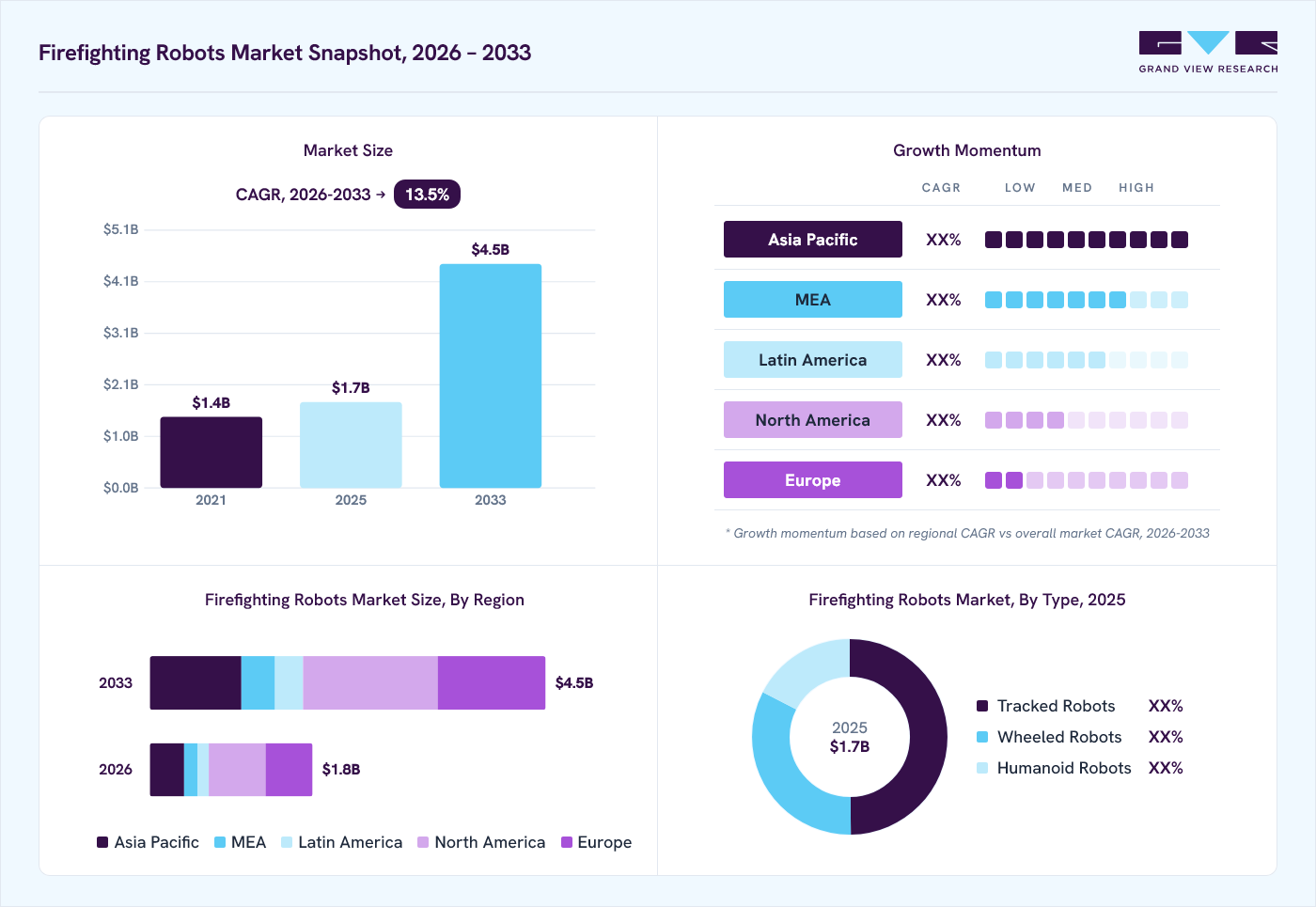
The global firefighting robots market size was valued at USD 1.7 billion in 2025 and is projected to grow from USD 1.8 billion in 2026 to USD 4.5 billion by 2033, at a CAGR of 13.5% from 2026 to 2033. North America dominated the global market with the largest revenue share of 35.0% in 2025. The increasing incidents of industrial fires and hazardous situations drive the market's growth
 Source: Grand View Research, IR Documents, Primary Interviews, Paid DatabasesTo learn more about this report,
 Download Free Sample Report
 Key Market Trends & Insights
- By type: Tracked robots segment dominated the market, with a revenue share of 49.8% in 2025.
- By application: Industrial segment held the largest market share of 38.8% in 2025.
Regional Highlights
- Largest regional market: North America (35.0% revenue share, 2025)
- Fastest-growing regional market: Asia Pacific (highest CAGR, 2026-2033)
- By country: The U.S. held the largest market share in 2025.
Market Size & Forecast
- Market size in 2025: USD 1.7 Billion
- Estimated market size in 2026: USD 1.4 Billion
- Projected market size by 2033: USD 4.5 Billion
- CAGR (2026-2033): 13.5%
Three ways to get this report
Buy it, customize it, or ask a question.Ask an Analyst
Analyst response in 1 business day
- AccessReport author, directly
- Reply timeWithin 1 working day
- No sales callDirect answer only
- FormatEmail reply
- CostFree, no cost
Get the Full Report
What the study covers
- FormatsPDF · Excel · Dashboard
- Timeline2026–2033 annual, 2025 base
- Coverage20+ countries, 5 regions
- Companies10+ key players profiled
Customize the Report
20% free customization
- IncludeCountries, segments, points
- TailorTo your product definition
- ExtendDeeper competitor detail
- OrA fully bespoke study
- Turnaround5–10 working days
Industrial sectors such as oil and gas, chemical manufacturing, power generation, and mining often operate in environments where the risk of fire is high. These industries deal with highly flammable materials, pressurized gases, and high-temperature machinery, making them prone to accidents that can quickly escalate into large-scale fires.Traditional firefighting methods involving human firefighters may not be feasible or safe in such hazardous conditions. The heat, smoke, toxic fumes, or explosive materials often make it too dangerous for people to approach the fire. Firefighting robots are designed to withstand extreme conditions, allowing them to suppress fires in inaccessible environments that are too risky for human intervention.
 To learn more about this report, Download Free Sample Report
 The rising adoption in defense and military operations drives market growth. The defense and military sectors are increasingly adopting firefighting robots for their ability to operate in high-risk environments such as battlefields and military installations. These robots can handle explosive materials, suppress fires in ammunition depots, and manage fires caused by combat operations. The military's focus on developing autonomous systems for safety and operational efficiency drives investments in firefighting robots.
The trend toward automation and the development of smart cities is also driving the market growth. As urban areas become more densely populated and technologically advanced, there is a growing need for automated systems that can quickly respond to emergencies, including fires. Firefighting robots are being integrated into smart city frameworks, where they can be deployed autonomously to respond to fire incidents in residential and commercial areas. The concept of smart cities emphasizes intelligent systems for public safety, and firefighting robots fit seamlessly into this vision by offering efficient and rapid-fire suppression capabilities.
Despite advancements, firefighting robots still face significant technological hurdles. Challenges include limitations in battery life, mobility in difficult terrains, and real-time decision-making capabilities in unpredictable fire environments. Many robots struggle to navigate through debris, extreme heat, or smoke, which can interfere with sensor accuracy and operational efficiency.
Market Dynamics
The firefighting robots market is evolving amid rising fire safety risks, increasing industrialization, and heightened emphasis on responder safety across high-risk environments. Urban densification, growth of hazardous industrial facilities, and climate-driven fire incidents are reinforcing demand for advanced firefighting technologies. Rapid progress in robotics, remote sensing, AI-based navigation, and thermal imaging is enabling the deployment of autonomous and semi-autonomous systems in environments inaccessible or unsafe for human firefighters. The market is moving toward mission-specific robotic platforms integrated with broader emergency response ecosystems.
The growing frequency and intensity of structural fires, industrial explosions, and hazardous material incidents have significantly increased safety risks for frontline firefighters. Industrial zones, petrochemical plants, tunnels, and defense installations expose responders to extreme heat, toxic gases, and structural instability. Regulatory bodies and fire departments are under pressure to reduce injury rates, fatalities, and long-term health impacts, creating strong demand for solutions that minimize direct human exposure during initial response and containment phases.
Firefighting robots address this challenge by enabling remote operation in high-temperature and toxic environments while maintaining effective suppression and reconnaissance capabilities. Equipped with thermal cameras, gas sensors, and high-pressure water or foam systems, these robots can enter fire zones ahead of human teams. Their adoption improves operational safety, enhances situational awareness, and accelerates containment, directly supporting market expansion across municipal, industrial, and defense applications.
Firefighting robots entail high upfront costs due to ruggedized hardware, advanced sensors, mobility systems, and specialized firefighting payloads. Additional expenses for customization, operator training, maintenance, and integration with existing firefighting infrastructure further elevate the total cost of ownership. Budget constraints among municipal fire departments and smaller industrial facilities limit large-scale procurement, particularly in cost-sensitive regions.
This restraint disproportionately impacts residential and small commercial segments, as well as developing markets where emergency response budgets are limited. Adoption remains concentrated in industrial facilities, airports, and defense installations, which have higher safety compliance requirements and greater capital availability. The cost barrier slows volume deployment, extends replacement cycles, and restrains near-term market penetration in emerging economies.
The increasing adoption of Industry 4.0 practices and smart city initiatives is creating new opportunities for firefighting robots. Industrial operators are integrating robotics, IoT sensors, and centralized command systems to enhance risk monitoring and emergency preparedness. Governments are also investing in intelligent emergency response infrastructure, enabling robotic systems to be integrated into coordinated disaster management frameworks.
This opportunity offers strong growth potential for vendors providing interoperable, AI-enabled robotic platforms designed for industrial and urban deployments. Tracked and wheeled robots with modular payloads are best positioned to benefit, particularly those that offer analytics integration, autonomous navigation, and compatibility with remote command. Vendors targeting industrial, defense, and large commercial facilities are expected to capture higher-value contracts and long-term service revenues.
Analyst Perspective
The firefighting robots market is transitioning from niche deployments toward strategic adoption in high-risk and high-value environments. Growth is driven by escalating safety regulations, industrial fire risks, and the need to protect human responders. Advancements in autonomous navigation, sensor fusion, and remote command systems are reshaping product capabilities and use cases. Investment is increasingly focused on industrial and defense applications where return on safety investment is quantifiable. Competitive differentiation is shifting toward modularity, interoperability, and lifecycle service offerings.
Type Insights
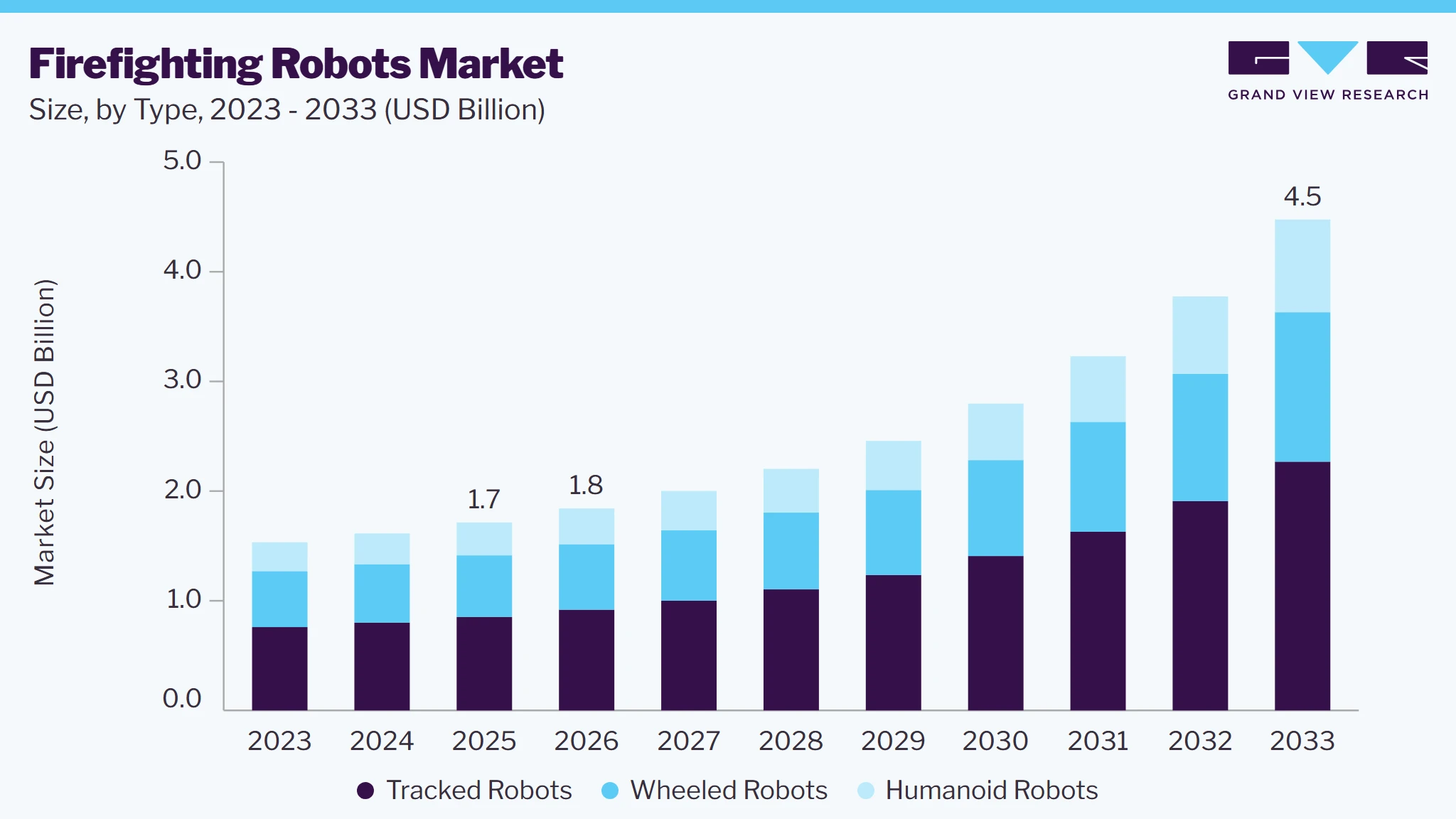
Based on type, the tracked robots segment led the market with the largest revenue share of 49.8% in 2025. The tracked robots segment's growth is driven by its ability to operate in extreme conditions. These robots are designed to withstand extreme heat, smoke, and hazardous environments, making them highly valuable in firefighting situations. They are often equipped with heat-resistant materials and advanced sensors that allow them to operate safely in conditions that are dangerous or inaccessible to human firefighters.
The humanoid robots segment is projected to grow at a significant CAGR from 2024 to 2030. Humanoid robots' ability to replicate human movements and perform tasks that would otherwise require human intervention drives the market's growth. Humanoid robots can navigate through tight spaces, climb stairs, open doors, and manipulate objects precisely. These capabilities are essential in fire rescue operations inside buildings, industrial sites, and hazardous areas. This human-like flexibility makes them ideal for accessing areas that traditional robots with wheels or tracks may struggle to reach.
Application Insights
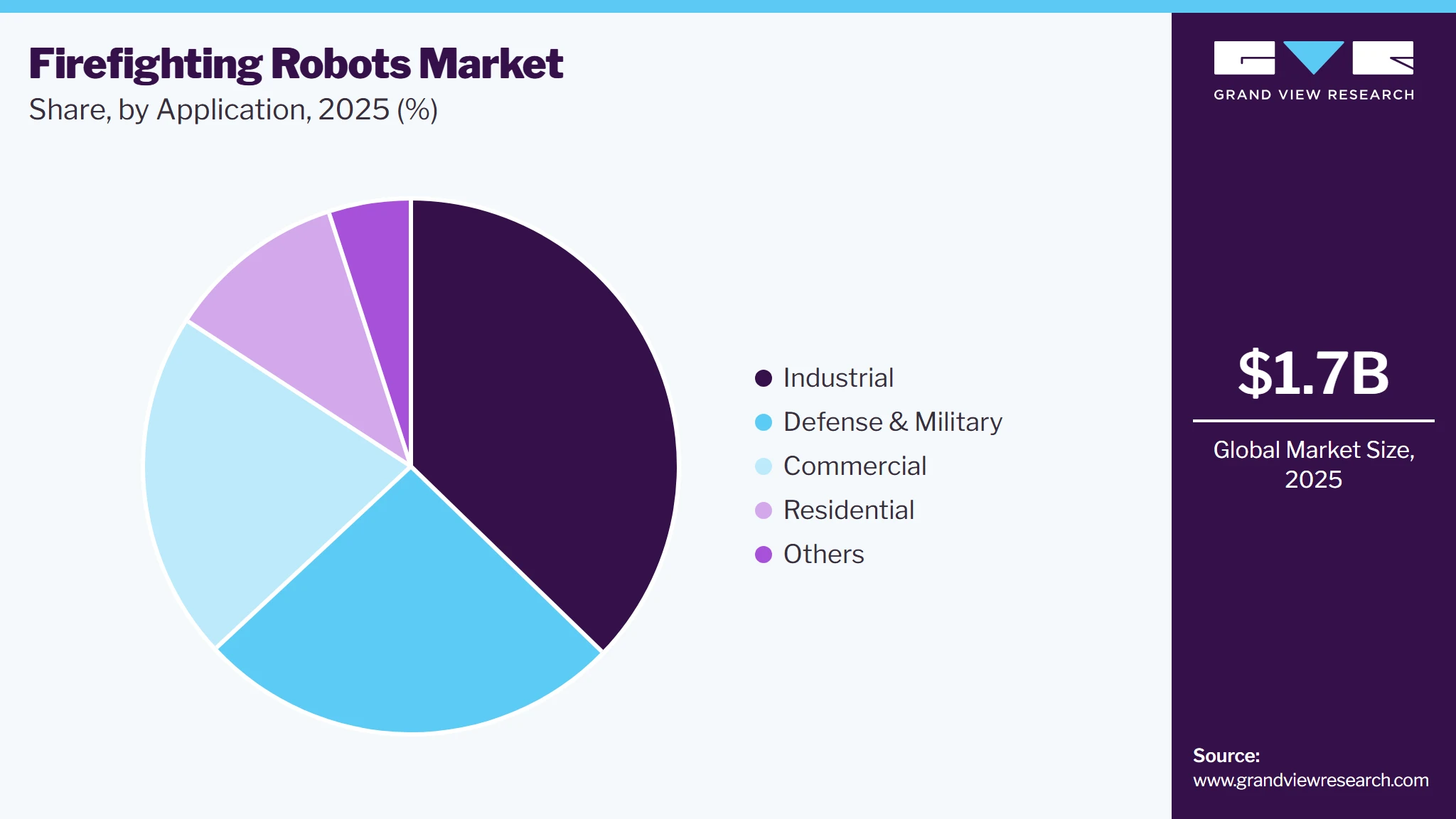
Based on application, the industrial segment led the market with the largest revenue share of 38.8% in 2025. The increasing demand for automation in industrial operations drives the market's growth. Firefighting robots can operate autonomously or be remotely controlled, allowing them to respond to fires quickly and efficiently. In industrial facilities where manual intervention can be slow or dangerous, robotic systems ensure that firefighting efforts are initiated promptly, reducing the likelihood of extensive damage.
 To learn more about this report, Download Free Sample Report
 The residential segment is projected to grow at a significant CAGR from 2024 to 2030. Urbanization and the growth of high-density residential areas such as apartment complexes and condominiums contribute to the demand for firefighting robots in residential applications. In densely populated areas, the risk of fire spreading between units is higher, and traditional firefighting methods may be slower or less effective. Firefighting robots can offer an immediate response within residential complexes, reducing the potential damage and risk to residents in these environments.
Regional Insights
North America dominated the global firefighting robots market with the largest revenue share of 35.0% in 2025. The increasing incidence of large-scale wildfires in North America, particularly in the western U.S. and parts of Canada, drives the market's growth. Due to climate change and other environmental factors, wildfires have become more frequent and intense, posing severe challenges to traditional firefighting methods.
 To learn more about this report, Download Free Sample Report
 U.S. Firefighting Robots Market Trends
The firefighting robots market in the U.S. held the largest share in the North America region in 2025. The growing emphasis on improving fire safety in various sectors, including residential, commercial, and industrial, is fueling the demand for firefighting robots in the U.S. High-profile incidents, such as large-scale fires and disasters, have heightened awareness of the need for advanced fire suppression solutions.
Europe Firefighting Robots Market Trends
The firefighting robots market in Europe is expected to witness at a notable CAGR from 2024 to 2030. Many European countries have strict building codes and continuously updated fire safety standards to improve protection and efficiency. These regulations often encourage or mandate advanced technologies to enhance fire safety and response capabilities. As a result, there is a growing demand for innovative solutions, such as firefighting robots that can meet these stringent standards and provide enhanced fire protection.
Asia Pacific Firefighting Robots Market Trends
The firefighting robots market in Asia Pacific held a significant share of the global market. Rapid urbanization and infrastructure development drive the market's growth. As cities expand and new urban areas are developed, the demand for firefighting robot solutions grows correspondingly. Rapid urbanization leads to new residential, commercial, and industrial zones requiring effective firefighting robots to ensure safety and functionality.
Key Firefighting Robots Company Insights
Key players operating in the market include Howe & Howe; Shark Robotics; Angatec; MITSUBISHI HEAVY INDUSTRIES, LTD.; Vimal Fire; EmiControls; DOK-ING d.o.o.; Shandong Guoxing Intelligent Technology Co., Ltd; QinetiQ; and Ryland Research Limited. The companies are focusing on various strategic initiatives, including new product development and launch, to enhance their market position, meet evolving customer demands, and capitalize on emerging technological advancements in the global market.
Key Firefighting Robots Companies:
The following key companies have been profiled for this study on the firefighting robots market.
- Howe & Howe
- Shark Robotics
- Angatec
- MITSUBISHI HEAVY INDUSTRIES, LTD.
- Vimal Fire
- EmiControls
- DOK-ING d.o.o.
- Shandong Guoxing Intelligent Technology Co., Ltd
- QinetiQ
- Ryland Research Limited
Competitive Benchmarking
Category
Operating Strategies
Competitive Edge
Weakness
Established Players (MITSUBISHI HEAVY INDUSTRIES, LTD., QinetiQ, DOK-ING d.o.o., Howe & Howe)
- These players are focused on focus on high-end industrial and defense deployments, long-term contracts, and integrated solutions
- These players have strong engineering expertise, global reach, and proven field performance
- High costs and longer sales cycles
Emerging Players (Shark Robotics, Angatec, Shandong Guoxing Intelligent Technology Co., Ltd)
- These players are target niche applications, regional markets, and cost-optimized platforms.
- Agile innovation, competitive pricing, application-specific designs
- Limited global presence and scale constraints.
Recent Developments
-
In May 2023, FFBOTS, a Dubai manufacturing company, launched Wabel, the first locally made firefighting robot in the Middle East. It is designed to enhance firefighting operations and improve safety for first responders. Wabel can be remotely controlled from up to 1 kilometer away and boasts a powerful water flow rate of 8,000 liters per minute, enabling it to tackle fires effectively
Firefighting Robots Market Report Scope
Report Attribute
Details
Market size in 2025
USD 1.7 billion
Estimated market size in 2026
USD 1.8 billion
Projected market size by 2033
USD 4.5 billion
Growth rate
CAGR of 13.5% from 2026 to 2033
Base year for estimation
2025
Historical data
2021 - 2024
Forecast period
2026 - 2033
Quantitative units
Revenue in USD billion and CAGR from 2026 to 2033
Report coverage
Revenue forecast, company market share, competitive landscape, growth factors, and trends
Segments covered
Type, application, and region
Regional scope
North America; Europe; North America; Central & South America; MEA
Country scope
U.S.; Canada; Mexico; Germany; U.K.; France; China; Japan; India; South Korea; Australia; Brazil; Saudi Arabia; UAE; and South Africa
Key companies profiled
Howe & Howe; Shark Robotics; Angatec; MITSUBISHI HEAVY INDUSTRIES, LTD.; Vimal Fire; EmiControls; DOK-ING d.o.o.; Shandong Guoxing Intelligent Technology Co., Ltd; QinetiQ; Ryland Research Limited.
Customization scope
Free report customization (equivalent up to 8 analysts' working days) with purchase. Addition or alteration to country, regional & segment scope.
Pricing and purchase options
Avail customized purchase options to meet your exact research needs. Explore purchase options
Global Firefighting Robots Market Report Segmentation
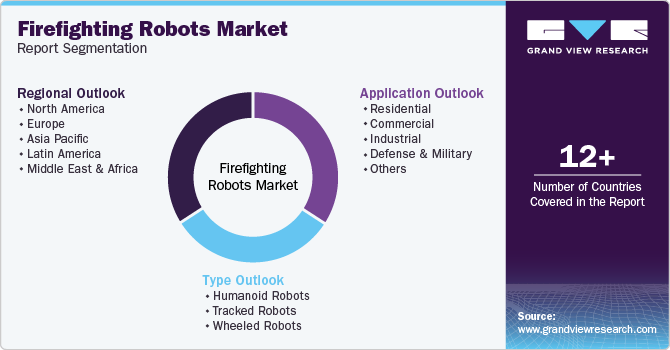
The report forecasts revenue growth at global, regional, and country levels and provides an analysis of the latest industry trends in each of the sub-segments from 2021 to 2033. For this study, Grand View Research has segmented the global firefighting robots market based on type, application, and region.
 To learn more about this report, Download Free Sample Report
 -
Type Outlook (Revenue, USD Million, 2021 - 2033)
-
Humanoid Robots
-
Tracked Robots
-
Wheeled Robots
-
-
Application Outlook (Revenue, USD Million, 2021 - 2033)
-
Residential
-
Commercial
-
Industrial
-
Defense & Military
-
Others
-
-
Regional Outlook (Revenue, USD Million, 2021 - 2033)
-
North America
-
U.S.
-
Canada
-
Mexico
-
-
Europe
-
Germany
-
UK
-
France
-
-
Asia Pacific
-
China
-
India
-
Japan
-
Australia
-
South Korea
-
-
Latin America
-
Brazil
-
-
Middle East & Africa
-
UAE
-
Kingdom of Saudi Arabia
-
South Africa
-
-
Research Methodology
The firefighting robots market figures in this report are based on a proven research process that combines executive interviews with secondary research from proprietary databases, company filings, and recognized regulatory and institutional sources. Market size is built through value-chain sizing - reconciling supply-side and demand-side estimates - and triangulated with bottom-up and top-down approaches. Every estimate passes multiple levels of expert validation before publication, with each firefighting robots segment quantified using the revenue-capture definitions in the table below.
Segment Definition
Segment - Type
Revenue capture definition
Humanoid Robots
Humanoid firefighting robots are designed to replicate human movement, enabling them to operate firefighting equipment, climb stairs, and perform complex tasks in structured environments. This segment includes humanoid robotic platforms with integrated fire suppression systems, sensors, control software, training services, and lifecycle maintenance, with adoption limited by high costs and technical complexity.
Tracked Robots
Tracked firefighting robots use continuous track systems that allow them to navigate debris, stairs, and uneven terrain in high-risk fire zones. This segment covers tracked robotic platforms, modular firefighting payloads, mobility and remote-control systems, software upgrades, and aftermarket services, supporting widespread use in industrial and hazardous environments.
Wheeled Robots
Wheeled firefighting robots operate on wheel-based mobility systems, making them easy to deploy and maintain in controlled environments. This segment includes wheeled robotic units, integrated firefighting equipment, navigation and control software, and support services, and is primarily used in warehouses, airports, and large commercial facilities.
Segment - Application
Revenue capture definition
Residential
Residential applications include the use of firefighting robots for fire detection, monitoring, and suppression in housing complexes and high-rise residential buildings. These robots support emergency response in confined or smoke-filled areas where human access may be limited or unsafe.
Commercial
Commercial applications involve the deployment of firefighting robots in offices, shopping malls, hotels, airports, hospitals, and other public infrastructure. These systems are used to improve response time, support evacuation efforts, and reduce risks to firefighting personnel.
Industrial
Industrial applications cover the use of firefighting robots in factories, warehouses, power plants, oil & gas facilities, and chemical processing sites. Robots are used to manage high-temperature fires, hazardous materials, and explosion-prone environments.
Defense & Military
This segment includes the use of firefighting robots at military bases, ammunition depots, and naval vessels, as well as in combat-support operations, to control fires caused by explosions, fuel storage, or battlefield incidents.
Others
Other applications include tunnels, mining operations, ports, transportation hubs, and disaster response scenarios where rapid fire suppression and enhanced safety are critical.
Estimation Model
Layer Name
Key Question
Description
Addressable Risk Environments
Where are firefighting robots required?
This layer evaluates industrial, commercial, defense, and infrastructure environments with high fire risk exposure. It assesses fire incident frequency, regulatory mandates, and safety compliance requirements. The analysis establishes the theoretical demand base for robotic firefighting solutions.
Technology Adoption Readiness
Who can adopt robotics today?
This layer analyzes budget availability, technical infrastructure, and workforce readiness across regions and end users. It distinguishes early adopters such as industrial operators and defense agencies from cost-sensitive municipal buyers.
Product and Application Mapping
Which robot types serve which needs?
Firefighting robot types are mapped to specific applications based on mobility, payload capacity, autonomy, and environmental resilience. This layer links tracked, wheeled, and humanoid platforms to end-use demand.
Revenue Realization
How is revenue captured?
The final layer estimates revenue through direct equipment sales, customization, software integration, and long-term service contracts. It reflects replacement cycles, fleet expansion, and service-based monetization trends.
Delivered Customizations
This report has been delivered with the following In-depth customizations
Client Request
Customization Delivered
Value Adds
Regional Firefighting Robots Market Opportunity Assessment
Assessed regional adoption drivers across industrial, defense, and municipal sectors
Evaluated regulatory readiness and safety mandates influencing procurement
Identified high-growth regions with elevated industrial fire risk exposure
Enabled region-specific market entry prioritization
Supported capital allocation toward high-demand geographies
Strengthened go-to-market planning with regulatory alignment
Cross-Segmentation Analysis for the Firefighting robots Market
Analyzed demand across robot type, and application
Benchmarked segment-level adoption maturity and spending capacity
Identified high-attractiveness segment intersections
Improved product-to-segment alignment
Supported target marketing and solution positioning
Enhanced customer prioritization accuracy
Competitive Benchmarking and Strategic Positioning in the Firefighting robots Market
Compared vendors on technology depth, pricing, and deployment scale
Assessed differentiation across autonomy, durability, and services
Identified competitive gaps and white-space opportunities
Enabled data-driven competitive strategy formulation
Supported differentiation through capability benchmarking
Improved long-term positioning and partnership decisions
Frequently Asked Questions About This Report
The global firefighting robots market size was estimated at USD 1.7 billion in 2025 and is expected to reach USD 1.8 billion in 2026.
North America dominated the market with the largest revenue share of 35.0% in 2025. The increasing incidence of large-scale wildfires in North America, particularly in the western U.S. and parts of Canada, drives the market's growth.
Asia-Pacific is the fastest-growing region over the forecast period.
The U.S. held the largest market share in 2025.
Industrial segment held the largest market share of 38.8% in 2025, while residential is the fastest growing area
The global firefighting robots market is expected to grow at a compound annual growth rate of 13.5% from 2026 to 2033, reaching USD 4.5 billion by 2033.
Tracked Robots segment dominated the market, with a revenue share of 49.8% in 2025. The tracked robots segment's growth is driven by its ability to operate in extreme conditions.
Some key players operating in the firefighting robots market include Howe & Howe; Shark Robotics; Angatec; MITSUBISHI HEAVY INDUSTRIES, LTD.; Vimal Fire; EmiControls; DOK-ING d.o.o.; Shandong Guoxing Intelligent Technology Co., Ltd; QinetiQ; Ryland Research Limited
The increasing incidents of industrial fires and hazardous situations drive the market's growth.
About the Author(s)
Next Generation Technologies Research Team
Technology · Next Generation TechnologiesThis report was authored by the next generation technologies research team at Grand View Research - comprising two research analysts, one senior research analyst, and one industry expert - with specialized expertise in the next generation technologies segment of the technology industry. All findings are based on proprietary technology databases, executive interviews, and regulatory analysis, subject to internal peer review prior to publication.
Last Updated:
Speak to Analyst

Customize this report to your needs - add regions, segments, or data points, with 20% free customization.
Or view our licence options:


ISO 9001:2015 & 27001:2022 Certified
We are GDPR and CCPA compliant! Your transaction & personal information is safe and secure. For more details, please read our privacy policy.


