
- Home
- »
- Specialty Polymers
- »
-
Firestopping Sealants Market Size, Share Report, 2026-2033GVR Report cover

Firestopping Sealants Market (2026 - 2033)
Size, Share & Trends Analysis Report By Type, By Product, By End Use (Residential, Commercial, Industrial), By Region (North America, Europe, Asia Pacific, Latin America, Middle East & Africa), And Segment Forecasts
Market Size, 2025
$499.2MMarket Estimate, 2026
$538.8MMarket Forecast, 2033
$928.9MCAGR, 2026–2033
8.1%Firestopping Sealants Market Summary
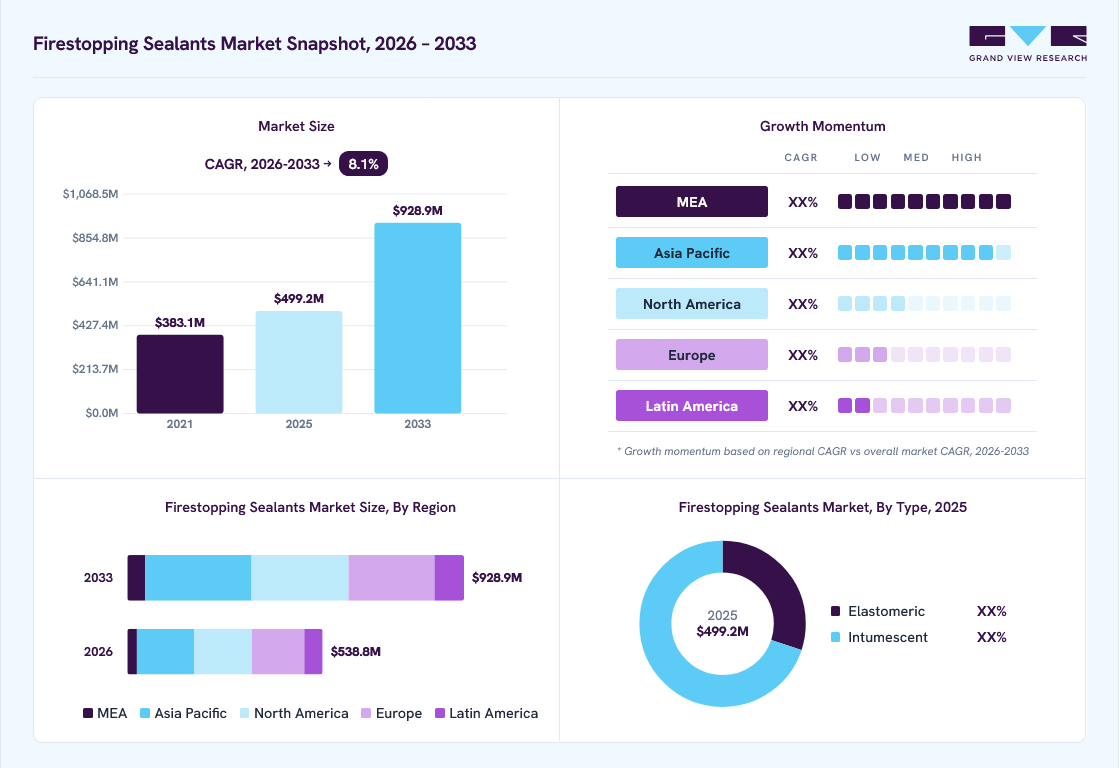
The global firestopping sealants market size was valued at USD 499.2 million in 2025 and is projected to grow from USD 538.8 million in 2026 to USD 928.9 million by 2033, at a CAGR of 8.1% from 2026 to 2033. North America dominated the market, accounting for a revenue share of 29.8% in 2025. Firestopping sealants are essential components in the construction industry, designed to prevent the spread of fire and smoke through openings in fire-rated walls and floors.
 Source: Grand View Research, IR Documents, Primary Interviews, Paid DatabasesTo learn more about this report,
 Download Free Sample Report
Key Market Trends & Insights
- By type: Intumescent segment dominated the market, with a revenue share of 70.0% in 2025.
- By product: Silicone segment held the largest market share of 61.3% in 2025.
- By end use: Commercial segment accounted for the largest revenue share of 50.5% in 2025.
Regional Highlights
- Largest regional market: North America (29.8% revenue share, 2025)
- Fastest-growing regional market: Asia Pacific (highest CAGR, 2026-2033)
- By country: The U.S. held the largest market share in 2025.
Market Size & Forecast
- Market size in 2025: USD 499.2 Million
- Estimated market size in 2026: USD 538.8 Million
- Projected market size by 2033: USD 928.9 million
- CAGR (2026-2033): 8.1%
Prism AI by Grand View Research Free to tryAsk a question about the firestopping sealants marketTry asking✓Every figure cited from GVR research Prefer the report? Download free sample →
These sealants play a critical role in ensuring compliance with fire safety regulations and enhancing building safety. Widely used across residential, commercial, and industrial sectors, firestopping sealants are increasingly in demand due to the growing focus on fire protection, rising infrastructure development, and stringent safety standards. The market is further driven by advancements in construction technologies and the trend toward sustainable building practices.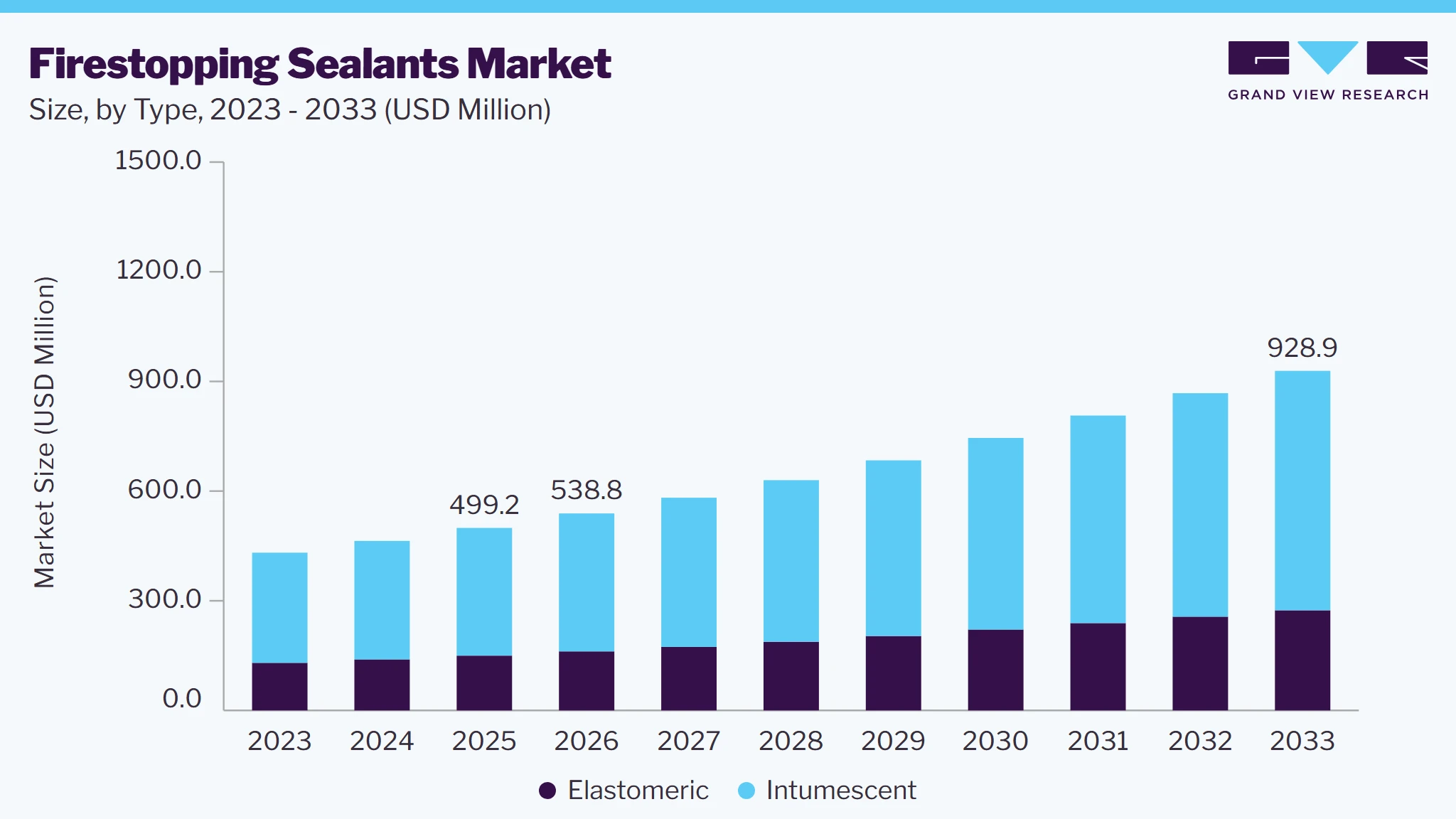 To learn more about this report, Download Free Sample Report
The increasing emphasis on building safety, stringent fire safety regulations, and rising construction activities across residential, commercial, and industrial sectors are key drivers fueling the growth of the firestopping sealants market. These sealants are essential in ensuring fire resistance in buildings, helping to seal gaps and prevent the spread of fire and smoke. Commonly used in construction end uses such as electrical conduits, cable trays, and wall or floor joints, firestopping sealants also find utility in high-risk environments like hospitals, data centers, and manufacturing facilities. With the growing focus on sustainable construction and green building certifications, the demand for eco-friendly firestopping solutions is further expanding, driving innovation and broader adoption.
Market Dynamics
Firestopping sealants are specialized passive fire protection materials used to prevent the spread of fire, smoke, and toxic gases through joints, penetrations, and openings in fire-rated walls and floors. These sealants help maintain the integrity of fire compartments and are widely used across residential, commercial, and industrial buildings. Increasing focus on occupant safety and stricter building regulations continue to support market growth globally.
The growing implementation of fire safety regulations and building code requirements is a major factor driving the firestopping sealants market. Governments and regulatory agencies worldwide are mandating the installation of certified passive fire protection systems in residential, commercial, and industrial structures to improve fire containment and minimize loss of life and property.
In addition, rising investments in commercial complexes, high-rise buildings, healthcare facilities, transportation infrastructure, and data centers are increasing demand for advanced firestopping solutions. Compliance with increasingly stringent fire protection standards is expected to continue supporting market expansion over the forecast period.
The adoption of firestopping sealants can be constrained by relatively high installation and compliance costs, particularly for large infrastructure and commercial projects. Proper installation often requires trained professionals and adherence to rigorous testing and certification standards.
Additionally, periodic inspections, maintenance requirements, and documentation associated with fire safety compliance can increase overall project costs. These factors may limit adoption in price-sensitive construction markets.
Increasing renovation and retrofitting activities across aging residential, commercial, and industrial infrastructure are creating significant opportunities for firestopping sealant manufacturers. Older buildings often require upgrades to meet current fire safety standards, driving demand for certified fire protection materials.
Furthermore, rapid urbanization and infrastructure development in emerging economies are expected to accelerate adoption of firestopping systems. Growing investments in smart buildings and sustainable construction projects are also supporting market growth opportunities.
Analyst Perspective
The firestopping sealants market is increasingly evolving from a compliance-driven segment to a performance-critical component of modern building safety systems. While commercial construction continues to account for the largest share of demand, emerging opportunities are being driven by data center expansion, smart city infrastructure, and industrial safety upgrades. Growing emphasis on integrated passive fire protection systems is encouraging innovation in advanced sealant formulations with improved durability, flexibility, and multi-application compatibility. Manufacturers focusing on high-performance, certified, and sustainable firestop solutions are expected to gain a competitive advantage as global building safety standards continue to tighten.
Drivers, Opportunities & Restraints
The firestopping sealants industry is witnessing significant growth due to the increasing demand for fire safety solutions in both new construction and renovation projects. These sealants are highly valued for their ability to prevent the spread of fire and smoke, making them essential in high-risk environments such as hospitals, data centers, and commercial buildings. The rising implementation of stringent building safety codes and the growing awareness of fire protection measures are driving market expansion. In addition, the construction industry's shift toward sustainable building practices is creating opportunities for eco-friendly firestopping solutions, further boosting the market growth.
The market is also influenced by the availability and cost of raw materials like polymers, resins, and intumescent agents, which are crucial for the production of firestop sealants. Fluctuations in raw material prices can significantly impact manufacturers' production costs and profitability. To mitigate these risks, companies are adopting strategic sourcing, diversifying their supply chains, and focusing on long-term procurement strategies.
Sustainability is emerging as a key opportunity in the firestopping sealants industry. As the demand for greener building materials increases, manufacturers have an opportunity to invest in research and development to create low-VOC, environmentally friendly products. By adopting sustainable production methods and leveraging green chemistry principles, companies can reduce their environmental impact while meeting the evolving needs of the construction industry.
Type Insights
Based on type, the intumescent segment led the market with the largest revenue share of 70.0% in 2025 and is expected to maintain its dominance throughout the forecast period. This growth is attributed to their superior flexibility, excellent adhesion properties, and resistance to cracking or shrinkage, making them ideal for sealing high-movement joints in fire-rated assemblies. The well-established technology supporting the production of elastomeric sealants ensures reliability, durability, and operational efficiency in various construction end uses. In addition, their cost-effectiveness and easy end use contribute to their widespread adoption across residential, commercial, and industrial sectors.
The intumescent sealants segment is anticipated to grow at a significant CAGR of 8.5% during the forecast period. These sealants expand when exposed to high temperatures, forming an insulating layer that blocks the spread of fire and smoke. The growing demand for fire protection solutions in high-risk environments such as hospitals, data centers, and industrial facilities is driving the expansion of this segment.
Intumescent firestop sealants are favored for their ability to provide superior fire resistance while meeting stringent fire safety regulations. This technology is particularly important in environments requiring high reliability and operational efficiency in fire protection, ensuring the safety of critical infrastructure. With the rising emphasis on building safety codes and increasing awareness of fire hazards, the demand for intumescent sealants is expected to grow further.
Key drivers for the growth of these segments include the growing demand for fire protection solutions, increasing construction activities, and the trend toward sustainable building practices. Firestopping sealants have become essential in modern construction to meet fire safety requirements, ensuring long-term reliability and performance.
Product Insights
The silicone segment led the market with the highest revenue share of 61.3% in 2025 and is expected to continue dominating the industry during the forecast period. This growth is attributed to silicone's exceptional durability, resistance to extreme temperatures, and flexibility, making it an ideal solution for high-performance fire protection. These sealants are widely used in both residential and industrial settings, particularly in areas that require enhanced moisture resistance and long-lasting performance.
The acrylic firestop sealants segment is projected to witness rapid growth, during the forecast period. Known for their ease of End Use, fast curing time, and eco-friendliness, acrylic sealants are preferred for sealing gaps and joints in commercial construction projects. The increasing focus on green building standards and the rising demand for cost-effective fire protection solutions are key factors driving this segment's growth.
The others (polyurethane, etc.) segment includes specialty firestop sealants designed for unique end uses that require chemical resistance and enhanced fire protection performance. This segment is growing steadily due to the demand for fire protection solutions in chemical plants, power plants, and heavy industries where extreme conditions are prevalent.
End Use Insights
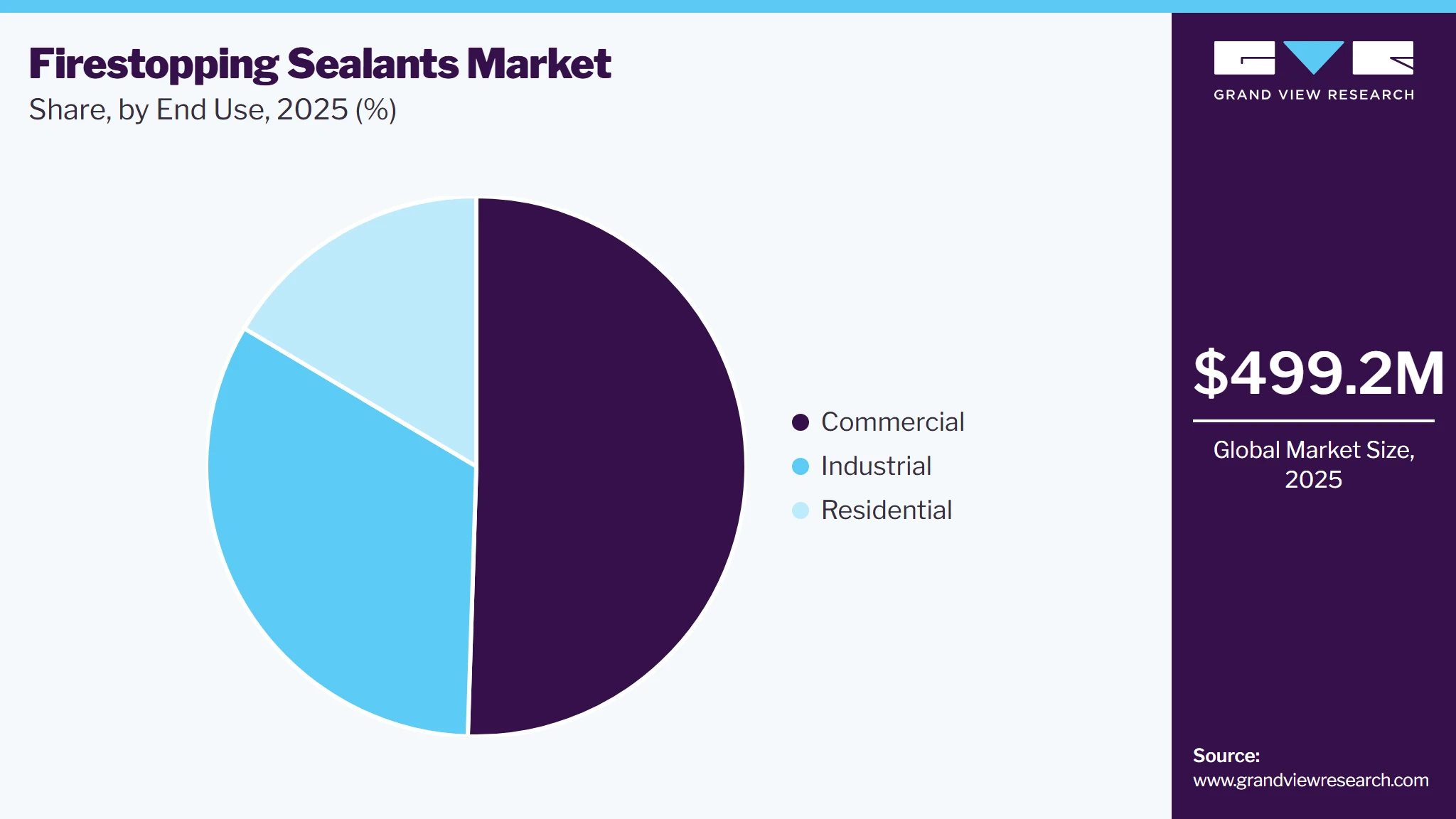
In 2025, the commercial segment held the dominating revenue share of 50.5% and is expected to maintain its leadership position over the forecast period. This growth is driven by the increasing number of infrastructure projects such as office spaces, shopping complexes, educational institutions, and healthcare facilities. Stringent fire safety regulations and rising investments in commercial real estate further contribute to the growing demand for firestopping sealants in this segment. The need to safeguard occupants and critical infrastructure has made firestop solutions essential in commercial buildings.
 To learn more about this report, Download Free Sample Report
The industrial segment is projected to witness significant growth, supported by the expansion of manufacturing facilities, power plants, and data centers. Firestopping sealants play a crucial role in ensuring safety and preventing fire-related incidents in industrial environments where high-risk operations are common. Increasing investment in industrial infrastructure and a growing focus on workplace safety are key drivers for this segment's expansion.
Regional Insights
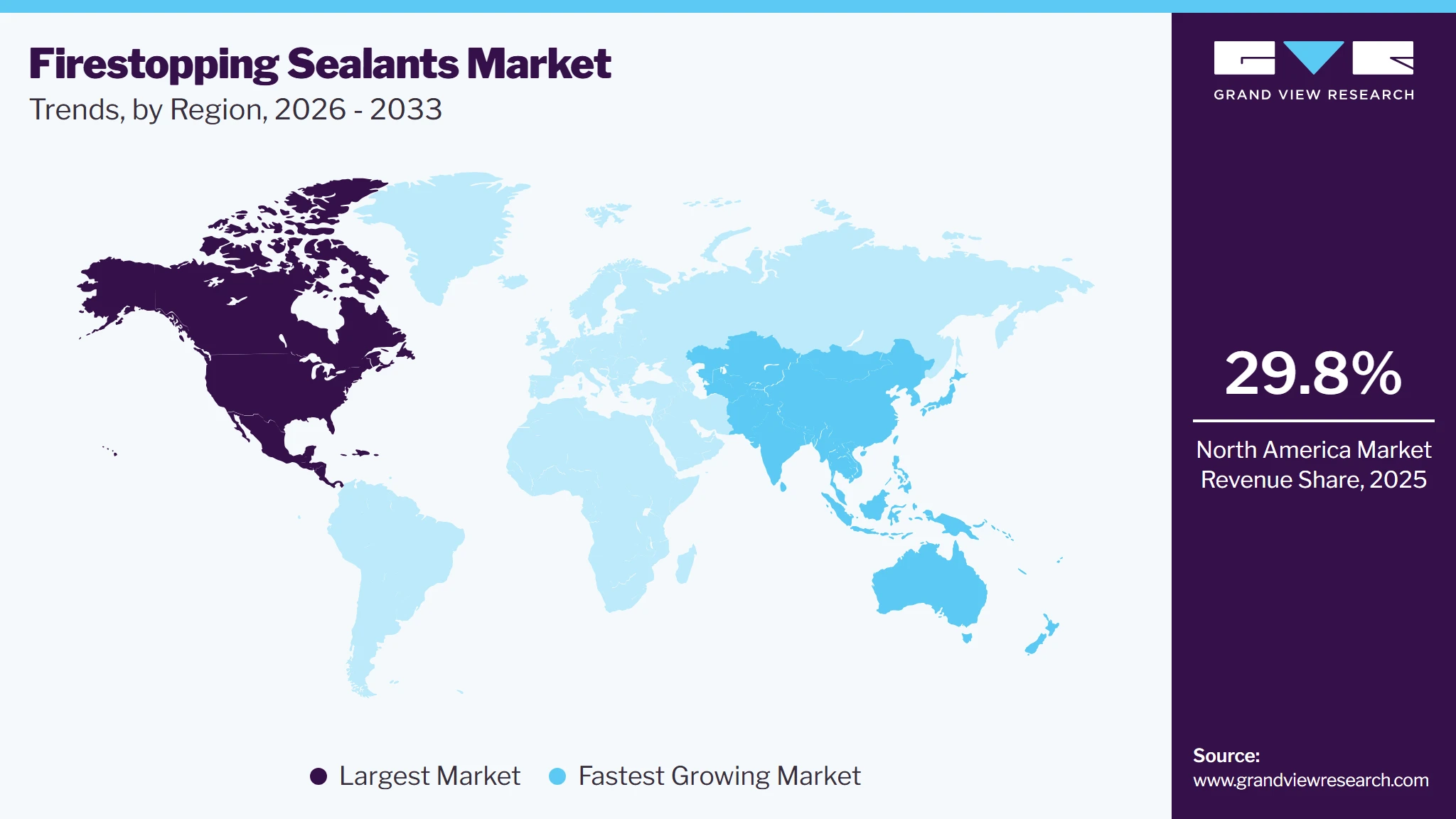
North America dominated the firestopping sealants market with the dominating revenue share of 29.8% in 2025, driven by the stringent implementation of building safety regulations and increasing construction activities across residential, commercial, and industrial sectors. The U.S. plays a significant role in this growth, attributed to its robust construction industry and high adoption of advanced fire protection solutions. The region’s well-established infrastructure and growing focus on workplace and residential safety further boost the demand for firestop sealants.
 To learn more about this report, Download Free Sample Report
U.S. Firestopping Sealants Market Trends
The U.S. accounted for 83.4% of the North American firestopping sealants market in 2025. The rapid expansion of commercial real estate and industrial facilities is driving the adoption of firestopping solutions. The presence of leading construction companies and ongoing investment in infrastructure development strengthens the region’s position as a key market for firestop sealants.
Asia Pacific Firestopping Sealants Market
The firestopping sealants market in Asia Pacific is expected to grow at the fastest CAGR during the forecast period. The firestopping sealants market in Asia Pacific is experiencing significant growth due to increasing construction activities and rising awareness of fire safety in countries such as China, India, and Japan. The region’s expanding pharmaceutical, manufacturing, and residential sectors are key contributors to the growing demand for firestop sealants. As countries in the Asia Pacific continue to invest in infrastructure development, the adoption of advanced fire protection materials is expected to rise steadily over the forecast period.
Europe Firestopping Sealants Market Trends
The firestopping sealants market in Europe is expected to grow at the fastest CAGR during the forecast period, driven by strict building regulations and the rising adoption of sustainable construction practices. The region's focus on improving fire safety in both new and existing buildings is fueling the demand for firestopping sealants. In response to this growing demand, manufacturers are expanding their production capacities and developing eco-friendly fire protection solutions.
Latin America Firestopping Sealants Market Trends
The firestopping sealants market in Latin America is expected to grow at a steady CAGR over the forecast period. The increasing demand for fire protection solutions in the personal care and cosmetics, agrochemicals, and pharmaceuticals industries is positively influencing market growth. Countries such as Brazil, Colombia, and Mexico are seeing rising construction activities, which is driving the adoption of firestop sealants in both residential and commercial buildings. The presence of local production facilities is also contributing to the growth of this regional market.
Middle East & Africa Firestopping Sealants Market Trends
The firestopping sealants market in the Middle East and Africa region is poised for steady growth, driven by increasing construction activities and the rising demand for fire protection solutions in residential and commercial sectors. Growing investments in infrastructure projects, particularly in countries such as the UAE, Saudi Arabia, and South Africa, are creating new opportunities for the firestopping sealants market. The region’s growing awareness of fire safety standards and the adoption of advanced fire protection materials are expected to further support market growth.
Key Firestopping Sealants Company Insights
Some of the key players operating in the global firestopping sealants industry include 3M Company, Hilti Group, Sika AG, and BASF SE. These companies focus on expanding their product portfolios, strategic collaborations, and innovation to strengthen their market presence and gain a competitive edge.
-
3M Company is a global leader in industrial, consumer, and healthcare products. In the firestopping sealants market, 3M offers a range of high-performance fire protection solutions for residential, commercial, and industrial sectors. The company continues to invest in research and development to create innovative, sustainable solutions.
-
Hilti Group specializes in construction technologies, offering a wide range of firestop solutions designed for easy End Use and long-term reliability. Its Firestop Documentation Manager provides digital integration for fire protection compliance, enhancing project efficiency and safety management.
Key Firestopping Sealants Companies:
The following key companies have been profiled for this study on the firestopping sealants market.
- 3M Company
- Hilti Group
- Sika AG
- BASF SE
- Fosroc, Inc.
- H.B. Fuller Company
- Tremco Incorporated
- RPM International Inc.
- Promat International
- Specified Technologies Inc. (STI)
- Pecora Corporation
- Nelson Firestop (Emerson Electric Co.)
Competitive Benchmarking
Category
Operating Strategies
Competitive Edge
Weakness
Established Players (3M Company, Hilti Group, Sika AG, BASF SE, H.B. Fuller Company, Tremco Incorporated, RPM International Inc., Promat International, Specified Technologies Inc. (STI), Nelson Firestop (Emerson Electric Co.)
- Expanding certified fire protection product portfolios to meet evolving global building safety standards.
- Strengthening relationships with contractors and construction firms for large-scale infrastructure project adoption.
- Strong global presence enables participation in high-value infrastructure and commercial construction projects.
- Advanced R&D capabilities support development of high-performance, certified firestopping solutions.
- High compliance and certification requirements increase product development timelines and costs.
- Dependence on construction cycle fluctuations impacts demand stability across regions.
Emerging Players (Fosroc, Inc., Pecora Corporation)
- Focusing on regional construction markets and specialized fire protection product offerings.
- Expanding distributor networks to improve accessibility in mid-sized infrastructure projects.
- Strong application expertise in construction chemicals supports targeted firestop solutions.
- Flexible operations enable faster adaptation to regional building code requirements.
- Limited global footprint restricts access to large multinational infrastructure projects.
- Lower scale of operations reduces competitiveness against global construction chemical leaders.
Recent Developments
-
In October 2024, FSi Promat launched an updated version of its High-Performance Elastomer (HPE) sealant, designed to contribute to healthier work environments. The new formulation of the HPE sealant incorporates advanced materials and technology to offer improved air quality and reduce harmful emissions, addressing growing concerns about workplace safety and employee well-being. This updated sealant provides superior fire resistance while ensuring compliance with the latest environmental standards, helping to create safer and more sustainable building conditions.
-
In September 2023, Nullifire, a manufacturer in the fire protection sector, launched a new sealant solution specifically designed for CPVC (Chlorinated Polyvinyl Chloride) materials. This innovative product aims to address the unique challenges faced by CPVC piping systems in fire safety End Uses. By offering superior fire resistance and enhanced sealing capabilities, the new sealant ensures that CPVC joints and penetrations maintain their integrity during a fire, preventing the spread of flames and smoke.
Firestopping Sealants Market Report Scope
Report Attribute
Details
Market size in 2025
USD 499.2 million
Estimated market size in 2026
USD 538.8 million
Projected market size by 2033
USD 928.9 million
Growth rate
CAGR of 8.1% from 2026 to 2033
Base year for estimation
2025
Historical data
2021 - 2024
Forecast period
2026 - 2033
Quantitative units
Revenue in USD million/billion, Volume in Kilotons and CAGR from 2026 to 2033
Report coverage
Revenue forecast, company ranking, competitive landscape, growth factors, and trends
Segments covered
Type, product, end-use, region
Regional scope
North America; Europe; Asia Pacific; Latin America; MEA
Country scope
U.S.; Canada; Mexico; Germany; UK; France; China; Japan; India; South Korea; Brazil; Argentina; South Africa; Saudi Arabia
Key companies profiled
3M Company; Hilti Group; Sika AG; BASF SE; Fosroc, Inc.; H.B. Fuller Company; Tremco Incorporated; RPM International Inc.; Promat International; Specified Technologies, Inc. (STI); Pecora Corporation; and Nelson Firestop (Emerson Electric Co.).
Customization scope
Free report customization (equivalent up to 8 analysts' working days) with purchase. Addition or alteration to country, regional & segment scope.
Pricing and purchase options
Avail customized purchase options to meet your exact research needs. Explore purchase options
Global Firestopping Sealants Market Report Segmentation
This report forecasts revenue and volume growth at global, regional, and country levels and provides an analysis of the latest industry trends in each of the sub-segments from 2021 to 2033. For this study, Grand View Research has segmented the global firestopping sealants market report based on the type, product, end use, and region.
 To learn more about this report, Download Free Sample Report
-
Type Outlook (Revenue, USD Million, 2021 - 2033)
-
Elastomeric
-
Intumescent
-
-
Product Outlook (Revenue, USD Million, 2021 - 2033)
-
Silicone
-
Acrylic
-
Others (Polyurethane, etc.)
-
-
End Use Outlook (Revenue, USD Million, 2021 - 2033)
-
Residential
-
Commercial
-
Industrial
-
-
Regional Outlook (Revenue, USD Million, 2021 - 2033)
-
North America
-
U.S.
-
Canada
-
Mexico
-
-
Europe
-
Germany
-
UK
-
France
-
-
Asia Pacific
-
China
-
India
-
Japan
-
-
Latin America
-
Brazil
-
Argentina
-
-
Middle East & Africa
-
Saudi Arabia
-
South Africa
-
-
Research Methodology
The firestopping sealants market figures in this report are based on a proven research process that combines executive interviews with secondary research from proprietary databases, company filings, and recognized regulatory and institutional sources. Market size is built through value-chain sizing - reconciling supply-side and demand-side estimates - and triangulated with bottom-up and top-down approaches. Every estimate passes multiple levels of expert validation before publication, with each firestopping sealants segment quantified using the revenue-capture definitions in the table below.
Segment Definition
Segment - Type
Revenue capture definition
Elastomeric
Revenue is generated through the sale of flexible firestopping sealants designed to maintain fire resistance while accommodating structural movement, vibration, and thermal expansion in walls, floors, and building penetrations.
Intumescent
As the dominant type segment, revenue is captured through sealants that expand significantly under fire exposure, sealing openings around cables, pipes, and joints to prevent the spread of flames, smoke, and hot gases.
Segment - Product
Revenue capture definition
Silicone
As the leading product segment, revenue is generated through silicone-based firestopping sealants utilized in high-performance construction applications requiring durability, flexibility, weather resistance, and long-term fire protection performance.
Acrylic
Revenue is supported by acrylic-based firestopping sealants used in interior construction applications where cost-effective fire protection, ease of application, and compatibility with building materials are important requirements.
Others (Polyurethane, etc.)
This segment captures revenue from specialty firestopping sealant formulations designed for niche applications requiring enhanced adhesion, chemical resistance, flexibility, or project-specific fire protection performance.
Segment - End Use
Revenue capture definition
Residential
Revenue is generated through the installation of firestopping sealants in residential buildings to maintain fire-rated barriers around service penetrations, joints, and openings in compliance with building safety standards.
Commercial
As the dominant end-use segment, revenue is captured through large-scale deployment of firestopping sealants across offices, hospitals, educational institutions, airports, retail facilities, and other commercial structures requiring stringent fire safety compliance.
Industrial
Revenue is supported by the use of firestopping sealants in manufacturing plants, warehouses, power facilities, and processing units where fire containment systems are critical for operational safety and regulatory compliance.
Estimation Model
Layer Name
Key Question
Description
Construction Stock Layer
What forms the addressable base?
Identify global residential, commercial, and industrial building stock requiring passive fire protection systems across new construction and renovation projects.
Fire Protection Adoption Layer
Where are firestopping sealants utilized?
Estimate the proportion of buildings implementing fire-rated compartmentalization systems, penetration sealing solutions, and code-compliant passive fire protection measures.
Installation Intensity Layer
How much product is consumed?
Analyze sealant consumption based on building size, penetration density, joint requirements, renovation frequency, and fire safety specifications across end-use sectors.
Revenue Layer
How is market revenue generated?
Revenue is generated through the sale of intumescent, elastomeric, silicone-based, acrylic-based, and specialty firestopping sealants supplied to contractors, builders, infrastructure developers, and fire protection system installers worldwide.
Delivered Customizations
This report has been delivered with the following In-depth customizations
Client Request
Customization Delivered
Value Adds
Regional Segmentation
The study delivers additional country-level insights covering UAE, Singapore, and Australia, etc., highlighting firestopping sealants demand across commercial construction, infrastructure development, industrial facilities, and passive fire protection applications..
Enables stakeholders to identify high-growth construction markets, assess country-specific fire safety adoption trends, and develop targeted expansion strategies across infrastructure-intensive economies.
Cross-Segmentation Analysis
The study delivers detailed cross-segmentation analysis evaluating firestopping sealants demand across application types and product formulations, highlighting usage patterns in commercial buildings, industrial facilities, and infrastructure projects.
Helps companies identify high-value application-product combinations, optimize portfolio strategies, and strengthen positioning across diversified construction and safety segments.
Opportunity Assessment
The study delivers assessment of emerging opportunities across data center construction, smart infrastructure development, industrial safety upgrades, and retrofitting projects requiring advanced fire protection systems.
Supports strategic planning by identifying high-growth application areas, evaluating infrastructure-driven demand, and aligning product development with evolving global fire safety standards.
Frequently Asked Questions About This Report
Based on type, the intumescent segment led the market with the largest revenue share of 70.0% in 2025 and is expected to maintain its dominance throughout the forecast period.
The silicone segment led the market with the highest revenue share of 61.3% in 2025, due to its excellent flexibility, durability, and resistance to moisture and temperature fluctuations in fire-rated assemblies.
The global firestopping sealants market is expected to grow at a CAGR of 8.1% from 2026 to 2033, reaching USD 928.9 million in 2033.
North America dominated with a 29.8% revenue share in 2025.
Key factors include rising implementation of stringent building safety codes and the growing awareness of fire protection measures are driving firestopping sealants market expansion.
The commercial segment dominated the firestopping sealants market in 2025, accounting for 50.5% of market revenue, driven by stringent building safety regulations and increasing adoption of passive fire protection systems in commercial infrastructure.
The global firestopping sealants market size was valued at USD 499.2 million in 2025 and is estimated at USD 538.8 million for 2026.
Some key players operating in the firestopping sealants market include 3M Company, Hilti Group, Sika AG, BASF SE, Fosroc, Inc., H.B. Fuller Company, Tremco Incorporated, RPM International Inc., Promat International, Specified Technologies Inc. (STI), Pecora Corporation, and Nelson Firestop (Emerson Electric Co.).
Asia Pacific is the fastest-growing region over the forecast period.
About the Author(s)
Specialty Polymers Research Team
Specialty & Chemicals · Specialty PolymersThis report was authored by the specialty polymers research team at Grand View Research - comprising two research analysts, one senior research analyst, and one industry expert - with specialized expertise in the specialty polymers segment of the specialty & chemicals industry. All findings are based on proprietary specialty & chemicals databases, executive interviews, and regulatory analysis, subject to internal peer review prior to publication.
Last Updated:
Speak to Analyst

Customize this report to your needs - add regions, segments, or data points, with 20% free customization.
Or view our licence options:


ISO 9001:2015 & 27001:2022 Certified
We are GDPR and CCPA compliant! Your transaction & personal information is safe and secure. For more details, please read our privacy policy.


