
- Home
- »
- Advanced Interior Materials
- »
-
Flame-Retardant Fiber Market Size & Share Report, 2033GVR Report cover

Flame-Retardant Fiber Market (2026 - 2033)
Size, Share & Trends Analysis Report By Fiber Type (Aramid, Modacrylic, Flame-retardant Polyester), By Application (Protective Apparel, Home Textiles, Transportation Textiles, Industrial Textiles), By Region, And Segment Forecasts
Market Size, 2025
$5.5BMarket Estimate, 2026
$5.7BMarket Forecast, 2033
$8.2BCAGR, 2026–2033
5.4%Flame-retardant Market Summary
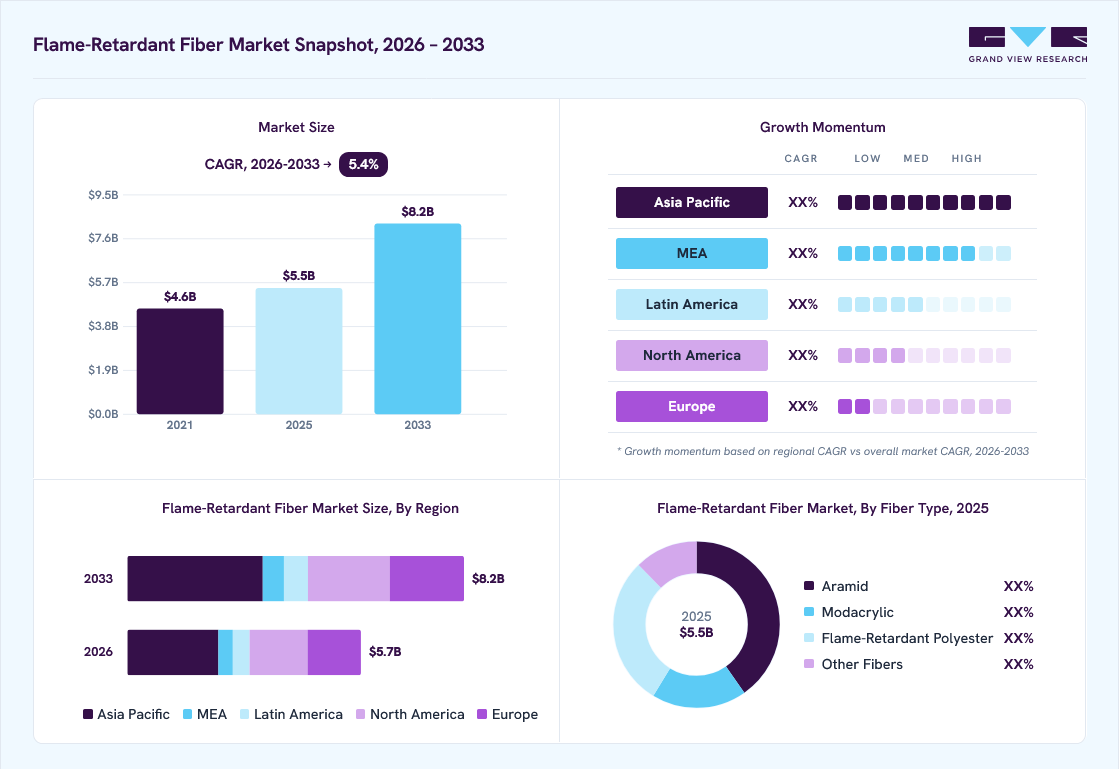
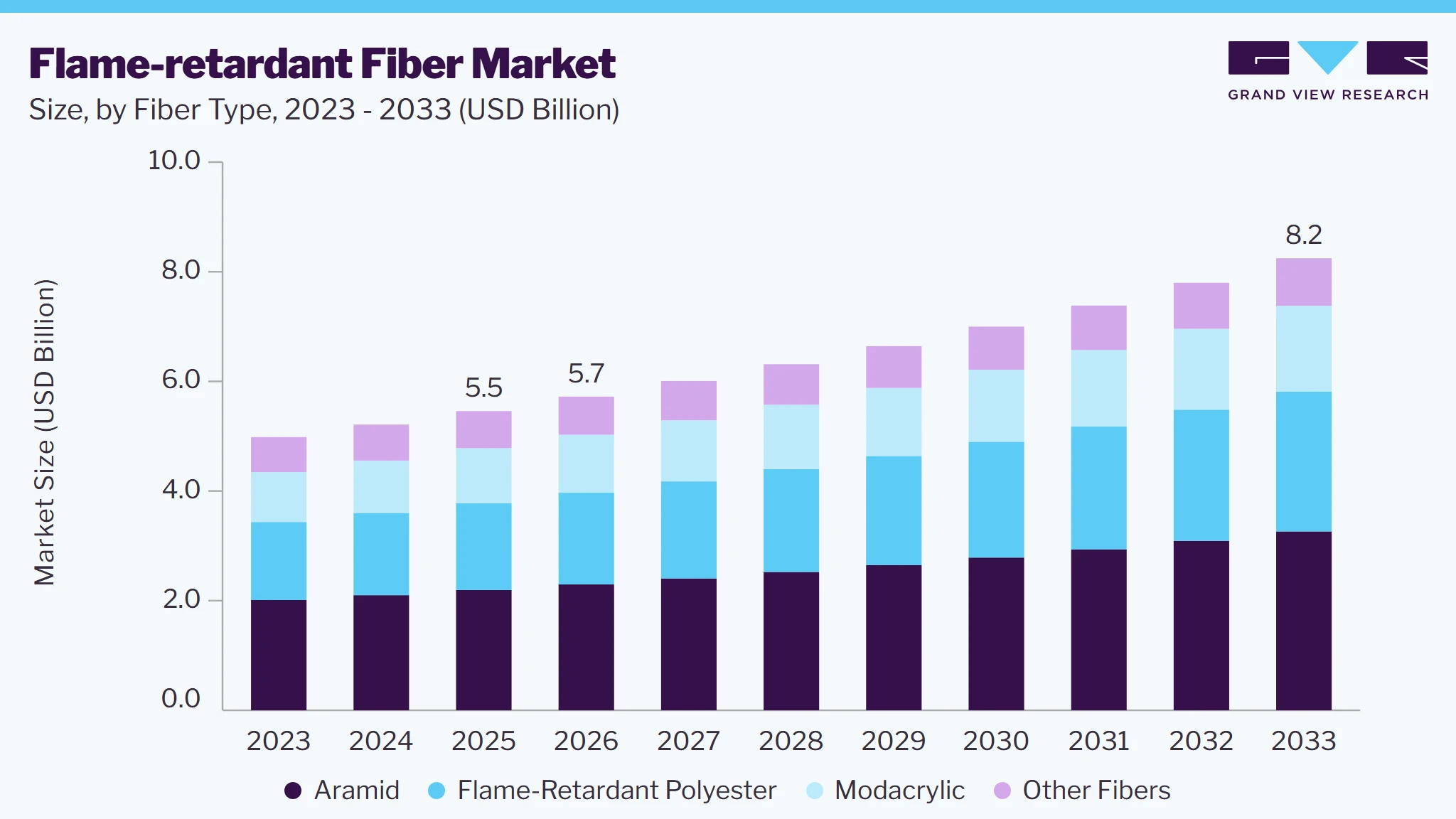
The global flame-retardant fiber market size was valued at USD 5.5 billion in 2025 and is projected to grow from USD 5.7 billion in 2026 to USD 8.2 billion by 2033, at a CAGR of 5.4% from 2026 to 2033. Asia Pacific dominated the market, accounting for the largest revenue share of 38.8% in 2025. The global flame-retardant fiber market is supported by rising demand for fibers that provide inherent or durable flame resistance across protective clothing, industrial textiles, transportation interiors, home furnishings, mattresses, and other applications where fire safety is a critical performance requirement.
 Source: Grand View Research, IR Documents, Primary Interviews, Paid DatabasesTo learn more about this report,
 Download Free Sample Report
Key Market Trends & Insights
- By fiber type: Flame-retardant polyester segment is expected to grow at a CAGR of 6.2% over the forecast period.
- By application: Protective apparel segment dominated the market with a revenue share of 44.0% in 2025.
Regional Highlights
- Largest regional market: Asia Pacific (38.8% revenue share, 2025)
- By country: China held the largest share of Asia Pacific in 2025.
Market Size & Forecast
- Market size in 2025: USD 5.5 Billion
- Estimated market size in 2026: USD 5.7 Billion
- Projected market size by 2033: USD 8.2 Billion
- CAGR (2026-2033): 5.4%
GVR research-powered AIAsk Prism AI about the Flame-Retardant fiber marketGet cited answers from GVR research on market growth, segments, regulations and forecasts.Start with✓ Source-linked answers ✓ Market-specific context ✓ Traceable figuresExplore Prism AI ↗Demand is particularly strong in industries such as oil & gas, chemicals, utilities, manufacturing, firefighting, defense, transportation, and construction, where exposure to heat, flame, electrical arcs, or molten materials creates stringent material requirements. Flame-retardant fibers include aramid, modacrylic, flame-retardant polyester, flame-retardant viscose, and other specialty fibers designed to limit ignition, flame spread, melting, or dripping.
 To learn more about this report, Download Free Sample Report
Market growth is being supported by increasing adoption of protective workwear and technical textiles as industrial safety requirements become more stringent. Inherently flame-retardant fibers are gaining importance because their flame-resistant characteristics are incorporated into the fiber structure rather than relying solely on surface treatments, supporting durability through repeated use and laundering.
Product development is increasingly focused on balancing flame resistance with comfort, mechanical strength, weight, moisture management, chemical resistance, and processability. Fiber manufacturers are therefore developing specialty grades and blended fiber systems for application-specific performance requirements. Modacrylic fibers are used where flame resistance needs to be combined with softness and dyeability, while aramid fibers remain important for applications requiring high thermal stability and mechanical performance. Sustainability is also emerging as a development area, with research increasingly focusing on recyclable flame-retardant fibers and composite systems.
Market Dynamics
The flame-retardant fiber market is influenced by the increasing need for reliable thermal and flame protection, evolving workplace safety requirements, demand for higher-performance protective textiles, material-cost considerations, and the transition toward more sustainable fiber technologies. Demand differs substantially by application because protective apparel, transportation interiors, home textiles, and industrial materials have different requirements regarding flame spread, thermal protection, comfort, durability, and certification.
Increasing workplace safety requirements across oil & gas, petrochemicals, utilities, manufacturing, metal processing, firefighting, and other high-risk industries are driving the use of flame-retardant fibers in protective garments. End users increasingly require materials that can provide reliable protection against flash fire, heat, flame, and electrical hazards while maintaining comfort and durability during repeated use. Standards such as ISO 11612 establish performance requirements for protective clothing intended to protect against heat and flame, reinforcing the need for appropriately engineered fiber and textile systems.
The shift toward inherently flame-retardant fibers is also driving market demand, as manufacturers and end users seek protection that remains effective throughout the garment's useful life. Aramid, modacrylic, PBI, and other specialty fibers can provide inherent flame resistance, while blended constructions allow manufacturers to balance protection with strength, softness, moisture management, and cost. Kaneka's Protex portfolio, for example, is designed to provide inherent flame retardancy and compatibility with multiple conventional and specialty fibers.
The relatively high cost of high-performance flame-retardant fibers can constrain adoption, particularly in price-sensitive textile and industrial applications. Aramid, PBI, and other specialty fibers require specialized polymer chemistry, spinning technologies, processing capabilities, and quality controls, resulting in higher material costs than conventional commodity fibers. This encourages textile producers to use blended constructions or lower-cost flame-retardant polyester, viscose, cotton, and modacrylic alternatives where application requirements permit.
Sustainability presents an opportunity for manufacturers to develop flame-retardant fibers and fiber systems that reduce environmental impact without compromising safety performance. Research is expanding toward recyclable polymers, bio-based feedstocks, recycled fiber content, and closed-loop material systems. Recent research has demonstrated closed-loop recyclable flame-retardant aramid composite systems, indicating potential for future material solutions that combine thermal protection with improved end-of-life recovery.
Market Concentration & Characteristics
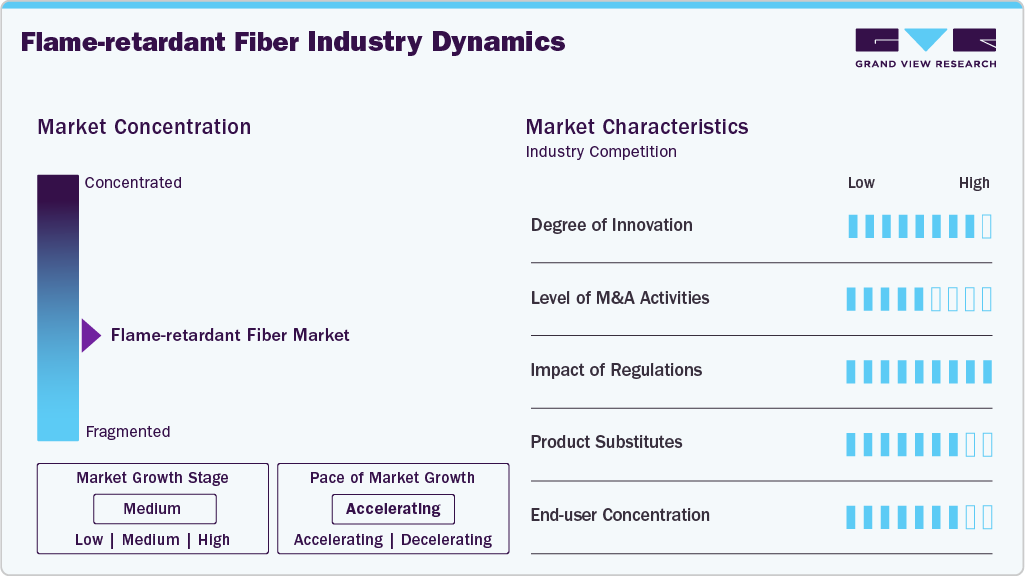
The flame-retardant fiber market is moderately concentrated, with established specialty-fiber manufacturers holding strong positions in high-performance segments such as aramid, modacrylic, PBI, and flame-retardant regenerated fibers, while regional and specialized producers compete in flame-retardant acrylic, polyester, and other cost-sensitive categories. Companies with proprietary fiber technologies, established certification capabilities, global production networks, and long-term relationships with protective-textile manufacturers maintain stronger competitive positions, whereas lower-cost producers participate more actively in standardized fiber categories.
 To learn more about this report, Download Free Sample Report
Substitution occurs primarily between different flame-resistant fiber systems rather than through a single alternative material. Aramid can be substituted by modacrylic, PBI, flame-retardant viscose, FR polyester, or treated cotton depending on the required level of thermal protection, comfort, durability, and cost. Conventional fibers treated with durable flame-retardant finishes can also compete with inherently flame-retardant fibers in selected applications, while blended systems are increasingly used to combine the characteristics of multiple materials. The degree of substitution is therefore highly application-specific and constrained by certification, performance specifications, and end-user safety requirements.
Analyst Perspective
The flame-retardant fiber market is evolving toward higher-performance, inherently flame-resistant, lightweight, and multifunctional fiber solutions, driven by increasing safety requirements across protective apparel, transportation, industrial textiles, and home-textile applications. Manufacturers are focusing on improving the balance between flame resistance, thermal stability, comfort, durability, and cost while also developing recycled, bio-based, and lower-impact fiber solutions. Competitive differentiation is increasingly shaped by proprietary fiber technologies, application-specific product development, certification capabilities, manufacturing capacity, and the ability to provide customized fiber blends for demanding end uses.
Fiber Type Insights
The aramid segment held the highest revenue share of 40.2% in 2025, supported by its strong combination of inherent flame resistance, high thermal stability, strength, and durability. Aramid fibers are widely used in protective apparel for firefighters, military personnel, and industrial workers, as well as in electrical applications, where reliable protection against heat and flame is critical. Their established adoption in high-performance protective textiles, stringent safety requirements, and ability to maintain performance under demanding conditions continue to support the segment’s leading position.
The flame-retardant polyester segment is expected to grow at a CAGR of 6.2% over the forecast period, driven by its cost advantages, durability, ease of processing, and broad applicability across protective apparel, transportation textiles, home furnishings, and industrial textiles. Increasing demand for permanently flame-retardant polyester fibers in transportation interiors, contract furnishings, and technical textiles is encouraging manufacturers to develop recycled-content, lightweight, and improved-performance FR polyester solutions, expanding their use across applications where high-performance aramid fibers may not be required.
Application Insights
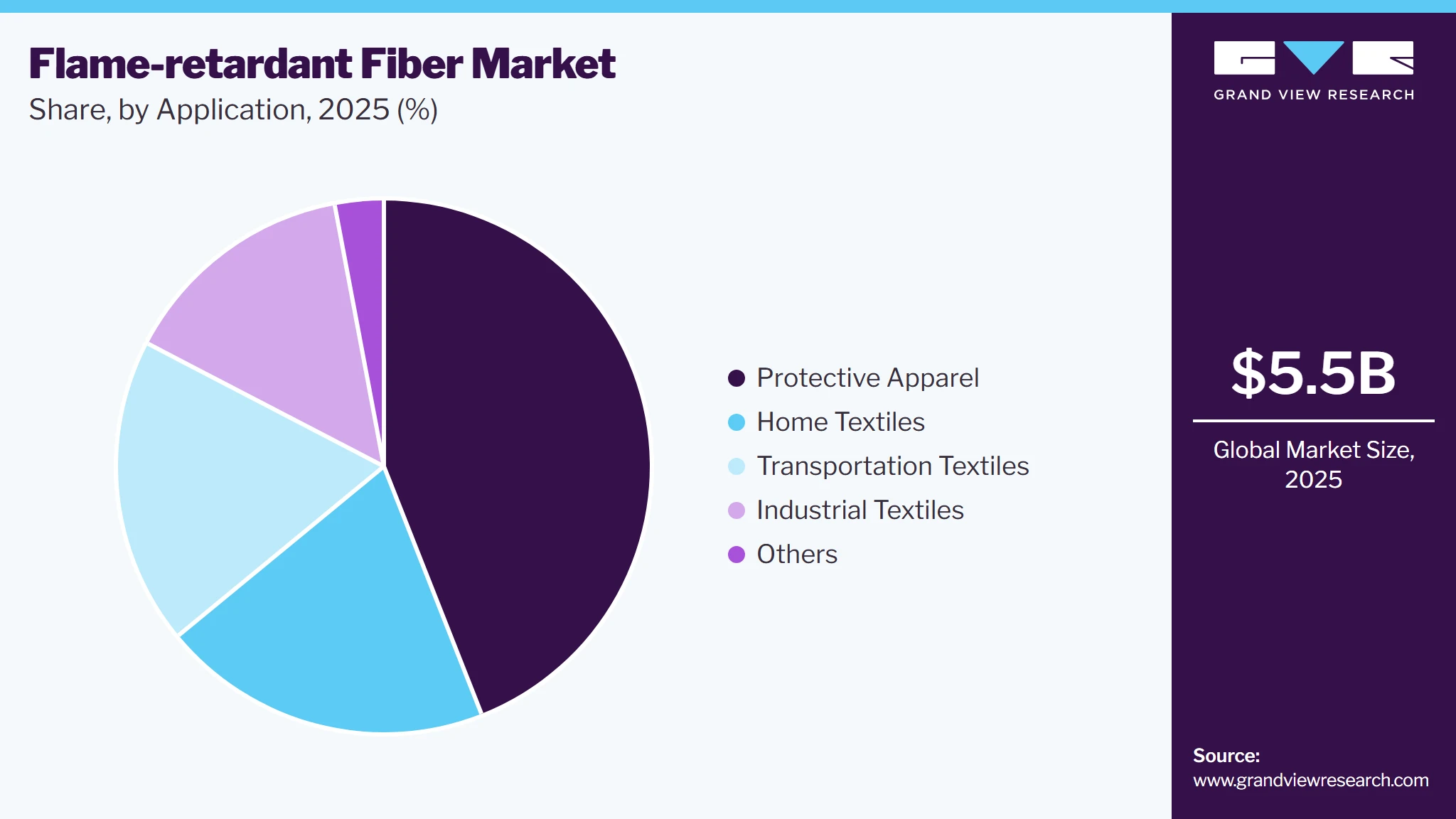
The protective apparel segment held the highest revenue market share of 44.0% in 2025, driven by widespread use of flame-retardant fibers in firefighting clothing, industrial workwear, oil & gas garments, electrical protective clothing, military apparel, and other occupational safety applications. Growing emphasis on worker protection, increasing exposure to thermal and flame hazards, and demand for garments combining protection with comfort and durability continue to support the consumption of flame-retardant fibers in protective apparel.
 To learn more about this report, Download Free Sample Report
The transportation textiles segment is expected to grow at a CAGR of 6.2% over the forecast period, supported by increasing use of flame-retardant fibers in automotive interiors, aircraft cabins, railway seating, marine interiors, carpets, curtains, and other components where fire safety is essential. Growth in vehicle production, increasing adoption of lightweight interior materials, and stringent fire-performance requirements are encouraging transportation manufacturers to incorporate advanced flame-retardant fibers that provide fire resistance while maintaining low weight, durability, and design flexibility.
Regional Insights
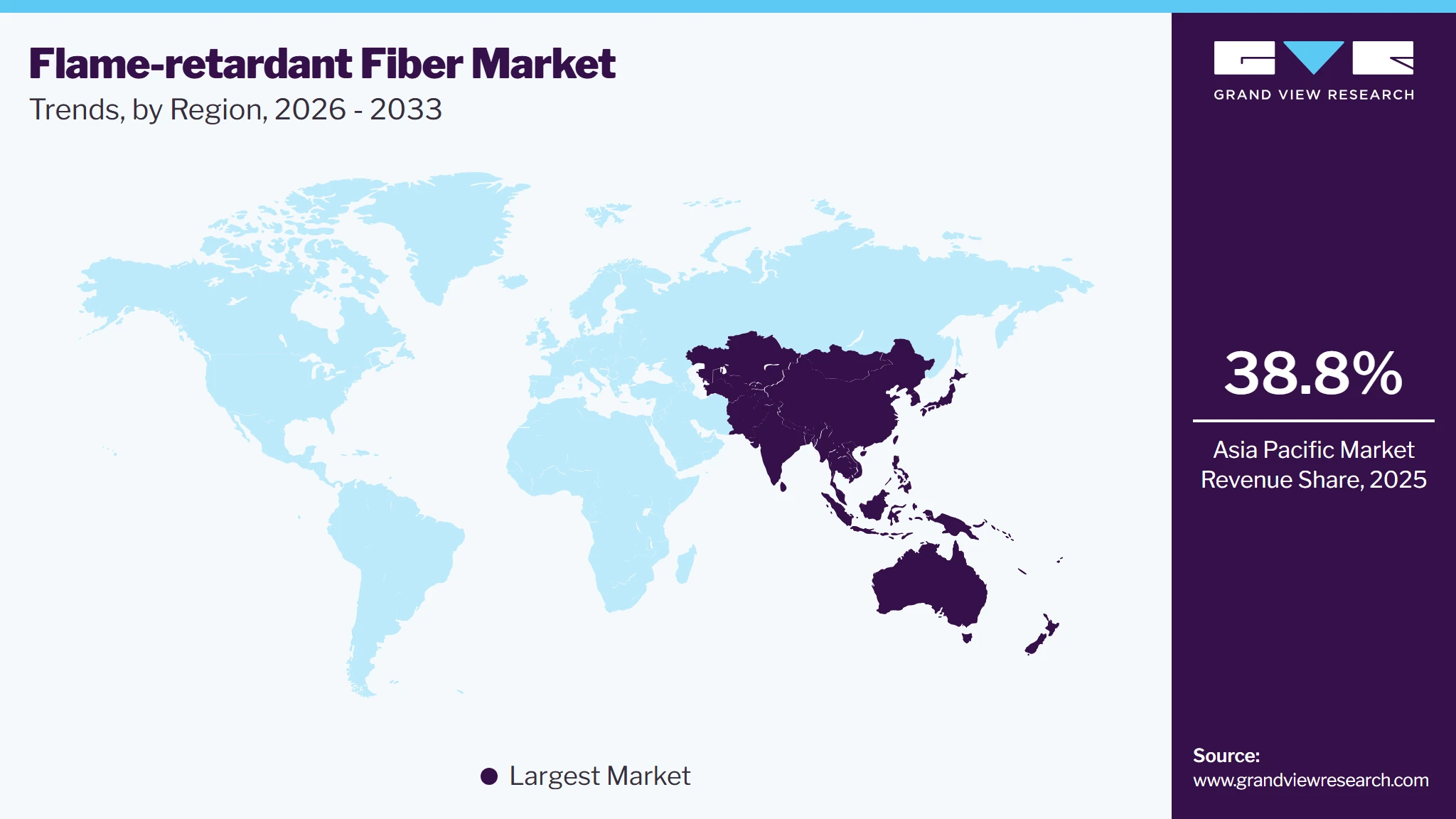
Asia Pacific dominated the global flame-retardant fiber market and accounted for the largest revenue share of 38.8% in 2025, as it is characterized by a combination of large-scale textile manufacturing, rapid industrialization, expanding transportation production, and increasing adoption of technical textiles. China, India, Japan, and South Korea represent distinct demand centers, with the region increasingly shifting from conventional treated fabrics toward inherently flame-retardant fiber systems for applications requiring longer-lasting protection.
 To learn more about this report, Download Free Sample Report
India is emerging as a particularly important growth market as domestic technical-textile manufacturing, defense production, infrastructure investment, and industrial safety programs expand. Japan and South Korea are more oriented toward high-performance fiber development and technologically advanced protective materials, while Southeast Asian countries are gaining importance as textile and garment manufacturing locations.
China Flame-Retardant Fiber Market Trends
China's flame-retardant fiber market is strongly linked to its large textile-processing ecosystem, transportation manufacturing, construction activity, and defense-related textile demand. A notable market trend is the gradual movement toward inherent flame-retardant fibers, which are expected to gain adoption where durability and repeated-use performance are important.
China also benefits from an extensive domestic manufacturing base capable of producing and processing polyester, acrylic, modacrylic, and other specialty fibers at scale. The country's large home-textile and industrial-textile industries create demand beyond protective apparel, particularly in applications where fire performance is incorporated into finished textile products.
North America Flame-Retardant Fiber Market Trends
North America has a comparatively specification-driven flame-retardant fiber market, with demand strongly influenced by electrical utilities, oil & gas, petrochemicals, firefighting, defense, and industrial safety applications. The region is seeing greater emphasis on fiber systems that combine flame protection with moisture management, durability, lightweight construction, and comfort. Another emerging trend is the development of alternative flame-retardant chemistries and reformulation of textile finishes in response to environmental and chemical-compliance requirements. Technical buyers and safety functions are increasingly involved in material selection, resulting in greater emphasis on certified performance and lifecycle durability rather than simply the lowest fiber cost.
U.S. Flame-Retardant Fiber Market Trends
The U.S. market is particularly differentiated by the strong role of electrical utilities and energy-sector protective apparel, in addition to oil & gas, firefighting, defense, and industrial applications. Demand for flame-retardant fibers is increasingly connected with arc-flash protection, thermal hazards, and high-performance workwear, creating opportunities for aramid, modacrylic, and engineered fiber blends. The market is also moving toward lighter and more breathable protective garments to improve worker comfort without compromising thermal protection.
Europe Flame-Retardant Fiber Market Trends
Europe's flame-retardant fiber market is distinguished by its strong focus on sustainability, chemical compliance, product traceability, and high-performance technical textiles. European fiber and textile manufacturers are increasingly evaluating recycled and bio-based feedstocks, lower-impact processing methods, and fiber systems compatible with circular-economy objectives. At the same time, demand remains strong for certified flame-resistant materials used in transportation, industrial workwear, construction, and public infrastructure.
The Germany flame-retardant fiber market is witnessing growth. The country has a more engineering- and transportation-oriented flame-retardant fiber market, supported by automotive manufacturing, rail transportation, electrical equipment, machinery, and industrial technical textiles. Flame-retardant fibers are increasingly incorporated into lightweight interior materials and technical textile structures where fire performance must be achieved without substantially increasing component weight. The country's advanced automotive and industrial supply chains also encourage development of application-specific fiber blends and high-performance materials rather than reliance on commodity flame-retardant fibers.
Central and South America Flame-Retardant Fiber Market Trends
Central & South America has a more resource-industry-driven flame-retardant fiber demand profile, with Brazil and Mexico representing important markets. Brazil's offshore oil production, mining, steel, and industrial manufacturing sectors generate demand for flame-resistant workwear, while Mexico's oil & gas, refining, manufacturing, and industrial activities support similar applications. The regional trend is toward greater adoption of certified protective clothing as industrial employers strengthen worker-safety practices.
Middle East & Africa Flame-Retardant Fiber Market Trends
The Middle East & Africa market has a distinctly energy- and climate-driven demand profile. Saudi Arabia, the UAE, and other Gulf markets generate substantial demand from oil & gas, refining, petrochemicals, and large infrastructure projects, where workers require flame-resistant protection under high-temperature operating conditions. A key product trend in the region is the movement toward lightweight, breathable, and inherently flame-resistant materials that can provide protection without excessive heat burden in hot climates. In Africa, demand is more closely associated with mining, oil & gas, construction, and industrial development, with greater emphasis on affordable protective solutions and improved access to certified materials.
Key Flame-Retardant Fiber Company Insights
Some of the key players operating in the market include Teijin Aramid and DuPont
-
Teijin Aramid is a Netherlands-based specialty fiber manufacturer focused on high-performance aramid fibers. Its portfolio includes Teijinconex, Twaron, and Technora, serving flame-resistant protective apparel, industrial, automotive, aerospace, and other demanding applications.
-
DuPont is a U.S.-based technology and materials company with a strong position in high-performance protective fibers through its Nomex brand. Nomex is an inherently flame-resistant meta-aramid fiber used in firefighting, industrial protective clothing, electrical, transportation, and other thermal-protection applications.
PBI Performance Products and Yantai Tayho Advanced Materials are some of the emerging market participants in the flame-retardant fiber market.
-
PBI Performance Products is a U.S.-based specialty fiber manufacturer focused on PBI fiber, an inherently flame- and heat-resistant high-performance fiber. Its materials are primarily used in firefighter protective clothing, industrial protective apparel, and other applications requiring extreme thermal and flame protection.
-
Yantai Tayho Advanced Materials is a China-based manufacturer of high-performance specialty fibers, including Newstar meta-aramid fiber. Its products are used in firefighting clothing, industrial protective workwear, electrical insulation, transportation, and other applications requiring heat and flame resistance.
Key Flame-Retardant Fiber Companies
The following key companies have been profiled for this study on the flame-retardant fiber market.
-
Teijin Aramid
-
DuPont
-
Kaneka Corporation
-
Kermel
-
Lenzing
-
Indorama Ventures
-
Yantai Tayho Advanced Materials
-
PBI Performance Products
-
Huvis
-
Birla Cellulose
Competitive Benchmarking
Category
Operating Strategies
Competitive Edge
Weakness
Established Players: Teijin Aramid, DuPont, Kaneka Corporation, Lenzing, Indorama Ventures
- Invest in inherently flame-resistant aramid, modacrylic, cellulosic, and FR polyester fibers to improve thermal protection, durability, comfort, and application performance.
- Expand production capabilities and product portfolios across protective apparel, transportation, industrial textiles, home textiles, electrical, and other technical applications.
- Develop application-specific fiber grades and strengthen relationships with textile manufacturers, garment producers, transportation companies, and industrial customers.
- Broad fiber portfolios and established manufacturing infrastructure support supply across multiple flame-retardant applications.
- Strong R&D, fiber-engineering expertise, certification capabilities, and customer relationships support adoption in safety-critical applications.
- Global production and distribution networks enable these companies to serve diverse regional markets and large industrial customers.
- High investment requirements for specialized polymer, spinning, processing, and quality-control infrastructure.
- Premium specialty-fiber pricing can restrict adoption in cost-sensitive textile and furnishing applications.
- Strict customer qualification, certification, and performance requirements can lengthen commercialization cycles.
Emerging Players: Kermel, Yantai Tayho Advanced Materials, PBI Performance Products, Huvis, Birla Cellulose
- Focus on specialized flame-retardant fibers for firefighting, industrial workwear, defense, transportation, technical textiles, and other demanding applications.
- Expand market presence through partnerships with textile producers, protective-clothing manufacturers, distributors, and industrial customers.
- Prioritize fiber-level flame resistance, lightweight construction, comfort, sustainability, and application-specific performance to differentiate from broader fiber suppliers.
- Specialized portfolios allow focused development for high-value flame-retardant applications.
- Technical differentiation is supported by inherent flame resistance, thermal stability, lightweight performance, and application-specific fiber characteristics.
- Focused product development can enable faster customization for specific protective-textile requirements.
- Smaller production scale and narrower portfolios compared with the largest global fiber manufacturers.
- Greater exposure to specific applications such as protective apparel can limit diversification.
- Lower manufacturing scale in some product categories can create cost and geographic-coverage disadvantages.
Recent Developments
-
In April 2026, Lenzing introduced Lenzing Solutions for Protective Wear, a three-tier cellulosic portfolio combining LENZING FR, TENCEL Lyocell, and FR-finished solutions. The portfolio addresses inherent, hybrid, and finished flame-resistant textile systems.
-
In January 2026, Indorama Ventures introduced Trevira flame-retardant fibers and filament yarns containing 50% recycled textile material. The recycled material is produced through its collaboration with Jiaren Chemical Recycling.
Flame-Retardant Fiber Market Report Scope
Report Attribute
Details
Market size in 2025
USD 5.5 billion
Estimated market size in 2026
USD 5.7 billion
Projected market size by 2033
USD 8.2 billion
Growth rate
CAGR of 5.4% from 2026 to 2033
Base year for estimation
2025
Actual data
2021 - 2024
Forecast period
2026 - 2033
Quantitative units
Revenue in USD billion, and CAGR from 2026 to 2033
Report coverage
Revenue forecast, company ranking, competitive landscape, growth factors, and trends
Segments covered
Fiber type, application, region
Regional scope
North America; Europe; Asia Pacific; Central & South America; Middle East & Africa
Country scope
U.S.; Canada; Mexico; Germany; UK; France; Italy; Spain; China; Japan; India; South Korea; Brazil; Saudi Arabia
Key companies profiled
Teijin Aramid; DuPont; Kaneka Corporation; Kermel; Lenzing; Indorama Ventures; Yantai Tayho Advanced Materials; PBI Performance Products; Huvis; Birla Cellulose
Customization scope
Free report customization (equivalent up to 8 analysts working days) with purchase. Addition or alteration to country, regional & segment scope.
Pricing and purchase options
Avail customized purchase options to meet your exact research needs. Explore purchase options
Global Flame-Retardant Fiber Market Report Segmentation
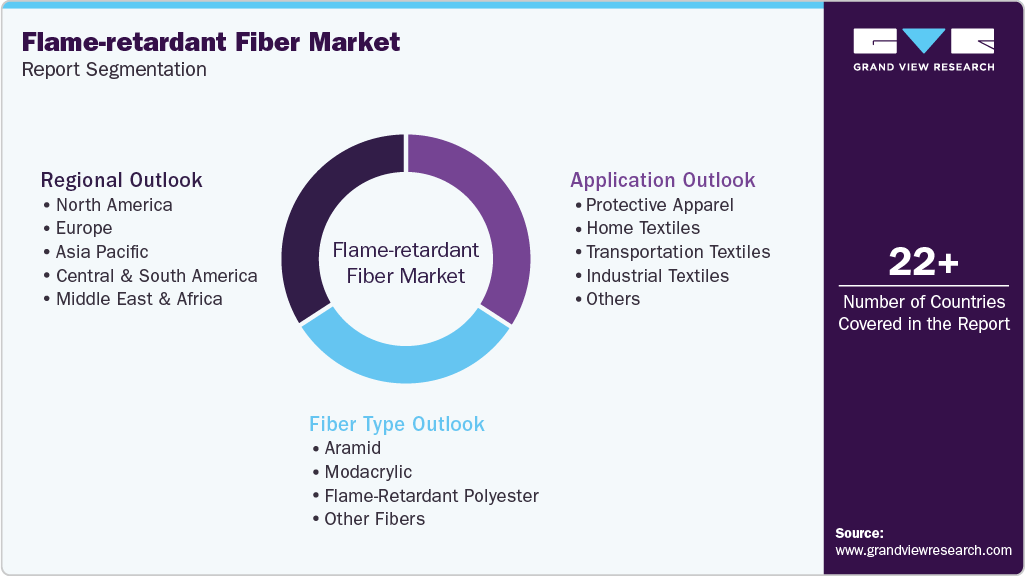
This report forecasts revenue growth at regional & country levels and provides an analysis on the industry trends in each of the sub-segments from 2021 to 2033. For the purpose of this study, Grand View Research has segmented the global flame-retardant fiber market report on the basis of fiber type, application, and region:
 To learn more about this report, Download Free Sample Report
-
Fiber Type Outlook (Revenue, USD Billion, 2021 - 2033)
-
Aramid
-
Modacrylic
-
Flame-Retardant Polyester
-
Other Fibers
-
-
Application Outlook (Revenue, USD Billion, 2021 - 2033)
-
Protective Apparel
-
Home Textiles
-
Transportation Textiles
-
Industrial Textiles
-
Others
-
-
Regional Outlook (Revenue, USD Billion, 2021 - 2033)
-
North America
-
U.S.
-
Canada
-
Mexico
-
-
Europe
-
UK
-
Germany
-
France
-
Italy
-
Spain
-
-
Asia Pacific
-
China
-
Japan
-
India
-
South Korea
-
-
Central and South America
-
Brazil
-
-
Middle East and Africa
-
Saudi Arabia
-
-
Research Methodology
The flame-retardant fiber market figures in this report are based on a proven research process that combines executive interviews with secondary research from proprietary databases, company filings, and recognized regulatory and institutional sources. Market size is built through value-chain sizing-reconciling supply-side and demand-side estimates-and triangulated with bottom-up and top-down approaches. Every estimate passes multiple levels of expert validation before publication, with each flame-retardant fiber segment quantified using the revenue-capture definitions in the table below.
Segment Definition
Fiber Type
Revenue Capture Definition
Aramid
Revenue generated from the sale of aramid flame-retardant fiber used in protective clothing, firefighting apparel, military and defense equipment, industrial workwear, and other applications requiring high strength, heat resistance, flame resistance, and mechanical protection.
Modacrylic
Revenue generated from the sale of modacrylic flame-retardant fiber used in protective apparel, workwear, upholstery, home textiles, transportation textiles, and other applications requiring inherent flame resistance, softness, dimensional stability, and comfort.
Flame-Retardant Polyester
Revenue generated from the sale of flame-retardant polyester fiber used in protective apparel, furnishings, transportation interiors, industrial textiles, home textiles, and other applications requiring flame resistance, durability, ease of processing, and cost-effective performance.
Other Fibers
Revenue generated from the sale of other flame-retardant fiber types, including flame-retardant viscose, acrylic, polyamide, and specialty fibers, used across protective clothing, industrial textiles, transportation, home furnishings, and other applications requiring enhanced resistance to ignition and flame spread.
Application
Revenue Capture Definition
Protective Apparel
Revenue generated from the sale of flame-retardant fibers incorporated into protective clothing, including industrial workwear, firefighting apparel, military and defense clothing, oil and gas workwear, electrical protective clothing, and other garments requiring protection against flame, heat, and thermal hazards.
Home Textiles
Revenue generated from the sale of flame-retardant fibers used in curtains, upholstery, carpets, bedding, mattresses, furniture fabrics, and other residential and commercial home-textile products requiring improved resistance to ignition and flame propagation.
Transportation Textiles
Revenue generated from the sale of flame-retardant fibers used in automotive interiors, aircraft textiles, railway seating and interiors, marine furnishings, carpets, curtains, and other transportation applications requiring flame resistance, low smoke generation, durability, and passenger safety.
Industrial Textiles
Revenue generated from the sale of flame-retardant fibers used in industrial fabrics, filtration materials, conveyor components, insulation systems, protective covers, welding textiles, and other technical textile applications requiring resistance to flame, heat, and demanding operating conditions.
Others
Revenue generated from the sale of flame-retardant fibers used in applications outside protective apparel, home textiles, transportation textiles, and industrial textiles, including construction materials, electrical and electronic components, specialty fabrics, and other applications requiring flame-resistant performance.
Estimation Model
Layer Name
Key Question
Description
Parent Market Analysis
What is the overall size and growth outlook of the global technical textiles, protective textiles, high-performance fibers, and specialty fiber markets?
The estimation begins with the broader technical textiles, protective textiles, high-performance fibers, and specialty fiber markets, assessing production, industrial demand, textile manufacturing, and safety requirements to establish the addressable market for flame-retardant fibers.
Flame-Retardant Fiber Penetration Analysis
What proportion of the broader fiber market is represented by flame-retardant fibers across different fiber types and applications?
This layer estimates penetration across aramid, modacrylic, flame-retardant polyester, and other fibers, considering flame resistance, thermal performance, durability, and application suitability across major end uses.
Regional & Application Demand Assessment
Which regions, fiber types, and applications contribute the highest demand for flame-retardant fibers?
Demand is assessed across major regions based on industrial activity, textile production, safety requirements, transportation manufacturing, and energy-sector activity, with application-level analysis across protective apparel, home textiles, transportation textiles, and industrial textiles.
Company Revenue Validation & Market Forecasting
How is the final market size validated and forecast across fiber types, applications, and regions?
Estimates are validated using company revenues, production capacity, product portfolios, facilities, investments, and product developments, with bottom-up and top-down approaches triangulated across company, fiber type, application, and regional data.
Delivered Customizations
We have successfully delivered the following deep-dive customizations
Client Request
Customization Delivered
Value Adds
Technology & Product Innovation Assessment
Evaluate key technologies and product developments across inherently flame-retardant fibers, modacrylic fibers, FR polyester, aramid fibers, fiber blends, bio-based and recycled flame-retardant fibers, and advanced fiber treatments based on flame resistance, thermal performance, durability, comfort, weight, and commercial adoption.
Identifies emerging technologies, product innovation trends, technology gaps, and opportunities for higher-performance, lightweight, sustainable, and multifunctional flame-retardant fiber solutions.
Flame-Resistance Performance & Application Assessment
Assess fiber requirements across protective apparel, home textiles, transportation textiles, industrial textiles, and other applications based on flame resistance, heat stability, ignition resistance, smoke generation, durability, applicable standards, and end-use requirements.
Highlights key application requirements and opportunities for specialized fiber development, performance improvement, product differentiation, and expansion into high-value flame-retardant applications.
Competitive Landscape & Capacity Benchmarking
Benchmark major flame-retardant fiber manufacturers based on production capacity, fiber portfolio, manufacturing footprint, technology capabilities, application coverage, geographic presence, partnerships, investments, and capacity expansions.
Provides visibility into competitive positioning, production capabilities, market concentration, technology strengths, and potential gaps for investments, partnerships, product development, and market expansion.
Frequently Asked Questions About This Report
The flame-retardant fiber market is expected to grow at a compound annual growth rate of 5.4% from 2026 to 2033, to reach USD 8.2 billion by 2033.
The protective apparel segment accounted for the highest revenue share of 44.0% in 2025, driven by increasing demand for flame-resistant workwear across industrial, firefighting, oil & gas, and defense applications.
Asia Pacific held the highest revenue market share of 38.8% in 2025, driven by expanding textile manufacturing, industrialization, and growing demand for flame-resistant fibers across protective apparel and transportation applications.
Key factors driving the flame-retardant fiber market include stringent safety regulations, rising demand for protective apparel, and growing adoption across transportation and industrial applications.
Some key players in the flame-retardant fiber market include Teijin Aramid, DuPont, Kaneka Corporation, Kermel, Lenzing, Indorama Ventures, Yantai Tayho Advanced Materials, PBI Performance Products, Birla Cellulose, and Huvis
The flame-retardant polyester segment is the fastest-growing fiber type in the flame-retardant fiber market.
The transportation textiles segment is the fastest growing application in the flame-retardant fiber market.
The aramid segment accounted for the largest revenue share of 40.2% in 2025, supported by its superior flame resistance, thermal stability, strength, and durability across demanding protective applications.
The flame-retardant fiber market size was valued at USD 5.5 billion in 2025 and is estimated at USD 5.7 billion in 2026.
About the Author(s)
Advanced Interior Materials Research Team
Advanced Materials · Advanced Interior MaterialsThis report was authored by the advanced interior materials research team at Grand View Research - comprising two research analysts, one senior research analyst, and one industry expert - with specialized expertise in the advanced interior materials segment of the advanced materials industry. All findings are based on proprietary advanced materials databases, executive interviews, and regulatory analysis, subject to internal peer review prior to publication.
Last Updated:
Speak to Analyst

Customize this report to your needs - add regions, segments, or data points, with 20% free customization.
Or view our licence options:


ISO 9001:2015 & 27001:2022 Certified
We are GDPR and CCPA compliant! Your transaction & personal information is safe and secure. For more details, please read our privacy policy.


