
- Home
- »
- Advanced Interior Materials
- »
-
Flat-roof Fasteners Market Size & Share Report 2026-2033GVR Report cover

Flat-roof Fasteners Market (2026 - 2033)
Size, Share & Trends Analysis Report By Product (Mechanically Fixed, Glued, Ballasted), By Roofing Membrane (Single-ply Membranes, Two-ply Bitumen), By End-use, By Distribution Channel, By Region, And Segment Forecasts
Market Size, 2025
$4.8BMarket Estimate, 2026
$5.1BMarket Forecast, 2033
$7.2BCAGR, 2026–2033
5.1%Flat-roof Fasteners Market Summary
The global flat-roof fasteners market size was valued at USD 4.8 billion in 2025 and is projected to grow from USD 5.1 billion in 2026 to USD 7.2 billion by 2033, at a CAGR of 5.1% from 2026 to 2033. Asia Pacific dominated the market, accounting for a revenue share of 31.3% in 2025. This growth can be attributed to the rising adoption of flat roofing systems in commercial, industrial, and residential buildings.
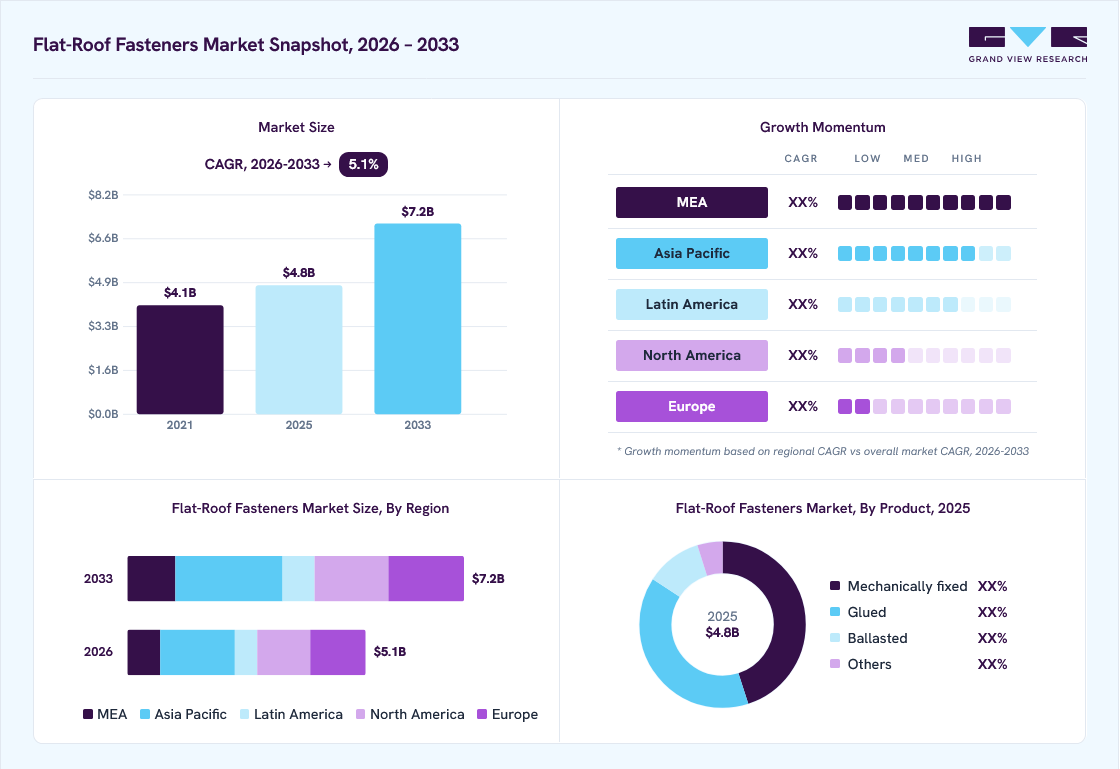 Source: Grand View Research, IR Documents, Primary Interviews, Paid DatabasesTo learn more about this report,
 Download Free Sample Report
Key Market Trends & Insights
- By product: Mechanically fixed segment led the market with the largest revenue share of 44.9% in 2025.
- By roofing membrane: Single-ply membranes segment led the market with the largest revenue share of 45.6% in 2025.
- By distribution channel: Direct segment led the market with the largest revenue share of 67.9% in 2025.
- By end use: Construction & real estate segment led the market with the largest revenue share of 48.2% in 2025.
Regional Highlights
- Largest regional market: Asia Pacific 31.3% revenue share, 2025)
- By country: China held the largest share in 2025
Market Size & Forecast
- Market size in 2025: USD 4.8 billion
- Estimated market size in 2026: USD 5.1 billion
- Projected market size by 2033: USD 7.2 billion
- CAGR (2026-2033): 5.1%
Prism AI by Grand View Research Free to tryAsk a question about the flat-roof fasteners marketTry asking✓Every figure cited from GVR research Prefer the report? Download free sample →Flat roofs offer benefits such as cost-effective construction, easier installation of HVAC systems, and the potential for green roofing or solar panel integration. This trend is particularly strong in urban environments where space optimization is critical. Advancements in construction materials and techniques are driving demand for specialized fasteners that can withstand extreme weather conditions and ensure long-term structural integrity. Governments and developers also focus on sustainable and energy-efficient building practices, often involving flat roofing solutions with high-performance membranes requiring compatible fastening systems.
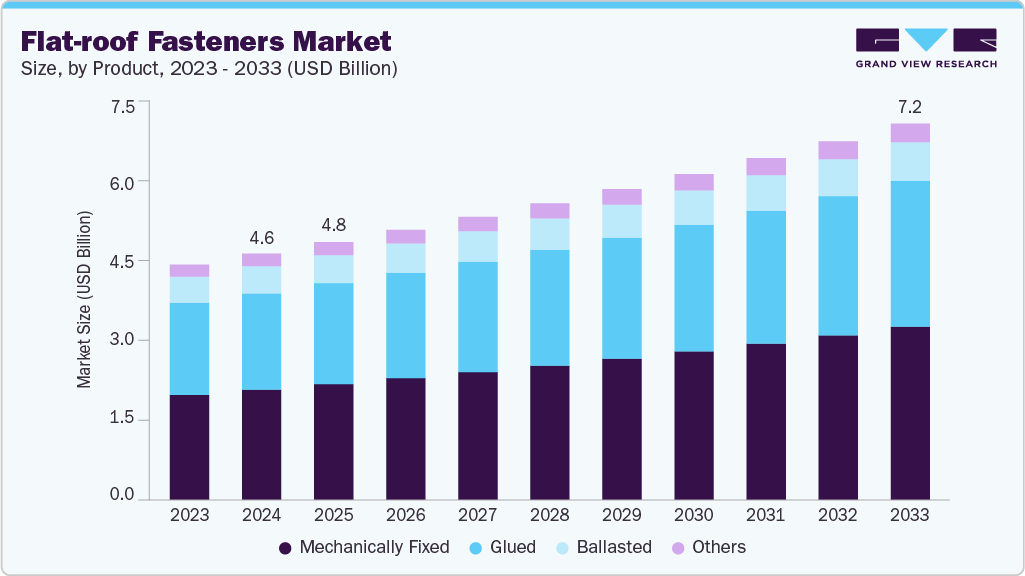 To learn more about this report, Download Free Sample Report
Prominent players in the flat roof fasteners market increasingly focus on direct-to-customer models through online platforms to streamline distribution and enhance profitability. By bypassing traditional intermediaries, manufacturers can better control pricing, reduce lead times, and improve customer engagement. These online channels also enable real-time tracking of customer preferences and market trends, allowing companies to adapt their product offerings accordingly. This strategic shift boosts profit margins and strengthens manufacturers’ responsiveness to evolving industry demands and end user requirements.
Market Dynamics
The flat-roof fasteners market is witnessing steady growth due to increasing commercial, industrial, and institutional construction activities, along with rising demand for durable roofing systems. Growth in warehouse, logistics, manufacturing, healthcare, and retail infrastructure is supporting market expansion. Manufacturers are introducing corrosion-resistant fasteners and products compatible with modern roofing membranes to improve installation performance and service life. However, fluctuations in raw material prices and intense pricing competition continue to influence profitability and procurement decisions across the market.
The expansion of commercial and industrial construction is a key driver of the flat-roof fasteners market. Increasing investments in warehouses, logistics centers, manufacturing facilities, office buildings, healthcare institutions, and educational facilities are creating sustained demand for flat roofing systems. These projects require reliable fastening solutions to secure insulation boards and roofing membranes while ensuring long-term structural performance. Continued urban development and infrastructure investments are expected to support demand for high-performance flat-roof fasteners across new construction and renovation projects.
Fluctuating steel raw material prices remain a major restraint for the flat-roof fasteners market. Steel is the primary material used in manufacturing roofing fasteners, and changes in steel prices directly affect production costs and product pricing. Rising energy costs, supply chain disruptions, and global market volatility further increase pricing uncertainty. These factors can reduce manufacturer profit margins and increase project costs, encouraging contractors to seek lower-cost alternatives or delay procurement during periods of price instability.
The growing adoption of energy-efficient roofing systems presents significant opportunities for the flat-roof fasteners market. Increasing installation of insulated roofing assemblies, cool roofs, and sustainable roofing materials requires fastening systems that provide long-term durability and compatibility with advanced roofing membranes. Rising emphasis on building energy efficiency and green construction is encouraging manufacturers to develop high-performance fastening solutions designed for modern roofing applications, creating new opportunities across commercial, industrial, and institutional construction sectors.
Market Concentration & Characteristics
The flat roof fasteners market is moderately fragmented, with a mix of global players and regional manufacturers competing across different geographies. Established companies such as SFS Group, 3M, and Bossard Group hold significant market shares due to their broad product portfolios, technological expertise, and well-established distribution networks. However, numerous smaller and specialized players catering to niche applications or local markets keep the market competitive. The moderate concentration level also allows room for innovation and pricing flexibility, giving buyers various options depending on their project needs.
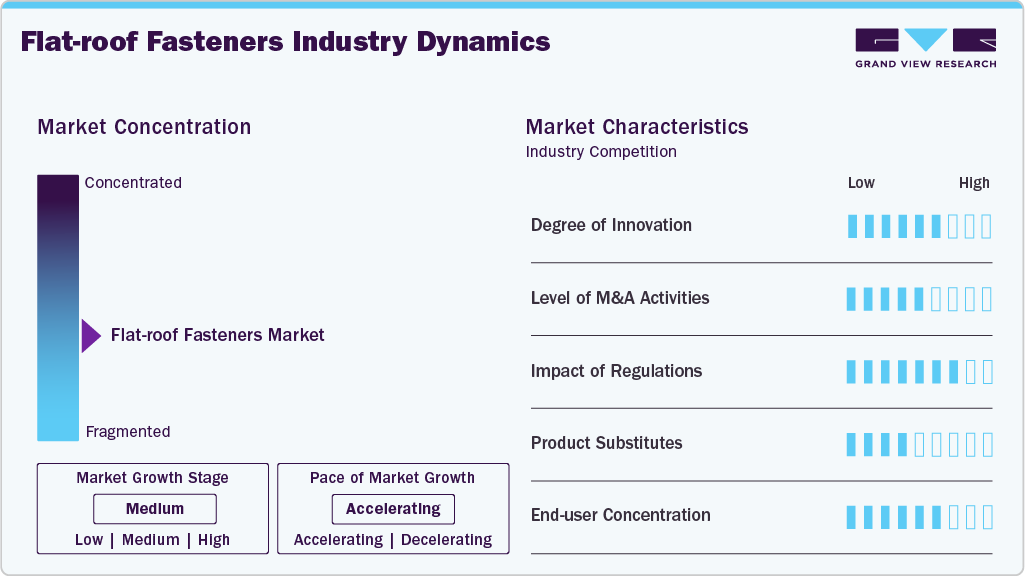 To learn more about this report, Download Free Sample Report
The threat of substitutes in the flat roof fasteners market is relatively low, as fasteners are essential in ensuring structural integrity and weatherproofing of roofing systems. While adhesive-based solutions and integrated roofing membranes are gaining traction due to their clean finish and reduced thermal bridging, they are generally suited for specific applications and require controlled installation conditions. Mechanical fasteners remain the preferred choice in large-scale and variable climate projects due to their reliability and ease of use. As a result, although some alternatives exist, they do not significantly threaten traditional fastening systems in most mainstream construction scenarios.
Analyst Perspective
The flat-roof fasteners market is expected to experience growth, driven by increasing commercial construction, industrial infrastructure development, and rising reroofing activities worldwide. Growing adoption of energy-efficient roofing systems, single-ply membranes, and green building practices is supporting demand for high-performance fastening solutions. Manufacturers are focusing on corrosion-resistant materials, improved wind uplift performance, and faster installation technologies to strengthen their competitive position. Continued investments in logistics facilities, warehouses, renewable energy projects, and institutional buildings are expected to create long-term growth opportunities for the market.
Product Insights
Based on product, the mechanically fixed segment led the market with the largest revenue share of 44.9% in 2025 due to its proven reliability, cost-effectiveness, and ease of installation across a wide range of substrates. Mechanical fastening provides strong resistance against wind uplift and ensures long-term structural stability, making it a preferred choice in new and re-roofing projects. It also allows quicker on-site application without specific temperature or surface conditions, making it ideal for large-scale commercial and industrial installations.
The glued segment is expected to grow at the fastest CAGR of 5.1% over the forecast period. This is due to its aesthetic appeal, lightweight application, and compatibility with modern roofing membranes. Adhesive-based fastening eliminates the need for penetrations, reducing the risk of leaks and improving thermal performance. This method is increasingly adopted in regions with stringent energy efficiency and insulation regulations. As sustainable building practices gain traction and technological advancements enhance adhesive performance, the glued segment is gaining momentum, particularly in residential and high-end commercial applications.
Roofing Membrane Insights
Based on roofing membrane, the single-ply membranes segment led the market with the largest revenue share of 45.6% in 2025 due to its lightweight properties, ease of installation, and cost-efficiency. Membranes such as TPO, PVC, and EPDM offer excellent weather resistance, UV stability, and flexibility, making them a popular choice for commercial and industrial flat roofs. Their compatibility with mechanical fastening systems and reduced labor requirements have made single-ply membranes a go-to solution for large-scale roofing projects, especially where speed and budget are key considerations.
The two-ply bitumen segment is expected to grow at the fastest CAGR of 5.1% over the forecast period. This is due to its superior durability, waterproofing capability, and enhanced resistance to punctures and harsh weather conditions. As construction projects increasingly focus on longevity and resilience, particularly in regions prone to extreme climates, two-ply bitumen systems are gaining popularity. The growing demand for roofing systems with higher load-bearing capacity and longer lifespans, coupled with advancements in modified bitumen technology, is driving adoption in retrofit and new build applications.
Distribution Channel Insights
Based on distribution channel, the direct segment led the market with the largest revenue share of 67.9% in 2025, as major manufacturers increasingly focus on selling directly to contractors, builders, and end users. This approach helps companies streamline their supply chain, reduce dependency on intermediaries, and improve profit margins. Direct channels also allow for better control over pricing, enhanced customer service, and quicker feedback loops, enabling manufacturers to respond more efficiently to market trends and customer needs. As a result, many leading players have established their own sales networks or online platforms to strengthen their direct-to-customer engagement.
The indirect distribution channel segment is expected to grow significantly at a CAGR of 5.0% over the forecast period, particularly in emerging markets where access to a wide network of local dealers and distributors remains crucial. These intermediaries offer regional expertise, logistics support, and well-established relationships with small and mid-sized contractors who prefer purchasing through familiar channels. As the construction industry expands in remote and developing areas, manufacturers increasingly partner with indirect distributors to tap into new customer bases, enhance market reach, and ensure product availability across diverse geographies.
End-use Insights
Based on end use, the construction & real estate segment led the market with the largest revenue share of 48.2% in 2025. This is due to the widespread use of flat-roofing systems in commercial buildings, residential complexes, and institutional infrastructure. These sectors prioritize cost-effective, space-efficient roofing solutions, making flat roofs ideal. With increasing urbanization and a steady rise in real estate development projects globally, especially in metro and tier-2 cities, demand for reliable and durable flatroof fasteners has remained consistently strong in this segment.
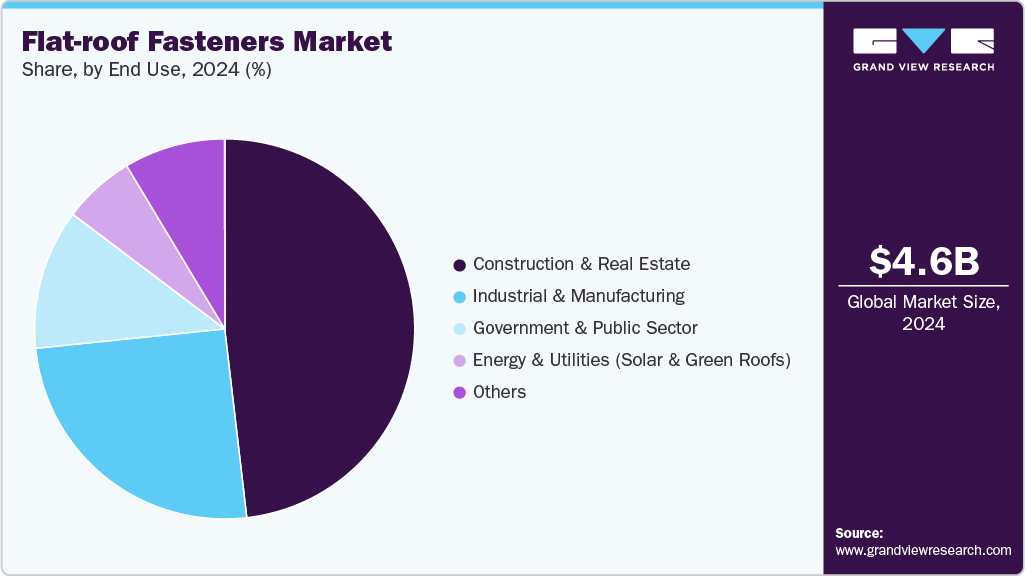 To learn more about this report, Download Free Sample Report
The industrial and manufacturing segment is expected to grow significantly at a CAGR of 5.6% over the forecast period, driven by the expansion of industrial facilities, warehouses, and logistics centers. These structures often require large flat roofing surfaces for operational efficiency and infrastructure optimization. As manufacturing activity scales up across developing economies and global supply chains evolve, the need for robust, weather-resistant roofing systems is rising. This pushes demand for high-performance fasteners to ensure long-term durability and structural integrity under demanding industrial conditions.
Regional Insights
North America holds a significant share in the flat roof fasteners market, backed by mature construction practices and a high rate of re-roofing and renovation projects. The region favors single-ply roofing systems in commercial and industrial buildings, increasing the use of mechanically fastened solutions. Sustainability regulations, energy efficiency targets, and the adoption of solar-ready flat roofs are also driving the market. Technological advancements and a focus on premium, weather-resistant materials are further shaping regional product development.
U.S. Flat-roof Fasteners Market Trends
The U.S. flat-roof fasteners market is characterized by consistent demand for flat roof fasteners, particularly in the commercial real estate and warehousing sectors. The growth of e-commerce has led to a surge in large-scale distribution centers, many of which utilize flat-roofing. Additionally, increasing investment in infrastructure revitalization and federal incentives for energy-efficient buildings fuel demand. The U.S. also strongly prefers mechanical fastening systems due to their proven reliability and ease of application in varying climate conditions.
Asia Pacific Flat-roof Fasteners Market Trends
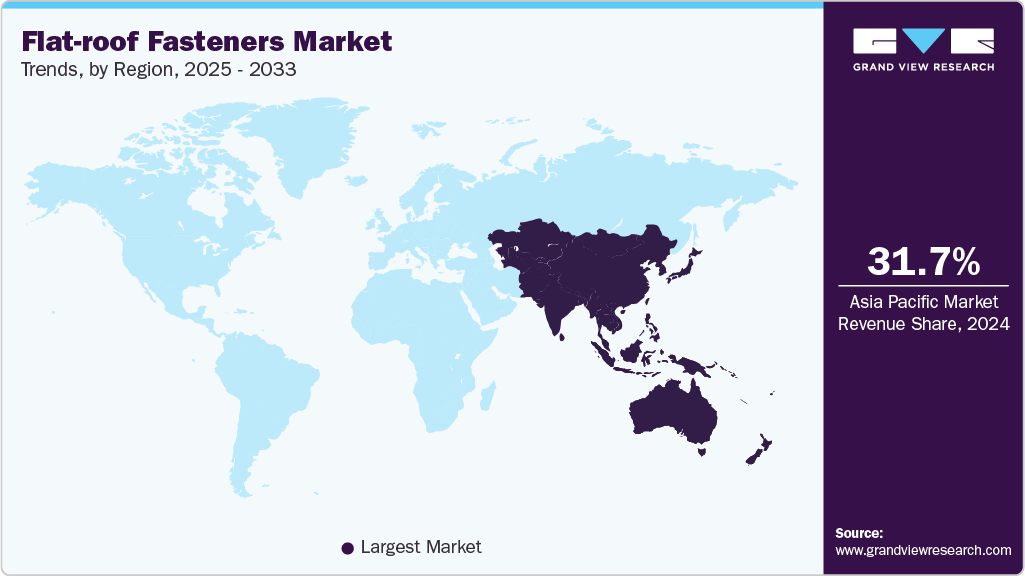
Asia Pacific dominated the flat-roof fasteners market with the largest revenue share of 31.3% in 2025, driven by rapid urbanization, a booming construction sector, and large-scale infrastructure development across countries like China, India, and Southeast Asian nations. The region is witnessing a surge in commercial and industrial building projects, and many prefer flatroofing systems for their cost-efficiency and space optimization. Moreover, government initiatives focused on smart cities, affordable housing, and industrial corridors fuel construction activities, directly boosting the demand for flatroof fasteners.
 To learn more about this report, Download Free Sample Report
The flat-roof fasteners market in the China held the largest share in the Asia Pacific region in 2025. China is a key contributor to the flatroof fasteners market, driven by its massive construction output and rapid urbanization. Government-backed infrastructure projects, rising commercial real estate development, and industrial expansion continue to push demand for flatroofing systems. The growing trend of green buildings and solar panel installations on flatroofs further supports fastener demand. Additionally, the country’s strong manufacturing base enables large-scale production of fasteners at competitive prices, making it both a leading consumer and supplier in the global market.
Europe Flat-roof Fasteners Market Trends
Europe’s flat roof fasteners market is shaped by stringent environmental regulations and the rising adoption of energy-efficient building practices. Countries across the region are investing in green construction, where flat roofs are often used for solar installations or green roofing systems. This has led to increased demand for durable and weather-resistant fasteners. Renovation of aging infrastructure and government subsidies for energy-saving construction also contribute to steady market growth, especially in Western Europe.
The Germany flat-roof fasteners market stands out within Europe due to its strong emphasis on sustainable architecture and high-quality construction standards. The country is a leader in green buildings, passive house developments, and solar-integrated roofing-all of which commonly use flat roofing systems. Demand for technically advanced and long-lasting fasteners is high, with local manufacturers focusing on precision-engineered, environmentally compliant products. Public and private sector investments in infrastructure and energy-efficient retrofitting further boost market activity.
Latin America Flat-roof Fasteners Market Trends
Latin America's flat roof fasteners market is experiencing gradual growth, driven by urban development and increasing industrial construction in countries like Brazil and Mexico. While sloped roofing is still common in residential applications, commercial and industrial sectors are adopting flat roofing systems for cost and space efficiency. Economic recovery in key countries and foreign investment in real estate and logistics create new opportunities for fastener suppliers. However, market penetration is still in the early stages compared to more developed regions.
Middle East & Africa Flat-roof Fasteners Market Trends
The Middle East & Africa region is showing promising growth in the flat roof fasteners market, fueled by large-scale construction projects, particularly in the Gulf Cooperation Council (GCC) countries. Flat roofs are widely used in the region due to climatic suitability and architectural preferences. Key demand drivers include mega infrastructure and commercial developments in countries like the UAE, Saudi Arabia, and South Africa. As the region diversifies beyond oil-dependent economies, increased focus on sustainable and smart building projects is expected to further support market expansion.
Key Flat-roof Fasteners Company Insights
The flat roof fasteners market consists of key players such as SFS Group U.S., Inc., MSA, Grainger Canada, Alimak Group, 3M, MISUMI Corporation, Prince Fastener, Leeden Sdn Bhd, Bossard Group, and Stronghold Asia. These companies actively focus on strategies such as product innovation, strategic partnerships, and expanding their regional presence to strengthen their market foothold. Emphasis is also placed on enhancing supply chain efficiency and developing advanced fastening solutions tailored to evolving construction demands.
Moreover, leading players are pursuing mergers and acquisitions to broaden their product offerings and penetrate new geographical markets. For instance, in April 2024, Sika launched a new pressure-sensitive acrylic adhesive designed for roofing installation applications, reinforcing its position in the roof fasteners market. This advanced adhesive technology enables quick, secure bonding without additional mechanical fasteners or curing time, significantly reducing installation and labor costs. Its strong initial tack and long-term durability make it ideal for roofing materials, including membranes and insulation boards.
Key Flat-roof Fasteners Companies
The following key companies have been profiled for this study on the flat-roof fasteners market.
-
SFS Group U.S., Inc.
-
MSA
-
Grainger Canada
-
Alimak Group
-
3M
-
MISUMI Corporation
-
Prince Fastener
-
Leeden Sdn Bhd
-
Bossard Group
-
Stronghold Asia
Competitive Benchmarking
Category
Operating Strategies
Competitive Edge
Weakness
Established Players (e.g. A SFS Group U.S., Inc., 3M, MISUMI Corporation, Bossard Group, Grainger Canada)
- Focus on expanding portfolios of mechanically fixed, glued, and specialized flat-roof fastening systems for commercial and industrial roofing applications.
- Invest in R&D to develop corrosion-resistant fasteners, high wind-uplift performance solutions, and roofing system compatibility.
- Strengthen distribution through roofing material distributors, construction suppliers, OEM partnerships, and direct sales while providing technical support and installation guidance.
- Strong global presence with established relationships across commercial construction, industrial roofing, and infrastructure sectors.
- Broad product portfolios offering high-performance fastening solutions compatible with multiple roofing membranes and insulation systems.
- Extensive distribution networks, engineering expertise, and technical support strengthen customer confidence and long-term business relationships.
- Premium product pricing may limit adoption in cost-sensitive construction projects.
- Large organizational structures can reduce flexibility in responding to changing regional roofing requirements and market trends.
Emerging & Regional Players (e.g MSA, Prince Fastener, Leeden Sdn Bhd, Stronghold Asia, Alimak Group)
- Focus on cost-effective flat-roof fastening solutions, customized products, and application-specific fastening systems for regional construction markets.
- Expand market presence through regional distributors, roofing contractors, and construction material suppliers.
- Develop products with improved corrosion resistance, installation efficiency, and compatibility with modern roofing systems.
- Greater flexibility in developing customized fastening solutions for specific roofing applications and regional customer requirements.
- Competitive pricing and faster product development support growth in regional construction markets.
- Ability to quickly respond to evolving roofing technologies and contractor preferences.
- Smaller global distribution networks and lower brand recognition than established multinational competitors.
- Limited financial resources for large-scale R&D, acquisitions, and international market expansion.
Flat-roof Fasteners Market Report Scope
Report Attribute
Details
Market size in 2025
USD 4.8 billion
Estimated market size in 2026
USD 5.1 billion
Projected market size by 2033
USD 7.2 billion
Growth rate
CAGR of 5.1% from 2026 to 2033
Base year for estimation
2025
Historical data
2021 - 2024
Forecast period
2026 - 2033
Quantitative units
Revenue in USD billion and CAGR from 2026 to 2033
Report coverage
Revenue forecast, company ranking, competitive landscape, growth factors, and trends
Segments covered
Product, roofing membrane, distribution channel, end use, region
Regional scope
North America; Europe; Asia Pacific; Latin America; Middle East & Africa
Country scope
U.S., Canada, Mexico, Germany, France, UK, Poland, Austria, Romania, China, China, Malaysia, Thailand, Indonesia, Singapore, Brazil
Key companies profiled
SFS Group U.S., Inc.; MSA; Grainger Canada; Alimak Group; 3M; MISUMI Corporation; Prince Fastener; Leeden Sdn Bhd; Bossard Group; Stronghold Asia
Customization scope
Free report customization (equivalent up to 8 analysts' working days) with purchase. Addition or alteration to country, regional & segment scope.
Pricing and purchase options
Avail customized purchase options to meet your exact research needs. Explore purchase options
Global Flat-roof Fasteners Market Report Segmentation
This report forecasts revenue growth at regional & country levels and provides an analysis of the industry trends in each of the sub-segments from 2021 to 2033. For this study, Grand View Research has segmented the global flat roof fasteners market report based on product, roofing membranes, end-use, distribution channel, and region:
-
Product Outlook (Revenue, USD Million, 2021 - 2033)
-
Mechanically fixed
-
Glued
-
Ballasted
-
Others
-
-
Roofing Membrane Outlook (Revenue, USD Million, 2021 - 2033)
-
Single-ply Membranes
-
Two-Ply Bitumen
-
Other Composite Systems
-
-
End-use Outlook (Revenue, USD Million, 2021 - 2033)
-
Construction & Real Estate
-
Energy & Utilities (Solar and Green Roofs)
-
Industrial & Manufacturing
-
Government & Public Sector
-
Others
-
-
Distribution Channel Outlook (Revenue, USD Million, 2021 - 2033)
-
Direct
-
Indirect
-
-
Regional Outlook (Revenue, USD Million, 2021 - 2033)
-
North America
-
U.S.
-
Canada
-
Mexico
-
-
Europe
-
UK
-
Germany
-
France
-
-
Asia Pacific
-
China
-
Japan
-
South Korea
-
-
Latin America
-
Brazil
-
-
Middle East & Africa
-
UAE
-
-
Research Methodology
The flat-roof fasteners Market figures in this report are based on a proven research process that combines executive interviews with secondary research from proprietary databases, company filings, and recognized regulatory and institutional sources. Market size is built through value-chain sizing - reconciling supply-side and demand-side estimates - and triangulated with bottom-up and top-down approaches. Every estimate passes multiple levels of expert validation before publication, with each flat-roof fasteners Market segment quantified using the revenue-capture definitions in the table below.
Segment Definition
Segment - Product
Revenue Capture Definition
Mechanically Fixed
Revenue generated from sales of mechanical flat-roof fastening systems, including screws, plates, and anchors used to secure roofing assemblies.
Glued
Revenue generated from flat-roof fastening solutions installed using adhesives for roofing membranes, insulation boards, and compatible roofing system components.
Ballasted
Revenue generated from fastening solutions used in ballasted flat-roof systems where membranes are secured using ballast materials and accessories.
Others
Revenue generated from other flat-roof fastening systems, including hybrid fastening methods and specialized roof attachment solutions not classified elsewhere.
Segment - Roofing Membrane
Revenue Capture Definition
Single-ply Membranes
Revenue generated from flat-roof fasteners used with single-ply roofing membranes, including TPO, PVC, and EPDM roofing installations.
Two-Ply Bitumen
Revenue generated from flat-roof fasteners used in modified bitumen roofing systems requiring secure mechanical attachment and long-term structural performance.
Others
Revenue generated from fasteners used with composite roofing systems incorporating multiple roofing materials, insulation layers, and waterproofing components.
Segment - End-use
Revenue Capture Definition
Construction & Real Estate
Revenue generated from flat-roof fasteners used in commercial, residential, institutional, and mixed-use building construction and renovation projects.
Energy & Utilities (Solar and Green Roofs)
Revenue generated from flat-roof fasteners supporting solar panel mounting systems, green roofs, and energy infrastructure roofing applications.
Industrial & Manufacturing
Revenue generated from flat-roof fasteners used in factories, warehouses, logistics facilities, and industrial buildings requiring durable roofing systems.
Government & Public Sector
Revenue generated from flat-roof fasteners supplied for schools, hospitals, public buildings, transportation facilities, and government infrastructure projects.
Others
Revenue generated from flat-roof fasteners used across agricultural buildings, recreational facilities, retail establishments, and other specialized applications.
Segment - Distribution Channel
Revenue Capture Definition
Direct
Revenue generated through direct sales of flat-roof fasteners from manufacturers to contractors, roofing companies, project developers, and industrial customers.
Indirect
Revenue generated through distributors, wholesalers, retailers, building material suppliers, and e-commerce channels supplying flat-roof fastening products.
Estimation Model
Layer Name
Key Question
Description
Construction and Roofing Demand Layer
Which sectors generate demand for flat-roof fasteners?
The estimation begins by evaluating demand across commercial construction, industrial facilities, warehouses, logistics centers, residential buildings, institutional infrastructure, energy projects, and renovation activities.
Product and Roofing System Layer
Which product types drive market demand?
This layer refines demand by assessing the adoption of mechanically fixed, glued, ballasted, and other fastening systems across single-ply membranes, two-ply bitumen, and composite roofing systems. Roofing material compatibility, wind uplift resistance, installation efficiency, corrosion resistance, and lifecycle performance influence product adoption.
End-user and Distribution Layer
What determines flat-roof fastener demand?
Market demand is estimated by evaluating adoption across construction & real estate, energy & utilities, industrial & manufacturing, government & public sector, and other end users through direct and indirect distribution channels. Building construction activity, reroofing projects, roofing contractor preferences, building codes, and infrastructure investments determine product demand.
Revenue Layer
How is total market revenue calculated?
Revenue is estimated by aggregating sales of flat-roof fasteners across product types, roofing membrane types, end-use industries, distribution channels, and regional markets. Construction spending, roofing installation volumes, replacement demand, product pricing, distributor sales, manufacturer revenues, and regional construction trends are incorporated to validate the overall market size.
Delivered Customizations
This report has been delivered with the following In-depth customizations
Client Request
Customization Delivered
Value Adds
Regional Segmentation
Detailed regional analysis of the flat-roof fasteners market covering North America, Europe, Asia-Pacific, Latin America, and the Middle East & Africa, along with country-level assessment of construction activity, commercial and industrial building development, roofing installation trends, renovation and reroofing demand, import-export analysis, and building material consumption.
Helped clients identify high-growth regional markets and prioritize expansion strategies based on construction activity, infrastructure investments, and regional roofing demand.
Opportunity Assessment
Comprehensive opportunity analysis focusing on energy-efficient roofing systems, green buildings, solar roof installations, advanced roofing membranes, corrosion-resistant fastening technologies, and infrastructure investments.
Enabled clients to develop targeted market entry, product development, and investment strategies by identifying high-growth applications and evolving roofing industry requirements.
Competitive benchmarking
In-depth benchmarking of major flat-roof fastener manufacturers based on product portfolio, geographic presence, distribution networks, manufacturing capabilities, R&D investments, and strategic partnerships. The analysis also compared company positioning across commercial construction, industrial roofing, energy projects, and infrastructure applications.
Assisted clients in understanding competitor strengths, product capabilities, and market positioning. Helped identify product differentiation opportunities, partnership potential, and competitive strategies to strengthen long-term market presence.
Frequently Asked Questions About This Report
The global flat-roof fasteners market size was estimated at USD 4.8 billion in 2025 and is expected to reach USD 5.1 billion in 2026.
Some of the key players operating in the flat-roof fasteners market include SFS Group U.S., Inc., MSA, Grainger Canada, Alimak Group, 3M, MISUMI Corporation, Prince Fastener, Leeden Sdn Bhd, Bossard Group, Stronghold Asia.
Some of the key players operating in the flat-roof fasteners market include SFS Group U.S., Inc., MSA, Grainger Canada, Alimak Group, 3M, MISUMI Corporation, Prince Fastener, Leeden Sdn Bhd, Bossard Group, Stronghold Asia.
The mechanically fixed segment of the market accounted for the largest revenue share of 44.9% in 2025, due to its strong wind resistance, ease of installation, and suitability for a wide range of roofing materials and climates.
Based on roofing membrane, the single-ply membranes segment led the market with the largest revenue share of 45.6% in 2025.
Based on distribution channel, the direct segment led the market with the largest revenue share of 67.9% in 2025.
Based on end use, the construction & real estate segment led the market with the largest revenue share of 48.2% in 2025.
The flat-roof fasteners market in the China held the largest share in the Asia Pacific region in 2025.
The global flat-roof fasteners market is expected to grow at a compound annual growth rate of 5.1% from 2026 to 2033 to reach USD 7.2 billion by 2033.
About the Author(s)
Advanced Interior Materials Research Team
Advanced Materials · Advanced Interior MaterialsThis report was authored by the advanced interior materials research team at Grand View Research - comprising two research analysts, one senior research analyst, and one industry expert - with specialized expertise in the advanced interior materials segment of the advanced materials industry. All findings are based on proprietary advanced materials databases, executive interviews, and regulatory analysis, subject to internal peer review prior to publication.
Last Updated:
Speak to Analyst

Customize this report to your needs - add regions, segments, or data points, with 20% free customization.
Or view our licence options:


ISO 9001:2015 & 27001:2022 Certified
We are GDPR and CCPA compliant! Your transaction & personal information is safe and secure. For more details, please read our privacy policy.


