
- Home
- »
- Advanced Interior Materials
- »
-
Foam Concrete Market Size & Trends, Industry Report, 2033GVR Report cover
![Foam Concrete Market Size, Share & Trends Report]()
Foam Concrete Market (2025 - 2033) Size, Share & Trends Analysis Report By Concrete Type (Precast Foam Concrete Elements, Ready-mix Foam Concrete, On-site Produced Foam Concrete), By End-use (Residential Construction, Commercial Construction), By Region, And Segment Forecasts
Market Size, 2024
$645.0MMarket Estimate, 2026
$685.0MMarket Forecast, 2033
$1,108.4MCAGR, 2025–2033
6.2%Foam Concrete Market Summary
The global foam concrete market size was estimated at USD 645.0 million in 2024 and is expected to reach USD 1,108.4 million by 2033, registering a CAGR of 6.2% from 2025 to 2033. The demand for foam concrete is increasing due to its lightweight properties, high workability, and cost-effectiveness compared to conventional concrete.

Key Market Trends & Insights
- Asia Pacific dominated the foam concrete market with the largest revenue share of 39.6% in 2024.
- By concrete type, the precast foam concrete elements segment is expected to grow at the fastest CAGR of 6.7% over the forecast period.
- By end use, the commercial construction segment is expected to grow at the fastest CAGR of 6.8% over the forecast period.
Market Size & Forecast
- 2024 Market Size: USD 645.0 Million
- 2033 Projected Market Size: USD 1,108.4 Million
- CAGR (2025-2033): 6.2%
- Asia Pacific: Largest market in 2024
Rising urbanization and infrastructure development projects are driving its usage in both residential and commercial construction. Foam concrete is particularly gaining traction in applications such as floor and roof insulation, void filling, road sub-bases, and precast blocks. Additionally, the global push for sustainable construction materials has increased its acceptance, as it uses less raw material and offers good thermal insulation.Key drivers of the market include rapid construction activities, government emphasis on green building materials, and cost benefits in terms of material usage and transportation. Its excellent thermal insulation properties make it ideal for energy-efficient construction, aligning with sustainability goals. In addition, foam concrete’s fire resistance and sound absorption properties drive its adoption in residential and commercial projects. The rising preference for prefabricated and modular construction is also a strong driver since foam concrete blocks and panels are easy to manufacture. Low production cost and the use of industrial waste such as fly ash in its mix further enhance its market appeal.

Innovations in foam concrete technology focus on improving compressive strength, durability, and production efficiency. Modern foam generators allow precise control of density, making it suitable for structural as well as non-structural applications. The integration of industrial by-products such as slag, silica fume, and recycled aggregates is a growing trend, enhancing sustainability. Automation in foam concrete production plants and mobile mixing units is increasing productivity on construction sites. The development of high-performance foaming agents with eco-friendly properties is further supporting the industry.
Market Dynamics
The growing emphasis on lightweight and energy-efficient construction materials is significantly driving the growth of the foam concrete market. Foam concrete offers advantages such as low density, thermal insulation, sound absorption, and reduced structural load, making it highly suitable for residential, commercial, and infrastructure applications. The increasing adoption of green building practices and sustainable construction technologies is encouraging the use of foam concrete in wall panels, roof insulation, void filling, and prefabricated building components. Additionally, rapid urbanization and rising investments in affordable housing projects are further supporting demand for lightweight concrete solutions across developing and developed economies.
Furthermore, the expansion of infrastructure modernization projects and smart city developments is contributing to increased utilization of foam concrete in road sub-bases, bridge abutments, tunnels, and geotechnical applications. Its self-leveling properties, ease of placement, and lower material consumption compared to traditional concrete are improving construction efficiency and reducing labor requirements. Growing focus on reducing carbon emissions in the construction sector and increasing use of recycled materials in foam concrete production are also expected to support long-term market growth.
Limited compressive strength and lower load-bearing capacity compared to conventional concrete materials continue to restrict the adoption of foam concrete in heavy structural applications. The material is primarily suitable for insulation, void filling, and lightweight construction purposes, which limits its usage in high-rise buildings, bridges, and other infrastructure projects requiring superior structural performance. In addition, variations in foam stability, curing conditions, and raw material composition can affect product consistency and long-term durability, creating challenges for broader commercial utilization.
Market Concentration & Characteristics
The industry is moderately fragmented with the presence of both global and regional players. At the same time, large construction material companies are entering the space with advanced product offerings, and numerous small and medium-sized manufacturers cater to localized markets with cost-effective solutions. The competition is based on pricing, density range, compressive strength, and application-specific formulations. Partnerships with contractors, real estate developers, and government agencies play a significant role in market share consolidation. In developed economies, product innovation and quality standards dominate competition, whereas in emerging economies, cost and supply chain efficiency are more critical.
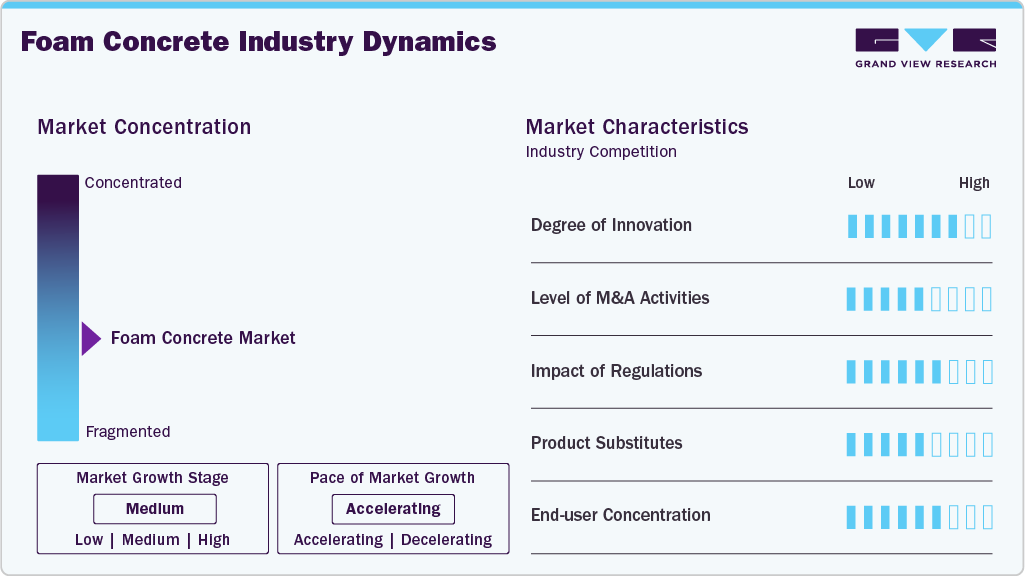
Foam concrete faces competition from materials such as autoclaved aerated concrete (AAC), lightweight aggregate concrete, and traditional cement blocks. AAC, in particular, is a strong substitute as it also offers lightweight properties with good thermal insulation and higher compressive strength. Hollow concrete blocks and expanded polystyrene-based lightweight concretes are also alternatives in certain applications. However, foam concrete maintains an edge in void filling, slope stabilization, and insulation layers where substitutes may not perform as effectively. The threat of substitutes is moderate, as foam concrete has unique applications but overlaps with AAC and lightweight blocks in housing construction.
Concrete Type Insights
The precast foam concrete elements segment held the highest revenue share of 43.9% in 2024, as they provide high efficiency, uniform quality, and reduced on-site labor costs. Widely used in blocks, panels, and insulation boards, they are preferred in large-scale residential and infrastructure projects due to their easy installation and consistency. Their ability to meet modern construction demands, including modular and prefabricated housing, has made them the largest segment.
The ready-mix foam concrete segment is expected to grow at a CAGR of 6.4% over the forecast period, as contractors increasingly prefer on-site mixing for greater flexibility and cost savings. This segment benefits from mobile mixing units and modern foaming agents, enabling quick delivery and application in void filling, road sub-bases, and renovation works. The growing trend of fast-paced construction projects and infrastructure repair is fueling this segment’s expansion.
End-use Insights
The residential construction segment held the highest revenue share of 42.6% in 2024, driven by rising housing demand, government affordable housing schemes, and the push for energy-efficient homes. Foam concrete’s lightweight, thermal insulation, and soundproofing properties make it ideal for walls, roofs, and floors. Its adoption in developing economies for low-cost housing further strengthens its leadership in the segment.

The commercial construction segment is expected to grow at the fastest CAGR of 6.8% over the forecast period, supported by urbanization, smart city initiatives, and rising demand for green buildings. Offices, malls, hospitals, and educational institutions increasingly use foam concrete for insulation, partition walls, and flooring due to its cost and energy efficiency. The emphasis on sustainable building materials in commercial projects is accelerating this trend.
Regional Insights
The North America foam concrete market is growing due to rising demand for energy-efficient and sustainable building materials. The U.S. and Canada are witnessing increased adoption in insulation applications and green building projects. Government energy codes and regulations are pushing contractors toward lightweight and thermally efficient materials. Moreover, infrastructure modernization initiatives are creating opportunities for foam concrete in void filling and road base stabilization.
U.S. Foam Concrete Market Trends
The foam concrete market in the U.S. is being driven by a strong emphasis on sustainable construction and energy-efficient buildings. Foam concrete is gaining ground in non-structural applications like insulation, void filling, and soundproofing in residential and commercial buildings. Public infrastructure investments, especially in road rehabilitation and underground utility projects, are key growth drivers. The market is also influenced by technological advancements in foaming agents and mobile mixing units.
Asia Pacific Foam Concrete Market Trends
Asia Pacific dominated the global foam concrete market and accounted for the largest revenue share of 39.6% in 2024, due to rapid urbanization, infrastructure investments, and large-scale government housing projects. Countries like China, India, and Indonesia are experiencing a boom in residential and commercial construction, boosting demand for lightweight materials. Low production costs and abundant availability of raw materials, such as fly ash, make foam concrete highly viable in the region. In addition, the growing focus on sustainable construction in China and India is encouraging adoption. The presence of numerous small and medium-scale manufacturers further contributes to regional dominance.

China foam concrete marketissupported by massive infrastructure investments and smart city development projects. Government policies promoting green building materials enhance foam concrete’s penetration. Its use in road construction, bridge embankments, and urban housing projects continues to rise. The availability of industrial by-products like fly ash also supports large-scale production. Increasing adoption of prefabricated building components is a major trend.
Europe Foam Concrete Market Trends
The foam concrete market in Europe is growing due to stringent sustainability standards and the demand for energy-efficient construction materials. Countries like Germany, the U.K., and France are leading markets. The use of foam concrete in tunnel lining, road construction, and green housing projects is expanding. EU directives promoting carbon reduction in construction directly support the growth of lightweight alternatives like foam concrete.
Germany foam concrete market is driven by advanced construction practices and government sustainability policies. Foam concrete is used extensively in energy-efficient housing, renovation projects, and public infrastructure. The country’s strong focus on recycling industrial waste materials like fly ash also supports foam concrete’s growth. Additionally, the push for modular construction methods is creating new opportunities.
Central & South America Foam Concrete Market Trends
The foam concrete market in Central & South America is driven by countries such as Brazil and Mexico, which are driving foam concrete adoption due to expanding housing projects and infrastructure developments. Economic housing schemes and government-backed construction programs are boosting demand. The region’s rising focus on cost-effective construction materials makes foam concrete an attractive choice, particularly in residential and commercial projects.
Middle East & Africa Foam Concrete Market Trends
The foam concrete market in the Middle East & Africa is expanding due to large-scale megaprojects and infrastructure development. Countries like Saudi Arabia and the UAE are incorporating foam concrete into smart city initiatives and sustainable housing programs. Its use in road embankments, airports, and commercial complexes is growing. Africa is also witnessing rising adoption in urban housing projects as governments push for affordable, lightweight building solutions.
Key Foam Concrete Companies Insights
Key players operating in the foam concrete market are undertaking various initiatives to strengthen their presence and increase the reach of their products and services. Strategies such as expansion activities and partnerships are key in propelling the market growth. Some of the key players operating in the market include JB International, Total Concrete Ltd.
-
JB International, founded in 2010, is one of India’s leading foam concrete suppliers. The company operates multiple high-capacity manufacturing units across metro cities like Mumbai, Bangalore, Chennai, and Hyderabad, with production capabilities reaching nearly 1000 m³ per day. Its foam concrete is available in a wide density range, from lightweight 300 kg/m³ mixes to structural 1600 kg/m³ variants, making it suitable for applications such as sunken slab filling, roof insulation, floor leveling, and lightweight structural elements.
-
Total Concrete Ltd. is a UK-based ready-mix concrete supplier that offers a wide range of specialized mixes, including foam concrete. The company is known for providing high-quality, pumpable, and lightweight foam concrete solutions tailored to void filling, ground stabilization, trench reinstatement, and thermal insulation applications. With a focus on reliability and quick site delivery, Total Concrete has built a strong reputation among contractors for offering practical and sustainable solutions in both residential and infrastructure projects. Their foam concrete offerings emphasize efficiency, safety, and compliance with local building standards.
Tarmac and Namra Tech are some of the emerging market participants in the foam concrete market.
-
Tarmac, one of the UK’s largest building materials companies, offers foam concrete under the product name “Topfoam.” This lightweight, self-leveling, and pumpable concrete is designed for a wide range of civil engineering and infrastructure applications such as void filling, trench reinstatement, bridge deck infill, culverts, and pipe encasements. Tarmac’s Topfoam is valued for its ease of placement, eliminating the need for compaction, and its thermal insulation properties.
-
Namra Tech, based in Kochi, Kerala, is a specialized contractor offering foam concrete services for commercial and industrial applications. The company provides foam concrete solutions for retail stores, warehouses, basements, vehicle showrooms, and office spaces where lightweight filling, insulation, and structural adaptability are required. In addition to foam concrete, Namra Tech is also involved in concrete polishing, combining functional flooring solutions with enhanced aesthetics.
Key Foam Concrete Companies:
The following are the leading companies in the foam concrete market. These companies collectively hold the largest market share and dictate industry trends.
- JB International
- THT International
- Tarmac
- Total Concrete Ltd
- Guangzhou Hengde Construction Technology Co., Ltd.
- EasyMix Concrete
- Namra Tech
- CLC Foam Concrete
- Heidelberg Materials AG
Competitive Benchmarking
Operating Strategies
Competitive Edge
Weakness
Mature Players: JB International, Total Concrete Ltd., Heidelberg Materials AG
- Focus on large-scale production of lightweight and insulating foam concrete solutions
- Investment in sustainable construction materials and advanced foaming technologies
- Strong manufacturing capabilities and established construction industry presence
- Advanced product development and diversified infrastructure application portfolio
- Dependence on construction and infrastructure project demand
Emerging Players: Tarmac, Namra Tech
- Focus on cost-effective foam concrete products and regional infrastructure applications
- Expansion in residential, geotechnical, and lightweight construction projects
- Competitive pricing and customized product offerings
- Limited global operational scale and distribution network
Recent Developments
-
In July 2024, Heidelberg Materials AG opened a selective separation recycling facility near Katowice, Poland, to more fully recycle demolition materials (sand, gravel) and substitute virgin materials in concrete production.
Foam Concrete Market Report Scope
Report Attribute
Details
Market size value in 2025
USD 685.0 million
Revenue forecast in 2033
USD 1,108.4 million
Growth rate
CAGR of 6.2% from 2025 to 2033
Base year for estimation
2024
Historical data
2021 - 2024
Forecast period
2025 - 2033
Quantitative units
Revenue in USD million/billion, and CAGR from 2025 to 2033
Report coverage
Revenue forecast, company ranking, competitive landscape, growth factors, and trends
Segments covered
Concrete type, end-use, region
Regional scope
North America; Europe; Asia Pacific; Central & South America; Middle East & Africa
Country scope
U.S.; Canada; Mexico; Germany; UK; France; Spain; China; Japan; India; South Korea; Saudi Arabia; UAE; Egypt; Kuwait; Qatar
Key companies profiled
JB International; THT International; Tarmac; Total Concrete Ltd; Guangzhou Hengde Construction Technology Co., Ltd.; EasyMix Concrete; Namra Tech; CLC Foam Concrete; Heidelberg Materials AG
Customization scope
Free report customization (equivalent up to 8 analysts working days) with purchase. Addition or alteration to country, regional & segment scope.
Pricing and purchase options
Avail customized purchase options to meet your exact research needs. Explore purchase options
Global Foam Concrete Market Report Segmentation
This report forecasts revenue growth at the global, regional & country levels and provides an analysis of the industry trends in each of the sub-segments from 2021 to 2033. For this study, Grand View Research has segmented the global foam concrete market report on the basis of concrete type, end-use, and region:

-
Concrete Type Outlook (Revenue, USD Million, 2021 - 2033)
-
Precast Foam Concrete Elements
-
Ready-Mix Foam Concrete
-
On-Site Produced Foam Concrete
-
Others
-
-
End-use Outlook (Revenue, USD Million, 2021 - 2033)
-
Residential Construction
-
Commercial Construction
-
Infrastructure & Industrial
-
Others
-
-
Regional Outlook (Revenue, USD Million, 2021 - 2033)
-
North America
-
U.S.
-
Canada
-
Mexico
-
-
Europe
-
UK
-
Germany
-
France
-
Spain
-
-
Asia Pacific
-
China
-
Japan
-
India
-
South Korea
-
-
Central & South America
-
Middle East & Africa
-
Saudi Arabia
-
UAE
-
Egypt
-
Qatar
-
Kuwait
-
-
Delivered Customizations
This report has been delivered with the following In-depth customizations
Client Request
Customization Delivered
Value Adds
Competition Analysis
In-depth evaluation of key foam concrete manufacturers based on product portfolio, production capacity, pricing strategies, regional presence, construction project expertise, and technological capabilities
Enables understanding of competitive positioning, product differentiation strategies, technological advancements, and strategic developments among foam concrete manufacturers
Sustainability Analysis
Detailed assessment of sustainable construction practices, lightweight building material adoption, recycled material utilization, energy-efficient construction technologies, and carbon emission reduction initiatives associated with foam concrete applications
Helps understand sustainability trends, green building compliance requirements, environmentally friendly construction material adoption, and long-term environmental impact reduction opportunities
Opportunity Assessment
Comprehensive analysis of growth opportunities across residential construction, infrastructure development, void filling, road sub-bases, prefabricated buildings, insulation systems, and geotechnical applications
Supports identification of high-growth application areas, infrastructure investment trends, lightweight construction demand, and long-term market expansion opportunities in the foam concrete market
Frequently Asked Questions About This Report
Rising demand for lightweight, cost-effective, and sustainable construction materials in residential, commercial, and infrastructure projects is driving the foam concrete market.
The global foam concrete market size was estimated at USD 645.0 million in 2024 and is expected to reach USD 685.0 million in 2025.
The global foam concrete market is expected to grow at a compound annual growth rate of 6.2% from 2025 to 2033 to reach USD 1,108.4 million by 2033.
The precast foam concrete elements segment held the highest revenue market share of 43.9% in 2024, as they provide high efficiency, uniform quality, and reduced on-site labor costs.
Some of the key players operating in the foam concrete market include JB International, THT International, Tarmac, Total Concrete Ltd, Guangzhou Hengde Construction Technology Co., Ltd., EasyMix Concrete, Namra Tech, CLC Foam Concrete, and Heidelberg Materials AG
About the Author(s)
Advanced Interior Materials Research Team
Advanced Materials · Advanced Interior MaterialsThis report was authored by the advanced interior materials research team at Grand View Research - comprising two research analysts, one senior research analyst, and one industry expert - with specialized expertise in the advanced interior materials segment of the advanced materials industry. All findings are based on proprietary advanced materials databases, executive interviews, and regulatory analysis, subject to internal peer review prior to publication.
Last Updated:
Speak to Analyst


Customize this report to your needs — add regions, segments, or data points, with 20% free customization.
Or view our licence options:


ISO 9001:2015 & 27001:2022 Certified
We are GDPR and CCPA compliant! Your transaction & personal information is safe and secure. For more details, please read our privacy policy.


