
- Home
- »
- Food Safety & Processing
- »
-
Food Waste Management Market Size Report, 2026-2033GVR Report cover

Food Waste Management Market (2026 - 2033)
Size, Share & Trends Analysis Report By Waste Type (Cereals, Dairy & Dairy Products, Fruits & Vegetables, Meat & Poultry, Fish & Seafood), By Source (Residential, Industrial, Commercial), By Service Type, By Region, And Segment Forecasts
Market Size, 2025
$81.7BMarket Estimate, 2026
$86.1BMarket Forecast, 2033
$124.2BCAGR, 2026–2033
5.4%Food Waste Management Market Summary
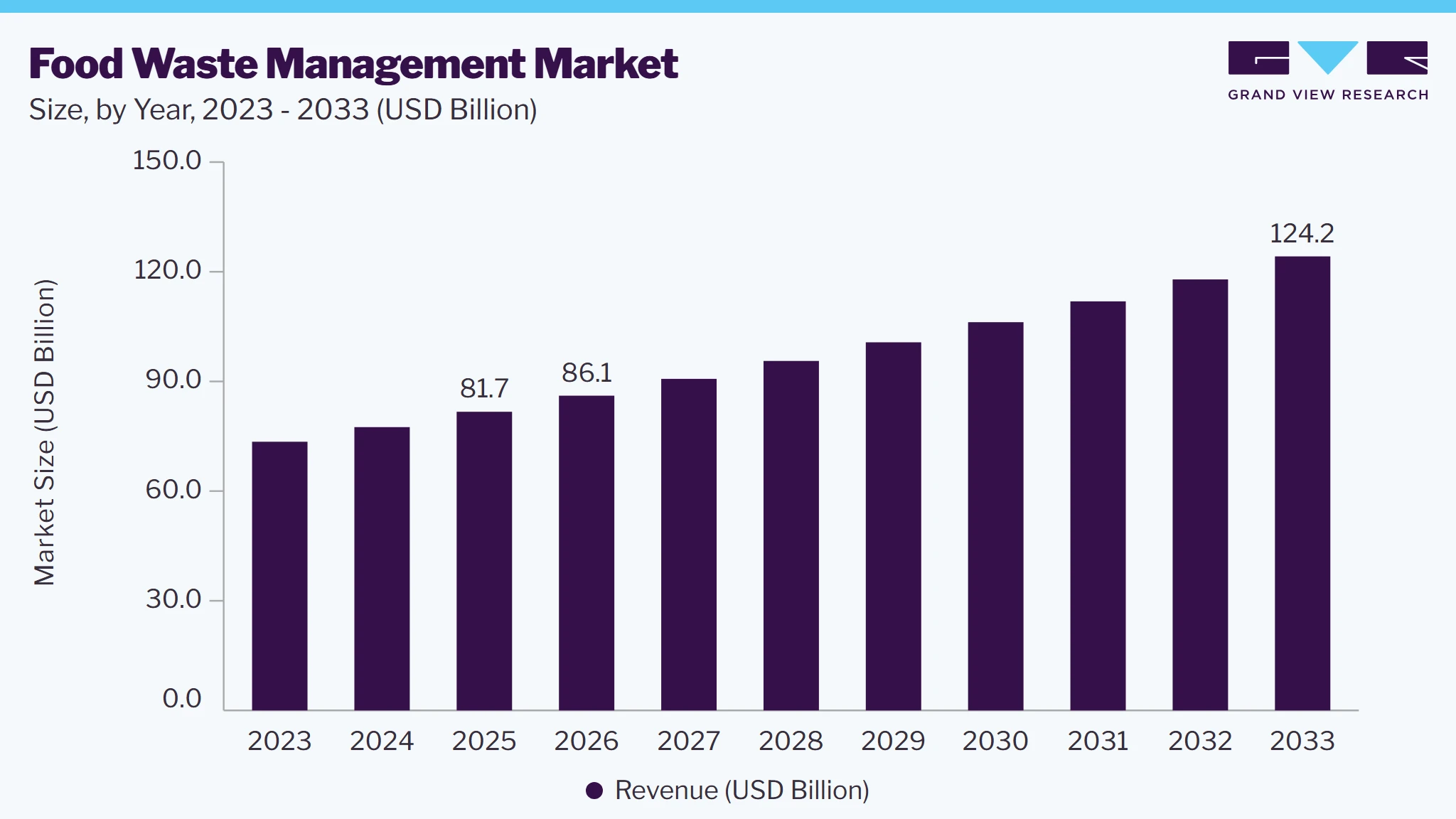
The global food waste management market size was valued at USD 81.7 billion in 2025 and is projected to grow from USD 86.1 billion in 2026 to USD 124.2 billion by 2033, at a CAGR of 5.4% from 2026 to 2033. The market in North America dominated with a revenue share of 33.0% in 2025. Food waste has increased due to the rising population, coupled with perpetually increasing manufacturing and consumption rates.
Key Market Trends & Insights
- By waste type: Fruit and vegetable segment accounted for over 20.0% of the total revenue share in 2025.
- By source: Residential source segment accounted for approximately 45.0% of the total revenue share in 2025.
- By service type: Collection segment accounted for above 55.0% of the total revenue share in 2025.
Regional Highlights
- Largest regional market: North America (33.0% revenue share, 2025)
Market Size & Forecast
- Market size in 2025: USD 81.7 Billion
- Estimated market size in 2026: USD 86.1 Billion
- Projected market size by 2033: USD 124.2 Billion
- CAGR (2026-2033): 5.4%
Three ways to get this report
Buy it, customize it, or ask a question.Ask an Analyst
Analyst response in 1 business day
- AccessReport author, directly
- Reply timeWithin 1 working day
- No sales callDirect answer only
- FormatEmail reply
- CostFree, no cost
Get the Full Report
What the study covers
- FormatsPDF · Excel · Dashboard
- Timeline2026–2033 annual, 2025 base
- Coverage20+ countries, 5 regions
- Companies10+ key players profiled
Customize the Report
20% free customization
- IncludeCountries, segments, points
- TailorTo your product definition
- ExtendDeeper competitor detail
- OrA fully bespoke study
- Turnaround5–10 working days
Furthermore, the shift in customer tastes and preferences has fueled the expansion of the market. The recent Russia-Ukraine war and the U.S.-Iran war continued to wreak havoc around the globe, posing substantial difficulties to food security and nutrition in several countries, including South Africa, the UAE, and Saudi Arabia. Supply chain disruptions caused by route blocks and transportation restrictions resulted in considerable increases in food waste, particularly for perishable agricultural items such as fruits, vegetables, fish, meat, and dairy products, thereby driving the market growth.According to FAO, while around 1.4 billion tons of food is wasted globally each year, the U.S. discards between 40 and 80 billion pounds of food annually. The U.S. Department of Agriculture estimates that the amount of food wasted in the U.S. is equivalent to 219 pounds of waste per person, which will have a beneficial impact on the market.
 Source: Grand View Research, IR Documents, Primary Interviews, Paid DatabasesTo learn more about this report,
 Download Free Sample Report
 The presence of health-conscious consumers in the U.S. is likely to boost the consumption of fruits and vegetables in the country, thereby resulting in increased food waste generated by it. Furthermore, increasing focus by the government on educating the people on appropriate storage methods for fruits & vegetables to prevent rotting is anticipated to impact the amount of waste generated.
Companies that produce food waste, such as food processing facilities, merchants, wholesalers, and food service providers, are required to inform the authorities of the source, amount, and disposal procedures. This helps businesses determine the cost of their waste and provides information to regulators about the amount and causes of food waste, both of which encourage waste reduction.
Increasing government support for waste disposal through the composting process, owing to its environmental benefits, is anticipated to drive the growth of the composting segment, which, in turn, is expected to drive the overall market. In addition, rising awareness regarding the recovery of biofuel and compost from food waste using composting is likely to drive the demand for aerobic digestion over the forecast period.
Market Dynamics
The increasing volume of food waste across production, distribution, and retail is driving the growth of the market. The demand for food products is rising perpetually, and industries are generating a huge quantity of waste to fulfill this demand. This has triggered the need for effective, appropriate waste collection, treatment, and disposal techniques. This helps counter growing food security concerns, ensures optimal resource utilization, and reduces food losses throughout the supply chain.
Stringent regulations levied by the government and regulatory bodies are mandating companies to adopt sustainable waste management practices. Moreover, rising environmental, social, and governance (ESG) commitments and circular-economy initiatives are prompting organizations to improve resource use and reduce waste. Effective food waste management also helps prevent landfill overflows and greenhouse gas emissions. Several food waste management firms are adopting techniques such as waste-to-energy, anaerobic digestion, composting, and other recovery methods. Additionally, the integration of advanced monitoring systems, data analytics, and AI-driven waste management solutions is further enhancing operational efficiency and supporting market growth.
The industry faces several challenges that restrain its growth. The overall process involves expensive activities, including collection, transport, and management. This deters smaller businesses with limited capital and resources. Furthermore, limited or no knowledge and a lack of access to appropriate resources pose serious issues to effective food waste management. Several developing nations have poor infrastructure, and inadequate policies make it difficult to adopt newer techniques to address waste management issues. Furthermore, inconsistencies in profitability from energy recovery and composting projects may also influence market growth. The complex nature of handling and processing food waste from different sources is yet another challenge for this process.
Factors such as the adoption of circular economy practices, the adoption of renewable energy, and the incorporation of advanced waste management technologies offer growth opportunities to the waste management industry. To attain sustainability goals and CSR mandates, businesses are moving towards circular economy frameworks. This result is a reduction of waste, facilitating resource utilization through reuse and recycling. This encourages the demand for advanced waste management solutions.
Perpetual growth in the popularity of non-conventional energy sources, namely waste-to-energy (WtE) processes, is promoting the use of appropriate waste management techniques. This process helps to convert organic and non-recyclable waste into electricity, heat, and biofuels. Technologies such as anaerobic digestion, gasification, and landfill gas recovery are being continuously adopted by organizations for clean energy generation.
Advancements in waste management technologies, including the use of artificial intelligence (AI), machine learning, robotics, and sensor-based monitoring systems, are enhancing the efficiency of waste sorting, collection, and processing. Advanced technologies are improving material recovery rates and reducing operational costs. This also helps companies to comply with environmental regulations. As a result, circular economy principles, renewable energy integration, and technological innovation are expected to create positive opportunities for market participants in the coming years.
Analyst Perspective
Growing awareness of food security, sustainability, and the environmental impact of food disposal is promoting the need for appropriate food waste management. With growing demand for food worldwide, various sources, including food production units, food service, and hospitality sectors, are generating a proportional volume of food waste. This is creating a strong demand for efficient waste collection, treatment, and resource recovery solutions. Additionally, regulatory initiatives for reducing landfill waste and greenhouse gas emissions are further encouraging the adoption of advanced waste management practices. The market is also benefiting from growing investments in waste-to-energy technologies, ESG objectives, and the constant need for resource optimization.
Waste Type Insights
The fruit and vegetable segment dominated the market and accounted for above 20% of the total revenue share in 2025, owing to improper handling, storage, processing, and cultivation of the produce. Improper storage and handling of fresh produce led to spoilage, which, in turn, is expected to lead to higher amounts of waste as compared to other segments, thereby driving the demand for the food waste management.
Cereals are mainly consumed in the developed economies of North America and Europe as breakfast and snack items. Factors such as improper preservation and the negligent attitude of consumers toward product expiration dates are expected to drive the generation of cereal wastage. In addition, unawareness concerning food wastage is likely to drive the need for cereal waste management.
The dairy & dairy product segment is expected to register a CAGR of more than 5.0% over the forecast period, due to product spoilage brought on by unsanitary storage at the wrong temperature. The demand for the food waste management industry is anticipated to increase due to the lack of infrastructure for cold storage of dairy products.
Improper disposal of waste leads to the generation of Green House Gases (GHGs), which, in turn, leads to ozone depletion. As a result, governments across the globe are focusing on the waste management of meat and meat products to reduce the impact of GHGs on the environment. In addition, the inappropriate disposal of waste leads to the contamination of natural resources, which, in turn, is expected to trigger the demand for the management of meat waste and is expected to drive segment growth over the forecast period.
Source Insights
The residential source segment dominated the market and accounted for approximately 45.0% of the total revenue share in 2025. Residential food waste is anticipated to increase due to the rapidly expanding population and changing lifestyles. Inadequate food management, excessive food preparation, excessive shopping, poor cooking skills, and inadequate storage are some factors that contribute to food waste in homes.
The Environmental Protection Agency (EPA) estimates that 63 billion tonnes of food waste were produced in the institutional, commercial, and residential sectors, with about 32% being managed by biochemical processing, animal feed, codigestion/anaerobic digestion, land application, composting, donation, and sewer/wastewater treatment.
The commercial segment is expected to register a CAGR of approximately 6.0% over the forecast period, owing to several factors such as overstocking, inefficient production, unskilled trimming, unidentified demand, spoilage, expiration, and overproduction of food items by hotels, restaurants, street food vendors, and cafes.
The industrial segment includes companies involved in the processing of raw food obtained from primary food producers. Losses due to spillage during slicing, washing, and peeling by manufacturers are some of the reasons adding to food waste. In addition, trimming spillage during meat slaughtering contributes significantly to food waste generation.
Service Type Insights
The collection segment dominated the market and accounted for more than 55.0% of the total revenue share in 2025. Segregation of food waste, loading, and unloading of waste, selection of a suitable area for food waste storage at a minimum distance from where the food waste is created, and food waste upkeep are part of food waste collection. Food waste collection companies must consider frequent cleaning and maintenance of these storage areas.
There are several ways of food waste disposal, such as landfills, incineration, open dumping, composting, and recycling. To prevent several illnesses and environmental deterioration among the masses, which is contributed to by improper food waste disposal, appropriate food waste disposal/ recycling is necessary, thereby contributing to market growth.
The application of biogas adds to a small share of the applications segment on account of the complexity of the treatment process and its high cost. Furthermore, increasing awareness regarding the application of food waste in power generation is anticipated to contribute to the growth of the segment.
Regional Insights
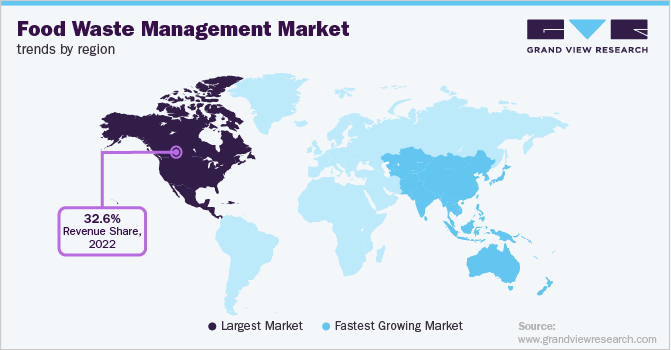
North America region dominated the market and accounted for more than 33.0% of the total revenue share in 2025. The factors contributing to food waste management in North America include damage to food products, overproduction, lack of cold-chain infrastructure, rigid food-grading specifications, standardized date labeling practices, and varying customer demand.
 To learn more about this report, Download Free Sample Report
 Europe Food Waste Management Market Trends
The food waste management market in Europe is expected to grow as the EU member states are working to reduce food waste at the source, while also investing in proper disposal methods to obtain beneficial goods like fertilizers and biogas from the processes. For instance, the EU is committed to fulfilling SDG Target 12.3 of halving per capita global food waste at consumer and retail levels by 2030. Moreover, strict food waste management rules are projected to drive the market in the region over the forecast period.
Asia Pacific Food Waste Management Market Trends
The food waste management market in Asia Pacific is expected to witness a CAGR of above 6.0% over the forecast period. The food and beverage industry in Asia Pacific is a major factor in the economic development of the region. Substantial growth is expected in the food trade with increasing levels of national and regional specialization. With a growing population and rising income, the food sector is likely to expand rapidly over the forecast period, thereby contributing to market growth.
Middle East & Africa Food Waste Management Market Trends
The advanced economies in the Middle East & Africa, such as Qatar, majorly contribute to the global food wastage on account of the lack of concern regarding losses associated with food. In addition, the unavailability of an adequate number of cold storage & warehouses and the lack of transportation facilities are the primary reasons for the generation of food waste in the region.
Key Food Waste Management Companies Insights
The market for food waste management is highly competitive in nature. Major companies in the market include Veolia, Suez, Waste Management, Inc., Republic Services, Inc., Clean Harbors, Inc., and Stericycle, Inc. The source of competition varies by region and type of service offered by the regional and local players.
Availability of skilled technical professional personnel, specialized equipment, quality of service, diversity of services, and prices are the key competitive factors in the industry. In addition, factors such as government policies, technology, high EPA fees, high capital investment, and the high cost of licensing restrict the entry of new players into the market. For instance, the U.S. has set a goal of reducing food waste by 50% by 2030 through its Department of Agriculture (USDA) and Environmental Protection Agency (EPA).
Key Food Waste Management Companies
The following key companies have been profiled for this study on the food waste management market.
-
Veolia
-
Suez
-
Waste Management, Inc.
-
Republic Services, Inc.
-
Covanta Ltd.
-
Stericycle, Inc.
-
Remondis SE & Co., KG
-
Clean Harbors, Inc.
-
Biffa
-
Rumpke
-
Advanced Disposal Services, Inc.
-
Cleanaway
-
FCC Recycling (UK) Limited
-
DS Smith
Recent Developments
-
In December 2025, food waste technology company Mill entered a strategic partnership with Amazon and Whole Foods Market to implement its commercially viable food waste recycling systems into Whole Foods supermarkets. The partnership aims to convert the fruit and vegetable waste into nutritious components for chicken feed within the closed-loop economy circle model. This project was supported by an investment from Amazon's Climate Pledge Fund.
-
In May 2026, according to an article published by the Times of India, India made substantial progress in implementing the technologies to process and convert the organic waste into energy sources and other useful materials in Nagpur. For instance, the Bhandewadi Integrated Solid Waste Processing Facility and India's first dry fermentation plant that converts municipal solid waste into compressed biogas and is proposed to process around 1,200 to 1,500 tons of waste per day and produce biogas, compost, and fuel alternatives.
Food Waste Management Market Report Scope
Report Attribute
Details
Market size in 2025
USD 81.7 billion
Estimated market size in 2026
USD 86.1 billion
Projected market size by 2033
USD 124.2 billion
Growth rate
CAGR of 5.4% from 2026 to 2033
Base year for estimation
2025
Historical data
2021 - 2024
Forecast period
2026 - 2033
Quantitative units
Revenue in USD billion, and CAGR from 2026 to 2033
Report coverage
Revenue forecast, company ranking, competitive landscape, growth factors, and trends
Segments covered
Waste type, source, service types, region
Regional scope
North America; Europe; Asia Pacific; Latin America; Middle East & Africa
Country scope
U.S.; Canada; Mexico; France; Germany; Italy; UK; China; India; Japan; South Korea; Australia; Brazil; Argentina; South Africa; UAE
Key companies profiled
Veolia; Suez; Waste Management, Inc.; Republic Services, Inc.; Covanta Ltd.; Stericycle, Inc.; Remondis SE & Co., KG; Clean Harbors, Inc.; Biffa; Rumpke; Advanced Disposal Services, Inc.; Cleanaway; FCC Recycling (UK)Limited; DS Smith
Customization scope
Free report customization (equivalent to up to 8 analysts working days) with purchase. Addition or alteration to country, regional & segment scope.
Pricing and purchase options
Avail of customized purchase options to meet your exact research needs. Explore purchase options
Global Food Waste Management Market Report Segmentation
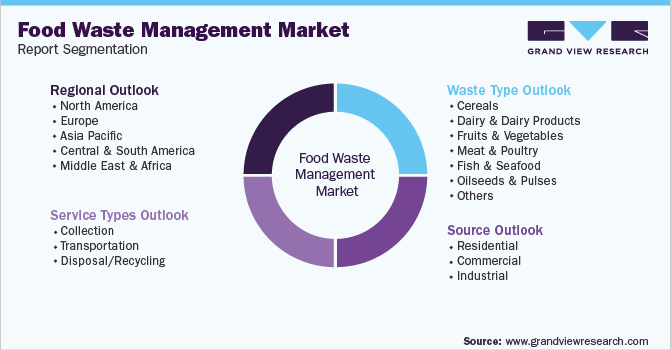
This report forecasts revenue growth at global, regional, and country levels and provides an analysis of the latest industry trends in each of the sub-segments from 2021 to 2033. For this study, Grand View Research has segmented the global food waste management market report based on waste type, source, service type, and region:
 To learn more about this report, Download Free Sample Report
 -
Waste Type Outlook (Revenue, USD Billion, 2021 - 2033)
-
Cereals
-
Dairy & Dairy Products
-
Fruits & Vegetables
-
Meat & Poultry
-
Fish & Seafood
-
Oilseeds & Pulses
-
Roots & Tubers
-
Others
-
-
Source Outlook (Revenue, USD Billion, 2021 - 2033)
-
Residential
-
Industrial
-
-
Service Types Outlook (Revenue, USD Billion, 2021 - 2033)
-
Collection
-
Transportation
-
Disposal/Recycling
-
Landfill
-
Incineration
-
Composting
-
Others
-
-
-
Regional Outlook (Revenue, USD Billion, 2021 - 2033)
-
North America
-
U.S.
-
Canada
-
Mexico
-
-
Europe
-
France
-
Germany
-
Italy
-
U.K.
-
-
Asia Pacific
-
China
-
India
-
Japan
-
South Korea
-
Australia
-
-
Central & South America
-
Brazil
-
Argentina
-
-
Middle East & Africa
-
South Africa
-
UAE
-
-
Frequently Asked Questions About This Report
North America dominated with a revenue share of 33.0% in 2025.
The global food waste management market size was valued at USD 81.7 billion in 2025 and is expected to be USD 86.1 billion in 2026.
The global food waste management market, in terms of revenue, is expected to grow at a compound annual growth rate of 5.4% from 2026 to 2033 to reach USD 124.2 billion by 2033.
Collection segment accounted for above 55.0% of the total revenue share in 2025.
Some of the key players operating in the food waste management market include Veolia; Suez; Waste Management, Inc.; Republic Services, Inc.; Covanta Ltd.; Stericycle, Inc.; Remondis SE & Co., KG; Clean Harbors, Inc.; Biffa; Rumpke; Advanced Disposal Services, Inc.; Cleanaway; FCC Recycling (UK)Limited; DS Smith
About the Author(s)
Food Safety & Processing Research Team
Consumer Goods · Food Safety & ProcessingThis report was authored by the food safety & processing research team at Grand View Research - comprising two research analysts, one senior research analyst, and one industry expert - with specialized expertise in the food safety & processing segment of the consumer goods industry. All findings are based on proprietary consumer goods databases, executive interviews, and regulatory analysis, subject to internal peer review prior to publication.
Last Updated:
Speak to Analyst

Customize this report to your needs - add regions, segments, or data points, with 20% free customization.
Or view our licence options:


ISO 9001:2015 & 27001:2022 Certified
We are GDPR and CCPA compliant! Your transaction & personal information is safe and secure. For more details, please read our privacy policy.


