
- Home
- »
- Network Security
- »
-
Fraud Detection And Prevention In BFSI Market Report, 2033GVR Report cover

Fraud Detection And Prevention In BFSI Market (2026 - 2033)
Size, Share & Trends Analysis Report By Component (Solutions, Services), By Fraud (Payment Fraud, Transaction Fraud), By Deployment (Cloud, On-premises), By End Use, By Region, and Segment Forecasts
Market Size, 2025
$10.2BMarket Estimate, 2026
$11.6BMarket Forecast, 2034
$31.9BCAGR, 2026–2034
15.6%Fraud Detection And Prevention In BFSI Market Summary
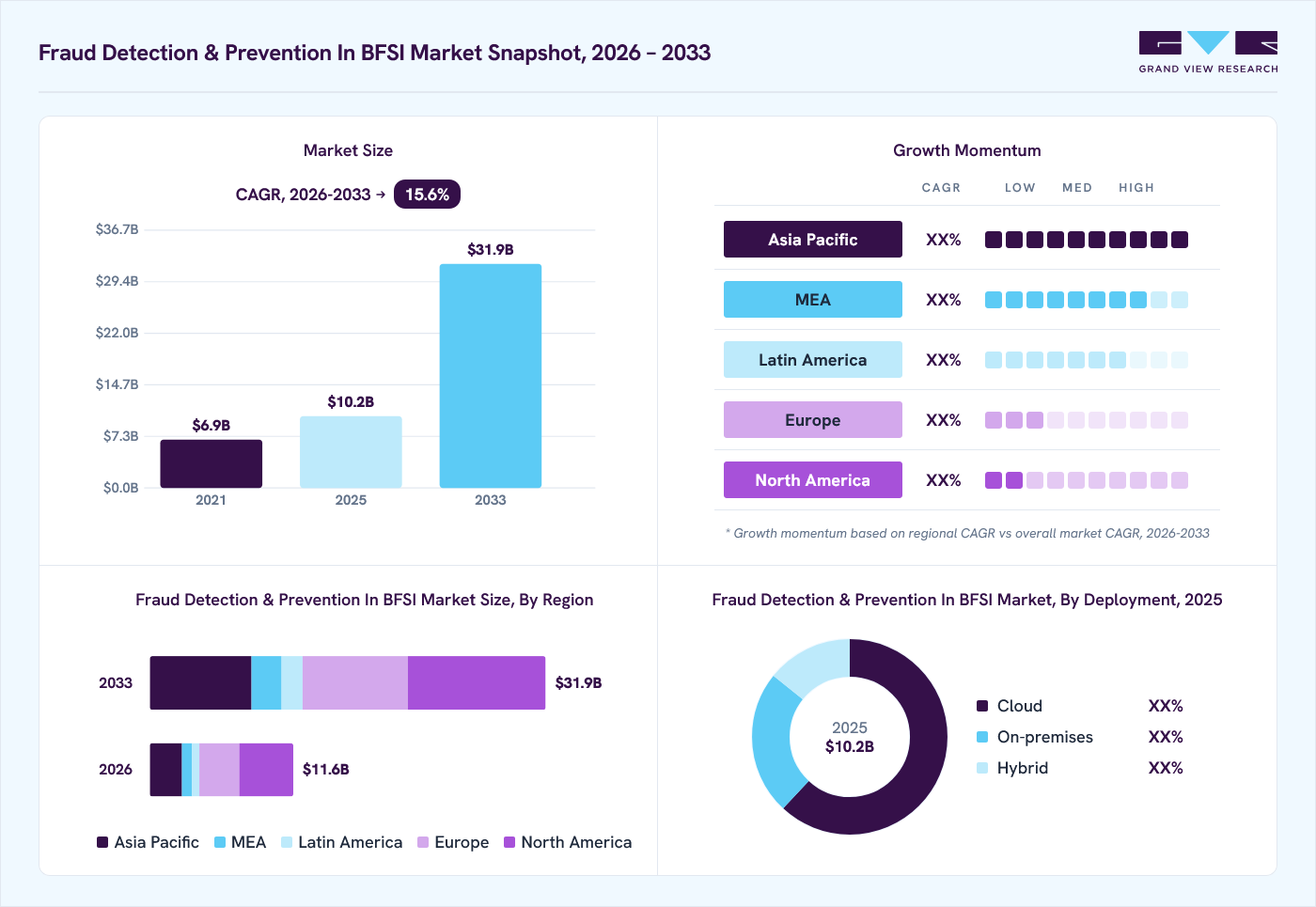
The global fraud detection and prevention in BFSI market size was valued at USD 10.2 billion in 2025 and is projected to grow from USD 11.6 billion in 2026 to USD 31.9 billion by 2033, at a CAGR of 15.6% from 2026 to 2033. North America dominated the market, accounting for a revenue share of 38.0% in 2025. The global market is witnessing strong growth as financial institutions accelerate digital transformation, expand real-time payment capabilities, and face increasingly sophisticated fraud and scam schemes.
 Source: Grand View Research, IR Documents, Primary Interviews, Paid DatabasesTo learn more about this report,
 Download Free Sample Report
 Key Market Trends & Insights
- By component: Solutions segment dominated the market, with a revenue share of 81.6% in 2025
- By fraud: Payment fraud dominated the market, with a revenue share of 48.9% in 2025.
- By deployment: Cloud segment held the largest market share in 2025.
- By end use: Banks segment held the largest market share in 2025.
Regional Highlights
- Largest regional market: North America (38.0% revenue share, 2025)
- Fastest-growing regional market: Asia Pacific (highest CAGR, 2026-2033)
- By country: The U.S. held the largest market share in 2025
Market Size & Forecasts
- Market size in 2025: USD 10.2 billion
- Estimated market size in 2026: USD 11.6 billion
- Projected market size by 2033: USD 31.9 billion
- CAGR (2026-2033): 15.6%
Three ways to get this report
Buy it, customize it, or ask a question.Ask an Analyst
A direct answer, usually in 1 working day
- AccessReport author, directly
- Reply timeWithin 1 working day
- No sales callDirect answer only
- FormatEmail reply
- CostFree, no cost
Get the Full Report
What the study covers
- FormatsPDF · Excel · Dashboard
- Timeline2026–2034 annual, 2025 base
- Coverage20+ countries, 5 regions
- Companies10+ key players profiled
Customize the Report
20% free customization
- IncludeCountries, segments, points
- TailorTo your product definition
- ExtendDeeper competitor detail
- OrA fully bespoke study
- Turnaround5–10 working days
At the same time, the growing sophistication of digital fraud is prompting banks and other financial institutions to move beyond traditional rule-based systems toward advanced, data-driven fraud prevention capabilities. The BIS highlights digital fraud as an increasing risk associated with the digitalization of finance, particularly as fraudsters exploit digital channels to obtain customer credentials and financial assets.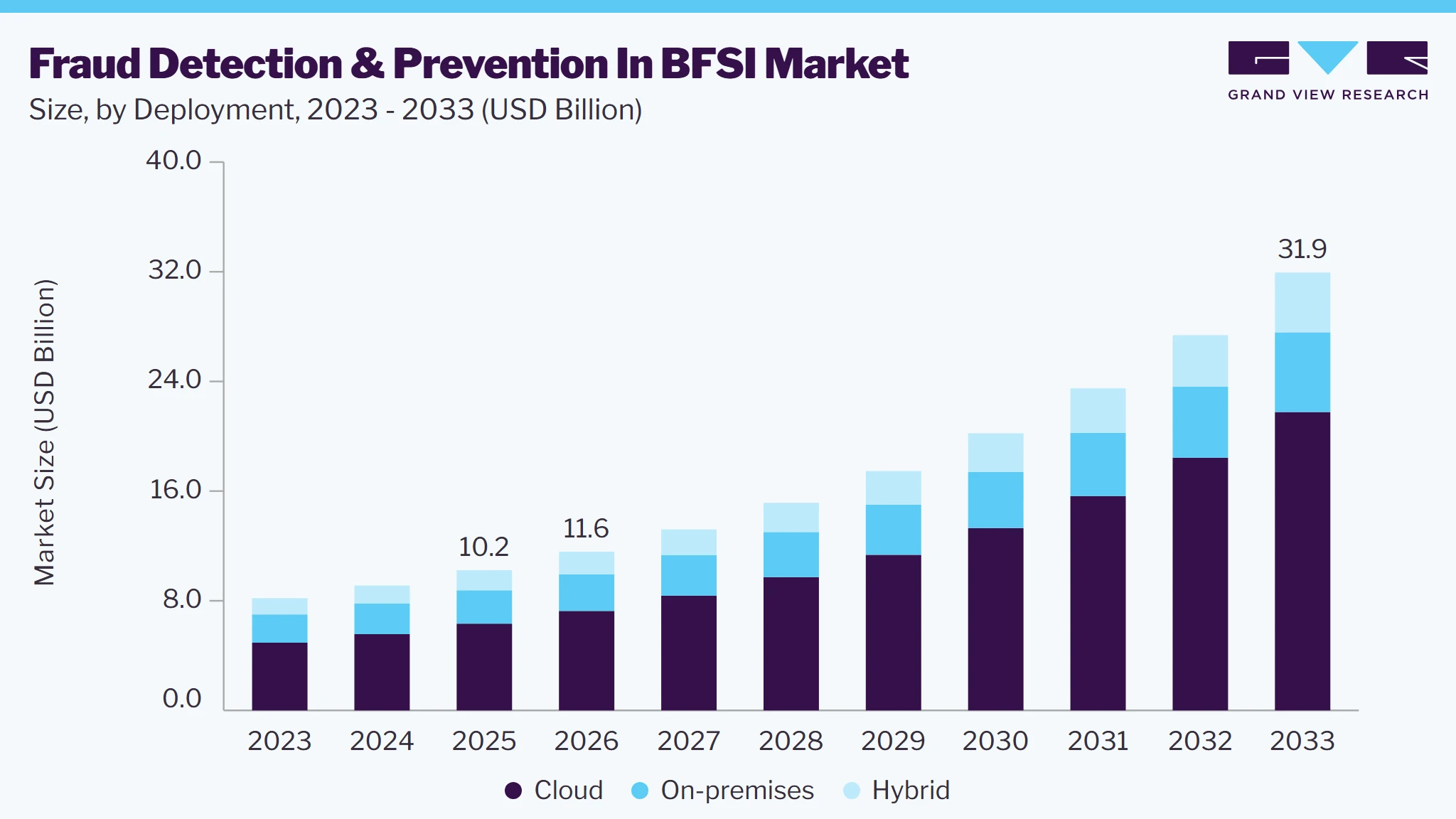 To learn more about this report, Download Free Sample Report
 The rapid adoption of mobile banking, digital wallets, instant payments, open banking, and embedded financial services has increased the volume and velocity of transactions that require continuous monitoring.
Artificial intelligence (AI), machine learning (ML), behavioral analytics, and real-time transaction monitoring are emerging as key technology trends shaping the market growth. Financial institutions are increasingly deploying AI to identify anomalous transaction patterns, detect account takeovers, assess behavioral signals, and prioritize suspicious activities. The use of network and graph-based analytics is also gaining traction as fraud increasingly involves interconnected accounts, mule networks, and coordinated criminal activity across multiple institutions. The BIS' Project Hertha demonstrated that transaction analytics and AI can identify complex financial-crime patterns in real-time payment systems using data across participants.
The market is also evolving from transaction-level fraud detection toward identity-, behavior-, and ecosystem-level prevention. Behavioral biometrics, device intelligence, digital identity verification, stronger authentication, and risk-based decisioning are increasingly being integrated into fraud platforms to identify suspicious activity before a transaction is completed. This shift is particularly important as scams and social-engineering attacks can involve legitimate users authorizing fraudulent transactions. Recent industry developments reinforce this trend; for example, Visa's planned acquisition of BioCatch is aimed at strengthening real-time fraud intelligence through behavioral signals such as keystrokes, touch gestures, and device behavior.
Market Dynamics
The fraud detection and prevention (FDP) in BFSI industry is driven by the increasing frequency and sophistication of financial fraud, including payment fraud, identity theft, account takeover, loan fraud, and digital banking scams. The rapid adoption of online banking, mobile payments, digital lending, and fintech platforms has expanded the attack surface for financial institutions, creating greater demand for real-time transaction monitoring, behavioral analytics, identity verification, and AI/ML-based fraud detection solutions. In addition, growing regulatory requirements related to financial crime prevention, AML, KYC, and customer authentication are encouraging BFSI organizations to strengthen their fraud management capabilities.
The market is also benefiting from the growing integration of artificial intelligence, machine learning, behavioral biometrics, predictive analytics, and graph-based technologies, which enable institutions to identify anomalous behavior and detect previously unknown fraud patterns. However, high implementation costs, integration challenges with legacy banking infrastructure, data privacy concerns, and the need for skilled cybersecurity and fraud-analysis professionals may restrain market growth. Meanwhile, the increasing adoption of cloud-based fraud prevention platforms, risk-based authentication, and real-time fraud orchestration presents significant opportunities for vendors as financial institutions seek scalable and proactive approaches to fraud prevention.
The rapid adoption of digital banking, mobile payments, online lending, and card-based transactions has expanded the attack surface for financial institutions. Increasingly sophisticated fraud techniques, including account takeover, identity theft, payment fraud, and synthetic identity fraud, are driving BFSI organizations to adopt advanced fraud detection and prevention solutions powered by AI, machine learning, behavioral analytics, and real-time transaction monitoring.
Integrating fraud detection solutions with legacy banking infrastructure, core banking systems, payment platforms, and multiple data sources can be complex and costly. Financial institutions may also face challenges related to data quality, system interoperability, model deployment, and ongoing maintenance, particularly when implementing real-time and AI-driven fraud prevention capabilities.
The increasing use of artificial intelligence, machine learning, behavioral analytics, and graph-based analytics creates significant opportunities for fraud detection providers. These technologies enable financial institutions to analyze large volumes of transactional and behavioral data in real time, identify previously unknown fraud patterns, reduce false positives, and proactively prevent fraudulent transactions across digital banking and payment channels.
Market Concentration & Characteristics
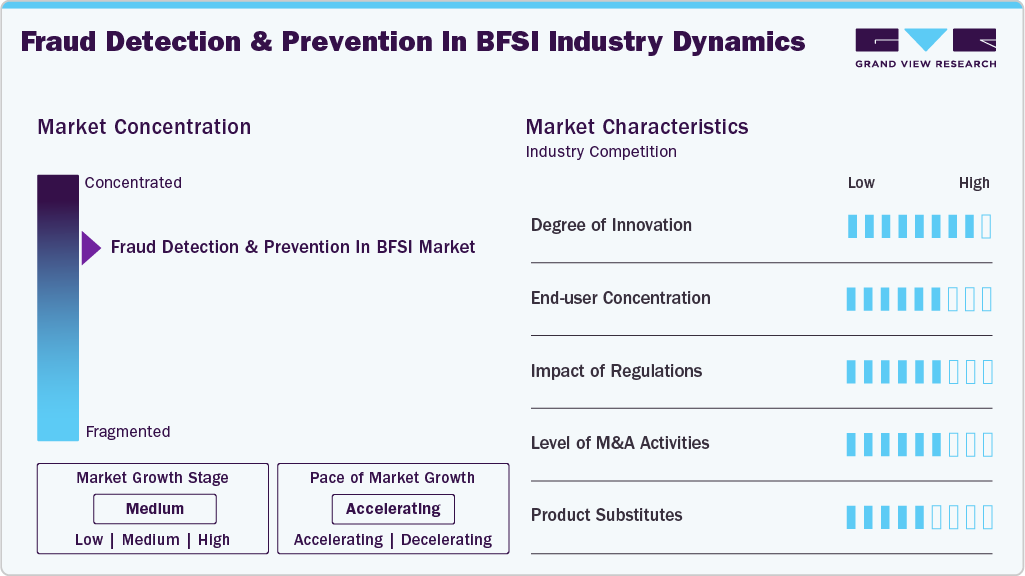
The global Fraud Detection and Prevention (FDP) in BFSI industry is moderately concentrated, with participation from established cybersecurity, financial technology, enterprise software, and risk management providers. Leading players such as IBM, Microsoft, SAS, FICO, Experian, LexisNexis Risk Solutions, NICE Actimize, Feedzai, BioCatch, and Mastercard are strengthening their presence through transaction monitoring, identity verification, behavioral analytics, payment fraud prevention, risk scoring, and financial crime management solutions. Specialized providers are also expanding their capabilities in AI-driven fraud detection, behavioral biometrics, device intelligence, graph analytics, and real-time transaction risk assessment.
 To learn more about this report, Download Free Sample Report
 The market is witnessing increasing technological development focused on real-time fraud detection, automated decision-making, behavioral analysis, and adaptive risk assessment. Vendors are integrating transaction data, customer behavior, device intelligence, identity signals, and external data sources into unified fraud prevention platforms, while growing digital banking and payment adoption is increasing the need for continuous and cross-channel fraud monitoring. Adoption of AI and machine learning, generative AI, behavioral biometrics, graph analytics, and cloud-based fraud platforms, alongside increasing regulatory requirements for financial crime prevention and stronger authentication, is further shaping competitive strategies and encouraging integrated fraud detection and prevention (FDP) architectures across banking, payments, lending, and insurance environments.
Analyst Perspective
The market is evolving rapidly as financial institutions increasingly prioritize real-time, AI-driven fraud detection across digital payment and banking channels. Established players maintain a competitive advantage through broad product portfolios, extensive customer bases, and deep integration capabilities, while emerging vendors differentiate through specialized behavioral analytics and AI-native solutions. Increasing fraud sophistication, including account takeover, synthetic identity, and AI-enabled scams, is accelerating demand for adaptive and continuous fraud monitoring. Partnerships, platform integrations, and cloud-based deployment are expected to remain key strategies for expanding market reach. Overall, vendors with strong AI capabilities, real-time analytics, and scalable platforms are likely to gain competitive share during the forecast period.
Component Insights
The solutions segment accounts for the largest share of 82.9% in 2025, driven by the increasing adoption of advanced fraud detection solutions that enable financial institutions to monitor transactions, identify suspicious activities, authenticate users, and mitigate fraud risks in real time. The growing sophistication of financial fraud, increasing digital and mobile banking transactions, and the need to protect customer accounts and sensitive financial information are further driving the deployment of AI- and machine learning-enabled fraud prevention solutions. In addition, the rising need for adaptive and real-time fraud detection capabilities is encouraging banks and financial institutions to replace conventional rule-based systems with intelligent solutions capable of detecting evolving fraud patterns and anomalies. For instance, in March 2026, Coherent Solutions released research highlighting how AI is advancing fraud detection in financial services, noting that AI and machine learning can enable real-time anomaly detection and help financial institutions address increasingly sophisticated transaction fraud, further supporting the adoption of AI-driven fraud prevention solutions. Consequently, the growing integration of AI, machine learning, behavioral analytics, and real-time monitoring capabilities is expected to sustain the dominance of the solutions segment throughout the forecast period.
The services segment is expected to witness significant CAGR from 2026 to 2033 due to the increasing reliance of banks and financial institutions on specialized third-party expertise for fraud risk assessment, solution implementation, system integration, continuous transaction monitoring, threat intelligence, and incident response. The growing complexity and frequency of financial fraud, coupled with the rapid adoption of digital banking, mobile payments, and online financial services, is increasing the need for continuous monitoring and proactive fraud management. Furthermore, financial institutions are increasingly seeking managed and professional services to integrate AI- and machine learning-based fraud detection capabilities with existing banking infrastructure, improve detection accuracy, reduce false positives, and respond rapidly to emerging fraud patterns. The need to comply with evolving financial crime regulations and strengthen fraud prevention capabilities while optimizing internal resources is also expected to accelerate the adoption of FDP-related services over the forecast period.
Fraud Insights
The payment fraud segment accounts for the largest market share of 47.9% in 2025, driven by the rapid growth of digital payments, increasing transaction volumes across debit cards, credit cards, ACH, wire transfers, and other electronic payment channels, and the growing sophistication of fraud schemes targeting payment transactions. The increasing use of impersonation, social engineering, account takeover, and credential compromise is further elevating fraud risks across payment ecosystems, prompting financial institutions to strengthen real-time transaction monitoring, authentication, anomaly detection, and fraud prevention capabilities. For instance, in April 2026, the Federal Reserve Financial Services reported that financial institutions were experiencing rising fraud attempts and losses across major payment channels, with debit card fraud remaining the most widespread type, reported by 75% of surveyed institutions and accounting for an estimated 40% of total payments fraud losses. Consequently, the continued expansion of digital payment ecosystems and the increasing financial impact of payment-related fraud are expected to sustain the segment's leading position in the market.
The transaction fraud segment is predicted to register the fastest CAGR during the upcoming forecast years, driven by the rapid expansion of digital banking and real-time payment transactions, increasing transaction volumes, and the growing sophistication of fraud techniques such as account takeover, credential compromise, social engineering, and unauthorized transfers. The increasing speed and complexity of financial transactions are also encouraging banks and financial institutions to adopt real-time transaction monitoring, behavioral analytics, AI-based anomaly detection, and automated risk scoring to identify suspicious activities before fraudulent transactions are completed. In addition, the growing attack surface created by interconnected digital payment ecosystems is increasing the need for continuous transaction-level monitoring and adaptive fraud prevention capabilities. The widespread adoption of digital payments and real-time payment infrastructure has increased the scale and speed of fraud execution, making fraud prevention and detection increasingly critical for financial institutions. Consequently, the rising volume and velocity of digital transactions, combined with increasingly sophisticated transaction-level fraud schemes, are expected to accelerate demand for advanced transaction fraud detection solutions over the forecast period.
Deployment Insights
The cloud segment dominated the market with the largest revenue share of 61.9% in 2025 due to the scalability, flexibility, and cost efficiency offered by cloud-based fraud detection platforms, which enable financial institutions to process growing volumes of transaction and customer data without significant investments in on-premises infrastructure. Cloud deployment also facilitates real-time data processing, rapid deployment of AI and machine learning models, seamless integration with digital banking and payment systems, and continuous updates to fraud detection capabilities. Furthermore, the increasing adoption of digital banking and real-time payments is creating demand for highly scalable infrastructure capable of monitoring large volumes of transactions and adapting to evolving fraud patterns. Cloud-native platforms enable financial institutions to combine real-time analytics, machine learning, and automated decision-making while supporting flexible capacity expansion as transaction volumes increase. Consequently, the ability of cloud-based FDP solutions to deliver scalable, real-time, and AI-enabled fraud detection while reducing infrastructure and operational burdens is expected to sustain the segment's dominance over the forecast period.
The hybrid segment is projected to witness notable growth during the forecast period due to the growing need among banks and financial institutions to balance the scalability and advanced analytics capabilities of cloud environments with the security, control, and compliance advantages of on-premises infrastructure. Hybrid deployment enables BFSI organizations to retain sensitive customer, transaction, and core banking data within controlled environments while leveraging cloud infrastructure for computationally intensive fraud analytics, AI/ML model training, and real-time transaction monitoring. The increasing complexity of fraud, stringent data protection requirements, and the continued presence of legacy banking systems are further encouraging financial institutions to adopt flexible deployment models that support gradual modernization without requiring complete migration to the cloud. For instance, in June 2026, N-iX highlighted that hybrid cloud is particularly relevant for banks because regulated and sensitive workloads can remain in private environments while elastic and computationally intensive workloads can leverage public cloud infrastructure, with fraud detection identified as a key hybrid-cloud use case. Consequently, the ability of hybrid deployments to combine data control, regulatory compliance, scalability, and advanced fraud analytics is expected to drive their adoption across BFSI institutions during the forecast period.
End Use Insights
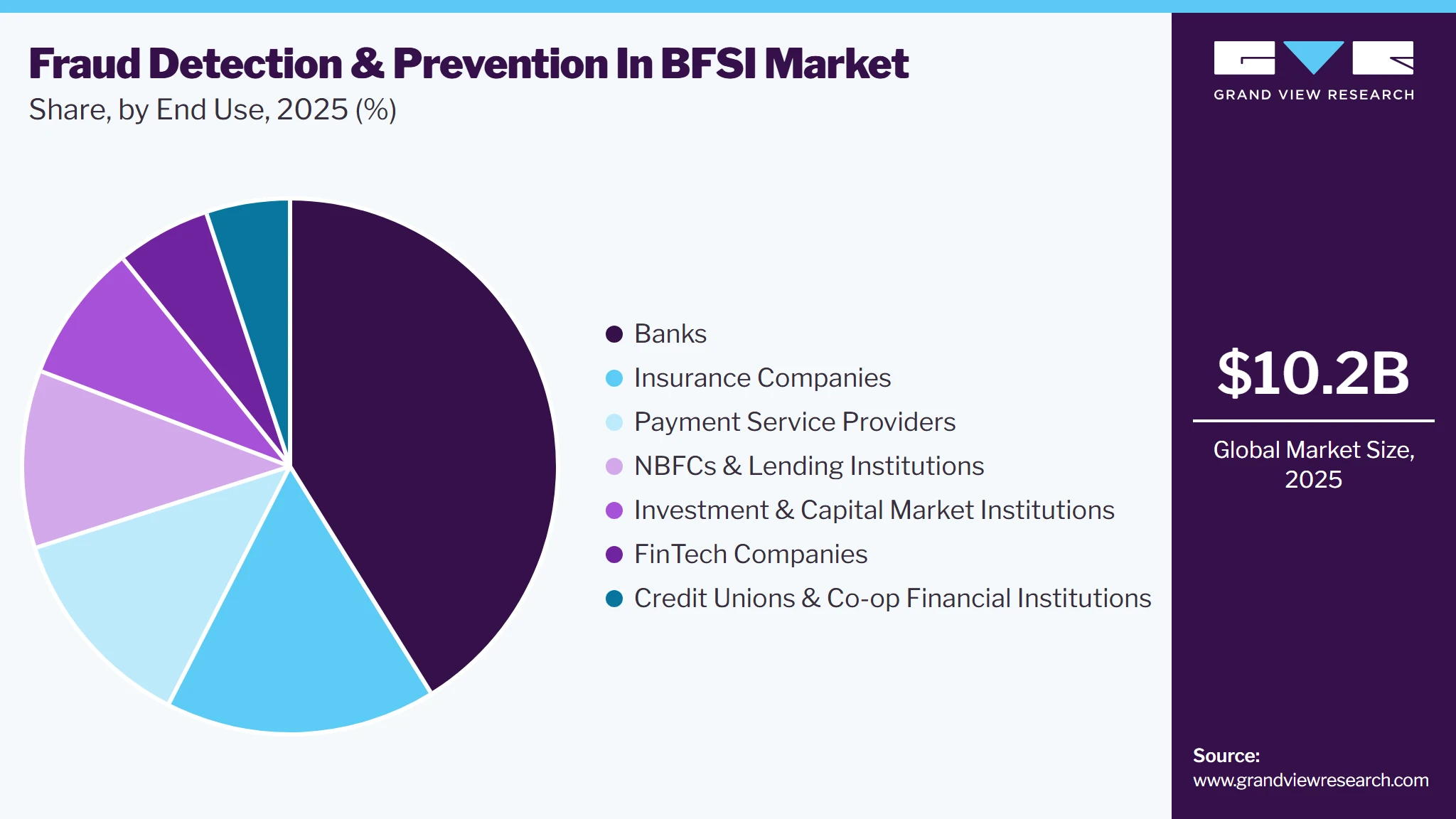
The banks segment accounted for the largest share of 41.1% in 2025, driven by the high volume and value of financial transactions processed by banks, the rapid expansion of digital and mobile banking services, and their increasing exposure to identity theft, payment fraud, account takeover, loan fraud, and money laundering. Banks are increasingly investing in advanced FDP solutions to strengthen real-time transaction monitoring, customer authentication, behavioral analytics, and risk assessment while complying with stringent regulatory requirements and protecting customer trust. The growing sophistication of fraud schemes and the increasing use of AI-enabled attacks are further compelling banks to enhance their fraud prevention infrastructure and adopt AI- and machine learning-based detection capabilities. For instance, in May 2026, the Indian Cyber Crime Coordination Centre (I4C) and Reserve Bank Innovation Hub (RBIH) signed an MoU to strengthen AI-driven detection of mule accounts and cyber financial frauds across the banking and digital payments ecosystem, including the use of suspect-registry data to enhance AI-based fraud-risk assessment models deployed across banks. Consequently, the substantial fraud exposure of banks, combined with their expanding digital transaction ecosystems and growing investments in advanced fraud prevention technologies, is expected to sustain their dominant position in the FDP in BFSI market.
 To learn more about this report, Download Free Sample Report
 The fintech companies segment is expected to grow at a significant CAGR over the forecast period, driven by the rapid expansion of digital financial services, mobile payments, digital lending, and embedded finance, which exposes fintech companies to increasing risks of payment fraud, identity theft, account takeover, and synthetic identity fraud. The highly digital and technology-driven nature of fintech operations is also encouraging these companies to integrate AI, machine learning, behavioral analytics, and real-time transaction monitoring into their platforms to identify suspicious activities and mitigate fraud without creating excessive friction for legitimate customers. In addition, the increasing regulatory focus on consumer protection, cybersecurity, and financial crime prevention is compelling fintech companies to strengthen their fraud management capabilities. Consequently, the combination of rapidly expanding digital transaction volumes, evolving fraud threats, and increasing adoption of AI-driven risk management is expected to accelerate FDP adoption among fintech companies during the forecast period.
Regional Insights
North America Fraud Detection And Prevention In BFSI Market Trends
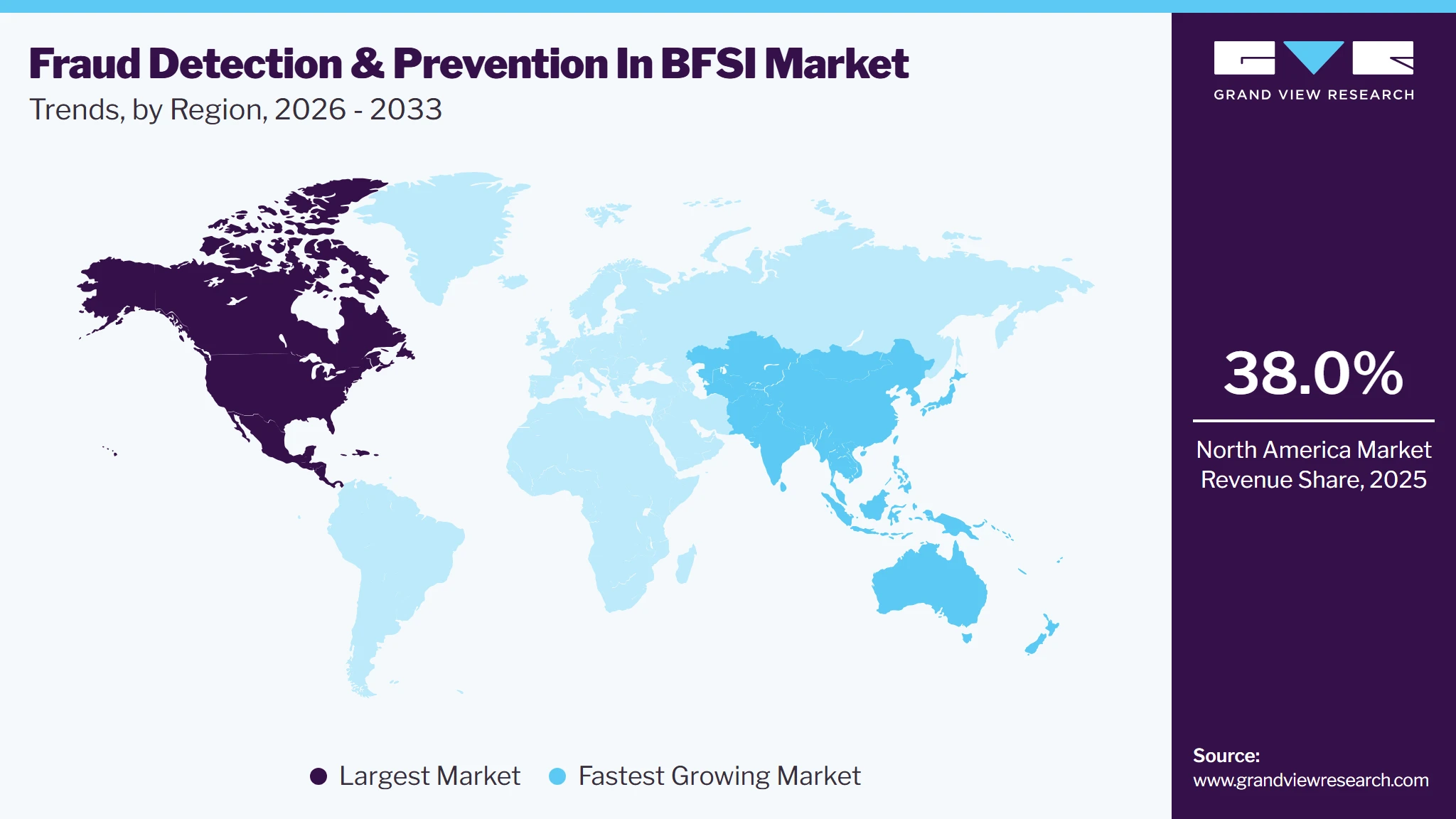
The North America fraud detection and prevention in BFSI industry accounted for the largest revenue share of 38.0% in 2025 and is witnessing strong adoption of AI-driven and real-time fraud detection technologies as financial institutions face rising payment fraud, account takeover, identity theft, and AI-enabled scams. Banks are increasingly deploying behavioral analytics, machine learning, biometric authentication, and transaction monitoring to improve detection accuracy and reduce false positives. The expansion of digital banking and instant payments, along with tightening fraud-risk management requirements, is further driving demand for advanced, integrated FDP solutions.
 To learn more about this report, Download Free Sample Report
 U.S. Fraud Detection And Prevention In BFSI Market Trends
The fraud detection and prevention in BFSI industry in the U.S. is expected to grow significantly from 2026 to 2033, driven by the increasing prevalence of account takeover, payment fraud, identity theft, and AI-enabled scams, alongside the rapid adoption of digital banking and electronic payment channels. Financial institutions are increasingly deploying AI, behavioral analytics, device intelligence, biometric authentication, and real-time transaction monitoring to strengthen fraud detection and reduce losses. The growing sophistication of automated attacks and generative-AI-enabled phishing and impersonation is further increasing the need for layered fraud prevention capabilities. For instance, the Federal Reserve reported in February 2026 that U.S. account-takeover losses exceeded $15.6 billion in 2024, highlighting the growing need for stronger detection and prevention measures. Consequently, rising fraud exposure and continued financial-sector digitalization are expected to accelerate FDP adoption across U.S. BFSI institutions.
Asia Pacific Fraud Detection And Prevention In BFSI Market Trends
The fraud detection and prevention (FDP) in BFSI industry in Asia Pacific region is expected to grow at the fastest CAGR during the forecast period, driven by the rapid expansion of digital banking, mobile wallets, real-time payments, and fintech ecosystems, which is increasing transaction volumes and exposure to sophisticated fraud and scams. The growing use of AI by fraudsters is also encouraging financial institutions to adopt AI-driven, behavioral, and real-time fraud detection capabilities. In addition, rising regulatory focus on digital payment security and fraud prevention across countries such as India, Singapore, and Australia is supporting market growth. For instance, in June 2026, a BioCatch survey found that 86% of surveyed financial institution leaders across APAC believed AI had increased the sophistication of fraud and scams, while 81% reported increasing fraud attempts, highlighting the growing need for advanced FDP solutions. Consequently, rapid financial digitalization, rising fraud exposure, and increasing adoption of AI-enabled fraud prevention technologies are expected to position Asia Pacific as the fastest-growing regional market.
The China market for fraud detection and prevention in BFSI industry held a significant share in 2025, owing to the rapid expansion of digital banking and mobile payment ecosystems, rising sophistication of financial fraud and scams, and increasing adoption of AI-driven risk management technologies by financial institutions. Chinese banks are increasingly deploying real-time transaction monitoring, AI-based fraud analytics, behavioral analysis, and automated risk controls to address large transaction volumes and evolving fraud patterns. Furthermore, government initiatives to strengthen digital financial risk management and the growing integration of AI into banking operations are supporting FDP adoption. For instance, in June 2026, China Industrial Bank unified its financial crime, fraud, and anti-money laundering applications into an AI-driven risk detection platform, demonstrating the increasing use of AI to strengthen fraud prevention and protect customers from evolving threats. Consequently, continued digitalization of financial services and growing investments in AI-enabled fraud prevention are expected to support the growth of the China FDP in BFSI market.
The fraud detection and prevention in BFSI industry in Japan is witnessing strong expansion driven by the increasing adoption of AI and advanced analytics across financial institutions, rising exposure to sophisticated financial fraud and cyber-enabled scams, and growing regulatory emphasis on AI-related risk management. Japanese banks and financial institutions are increasingly using AI for advanced risk management and fraud detection, while the rapid adoption of generative AI is creating additional requirements for stronger fraud prevention and security controls. In August 2026, the Bank of Japan reported that more than 90% of surveyed Japanese financial institutions were using or trialing generative AI, with applications expanding into core operations and risk management. In addition, Japan's Financial Services Agency and Bank of Japan have strengthened initiatives addressing threats arising from frontier AI, encouraging financial institutions to enhance risk management and security measures. Consequently, growing AI adoption, evolving fraud threats, and increasing regulatory focus are expected to drive demand for advanced FDP solutions in Japan.
The India market for fraud detection and prevention (FDP) in BFSI is experiencing strong growth, driven by rapid expansion of digital banking, UPI, mobile payments, and other electronic financial services, which is increasing transaction volumes and exposure to sophisticated fraud schemes. The growing use of AI-enabled impersonation, social engineering, identity theft, account takeover, and mule accounts is further increasing the need for real-time fraud detection and prevention capabilities. In addition, Indian financial institutions are increasingly adopting AI, machine learning, behavioral analytics, and transaction monitoring technologies to strengthen fraud-risk assessment and identify suspicious activities more effectively. For instance, in May 2026, the Indian Cyber Crime Coordination Centre (I4C) and Reserve Bank Innovation Hub (RBIH) signed an MoU to strengthen AI-driven detection of mule accounts and cyber-enabled financial frauds across the banking and digital payments ecosystem. Furthermore, the continued scaling of UPI and other digital payment channels is expanding the fraud attack surface and increasing demand for advanced, real-time fraud prevention solutions. Consequently, the increasing digitalization of India's BFSI sector, rising sophistication of financial fraud, and growing deployment of AI-driven fraud management technologies are expected to support strong market growth over the forecast period.
Europe Fraud Detection And Prevention In BFSI Market Trends
The Europe fraud detection and prevention in BFSI industry is growing at a significant CAGR from 2026 to 2033 due to the increasing adoption of digital banking and electronic payment services, rising sophistication of payment fraud and financial scams, and growing deployment of AI-driven fraud detection technologies across financial institutions. In addition, stringent regulatory requirements and increasing supervisory focus on operational resilience, AI governance, and fraud risk management are encouraging financial institutions to strengthen their fraud prevention capabilities. For instance, the European Central Bank reported that more than 85% of supervised banks were using AI, with fraud detection among the key applications, while European supervisory authorities have emphasized stronger governance and risk management for AI-related risks in the financial sector. Consequently, increasing digitalization, evolving fraud threats, and regulatory emphasis on advanced fraud prevention and AI governance are expected to drive sustained growth of the European FDP in BFSI market during the forecast period.
The fraud detection and prevention in BFSI industry in the UK is witnessing strong growth due to the increasing prevalence of financial fraud and scams, rapid adoption of digital banking and electronic payment services, and growing deployment of AI and data-driven technologies for fraud detection. In addition, regulatory efforts to combat financial crime and strengthen fraud prevention are supporting market growth, with the Financial Conduct Authority (FCA) emphasizing data-driven detection and the adoption of new technologies to identify and disrupt financial crime more effectively. Furthermore, the FCA's 2026 Supercharged Sandbox includes initiatives focused on developing AI-enabled solutions for more effective fraud and economic crime detection, highlighting the increasing role of advanced technologies in the UK financial sector. Consequently, rising fraud risks, regulatory emphasis, and increasing adoption of AI-driven fraud prevention technologies are expected to drive continued growth of the UK FDP in BFSI market during the forecast period.
Germany fraud detection and prevention in BFSI industry held a significant market share in 2025, supported by the country’s large and highly developed banking and financial services sector, increasing digitalization of financial services, and growing adoption of AI-driven fraud detection and prevention technologies. German financial institutions are increasingly deploying AI for fraud detection, prevention, automated risk management, and customer-related processes, with the financial and insurance sector reporting AI adoption of 54% in 2025. The increasing regulatory oversight of AI use in financial institutions by BaFin is further supporting the development of controlled and secure AI applications across the sector. Consequently, strong AI adoption, continued digitalization of financial services, and increasing regulatory emphasis on fraud and technology risk management are expected to support the growth of the Germany FDP in BFSI market over the forecast period.
Key Fraud Detection And Prevention In BFSI Company Insights
Some of the key companies operating in the market include ACI Worldwide, BioCatch, DataVisor, Experian, among others. These companies are some of the leading participants in the market.
Key Fraud Detection And Prevention In BFSI Companies:
The following key companies have been profiled for this study on the fraud detection and prevention in BFSI market.
-
ACI Worldwide
-
BioCatch
-
DataVisor
-
Experian
-
Featurespace
-
Feedzai
-
FICO
-
Fiserv
-
IBM
-
LexisNexis Risk Solutions
-
NICE Actimize
-
Outseer
-
SAS
-
TransUnion
-
Verafin (Nasdaq)
Competitive Benchmarking
Operating Strategies
Competitive Edge
Weaknesses
Mature Players: ACI Worldwide; Experian; FICO; Fiserv; IBM; LexisNexis Risk Solutions; NICE Actimize; SAS; TransUnion
- Developing and expanding integrated Fraud Detection and Prevention (FDP) portfolios covering transaction monitoring, payment fraud prevention, identity verification, behavioral analytics, risk scoring, account takeover prevention, and fraud investigation.
- Increasing investments in AI/ML, behavioral biometrics, real-time analytics, graph analytics, and automated decisioning to detect sophisticated and evolving fraud patterns across digital banking and payment channels.
- Strong global presence established relationships with banks, insurers, payment providers, and other financial institutions, and extensive installed customer bases.
- Ability to integrate multiple fraud prevention capabilities, including identity intelligence, transaction monitoring, authentication, risk analytics, case management, and AI-driven detection, into comprehensive FDP platforms.
- Large-scale and highly integrated FDP platforms can involve high implementation costs, complex integration requirements, and lengthy deployment cycles, particularly for financial institutions operating legacy systems.
- Broad product portfolios and complex technology architectures can increase customization, integration, and ongoing management requirements for customers.
Emerging Players: BioCatch; DataVisor; Feedzai; Featurespace; Outseer
- Focusing on specialized FDP capabilities such as behavioral intelligence, real-time fraud detection, AI-driven risk scoring, payment fraud prevention, and adaptive analytics.
- Increasing emphasis on emerging fraud risks, including account takeover, authorized push payment fraud, synthetic identity, social engineering, and AI-enabled scams, while expanding partnerships with banks, fintechs, and payment providers.
- Greater specialization in AI-native, behavioral, and real-time fraud detection technologies enables these companies to address rapidly evolving fraud patterns with greater flexibility.
- Agile technology development and cloud-native architectures can enable faster deployment, integration, and adaptation to emerging fraud scenarios compared with traditional legacy platforms.
- Comparatively smaller installed bases and global footprints can limit their ability to compete for large, enterprise-wide FDP deployments against established technology and financial-services vendors.
- Greater dependence on partnerships, integrations, and adoption by financial institutions can increase commercialization and scaling risks, particularly in highly regulated BFSI markets.
Recent Developments
-
In August 2026, DataVisor partnered with Navan to strengthen real-time fraud detection across Navan’s travel, expense, and payments platform by combining adaptive AI and machine learning with real-time risk detection. The partnership enhances FDP capabilities by enabling detection of emerging fraud patterns and coordinated attacks in high-volume transaction environments, while reducing fraud risk without adding friction to legitimate customers.
-
In August 2026, Visa announced its agreement to acquire BioCatch for USD 2.4 billion, adding BioCatch’s behavioral and device intelligence capabilities to its existing fraud and security solutions. The acquisition strengthens FDP capabilities by enabling earlier detection of account takeovers, scams, money mules, and application fraud through AI/ML-based behavioral signals, helping prevent fraud before a payment occurs.
-
In April 2026, ACI Worldwide and Kinexys by J.P. Morgan integrated Kinexys Liink’s Confirm application into ACI’s Fraud and Financial Crime solution, enabling real-time account and payee verification before payments are initiated. The integration strengthens FDP capabilities for real-time payments by helping banks detect misdirected payments and APP scams upfront, rather than relying solely on post-transaction monitoring.
Fraud Detection And Prevention In BFSI Market Report Scope
Report Attribute
Details
Market size in 2025
USD 10.2 billion
Estimated market size in 2026
USD 11.6 billion
Projected market size by 2033
USD 31.9 billion
Growth rate
CAGR of 15.6% from 2026 to 2033
Actual data
2021 - 2025
Forecast period
2026 - 2033
Quantitative units
Revenue in USD billion and CAGR from 2026 to 2033
Report coverage
Revenue forecast, company share, competitive landscape, growth factors, and trends
Segments covered
Component, fraud, deployment, end use, region
Regional scope
North America; Europe; Asia Pacific; Latin America; MEA
Country scope
U.S.; Canada; Mexico; UK; Germany; France; China; India; Japan; Australia; South Korea; Brazil; UAE; Saudi Arabia; South Africa
Key companies profiled
ACI Worldwide; BioCatch; DataVisor; Experian; Featurespace; Feedzai; FICO; Fiserv; IBM; LexisNexis Risk Solutions; NICE Actimize; Outseer; SAS; TransUnion; Verafin (Nasdaq)
Customization scope
Free report customization (equivalent to 8 analysts working days) with purchase. Addition or alteration to country, regional & segment scope.
Pricing and purchase options
Avail customized purchase options to meet your exact research needs. Explore purchase options
Global Fraud Detection And Prevention In BFSI Market Report Segmentation
This report forecasts revenue growth at global, regional, and country levels and provides an analysis of the latest trends in each of the sub-segments from 2021 to 2033. For this study, Grand View Research has segmented the Fraud Detection and Prevention (FDP) in BFSI market report based on component, fraud, deployment, end use, and region.
-
Component Outlook (Revenue, USD Billion, 2021 - 2033)
-
Solutions
-
Fraud Analytics & Risk Scoring
-
Authentication & Identity Verification
-
Transaction Monitoring & Fraud Detection
-
Governance, Risk & Compliance (GRC)
-
Case Management & Investigation
-
Others
-
-
Services
-
-
Fraud Outlook (Revenue, USD Billion, 2021 - 2033)
-
Payment Fraud
-
Identity & Account Fraud
-
Transaction Fraud
-
Loan & Credit Fraud
-
Insurance Fraud
-
Others
-
-
Deployment Outlook (Revenue, USD Billion, 2021 - 2033)
-
Cloud
-
On-premises
-
Hybrid
-
-
End Use Outlook (Revenue, USD Billion, 2021 - 2033)
-
Banks
-
Insurance Companies
-
NBFCs & Lending Institutions
-
Payment Service Providers
-
Investment & Capital Market Institutions
-
FinTech Companies
-
Credit Unions & Cooperative Financial Institutions
-
-
Regional Outlook (Revenue, USD Billion, 2021 - 2033)
-
North America
-
U.S.
-
Canada
-
Mexico
-
-
Europe
-
Germany
-
UK
-
France
-
-
Asia Pacific
-
China
-
India
-
Japan
-
South Korea
-
Australia
-
-
Latin America
-
Brazil
-
-
Middle East & Africa
-
UAE
-
Saudi Arabia
-
South Africa
-
-
Research Methodology
The fraud detection and prevention in BFSI market figures in this report are based on a proven research process that combines executive interviews with secondary research from proprietary databases, company filings, and recognized regulatory and institutional sources. Market size is built through value-chain sizing-reconciling supply-side and demand-side estimates-and triangulated with bottom-up and top-down approaches. Every estimate passes multiple levels of expert validation before publication, with each fraud detection and prevention in BFSI segment quantified using the revenue-capture definitions in the table below.
Segment Definition
Component
Revenue Capture Definition
Solutions
Revenue generated from fraud detection and prevention solutions, platforms, and software applications designed to identify, assess, monitor, prevent, and respond to fraudulent activities across the BFSI sector. Includes transaction monitoring, fraud analytics and risk scoring, identity and account verification, behavioral analytics, anomaly detection, payment fraud prevention, case management, fraud orchestration, and AI/ML-enabled fraud detection and prevention platforms.
Services
Revenue generated from professional, implementation, operational, and lifecycle services associated with the deployment, integration, management, and maintenance of fraud detection and prevention systems in BFSI institutions. Includes consulting and risk assessment, solution implementation and integration, managed fraud monitoring, fraud investigation and response, system maintenance and support, model management, and compliance and advisory services.
Fraud
Revenue Capture Definition
Payment Fraud
Revenue generated from solutions and services designed to detect, prevent, monitor, and respond to fraudulent activities involving payment transactions and payment instruments. Includes card fraud, digital payment fraud, electronic payment fraud, unauthorized payments, payment account compromise, and fraud across payment channels such as cards, mobile payments, digital wallets, and electronic fund transfers.
Identity & Account Fraud
Revenue generated from solutions and services designed to prevent fraudulent use, creation, or compromise of customer identities and financial accounts. Includes identity theft, synthetic identity fraud, account takeover, credential compromise, impersonation, fraudulent account opening, identity verification, authentication, and account-risk monitoring.
Transaction Fraud
Revenue generated from solutions and services designed to identify and prevent unauthorized, suspicious, or fraudulent financial transactions across banking and financial service channels. Includes anomalous transactions, unauthorized fund transfers, suspicious transaction patterns, real-time transaction monitoring, behavioral analytics, transaction risk scoring, and automated transaction blocking or intervention.
Loan & Credit Fraud
Revenue generated from solutions and services designed to identify, assess, and prevent fraudulent activities associated with loan and credit products. Includes loan application fraud, fraudulent borrower identities, income and document manipulation, credit application fraud, synthetic identities, collateral-related fraud, and other fraudulent activities occurring during loan origination and servicing.
Insurance Fraud
Revenue generated from solutions and services designed to detect and prevent fraudulent activities associated with insurance policies, claims, applications, and payments. Includes fraudulent claims, application fraud, staged incidents, identity-related insurance fraud, policy fraud, claims manipulation, and AI- or analytics-based insurance fraud detection.
Others
Revenue generated from fraud detection and prevention solutions and services addressing frauds not classified under payment fraud, identity and account fraud, transaction fraud, loan and credit fraud, or insurance fraud. Includes insider fraud, securities and investment fraud, merchant fraud, procurement-related financial fraud, and other specialized financial fraud risks.
Deployment
Revenue Capture Definition
Cloud
Revenue generated from fraud detection and prevention solutions and services deployed through cloud infrastructure, where FDP applications, platforms, analytics capabilities, or associated processing environments are hosted and accessed through public, private, or other cloud environments. Includes cloud-based fraud analytics, transaction monitoring, AI/ML fraud detection, risk scoring, and fraud management platforms delivered through subscription, software-as-a-service, or other cloud-based models.
On-premises
Revenue generated from fraud detection and prevention solutions and services deployed within the physical IT infrastructure and controlled environment of a BFSI institution. Includes internally hosted fraud detection platforms, transaction monitoring systems, fraud analytics, identity verification systems, and other FDP applications installed and operated on the institution's own servers and infrastructure.
Hybrid
Revenue generated from fraud detection and prevention solutions and services that combine on-premises and cloud-based deployment environments to support FDP operations. Includes hybrid architectures in which sensitive customer or transaction data and critical fraud systems are retained on-premises while cloud infrastructure is used for analytics, AI/ML processing, scalability, monitoring, or other fraud prevention functions.
End Use
Revenue Capture Definition
Banks
Revenue generated from fraud detection and prevention solutions and services adopted by commercial banks, retail banks, digital banks, universal banks, and other banking institutions to identify, prevent, monitor, and respond to fraudulent activities across banking operations. Includes FDP systems for payments, accounts, digital banking, lending, customer onboarding, and other banking transactions and services.
Insurance Companies
Revenue generated from fraud detection and prevention solutions and services adopted by insurance companies and insurers to detect and mitigate fraudulent activities across insurance applications, policies, claims, payments, and customer interactions. Includes solutions for claims fraud detection, identity verification, application fraud, suspicious behavior monitoring, and fraud investigation.
NBFCs & Lending Institutions
Revenue generated from fraud detection and prevention solutions and services adopted by non-banking financial companies, consumer finance providers, digital lenders, mortgage lenders, and other lending institutions to prevent fraud across customer onboarding, loan origination, credit assessment, disbursement, and repayment processes.
Payment Service Providers
Revenue generated from fraud detection and prevention solutions and services adopted by payment processors, payment gateways, digital wallet providers, merchant payment platforms, and other payment service providers to detect and prevent fraudulent transactions across card, account-to-account, mobile, digital wallet, and other electronic payment channels.
Investment & Capital Market Institutions
Revenue generated from fraud detection and prevention solutions and services adopted by investment banks, brokerage firms, securities firms, asset managers, exchanges, and other capital market institutions to identify and prevent fraudulent activities involving securities transactions, investment accounts, trading activities, and financial market operations.
FinTech Companies
Revenue generated from fraud detection and prevention solutions and services adopted by fintech companies and technology-enabled financial service providers to protect digital financial products and platforms against payment fraud, identity fraud, account takeover, transaction fraud, lending fraud, and other financial crime risks. Includes FDP capabilities integrated into digital banking, payments, lending, wealth management, and embedded finance platforms.
Credit Unions & Cooperative Financial Institutions
Revenue generated from fraud detection and prevention solutions and services adopted by credit unions, cooperative banks, mutual financial institutions, and other member-owned financial organizations to identify, prevent, and respond to fraudulent activities involving member accounts, payments, lending, digital banking, and other financial transactions.
Estimation Model
Layer
Question
Analysis
BFSI Financial Services Infrastructure Layer (TAM)
Who might require Fraud Detection and Prevention (FDP) solutions?
BFSI organizations exposed to financial fraud risks, including banks, insurers, lenders, payment providers, investment institutions, fintech companies, and credit unions.
Fraud Detection and Prevention (FDP) Requirement Layer (SAM)
Who can technically adopt FDP solutions?
BFSI organizations requiring transaction monitoring, identity verification, fraud analytics, risk scoring, and fraud prevention across digital and financial operations.
Active Fraud Detection and Prevention (FDP) Adoption Layer (SOM)
Who actively deploys FDP solutions today?
BFSI organizations actively deploying fraud detection platforms and services, particularly those handling high transaction volumes, digital payments, online lending, insurance claims, and large customer bases.
Revenue Realization Layer
How is revenue generated?
Revenue is generated through FDP solution sales, licensing, subscriptions, implementation, integration, managed services, consulting, maintenance, and support.
Delivered Customizations
This report has been delivered with the following In-depth customizations
Client Request
Customization Delivered
Value Adds
Fraud Detection and Prevention (FDP) in BFSI strategy and fraud-risk architecture assessment for a financial institution
Assessment of the institution’s digital banking, payment, lending, insurance, customer onboarding, and transaction environments to identify FDP requirements and fraud-risk exposure.
Evaluation of transaction monitoring, identity verification, authentication, behavioral analytics, risk scoring, anomaly detection, case management, and fraud-response requirements across key BFSI processes.
Developed a FDP strategy and technology roadmap aligned with the institution’s fraud-risk profile, digital transformation priorities, and regulatory requirements.
Recommended integrated fraud prevention controls to strengthen real-time detection, reduce fraud losses and false positives, and improve response to emerging fraud threats.
Fraud Detection and Prevention (FDP) technology and vendor benchmarking
Comparative assessment of FDP providers based on transaction monitoring, payment fraud prevention, identity and account protection, behavioral analytics, AI/ML capabilities, real-time risk scoring, case management, and fraud investigation capabilities.
Benchmarking of leading vendors across banks, insurance companies, payment service providers, fintechs, lending institutions, and capital market organizations.
Delivered a structured vendor evaluation and technology benchmarking framework to support FDP technology-selection and investment decisions.
Identified suitable vendors and solutions based on detection capabilities, AI maturity, integration flexibility, scalability, deployment model, geographic coverage, and BFSI use-case alignment.
Fraud Detection and Prevention (FDP) use-case, threat, and vulnerability assessment
Assessment of key BFSI fraud risks, including payment fraud, account takeover, identity theft, synthetic identity, transaction fraud, loan and credit fraud, insurance fraud, social engineering, and insider fraud.
Evaluation of fraud prevention use cases across digital banking, card and electronic payments, account opening, lending, insurance claims, online transactions, and customer authentication environments.
Provided actionable recommendations for real-time transaction monitoring, identity verification, behavioral analytics, risk scoring, authentication, and automated fraud response capabilities.
Identified high-priority FDP opportunities based on fraud exposure, transaction volumes, customer risk, digital-channel adoption, regulatory requirements, and existing fraud-management maturity.
Frequently Asked Questions About This Report
Asia Pacific is the fastest-growing region over the forecast period.
North America dominated with 38.0% revenue share in 2025.
The global fraud detection and prevention in BFSI market size was valued at USD 10.2 billion in 2025 and and is estimated at USD 11.6 billion in 2026.
The global fraud detection and prevention in BFSI market is expected to grow at a CAGR of 15.6% from 2026 to 2033, reaching USD 31.9 billion by 2033.
Key factors include financial institutions accelerating digital transformation, expanding real-time payment capabilities, and facing increasingly sophisticated fraud and scam schemes. Additionally, the rapid adoption of mobile banking, digital wallets, instant payments, open banking, and embedded financial services has increased the volume and velocity of transactions that require continuous monitoring.
Key players operating in the Fraud Detection and Prevention (FDP) in BFSI market include ACI Worldwide, BioCatch, DataVisor, Experian, Featurespace, Feedzai, FICO, Fiserv, IBM, LexisNexis Risk Solutions, NICE Actimize, Outseer, SAS, TransUnion, and Verafin (Nasdaq), and Others.
The solutions segment led with a 81.6% revenue share in 2025, while services segment is the fastest-growing segment.
The payment fraud dominated the market, with a revenue share of 48.9% in 2025, while transaction fraud segment is the fastest-growing segment.
The cloud segment dominated the market with the largest revenue share of 61.9% in 2025 due to the scalability, flexibility, and cost efficiency offered by cloud-based fraud detection platforms, which enable financial institutions to process growing volumes of transaction and customer data without significant investments in on-premises infrastructure.
About the Author(s)
Network Security Research Team
Technology · Network SecurityThis report was authored by the network security research team at Grand View Research - comprising two research analysts, one senior research analyst, and one industry expert - with specialized expertise in the network security segment of the technology industry. All findings are based on proprietary technology databases, executive interviews, and regulatory analysis, subject to internal peer review prior to publication.
Last Updated:
Speak to Analyst

Customize this report to your needs - add regions, segments, or data points, with 20% free customization.
Or view our licence options:


ISO 9001:2015 & 27001:2022 Certified
We are GDPR and CCPA compliant! Your transaction & personal information is safe and secure. For more details, please read our privacy policy.


