
- Home
- »
- Advanced Interior Materials
- »
-
Gallium Market Size, Share & Trends Report, 2026-2033GVR Report cover
![Gallium Market (2026 - 2033)Report]()
Gallium Market (2026 - 2033)
Size, Share & Trends Analysis Report By Product (Low Purity Gallium, High Purity Gallium), By Application (ICs, Optoelectronics, R&D), By Region (North America, Europe, Asia Pacific, Latin America, MEA), And Segment Forecasts
Market Size, 2025
$277.1MMarket Estimate, 2026
$286.8MMarket Forecast, 2033
$448.8MCAGR, 2026–2033
6.6%Gallium Market Summary
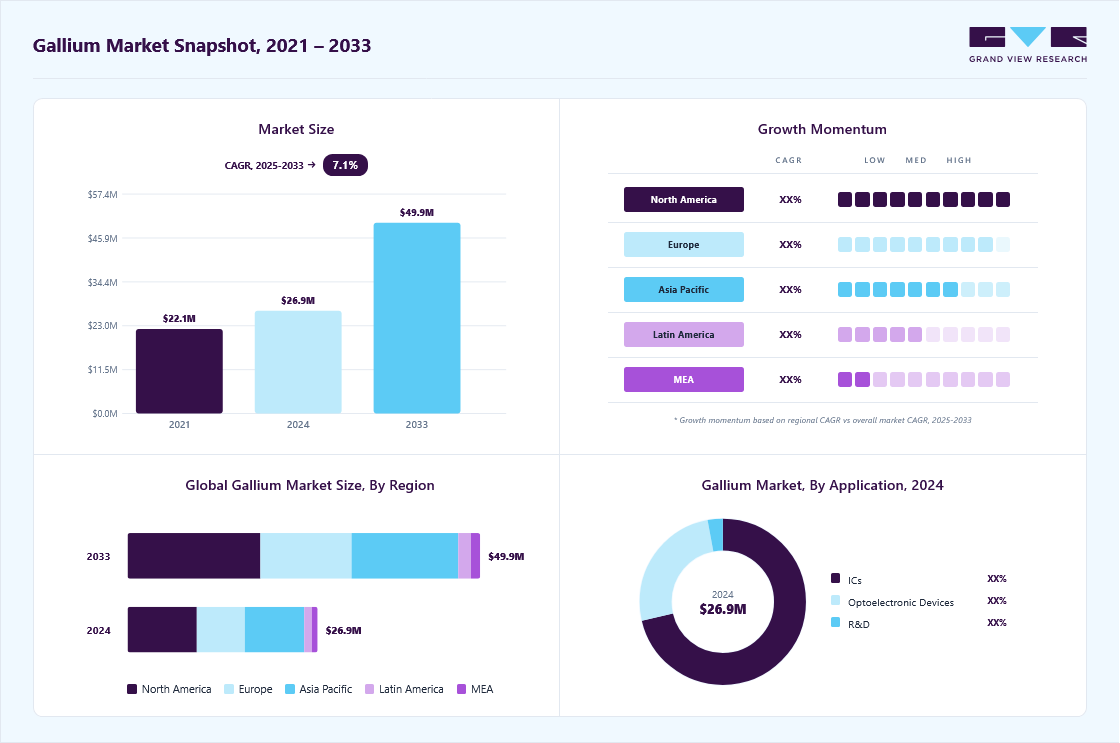
The global gallium market size was valued at USD 277.1 million in 2025 and is projected to grow from USD 286.8 million in 2026 to USD 448.8 million by 2033, at a CAGR of 6.6% from 2026 to 2033. Asia Pacific dominated the market, accounting for a revenue share of 60.5% in 2025. The growing usage of gallium (Ga)-based products is anticipated to increase, owing to the rapid growth in popularity of electronic devices such as mobile phones and laptops, television transmission, light-emitting diodes (LEDs), lighting applications, wireless infrastructure, power electronics, and satellite markets.
Key Market Trends & Insights
- By product: High purity gallium segment led the market with the largest revenue share of 58.2% in 2025.
- By application: ICs segment led the market with the largest revenue share of 73.6% in 2025.
Regional Highlights
- Largest regional market: Asia Pacific (60.5% revenue share, 2025)
- By country: The China held the largest market share in 2025.
Market Size & Forecast
- Market size in 2025: USD 277.1 Million
- Estimated market size in 2026: USD 286.8 Million
- Projected market size by 2033: USD 448.8 Million
- CAGR (2026-2033): 6.6%

The growth of the gallium industry is anticipated to be driven mainly by Ga usage in integrated circuits (ICs). The digital revolution that has marked recent years, the expansion of the telecommunications industry, increasing innovations in automotive electronics, and the Internet of Things (IoT) are anticipated to drive IC demand.

Market Dynamics
The growing use of gallium in semiconductor applications is a major factor supporting market expansion. Gallium-based compounds such as gallium arsenide (GaAs) and gallium nitride (GaN) are widely used in high-frequency, high-power, and high-efficiency electronic devices. These materials are increasingly adopted in smartphones, data centers, telecommunications infrastructure, consumer electronics, and advanced computing systems due to their superior performance over conventional silicon in certain applications. The rapid digitalization of economies and increasing demand for faster data processing continue to drive consumption across the semiconductor value chain.
The rapid deployment of 5G networks across developed and emerging economies is significantly driving demand for gallium-based semiconductor materials. GaAs and GaN are widely used in radio frequency components, power amplifiers, antennas, and network equipment due to their ability to operate efficiently at high frequencies and power levels. Compared to traditional silicon-based alternatives, these materials offer superior signal transmission performance, making them essential for supporting the higher data speeds, lower latency, and greater network capacity required by 5G communications.
Telecommunications operators and governments are investing heavily to expand 5G coverage to support growing data consumption, smart city initiatives, industrial automation, and Internet of Things (IoT) applications. The increasing deployment of 5G base stations, small cells, and advanced networking infrastructure is creating substantial demand for gallium-containing components throughout the telecommunications value chain. As 5G adoption continues to accelerate globally and network upgrades progress toward more advanced wireless generations, demand for gallium is expected to remain strong, supporting long-term market growth.
Price volatility and uncertainties in raw material availability remain key challenges for the gallium market. Since gallium is primarily recovered as a byproduct of bauxite and zinc ore processing, its supply is heavily influenced by the production levels and economics of these parent industries rather than direct market demand. Fluctuations in mining activity, refining output, energy costs, and trade policies can lead to significant variations in supply and pricing. In addition, supply chain disruptions and export restrictions imposed by major producing countries can create shortages and increase procurement costs for semiconductor, electronics, and renewable energy manufacturers. These factors make long term sourcing and cost planning more difficult for end users, potentially limiting market growth and investment in gallium dependent applications.
The growing use of advanced electronic systems in defense, aerospace, and satellite communication applications presents a significant opportunity for the gallium market. GaAs and GaN technologies are widely used in radar systems, electronic warfare equipment, satellite communication devices, avionics, and space-based sensors for their ability to operate at high frequencies, withstand harsh environments, and deliver superior power efficiency. Rising global defense expenditures, increasing satellite launches for communications and Earth observation, and growing investments in space exploration programs are driving demand for high-performance semiconductor components. As governments and private companies continue to expand aerospace and defense capabilities, the adoption of gallium-based technologies is expected to increase, creating substantial long-term growth opportunities for the market.
Analyst Perspective
The gallium market is emerging as a strategically important segment within the global semiconductor and advanced electronics industry, driven by the rapid expansion of 5G networks, high-performance computing, data centers, electric vehicles, and next-generation communication technologies. Gallium-based materials such as gallium arsenide (GaAs) and gallium nitride (GaN) offer superior efficiency, power-handling capabilities, and high-frequency performance compared to conventional silicon, making them essential for advanced integrated circuits, optoelectronic devices, RF components, and defense electronics. The market is also benefiting from growing investments in aerospace, satellite communications, renewable energy systems, and advanced defense technologies that increasingly rely on gallium-based semiconductors.
Product Insights
Based on product, high purity gallium segment led the market with the largest revenue share of 58.2% in 2025, owing to its critical role in advanced electronic applications. High-purity gallium, often a refined metal, typically contains a minimum purity level ranging from 99.999% (5N) to 99.99999% (7N). This grade of gallium is essential for producing compound semiconductors such as gallium arsenide (GaAs) and gallium nitride (GaN), which are used in the manufacturing of a wide array of high-performance electronic devices.
GaAs-based integrated circuits (ICs), which have gained significant traction recently, are preferred in specialized applications such as satellite communications, supercomputers, and defense electronics. These circuits offer distinct advantages over traditional silicon-based ICs, including faster data transmission, higher resistance to radiation, and the ability to operate at elevated temperatures, making them suitable for harsh and high-performance environments.
Low-purity gallium, with a minimum purity level of 99.99% (4N), primarily serves as a feedstock for refining into high-purity material. It is typically recovered through primary extraction processes and recycling scraps derived from end-of-life ICs and optoelectronic components. This lower-grade variant is more abundant and less expensive, with China accounting for most global production. While it is a cost-effective option for specific industrial uses, the refined, high-purity form is in greater demand due to its critical role in next-generation technologies and other specialized, high-value applications.
Application Insights
Based on application, ICs segment led the market with the largest revenue share of 73.6% in 2025, driven by their expanding role across various high-growth industries. These specialized semiconductor components enable the conversion of light energy into electrical energy and vice versa. They are integral to multiple applications in military systems, telecommunications, medical devices, and automated access control. Common examples include LEDs, solar cells, and photodiodes. Due to the indirect bandgap of silicon, which results in poor optical absorption and emission, it is not ideally suited for such applications. This limitation has paved the way for gallium-based compounds like gallium arsenide (GaAs) and gallium nitride (GaN), which are widely adopted in optoelectronics for their superior optical properties-a trend expected to persist over the forecast period.
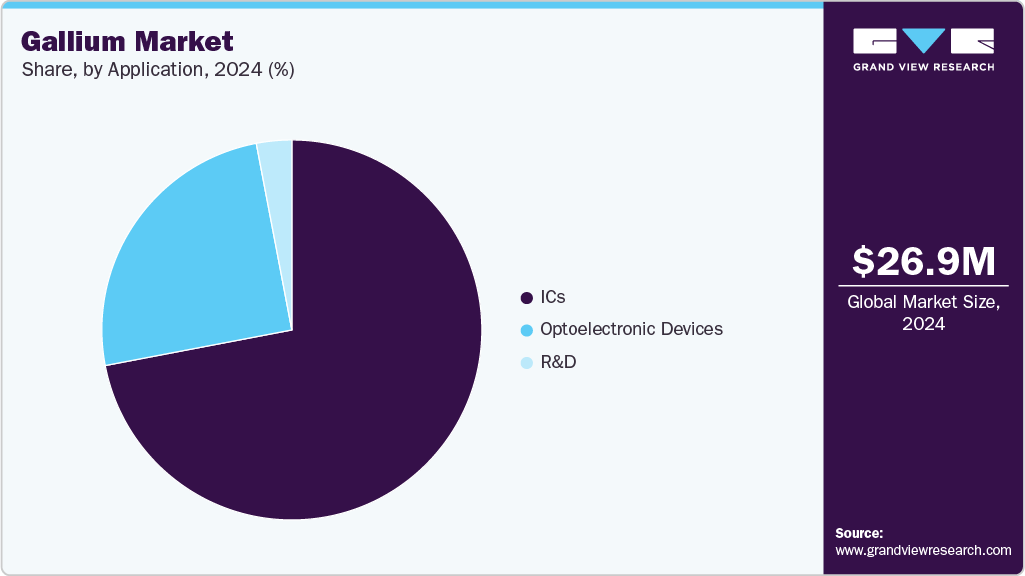
Integrated circuits (ICs) represent another key application segment in the gallium industry, contributing a substantial revenue share in 2024. Gallium offers high electrical conductivity and thermal stability, making it an ideal material for manufacturing high-speed, high-performance ICs and transistors. These components are used extensively in defense electronics, advanced computing systems, and telecommunications equipment. Compared to traditional silicon-based ICs, gallium-based alternatives deliver faster switching speeds, improved heat resistance, and lower electrical resistance, enhancing overall system performance.
Continued investment in R&D further supports the adoption of it in emerging electronic technologies. For instance, in May 2022, Singapore-based Gallium Semiconductor inaugurated a new R&D center in Nijmegen, the Netherlands, focusing on advancing radio frequency (RF) GaN technology innovations for 5G mobile communications. The center focuses on product development, device design, and customer-specific engineering solutions to serve the growing European market. Such initiatives underscore the strategic importance of gallium in enabling next-generation communication infrastructure and high-performance electronics.
Regional Insights
The North America gallium market is expected to witness steady growth over the forecast period, primarily driven by the demand in the United States. The region’s expansion is underpinned by the increasing use of gallium-based integrated circuits (ICs) in defense electronics and telecommunication systems. As national security and advanced communications remain top priorities, the U.S. will likely continue investing in next-generation semiconductor technologies, positioning gallium as a critical material in military-grade and high-frequency applications.
U.S. Gallium Market Trends
In the U.S., high defense spending plays a crucial role in propelling the growth of the gallium industry. The growing demand for cutting-edge electronics used in defense and aerospace sectors contributes to increased gallium-based compounds like GaAs and GaN consumption. Moreover, the U.S. Department of Energy’s Solid-State Lighting Plan, which aims for a 73.7% market share of LED-based solid-state lighting by 2030, is expected to boost gallium demand significantly. LEDs rely heavily on GaN-based technologies, reinforcing the importance of gallium in achieving national energy efficiency and technological goals.
Asia Pacific Gallium Market Trends
Asia Pacific dominated the gallium market with the largest revenue share of 60.5% in 2025, owing to strong manufacturing capabilities and sustained investment in electronics. Countries like China, Japan, South Korea, and Taiwan are central in producing ICs and optoelectronic devices, benefiting from large-scale contract manufacturing and robust R&D activity. China demonstrated consistent growth due to increased usage of gallium in power electronics, 5G infrastructure, and defense-related applications. Regional emphasis on technological self-sufficiency and expansion in semiconductor fabrication will likely elevate gallium consumption across the region.
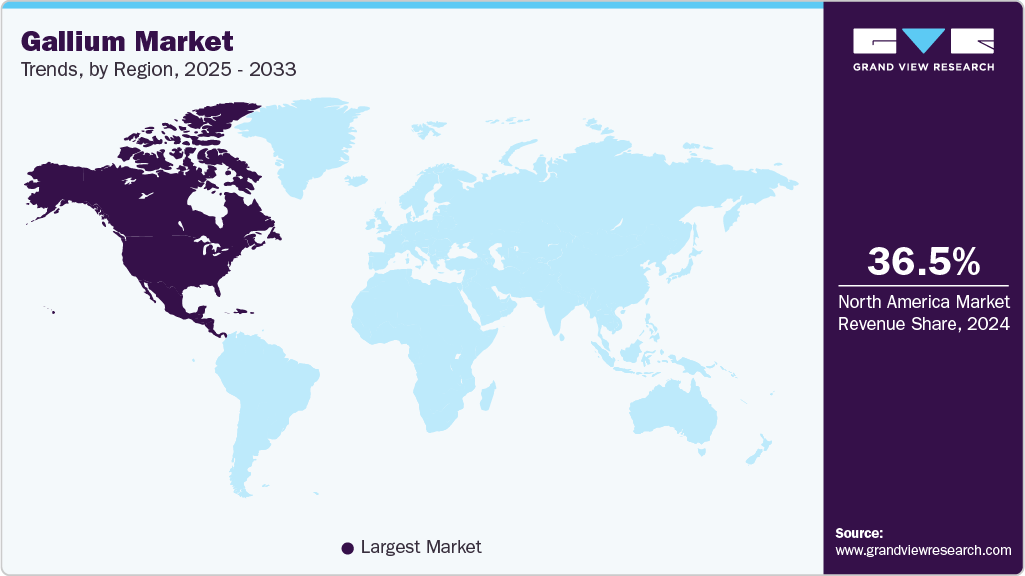
The gallium market in the China held the largest share in the Asia Pacific region in 2025.
Europe Gallium Market Trends
Europe is expected to witness healthy growth in the gallium industry, supported by the increasing IC production and expanding R&D investments in semiconductors and optoelectronic technologies. Countries like Germany, France, and the Netherlands are promoting high-performance materials for energy-efficient and defense applications. Strategic initiatives to reduce dependency on imported semiconductor materials and boost domestic capabilities, especially in response to global supply chain concerns, encourage regional adoption of gallium-based compounds. Additionally, investments in next-generation wireless and photonics technologies will likely sustain the upward trajectory of gallium demand in the region.
Key Gallium Company Insights
Some of the key players operating in the market include American Elements, Neo, NICHIA, and Reade.
-
American Elements is a leading supplier of engineered and advanced materials, specializing in producing and distributing high‑purity metals,including gallium, germanium, and antimony. The company offers a comprehensive portfolio of products, including alloys, oxides, chlorides, nitrates, nanoparticles, thin-film coatings, and sputtering targets. It serves diverse high-tech sectors such as semiconductors, optoelectronics, and aerospace
-
Neo is a vertically integrated specialty materials company offering critical metals, including gallium, hafnium, niobium, and tantalum, as well as permanent magnets. Its operations span recycling electronic scrap to produce high-purity gallium, chemical and oxide processing, environmental catalyst manufacturing, and the production of rare-earth magnets. The company targets downstream, high-margin niche markets including defense, EV, and clean energy applications.
-
NICHIA is a renowned Japanese chemical and electronics manufacturer known for pioneering gallium nitride (GaN) LED and laser diode technologies. The firm produces phosphors, LEDs across the visible spectrum, and laser diodes in displays, lighting, automotive, and industrial applications. NICHIA’s work contributed to the development of blue LEDs, a breakthrough recognized by the 2014 Nobel Prize in Physics.
-
Reade is a global distributor of specialty chemical solids, including high‑purity metals, oxides, and compounds. In the gallium space, Reade supplies gallium metal and gallium oxide powders to the semiconductors, aerospace, and electronics sectors. Its strength lies in distributing advanced materials across research, industrial, and technical markets.
Key Gallium Companies
The following key companies have been profiled for this study on the gallium market.
-
American Elements
-
China JinMuan Nonferrous Metal Group Co., Ltd.
-
Dowa Electronics Materials Co., Ltd.
-
NEO Performance Materials
-
NICHIA Corporation
-
Noah Chemicals Corporation
-
Reade Advanced Materials
-
Umicore
-
Vital Materials Co., Ltd.
-
Zhuzhou Smelter Group Co., Ltd. (ZSG)
Competitive Benchmarking
Category
Operating Strategies
Competitive Edge
Weakness
Established Players (e.g. American Elements, Dowa Electronics Materials Co., Ltd.)
- Mature participants in the gallium market primarily focus on securing stable feedstock supplies from alumina refining and zinc processing operations, as gallium is predominantly recovered as a byproduct.
- These companies emphasize vertical integration, advanced purification technologies, and long term supply agreements with semiconductor, optoelectronics, defense, and telecommunications manufacturers.
- Established players possess significant competitive advantages through their extensive refining infrastructure, proprietary purification technologies, and long standing industry expertise.
- Their ability to consistently produce high purity and ultra high purity gallium products enables them to meet the stringent quality requirements of semiconductor and optoelectronic applications.
- Despite their strong market positions, mature players face challenges related to dependence on byproduct availability from alumina and zinc production.
- Since gallium output is tied to the production levels of these primary industries, supply flexibility can be limited during periods of changing market conditions.
Emerging & Regional Players (e.g., China JinMuan Nonferrous Metal Group Co., Ltd., Noah Chemicals Corporation)
- Emerging participants in the gallium market generally focus on developing alternative supply sources, improving extraction technologies, and establishing regional refining capabilities.
- Their strategies emphasize reducing dependence on concentrated supply chains while supporting growing demand from semiconductors, advanced electronics, renewable energy systems, and defense applications.
- Emerging companies benefit from operational flexibility and the ability to adopt modern extraction, purification, and recycling technologies without extensive legacy infrastructure constraints.
- Their facilities are often designed around current efficiency standards and environmental requirements, enabling them to respond quickly to changing market demands.
- Emerging participants face significant challenges related to limited production capacity, technology commercialization risks, and high capital requirements.
- Developing economically viable gallium extraction and purification operations requires substantial investment in specialized equipment, technical expertise, and quality control systems.
Recent Developments
-
In December 2024, American Elements announced a significant expansion of its production facilities in Salt Lake City, aiming to scale up the output of gallium, germanium, and antimony in various forms, including alloys, oxides, chlorides, nitrates, nanoparticles, and thin-film coating materials. This expansion was driven by the growing demand for high-purity materials amid tightening global supply, especially after China's export restrictions on gallium and germanium. The company positioned itself as a strategic U.S. supplier capable of mitigating export risks and ensuring uninterrupted access for domestic and international clients.
-
Neo reported several key milestones throughout 2024, reflecting strong financial performance and strategic realignment. In Q2 2024, the company achieved an Adjusted EBITDA of USD 24.2 million, and by Q3, had signed a long-term contract with a Tier-1 European automaker, covering ~35% capacity of its new European magnet plant. In August 2024, Neo divested its Oklahoma gallium trichloride facility, part of a portfolio streamlining effort. The company further announced plans to exit certain rare-earth separation facilities in China to focus on downstream, high-value operations.
-
In early 2025, European officials, including the European Commission’s executive vice president, highlighted a planned gallium extraction facility in Greece operated by Metlen Energy & Metals, part of a USD 24.6 billion EU strategy to secure critical minerals. The plant, tapping domestic bauxite refinement, will produce up to 50 tons annually starting in 2027. Though operations began later, project planning and EU alignment occurred throughout 2024.
Gallium Market Report Scope
Report Attribute
Details
Market definition
The market size represents the apparent consumption of gallium, including low- and high-purity grades, across various applications.
Market size in 2025
USD 277.1 million
Estimated market size in 2026
USD 286.8 million
Projected market size by 2033
USD 448.8 million
Growth rate
CAGR of 6.6% from 2026 to 2033
Base year for estimation
2025
Historical data
2021 - 2024
Forecast period
2026 - 2033
Quantitative units
Revenue in USD million, volume in kilotons, and CAGR from 2026 to 2033
Report coverage
Revenue forecast, volume forecast, company ranking, competitive landscape, growth factors, and trends
Segments covered
Product, application, and region.
Regional scope
North America; Europe; Asia Pacific; Latin America; Middle East & Africa
Country scope
U.S., Canada, Mexico, Germany, UK, France, Italy, Russia, Turkey, India, China, Japan, South Korea, Brazil
Key companies profiled
American Elements; China JinMuan Nonferrous Metal Group Co., Ltd.; Dowa Electronics Materials Co., Ltd.; NEO Performance Materials; NICHIA Corporation; Noah Chemicals Corporation; Reade Advanced Materials; Umicore; Vital Materials Co., Ltd.; Zhuzhou Smelter Group Co., Ltd. (ZSG)
Customization scope
Free report customization (equivalent up to 8 analysts' working days) with purchase. Addition or alteration to country, regional & segment scope.
Pricing and purchase options
Avail customized purchase options to meet your exact research needs. Explore purchase options
Global Gallium Market Report Segmentation
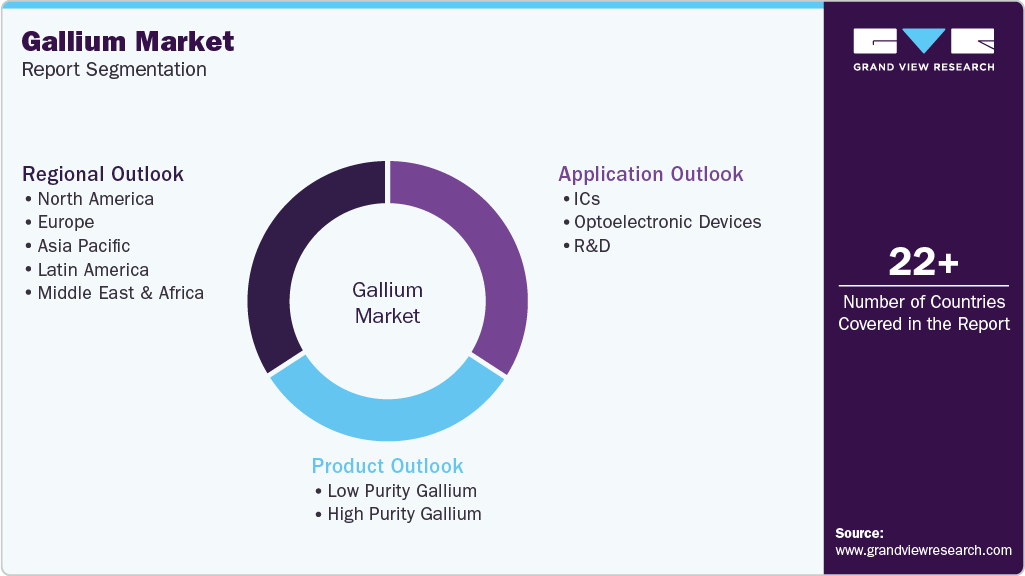
This report forecasts revenue and volume growth at the global, regional, and country levels and provides an analysis of the latest trends in each of the sub-segments from 2021 to 2033. For this study, Grand View Research has segmented the global gallium market report based on product, application, and region:
-
Product Outlook (Volume, Tons; Revenue, USD Million, 2021 - 2033)
-
Low Purity Gallium
-
High Purity Gallium
-
-
Application Outlook (Volume, Tons; Revenue, USD Million, 2021 - 2033)
-
ICs
-
Optoelectronic Devices
-
R&D
-
-
Regional Outlook (Volume, Tons; Revenue, USD Million, 2021 - 2033)
-
North America
-
U.S.
-
Canada
-
Mexico
-
-
Europe
-
Germany
-
UK
-
France
-
Italy
-
Turkey
-
Russia
-
-
Asia Pacific
-
China
-
India
-
Japan
-
South Korea
-
-
Latin America
-
Brazil
-
-
Middle East & Africa
-
Research Methodology
The gallium market figures in this report are based on a proven research process that combines executive interviews with secondary research from proprietary databases, company filings, and recognized regulatory and institutional sources. Market size is built through value-chain sizing - reconciling supply-side and demand-side estimates - and triangulated with bottom-up and top-down approaches. Every estimate passes multiple levels of expert validation before publication, with each gallium segment quantified using the revenue-capture definitions in the table below.
Segment Definition
Product
Revenue Capture Definition
Low Purity Gallium
Low purity gallium typically refers to material with purity levels around 99.99%. It is primarily used as a raw material for further purification, alloy manufacturing, research purposes, and industrial applications where ultra high purity specifications are not essential.
High Purity Gallium
High purity gallium includes grades with purity levels of 99.999% and 99.99999%, which are required for advanced electronic and semiconductor applications. These grades are extensively used in the production of GaAs, GaN, LEDs, integrated circuits, photonic devices, and high frequency communication components.
Application
Revenue Capture Definition
ICs
Gallium is used in the manufacture of high performance integrated circuits, particularly those based on GaAs and GaN. These ICs are widely employed in telecommunications, wireless communication systems, data centers, and advanced electronic devices due to their high speed and power efficiency.
Optoelectronic Devices
Gallium is a key material in optoelectronic devices such as LEDs, laser diodes, photodetectors, and optical communication components. Its semiconductor properties enable efficient light emission and signal transmission, making it essential for lighting, display technologies, fiber optic networks, and sensing applications.
R&D
Gallium is extensively utilized in research and development activities focused on advanced semiconductors, nanotechnology, photonics, and next generation electronic materials. Academic institutions, government laboratories, and industrial research centers use gallium for material innovation, prototype development, and performance testing of emerging technologies.
Estimation Model
Layer Name
Key Question
Description
Electronics & Semiconductor Demand Base Layer
What forms the demand base?
Identify global demand from major gallium consuming industries including semiconductors, optoelectronics, telecommunications, consumer electronics, renewable energy, aerospace, and defense. Assess production volumes of electronic devices, power electronics, LEDs, and communication equipment to establish the total addressable demand for gallium globally.
Gallium Application Penetration Layer
Where is gallium utilized?
Estimate the penetration of gallium across key applications including integrated circuits, optoelectronic devices, radio frequency (RF) devices, power semiconductors, LEDs, solar cells, and research & development activities. Analyze the adoption of gallium arsenide (GaAs), gallium nitride (GaN), and other gallium based materials across industries and regions.
Gallium Consumption Intensity Layer
How much gallium is consumed?
Analyze gallium consumption intensity based on semiconductor production, LED manufacturing, telecommunications infrastructure deployment, electric vehicle electronics, and defense system production. Evaluate the utilization of low purity and high purity gallium grades across applications. Consumption intensity varies according to technological advancements, device complexity, material efficiency, and production yields.
Revenue Layer
How is market revenue generated?
Market revenue is quantified through the sale of gallium products including low purity gallium, high purity gallium, gallium arsenide wafers, gallium nitride materials, and specialty gallium compounds. Revenue generation is driven by demand from semiconductor, optoelectronics, telecommunications, renewable energy, aerospace, and defense sectors. Market value is influenced by gallium prices, purity grade premiums, production capacity, technology adoption, and regional supply demand dynamics.
Delivered Customizations
This report has been delivered with the following In-depth customizations
Client Request
Customization Delivered
Value Adds
Regional Segmentation
Detailed regional analysis of the gallium market across North America, Europe, Asia Pacific, Latin America, and Middle East & Africa. Included evaluation of gallium production capacities, alumina and zinc refining activities, semiconductor manufacturing investments, LED production, defense electronics demand, photovoltaic installations, and government initiatives supporting critical mineral supply chains.
Identified key production hubs, high growth consumption regions, and emerging semiconductor manufacturing centers. Enabled strategic expansion planning based on electronics production, renewable energy investments, and advanced technology adoption. Supported regional demand forecasting and sourcing strategies.
Trade Assessment
Evaluation of global gallium trade flows, export import trends, country level trade balances, supply concentration risks, geopolitical influences, and international sourcing patterns. Included assessment of primary and refined gallium trade routes, semiconductor material supply chains, export restrictions, and critical mineral security initiatives impacting global trade.
Highlighted supply security risks, export opportunities, and sourcing diversification options. Supported strategic procurement decisions, supply chain resilience planning, and international market expansion initiatives.
Opportunity Assessment
Identification of high growth opportunities across integrated circuits, optoelectronic devices, 5G infrastructure, electric vehicles, satellite communications, defense electronics, advanced photovoltaics, and next generation semiconductor technologies.
Enabled prioritization of high return growth segments and emerging regional opportunities. Supported long term investment planning, capacity expansion decisions, and strategic business development initiatives aligned with global digitalization and energy transition trends.
Frequently Asked Questions About This Report
North America is anticipated to register the fastest CAGR over the forecast period.
Based on product, high purity gallium accounted for largest revenue share of 58.2% in 2025.
Based on application, ICs accounted for largest revenue share of 73.6% in 2025, while optoelectronic devices registered a CAGR of 6.9% over the forecast period.
The key players operating in the gallium market are American Elements; China JinMuan Nonferrous Metal Group Co., Ltd.; Dowa Electronics Materials Co., Ltd.; NEO Performance Materials; NICHIA Corporation; Noah Chemicals Corporation; Reade Advanced Materials; Umicore; Vital Materials Co., Ltd.; Zhuzhou Smelter Group Co., Ltd. (ZSG).
The gallium market size was estimated at USD 277.1 million in 2025 and is expected to reach USD 286.8 million in 2026.
The gallium market is expected to grow at a compound annual growth rate of 6.6% from 2026 to 2033 to reach USD 448.8 million by 2033.
The global gallium market is experiencing growth driven primarily by its critical applications in integrated circuits (ICs) and optoelectronic devices. Gallium is extensively used as a semiconductor material in ICs, which form the backbone of modern electronics.
Asia Pacific dominated the market with revenue share of 60.5% in 2025.
China dominated the Asia Pacific market with revenue share of 48.0% in 2025.
About the Author(s)
Advanced Interior Materials Research Team
Advanced Materials · Advanced Interior MaterialsThis report was authored by the advanced interior materials research team at Grand View Research - comprising two research analysts, one senior research analyst, and one industry expert - with specialized expertise in the advanced interior materials segment of the advanced materials industry. All findings are based on proprietary advanced materials databases, executive interviews, and regulatory analysis, subject to internal peer review prior to publication.
Last Updated:
Speak to Analyst


Customize this report to your needs — add regions, segments, or data points, with 20% free customization.
Or view our licence options:


ISO 9001:2015 & 27001:2022 Certified
We are GDPR and CCPA compliant! Your transaction & personal information is safe and secure. For more details, please read our privacy policy.


