
- Home
- »
- Next Generation Technologies
- »
-
Generative AI In Agriculture Market Size Report, 2025-2033GVR Report cover

Generative AI In Agriculture Market (2025 - 2033)
Size, Share & Trends Analysis Report By Technology, By Application (Precision Farming, Livestock Management, Agricultural Robotics & Automation, Weather Forecasting), By Region, And Segment Forecasts
Market Size, 2024
$226.2MMarket Estimate, 2026
$364.9MMarket Forecast, 2033
$2,158.9MCAGR, 2025–2033
28.7%Generative AI In Agriculture Market Summary
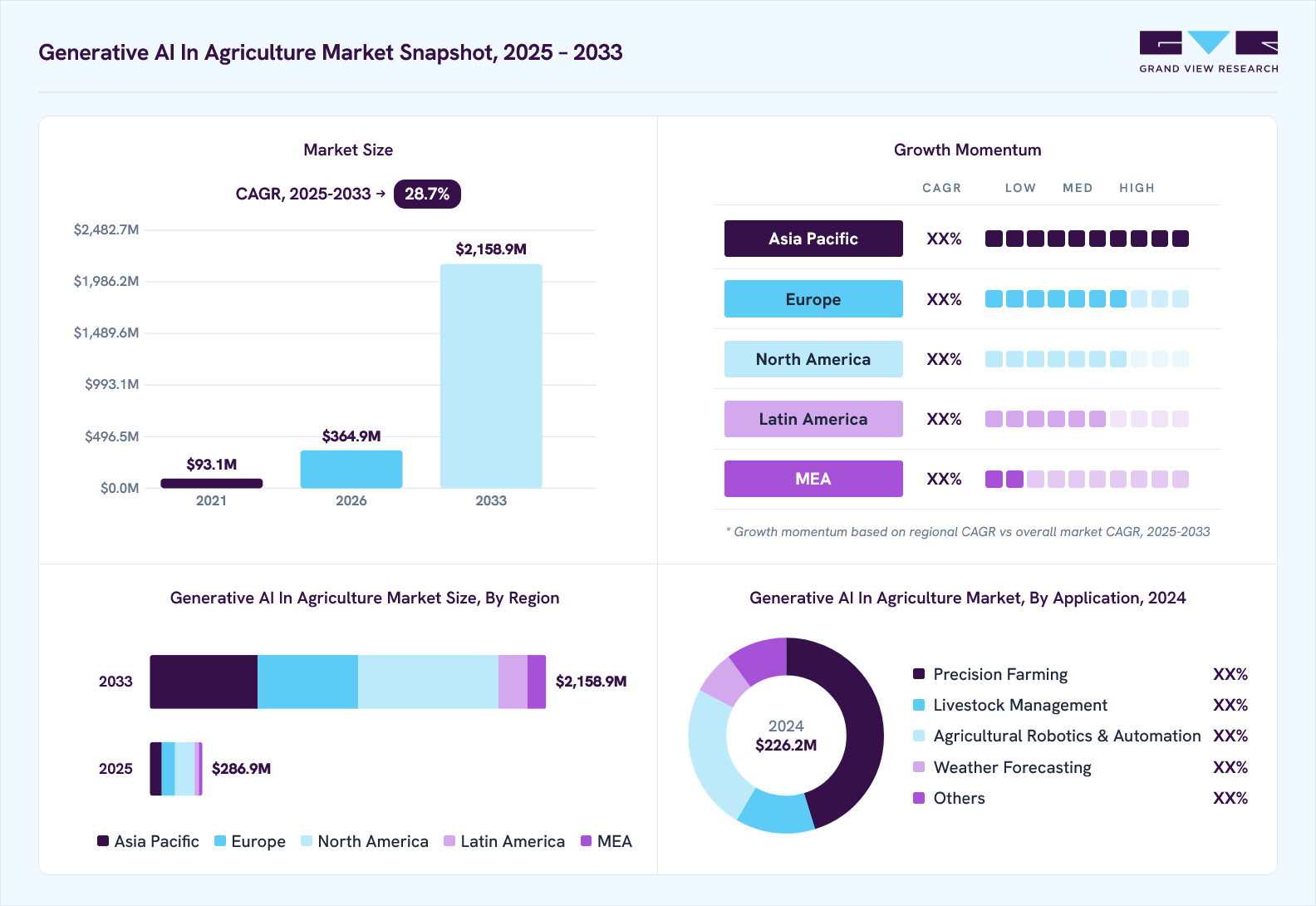
The global generative AI in agriculture market size was valued at USD 226.2 million in 2024 and is projected to grow from USD 364.9 million in 2026 to USD 2,158.9 million by 2033, at a CAGR of 28.7% from 2025 to 2033. North America dominated the market, accounting for a revenue share of 37.2% in 2024. Farmers are increasingly using generative models to predict yields, weather impacts, and input requirements.
 Source: Grand View Research, IR Documents, Primary Interviews, Paid DatabasesTo learn more about this report,
 Download Free Sample Report
 Key Market Trends & Insights
- The Generative AI in Agriculture market in U.S. led the North America market and held the largest revenue share in 2024.
- By technology, machine learning segment led the market and held the largest revenue share of 42.5% in 2024.
- By application, the agricultural robotics & automation driving segment is expected to grow at the fastest CAGR of 31.2% from 2025 to 2033.
Market Size & Forecast
- 2024 Market Size: USD 226.2 Million
- 2033 Projected Market Size: USD 2,158.9 Million
- CAGR (2025-2033): 28.7%
- North America: Largest market in 2024
- Asia Pacific: Fastest growing market
Three ways to get this report
Buy it, customize it, or ask a question.Ask an Analyst
Analyst response in 1 business day
- AccessReport author, directly
- Reply timeWithin 1 working day
- No sales callDirect answer only
- FormatEmail reply
- CostFree, no cost
Get the Full Report
What the study covers
- FormatsPDF · Excel · Dashboard
- Timeline2025–2033 annual, 2024 base
- Coverage20+ countries, 5 regions
- Companies10+ key players profiled
Customize the Report
20% free customization
- IncludeCountries, segments, points
- TailorTo your product definition
- ExtendDeeper competitor detail
- OrA fully bespoke study
- Turnaround5–10 working days
This trend supports precision agriculture by enabling scenario-based planning. The global generative AI in agriculture industry is witnessing a shift toward AI-driven crop simulation and decision-making tools. The development of specialized, accessible, and efficient AI models for agricultural advisory, yield prediction, and climate adaptation is driving growth in the generative AI in agriculture market. This indicates growing demand for localized, multilingual, and climate-resilient advisory tools, especially for smallholder farmers in emerging regions, and signals a shift from general-purpose AI to frugal, scalable solutions suited for underserved agricultural ecosystems. Companies are increasingly developing lightweight, specialized models to address these needs at scale. For instance, in April 2024, Cropin Technology Solutions Private Limited, a software company in India, launched akṣara, an open-source micro language model built on Mistral, designed for climate-smart agriculture in the Global South. It supports nine key crops across five countries, offering localized, low-resource generative AI advisory to smallholder farmers and agricultural stakeholders. This initiative highlights the growing focus on making generative AI more inclusive, sustainable, and aligned with regional agrarian priorities.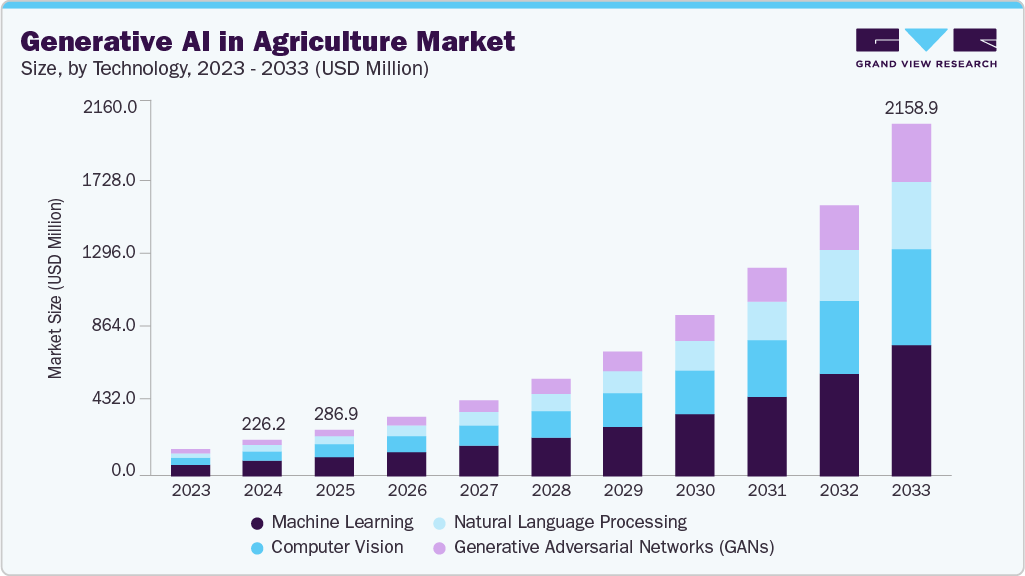 To learn more about this report, Download Free Sample Report
 The increasing integration of AI with existing digital agriculture platforms is propelling market growth as it enables timely and data-driven decisions throughout the farming cycle. These platforms use generative AI alongside satellite imagery, IoT data, and management systems to deliver context-specific recommendations. This improves resource efficiency, better crop outcomes, and reduced operational risks. Farmers can respond more effectively to dynamic factors such as weather changes or pest threats. The rising demand for intelligent, connected farming solutions is accelerating the adoption of generative AI in agriculture. For instance, in March 2024, Bayer AG, a German life science company, collaborated with Microsoft and Ernst & Young to launch a pilot generative AI system trained on proprietary agronomic data and expert insights. The tool provides fast, accurate recommendations and expands access to agronomic intelligence, especially for smallholder farmers, through customized, validated responses.
Advancements in machine learning, computer vision, and compute/cloud infrastructure are transforming agricultural practices. Machine learning algorithms enable accurate predictions for crop yields, disease outbreaks, and soil health. Computer vision systems process drone and satellite imagery to monitor crop conditions in real time. These tools help detect issues such as pest infestations or nutrient deficiencies with high precision. Meanwhile, improvements in cloud infrastructure provide scalable data storage and processing capabilities. Farmers can now access analytics platforms from remote locations, enabling informed decision-making. Integration with IoT devices further enhances real-time monitoring and automation. These technologies reduce manual intervention and improve operational efficiency. Cloud-based solutions also support collaboration between stakeholders across the value chain. Together, these advancements are driving a data-driven shift toward smarter, more sustainable agriculture.
Technology Insights
The machine learning segment dominated the generative AI in agriculture market in 2024, accounting for a 42.5% share. This dominance was driven by its ability to analyze large datasets with high accuracy. Machine learning models supported predictive insights for crop yields, weather patterns, and pest risks. Their adaptability across diverse farming environments enhanced their adoption. Integration with sensor data and remote imagery improved decision-making. These capabilities positioned machine learning as the most impactful technology in the market.
Generative Adversarial Networks (GANs) are gaining momentum in the generative AI in agriculture market. Their growth is driven by the need for high-quality synthetic data to train AI models, especially in regions with limited labeled datasets. GANs help simulate realistic crop conditions, weather patterns, and disease outbreaks, enabling more robust and accurate predictive tools. They also enhance the quality of satellite and drone imagery, improving visual analytics for crop monitoring. This technology supports faster model development with reduced dependency on field trials. As data scarcity and variability remain major challenges in agriculture, the adoption of GANs continues to expand steadily.
Application Insights
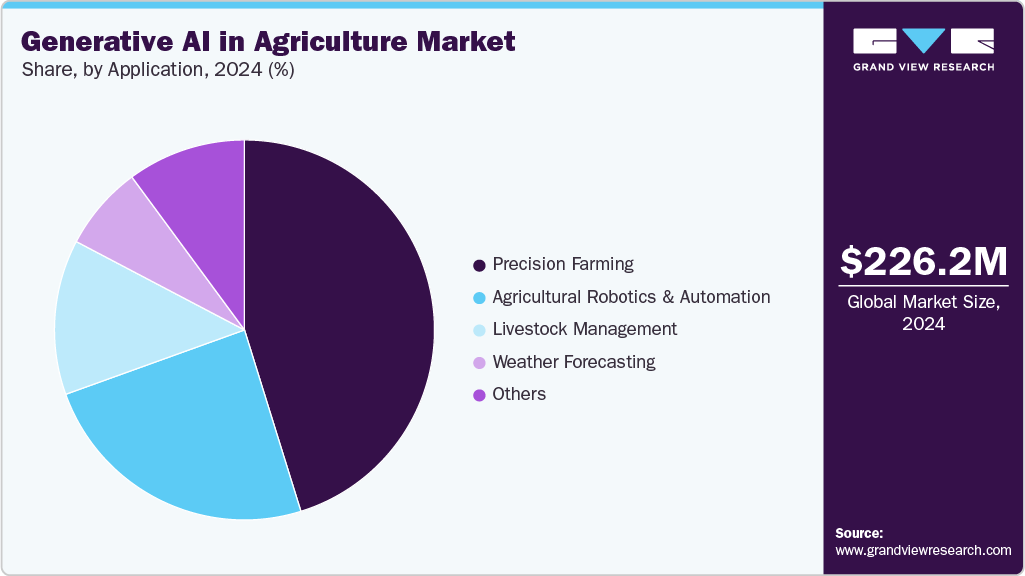
Precision farming led the generative AI in agriculture market in 2024, holding the largest share. Its dominance is driven by the need to optimize resource use and maximize yield. AI models analyze real-time data from sensors, drones, and satellites. This enables targeted decisions regarding irrigation, fertilization, and crop protection. Precision farming reduces input costs while maintaining high productivity levels. Large farms especially benefit from its scalable and data-driven approach. Environmental benefits such as reduced chemical usage add to its appeal. As sustainability and efficiency become priorities, adoption continues to expand.
 To learn more about this report, Download Free Sample Report
 Agricultural robotics and automation are experiencing significant growth in the generative AI in agriculture market. These systems include autonomous tractors, robotic harvesters, and drones. Generative AI enhances their perception, path planning, and task execution capabilities. The technology addresses labor shortages and rising operational costs in farming. Robotics improve speed, consistency, and accuracy in various agricultural processes. Their use is expanding in planting, weeding, spraying, and harvesting. Integration with cloud platforms allows real-time monitoring and control. As farms modernize, demand for robotic solutions continues to rise.
Regional Insights
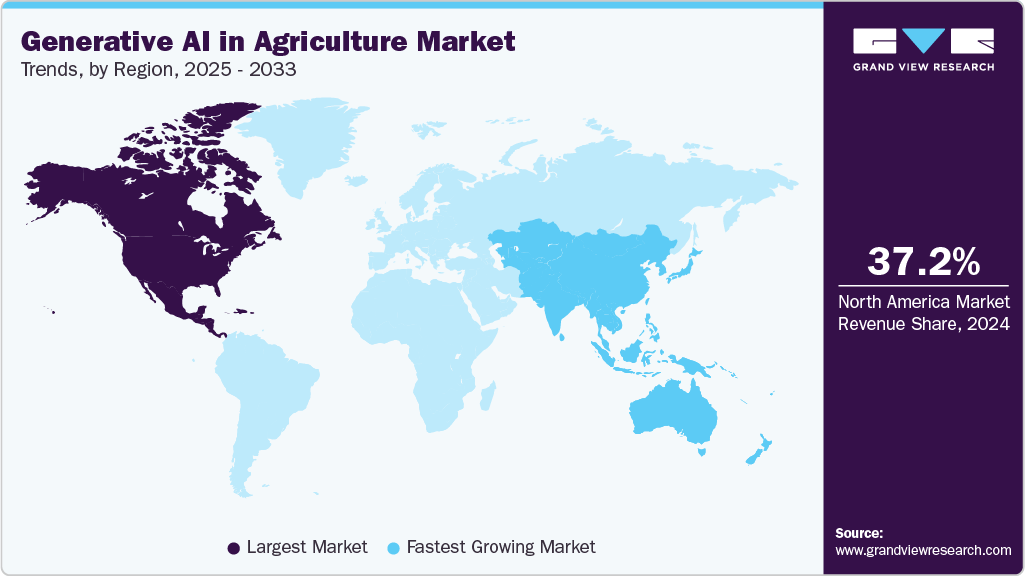
North America generative AI in agriculture market held the largest share in 2024, accounting for 37.2%. The region's extensive use of digital platforms and precision farming tools has enabled widespread integration of AI-driven solutions. Advanced infrastructure, including high-speed connectivity and cloud services, facilitates real-time data analysis and model deployment. Government incentives and private sector investments have encouraged innovation and large-scale implementation.
 To learn more about this report, Download Free Sample Report
 U.S. Generative AI in Agriculture Market Trends
The U.S. held the largest share in the generative AI in agriculture market in 2024. Its dominance is supported by strong digital infrastructure and early AI adoption. Major agritech companies actively invest in AI research and deployment. Precision farming is widely practiced across large commercial farms. Government funding and private partnerships continue to drive innovation.
Europe Generative AI in Agriculture Market Trends
Europe maintained a steady share in the generative AI in agriculture market. The region focuses heavily on sustainable and environmentally responsible farming. Regulations encourage the adoption of data-driven and efficient practices. Countries like Germany, France, and the Netherlands lead in smart farming technologies. Cross-border research initiatives further support innovation and AI integration.
Asia Pacific Generative AI in Agriculture Market Trends
Asia Pacific is the fastest-growing region in the generative AI in agriculture market. The rising population is creating strong pressure to boost food production efficiently. Governments in India, China, and Japan are heavily investing in agricultural digital infrastructure. Farmers are increasingly using AI-based tools to improve resource use and minimize crop losses. Greater awareness and widespread smartphone access are accelerating the adoption of these technologies.
Key Generative AI In Agriculture Market Company Insights
Some of the key companies in the Generative AI in Agriculture industry include Aptiv PLC, General Motors Company, Hyundai Motor Company, NVIDIA Corporation, Qualcomm Technologies, Inc., and others. Organizations are focusing on increasing customer base to gain a competitive edge in the industry. Therefore, key players are taking several strategic initiatives, such as mergers and acquisitions, and partnerships with other major companies.
-
AgroScout uses generative AI to improve crop scouting by analyzing drone and satellite imagery. The AI models generate detailed insights on pest infestations, nutrient deficiencies, and plant diseases. These insights enable early intervention and reduce reliance on manual field inspections. The technology supports real-time decision-making for precision agriculture.
-
Bayer AG is applying generative AI to provide intelligent support for agronomic decisions. The system is trained on proprietary data to generate precise, field-specific recommendations. It delivers insights faster than traditional methods, improving farming efficiency. The tool is especially useful in optimizing crop planning and disease management. Bayer’s AI efforts aim to support farmers with reliable, data-driven strategies.
Key Generative AI In Agriculture Companies:
The following are the leading companies in the generative AI in agriculture market. These companies collectively hold the largest market share and dictate industry trends.
- Agmatix
- AgroScout
- Bayer AG
- Carbon Robotics
- Deere & Company (John Deere)
- DeepAgro
- IBM Corporation
- KissanAI
- Microsoft
- Syngenta Group
Recent Developments
-
In March 2025, Agmatix, an agronomic technology company, partnered with BASF via its AgroStart platform to develop a digital detection and predictive tool for Soybean Cyst Nematode (SCN). This uses Agmatix’s AI engine Axiom, combined with BASF agronomic expertise, to provide real‑time, scalable SCN risk forecasts customized for growers.
-
In September 2024, Syngenta Group launched Cropwise AI, a generative AI system that uses over 20 years of agronomic data to provide natural-language crop management recommendations for increased yields and sustainability. Currently available in the U.S. and Brazil, it delivers precision agriculture support through multilingual AI, with future expansion planned for Europe.
-
In April 2024, ITC Limited collaborated with Microsoft to launch the Krishi Mitra app, developed using Microsoft Copilot templates. The AI-powered tool is designed to provide timely, personalized agricultural insights to 300,000 farmers during its pilot phase, with plans to expand access to 10 million users across India.
Generative AI In Agriculture Market Report Scope
Report Attribute
Details
Market size in 2024
USD 226.2 million
Estimated market size in 2026
USD 364.9 million
Projected market size by 2033
USD 2,158.9 million
Growth rate
CAGR of 28.7% from 2025 to 2033
Base year for estimation
2024
Historical data
2021 - 2023
Forecast period
2025 - 2033
Quantitative units
Revenue in USD million/billion, and CAGR from 2025 to 2033
Report coverage
Revenue forecast, company ranking, competitive sector, growth factors, and trends
Segment scope
Technology, application, region
Region scope
North America; Europe; Asia Pacific; Latin America; Middle East & Africa
Country scope
U.S.; Canada; Mexico; Germany; UK; France; China; Japan; India; Australia; South Korea; Brazil; KSA; UAE; South Africa
Key companies profiled
Agmatix; AgroScout; Bayer AG; Carbon Robotics; Deere & Company (John Deere); DeepAgro; IBM Corporation; KissanAI; Microsoft; Syngenta Group
Customization scope
Free report customization (equivalent up to 8 analysts’ working days) with purchase. Addition or alteration to country, regional & segment scope
Pricing and purchase options
Avail customized purchase options to meet your exact research needs. Explore purchase options
Global Generative AI In Agriculture Market Report Segmentation
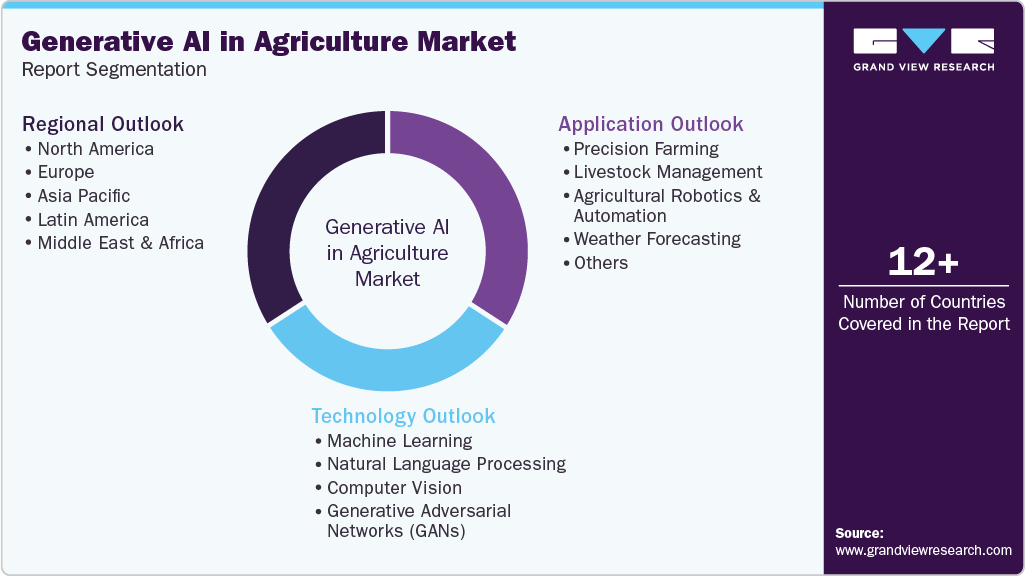
This report forecasts revenue growth at global, regional, and country levels and provides an analysis of the latest industry trends and opportunities in each of the sub-segments from 2021 to 2033. For this study, Grand View Research has segmented the global generative AI in agriculture market report in terms of technology, application, and region.
 To learn more about this report, Download Free Sample Report
 -
Technology Outlook (Revenue, USD Million, 2021 - 2033)
-
Machine Learning
-
Natural Language Processing
-
Computer Vision
-
Generative Adversarial Networks (GANs)
-
-
Application Outlook (Revenue, USD Million, 2021 - 2033)
-
Precision Farming
-
Livestock Management
-
Agricultural Robotics & Automation
-
Weather Forecasting
-
Others
-
-
Regional Outlook (Revenue, USD Million, 2021 - 2033)
-
North America
-
U.S.
-
Canada
-
Mexico
-
-
Europe
-
UK
-
Germany
-
France
-
-
Asia Pacific
-
China
-
Japan
-
India
-
Australia
-
South Korea
-
-
Latin America
-
Brazil
-
-
Middle East & Africa (MEA)
-
KSA
-
UAE
-
South Africa
-
-
Frequently Asked Questions About This Report
North America dominated the generative AI in agriculture market with a share of 37.2% in 2024. This is attributable to strong technological infrastructure, early adoption of AI solutions, and significant investments in precision farming.
Some key players operating in the generative AI in agriculture market include Agmatix, AgroScout, Bayer AG, Carbon Robotics, Deere & Company (John Deere), DeepAgro, IBM Corporation, KissanAI, Microsoft, and Syngenta Group.
Key factors that are driving the market growth include increasing demand for crop yield optimization, labor shortage in agriculture, and rising integration of AI in farm management systems.
The global generative AI in agriculture market size was valued at USD 226.2 million in 2024 and is estimated at USD 364.9 million for 2026.
The global generative AI in agriculture market is expected to grow at a CAGR of 28.7% from 2025 to 2033, reaching USD 2,158.9 million by 2033.
About the Author(s)
Next Generation Technologies Research Team
Technology · Next Generation TechnologiesThis report was authored by the next generation technologies research team at Grand View Research - comprising two research analysts, one senior research analyst, and one industry expert - with specialized expertise in the next generation technologies segment of the technology industry. All findings are based on proprietary technology databases, executive interviews, and regulatory analysis, subject to internal peer review prior to publication.
Last Updated:
Speak to Analyst

Customize this report to your needs - add regions, segments, or data points, with 20% free customization.
Or view our licence options:


ISO 9001:2015 & 27001:2022 Certified
We are GDPR and CCPA compliant! Your transaction & personal information is safe and secure. For more details, please read our privacy policy.


