
- Home
- »
- Green Building Materials
- »
-
Waterproofing Membranes Market, Industry Report, 2033GVR Report cover

Waterproofing Membranes Market (2026 - 2033) Size, Share & Trends Analysis Report By Product (Liquid Applied Membrane, Sheet Membrane), By End Use (Roofing, Walls, Building Structures, Landfills & Tunnels), By Region, And Segment Forecasts
Market Size, 2025
$27.9BMarket Estimate, 2026
$29.9BMarket Forecast, 2033
$50.5BCAGR, 2026–2033
7.8%Waterproofing Membranes Market Summary
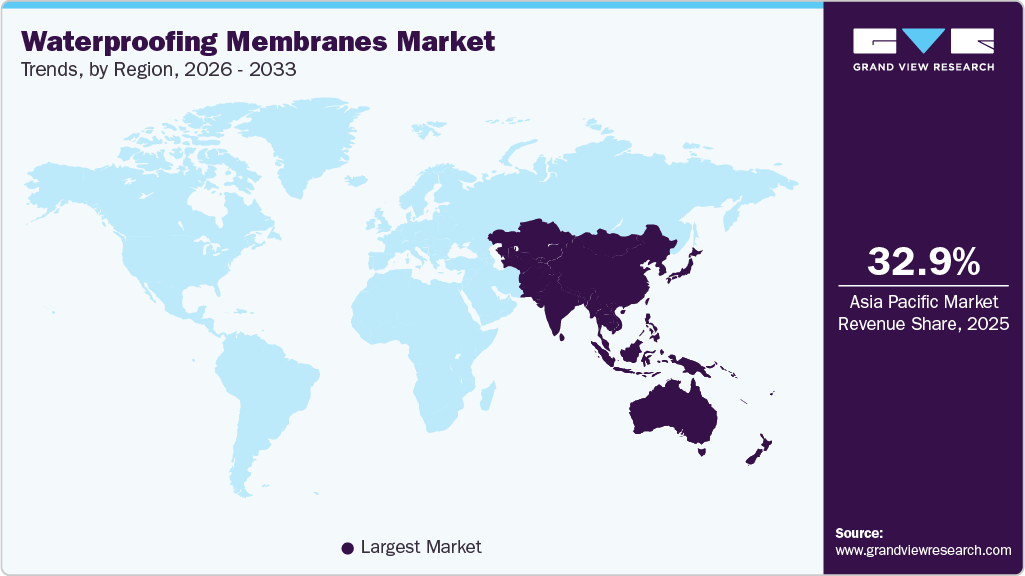
The global waterproofing membranes market size was valued at USD 27.9 billion in 2025 and is projected to grow from USD 29.9 billion in 2026 to USD 50.5 billion by 2033, at a CAGR of 7.8% from 2026 to 2033. The Asia Pacific waterproofing membranes market held the largest share of 32.9% of the global market in 2025. The demand for waterproofing membranes is increasing significantly due to the rapid growth of global construction activities across residential, commercial, and infrastructure sectors.
 Source: Grand View Research, IR Documents, Primary Interviews, Paid DatabasesTo learn more about this report,
 Download Free Sample Report
 Key Market Trends & Insights
- By product: Liquid applied membrane segment is expected to grow at the fastest CAGR of 8.2% over the forecast period.
- By product: Sheet membrane segment is expected to grow at a CAGR of 7.0% over the forecast period.
- By end use: Roofing segment accounted for the largest revenue share of 32.0% in 2025.
Regional Highlights
- Largest regional market: Asia Pacific (32.9% revenue share, 2025)
- By country: The U.S. waterproofing membranes industry is expected to grow at a CAGR of 7.1% from 2026 to 2033.
Market Size & Forecast
- Market size in 2025: USD 27.9 billion
- Estimated market size in 2026: USD 29.9 billion
- Projected market size by 2033: USD 50.5 billion
- CAGR (2026-2033): 7.8%
Three ways to get this report
Buy it, customize it, or ask a question.Ask an Analyst
Analyst response in 1 business day
- AccessReport author, directly
- Reply timeWithin 1 working day
- No sales callDirect answer only
- FormatEmail reply
- CostFree, no cost
Get the Full Report
What the study covers
- FormatsPDF · Excel · Dashboard
- Timeline2026–2033 annual, 2025 base
- Coverage20+ countries, 5 regions
- Companies10+ key players profiled
Customize the Report
20% free customization
- IncludeCountries, segments, points
- TailorTo your product definition
- ExtendDeeper competitor detail
- OrA fully bespoke study
- Turnaround5–10 working days
As urbanization accelerates, the need to protect buildings and structures from water damage, leaks, and moisture penetration grows. Waterproofing membranes are widely used in roofs, basements, tunnels, bridges, and foundations to enhance durability and structural integrity. Rising investments in large-scale infrastructure projects and real estate developments are also boosting the demand for advanced waterproofing solutions.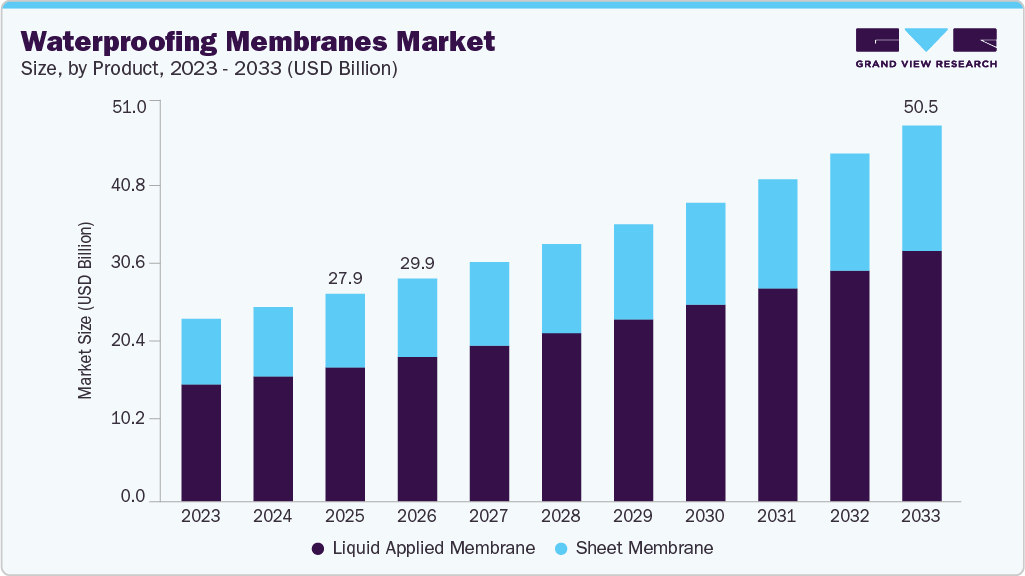 To learn more about this report, Download Free Sample Report
 Key drivers of the waterproofing membrane market include the growing focus on building longevity, strict construction quality standards, and increasing awareness regarding structural protection. Rapid infrastructure expansion in emerging economies, particularly in Asia Pacific and the Middle East, has significantly increased demand for waterproofing materials. The expansion of transportation infrastructure such as tunnels, highways, and metro systems further supports market growth. In addition, the rising adoption of green buildings and energy-efficient construction practices has accelerated the use of advanced waterproofing technologies. Increasing renovation and refurbishment activities in aging infrastructure across developed economies also contribute to demand.
Technological advancements and product innovations are shaping the waterproofing membranes industry. Manufacturers are increasingly focusing on high-performance membranes with improved flexibility, durability, and resistance to extreme weather conditions. The development of liquid-applied membranes, self-adhesive membranes, and eco-friendly formulations is gaining popularity due to their ease of application and enhanced protection capabilities. The integration of polymer-modified bitumen and advanced synthetic materials has improved the performance and lifespan of waterproofing systems.
Market Dynamics
Rapid growth in residential, commercial, and infrastructure construction activities is significantly driving the demand for waterproofing membranes worldwide. Waterproofing membranes are widely used in roofs, walls, basements, tunnels, bridges, and water-retaining structures to prevent water infiltration, moisture damage, and structural deterioration. Rising urbanization and growing investments in smart cities, transportation infrastructure, and industrial facilities are increasing the need for long-lasting and weather-resistant construction materials. In addition, stringent building regulations and rising awareness of the benefits of durable, low-maintenance buildings are driving the adoption of advanced waterproofing systems across new construction and renovation projects.
Furthermore, rising concerns about water leakage, mold growth, and structural corrosion are accelerating the adoption of waterproofing membranes in both developed and developing economies. Modern waterproofing technologies offer enhanced flexibility, UV resistance, chemical resistance, and extended service life, making them suitable for harsh environmental conditions and complex construction applications. The growing trend toward green buildings and energy-efficient infrastructure is also driving market growth, as waterproofing membranes enhance building protection, sustainability, and lifecycle cost optimization.
The waterproofing membranes market faces challenges associated with fluctuating raw material prices and complex installation requirements. Many waterproofing membranes are manufactured using petroleum-based materials such as bitumen, PVC, TPO, and polyurethane, making production costs sensitive to crude oil price volatility. In addition, improper installation, inadequate surface preparation, and lack of skilled labor can negatively impact membrane performance and durability, leading to leakage issues and higher maintenance costs. These factors may increase overall project expenses and limit adoption in cost-sensitive construction markets.
Market Concentration & Characteristics
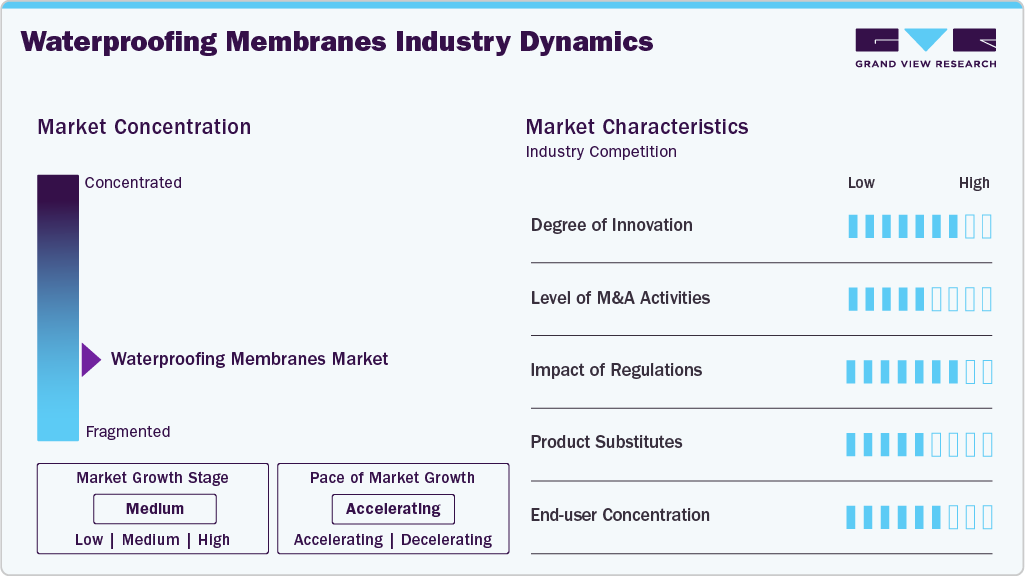
The waterproofing membranes market is moderately fragmented, with the presence of several global and regional manufacturers competing through product innovation, pricing strategies, and distribution networks. Leading companies focus on expanding their product portfolios and strengthening their geographic presence through partnerships, acquisitions, and capacity expansions. Large multinational firms dominate premium product segments due to strong brand recognition and technological expertise, while regional manufacturers cater to price-sensitive markets with cost-effective solutions. The market is also characterized by strong competition in infrastructure and commercial construction applications, where performance standards and long-term durability are critical.
 To learn more about this report, Download Free Sample Report
 The waterproofing membranes industry faces moderate competition from alternative waterproofing solutions such as cementitious coatings, polyurethane coatings, and integral waterproofing admixtures used in concrete structures. These alternatives are sometimes preferred for specific applications due to their lower installation cost or ease of application. However, waterproofing membranes offer superior performance in terms of durability, flexibility, and resistance to environmental stress, making them more suitable for critical infrastructure and roofing applications. In many large construction projects, membranes are often used alongside other waterproofing techniques to enhance protection.
Product Insights
The liquid applied membrane segment held the largest revenue share of 64.6% in 2025, due to its ease of application and ability to form seamless waterproof layers over complex surfaces. These membranes can be directly applied using rollers, brushes, or spray equipment, allowing efficient installation on roofs, terraces, balconies, and foundations. Their strong adhesion, flexibility, and crack-bridging capabilities make them highly effective in preventing water infiltration. In addition, liquid membranes are widely preferred in renovation and maintenance projects because they can be applied over existing substrates with minimal surface preparation. The growing demand for durable and adaptable waterproofing systems in modern construction continues to support the dominance of this segment.
The sheet membrane segment is expected to grow at a CAGR of 7.0% over the forecast period, due to its high durability and consistent waterproofing performance. These membranes, typically manufactured from bitumen, PVC, TPO, or HDPE materials, are widely used in large infrastructure projects such as tunnels, bridges, basements, and underground structures. Sheet membranes provide uniform thickness and strong resistance to mechanical damage, making them suitable for demanding construction environments. The increasing development of transportation infrastructure and underground construction activities is further driving demand for sheet membrane systems.
End Use Insights
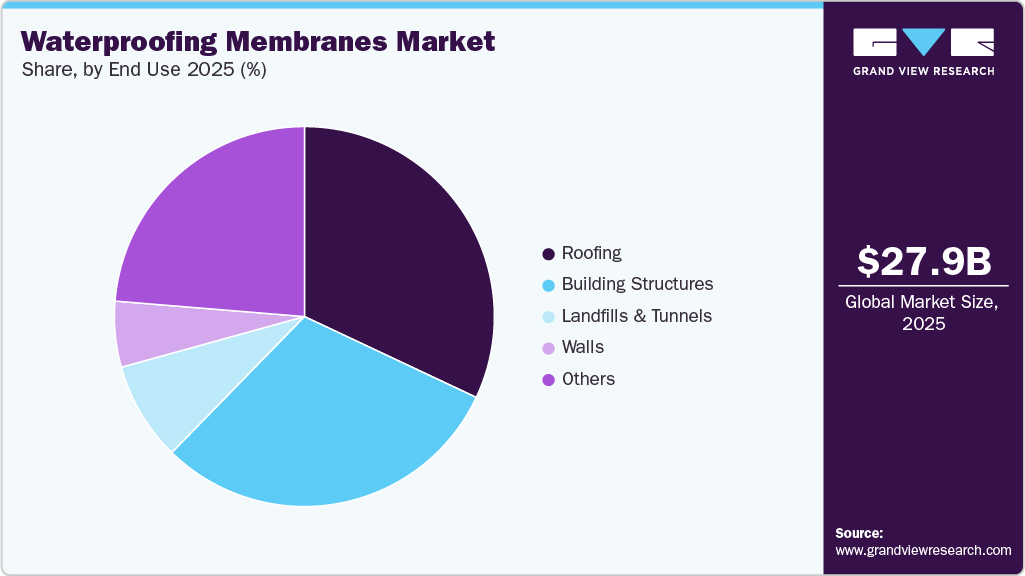
The roofing segment held the largest revenue share of 32.0% in 2025, driven by the critical need to protect buildings from rainwater, moisture penetration, and weather exposure. Waterproofing membranes are widely used on flat and low-slope roofs to prevent leaks and extend the lifespan of roofing systems. Rapid growth in residential, commercial, and industrial construction projects has significantly increased the demand for roofing waterproofing solutions. Moreover, the rising adoption of energy-efficient roofing systems and green roofs has further strengthened the use of advanced waterproofing membranes. As buildings increasingly incorporate durable roofing systems, the roofing segment continues to dominate market demand.
 To learn more about this report, Download Free Sample Report
 The building structures segment is expected to grow at the fastest CAGR of 8.4% over the forecast period, as developers increasingly prioritize long-term structural protection against water damage. Waterproofing membranes are widely applied in basements, foundations, retaining walls, and underground structures to prevent moisture intrusion and structural deterioration. Rapid urbanization and the rising construction of high-rise buildings are driving the need for advanced waterproofing solutions that ensure building durability. Additionally, stricter construction regulations and quality standards are driving the adoption of high-performance waterproofing systems for structural components.
Regional Insights
Asia Pacific waterproofing membranes market dominated the global market, accounting for the largest revenue share of 32.9% in 2025, driven by rapid urbanization, strong infrastructure development, and expanding construction activity across countries such as China, India, and Southeast Asian nations. Increasing population and urban housing demand have significantly accelerated residential construction projects. Governments across the region are investing heavily in smart cities, transportation networks, and industrial infrastructure, all of which require durable, waterproofing systems. Additionally, rising awareness regarding building safety and long-term structural protection is encouraging developers to adopt high-performance waterproofing materials.
 To learn more about this report, Download Free Sample Report
 China Waterproofing Membranes Market Trends
Waterproofing membranes market in China represents one of the largest markets for waterproofing membranes due to massive investments in infrastructure, urban housing, and commercial real estate projects. The government’s continuous focus on urban redevelopment, transportation infrastructure, and industrial expansion has significantly increased demand for waterproofing systems. Large-scale projects such as tunnels, bridges, and metro rail networks require advanced waterproofing solutions to ensure structural durability. Additionally, strict building regulations and quality standards are encouraging the use of high-performance membranes in modern construction.
Europe Waterproofing Membranes Market Trends
Europe’s waterproofing membranes market is driven by strict construction regulations, sustainability standards, and infrastructure maintenance projects. Many European countries are focusing on improving building energy efficiency and adopting environmentally friendly construction materials. Renovation of historic and aging buildings is a major factor contributing to waterproofing membrane demand in the region. Additionally, increasing investments in transportation infrastructure and commercial construction projects support market growth.
Waterproofing membranes market in Germany is one of the leading markets in the Europe, due to its strong construction sector and strict building standards. The country emphasizes high-quality infrastructure, energy-efficient buildings, and durable construction materials. Renovation of existing buildings and infrastructure modernization programs are key drivers of waterproofing membrane demand. Additionally, Germany’s focus on sustainable construction practices encourages the use of eco-friendly waterproofing materials. The presence of technologically advanced manufacturers and research-driven product development further supports the growth of the waterproofing membranes market in Germany.
North America Waterproofing Membranes Market Trends
North America is a mature market for waterproofing membranes, driven primarily by renovation activities, infrastructure modernization, and commercial construction projects. Aging buildings and infrastructure across the region require advanced waterproofing systems to improve structural durability and reduce maintenance costs. The growing focus on energy-efficient buildings and sustainable construction materials also supports the adoption of innovative waterproofing technologies. Roofing applications account for a major share of demand in the region due to harsh weather conditions and temperature fluctuations.
The United States represents a significant share of the North American waterproofing membranes market due to strong construction and infrastructure development activities. Increasing investments in commercial buildings, transportation infrastructure, and residential housing projects are driving demand for high-performance waterproofing materials. Additionally, renovation and refurbishment projects in aging structures require effective waterproofing solutions to prevent water damage and structural deterioration. The adoption of sustainable construction practices and energy-efficient building standards is also encouraging the use of advanced membrane technologies. Innovation and product development remain key strategies among manufacturers operating in the U.S. market.
Central and South America Waterproofing Membranes Market Trends
The waterproofing membranes market in Central and South America is expanding due to increasing urbanization and infrastructure development across countries such as Brazil and Mexico. Rising investments in residential housing projects and commercial construction are contributing to the demand for waterproofing solutions. Additionally, government initiatives aimed at improving infrastructure and urban development are creating new opportunities for market growth. However, price sensitivity and economic fluctuations may influence adoption rates in certain regions.
Middle East & Africa Waterproofing Membranes Market Trends
The Middle East & Africa region is experiencing significant growth in the waterproofing membranes market due to large-scale infrastructure projects and urban development initiatives. Countries such as the UAE, Saudi Arabia, and Qatar are investing heavily in commercial buildings, tourism infrastructure, and transportation networks. Harsh climatic conditions, including extreme heat and occasional heavy rainfall, increase the need for effective waterproofing solutions in buildings and infrastructure. Additionally, ongoing investments in smart cities and mega construction projects further drive demand for advanced waterproofing membrane technologies across the region.
Key Waterproofing Membranes Company Insights
Some of the key players operating in the market include BASF SE, Kemper System America, Inc.
-
BASF SE is a global chemical company that provides advanced construction chemicals and waterproofing solutions for infrastructure and building applications. Its waterproofing portfolio includes high-performance membrane systems used in tunnels, basements, roofs, and foundation protection to enhance durability and moisture resistance.
-
Kemper System America, Inc. specializes in liquid-applied waterproofing and roofing membranes widely used in commercial construction. The company’s reinforced membrane systems provide seamless waterproofing solutions for roofs, plazas, balconies, and complex structural surfaces.
Maris Polymers and Alchimica Building Chemicals are some of the emerging market participants in the waterproofing membranes market.
-
Maris Polymers develops polyurethane-based liquid waterproofing membranes designed for roofs, terraces, and infrastructure protection. Its products are widely used in construction projects requiring flexible, durable, and weather-resistant waterproofing solutions.
-
Alchimica Building Chemicals produces polyurethane liquid waterproofing membranes and sealants used in roofing and structural waterproofing applications. The company is known for its advanced membrane technologies designed to provide long-term protection against water infiltration and environmental exposure.
Key Waterproofing Membranes Companies:
The following key companies have been profiled for this study on the waterproofing membranes market.
- BASF SE
- Kemper System America, Inc.
- GAF Materials Corporation
- Paul Bauder GmbH & Co. KG
- Sika AG
- Fosroc Ltd
- Alchimica Building Chemicals
- Maris Polymers
- Isomat S.A.
- Soprema Group
Competitive Benchmarking
Operating Strategies
Competitive Edge
Weakness
Mature Players: BASF SE; Kemper System America, Inc.; Sika AG
- Focus on large-scale production of advanced waterproofing membrane solutions
- Investment in durable, chemical-resistant, and energy-efficient waterproofing technologies
- Strong global distribution network and R&D capabilities
- Established relationships with construction and infrastructure companies
- Dependence on construction sector demand and raw material availability
Emerging Players: Maris Polymers; Alchimica Building Chemicals
- Focus on customized and cost-competitive waterproofing solutions
- Expansion in regional construction and renovation markets
- Flexible manufacturing and specialized product offerings
- Growing presence in niche waterproofing applications
- Lower production scale compared to established players
Recent Developments
-
In February 2026, Sika announced the expansion of its global manufacturing network with the opening of five new sites located in the United States, Argentina, Colombia, Bangladesh, and Tanzania. These facilities mark an important step in increasing the company’s production capacity and further strengthening its global supply chain in key growth markets.
-
In January 2024, Soprema introduced Tex 350 PP Geotextile, a recycled polypropylene protective layer used with waterproofing membranes in pool structures to extend membrane lifespan and improve sustainability.
Waterproofing Membranes Market Report Scope
Report Attribute
Details
Market size in 2025
USD 27.9 billion
Estimated market size in 2026
USD 29.9 billion
Projected market size by 2033
USD 50.5 billion
Growth rate
CAGR of 7.8% from 2026 to 2033
Base year for estimation
2025
Actual estimates/Historical data
2021 - 2025
Forecast period
2026 - 2033
Quantitative units
Revenue in USD million/billion and CAGR from 2026 to 2033
Report coverage
Revenue forecast, company ranking, competitive landscape, growth factors, and trends
Segments covered
Product, end use, and region.
Regional scope
North America; Europe; Asia Pacific; Central and South America; Middle East and Africa
Country scope
U.S.; Germany; UK; China; Japan; Brazil
Key companies profiled
BASF SE; Kemper System America, Inc.; GAF Materials Corporation; Paul Bauder GmbH & Co. KG; Sika AG; Fosroc Ltd; Alchimica Building Chemicals; PotlatchDeltic Corporation; Isomat S.A.; Soprema Group
Customization scope
Free report customization (equivalent up to 8 analysts working days) with purchase. Addition or alteration to country, regional & segment scope.
Pricing and purchase options
Avail customized purchase options to meet your exact research needs. Explore purchase options
Global Waterproofing Membranes Market Report Segmentation
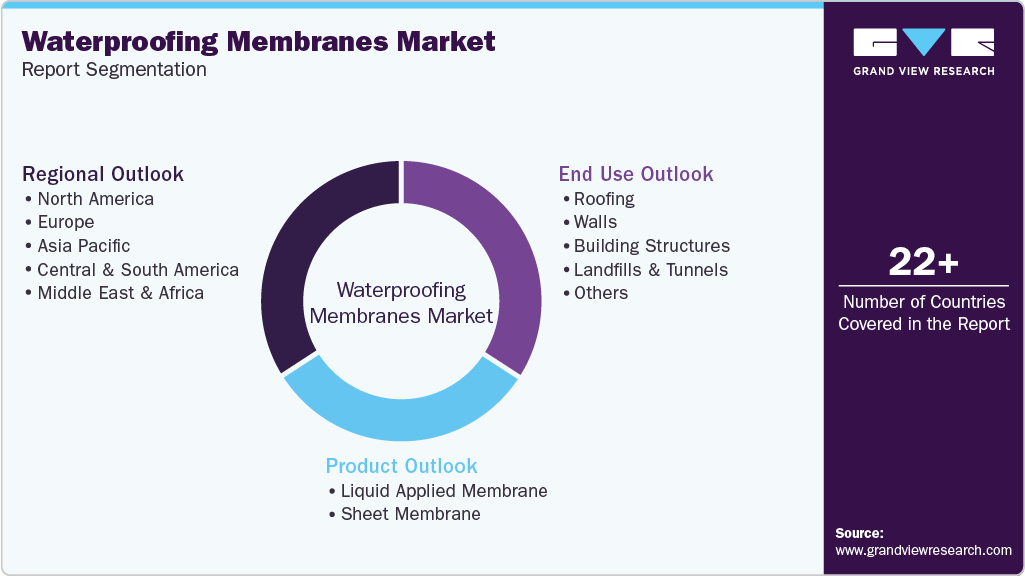
This report forecasts revenue growth at global, regional, and country levels and provides an analysis on the industry trends in each of the sub-segments from 2021 to 2033. For this study, Grand View Research has segmented the waterproofing membranes market on the basis of product, end use, and region:
 To learn more about this report, Download Free Sample Report
 -
Product Outlook (Volume, Million Square Meters; Revenue, USD Million, 2021 - 2033)
-
Liquid Applied Membrane
-
Cementitious
-
Bituminous
-
Polyurethane
-
Acrylic
-
Others
-
-
Sheet Membrane
-
Bituminous
-
PVC
-
EPDM
-
Others
-
-
-
End Use Outlook (Volume, Million Square Meters; Revenue, USD Million, 2021 - 2033)
-
Roofing
-
Walls
-
Building Structures
-
Landfills & Tunnels
-
Others
-
-
Regional Outlook (Volume, Million Square Meters; Revenue, USD Million, 2021 - 2033)
-
North America
-
U.S.
-
-
Europe
-
UK
-
Germany
-
-
Asia Pacific
-
China
-
Japan
-
-
Central and South America
-
Brazil
-
-
Middle East and Africa
-
Delivered Customizations
This report has been delivered with the following In-depth customizations
Client Request
Customization Delivered
Value Adds
Pricing Analysis
Detailed assessment of waterproofing membrane pricing trends across bituminous, PVC, EPDM, and liquid-applied membranes, including raw material cost fluctuations, regional pricing variations, supply chain dynamics, and contractor pricing structures
Helps understand cost competitiveness, pricing volatility, procurement strategies, and margin optimization opportunities across residential, commercial, and infrastructure applications
Strategy Mapping
Comprehensive evaluation of competitive strategies adopted by key waterproofing membrane manufacturers, including product innovation, distribution expansion, strategic partnerships, sustainability initiatives, and regional capacity expansions
Supports benchmarking of competitor positioning, identification of market differentiation strategies, assessment of expansion approaches, and understanding of evolving competitive dynamics
Opportunity Analysis
In-depth analysis of growth opportunities across roofing, below-grade structures, tunnels, bridges, commercial construction, and green building applications, including increasing demand for durable and energy-efficient waterproofing solutions
Enables identification of high-growth application areas, emerging construction trends, infrastructure investment opportunities, and long-term revenue potential in developing and mature markets
Frequently Asked Questions About This Report
The global waterproofing membranes market size was valued at USD 27.9 billion in 2025 and is estimated at USD 29.9 billion for 2026.
The global waterproofing membranes market is expected to grow at a CAGR of 7.8% from 2026 to 2033, reaching USD 50.5 billion.
Asia Pacific dominated with a 32.9% revenue share in 2025.
Rapid growth in global construction activities and increasing demand for durable infrastructure protection against water leakage and moisture damage are key factors driving the waterproofing membranes market.
The liquid applied membrane segment held the highest revenue share of 64.6% in 2025, due to its ease of application and ability to form seamless waterproof layers over complex surfaces.
Key players include BASF SE; Kemper System America, Inc.; GAF Materials Corporation; Paul Bauder GmbH & Co. KG; Sika AG; Fosroc Ltd; Alchimica Building Chemicals; PotlatchDeltic Corporation; Isomat S.A.; Soprema Group.
Roofing segment led with a 32.0% revenue share in 2025, while building structures is the fastest-growing segment.
About the Author(s)
Green Building Materials Research Team
Advanced Materials · Green Building MaterialsThis report was authored by the green building materials research team at Grand View Research - comprising two research analysts, one senior research analyst, and one industry expert - with specialized expertise in the green building materials segment of the advanced materials industry. All findings are based on proprietary advanced materials databases, executive interviews, and regulatory analysis, subject to internal peer review prior to publication.
Last Updated:
Speak to Analyst

Customize this report to your needs - add regions, segments, or data points, with 20% free customization.
Or view our licence options:


ISO 9001:2015 & 27001:2022 Certified
We are GDPR and CCPA compliant! Your transaction & personal information is safe and secure. For more details, please read our privacy policy.


