
- Home
- »
- Organic Chemicals
- »
-
Glycolic Acid Market Size, Share & Trends Report 2026-2033GVR Report cover
![Glycolic Acid Market (2026 - 2033)Report]()
Glycolic Acid Market (2026 - 2033)
Size, Share & Trends Analysis Report By Grade (Cosmetic, Technical), By Application (Personal Care, Household, Construction, Industrial), By Region (North America, Europe, Asia Pacific, Latin America, MEA), And Segment Forecasts
Market Size, 2025
$520.2MMarket Estimate, 2026
$554.8MMarket Forecast, 2033
$929.6MCAGR, 2026–2033
7.7%Glycolic Acid Market Summary
The global glycolic acid market size was estimated at USD 520.2 million in 2025 and is projected to grow from USD 554.8 million in 2026 to USD 929.6 million by 2033, growing at a CAGR of 7.7% from 2026 to 2033. Asia Pacific dominated the global market with the largest revenue share of 38.4% in 2025. Increasing demand of skin and hair care products containing glycolic acid is driving the market.

Key Market Trends & Insights
- By application: Personal care segment accounted for the dominating revenue share of 66.8% in 2025.
- By grade: Cosmetic segment led the market with the largest revenue share of 66.8% in 2025.
Regional Highlights
- Largest regional market: Asia Pacific (38.4% revenue share, 2025)
- By country: China glycolic acid market accounted for 45% revenue share of the Asia Pacific in 2025.
Market Size & Forecast
- Market Size in 2025: USD 520.2 Million
- Estimated Market Size in 2026: USD 554.8 Million
- Projected Market Size by 2033: USD 929.6 Million
- CAGR (2026-2033): 7.7%
It is also used in emulsion polymers and additives for inks & paints, further expanding the market growth. Glycolic acid is a natural compound primarily obtained from citrus fruits such as oranges and grapes. Kiwi, beets, sugarcane are other rich sources of glycolic acid. Growing production of formaldehyde coupled with technological advancements to optimize the production grade is expected to boost the market growth further.In addition, rising expenditure on R&D has resulted in an increased scope of application, which is expected to drive product demand over the forecast period. However, high awareness levels about the negative effects of glycolic acid, such as skin allergies, are expected to restrain the market growth to some extent. Stringent regulations imposed by regulatory bodies, such as the European Union, regarding product usage in cosmeceutical formulations, are also likely to hinder growth. On the other hand, the rising popularity of natural cosmetics is likely to positively affect the industry dynamics over the years to come.
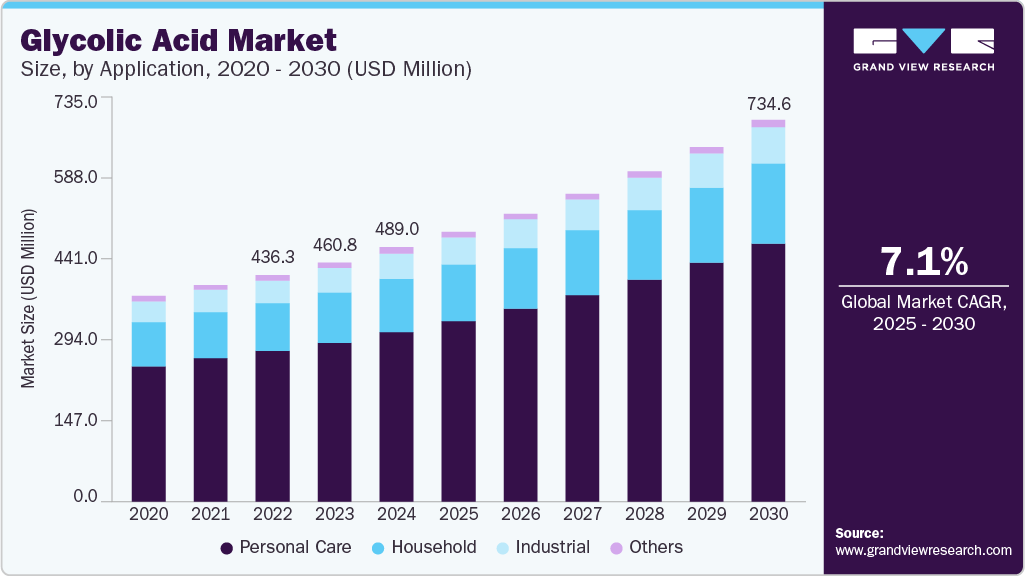
The rising need for online cosmetics and personal care products such as moisturizers, body wash, fragrances, scrubs, lipsticks, sunscreens, and others has encouraged many companies or manufacturers to develop a broad sales network, which is anticipated to drive the market. With the advent of the e-commerce sector and the growth of social media, consumer demand for high-end, unique, and novel cosmetics has also emerged. Glycolic acid is a vital element in the manufacturing of the above-mentioned goods, which is anticipated to propel industry growth, coupled with rising consumer healthcare awareness. The rising demand for glucosides in biopolymers usage, due to their harmless and excellent recyclability, represents a significant potential for glycolic acid producers. Hence, it acts as an opportunity for the manufacturers in the market.
However, the excessive use of acids in personal care & cosmetic products can damage the skin. It results in skin irritation, swelling, itching, and skin burning. In addition, chemical peeling frequently can make the skin more sensitive to UV rays and make people more prone to sunburn. If inhaled at high amounts for a prolonged time, it can harm the lungs and liver, and create respiratory ailments. Furthermore, the increasing consumer inclination toward organic products as a substitute can limit market growth.
Market Dynamics
Glycolic acid is a versatile alpha-hydroxy acid (AHA) widely utilized across personal care, household, industrial, and specialty applications owing to its exfoliating, cleaning, descaling, and surface treatment properties. The market is primarily driven by increasing demand for advanced skincare formulations, growing consumer preference for active cosmetic ingredients, and expanding industrial adoption in cleaning and surface treatment applications. Rising awareness regarding skin health, anti-aging solutions, and premium cosmetic products continues to support market expansion globally.
The growing consumer focus on skincare, anti-aging treatments, and dermatological wellness remains a key driver for the glycolic acid market. Glycolic acid is extensively used in cosmetic formulations including facial peels, exfoliants, cleansers, serums, and anti-aging products due to its ability to improve skin texture, stimulate cell turnover, and reduce signs of aging.
Increasing disposable incomes, rising beauty consciousness, and growing demand for professional skincare treatments are supporting the adoption of glycolic acid-based formulations across developed and emerging markets. Product innovation and the introduction of premium skincare solutions continue to strengthen market demand.
Compliance with cosmetic, pharmaceutical, and chemical safety regulations remains a significant challenge for glycolic acid manufacturers. Product concentration limits, labeling requirements, consumer safety standards, and environmental regulations increase compliance costs and may restrict formulation flexibility in certain markets.
Additionally, concerns regarding skin sensitivity and improper product usage can affect consumer adoption, requiring manufacturers to invest in product safety validation and consumer education initiatives.
The growing demand for premium skincare products and professional cosmetic treatments is creating significant opportunities for glycolic acid manufacturers. Increasing adoption of active ingredients in cosmetic formulations, coupled with the development of multifunctional skincare products, is expected to support long-term market growth.
Furthermore, expanding utilization in industrial cleaning, metal treatment, and specialty chemical applications presents additional opportunities for manufacturers seeking to diversify revenue streams beyond traditional personal care markets.
Analyst Perspective
The glycolic acid market is increasingly being driven by the premiumization of skincare and personal care products, where ingredient efficacy has become a key differentiating factor for manufacturers and brands. While personal care applications continue to account for the majority of market demand, growing adoption across industrial cleaning and specialty chemical applications is expanding the market's addressable opportunity beyond traditional cosmetic uses. The industry's competitive landscape is gradually shifting from volume-based competition toward product purity, formulation performance, and regulatory compliance, particularly within cosmetic-grade applications. As consumers continue to prioritize scientifically backed skincare solutions and manufacturers invest in high-performance formulations, companies with advanced production capabilities, strong quality assurance systems, and established relationships with personal care brands are expected to be best positioned to capture future market growth.
Drivers, Opportunities & Restraints
The global glycolic acid market is experiencing robust growth, primarily driven by its increasing application in personal care and dermatology products. Glycolic acid's efficacy in treating acne, hyperpigmentation, and signs of aging has made it a favored ingredient in skincare formulations. Its small molecular size allows for deep skin penetration, enhancing its effectiveness in exfoliation and skin rejuvenation. Beyond cosmetics, glycolic acid is utilized in industrial cleaning agents, textile dyeing, and as a precursor in biodegradable polymers like polyglycolic acid (PGA), which are used in medical sutures and drug delivery systems. The demand for biodegradable and sustainable products further propels its market growth.
The glycolic acid market is expanding with the rising consumer preference for natural and eco-friendly products. The shift towards sustainable production methods and the development of bio-based glycolic acid present significant growth avenues. Additionally, the increasing demand for glycolic acid in emerging economies, driven by urbanization and rising disposable incomes, offers potential for market expansion. Innovations in product formulations and the exploration of new applications in pharmaceuticals and agriculture also contribute to the market's positive outlook.
The potential side effects of glycolic acid, such as skin irritation and sensitivity, can limit its usage in cosmetic products. Moreover, stringent regulatory frameworks governing its concentration and application in various industries pose challenges for manufacturers. Compliance with diverse regional regulations requires significant investment in research and development, potentially hindering market growth. Additionally, the high production costs associated with glycolic acid, especially when derived from natural sources, may affect its competitiveness compared to synthetic alternatives.
Application Insights
The personal care segment by application, accounted for the dominating revenue share of 66.8% in 2025. The increasing awareness about self-care and the availability of products aligning with dermatological requirements are driving the segment's growth. Consumers are proactively paying attention to grooming needs, advice from professionals, and social media reviews of various products, due to which scalp & hair treatments are followed.

Polyurethane (PU) coatings are widely used in the wood and furniture industry for their exceptional durability, scratch resistance, and aesthetic appeal. They enhance the longevity of wooden surfaces by providing protection against moisture, stains, and UV exposure, making them ideal for flooring, cabinetry, and high-end furniture. With increasing demand for eco-friendly solutions, water-based PU coatings are gaining popularity as a low-VOC alternative to traditional solvent-based formulations.
The household segment held a notable share of the market in 2024, driven by its widespread use in surface cleaners, descalers, and bathroom and kitchen maintenance products. Growing consumer preference for non-toxic, eco-friendly cleaning solutions and the demand for multifunctional household cleaners further propel segment growth.
Grade Insights
Based on grade, the cosmetic segment led the market with the largest revenue share of 66.8% in 2025. The cosmetic grade market is driven by its widespread use in skincare products such as chemical peels, anti-aging creams, exfoliants, and acne treatments. Known for its small molecular size and effective skin penetration, glycolic acid helps in removing dead skin cells, improving texture, and promoting collagen production. Rising consumer demand for dermatologist-recommended and premium skincare is fueling the growth of this segment, especially in North America, Europe, and Asia-Pacific.
The technical grade segment is primarily driven by its applications in industrial cleaning, metal surface treatment, and oil & gas descaling. Its strong chelating properties make it effective in removing rust, scale, and mineral deposits without damaging surfaces. This grade is widely used in boiler cleaning agents, electronics manufacturing, and automotive maintenance. Demand is increasing due to its biodegradability and low toxicity, offering a safer alternative to harsher acids.
Regional Insights
The North American glycolic acid market is experiencing growth. High population of working women and increasing awareness among these to maintain grooming standards are driving the market. Increasing influence of social media trends and celebrity endorsements are boosting the growth as well.
U.S. Glycolic Acid Market Trends
The glycolic acid market in the U.S. is expected to grow at CAGR at 7.5% during the forecast period. The presence of key players in the cosmetics sector and continuous R&D activities to offer enhanced products are fostering the market. The growing inclination towards youthful appearance and flawless skin & hair are shaping the market of constituents in cosmetics including glycolic acid.
Europe Glycolic Acid Market Trends
Europe is projected to expand at a CAGR of 7.0% during 2025 to 2030 due to a rapidly evolving skin and hair care industry. Increasing popularity of anti-aging and acne removing creams in European population is expected to drive the market in coming years. Additionally, global fashion hubs such as France and Italy have attracted several cosmetic manufacturers in the region, positively impacting regional growth.
Asia Pacific Glycolic Acid Market Trends
Asia Pacific dominated the glycolic acid market with the largest revenue share of 38.4% in 2025. It is expected to grow at a CAGR of 7.4% and retain its dominance during the forecast period. Highly populated and developing countries such as China and India are the major contributors to the segment's growth.

China glycolic acid market accounted for 45% revenue share of the Asia Pacific in 2025. The market in China is expected to grow during the forecast period. This growth is attributed to the increasing personal care in the region, which led to increased demand for the product.
Key Glycolic Acid Company Insights
Some of the key participants in the glycolic acid market are PureTech Scientific Inc.,
CABB Chemicals, CrossChem Limited, Nikko Chemicals, Avid Organics Pvt. Ltd. Companies and others.
- PureTech Scientific operates in production of nature-identical and readily biodegradable glycolic acid which is used in variety of industries including personal care products. Its objective is to offer safer and healthier products through innovations, grade and research. Company aims to deliver environmentally sustainable products by reducing carbon emission in the process.
Key Glycolic Acid Companies:
The following are the leading companies in the glycolic acid market. These companies collectively hold the largest market share and dictate industry trends.
- PureTech Scientific Inc.
- CABB Chemicals
- CrossChem Limited
- Nikko Chemicals
- Avid Organics Pvt. Ltd.
- Mehul Dye Chem Industries
- Kanto Chemical Co., Inc.
- Junsei Chemical Co., Ltd.
- Kishida Chemical Co., Ltd.
- Fengchen Group Co., Ltd.
- BASF SE
Competitive Benchmarking
Category
Operating Strategies
Competitive Edge
Weakness
Established Players (PureTech Scientific Inc.; CABB Chemicals; BASF SE; Nikko Chemicals; Kanto Chemical Co., Inc.)
- Expanding production capacities and strengthening supply chain integration to improve product availability and cost competitiveness. Investing in high-purity cosmetic-grade glycolic acid production to capitalize on growing skincare and personal care demand. Strengthening global distribution networks and regulatory compliance capabilities.
- Established manufacturing infrastructure supports reliable large-scale production. Strong customer relationships across personal care and industrial sectors. Broad product portfolios and regulatory expertise facilitate access to global markets.
- Exposure to raw material price fluctuations and energy cost volatility can impact manufacturing economics. Capital-intensive operations require continuous investments in quality assurance, process optimization, and regulatory compliance.
Emerging Players (CrossChem Limited; Avid Organics Pvt. Ltd.; Mehul Dye Chem Industries; Junsei Chemical Co., Ltd.; Kishida Chemical Co., Ltd.; Fengchen Group Co., Ltd.)
- Focusing on regional market penetration and specialty-grade glycolic acid offerings. Developing customized solutions for personal care and industrial customers. Expanding participation through strategic partnerships and distribution agreements.
- Greater flexibility in addressing niche customer requirements. Ability to respond quickly to emerging skincare and specialty chemical trends. Strong regional customer relationships support targeted market growth.
- Limited production scale compared to established manufacturers may restrict cost competitiveness. Lower global market presence and distribution reach can constrain expansion opportunities.
Recent Developments
-
In December 2024, BASF SE personal care division has launched Symbiocell, a clinically proven active ingredient targeting sensitive skin, formulated with Cestrum latifolium extract which contains glycolic acid in the form of butylene glycol and caprylyl gycol. Recently approved for commercialization in China, Symbiocell addresses the growing demand in Asia-Pacific for glycolic acid.
-
In August 2023, The Chemours Company announced the sale of its Glycolic Acid Business. It is acquired by PureTech Scientific, LLC and backed by a private equity firm, Iron Path Capital.
Glycolic Acid Market Report Scope
Report Attribute
Details
Market size value in 2025
USD 520.2 million
Estimated market size in 2026
USD 554.8 million
Projected market size by 2033
USD 929.6 million
Growth rate
CAGR of 7.7% from 2026 to 2033
Base year for estimation
2025
Historical data
2021 - 2024
Forecast period
2026 - 2033
Quantitative units
Revenue in USD million/billion, volume in kilotons and CAGR from 2026 to 2033
Report coverage
Revenue forecast, company ranking, competitive landscape, growth factors, and trends
Segments covered
Grade, application, region
Regional scope
North America; Europe; Asia Pacific; Latin America; MEA
Country scope
U.S.; Canada; Mexico; Germany; UK; France; Italy; Spain; China; Japan; India; South Korea; Brazil; Argentina; Saudi Arabia; South Africa
Key companies profiled
PureTech Scientific Inc.; CABB Chemicals; CrossChem Limited; Nikko Chemicals; Avid Organics Pvt. Ltd.; Mehul Dye Chem Industries; Kanto Chemical Co., Inc.; Junsei Chemical Co., Ltd.; Kishida Chemical Co., Ltd.; Fengchen Group Co., Ltd.; BASF SE
Customization scope
Free report customization (equivalent up to 8 analysts' working days) with purchase. Addition or alteration to country, regional & segment scope.
Pricing and purchase options
Avail customized purchase options to meet your exact research needs. Explore purchase options
Global Glycolic Acid Market Report Segmentation
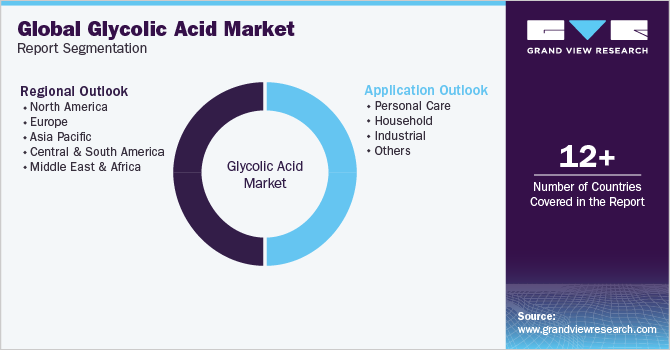
This report forecasts revenue and volume growth at global, regional, and country levels and provides an analysis of the latest industry trends in each of the sub-segments from 2021 to 2033. For the purpose of this study, Grand View Research has segmented the global glycolic acid market report on the basis of grade, application, and region.
-
Grade Outlook (Volume, Kilotons; Revenue, USD Million; 2021- 2033)
-
Cosmetic
-
Technical
-
-
Application Outlook (Volume, Kilotons; Revenue, USD Million; 2021- 2033)
-
Personal Care
-
Household
-
Construction
-
Industrial
-
Others
-
-
Regional Outlook (Volume, Kilotons; Revenue, USD Million; 2021- 2033)
-
North America
-
U.S.
-
Canada
-
Mexico
-
-
Europe
-
Germany
-
UK
-
France
-
Italy
-
Spain
-
-
Asia Pacific
-
China
-
India
-
Japan
-
South Korea
-
-
Latin America
-
Brazil
-
Argentina
-
-
Middle East & Africa
-
Saudi Arabia
-
South Africa
-
-
Research Methodology
Segment Definition
Segment - Grade
Revenue capture definition
Cosmetic Grade
As the dominant grade segment, revenue is primarily generated through its use in skincare, anti-aging, exfoliation, professional peel treatments, and cosmetic formulations. Market growth is supported by increasing consumer spending on premium personal care products and growing demand for active cosmetic ingredients.
Technical Grade
Revenue is supported by applications in industrial cleaning, metal treatment, descaling, surface preparation, and specialty chemical manufacturing. Demand is influenced by industrial production activity, infrastructure maintenance requirements, and adoption across commercial cleaning applications.
Segment - Application
Revenue capture definition
Personal Care
As the largest application segment, revenue is generated through glycolic acid consumption in skincare products including cleansers, serums, creams, exfoliants, chemical peels, and anti-aging formulations. Consumer awareness regarding skin rejuvenation and cosmetic efficacy remains a primary growth driver.
Household
Revenue is supported by utilization in household cleaning products, surface cleaners, bathroom cleaners, and descaling formulations. Demand is influenced by consumer spending on premium cleaning products and increasing preference for high-performance cleaning solutions.
Industrial
Market value is generated through glycolic acid applications in metal cleaning, surface treatment, oilfield chemicals, textile processing, and specialty industrial formulations. Industrial activity levels and manufacturing output significantly influence segment demand.
Others
This segment derives revenue from pharmaceutical intermediates, specialty chemical synthesis, institutional cleaning products, and niche applications. Product innovation and emerging industrial uses continue to create additional revenue opportunities.
Estimation Model
Layer Name
Key Question
Description
Feedstock Production Layer
What forms the supply base?
Identify global glycolic acid production capacity supported by raw material availability, manufacturing facilities, process technologies, and regional production capabilities. This establishes the foundational supply base available for downstream commercial applications.
Application Adoption Layer
Where is glycolic acid consumed?
Estimate the proportion of glycolic acid utilized across personal care, household, industrial, and other applications based on formulation requirements, end-use demand patterns, and industry adoption rates.
Consumption Intensity Layer
How much glycolic acid is used?
Analyze application-specific consumption rates, product inclusion levels, industrial utilization patterns, and regional demand trends to determine annual glycolic acid consumption across major end-use sectors.
Revenue Layer
How is market revenue generated?
Market revenue is quantified through the sale of cosmetic-grade and technical-grade glycolic acid supplied to personal care manufacturers, household cleaning product producers, industrial formulators, and specialty chemical companies worldwide.
Delivered Customizations
This report has been delivered with the following In-depth customizations
Client Request
Customization Delivered
Value Adds
Regional Segmentation
The study delivers detailed country-level analysis across key glycolic acid markets including the U.S., Germany, France, UK, China, Japan, South Korea, and India, covering production, consumption, pricing trends, regulatory landscape, and demand outlook.
Provides stakeholders with a detailed understanding of regional demand dynamics, competitive positioning, regulatory influences, and growth opportunities to support market expansion and investment decisions.
Application Assessment
The report delivers detailed analysis of glycolic acid consumption across personal care, household cleaning, industrial cleaning, surface treatment, pharmaceutical, and specialty chemical applications, including demand trends and growth outlook.
Enables companies to identify the most attractive end-use segments, optimize product portfolios, and prioritize investment opportunities based on application-specific growth potential.
Competitive Benchmarking
The study provides detailed benchmarking of major glycolic acid manufacturers, including production capacities, product offerings, distribution strategies, technological capabilities, and regional market presence.
Supports strategic planning by helping stakeholders evaluate competitive positioning, identify market gaps, and understand best practices adopted by leading industry participants.
Frequently Asked Questions About This Report
The global glycolic acid market size was estimated at USD 520.2 million in 2025 and is expected to reach USD 554.8 million in 2026.
The global glycolic acid market is expected to grow at a compound annual growth rate of 7.7% from 2026 to 2033 to reach USD 929.6 million by 2033.
Asia Pacific dominated the glycolic acid market with a share of 38.4% in 2025. This is attributable to increasing product use in industrial, cosmeceutical, and household applications.
Some key players operating in the glycolic acid market include PureTech Scientific Inc.; CABB Chemicals; CrossChem Limited; Nikko Chemicals; Avid Organics Pvt. Ltd.; Mehul Dye Chem Industries; Kanto Chemical Co., Inc.; Junsei Chemical Co., Ltd.; Kishida Chemical Co., Ltd.; Fengchen Group Co., Ltd.; BASF SE
Key factors that are driving the market growth include growing demand for glycolic acid-based skin and hair care products.
Cosmetic grade accounted for the largest revenue share of 66.8% in 2025. This is due to widespread use of glycolic acid in skincare products such as chemical peels, anti-aging creams, exfoliants, and acne treatments.
China led the Asia Pacific market with a revenue share of 45.0% in 2025. This growth is attributed to the increasing personal care in the region, which led to increased demand for the product.
Personal care accounted for the highest revenue share of 66.8% in 2025. The increasing awareness about self-care and the availability of products aligning with dermatological requirements are driving the segment's growth.
About the Author(s)
Organic Chemicals Research Team
Bulk Chemicals · Organic ChemicalsThis report was authored by the organic chemicals research team at Grand View Research - comprising two research analysts, one senior research analyst, and one industry expert - with specialized expertise in the organic chemicals segment of the bulk chemicals industry. All findings are based on proprietary bulk chemicals databases, executive interviews, and regulatory analysis, subject to internal peer review prior to publication.
Last Updated:
Speak to Analyst

Need a Tailored Report?
Customize this report to your needs — add regions, segments, or data points, with 20% free customization.
Or view our licence options:


ISO 9001:2015 & 27001:2022 Certified
We are GDPR and CCPA compliant! Your transaction & personal information is safe and secure. For more details, please read our privacy policy.












