
- Home
- »
- Distribution & Utilities
- »
-
Grid Automation Market Size, Share & Trends Report, 2033GVR Report cover
![Grid Automation Market (2026 - 2033)Report]()
Grid Automation Market (2026 - 2033)
Size, Share & Trends Analysis Report By Component (Hardware, Software, Services), By Grid Level, By Automation Solution (Substation Solutions, Distribution Solutions), By End Use, By Region, And Segment Forecasts
Market Size, 2025
$42.5BMarket Estimate, 2026
$44.4BMarket Forecast, 2033
$65.5BCAGR, 2026–2033
5.7%Grid Automation Market Summary
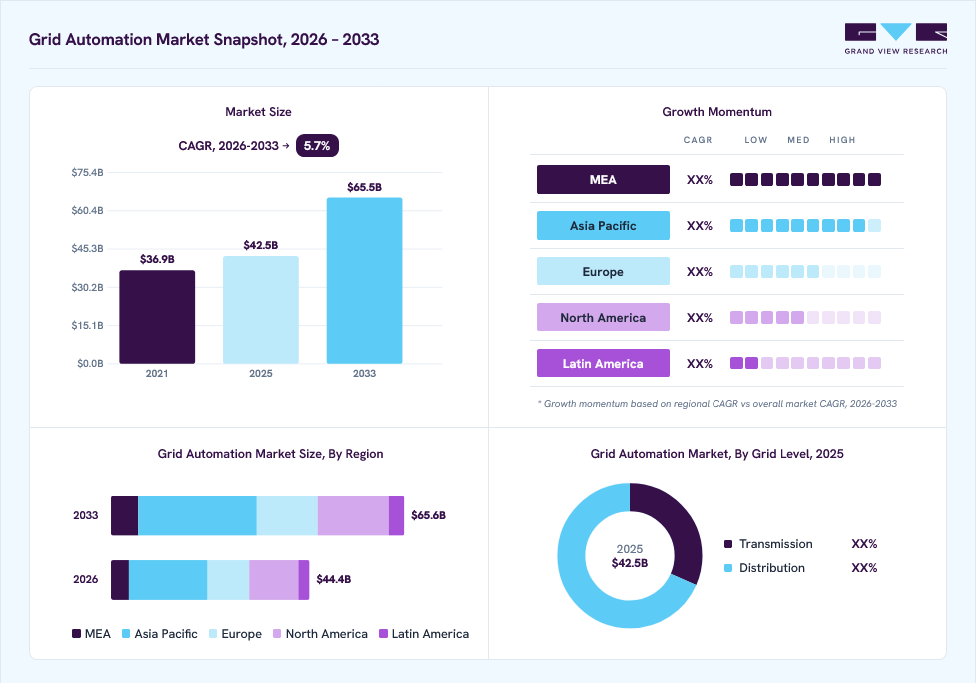
The global grid automation market size was valued at USD 42.5 billion in 2025 and is projected to grow from USD 44.4 billion in 2026 to USD 65.5 billion by 2033, at a CAGR of 5.7% from 2026 to 2033. Asia Pacific dominated the market, accounting for a revenue share of 39.5% in 2025. The market is driven by rising electricity demand, increasing integration of renewable energy, grid modernization, and the growing need for real-time monitoring, automated fault detection, and improved grid reliability and resilience.
Key Market Trends & Insights
- By grid level: The distribution held the largest revenue share of 68.4% in 2025.
- By component: The hardware held the largest revenue share of 52.6% in 2025.
- By end use: The distribution operators held the largest revenue share of 48.9% in 2025.
- By automation solution: The distribution solutions segment held the largest revenue share of 28.3% in 2025.
Regional Highlights
- Largest regional market: Asia Pacific (39.5% revenue share, 2025)
- By country: India held the largest market share in 2025
Market Size & Forecast
- Market size in 2025: USD 42.5 Billion
- Estimated market size in 2026: USD 44.4 Billion
- Projected market size by 2033: USD 65.5 Billion
- CAGR (2026-2033): 5.7%
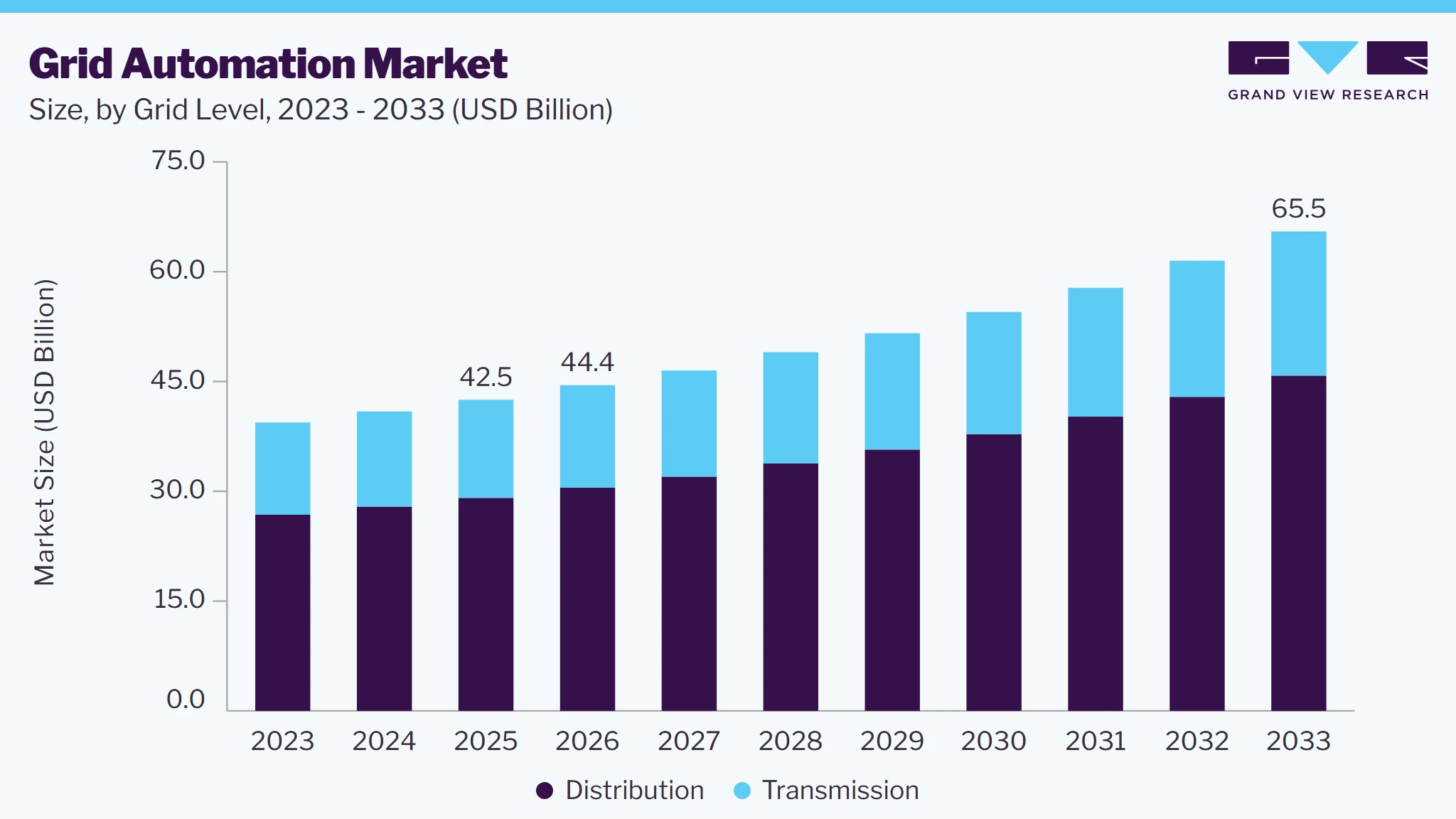
The increasing deployment of smart grids, advanced distribution management systems, and digital substations is further supporting market growth.Market Dynamics
The market is driven by rising electricity demand, increasing integration of renewable energy, grid modernization, and the need for improved grid reliability and resilience. Utilities are adopting automation solutions such as SCADA, digital substations, smart meters, and advanced distribution management systems to enable real-time monitoring and automated fault detection. The growing deployment of distributed energy resources, battery storage, and electric vehicles is further increasing demand for flexible grid management. However, high implementation costs, cybersecurity risks, interoperability issues, and legacy infrastructure remain key challenges. Meanwhile, increasing smart grid investments and the integration of AI, IoT, and advanced analytics are creating new growth opportunities.
Utilities are increasingly adopting grid automation to modernize aging power infrastructure, improve grid reliability, and reduce the risk and duration of outages. Aging substations, feeders, and other grid assets require greater visibility, automated fault detection, and faster restoration capabilities. Grid automation enables real-time monitoring and automated control, helping utilities improve operational efficiency and resilience while extending the value of existing infrastructure.
In May 2025, GE Vernova announced a USD 16 billion investment in India to expand its electrification manufacturing and engineering capabilities in Chennai and Noida. The investment includes a new manufacturing line for HVDC and FACTS components and an engineering and testing laboratory, with the Chennai facility expected to be operational by early 2027 and the Noida lab by the end of 2025. The investment was driven by rising energy demand, the integration of renewable energy, and the need for stronger, smarter, and more flexible grid infrastructure, underscoring the growing need for grid modernization and automation technologies.
High upfront investment and the complexity of integrating automation technologies with legacy grid infrastructure are key restraints for the market. Utilities often need to upgrade aging equipment, communication networks, software, and control systems, increasing deployment costs and project timelines. Interoperability issues across multi-vendor systems and the need for specialized technical expertise can further delay automation projects.
The growing integration of AI, IoT, distributed energy resources (DERs), and advanced analytics is creating opportunities for intelligent grid automation solutions that enable predictive maintenance, automated fault detection, demand forecasting, and real-time grid optimization. AI and machine learning are increasingly being applied to manage the complexity of decentralized and bidirectional power flows from solar, batteries, EVs, and other DERs. Digital twins, DERMS, and AI-enabled substation automation are emerging as high-potential areas that enable utilities to improve asset utilization, resilience, and operational efficiency.
Analyst Perspective
The market is expected to maintain strong growth as utilities transition toward digital, automated, and resilient grid infrastructure. A key trend is the shift toward AI-enabled grid operations, DERMS, digital substations, and predictive maintenance, enabling utilities to manage increasingly complex power flows in real time. The growing adoption of IoT sensors, edge computing, digital twins, and IEC 61850-based communication is further moving grid automation from hardware-centric systems toward software-driven platforms. However, legacy infrastructure, interoperability, cybersecurity, and high modernization costs will continue to influence the pace of adoption.
Grid Level Insights
The distribution segment held the largest revenue share of 68.4% in 2025, driven by the growing need to modernize aging distribution networks, improve grid reliability, integrate distributed energy resources, and manage increasingly complex electricity flows. Utilities are increasingly deploying automated distribution equipment and digital grid technologies to enable real-time monitoring, fault detection, outage management, and efficient power delivery. Rising investments in smart grids and decentralized energy generation are further supporting the adoption of grid automation solutions across distribution networks.
The transmission segment is anticipated to register the second-fastest CAGR of 5.0% during the forecast period, supported by increasing investments in high voltage transmission infrastructure, grid modernization initiatives, and the integration of renewable power generation. The growing need to improve grid reliability, reduce transmission losses, and manage rising electricity demand is encouraging utilities to deploy advanced automation, monitoring, and control technologies across transmission networks.
Component Insights
The hardware segment accounted for the largest revenue share of 52.6% in 2025, driven by the widespread deployment of physical grid automation equipment, including sensors, intelligent electronic devices, protection relays, controllers, and communication equipment. Growing investments in grid modernization, replacement of aging infrastructure, and the need for reliable real-time monitoring and automated fault management are driving utilities to expand their hardware installations across transmission and distribution networks.
The software segment is expected to register the fastest CAGR of 6.4% for the forecast period. This segment’s growth is driven by the increasing adoption of advanced grid management platforms, real-time monitoring systems, predictive analytics, and automated control solutions. Utilities are increasingly leveraging software to optimize grid operations, improve asset performance, integrate distributed energy resources, and enhance system reliability while reducing operational costs.
Automation Solution Insights
The distribution solutions segment held the largest revenue share of 28.3% in 2025, driven by increasing investments in distribution grid modernization, smart grid deployment, and automated power distribution infrastructure. Utilities are increasingly adopting distribution automation solutions to improve network reliability, enable faster fault detection and restoration, reduce power losses, and manage the growing integration of distributed energy resources. The expansion of decentralized power generation and rising electricity demand are further encouraging utilities to enhance the intelligence and flexibility of distribution networks.
The grid management segment is anticipated to register the fastest CAGR of 7.3% for the forecast period. This segment’s growth is driven by the increasing need for real-time grid monitoring, advanced energy management, and automated decision-making across increasingly complex power networks. The integration of renewable energy sources, distributed energy resources, and smart grid technologies is further increasing demand for grid management solutions that improve system flexibility, reliability, and operational efficiency.
End Use Insights
The distribution operators segment held the largest share of 48.9% in 2025, driven by increasing investments in distribution network modernization, grid automation, and smart grid infrastructure. Growing electricity demand, the integration of distributed energy resources, and the need for improved outage management are encouraging distribution operators to adopt advanced monitoring, control, and automation solutions. The expansion of decentralized power generation is further increasing the need for flexible and reliable distribution network management.
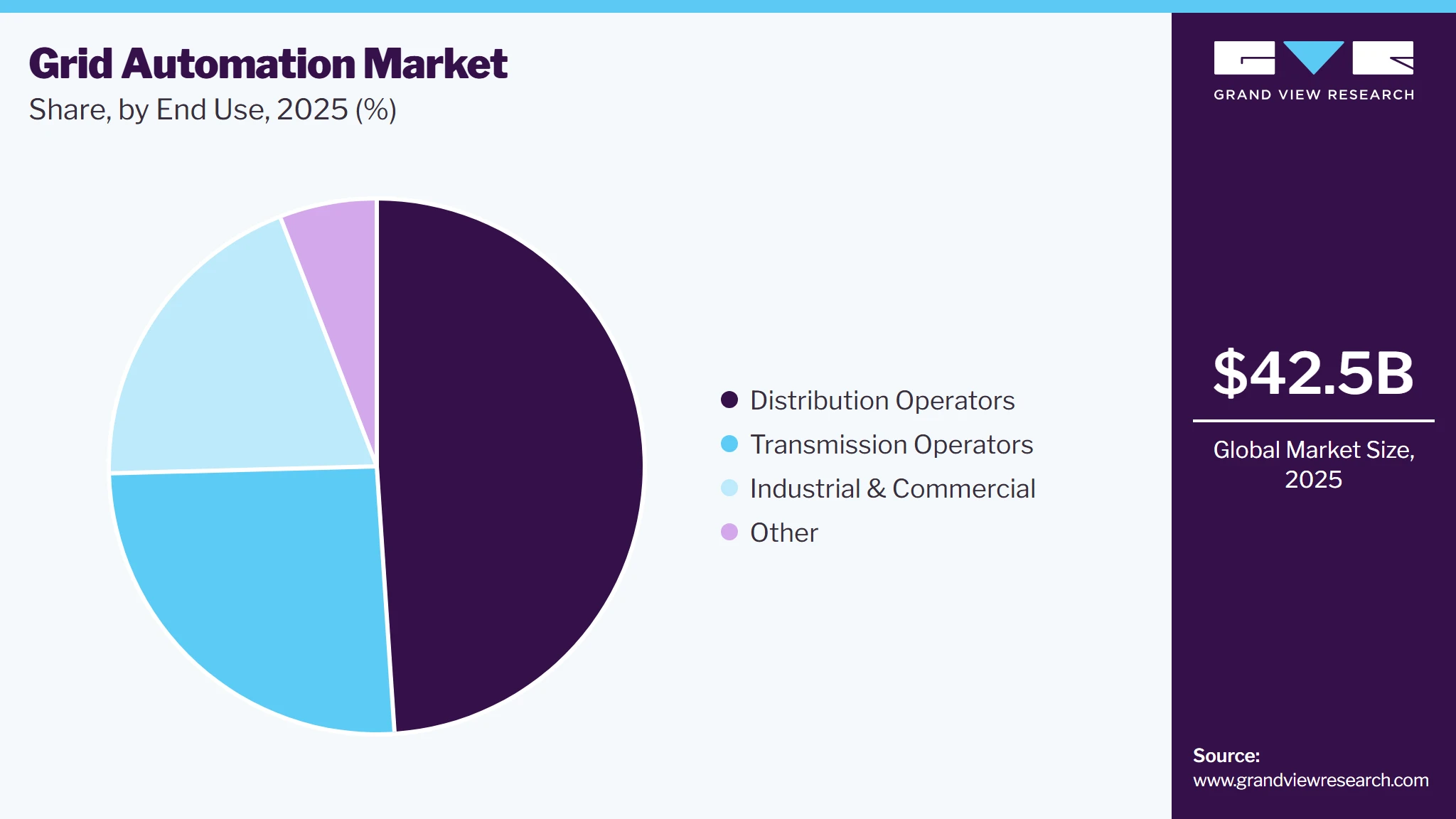
The industrial & commercial segment is expected to register the fastest CAGR of 6.2% during the forecast period, driven by the increasing adoption of automated energy management, smart monitoring, and advanced control systems across industrial and commercial facilities. Rising electricity consumption, growing emphasis on energy efficiency, and the integration of distributed energy resources are encouraging businesses to deploy grid automation technologies to improve power reliability, optimize energy use, and reduce operational costs.
Regional Insights
Europe grid automation market is supported by the modernization of aging electricity infrastructure, the integration of renewable energy, and increasing cross-border power flows. The EU is focusing on expanding and digitalizing grids to address growing connection queues and improve system resilience. In 2025, the European Commission advanced its European Grids Package, while EU initiatives increasingly emphasize smart-grid indicators, digitalization, and AI-enabled grid management. These developments are expected to support demand for SCADA, ADMS, digital substations, and automated grid control solutions.
North America Grid Automation Market Trends
The grid automation market in North America is a major market, driven by aging grid infrastructure, rising electricity demand, renewable integration, and increasing investments in grid resilience. Utilities are increasingly deploying digital substations, distribution automation, advanced monitoring, and automated fault-management systems to improve reliability. Demand is also being strengthened by data centers, electrification, and energy storage, which are placing additional pressure on existing networks. The region is therefore moving toward more intelligent and flexible grid infrastructure to manage growing power requirements.
The U.S. grid automation market is being driven by the need to modernize aging infrastructure while accommodating rapidly increasing electricity demand from data centers, EVs, industrial electrification, and renewable generation. U.S. utilities are investing in automated distribution systems, digital substations, grid monitoring, and advanced control technologies to improve reliability and resilience. In 2026, U.S. clean-energy additions are forecast to reach a record 45 GW, further increasing the need for flexible and automated grid management. Grid investments are also being supported by the growing need to address wildfire risks and other climate-related disruptions.
Asia Pacific Grid Automation Market Trends
The grid automation market in the Asia Pacific region accounted for the largest revenue share, at 39.5%, in the global market in 2025. The growth of this market is supported by rapid urbanization, rising electricity consumption, the deployment of renewables, and the large-scale expansion of transmission and distribution. Countries across the region are increasingly adopting smart grids, digital substations, automated distribution systems, and advanced grid management technologies. The need is particularly strong as utilities manage variable renewable generation, distributed energy resources, and increasingly complex power flows. The region’s large-scale grid investment requirements create significant opportunities for automation and digitalization providers.

China grid automation market represents a significant opportunity due to its large electricity network, rapid deployment of renewable energy, and continued investment in transmission and distribution infrastructure. The country’s expanding wind and solar capacity is increasing the need for advanced monitoring, automated control, storage integration, and grid-enhancing technologies. In the first half of 2026, China reportedly curtailed 360 TWh of clean electricity, highlighting the growing pressure on grid infrastructure to absorb renewable generation. This is expected to accelerate investment in grid optimization, automation, and transmission capacity.
Latin America Grid Automation Market Trends
The grid automation market in Latin America is supported by grid modernization, rising electricity demand, renewable energy integration, and the need to improve grid reliability and resilience. The region’s high share of renewable electricity is increasing the need for automated monitoring and control systems to manage variable generation and changing power flows. Utilities are increasingly adopting digital substations, SCADA, distribution automation, and advanced grid management technologies. Aging infrastructure and underinvestment in grid networks remain key challenges, creating additional opportunities for automation solutions.
Middle East & Africa Grid Automation Market Trends
The grid automation market in MEA is anticipated to register the second-fastest CAGR of 5.9% during the forecast period. This growth is driven by rising electricity demand, renewable energy deployment, grid modernization, and increasing digitalization of utility operations. Utilities are adopting automation, smart-grid technologies, and real-time monitoring to improve network efficiency, reliability, and outage management. The integration of large-scale solar and wind projects is further increasing demand for flexible and automated grid control. Aging infrastructure, limited digital capabilities, and high modernization costs in several African markets remain important challenges.
Key Grid Automation Company Insights
Some of the key players in the global market include GE Vernova and Siemens.
-
GE Vernova is a major technology provider, offering grid automation, substation automation, protection and control, SCADA, and advanced grid management solutions that enable utilities to monitor, control, and optimize power networks in real time. Through its Grid Automation portfolio and GridOS platform, the company supports automated fault detection, grid stability, renewable energy integration, and distributed energy resource management. Its capabilities across grid digitalization, automation, and power system management, combined with a broad global presence, position GE Vernova as a key participant.
-
Siemens is a prominent technology provider in the market, offering substation automation, protection and control, SCADA, energy management, and digital grid solutions for transmission and distribution networks. Its portfolio enables utilities to improve real-time monitoring, automate grid operations, detect and manage faults, and integrate renewable energy and distributed energy resources. Siemens’ strong expertise in electrification, automation, and digitalization, supported by its global customer base and comprehensive grid technology portfolio, positions the company as a leading participant in the market.
Key Grid Automation Companies
The following key companies have been profiled for this study on the grid automation market:
-
ABB
-
Eaton
-
Emerson
-
GE Vernova
-
Hitachi Energy
-
Honeywell
-
Mitsubishi Electric
-
NovaTech, LLC
-
S&C Electric Company
-
Schneider Electric
-
Siemens
-
Toshiba Energy Systems & Solutions
Competitive Benchmarking
Category
Operating Strategies
Competitive Edge
Weakness
Established Players (ABB, Eaton, Emerson, GE Vernova, Hitachi Energy, Honeywell, Mitsubishi Electric, Schneider Electric, Siemens, Toshiba Energy Systems & Solutions)
- Leverage extensive global operations, established utility relationships, and broad technology portfolios to provide integrated grid automation solutions.
- Invest in digital platforms, AI-enabled grid management, advanced analytics, and automation technologies to improve real-time monitoring, control, and optimization.
- Expand strategic partnerships, acquisitions, and localized operations to strengthen capabilities and accelerate grid modernization projects.
- Strong brand recognition, extensive installed bases, and long-standing relationships with utilities and grid operators.
- Broad portfolios covering hardware, software, communication, protection, control, and grid management solutions.
- Strong financial resources, global service networks, and large-scale R&D capabilities support complex grid automation projects.
- High solution costs and complex implementation requirements can limit adoption among smaller utilities.
- Large organizational structures can result in slower decision-making and longer deployment cycles.
- Integration with legacy infrastructure and multi-vendor systems can increase project complexity and implementation time.
Emerging Players (NovaTech, LLC, S&C Electric Company)
- Focus on specialized grid automation applications and targeted solutions to address specific utility requirements.
- Develop flexible, interoperable, and modular automation technologies that can integrate with existing grid infrastructure.
- Expand through strategic partnerships, technology collaborations, and targeted investments to broaden capabilities and strengthen market reach.
- Specialized expertise enables greater focus on specific grid automation applications and customer requirements.
- Flexible product portfolios can support faster customization and integration compared with broader vendor platforms.
- Competitive pricing and focused solutions can improve accessibility for utilities with specific automation requirements.
- Smaller global presence and installed customer base compared with major integrated vendors.
- More limited financial and R&D resources can constrain investment in advanced digital and AI-enabled platforms.
- Narrower technology portfolios may limit their ability to compete for large-scale, end-to-end grid modernization projects.
Recent Developments
-
In February 2026, GE Vernova launched GridBeats APS (Automation and Protection System), a software-defined grid automation solution designed to modernize substation protection and control without disrupting operations. The platform allows multiple protection and control applications to run on a common device, reducing substation hardware requirements and enabling utilities to consolidate what previously required hundreds of communication and cybersecurity packages into as few as ten. The solution also supports remote software updates, simplified maintenance, and improved grid resilience as electricity networks become more complex.
Grid Automation Report Scope
Report Attribute
Details
Market Definition
The market comprises revenue from the sale of hardware, software, and services used to automate, monitor, control, and manage transmission and distribution grids, including substation, distribution, transmission, grid management, and communication & control solutions.
Market size in 2025
USD 42.5 billion
Estimated market size in 2026
USD 44.4 billion
Projected market size by 2033
USD 65.5 billion
Growth rate
CAGR of 5.7% from 2026 to 2033
Historical data
2021 - 2025
Forecast period
2026 - 2033
Quantitative Units
Revenue in USD billion and CAGR from 2026 to 2033
Report coverage
Revenue forecast, competitive landscape, growth factors, and trends
Segments covered
Grid Level, component, automation solution, end use, region
Regional scope
North America; Europe; Asia Pacific; Latin America; MEA
Country scope
U.S.; Canada; Mexico; Germany; UK; France; Italy; Spain; China; India; Japan; South Korea; Australia; Brazil; Argentina; UAE; Saudi Arabia; South Africa
Key companies profiled
ABB; Eaton; Emerson; GE Vernova; Hitachi Energy; Honeywell; Mitsubishi Electric; NovaTech, LLC; S&C Electric Company; Schneider Electric; Siemens; Toshiba Energy Systems & Solutions
Customization scope
Free report customization (equivalent up to 8 analysts working days) with purchase. Addition or alteration to country, regional & segment scope.
Pricing and purchase options
Avail customized purchase options to meet your exact research needs. Explore purchase options
Global Grid Automation Market Report Segmentation
This report forecasts revenue growth at global, regional, and country levels and provides an analysis of the latest industry trends in each of the sub-segments from 2021 to 2033. For this study, Grand View Research has segmented the global grid automation market report based on grid level, component, automation solution, end use, and region:
-
Grid Level Outlook (Revenue, USD Billion, 2021 - 2033)
-
Transmission
-
Distribution
-
-
Component Outlook (Revenue, USD Billion, 2021 - 2033)
-
Hardware
-
Software
-
Services
-
-
Automation Solution Outlook (Revenue, USD Billion, 2021 - 2033)
-
Substation Solutions
-
Distribution Solutions
-
Transmission Solutions
-
Grid Management Solutions
-
Communication & Control Solutions
-
-
End Use Outlook (Revenue, USD Billion, 2021 - 2033)
-
Transmission Operators
-
Distribution Operators
-
Industrial & Commercial
-
Other
-
-
Regional Outlook (Revenue, USD Billion, 2021 - 2033)
-
North America
-
U.S.
-
Canada
-
Mexico
-
-
Europe
-
Germany
-
UK
-
France
-
Italy
-
Spain
-
-
Asia Pacific
-
China
-
India
-
Japan
-
South Korea
-
Australia
-
-
Latin America
-
Brazil
-
Argentina
-
-
Middle East & Africa
-
Saudi Arabia
-
UAE
-
South Africa
-
-
Research Methodology
The grid automation market figures in this report are based on a proven research process that combines executive interviews with secondary research from proprietary databases, company filings, and recognized regulatory and institutional sources. Market size is built through value-chain sizing-reconciling supply-side and demand-side estimates-and triangulated with bottom-up and top-down approaches. Every estimate passes multiple levels of expert validation before publication, with each grid automation segment quantified using the revenue-capture definitions in the table below.
Segment Definition
Segment - Grid Level
Revenue capture definition
Transmission
Revenue from sales of automation products and solutions used to monitor, control, and optimize high-voltage transmission networks.
Distribution
Revenue from sales of automation products and solutions deployed across electricity distribution networks and feeders.
Segment - Component
Revenue capture definition
Hardware
Revenue generated from sales of physical automation equipment, including protection devices, controllers, sensors, RTUs, IEDs, and related equipment.
Software
Revenue from sales or licenses of grid automation software, including SCADA, ADMS, EMS, DERMS, analytics, and grid management platforms.
Services
Revenue generated from the sale of installation, integration, commissioning, maintenance, consulting, and other automation-related services.
Segment - Automation Solution
Revenue capture definition
Substation Solutions
Revenue from sales of automation systems for substation protection, monitoring, control, and asset management.
Distribution Solutions
Revenue from sales of automated distribution systems for feeder control, fault management, and network optimization.
Transmission Solutions
Revenue from sales of automation systems for transmission network protection, monitoring, control, and optimization.
Grid Management Solutions
Revenue from sales of centralized platforms for grid monitoring, analysis, forecasting, and operational management.
Communication & Control Solutions
Revenue from sales of communication networks, control systems, gateways, and related technologies enabling automated grid operations.
Segment - end use
Revenue capture definition
Transmission Operators
Revenue from sales of grid automation products and solutions to entities operating transmission networks.
Distribution Operators
Revenue from sales of automation offerings to utilities and entities operating electricity distribution networks.
Industrial & Commercial
Revenue from sales of grid automation solutions to industrial and commercial facilities for power monitoring, control, and reliability.
Other
Revenue from sales to other users, including renewable energy facilities, infrastructure operators, government entities, and specialized power networks.
Estimation Model
Layer Name
Key Question
Description
Grid Level Layer
Which grid levels contribute to grid automation market revenue?
Assess revenue across transmission and distribution networks. Analyze adoption based on grid modernization, aging infrastructure, renewable energy integration, rising electricity demand, and reliability requirements.
Component Layer
Which components generate grid automation market revenue?
Evaluate revenue across hardware, software, and services. Analyze demand for automation equipment, SCADA, and grid management software, system integration, installation, maintenance, and technical services.
Automation Solution Layer
Which automation solutions drive market revenue?
Assess revenue across substation, distribution, transmission, grid management, and communication & control solutions. Analyze adoption based on real-time monitoring, automated fault detection, network optimization, protection, and grid control requirements.
Revenue Layer
How is market revenue generated?
Market revenue is quantified through the sale of grid automation hardware and software and the provision of related services across transmission and distribution networks. Revenue is influenced by grid modernization investments, renewable integration, digitalization, automation penetration, and demand for reliable and resilient power infrastructure.
Delivered Customizations
We have successfully delivered the following deep-dive customizations
Client Request
Customization Delivered
Value Adds
Grid Level Opportunity Assessment
Market analysis was conducted across transmission and distribution levels by evaluating grid modernization investments, aging infrastructure, renewable energy integration, electricity demand, automation penetration, and reliability requirements.
Enabled identification of the most attractive grid levels based on automation adoption, infrastructure investment, modernization needs, and long-term growth potential.
Automation Solution-Level Opportunity Assessment
Market analysis was performed across substation, distribution, transmission, grid management, and communication & control solutions by evaluating deployment trends, grid digitalization, automation requirements, renewable integration, and real-time monitoring needs.
Enabled identification of high-growth automation solutions based on technological adoption, utility requirements, modernization activity, and future demand.
Regional Opportunity Assessment
Country-level analysis was conducted to assess grid automation adoption based on grid modernization programs, renewable energy deployment, electricity demand, digitalization initiatives, transmission and distribution investments, and regulatory support across key regions.
Identified high-growth countries with strong grid modernization activity, increasing automation adoption, supportive policies, and favorable investment opportunities.
Frequently Asked Questions About This Report
The grid automation market size was estimated at USD 42.5 billion in 2025 and is expected to reach USD 44.4 billion in 2026.
The grid automation market is expected to grow at a CAGR of 5.7% from 2026 to 2033 to reach USD 65.5 billion by 2033.
The grid automation market is driven by rising electricity demand, increasing renewable energy integration, grid modernization, and the need for improved reliability, resilience, and real-time monitoring.
The Asia Pacific region dominated the grid automation market with a revenue share of 39.5% in 2025.
China dominated the Asia Pacific region market with a revenue share in 2025.
Based on automation solution, the distribution solutions segment accounted for largest revenue share of 28.3% in 2025.
Based on component, the hardware segment accounted for largest revenue share of 52.6% in 2025.
The key players operating in the grid automation market are ABB, Eaton, Emerson, GE Vernova, Hitachi Energy, Honeywell, Mitsubishi Electric, NovaTech, LLC, S&C Electric Company, Schneider Electric, Siemens, Toshiba Energy Systems & Solutions, and others.
About the Author(s)
Distribution & Utilities Research Team
Energy & Power · Distribution & UtilitiesThis report was authored by the distribution & utilities research team at Grand View Research - comprising two research analysts, one senior research analyst, and one industry expert - with specialized expertise in the distribution & utilities segment of the energy & power industry. All findings are based on proprietary energy & power databases, executive interviews, and regulatory analysis, subject to internal peer review prior to publication.
Last Updated:
Speak to Analyst


Customize this report to your needs — add regions, segments, or data points, with 20% free customization.
Or view our licence options:


ISO 9001:2015 & 27001:2022 Certified
We are GDPR and CCPA compliant! Your transaction & personal information is safe and secure. For more details, please read our privacy policy.


