
- Home
- »
- Distribution & Utilities
- »
-
Grid Interoperability Market Size, Share, Trends Report, 2033GVR Report cover
![Grid Interoperability Market (2026 - 2033)Report]()
Grid Interoperability Market (2026 - 2033)
Size, Share & Trends Analysis Report By Component (Hardware, Software, Services), By Application (Transmission Grid, Distribution Grid, Distributed Energy Resources), By End-use, By Region, And Segment Forecasts
Market Size, 2025
$7.2BMarket Estimate, 2026
$7.9BMarket Forecast, 2033
$18.4BCAGR, 2026–2033
12.9%Grid Interoperability Market Summary
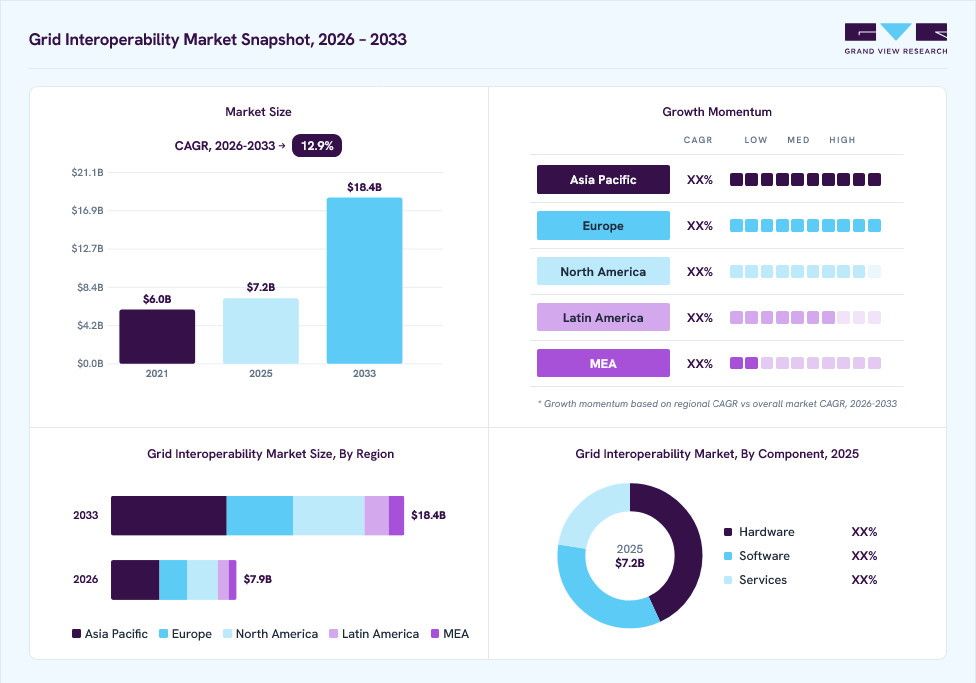
The global grid interoperability market size was valued at USD 7.2 billion in 2025 and is projected to grow from USD 7.9 billion in 2026 to USD 18.4 billion by 2033, at a CAGR of 12.9% from 2026 to 2033. Asia Pacific dominated the market, accounting for the largest revenue share of 38.5% in 2025. The market is driven by the growing integration of renewable energy, increasing adoption of distributed energy resources, grid modernization initiatives, and the need for seamless communication and coordination between diverse grid assets.
Key Market Trends & Insights
- By component: The hardware segment held the largest revenue share of 43.1% in 2025.
- By application: The distribution grid segment held the largest revenue share of 41.9% in 2025.
- By end-use: The utilities segment held the largest revenue share of 65.3% in 2025.
Regional Highlights
- Largest regional market: Asia Pacific (38.5% revenue share, 2025)
- By country: India held the largest market share in 2025.
Market Size & Forecast
- Market size in 2025: USD 7.2 Billion
- Estimated market size in 2026: USD 7.9 Billion
- Projected market size by 2033: USD 18.4 Billion
- CAGR (2026-2033): 12.9%
Three ways to get this report
Buy it, customize it, or ask a question.Ask an Analyst
A direct answer, usually in 1 working day
- AccessReport author, directly
- Reply timeWithin 1 working day
- No sales callDirect answer only
- FormatEmail reply
- CostFree, no cost
Get the Full Report
What the study covers
- FormatsPDF · Excel · Dashboard
- Timeline2026–2033 annual, 2025 base
- Coverage20+ countries, 5 regions
- Companies10+ key players profiled
Customize the Report
20% free customization
- IncludeCountries, segments, points
- TailorTo your product definition
- ExtendDeeper competitor detail
- OrA fully bespoke study
- Turnaround5–10 working days
Rising deployment of smart grid technologies, electric vehicles, energy storage systems, and digital grid management solutions is further increasing demand for interoperability. Growing grid complexity and the need to maintain reliability and stability are also encouraging utilities to adopt solutions that enable different equipment, platforms, and systems to exchange data and operate efficiently.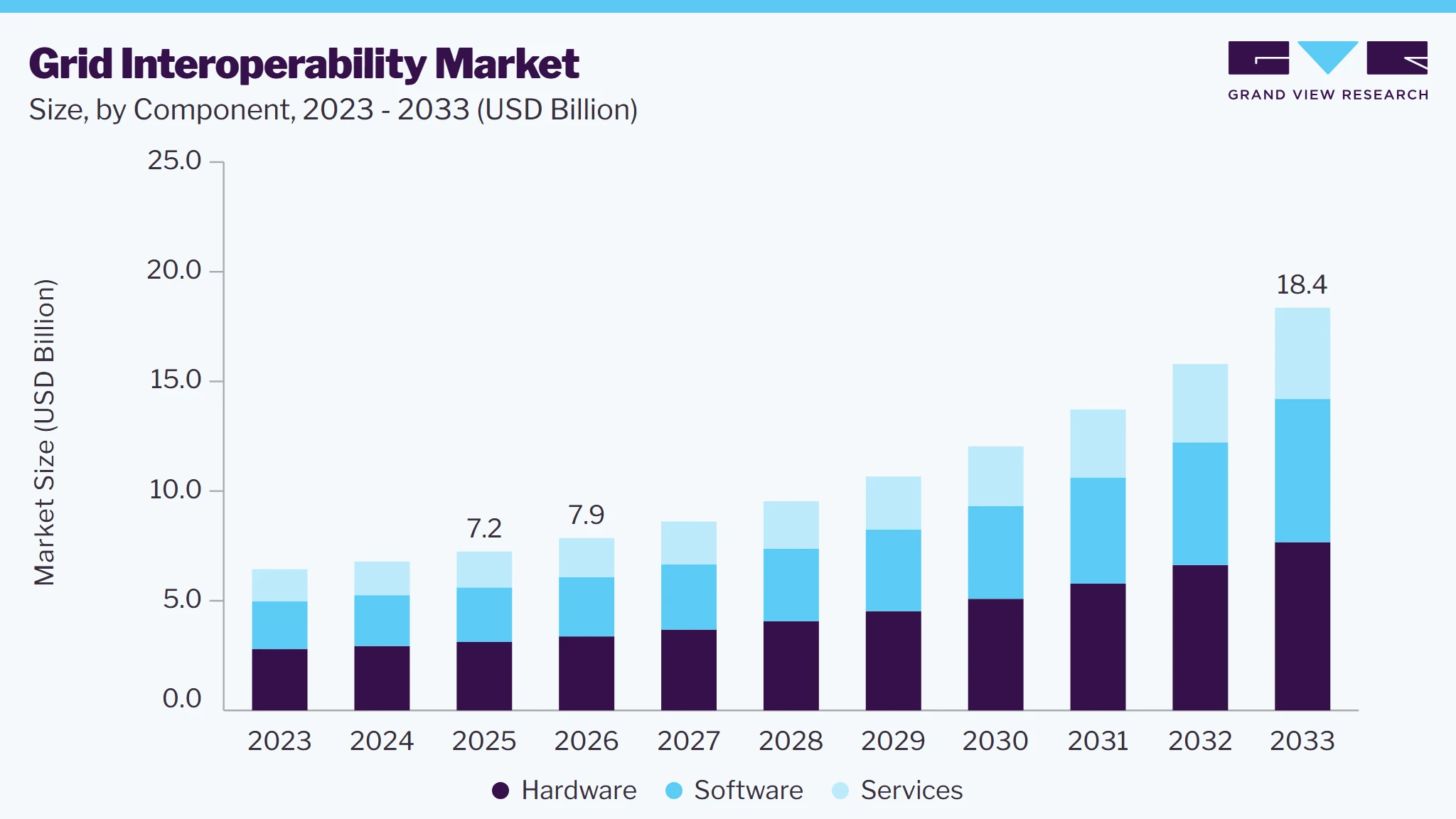
Market Dynamics
The market is shaped by the growing integration of renewable energy, distributed energy resources, energy storage, electric vehicles, and smart grid technologies into existing power networks. Utilities are increasingly adopting interoperable systems to enable seamless communication among grid equipment, control platforms, and digital technologies, thereby improving grid visibility and operational efficiency. Aging infrastructure, rising electricity demand, and the need to accommodate variable renewable generation are further encouraging investments in modern grid management solutions. Differences in communication protocols, legacy systems, cybersecurity requirements, and integration costs can create challenges for market adoption. However, increasing grid digitalization, deployment of advanced metering and automation systems, and government-led grid modernization programs are creating new opportunities for interoperability solutions.
The market is primarily driven by the rapid integration of renewable energy sources such as solar and wind, as well as distributed energy resources (DERs), energy storage, and electric vehicles. These technologies involve multiple devices, software platforms, and grid systems that need to communicate and operate together efficiently. Grid interoperability solutions help utilities connect these diverse assets, exchange data in real time, and manage variable power generation while maintaining grid stability. As electricity networks become more decentralized and digital, the need for standardized communication, data exchange, and coordinated grid operations is increasing.
For instance, in March 2026, the Government of India announced plans to strengthen the transmission network to support the integration of more than 500 GW of renewable energy capacity by 2030. The initiative includes the expansion and modernization of transmission infrastructure to manage increasing renewable power generation and maintain grid reliability. This growing deployment of renewable generation and supporting grid infrastructure is expected to increase demand for interoperability solutions that enable renewable plants, energy storage systems, grid equipment, and control platforms to communicate and operate together efficiently.
A primary market restraint is the complexity of integrating modern communication frameworks with traditional, legacy utility infrastructure. Many utilities operate equipment and systems based on different protocols, architectures, and vendor-specific technologies, making seamless data exchange and system integration difficult. NIST notes that integrating new equipment with existing grid systems often requires significant effort, customized testing, coding, and system development, increasing deployment costs and implementation timelines. The absence of fully harmonized standards across grid technologies can further complicate interoperability and limit the adoption of standardized interoperability solutions.
Virtual power plant (VPP) aggregation is an emerging market opportunity that enables residential batteries, smart thermostats, EV chargers, and distributed solar systems to operate as coordinated grid assets. Interoperable platforms enable diverse distributed energy resources (DERs) to communicate with utilities and grid operators to support demand response, load balancing, and ancillary services. Growing DER deployment is creating demand for advanced communication, control, and energy management solutions. This provides interoperability providers with opportunities to develop platforms that connect fragmented DER assets with electricity markets.
Analyst Perspective
The market is expected to grow as utilities modernize aging networks and connect more distributed energy resources, energy storage, EVs, and renewable power systems. Demand is shifting toward solutions that enable different grid devices, software, and communication systems to work together efficiently. Utilities are also focusing on interoperability to improve grid reliability, manage power flows, and support real-time operations. As more decentralized assets are added to the grid, interoperability will become increasingly important for coordinating these resources and improving network flexibility. This is likely to create opportunities for software, communication, integration, and testing providers.
Component Insights
The hardware segment accounted for the largest revenue share, at 43.1% in 2025, driven by the growing deployment of physical equipment required for grid interoperability. Utilities are investing in smart meters, sensors, communication devices, protection systems, and intelligent grid equipment to improve connectivity between diverse grid assets. Rising grid modernization and renewable energy integration are further increasing demand for interoperable hardware. The need for reliable real-time monitoring and data exchange supports continued hardware adoption.
The software segment is anticipated to register the fastest CAGR of 13.4% during the forecast period. This growth is driven by the increasing adoption of grid management platforms, advanced monitoring and control systems, and data analytics solutions that enable seamless communication across diverse grid assets. Growing grid digitalization, renewable energy integration, and the need for real-time visibility and automated grid management are further driving demand for interoperability software.
Application Insights
The distribution grids segment dominated the global market, accounting for 41.9% of revenue in 2025, driven by rising investments in grid modernization and the integration of distributed energy resources. The growing deployment of rooftop solar, battery storage, smart meters, and electric vehicles is increasing the need for interoperable systems across distribution networks. In addition, utilities are adopting digital monitoring and control technologies to improve grid reliability, flexibility, and real-time data exchange.
The distributed energy resources segment is expected to register the fastest CAGR of 13.5% from 2026 to 2033, driven by the rapid deployment of rooftop solar, battery storage, electric vehicles, and other decentralized energy assets. Growing integration of these resources into existing grids is increasing the need for interoperable communication, monitoring, and control systems. Rising demand for flexible and reliable power management is further supporting segment growth.
End-use Insights
The utilities segment dominated with a revenue market share of 65.3% in 2025, supported by increasing investments in grid modernization, digitalization, and infrastructure upgrades. Utilities are adopting interoperable systems to connect diverse grid assets, improve real-time monitoring, and enhance grid reliability. The growing integration of renewable energy, distributed energy resources, and smart grid technologies is further increasing the need for seamless communication and data exchange across utility networks.
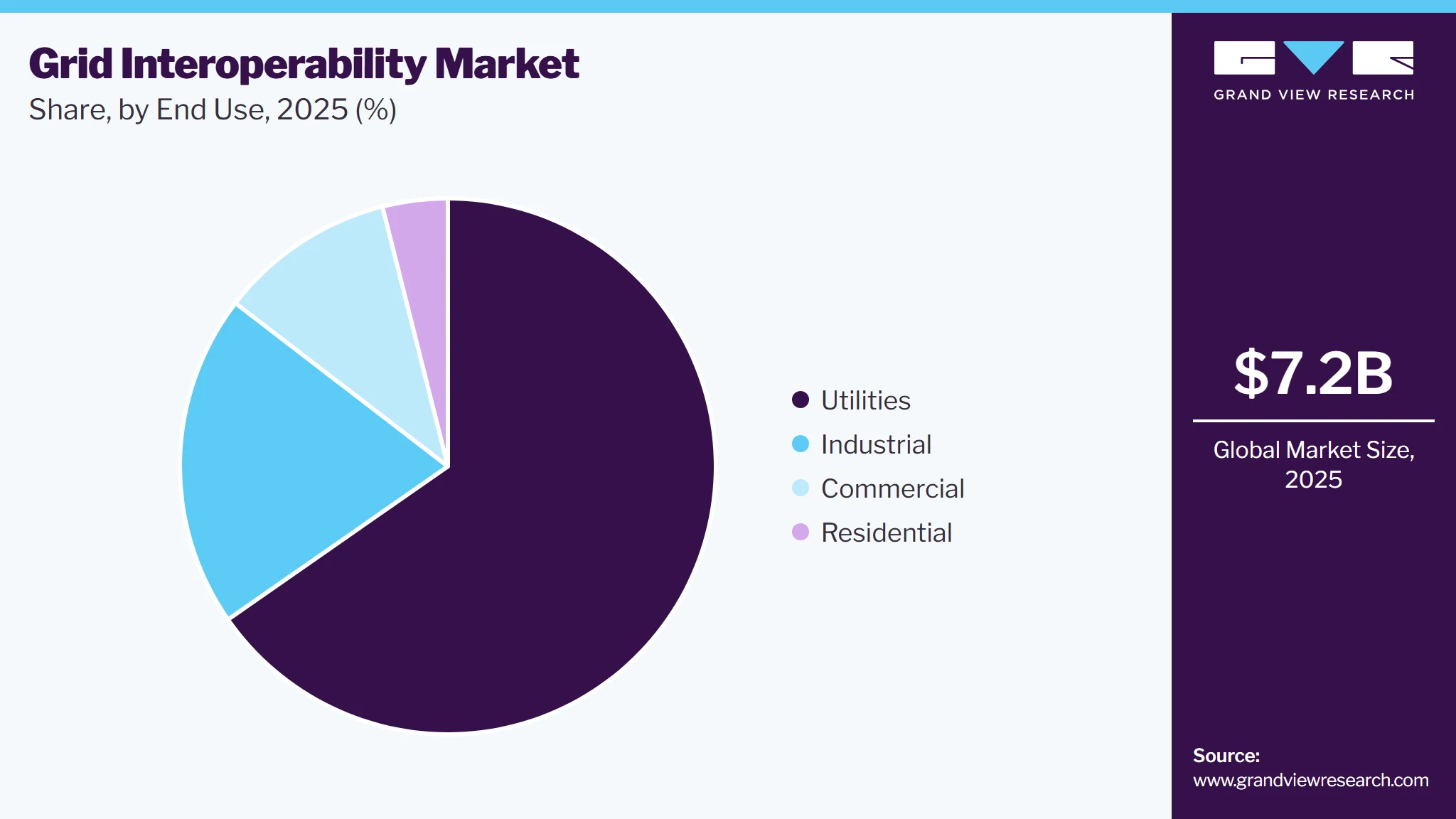
The commercial segment is expected to grow at the fastest CAGR of 13.7% during the forecasted period as businesses increasingly adopt smart energy management systems, distributed energy resources, and digital grid technologies. Growing demand for reliable power, real-time energy monitoring, and efficient load management is driving the adoption of interoperable solutions across commercial facilities. In addition, rising electrification and integration of renewable energy and energy storage are supporting segment growth.
Regional Insights
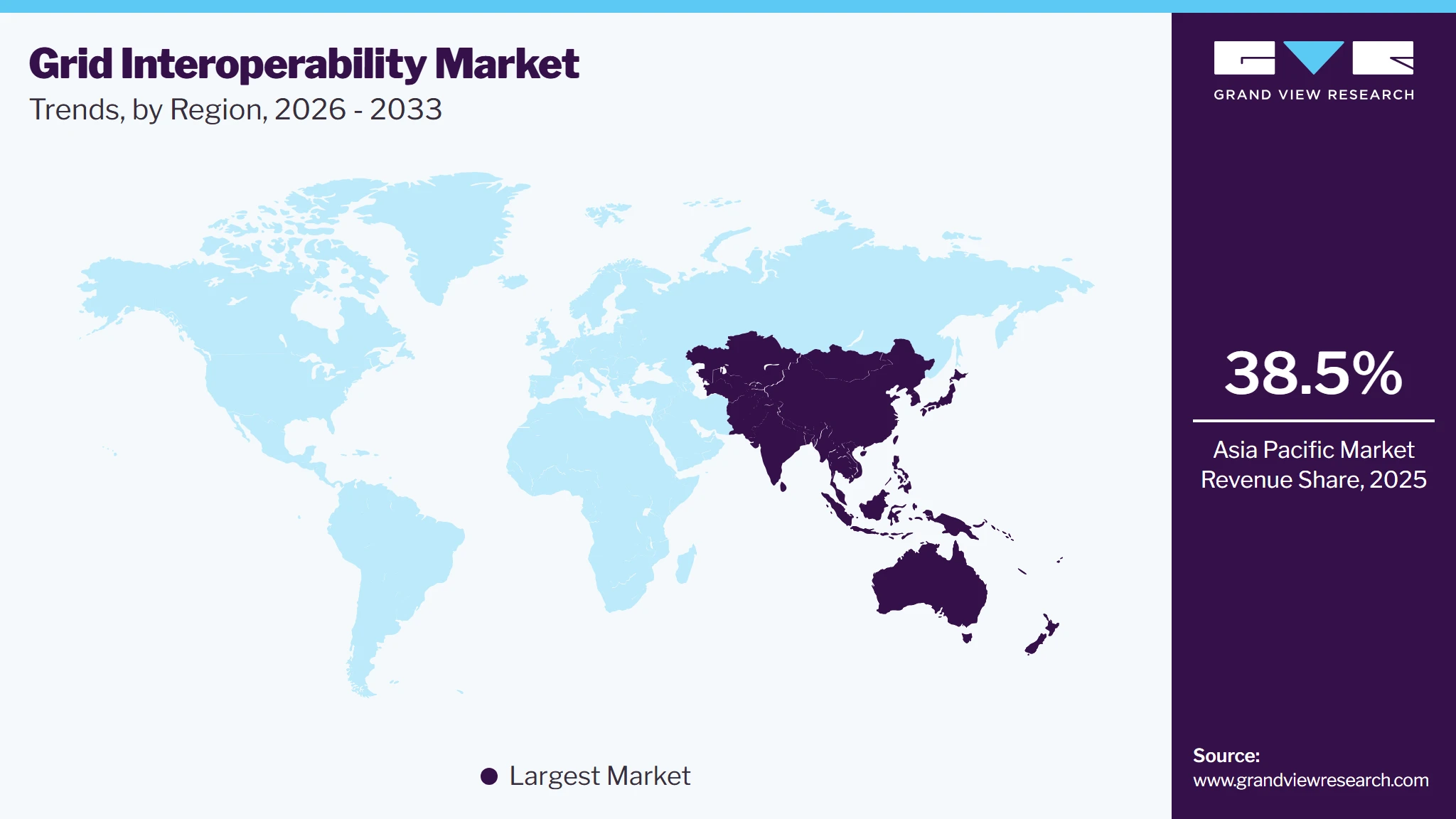
Asia Pacific dominated the global market, accounting for 38.5% of revenue in 2025. The region is expected to experience strong growth as countries invest heavily in smart grids, renewable energy, energy storage, and digital power infrastructure. Rapid growth in electricity demand and large-scale deployment of solar, wind, batteries, and EVs are increasing the need to coordinate diverse grid assets. Countries such as China, Japan, India, and South Korea are advancing grid digitalization and automation, supporting demand for interoperable communication and control solutions. The region’s expanding power infrastructure also creates opportunities for new digital systems to be integrated into grid networks.
China Grid Interoperability Market Trends
The grid interoperability market in China represents a major opportunity due to its large-scale investment in power infrastructure, renewable energy, energy storage, and smart grid technologies. The rapid expansion of solar and wind generation requires greater coordination between generation assets, storage systems, transmission networks, and distribution infrastructure. Increasing automation and digitalization of the power system are also driving demand for advanced communication, monitoring, and control solutions. The development of new digital grid infrastructure provides opportunities for interoperability technologies across utilities and grid equipment.
Europe Grid Interoperability Market Trends
The grid interoperability market in Europe is expected to register the second-fastest CAGR of 13.1% during the forecast period. This growth is supported by the region’s focus on renewable integration, smart grids, distributed energy resources, and energy-system digitalization. The European Commission is actively developing common standards and interoperability requirements for data exchange across grids, buildings, mobility, storage, and distributed energy resources. The growing deployment of EVs, smart meters, and flexible energy systems is creating demand for interoperable communication and data management solutions.
North America Grid Interoperability Market Trends
The grid interoperability market in North America is experiencing growing demand as utilities modernize transmission and distribution networks and integrate renewable generation, battery storage, EVs, and other distributed energy resources. The need to integrate equipment from multiple vendors and manage increasingly decentralized power flows is spurring investment in advanced communication, control, and grid management platforms. Utilities are also focusing on interoperability to improve reliability, flexibility, and real-time grid visibility. The region’s established utility infrastructure and strong investment in grid modernization are expected to support market growth.
The U.S. grid interoperability marketis driven by grid modernization, rising deployment of renewables and storage, and the growing adoption of distributed energy resources. Utilities increasingly require interoperable systems that can connect legacy equipment with newer digital technologies and coordinate resources across transmission, distribution, and customer networks. Growth in EV charging, smart meters, demand response, and virtual power plants is further increasing the need for standardized communication and data exchange. This is creating opportunities for interoperability software, integration services, and grid-edge technologies.
Latin America Grid Interoperability Market Trends
The grid interoperability market in Latin America is gradually increasing adoption as utilities modernize networks and integrate growing volumes of renewable power. Countries such as Brazil, Chile, Mexico, and Colombia are expanding solar and wind generation, increasing the need for better coordination between distributed resources and existing grid infrastructure. Smart metering, grid automation, and digital monitoring are also gaining importance as utilities seek to improve reliability and manage changing electricity demand. However, differences in infrastructure maturity across countries are likely to lead to varying adoption rates.
Middle East & Africa Grid Interoperability Market Trends
The grid interoperability market in MEA is gaining momentum through investments in grid modernization, renewable energy, smart metering, and digital utility infrastructure. Large solar projects, battery storage, and new transmission networks are increasing the need for systems that can exchange data and coordinate different grid assets efficiently. Countries such as Saudi Arabia, the UAE, and South Africa are advancing digital power networks as part of broader energy-transition and infrastructure programs. Growing electrification and renewable integration are expected to create further demand for interoperable grid-management and communication technologies.
Key Company Insights
Some of the key players in the market include ABB and Eaton.
-
ABB Ltd. is a prominent technology provider, offering digital substation automation, grid management, SCADA, protection and control, and communication gateway solutions. Through its IEC 61850-based grid automation portfolio, ABB enables equipment from different manufacturers and legacy systems to communicate through standardized protocols. Its ReliaGrid Substation Gateway and COM600 platforms support multiple protocols, including IEC 61850, DNP3, Modbus, and IEC 60870-5, enabling connectivity between substation devices and higher-level control systems. These capabilities, combined with ABB’s expertise in digital substations and grid automation, position the company as a key market participant.
-
Eaton is an established technology provider in the market, offering substation automation, data concentration, protocol translation, grid control, and power management solutions. Its SMP automation platform serves as a substation controller and data concentrator, supporting multiple protocols, including IEC 61850, GOOSE, DNP3, Modbus, IEC 60870-5-101/104, and OPC UA. The platform enables utilities to connect diverse intelligent electronic devices (IEDs) and legacy systems while providing interoperable and scalable automation capabilities. Eaton’s focus on multi-protocol connectivity, cybersecurity, and substation automation strengthens its market position.
Key Grid Interoperability Companies
The following key companies have been profiled for this study on the grid interoperability market.
-
ABB
-
Eaton
-
GE Vernova
-
Hitachi Energy Ltd.
-
Honeywell International Inc.
-
Itron, Inc.
-
Landis+Gyr
-
Oracle
-
Schneider Electric
-
Siemens
-
Smarter Grid Solutions, Ltd.
-
Spirae, LLC
-
Uplight, Inc.
Competitive Benchmarking
Category
Operating Strategies
Competitive Edge
Weakness
Established Players (ABB, Eaton, GE Vernova, Hitachi Energy Ltd., Honeywell International Inc., Itron, Inc., Landis+Gyr, Oracle, Schneider Electric, Siemens)
- Focus on integrating grid interoperability capabilities with broader ADMS, SCADA, EMS, DERMS, substation automation, metering, and digital grid platforms.
- Leverage established utility relationships and global sales networks to secure large-scale grid modernization projects and long-term service contracts.
- Develop interoperable solutions that connect legacy utility infrastructure with newer digital, distributed, and renewable energy assets.
- Broad technology portfolios spanning grid hardware, automation, software, communications, metering, and energy management.
- Strong installed base with utilities, providing opportunities to integrate new interoperability solutions into existing infrastructure.
- Ability to execute complex, multi-year projects covering multiple grid layers and geographic markets.
- Broad product portfolios can result in complex integration, implementation, and customization requirements for utilities.
- Large organizations may have longer product-development and decision-making cycles compared with specialized software companies.
- Legacy product portfolios and installed systems can complicate migration to fully open, software-defined architectures.
Emerging Players (Smarter Grid Solutions, Ltd., Spirae, LLC, Uplight, Inc.)
- Focus on specialized DERMS, grid-edge orchestration, flexibility management, and distributed-energy interoperability rather than offering the entire grid technology stack.
- Develop vendor-neutral platforms that connect solar, batteries, EVs, flexible loads, microgrids, and other DERs with utility control systems.
- Prioritize open APIs, standardized communications, and flexible software architectures to integrate with existing ADMS, DERMS, AMI, and utility IT/OT systems.
- Strong focus on real-time DER visibility, forecasting, optimization, and automated dispatch.
- Ability to address emerging applications such as flexible interconnection, congestion management, virtual power plants, microgrids, and local flexibility markets.
- Smaller organizational structures can support faster product development and customization compared with large incumbent vendors.
- Smaller global sales and implementation networks compared with major grid technology providers.
- More limited ability to provide complete hardware-to-software grid modernization projects.
- Greater dependence on utility partnerships, system integrators, and larger technology vendors for large-scale deployments.
Recent Developments
-
In May 2026, the OpenADR Alliance and Connectivity Standards Alliance announced a liaison agreement to improve interoperability between smart-home devices and the electricity grid. Under the collaboration, Matter will manage communication between devices such as EV chargers, heat pumps, solar panels, and home batteries, while OpenADR 3 will facilitate communication between energy gateways, utilities, and the grid. The combined standards are designed to create an end-to-end communication pathway that enables residential devices to participate in demand response programs, helping utilities manage growing distributed energy resources and improve grid flexibility. The development highlights increasing industry efforts to establish standardized communication frameworks for grid-connected devices and accelerate grid interoperability.
Grid Interoperability Market Report Scope
Report Attribute
Details
Market definition
The market represents revenue generated from the sale of hardware, software, and services that enable seamless communication, data exchange, integration, and coordinated operation among diverse power grid systems and assets.
Market size in 2025
USD 7.2 billion
Estimated market size in 2026
USD 7.9 billion
Projected market size by 2033
USD 18.4 billion
Growth rate
CAGR of 12.9% from 2026 to 2033
Historical data
2021 - 2025
Forecast period
2026 - 2033
Quantitative Units
Revenue in USD billion, and CAGR from 2026 to 2033
Report coverage
Revenue forecast, competitive landscape, growth factors, and trends
Segments covered
Component, application, end-use, region
Regional scope
North America; Europe; Asia Pacific; Latin America; MEA
Country scope
U.S.; Canada; Mexico; Germany; UK; France; Italy; Spain; China; India; Japan; South Korea; Brazil; Argentina; UAE; Saudi Arabia; South Africa
Key companies profiled
ABB; Eaton; E Vernova; Hitachi Energy Ltd.; Honeywell International Inc.; Itron, Inc.; Landis+Gyr; Oracle; Schneider Electric; Siemens; Smarter Grid Solutions, Ltd.; Spirae, LLC; Uplight, Inc.
Customization scope
Free report customization (equivalent up to 8 analysts working days) with purchase. Addition or alteration to country, regional & segment scope.
Pricing and purchase options
Avail customized purchase options to meet your exact research needs. Explore purchase options
Global Grid Interoperability Market Report Segmentation
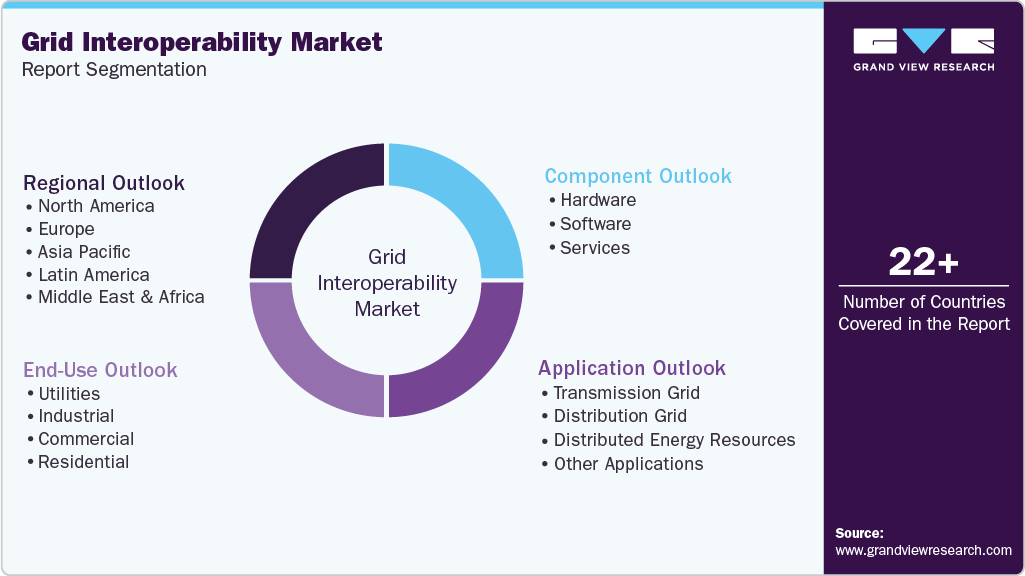
This report forecasts revenue growth at global, regional, and country levels and provides an analysis of the latest industry trends in each of the sub-segments from 2021 to 2033. For this study, Grand View Research has segmented the global grid interoperability market report based on component, application, end-use, and region:
-
Component Outlook (Revenue, USD Billion, 2021 - 2033)
-
Hardware
-
Software
-
Services
-
-
Application Outlook (Revenue, USD Billion, 2021 - 2033)
-
Transmission Grid
-
Distribution Grid
-
Distributed Energy Resources
-
Other Applications
-
-
End-use Outlook (Revenue, USD Billion, 2021 - 2033)
-
Utilities
-
Industrial
-
Commercial
-
Residential
-
-
Regional Outlook (Revenue, USD Billion, 2021 - 2033)
-
North America
-
U.S.
-
Canada
-
Mexico
-
-
Europe
-
Germany
-
UK
-
France
-
Italy
-
Spain
-
-
Asia Pacific
-
China
-
India
-
Japan
-
South Korea
-
-
Latin America
-
Brazil
-
Argentina
-
-
Middle East & Africa
-
Saudi Arabia
-
UAE
-
South Africa
-
-
Research Methodology
The grid interoperability market figures in this report are based on a proven research process that combines executive interviews with secondary research from proprietary databases, company filings, and recognized regulatory and institutional sources. Market size is built through value-chain sizing-reconciling supply-side and demand-side estimates-and triangulated with bottom-up and top-down approaches. Every estimate passes multiple levels of expert validation before publication, with each grid interoperability segment quantified using the revenue-capture definitions in the table below.
Segment Definition
Segment - Component
Revenue capture definition
Hardware
Revenue from the sale of physical equipment that enables communication, connectivity, monitoring, control, and interoperability among grid assets and systems.
Software
Revenue from the sale and licensing of software platforms and applications that enable grid data exchange, system integration, monitoring, control, and interoperability.
Services
Revenue from integration, implementation, consulting, testing, maintenance, technical support, and other services related to grid interoperability solutions.
Segment - Application
Revenue capture definition
Transmission Grid
Revenue from interoperability solutions deployed in high-voltage transmission networks to enable communication, coordination, monitoring, and control of transmission assets and systems.
Distribution Grid
Revenue from interoperability solutions used to connect, monitor, and coordinate distribution network equipment, smart grid systems, meters, and field assets.
Distributed Energy Resources
Revenue from interoperability solutions used to integrate, communicate with, monitor, and control distributed energy resources, including solar PV, battery storage, and electric vehicles.
Other Applications
Revenue from interoperability solutions deployed in grid applications other than transmission grids, distribution grids, and distributed energy resources.
Segment - End Use
Revenue capture definition
Utilities
Revenue from grid interoperability solutions sold to electricity utilities for integrating, monitoring, managing, and coordinating grid assets and systems.
Industrial
Revenue from interoperability solutions sold to industrial facilities for integrating onsite power systems, energy assets, automation systems, and grid-connected equipment.
Commercial
Revenue from interoperability solutions sold to commercial facilities for energy management, grid connectivity, and integration of distributed energy assets.
Residential
Revenue from interoperability solutions sold for residential applications, including smart home energy systems, distributed energy resources, smart meters, and other grid-connected devices.
Estimation Model
Layer No.
Layer Name
Key Question
Description
01
Demand Layer
Which factors generate demand for grid interoperability solutions?
Assess demand arising from grid modernization, increasing renewable energy integration, distributed energy resource deployment, electrification, grid digitalization, and the need for reliable communication and coordinated operation among diverse grid assets. Evaluate how rising grid complexity and the adoption of smart grid technologies influence demand for interoperability solutions.
02
Component Layer
Which components generate market revenue?
Evaluate revenue across hardware, software, and services based on their role in enabling grid communication, data exchange, system integration, monitoring, control, interoperability, and ongoing technical support.
03
Application & End Use Layer
Where are grid interoperability solutions deployed and who generates market revenue?
Assess revenue across transmission grids, distribution grids, distributed energy resources, and other applications, as well as utilities, industrial, commercial, and residential end users, based on their requirements for grid connectivity, system integration, monitoring, control, and reliable power management.
04
Revenue Layer
How is market revenue generated?
Market revenue is quantified through the sale of grid interoperability hardware, software, and services, including communication and control equipment, software platforms, system integration, implementation, testing, maintenance, and technical support. Revenue varies by component, application, project scale, technology deployment, and end user.
Delivered Customizations
This report has been delivered with the following In-depth customizations
Client Request
Customization Delivered
Value Adds
Competitive Benchmarking
Conducted a detailed assessment of established and emerging grid interoperability providers based on technology capabilities, interoperability platforms, grid automation and management solutions, communication protocols, software and data integration capabilities, utility deployments, geographic presence, partnerships, and overall market positioning.
Helps the client understand competitive strengths, identify technology and portfolio gaps, assess interoperability capabilities, and benchmark its positioning against key market participants.
End Use Opportunity Assessment
Market analysis was conducted across utilities, industrial, commercial, and residential end uses by assessing grid modernization needs, power reliability requirements, interoperability adoption, infrastructure investments, and integration of distributed energy resources.
Identified high-potential end use segments based on grid connectivity requirements, digitalization, renewable energy integration, infrastructure upgrades, and future revenue opportunities.
Regional Opportunity Assessment
Evaluated grid interoperability market potential across key geographic markets by analyzing grid modernization initiatives, renewable and distributed energy integration, transmission and distribution infrastructure, utility digitalization, interoperability standards, regulatory developments, and adoption of smart-grid technologies.
Enables identification of high-potential markets, key demand drivers, interoperability requirements, and priority areas for expansion and investment.
Frequently Asked Questions About This Report
The grid interoperability solutions market is expected to grow at a CAGR of 12.9% from 2026 to 2033 to reach USD 18.4 billion by 2033.
The key factors driving the grid interoperability solutions market include rapid grid digitalization, increasing integration of renewable energy and distributed energy resources, growing adoption of smart-grid technologies, and the need for seamless multi-vendor communication and data exchange.
The Asia Pacific region dominated the grid interoperability solutions market with a revenue share of 38.5% in 2025.
China dominated the Asia Pacific region market with a revenue share of 40.1% in 2025.
Europe is anticipated to register the second-fastest CAGR of 13.1% over the forecast period.
Based on component, the hardware segment accounted for largest revenue share of 43.1% in 2025.
Based on end-use, the utilities segment accounted for largest revenue share of 65.3% in 2025.
The key players operating in the grid interoperability solutions market are ABB, Eaton, GE Vernova, Hitachi Energy Ltd., Honeywell International Inc., Itron, Inc., Landis+Gyr, Oracle, Schneider Electric, Siemens, Smarter Grid Solutions, Ltd., Spirae, LLC, Uplight, Inc., and others.
The grid interoperability solutions market size was valued at USD 7.2 billion in 2025 and is estimated at USD 7.9 billion in 2026.
About the Author(s)
Distribution & Utilities Research Team
Energy & Power · Distribution & UtilitiesThis report was authored by the distribution & utilities research team at Grand View Research - comprising two research analysts, one senior research analyst, and one industry expert - with specialized expertise in the distribution & utilities segment of the energy & power industry. All findings are based on proprietary energy & power databases, executive interviews, and regulatory analysis, subject to internal peer review prior to publication.
Last Updated:
Speak to Analyst


Customize this report to your needs - add regions, segments, or data points, with 20% free customization.
Or view our licence options:


ISO 9001:2015 & 27001:2022 Certified
We are GDPR and CCPA compliant! Your transaction & personal information is safe and secure. For more details, please read our privacy policy.


