
- Home
- »
- Plastics, Polymers & Resins
- »
-
Hot-fill Food Packaging Market Size And Share Report, 2033GVR Report cover

Hot-fill Food Packaging Market (2026 - 2033)
Size, Share & Trends Analysis Report By Material (Plastic, Glass, Paperboard / Carton), By Packaging Type (Bottles, Jars), By Application (Sauces & Condiments, Juices & Fruit Beverages), By Region, And Segment Forecasts
Market Size, 2025
$7.3BMarket Estimate, 2026
$7.6BMarket Forecast, 2033
$10.5BCAGR, 2026–2033
4.6%Hot-fill Food Packaging Market Summary
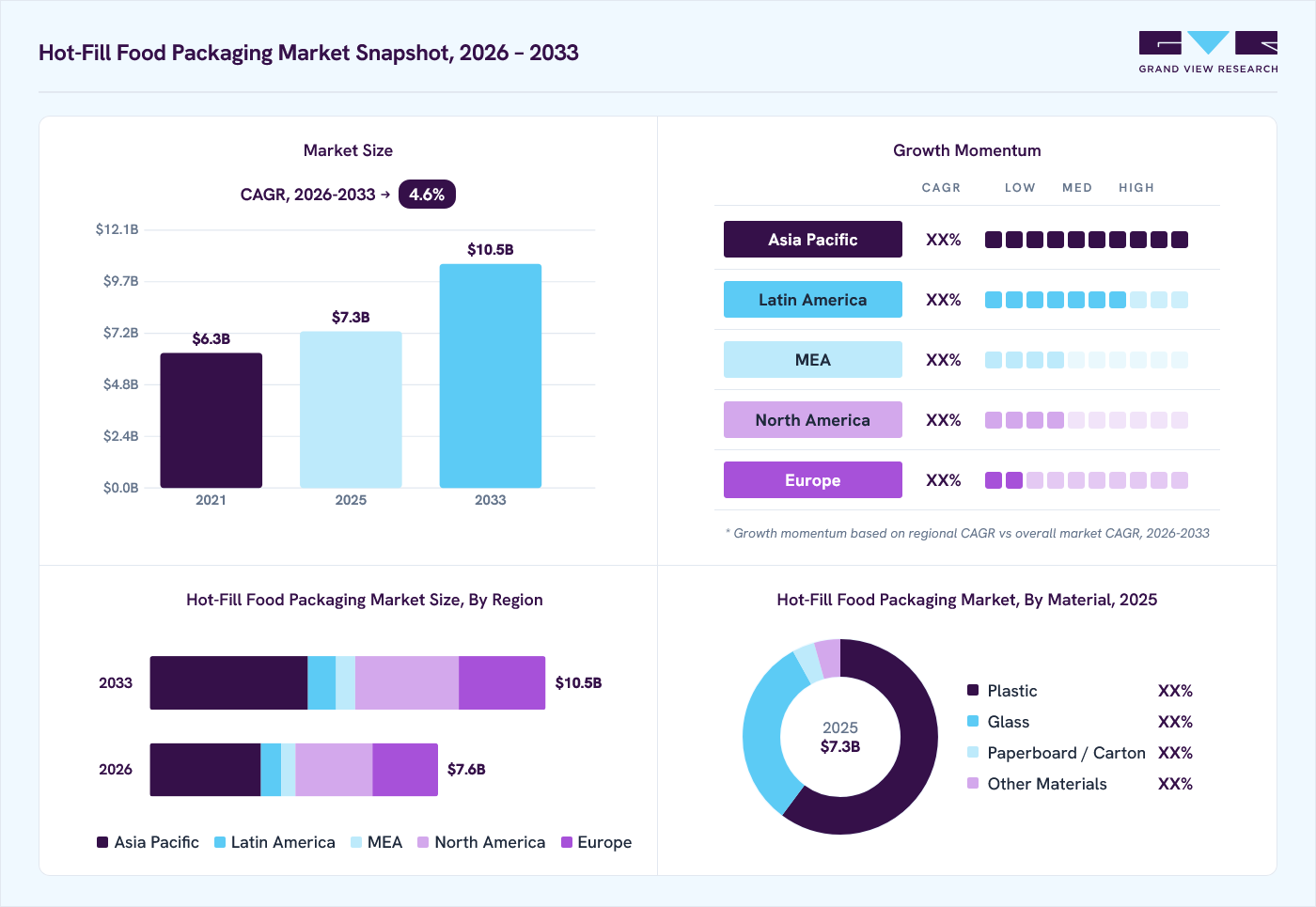
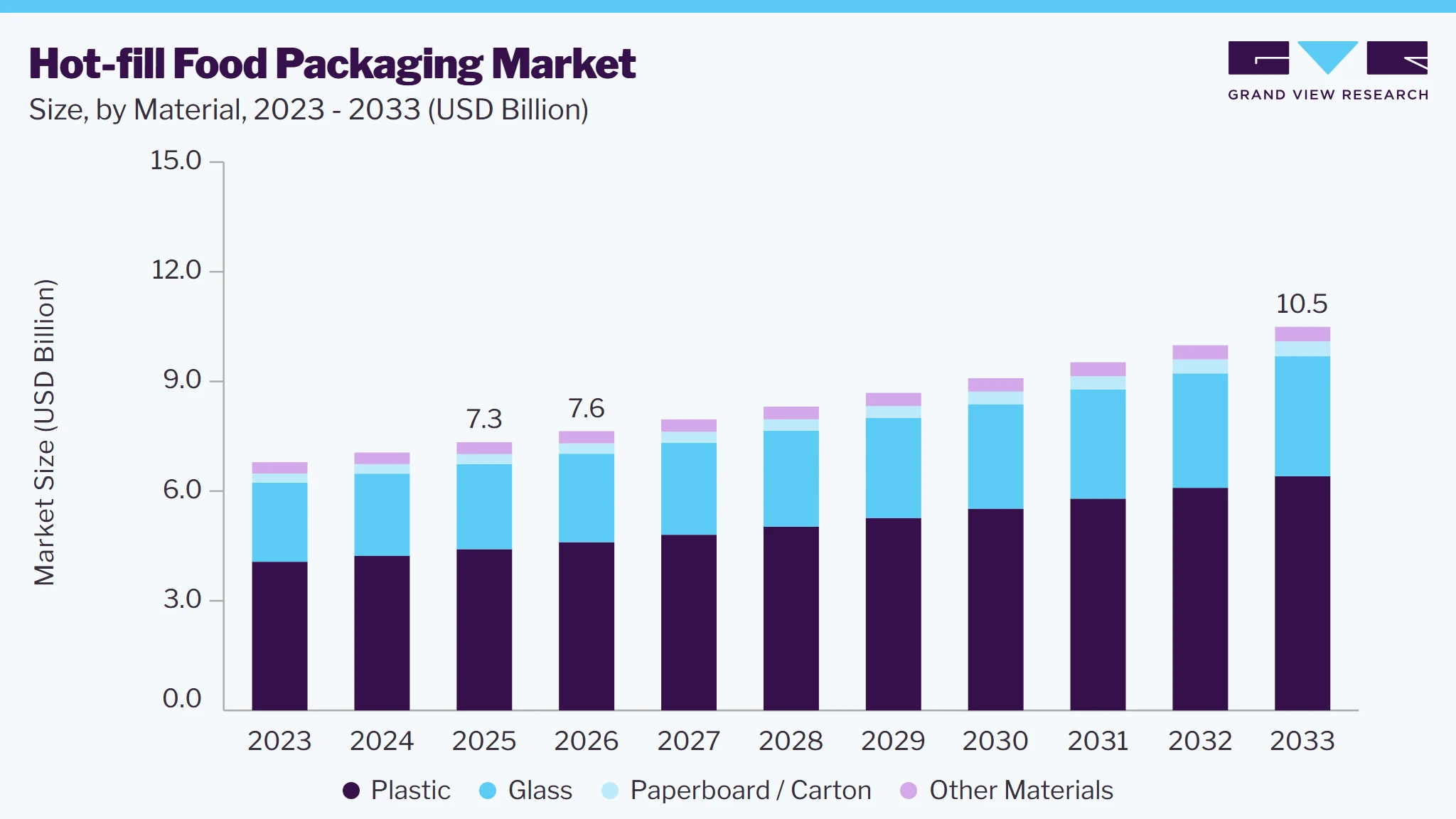
The global hot-fill food packaging market size was valued at USD 7.3 billion in 2025 and is projected to grow from USD 7.6 billion in 2026 to USD 10.5 billion by 2033, at a CAGR of 4.6% from 2026 to 2033. Asia Pacific dominated the market, accounting for a revenue share of 38.4% in 2025. The market is driven by the rising demand for convenient, shelf-stable, and minimally processed food products, along with the growing consumption of sauces, juices, ready-to-eat foods, and other heat-processed products.
 Source: Grand View Research, IR Documents, Primary Interviews, Paid DatabasesTo learn more about this report,
 Download Free Sample Report
 Key Market Trends & Insights
- By material: Plastic segment accounted for the largest revenue share of 60.1% in 2025.
- By packaging type: Pouches segment is projected to register the fastest CAGR of 5.7% from 2026 to 2033.
- By application: Sauces & condiments segment accounted for the largest revenue share of 34.8% in 2025.
Regional Highlights
- Largest regional market: Asia Pacific (38.4% revenue share, 2025)
- By country: China held the major share in 2025
Market Size & Forecast
- Market Size in 2025: USD 7.3 Billion
- Estimated Market Size in 2026: USD 7.6 Billion
- Projected Market Size by 2033: USD 10.5 Billion
- CAGR (2026-2033): 4.6%
Three ways to get this report
Buy it, customize it, or ask a question.Ask an Analyst
A direct answer, usually in 1 working day
- AccessReport author, directly
- Reply timeWithin 1 working day
- No sales callDirect answer only
- FormatEmail reply
- CostFree, no cost
Get the Full Report
What the study covers
- FormatsPDF · Excel · Dashboard
- Timeline2026–2033 annual, 2025 base
- Coverage20+ countries, 5 regions
- Companies10+ key players profiled
Customize the Report
20% free customization
- IncludeCountries, segments, points
- TailorTo your product definition
- ExtendDeeper competitor detail
- OrA fully bespoke study
- Turnaround5–10 working days
Increasing adoption of hot-fill packaging for its ability to support product safety, extend shelf life, and maintain packaging integrity during high-temperature filling is further supporting market growth.
As food manufacturers adopt hot-fill processing to improve product safety, extend shelf life, and maintain product quality, there is a growing demand for packaging materials capable of withstanding elevated filling temperatures without compromising structural integrity. The continued expansion of packaged food consumption, convenience-oriented eating habits, and modern food processing infrastructure is further supporting demand for hot-fill packaging solutions.
 To learn more about this report, Download Free Sample Report
 Hot-fill packaging is widely used for products where thermal processing and packaging integrity are important for maintaining product quality. Glass continues to represent a significant material option, accounting for 31.8% of market revenue in 2025, owing to its thermal resistance, product compatibility, barrier properties, and established use in food applications.
Sustainability initiatives and the transition toward more resource-efficient food packaging systems are also contributing to market development. A defining trend in the industry is the increasing exploration of recyclable, lightweight, and material-efficient packaging formats as food manufacturers seek to reduce packaging waste while maintaining the thermal and barrier performance required for hot-fill applications. This transition is supporting greater interest in paperboard/carton solutions as well as lightweight plastic structures that can provide functional performance with reduced material consumption. Paperboard/carton’s share is projected to increase from USD 271.5 million in 2025 to USD 405.7 million by 2033, reflecting its comparatively faster growth within the material landscape. Such developments are expected to broaden the material base of the market and support the adoption of packaging solutions aligned with evolving sustainability requirements.
Market Dynamics
The market is witnessing steady growth, as manufacturers are focusing on packaging formats that can withstand high filling temperatures while maintaining product safety. Additionally, the growing emphasis on packaging sustainability and material efficiency is further encouraging innovation across plastic, glass, paperboard, and carton-based solutions.
Hot-fill processing enables manufacturers to fill products at elevated temperatures, helping control microbial contamination and support extended shelf life without relying extensively on preservatives. Growing consumer preference for convenient, ready-to-use food products and the expansion of packaged food consumption across retail and foodservice channels are creating sustained demand for packaging formats compatible with hot-fill processing. As food and beverage manufacturers expand their portfolios of shelf-stable products, the need for packaging that provides thermal resistance, barrier protection, dimensional stability, and reliable sealing performance is increasing.
Restraint - Material Performance and Packaging Integrity Challenges at Elevated Filling Temperatures
A significant restraint is the technical challenge of maintaining packaging integrity under high-temperature filling and subsequent cooling conditions. Exposure to elevated temperatures can create risks such as deformation, shrinkage, vacuum formation, seal failure, or changes in container dimensions, particularly when packaging materials are not appropriately engineered for thermal processing. Manufacturers, therefore, need to maintain precise control over material composition, container design, filling temperature, and cooling conditions, which can increase production complexity and packaging development requirements.
A major opportunity for the market lies in the growing development of sustainable, recyclable, and lightweight packaging solutions. Food and beverage manufacturers are seeking packaging materials that can reduce environmental impact while maintaining thermal resistance, barrier protection, sealing performance, and shelf-life requirements of hot-fill applications. This is encouraging innovation in recyclable plastics, lightweight glass, and paperboard-based formats, while also creating opportunities for packaging designs that use fewer resources without compromising product protection.
The growing preference for convenient and flexible formats is further supporting the development of pouches and other material-efficient solutions, enabling manufacturers to address sustainability objectives while meeting evolving consumer and brand requirements.
Market Concentration & Characteristics
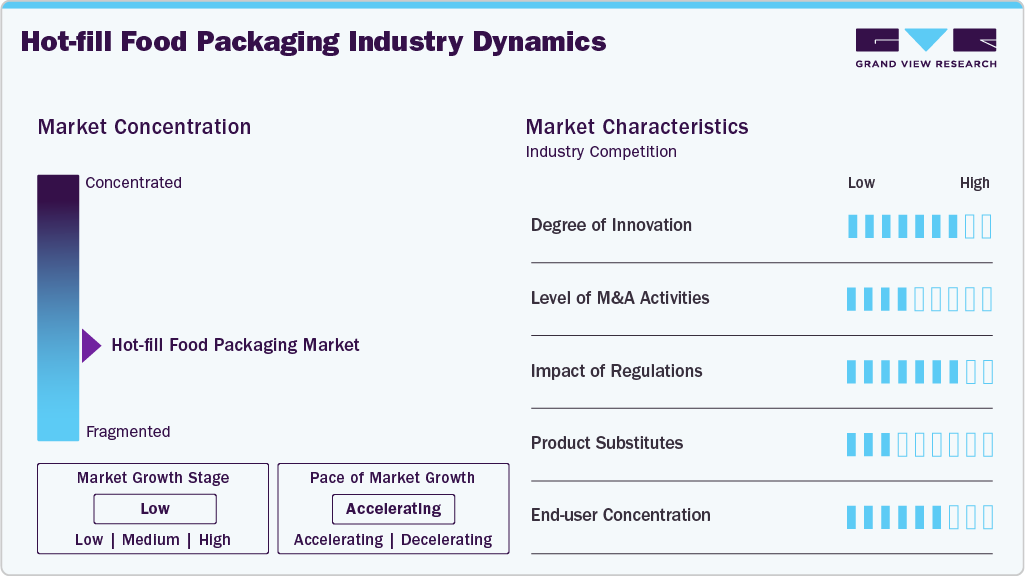
The market is characterized by its strong dependence on food safety. Leading packaging manufacturers are optimizing material formulations, container designs, and production processes to improve packaging performance and meet the requirements of high-volume food processing operations.
A defining feature of the industry is its increasing emphasis on lightweight, recyclable, and material-efficient packaging solutions. Growing sustainability expectations across the food and beverage sector are encouraging manufacturers to reduce packaging material usage, improve recyclability, and explore alternatives to conventional packaging structures.
 To learn more about this report, Download Free Sample Report
 Flexible formats such as pouches are also becoming relevant because they can provide convenient handling and efficient material utilization. At the same time, the adoption of alternative materials varies across applications and regions depending on thermal performance, recycling infrastructure, production costs, food-contact requirements, and compatibility with existing filling and processing equipment. These factors are shaping packaging development strategies and influencing investments in next-generation hot-fill food packaging solutions.
Analyst Perspective
The market has evolved from conventional glass bottles and jars toward lightweight plastic, flexible pouches, and advanced barrier packaging designed to withstand high-temperature filling while maintaining product safety and shelf life. Going forward, the market is expected to maintain steady growth, supported by rising demand for convenient and shelf-stable foods, packaging innovation, and the shift toward sustainable hot-fill solutions. Recyclable plastics, flexible packaging, improved barrier structures, and efficient packaging designs are expected to remain key areas of development, while thermal resistance, packaging integrity, material costs, and recyclability will continue to influence future market evolution.
Material Insights
The plastic segment led the market with the largest revenue share of 60.1% in 2025. Plastic is widely used due to its lightweight, durable, and versatile characteristics, making it suitable for hot-fill bottles, pouches, cups, and tubs. Its flexibility in packaging design, efficient handling, and compatibility with sauces, beverages, and processed foods support its continued dominance.
The paperboard/carton segment is expected to grow at the fastest CAGR of 5.2% during the forecast period. Its growth is supported by increasing demand for recyclable and material-efficient packaging solutions in the food and beverage industry. Advancements in barrier coatings and packaging structures are improving their suitability for hot-fill applications, while sustainability initiatives are encouraging manufacturers to explore paperboard-based alternatives.
Packaging Type Insights
The bottles segment led the market with the largest revenue share of 35.3% in 2025. Bottles are widely used for sauces, condiments, juices, and fruit beverages due to their durability, convenient handling, and suitability for hot-fill processing. Their ability to provide reliable product protection and integrate with various closure and dispensing systems supports their continued use across food and beverage applications.
The pouches segment is expected to grow at the fastest CAGR of 5.7% during the forecast period. Hot-fill pouches are gaining traction due to their lightweight construction, material efficiency, portability, and convenience. Their growing use in sauces, processed foods, and beverages is supported by increasing demand for flexible packaging solutions that offer efficient transportation, easy handling, and reduced packaging material consumption.
Application Insights
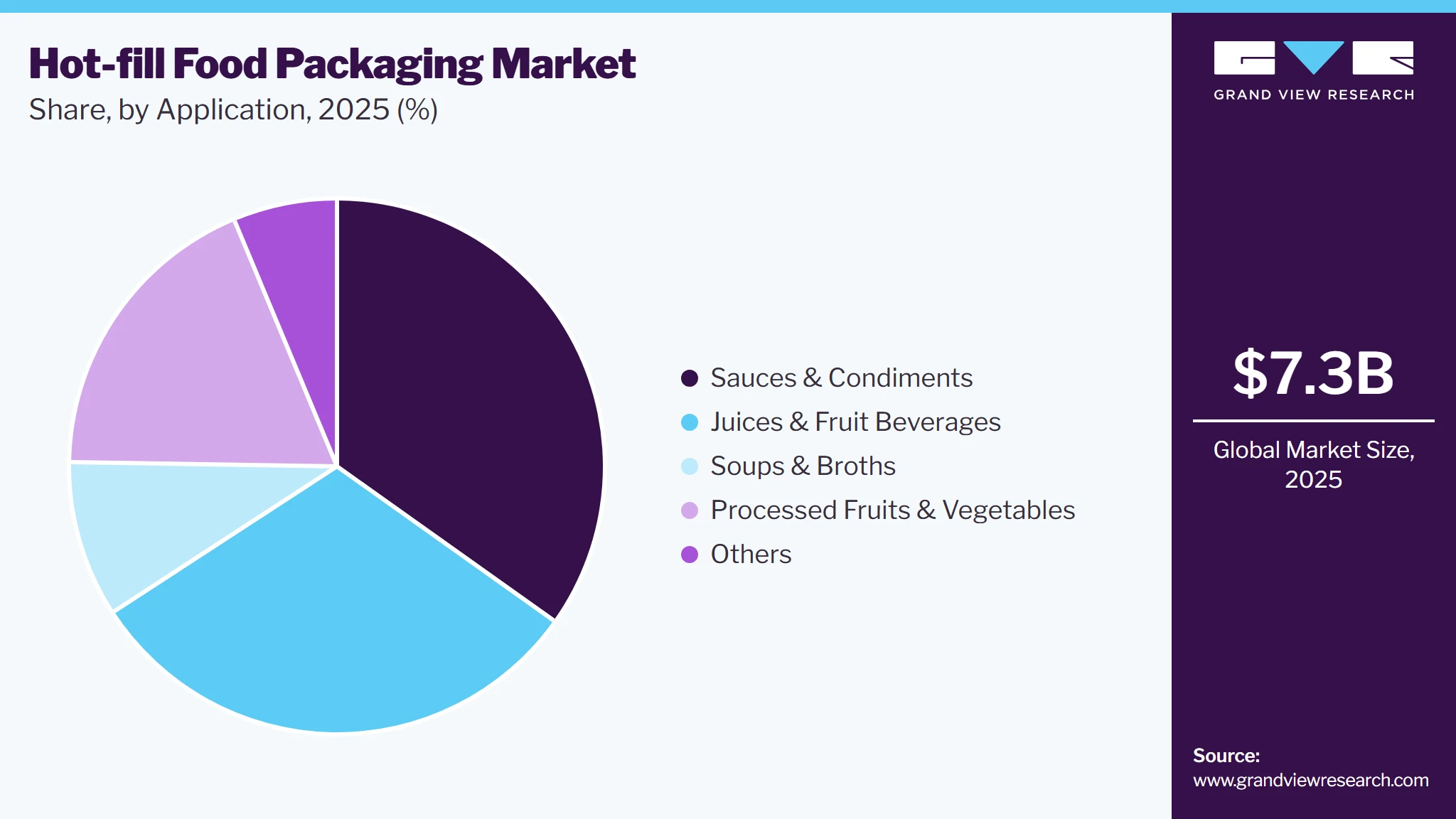
The sauces & condiments segment led the market with the largest revenue share of 34.8% in 2025. Hot-fill packaging is widely used for sauces, ketchup, dressings, and other condiments because it supports thermal processing, product safety, and extended shelf life. Growing consumption of packaged and ready-to-use condiments is further supporting demand for hot-fill bottles, jars, and pouches.
 To learn more about this report, Download Free Sample Report
 The processed fruits & vegetables segment is expected to grow at the fastest CAGR of 5.3% during the forecast period. Increasing demand for convenient and shelf-stable processed foods is supporting the adoption of hot-fill packaging in this application. Packaging formats that provide reliable product protection, thermal resistance, and extended shelf life are gaining importance as food manufacturers expand processed fruit and vegetable offerings.
Regional Insights
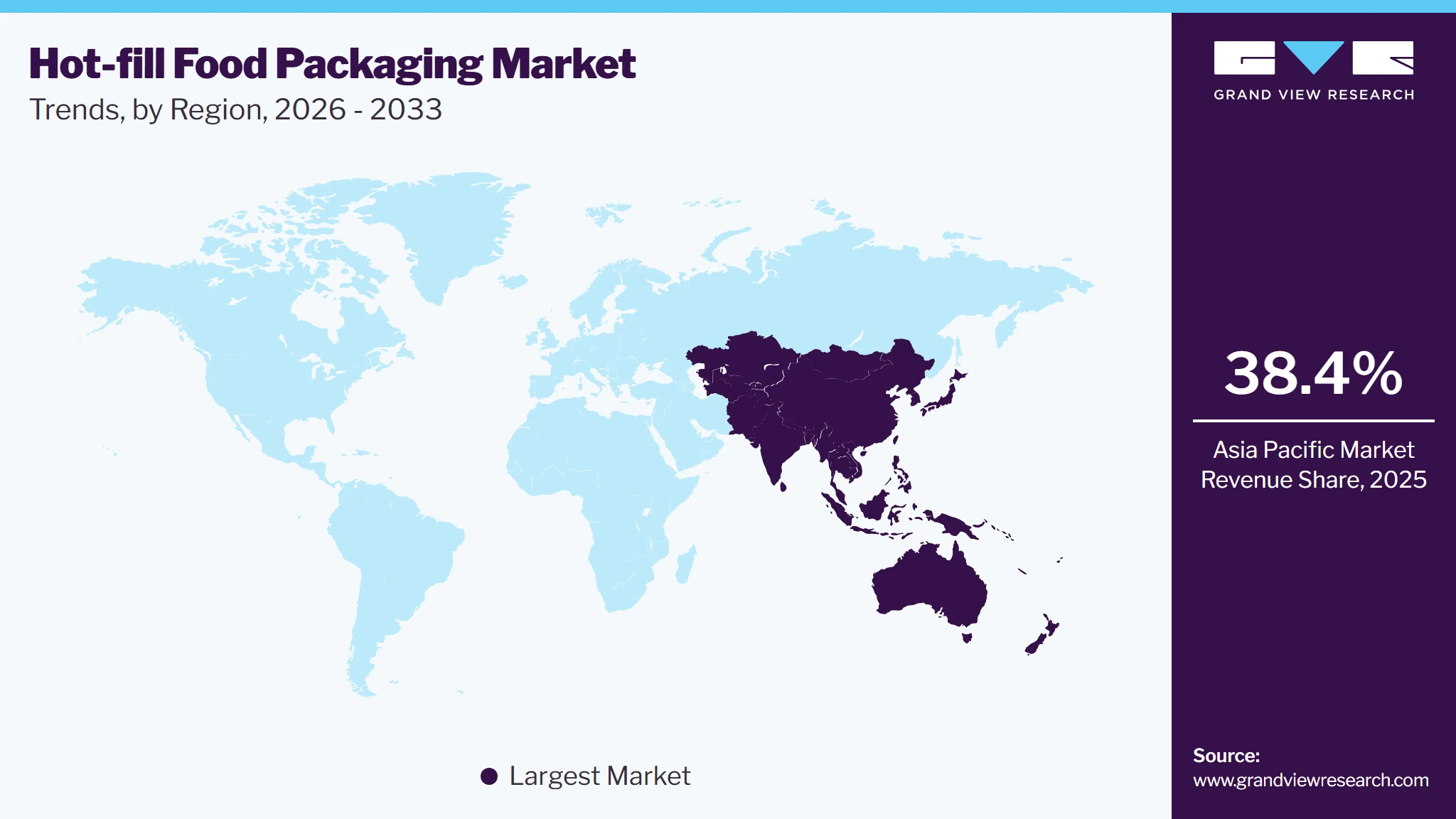
The Asia Pacific hot-fill food packaging market dominated with a revenue share of 38.4% in 2025 and is projected to register the fastest CAGR of 5.2% during the forecast period. Regional growth is supported by the rapid expansion of food processing and packaged food industries, urbanization, rising disposable incomes, and increasing consumption of convenient and shelf-stable foods. Growing production of heat-processed products is strengthening demand for hot-fill packaging in this region. Expanding manufacturing capacity and increasing adoption of lightweight and flexible packaging formats are further reinforcing the region's market position.
 To learn more about this report, Download Free Sample Report
 China Hot-fill Food Packaging Market Trends
The hot-fill food packaging market in China represents a major share of the Asia Pacific, supported by its large food and beverage manufacturing base and extensive packaged food consumption. Rising demand for convenient food products is creating sustained requirements for hot-fill bottles, jars, pouches, and other formats in the country. Investments in modern food processing and packaging technologies are also supporting the adoption of more efficient and sustainable packaging solutions.
The India hot-fill food packaging market is expected to experience strong growth during the forecast period, supported by urbanization and the development of food processing and organized retail. Increasing demand for fruit beverages and processed food products is creating new opportunities for hot-fill packaging manufacturers in India.
North America Hot-fill Food Packaging Market Trends
The hot-fill food packaging market in North America is expected to witness steady growth during the forecast period, supported by established food processing industries. Strong demand for convenient and packaged foods, along with the widespread use of hot-fill processing for product safety and extended shelf life, is supporting regional market development. Manufacturers are also focusing on high-performance packaging formats to meet evolving sustainability and convenience requirements.
The hot-fill food packaging market in the U.S. is projected to expand steadily throughout the forecast period, driven by established food and beverage manufacturing capabilities and continued innovation in bottles, pouches, jars, and other hot-fill formats. Moreover, as U.S. states pass strict packaging laws and bans on harmful chemicals, packaging manufacturers are rapidly engineering new, highly recyclable, and safer hot-fill materials to stay legally compliant.
Europe Hot-fill Food Packaging Market Trends
The hot-fill food packaging market in Europe is anticipated to experience moderate growth during the forecast period. Demand is supported by the region's mature food and beverage sector. Moreover, European food brands are rapidly switching to newly engineered mono-material plastics (made from just one type of polymer) and high-purity recycled PET (rPET). These materials are specially treated to handle high hot-fill temperatures while still being perfectly accepted by European recycling plants.
The Germany hot-fill food packaging market accounts for a significant share of the European market, supported by its well-developed food processing industry and strong manufacturing capabilities. In addition, hot-fill packaging suits products destined for longer supply chains.
Latin America Hot-fill Food Packaging Market Trends
The hot-fill food packaging market in Latin America is projected to grow steadily during the forecast period, supported by rising food processing activities. Improvements in retail distribution and growing consumer preference for convenient packaged foods are expected to create additional opportunities for packaging manufacturers across the region.
The Brazil hot-fill food packaging market is supported by the country’s large food and beverage manufacturing base. According to the Brazilian Food Industry Association (ABIA), Brazil’s food and beverage industry generated approximately R$1.39 trillion in revenue in 2025, indicating a strong downstream market for packaged products. In addition, Brazil’s Decree No. 12,688/2025 established a national reverse-logistics system for plastic packaging, encouraging greater use of recyclable, lightweight, and material-efficient packaging solutions suitable for hot-fill applications.
Middle East & Africa Hot-fill Food Packaging Market Trends
The hot-fill food packaging market in the Middle East & Africa is expected to register steady growth during the forecast period, supported by improvements in retail infrastructure. Growing investments in food manufacturing and the increasing availability of modern packaging technologies are expected to further support regional market development.
Key Hot-fill Food Packaging Company Insights
The hot-fill food packaging market is characterized by the development of heat-resistant PET and PP containers, flexible pouches, high-barrier films, rigid thermoformed packaging, and specialized closures designed to withstand elevated filling temperatures while maintaining product integrity and shelf life.
-
Amcor plc is a major packaging manufacturer with expertise in rigid and flexible food packaging solutions for hot-fill applications. The company has developed PET packaging specifically for hot-fill foods, including wide-mouth containers designed for products such as pasta sauce, apple sauce, jams, jellies, and salsa. Its hot-fill packaging technologies focus on lightweight construction, dimensional stability, seal integrity, and product protection, providing alternatives to heavier glass containers in thermally demanding food applications.
-
Plastipak Holdings, Inc. specializes in PET packaging technologies and offers dedicated hot-fill containers for food and beverage applications. Its hot-fill portfolio includes lightweight PET solutions and ThermoShape™ technology designed for high-acid foods and beverages, including juices, teas, sauces, jams, jellies, dips, and salsa. The company's solutions emphasize lightweighting, design flexibility, shelf stability, and compatibility with high-output manufacturing processes.
Key Hot-fill Food Packaging Companies
The following key companies have been profiled for the study on the hot-fill food packaging market.
-
Amcor plc
-
Plastipak Holdings, Inc.
-
Graham Packaging
-
Guala Pack S.p.a.
-
Aptar
-
Huhtamaki India Ltd
-
Borealis GmbH
-
Klöckner Pentaplast
-
Tetra Pak International S.A.
-
Alpha Group
-
Evertis
-
Pretium Packaging
-
RESILUX
Competitive Benchmarking
Category
Operating Strategies
Competitive Edge
Weakness
Established Players (Amcor plc; Plastipak Holdings, Inc.; Graham Packaging; Guala Pack S.p.A.; Aptar; Huhtamaki India Ltd.; Borealis GmbH; Klöckner Pentaplast; Tetra Pak International S.A.)
- Focus on hot-fill packaging, PET/PP containers, flexible pouches, barrier films, and cartons. Invest in thermal resistance, lightweighting, shelf-life extension, recyclability, and sustainable packaging technologies for sauces, beverages, and processed foods.
- Strong manufacturing capabilities, broad food packaging portfolios, advanced barrier and hot-fill technologies, established customer networks, and strong R&D capabilities.
- High production and R&D costs, exposure to polymer and raw-material prices, stringent food-contact requirements, and increasing pressure for recyclable packaging structures.
Emerging & Regional Players (Alpha Group; Evertis; Pretium Packaging; RESILUX)
- Emphasize PET bottles, preforms, rigid containers, specialty films, and customized hot-fill solutions. Focus on lightweight packaging, thermal performance, recycled content, and customer-specific designs.
- Specialized PET and rigid packaging expertise, flexible production capabilities, hot-fill compatibility, and faster response to regional and customized requirements.
- Smaller global footprint, narrower product portfolios, lower economies of scale, and dependence on PET/polymer feedstocks and investments in advanced sustainable packaging technologies.
Recent Development
-
In April 2026, Amcor launched new Apex PET jars featuring Elevate technology for hot-fill food applications. The lightweight PET jars are designed to provide improved resistance to deformation during hot-fill processing while reducing breakage and supporting compatibility with existing filling and capping equipment. The development strengthens Amcor’s focus on lightweight, recyclable, and high-performance hot-fill food packaging solutions.
-
In 2026, Graham Packaging continued to advance its Active Base technology for hot-fill PET bottles, providing greater design flexibility and improved sustainability compared with conventional hot-fill containers that require vacuum panels. The technology is particularly suited to juices, sports drinks, and ready-to-drink beverages, supporting lightweighting and enhanced recyclability in hot-fill packaging.
Hot-fill Food Packaging Market Report Scope
Report Attribute
Details
Market size in 2025
USD 7.3 billion
Estimated market size in 2026
USD 7.6 billion
Projected market size by 2033
USD 10.5 billion
Growth rate
CAGR of 4.6% from 2026 to 2033
Base year for estimation
2025
Historical data
2021 - 2024
Forecast period
2026 - 2033
Quantitative units
Revenue in USD billion and CAGR from 2026 to 2033
Report coverage
Revenue forecast, company ranking, competitive landscape, growth factors, and trends
Segments covered
Material, packaging type, application, region
Regional scope
North America; Europe; Asia Pacific; Latin America; Middle East & Africa
Country scope
U.S.; Canada; Mexico; Germany; France; UK; Italy; Spain; China; India; Japan; South Korea; Australia; Brazil; Argentina; Saudi Arabia; UAE; South Africa
Key companies profiled
Amcor plc; Plastipak Holdings, Inc.; Graham Packaging; Guala Pack S.p.a.; Aptar; Huhtamaki India Ltd; Borealis GmbH; Klöckner Pentaplast; Tetra Pak International S.A.; Alpha Group; Evertis; Pretium Packaging; RESILUX
Customization scope
Free report customization (equivalent up to 8 analysts working days) with purchase. Addition or alteration to country, regional & segment scope.
Pricing and purchase options
Avail of customized purchase options to meet your exact research needs. Explore purchase options
Global Hot-fill Food Packaging Market Report Segmentation
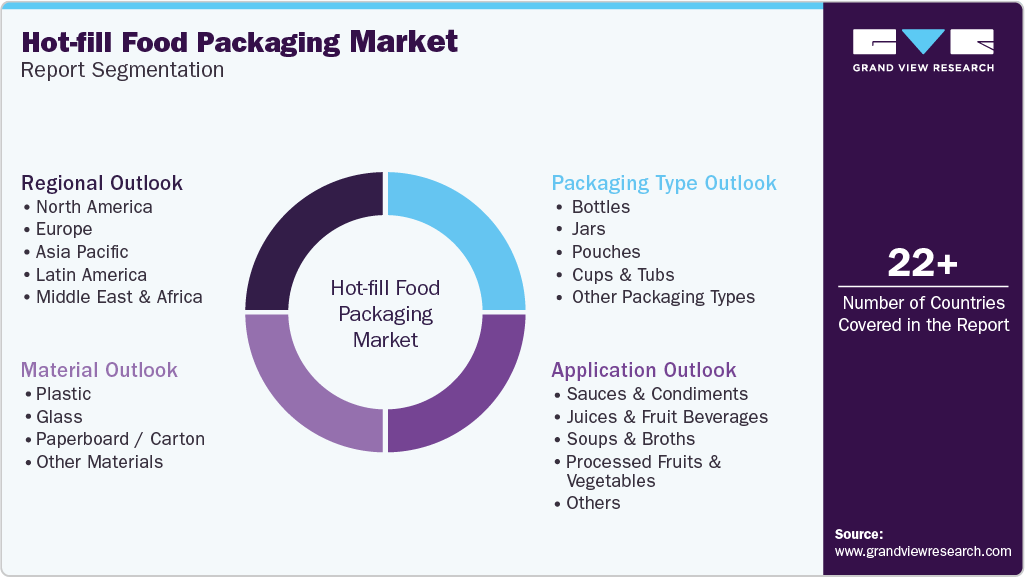
This report forecasts revenue growth at the global, regional, and country levels and provides an analysis of the latest industry trends and opportunities in each of the sub-segments from 2021 to 2033. For this study, Grand View Research has segmented the global hot-fill food packaging market report on the basis of material, application, packaging type, and region:
 To learn more about this report, Download Free Sample Report
 -
Material Outlook (Revenue, USD Billion, 2021 - 2033)
-
Plastic
-
Glass
-
Paperboard / Carton
-
Other Materials
-
-
Packaging Type Outlook (Revenue, USD Billion, 2021 - 2033)
-
Bottles
-
Jars
-
Pouches
-
Cups & Tubs
-
Other Packaging Types
-
-
Application Outlook (Revenue, USD Billion, 2021 - 2033)
-
Sauces & Condiments
-
Juices & Fruit Beverages
-
Soups & Broths
-
Processed Fruits & Vegetables
-
Others
-
-
Regional Outlook (Revenue, USD Billion, 2021 - 2033)
-
North America
-
U.S.
-
Canada
-
Mexico
-
-
Europe
-
Germany
-
France
-
UK
-
Italy
-
Spain
-
-
Asia Pacific
-
China
-
India
-
Japan
-
South Korea
-
Australia
-
-
Latin America
-
Brazil
-
Argentina
-
-
Middle East & Africa
-
Saudi Arabia
-
UAE
-
South Africa
-
-
Research Methodology
The hot-fill food packaging market figures in this report are based on a proven research process that combines executive interviews with secondary research from proprietary databases, company filings, and recognized regulatory and institutional sources. Market size is built through value-chain sizing - reconciling supply-side and demand-side estimates - and triangulated with bottom-up and top-down approaches. Every estimate passes multiple levels of expert validation before publication, with each hot-fill food packaging segment quantified using the revenue-capture definitions in the table below.
Segment Definition
Segment - Material Type
Revenue capture definition
Plastic
Revenue generated from the sale of plastic hot-fill food packaging, including PET, PP, and other heat-resistant plastic containers, bottles, jars, pouches, cups, and tubs designed for high-temperature filling and shelf-stable food applications.
Glass
Revenue generated from the sale of glass packaging used for hot-fill food products, including bottles and jars designed to withstand elevated filling temperatures and provide strong barrier protection for sauces, condiments, beverages, and processed foods.
Paperboard / Carton
Revenue generated from the sale of paperboard and carton-based hot-fill packaging, including heat-resistant and barrier-coated cartons designed for sauces, beverages, processed foods, and other shelf-stable applications requiring thermal processing.
Other Materials
Revenue generated from the sale of hot-fill food packaging made from other materials or specialized packaging structures, including multilayer and alternative material formats used to provide thermal resistance, barrier protection, product safety, and extended shelf life.
Segment - Packaging Type
Revenue capture definition
Bottles
Revenue generated from the sale of hot-fill food packaging bottles designed for sauces, condiments, juices, fruit beverages, and other shelf-stable products requiring high-temperature filling.
Jars
Revenue generated from the sale of hot-fill jars used for sauces, condiments, processed fruits and vegetables, spreads, and other heat-processed food products, providing thermal resistance and product protection.
Pouches
Revenue generated from the sale of flexible hot-fill pouches used for sauces, beverages, processed foods, and other shelf-stable applications, including packaging structures designed for thermal resistance, barrier protection, lightweighting, and extended shelf life.
Cups & Tubs
Revenue generated from the sale of hot-fill cups and tubs used for processed foods, sauces, condiments, beverages, and other food products requiring heat-resistant and reliable packaging formats.
Other Packaging Types
Revenue generated from other hot-fill food packaging formats, including specialized containers and flexible or rigid packaging structures used for heat-processed and shelf-stable food applications.
Segment - Application
Revenue capture definition
Sauces & Condiments
Revenue generated from hot-fill food packaging used for sauces, ketchup, dressings, marinades, dips, and other condiments requiring thermal processing, product protection, and extended shelf life.
Juices & Fruit Beverages
Revenue generated from hot-fill packaging used for juices, fruit drinks, nectar, and other fruit-based beverages that require high-temperature filling for microbial control and shelf stability.
Soups & Broths
Revenue generated from hot-fill packaging used for soups, broths, stocks, and similar heat-processed liquid food products, including formats designed to provide thermal resistance and product protection.
Processed Fruits & Vegetables
Revenue generated from hot-fill packaging used for processed fruits and vegetables, including fruit preparations, vegetable products, purees, and other shelf-stable processed foods requiring thermal processing and barrier protection.
Others
Revenue generated from hot-fill packaging used across other food applications requiring high-temperature filling, including spreads, ready-to-use food products, specialty food preparations, and other shelf-stable products.
Estimation Model
Layer No.
Layer Name
Key Question
Description
01
End-use Industry Layer
What drives demand?
Estimate demand from food and beverage industries using hot-fill packaging for sauces, condiments, juices, fruit beverages, soups, broths, and processed fruits & vegetables requiring thermal processing and extended shelf life.
02
Application & Packaging Adoption Layer
Where is hot-fill packaging used?
Assess adoption of hot-fill packaging across major food applications and packaging formats, including bottles, jars, pouches, cups, and tubs, based on requirements for thermal resistance, barrier protection, product safety, convenience, and shelf stability.
03
Material & Packaging Consumption Layer
Which materials and formats generate demand?
Evaluate consumption of plastic, glass, paperboard/carton, and other materials across hot-fill bottles, jars, pouches, cups & tubs, and other packaging formats, considering lightweighting, recyclability, thermal performance, and shelf-life requirements.
04
Revenue Layer
How is revenue generated?
Revenue is generated through the sale of hot-fill food packaging solutions used across sauces & condiments, juices & fruit beverages, soups & broths, processed fruits & vegetables, and other shelf-stable food applications.
Delivered Customizations
This report has been delivered with the following In-depth customizations
Client Request
Customization Delivered
Value Adds
Competitive Benchmarking
Comparative benchmarking of key Hot-fill Food Packaging companies based on hot-fill packaging portfolio, material capabilities, thermal performance, lightweighting, recyclability, manufacturing footprint, product innovation, and strategic developments across bottles, jars, pouches, cups, and tubs.
Enables clients to assess competitive positioning, technology capabilities, product differentiation, sustainability strategies, and market expansion opportunities among leading packaging manufacturers.
Regional Segmentation Analysis
Detailed assessment of the Hot-fill Food Packaging market across North America, Europe, Asia Pacific, Latin America, and Middle East & Africa, covering regional demand patterns, food processing activity, packaging material preferences, hot-fill adoption, sustainability trends, and growth outlook across key applications.
Helps identify regional demand variations, high-growth markets, application opportunities, and strategic expansion areas for hot-fill packaging manufacturers and suppliers.
Opportunity Assessment
In-depth evaluation of emerging opportunities across plastic, glass, paperboard/carton, packaging formats, and food applications, including sauces & condiments, juices & fruit beverages, soups & broths, and processed fruits & vegetables. The analysis considers lightweighting, recyclable materials, flexible packaging, shelf-life extension, thermal resistance, and evolving consumer preferences.
Helps clients identify untapped opportunities, high-potential product applications, sustainability-driven demand, and areas for portfolio expansion and innovation in the Hot-fill Food Packaging market.
About the Author(s)
Plastics, Polymers & Resins Research Team
Bulk Chemicals · Plastics, Polymers & ResinsThis report was authored by the plastics, polymers & resins research team at Grand View Research - comprising two research analysts, one senior research analyst, and one industry expert - with specialized expertise in the plastics, polymers & resins segment of the bulk chemicals industry. All findings are based on proprietary bulk chemicals databases, executive interviews, and regulatory analysis, subject to internal peer review prior to publication.
Last Updated:
Speak to Analyst

Customize this report to your needs - add regions, segments, or data points, with 20% free customization.
Or view our licence options:


ISO 9001:2015 & 27001:2022 Certified
We are GDPR and CCPA compliant! Your transaction & personal information is safe and secure. For more details, please read our privacy policy.


