
- Home
- »
- IT Services & Applications
- »
-
Hydrogen Technology Testing, Inspection, And Certification Market Report, 2033GVR Report cover

Hydrogen Technology Testing, Inspection, And Certification Market (2026 - 2033)
Size, Share & Trends Analysis Report By Service Type (Testing, Inspection), By Testing Type, By Application, By Process, By Region, And Segment Forecasts
Market Size, 2025
$5.2BMarket Estimate, 2026
$6.1BMarket Forecast, 2033
$20.5BCAGR, 2026–2033
18.8%Hydrogen Technology Testing, Inspection, And Certification Market Summary
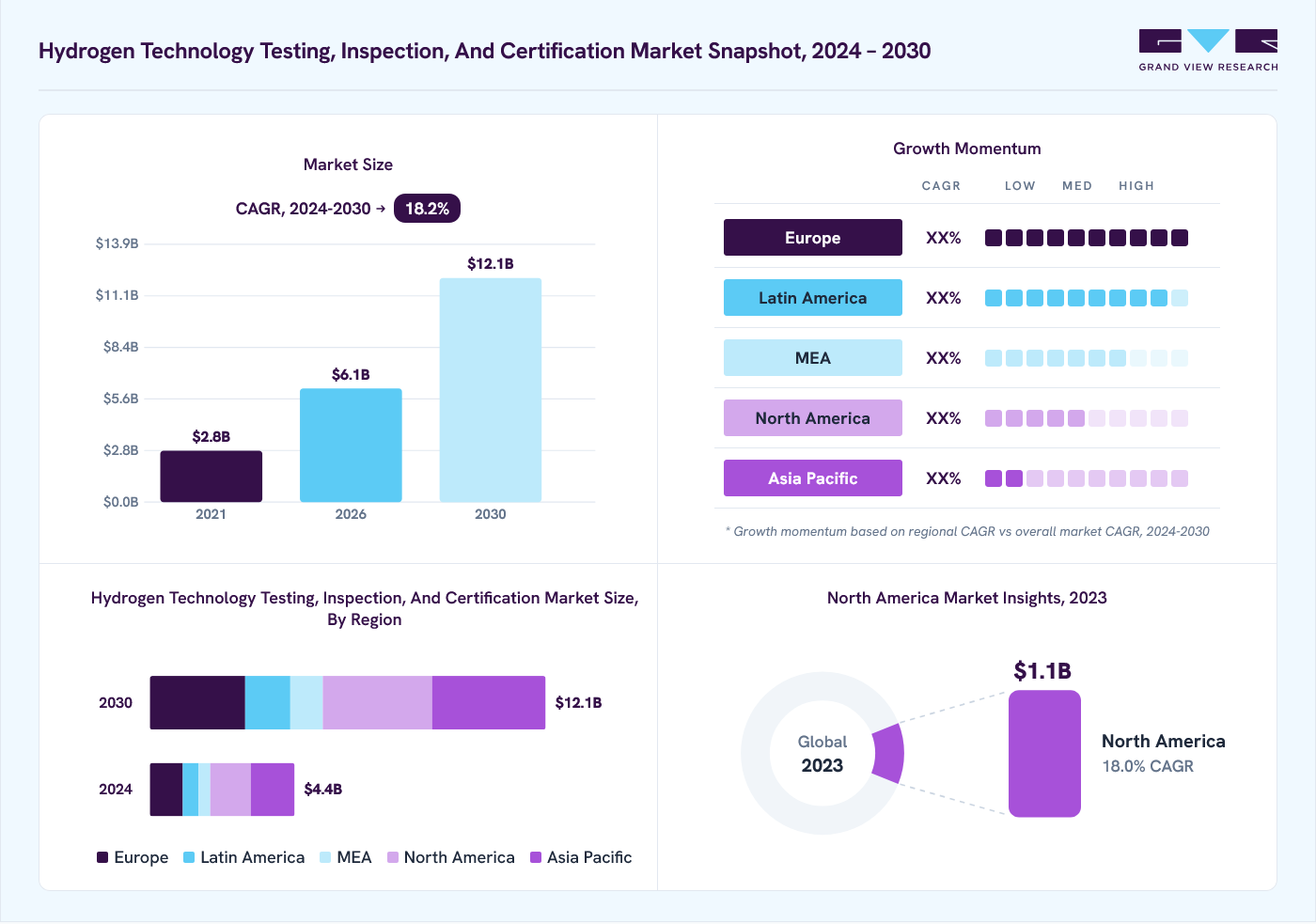
The global hydrogen technology testing, inspection, and certification (TIC) market size was valued at USD 5.2 billion in 2025 and is projected to grow from USD 6.1 billion in 2026 to USD 20.5 billion by 2033, at a CAGR of 18.8% from 2026 to 2033. The market in Asia Pacific dominated with a revenue share of 30.0% in 2025. The global Hydrogen Technology Testing, Inspection and Certification (TIC) market is experiencing strong growth.
 Source: Grand View Research, IR Documents, Primary Interviews, Paid DatabasesTo learn more about this report,
 Download Free Sample Report
 Key Market Trends & Insights
- By service type: Testing segment held the largest market share of 69.6% in 2025.
- By testing type: Hydrogen permeation and compatibility testing segment held the largest market share of 44.0% in 2025.
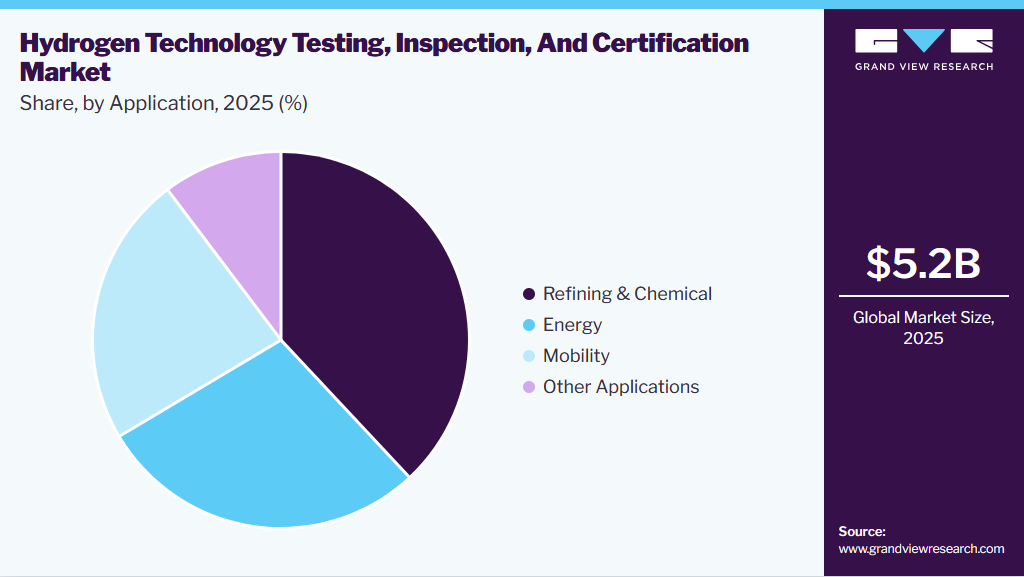
- By application: Refining & chemical segment held the largest market share of 38.0% in 2025.
- By process: Generation segment held the largest market share of 45.9% in 2025.
Regional Highlights
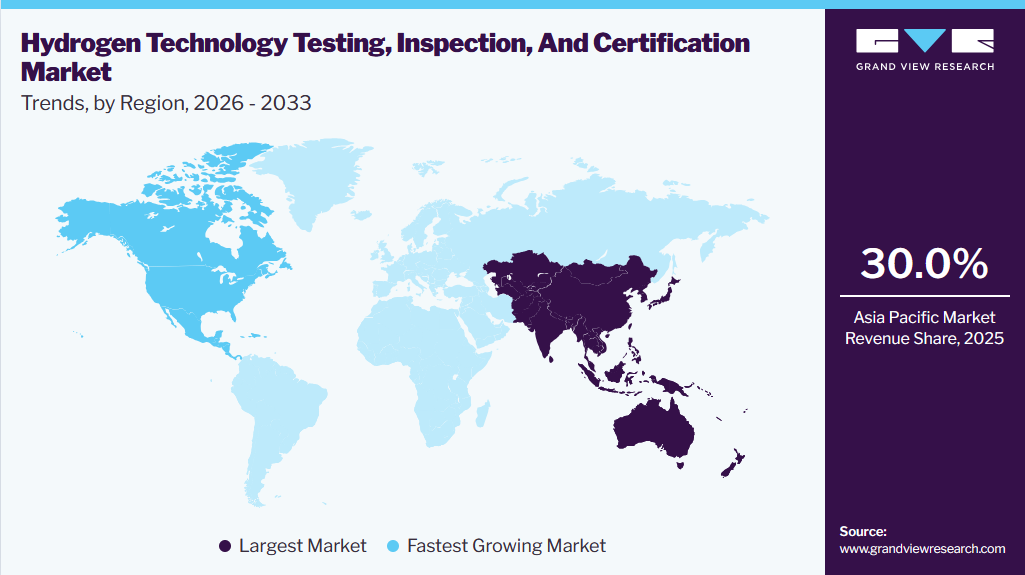
- Largest regional market: Asia Pacific (30.0% revenue share, 2025)
- Fastest-growing regional market: North America (highest CAGR, 2026-2033)
- By country: China held the largest market share in 2025
Market Size & Forecast
- Market size in 2025: USD 5.2 Billion
- Estimated market size in 2026: USD 6.1 Billion
- Projected market size by 2033: USD 20.5 Billion
- CAGR (2026-2033): 18.8%
Three ways to get this report
Buy it, customize it, or ask a question.Ask an Analyst
A direct answer, usually in 1 working day
- AccessReport author, directly
- Reply timeWithin 1 working day
- No sales callDirect answer only
- FormatEmail reply
- CostFree, no cost
Get the Full Report
What the study covers
- FormatsPDF · Excel · Dashboard
- Timeline2026–2033 annual, 2025 base
- Coverage20+ countries, 5 regions
- Companies10+ key players profiled
Customize the Report
20% free customization
- IncludeCountries, segments, points
- TailorTo your product definition
- ExtendDeeper competitor detail
- OrA fully bespoke study
- Turnaround5–10 working days
The growth is driven by increasing investments in hydrogen production, storage, and transportation infrastructure. Rising demand for safe and reliable hydrogen systems is further supporting market expansion. This high share is driven by the increasing adoption of hydrogen as a clean energy source and the need for stringent safety and performance standards. As countries prioritize hydrogen in their energy transition strategies, the demand for reliable testing, inspection, and certification (TIC) services is surging. These services ensure that hydrogen production, storage, and distribution technologies meet regulatory requirements and safety standards, fostering stakeholder confidence. Innovations in hydrogen applications, such as fuel cells and hydrogen-powered vehicles, require comprehensive testing and certification to mitigate risks and enhance operational efficiency.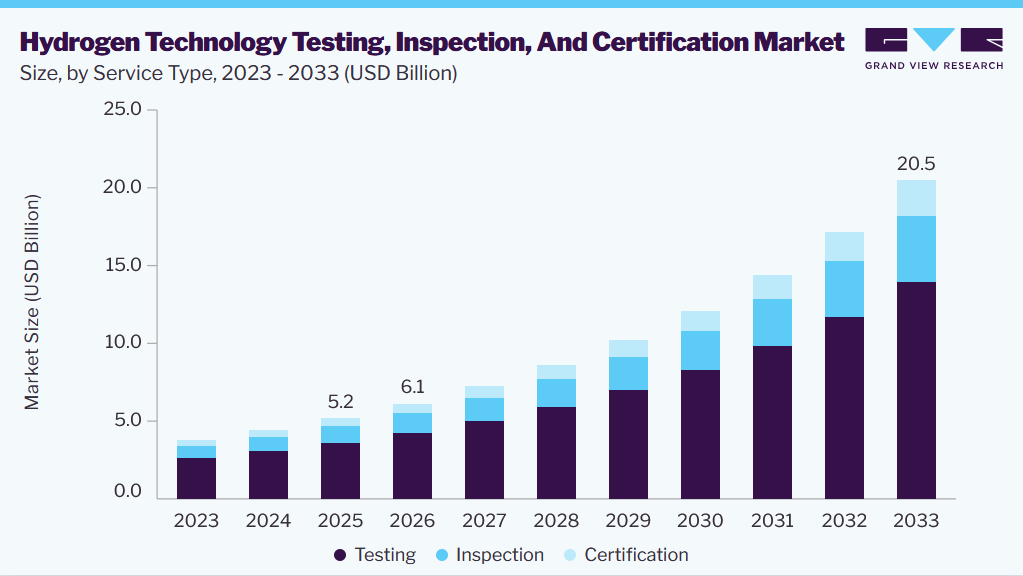 To learn more about this report, Download Free Sample Report
 Advancements in TIC methodologies and technologies, including integrating digital solutions such as IoT and AI for real-time monitoring and assessment, support the market. Furthermore, collaborations between governments, research institutions, and private sectors are pivotal in developing standardized protocols and certifications, which are essential for market growth. Regions like Europe and Asia Pacific are at the forefront of this market, fueled by substantial investments in hydrogen infrastructure and ambitious decarbonization targets. As the global hydrogen economy evolves, the market is poised for robust expansion, offering opportunities for specialized service providers to cater to diverse industries. With rising environmental awareness and technological advancements, the TIC sector will play a crucial role in ensuring the safety and sustainability of hydrogen technologies, ultimately contributing to a greener energy future.
Future opportunities in the hydrogen TIC market are vast, driven by increasing investments in hydrogen infrastructure and the scaling of hydrogen fuel cell technologies. As countries implement stricter regulations and safety standards for hydrogen usage, demand for TIC services is expected to surge. In addition, the growing focus on green hydrogen, produced through renewable energy sources, opens new avenues for TIC companies to support certification processes, ensuring sustainability and efficiency. The market will continue to thrive as hydrogen adoption accelerates across industries, creating numerous growth prospects for TIC providers.
Market Dynamics
The hydrogen technology testing, inspection and certification (TIC) market is driven by increasing industrial activities, evolving regulatory requirements, and growing emphasis on safety, quality, and compliance across industries. Technological advancements and rising investments in infrastructure are further supporting market growth. Market participants are also focusing on service innovation and expanding their capabilities to meet changing customer requirements. However, high operational costs, regulatory complexities, and technical challenges may restrain market expansion. Ongoing technological progress and increasing demand for reliable certification services are expected to create growth opportunities during the forecast period.
The expansion of hydrogen production, storage, and transportation infrastructure is driving the demand for testing, inspection, and certification (TIC) services worldwide. As hydrogen technologies move from pilot projects to large-scale commercial deployment, organizations require independent verification to ensure equipment, facilities, pipelines, storage systems, and operational processes meet established safety, quality, and performance standards. The increasing complexity of hydrogen value chains is further strengthening the need for reliable TIC services throughout project development and operation.
The growing adoption of hydrogen technologies is also increasing the importance of compliance with national and international regulations. TIC providers help manufacturers, project developers, and operators verify compliance with technical standards, minimize operational risks, and improve system reliability throughout the asset lifecycle. As hydrogen applications continue to expand across energy, transportation, industrial, and power generation sectors, demand for specialized testing, inspection, and certification services is expected to grow steadily.
The absence of harmonized global standards and continuously evolving regulatory frameworks remains a key restraint for the hydrogen technology testing, inspection and certification (TIC) market. Certification requirements, testing procedures, and safety regulations differ across countries and regions, creating inconsistencies for manufacturers, project developers, and service providers operating in international markets. These variations make it more challenging to achieve uniform compliance and certification for hydrogen technologies.
Frequent updates to technical standards and regulatory requirements can increase project complexity, extend approval timelines, and raise compliance costs for industry participants. Companies often need to undergo multiple testing and certification processes to meet the requirements of different jurisdictions, resulting in additional administrative and operational burdens. As hydrogen technologies continue to evolve, the lack of globally aligned certification frameworks may delay project execution and slow the adoption of hydrogen infrastructure in certain regions.
The rapid expansion of the global hydrogen economy is creating significant opportunities for the hydrogen technology testing, inspection and certification (TIC) market. Governments and industries are accelerating the deployment of hydrogen production facilities, storage systems, transportation networks, and end-use applications to support decarbonization goals. As new hydrogen projects are developed, the demand for independent testing, inspection, and certification services is expected to increase across the entire hydrogen value chain.
The growing adoption of hydrogen technologies across energy, transportation, industrial, and manufacturing sectors is creating long-term opportunities for TIC providers to expand their service portfolios. Increasing cross-border hydrogen trade and the development of international certification frameworks are further driving the need for standardized verification and compliance services. These trends are expected to support sustained demand for specialized TIC solutions throughout the forecast period.
Market Concentration & Characteristics
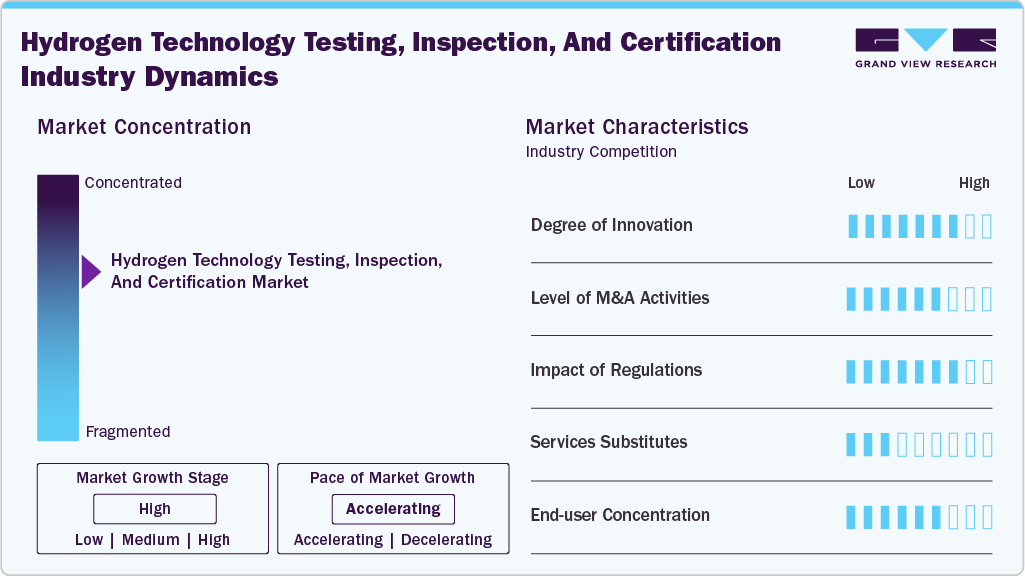
The hydrogen technology testing, inspection and certification (TIC) market is moderately concentrated, with leading global TIC providers accounting for a significant share of the market. These companies leverage their extensive technical expertise, global accreditation, established customer relationships, and broad service portfolios to support large-scale hydrogen production, storage, transportation, and infrastructure projects. Their strong international presence enables them to serve multinational clients while meeting diverse regulatory and safety requirements.
 To learn more about this report, Download Free Sample Report
 At the same time, the market remains fragmented in specialized hydrogen testing and certification services, where regional laboratories and niche providers compete through technical expertise, specialized testing capabilities, and knowledge of local regulatory requirements. These companies often focus on specific hydrogen technologies or regional markets, complementing the offerings of larger TIC providers. The market is gradually moving toward consolidation as leading companies strengthen their capabilities through acquisitions, strategic partnerships, and the expansion of hydrogen-focused testing and certification services.
Analyst Perspective
The Hydrogen Technology Testing, Inspection and Certification (TIC) market is expected to witness steady growth as hydrogen production, storage, and transportation activities continue to expand worldwide. Increasing emphasis on safety, regulatory compliance, and quality assurance is creating sustained demand for specialized TIC services across the hydrogen value chain. While established global TIC providers maintain a strong market position through broad service portfolios and international accreditations, niche and regional companies are strengthening competition by developing specialized hydrogen testing capabilities.
Service Type Insights
Based on service type, testing segment led the market with a significant revenue share of 69.6% in 2025. As hydrogen-based systems, including fuel cells and storage solutions, gained traction, ensuring their safety, efficiency, and performance became paramount. Testing is essential for detecting potential hazards like leaks, material degradation, or equipment failure, especially in high-pressure environments. With the global push towards hydrogen as a clean energy alternative, regulatory bodies imposed stricter standards on hydrogen applications, further driving the demand for comprehensive testing services. Moreover, increased research and development activities in hydrogen infrastructure, transportation, and production contributed to the testing segment's dominant position in the TIC market.
The inspection segment is predicted to foresee significant growth in the coming years. As hydrogen production, storage, and transportation systems expand, regular inspections are essential to prevent risks like leaks, structural failures, and equipment malfunctions. The growth in hydrogen refueling stations, pipelines, and industrial applications has heightened the need for ongoing monitoring and compliance with evolving safety standards. Moreover, stringent regulatory frameworks and industry-specific requirements across sectors like energy, automotive, and manufacturing drive the demand for specialized inspection services, ensuring operational safety and reliability in the rapidly expanding hydrogen economy.
Testing Type Insights
Based on testing type, the hydrogen permeation and compatibility testing segment led the market with a significant revenue share of 44.0% in 2025. Hydrogen permeation can lead to material degradation, embrittlement, and leaks, posing significant safety risks. As hydrogen adoption expands across industries, ensuring the compatibility of materials such as metals, polymers, and composites with hydrogen environments becomes critical. This type of testing is vital for components used in storage, transportation, and fuel cell systems. The growth is further driven by the need for advanced testing solutions to meet stringent regulatory standards and ensure that hydrogen systems operate safely and efficiently under various conditions.
The pressure cycle, leakage, and tightness testing segment is anticipated to exhibit the highest CAGR over the forecast period. Hydrogen is stored and transported under extreme pressure, making systems prone to leakage and potential failures. This testing ensures tanks, pipelines, and other components can withstand repeated pressure cycles without degradation. The rising deployment of hydrogen infrastructure, such as refueling stations and storage facilities, increases the need for rigorous testing to prevent leaks and ensure system tightness.
Application Insights
Based on application, the refining & chemical segment led the market with a significant revenue share of 38.0% in 2025. Hydrogen is critical in refining operations, such as hydrocracking and desulfurization, to produce cleaner fuels. As industries aim to meet stricter environmental regulations, demand for hydrogen-based processes is rising, driving the need for rigorous testing and inspection. Furthermore, hydrogen is increasingly used as a feedstock in the chemical industry to produce ammonia, methanol, and other chemicals. The growing emphasis on sustainable and efficient hydrogen usage in these sectors heightens the need for TIC services to ensure safety, compliance, and process optimization, fueling strong segment growth.
 To learn more about this report, Download Free Sample Report
 The mobility segment is anticipated to exhibit the highest CAGR over the forecast period due to the rapid expansion of hydrogen-powered vehicles and transportation infrastructure. With the increasing adoption of hydrogen fuel cell vehicles (FCEVs) in the automotive, trucking, and public transportation sectors, there is a growing need for rigorous testing and certification to ensure safety, performance, and regulatory compliance. Hydrogen storage systems, fuel cells, and refueling stations require detailed inspections and testing for pressure resistance, leakage, and material compatibility. As governments and industries invest heavily in hydrogen mobility solutions to reduce carbon emissions, the demand for TIC services in this segment is surging, driving its projected high growth rate.
Process Insights
Based on process, the generation segment led the market with the largest revenue share of 45.9% in 2025 due to the rising emphasis on green hydrogen production and the need for stringent quality control in hydrogen generation technologies. As industries shift towards low-carbon hydrogen, particularly through electrolysis and other renewable methods, ensuring efficiency, safety, and compliance is critical. The TIC of hydrogen generation plants is crucial for meeting regulatory requirements and optimizing production performance. In addition, advancements in hydrogen generation technologies and increasing investments in scaling hydrogen production globally are driving the demand for TIC services.
The storage segment is anticipated to witness significant growth in the coming years. As hydrogen is often stored under high pressure or in liquid form at extremely low temperatures, rigorous testing and inspection are required to prevent potential hazards such as leaks, material degradation, or system failures. With the expansion of hydrogen-powered transportation and industrial applications, demand for large-scale storage solutions like tanks, pipelines, and underground facilities is increasing. This growth is further fueled by the need to comply with strict safety standards, making TIC services essential for ensuring the reliability and safety of hydrogen storage infrastructure.
Regional Insights
The hydrogen technology testing, inspection, and certification market in the North America region is anticipated to register the highest CAGR over the forecast period. The region's strong focus on developing a hydrogen economy, supported by government policies and private sector initiatives, has driven the demand for comprehensive TIC services. Key factors include substantial funding for hydrogen research and development, establishing hydrogen refueling networks, and partnerships to scale hydrogen production and utilization. In addition, North America's stringent regulatory requirements and safety standards have bolstered the need for rigorous testing and certification processes.
U.S. Hydrogen Technology Testing, Inspection, And Certification Market Trends
The U.S. hydrogen technology TIC Market is expected to grow at a CAGR of 19.0% from 2026 to 2033. The U.S. government’s supportive policies, including substantial investments in hydrogen research, development, and commercialization, drive the demand for extensive TIC services. The rapid expansion of hydrogen refueling stations, fuel cell vehicle deployments, and large-scale hydrogen production projects necessitate rigorous testing and certification to meet safety and regulatory standards.
Asia Pacific Hydrogen Technology Testing, Inspection, And Certification Market Trends
Asia Pacific dominated the hydrogen technology testing, inspection and certification (TIC) market with the largest revenue share of 30.0% in 2025 due to its rapid industrialization and significant investments in hydrogen technology. Countries like China, Japan, and South Korea lead the charge in hydrogen adoption, driven by their ambitious energy transition goals and commitment to reducing greenhouse gas emissions. The growth is fueled by substantial government funding for hydrogen infrastructure projects, such as refueling stations and production facilities, as well as advancements in fuel cell technologies.
 To learn more about this report, Download Free Sample Report
 Europe Hydrogen Technology Testing, Inspection, And Certification Market Trends
The hydrogen technology TIC market in Europe is expected to witness significant growth over the forecast period due to its aggressive push towards a hydrogen-based economy as part of its broader Green Deal and sustainability goals. European countries invest heavily in hydrogen infrastructure, including production, storage, and refueling stations, driven by stringent climate targets and regulatory frameworks. The European Union's commitment to reducing carbon emissions and enhancing energy security fosters significant demand for advanced TIC services to ensure safety and environmental standards compliance.
Key Hydrogen Technology Testing, Inspection, And Certification Company Share Insights
Key hydrogen technology TIC companies include SGS SA, Bureau Veritas SA, Intertek Group plc, and DEKRA SE. Companies active in the market focus aggressively on expanding their customer base and gaining a competitive edge over their rivals. Hence, they pursue various strategic initiatives, including partnerships, mergers & acquisitions, collaborations, and new product/ technology development. For instance, in July 2024, UL Solutions Inc. announced its acquisition of TesTneT Engineering GmbH, a prominent Germany-based company specializing in hydrogen system and component testing. This acquisition strengthens UL Solutions Inc.'s expertise in alternative fuels and bolsters its capacity to contribute to global decarbonization initiatives.
Key Hydrogen Technology Testing, Inspection, And Certification Companies:
The following key companies have been profiled for this study on the hydrogen technology testing, inspection, and certification market.
-
SGS SA
-
Bureau Veritas SA
-
Intertek Group plc
-
DEKRA SE
-
TÜV SÜD
-
DNV GL
-
TÜV Rheinland
-
Applus+
-
TÜV NORD GROUP
-
UL LLC
Competitive Benchmarking
Operating Strategies
Competitive Edge
Weaknesses
Mature Players: SGS SA, Bureau Veritas SA, Intertek Group plc
- Expand global operations, strengthen hydrogen testing and certification capabilities, invest in advanced technologies, and secure large-scale projects through long-term partnerships.
- Strong global accreditation, broad service portfolios, extensive regulatory expertise, established customer relationships, and the ability to support large-scale international hydrogen projects.
- Higher service costs, longer certification timelines, complex organizational structures, and lower flexibility in addressing highly specialized or smaller regional hydrogen projects.
Emerging Players: Applus+, UL LLC
- Expand hydrogen service offerings, strengthen regional presence, develop niche technical expertise, and pursue partnerships and acquisitions to increase market presence.
- Specialized hydrogen expertise, flexible service delivery, strong regional presence, faster adoption of new technologies, and the ability to address niche testing and certification requirements.
- Limited global presence, fewer international accreditations, smaller customer base, lower brand recognition, and comparatively limited resources to support large-scale, multi-country hydrogen projects.
Recent Developments
-
In January 2024, Baker Hughes Company launched a new Hydrogen Testing Facility designed to validate its NovaLT industrial turbines for operation with hydrogen blends up to 100%. The facility features a test bench capable of full-load testing and offers complete fuel flexibility, accommodating pressures up to 300 bars and a storage capacity of 2,450 kg. This new Hydrogen Testing Facility will be a central hub for Baker Hughes Company’s collaborations with clients within the expanding hydrogen economy.
-
In November 2023, Element Materials Technology, a London-based provider of TIC services, initiated the first phase of a USD 10 million investment program. This investment involves acquiring advanced hydrogen testing equipment and expanding its global team dedicated to hydrogen technologies.
-
In September 2023, Intertek Group plc, a global leader in Total Quality Assurance, enhanced its quality, safety, and sustainability services by launching Intertek Hydrogen Assurance. This comprehensive advisory and assurance platform offers companies unparalleled access to hydrogen expertise and engineering resources, supporting their projects and processes throughout the hydrogen value chain.
Hydrogen Technology Testing, Inspection, And Certification Market Report Scope
Report Attribute
Details
Market size in 2025
USD 5.2 billion
Estimated market size in 2026
USD 6.1 billion
Projected market size by 2033
USD 20.5 billion
Growth rate
CAGR of 18.8% from 2026 to 2033
Base year for estimation
2025
Historical data
2021 - 2024
Forecast period
2026 - 2033
Quantitative units
Revenue in USD million/Million and CAGR from 2026 to 2033
Report coverage
Revenue forecast, company ranking, competitive landscape, growth factors, and trends
Segments covered
Service type, process, testing type, application, region
Regional scope
North America; Europe; Asia Pacific; Latin America; MEA
Country scope
U.S.; Canada; Mexico; Germany; UK; France; China; Japan; India; Australia; South Korea; Brazil; KSA; UAE; South Africa
Key companies profiled
SGS SA; Bureau Veritas SA; Intertek Group plc; DEKRA SE; TÜV SÜD; DNV GL; TÜV Rheinland; Applus+; TÜV NORD GROUP; UL LLC
Customization scope
Free report customization (equivalent up to 8 analysts' working days) with purchase. Addition or alteration to country, regional & segment scope.
Pricing and purchase options
Avail customized purchase options to meet your exact research needs. Explore purchase options
Global Hydrogen Technology Testing, Inspection, And Certification Market Report Segmentation
This report forecasts revenue growth at global, regional, and country levels and provides an analysis of the latest industry trends in each of the sub-segments from 2021 to 2033. For this study, Grand View Research has segmented the global hydrogen technology testing, inspection, and certification market report based on service type, process, testing type, application, and region.
-
Service Type Outlook (Revenue, USD Billion, 2021 - 2033)
-
Testing
-
Inspection
-
Certification
-
-
Process Outlook (Revenue, USD Billion, 2021 - 2033)
-
Generation
-
Storage
-
Transportation
-
-
Testing Type Outlook (Revenue, USD Billion, 2021 - 2033)
-
Overpressure, Burst, And Flow Testing
-
Pressure Cycle, Leakage, And Tightness Testing
-
Hydrogen Permeation And Compatibility Testing
-
-
Application Outlook (Revenue, USD Billion, 2021 - 2033)
-
Mobility
-
Refining & Chemical
-
Energy
-
Others
-
-
Regional Outlook (Revenue, USD Billion, 2021 - 2033)
-
North America
-
U.S.
-
Canada
-
Mexico
-
-
Europe
-
UK
-
Germany
-
France
-
-
Asia Pacific
-
China
-
India
-
Japan
-
Australia
-
South Korea
-
-
Latin America
-
Brazil
-
-
MEA
-
UAE
-
South Africa
-
KSA
-
-
Research Methodology
The hydrogen technology testing, inspection, and certification market figures in this report are based on a proven research process that combines executive interviews with secondary research from proprietary databases, company filings, and recognized regulatory and institutional sources. Market size is built through value-chain sizing - reconciling supply-side and demand-side estimates - and triangulated with bottom-up and top-down approaches. Every estimate passes multiple levels of expert validation before publication, with each hydrogen technology testing, inspection, and certification segment quantified using the revenue-capture definitions in the table below.
Segment Definition
Segment - Service Type
Revenue Capture Definition
Testing
Revenue generated from testing hydrogen technologies, equipment, and components to evaluate performance, durability, safety, and compliance with technical standards.
Inspection
Revenue derived from inspection services that verify the condition, quality, installation, and operational integrity of hydrogen systems and infrastructure.
Certification
Revenue earned from certifying hydrogen products, facilities, and processes against applicable national and international regulatory and industry standards.
Segment - Process
Revenue Capture Definition
Generation
Revenue associated with TIC services provided for hydrogen production facilities, including electrolyzers, reformers, and related generation equipment.
Storage
Revenue generated from testing, inspecting, and certifying hydrogen storage tanks, cylinders, vessels, and associated storage systems.
Transportation
Revenue captured from TIC services for hydrogen transportation infrastructure, including pipelines, trailers, tankers, and distribution equipment.
Segment - Testing Type
Revenue Capture Definition
Overpressure, Burst, and Flow Testing
Revenue from evaluating the pressure tolerance, burst resistance, and flow performance of hydrogen components under operating conditions.
Pressure Cycle, Leakage, and Tightness Testing
Revenue generated by assessing pressure durability, leak prevention, and sealing performance of hydrogen systems through repeated operational cycles.
Hydrogen Permeation and Compatibility Testing
Revenue derived from testing material compatibility, hydrogen permeation behavior, and long-term resistance to hydrogen exposure.
Segment - Application
Revenue Capture Definition
Mobility
Revenue from TIC services supporting hydrogen-powered vehicles and related refueling infrastructure.
Refining & Chemical
Revenue generated from TIC activities for hydrogen applications used in refining, petrochemical, and chemical manufacturing processes.
Energy
Revenue earned from TIC services supporting hydrogen use in power generation, energy storage, and grid-related applications.
Others
Revenue from TIC services across additional hydrogen applications, including industrial manufacturing, research, aerospace, marine, and emerging end-use sectors.
Estimation Model
Layer Name
Key Question
Description
Hydrogen Industry End-user Layer
Who creates demand for Hydrogen Technology TIC services?
Identifies organizations involved in the hydrogen value chain, including hydrogen producers, equipment manufacturers, infrastructure developers, transportation companies, energy utilities, and industrial users that require testing, inspection, and certification services.
Adoption / Compliance Layer
Who utilizes Hydrogen Technology TIC services?
Filters the addressable market based on regulatory compliance requirements, safety standards, quality assurance needs, project development activities, and adoption of hydrogen technologies across end-use industries.
Service Layer
Which TIC services generate demand?
Estimates demand testing, inspection, and certification services covering hydrogen generation, storage, transportation, and end-use applications, including specialized testing for safety, material compatibility, pressure, leakage, and performance validation.
Revenue Capture Layer
How is revenue generated in the Hydrogen Technology Testing, Inspection and Certification (TIC) ecosystem?
Calculates revenue generated from testing, inspection, certification, compliance assessments, laboratory analysis, field inspections, technical audits, conformity verification, consulting, and other value-added TIC services provided across the hydrogen value chain.
Delivered Customizations
This report has been delivered with the following In-depth customizations
Client Objective
Custom Research Modules Delivered
Strategic Value / Business Impact
Market Entry & Expansion Assessment
Regional market sizing and forecasting
Competitive landscape analysis
Regulatory and certification framework assessment
Identified high-growth markets
Supported market entry strategy
Enabled expansion planning
Technology & Innovation Assessment
Hydrogen technology trend analysis
Testing technology evaluation
Standards and compliance assessment
Partnership ecosystem mapping
Identified future growth opportunities
Supported technology roadmap
Strengthened partnership strategy
Investment Feasibility & Opportunity Analysis
Market attractiveness assessment
Revenue opportunity analysis
SWOT and risk assessment
Industry trend analysis
Supported investment decisions
Reduced market uncertainty
Identified high-potential opportunities
Frequently Asked Questions About This Report
The global hydrogen technology testing, inspection, and certification market is expected to grow at a CAGR of 18.8% from 2026 to 2033, reaching USD 20.5 billion by 2033.
The testing segment led with a 69.6% revenue share in 2025, while certification is the fastest-growing segment.
North America is the fastest-growing region over the forecast period.
The Generation segment accounted for the largest share of 45.9% in 2025, driven by rising hydrogen production, increasing clean energy investments, and growing demand for green hydrogen.
The hydrogen permeation and compatibility testing segment led with a 44.0% revenue share in 2025, while pressure cycle, leakage, and tightness testing is the fastest-growing segment.
Asia Pacific dominated the market with a 30.0% revenue share in 2025, driven by strong government support, rising hydrogen investments, and rapid infrastructure development.
Some key players operating in the hydrogen technology testing, inspection, and certification market include SGS SA, Bureau Veritas SA, Intertek Group plc, DEKRA SE, TÜV SÜD, DNV GL, TÜV Rheinland, Applus+, TÜV NORD GROUP, UL LLC.
Key factors that are driving the hydrogen technology testing, inspection, and certification market growth include increasing use of hydrogen as a clean energy source in various sectors, and stringent regulatory frameworks and supportive government policies aimed at reducing carbon emissions and promoting hydrogen infrastructure.
The global hydrogen technology testing, inspection, and certification market size was valued at USD 5.2 billion in 2025 and is estimated at USD 6.1 billion for 2026.
The refining & chemical segment led with a 38.0% revenue share in 2025, while the mobility segment is the fastest-growing.
About the Author(s)
IT Services & Applications Research Team
Technology · IT Services & ApplicationsThis report was authored by the it services & applications research team at Grand View Research - comprising two research analysts, one senior research analyst, and one industry expert - with specialized expertise in the it services & applications segment of the technology industry. All findings are based on proprietary technology databases, executive interviews, and regulatory analysis, subject to internal peer review prior to publication.
Last Updated:
Speak to Analyst

Customize this report to your needs - add regions, segments, or data points, with 20% free customization.
Or view our licence options:


ISO 9001:2015 & 27001:2022 Certified
We are GDPR and CCPA compliant! Your transaction & personal information is safe and secure. For more details, please read our privacy policy.


