
- Home
- »
- Next Generation Technologies
- »
-
Immersive Entertainment Market Size Report, 2026-2033GVR Report cover

Immersive Entertainment Market (2026 - 2033)
Size, Share & Trends Analysis Report By Technology Type (Virtual Reality, Augmented Reality, Mixed Reality), By Application (Gaming, Live Events, Museum & Cultural Experiences, Music & Concerts, Arcade Studios), By Region, And Segment Forecasts
Market Size, 2025
$137.7BMarket Estimate, 2026
$168.5BMarket Forecast, 2033
$1,024.6BCAGR, 2026–2033
29.4%Immersive Entertainments Market Summary
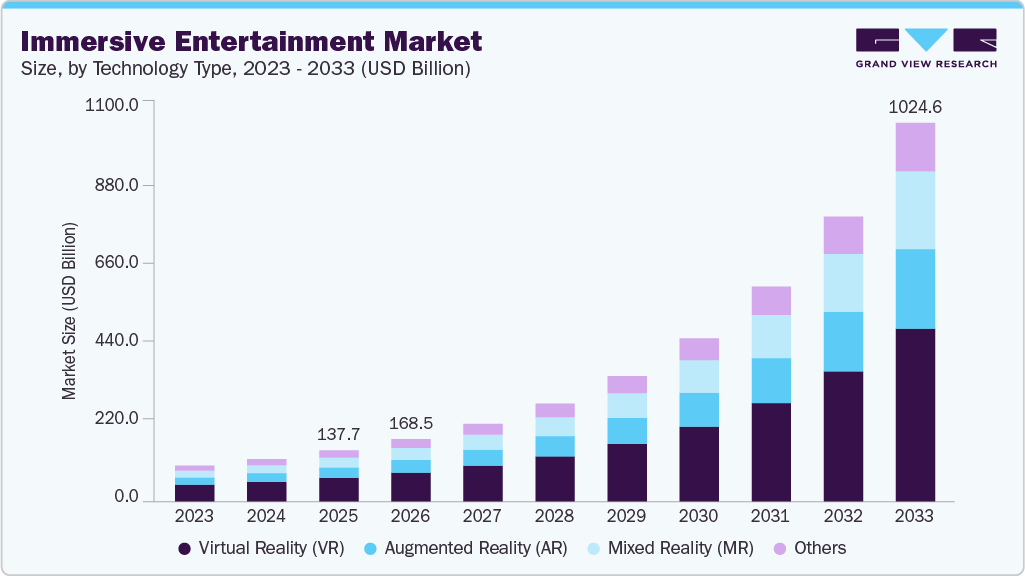
The global immersive entertainment market size was valued at USD 137.7 billion in 2025 and is projected to grow from USD 168.5 billion in 2026 to USD 1,024.6 billion by 2033, at a CAGR of 29.4% from 2026 to 2033. The market in North America dominated with a revenue share of 44.0% in 2025. The growth is driven by the increasing consumer demand for engaging experiences and rapid technological advancements in virtual reality (VR) and augmented reality (AR).
 Source: Grand View Research, IR Documents, Primary Interviews, Paid DatabasesTo learn more about this report,
 Download Free Sample Report
 Key Market Trends & Insights
- By technology type: Virtual reality (VR) segment held the largest market share of 46.0% in 2025.
- By application: Gaming segment held the largest market share in 2025.
Regional Highlights
- Largest regional market: North America (44.0% revenue share, 2025)
- Fastest-growing regional market: Asia Pacific (highest CAGR, 2026-2033)
- By country: The U.S. held the largest market share in 2025
Market Size & Forecast
- Market size in 2025: USD 137.7 Billion
- Estimated market size in 2026: USD 168.5 Billion
- Projected market size by 2033: USD 1,024.6 Billion
- CAGR (2026-2033): 29.4%
Three ways to get this report
Buy it, customize it, or ask a question.Ask an Analyst
Analyst response in 1 business day
- AccessReport author, directly
- Reply timeWithin 1 working day
- No sales callDirect answer only
- FormatEmail reply
- CostFree, no cost
Get the Full Report
What the study covers
- FormatsPDF · Excel · Dashboard
- Timeline2026–2033 annual, 2025 base
- Coverage20+ countries, 5 regions
- Companies10+ key players profiled
Customize the Report
20% free customization
- IncludeCountries, segments, points
- TailorTo your product definition
- ExtendDeeper competitor detail
- OrA fully bespoke study
- Turnaround5–10 working days
Consumers are moving from passive viewing to active participation and are willing to pay more for interactive, sensory-rich experiences. This shift is fueled by advancements in VR, AR, and mixed reality technologies that enable the co-creation of narratives in theme parks, concerts, esports arenas, and at-home setups. Theme parks are increasingly adopting immersive storytelling techniques, creating interactive environments that transport visitors into narrative-driven worlds. By combining VR, AR, and physical set design, theme parks are enhancing attractions to make them feel such as fully realized universes. Popular franchises such as Star Wars and Harry Potter have set the stage for immersive experiences that let visitors step into their favorite stories. The integration of interactive characters, real-time decision-making, and multisensory experiences takes traditional theme park rides to the next level. This trend underscores the increasing convergence of physical experiences and immersive entertainment, offering visitors a deeper level of engagement than ever before.Additionally, immersive technologies are revolutionizing fan engagement in sports, taking spectator experiences to the next level in the immersive entertainment industry. Virtual Reality enables fans to watch live games from various angles or even experience the excitement of being on the field. Esports are also tapping into immersive experiences, offering fans the chance to participate in or watch competitive gaming in new, interactive ways. Mixed Reality and AR are enhancing live sports broadcasts by providing real-time stats, player information, and interactive content during the game. The integration of immersive technologies into sports is paving the way for dynamic fan engagement, which is poised to play a significant role in the future of sports media.
 To learn more about this report, Download Free Sample Report
 Furthermore, the immersive entertainment industry is expanding into fitness, with VR and AR technologies transforming how people engage in physical activities. Virtual fitness experiences, such as VR workouts and fitness games, combine exercise with gamified elements to keep users motivated and engaged. AR is being incorporated into fitness apps to provide real-time feedback and virtual trainers to improve performance. Additionally, immersive fitness is fostering social connections by allowing users to participate in virtual classes with others from around the world.
Moreover, the growing strategic partnerships among tech giants, content creators, and venue operators are accelerating the adoption of immersive entertainment by pooling resources for scalable platforms and cross-industry content pipelines. Collaborations such as those between Disney and Apple or Meta with live event promoters integrate AR overlays into real-world spectacles, boosting ticket revenues through premium tiers. Such alliances standardize hardware-software interoperability, reducing fragmentation and enabling seamless experiences across devices.
Technology Type Insights
The virtual reality (VR) segment accounted for the largest market share of over 46.0% in 2025. Advancements in headset technology and graphics have made VR more accessible and engaging, offering users fully interactive and lifelike environments. VR experiences are not limited to gaming but are expanding into theme parks, concerts, and live events, offering an unprecedented level of immersion. Furthermore, VR has proven valuable in virtual tourism, enabling users to explore remote locations from the comfort of their own homes. As VR technology continues to improve, the line between the physical and virtual worlds is becoming increasingly indistinct.
The mixed reality segment is expected to register the fastest CAGR of over 30% from 2026 to 2033. Mixed Reality (MR) is blending the physical and digital worlds in innovative ways, pushing the boundaries of what’s possible in the Immersive Entertainment industry. MR enables users to interact with digital objects placed in real-world environments, creating a seamless fusion of the virtual and physical. The gaming sector has been at the forefront of MR innovations, providing experiences that make digital elements feel as though they exist in the player's immediate surroundings. Additionally, MR is being explored in live performances, art installations, and educational experiences, offering audiences interactive and multisensory engagements. As hardware and software continue to improve, the potential for MR to redefine how we experience both entertainment and daily activities is growing exponentially.
Application Insights
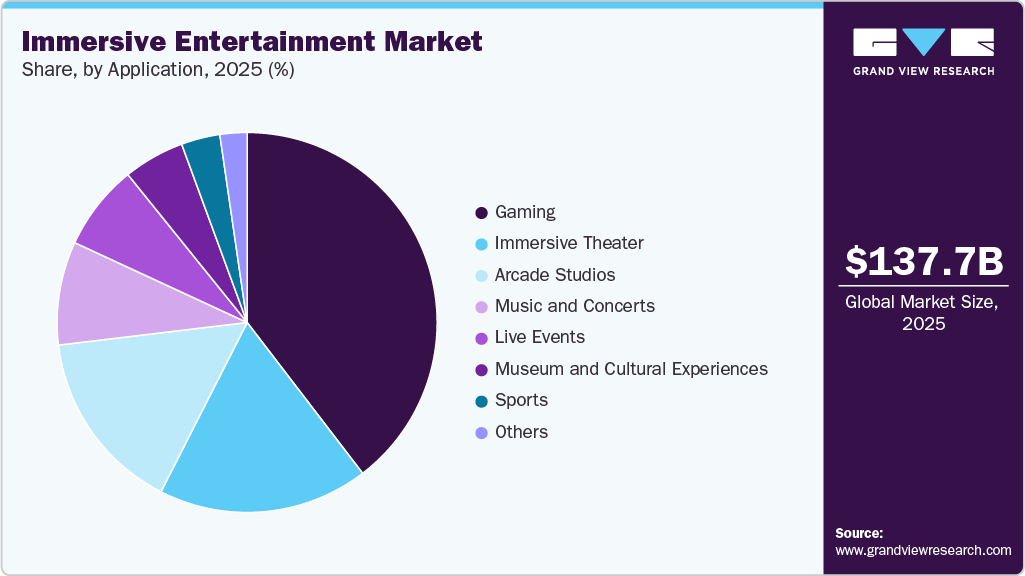
The gaming segment accounted for the largest market share in 2025. Virtual Reality (VR) and Augmented Reality (AR) are playing central roles in transforming player experiences. VR gaming has evolved significantly, offering more realistic and interactive environments through advanced headsets and motion-tracking technology. AR gaming continues to grow, enhancing real-world interactions with virtual elements, as seen in location-based games like Pokémon GO. These immersive technologies enable deeper levels of engagement, allowing players to either step into virtual worlds or blend them with reality. As technology advances, the gaming segment is expected to set new standards for interactivity and immersion, influencing not only entertainment but also other industries such as education and healthcare.
 To learn more about this report, Download Free Sample Report
 The music and concerts segment is expected to grow at the fastest CAGR from 2026 to 2033. The immersive entertainment industry is reshaping how music and live concerts are experienced, with Virtual Reality (VR) and Augmented Reality (AR) playing pivotal roles in creating more engaging performances. VR concerts enable fans to experience live shows from anywhere, allowing them to "attend" performances remotely while interacting with the environment and other fans. AR is enhancing in-person concerts by adding dynamic visuals and virtual elements to stage performances, elevating the overall sensory experience. Artists and event organizers are embracing these immersive technologies to replicate or even surpass traditional live events, offering fans a deeper, more interactive connection to the performance.
Regional Insights
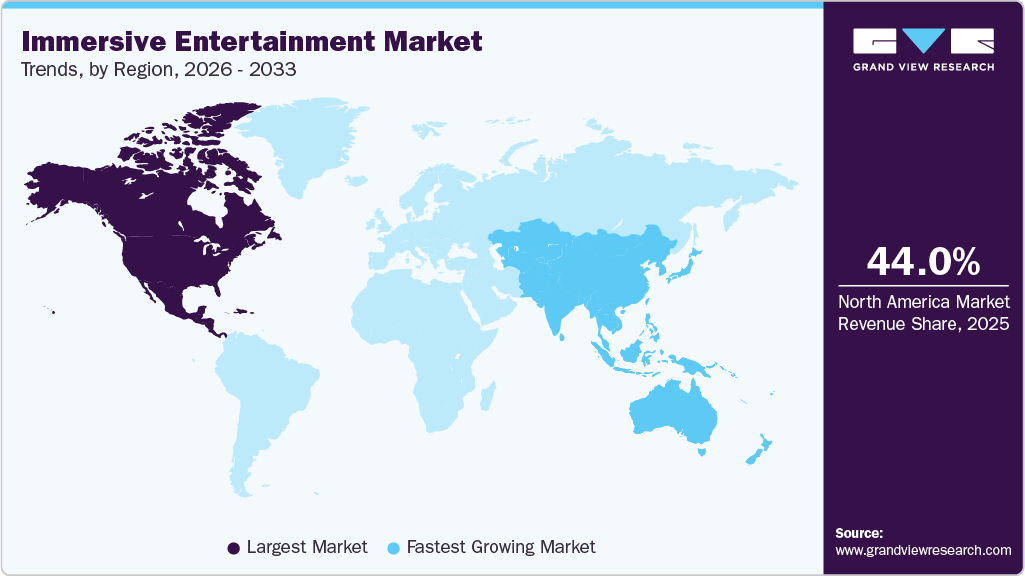
North America immersive entertainment market accounted for the largest revenue share of 44.0% in 2025, owing to a strong presence of leading technology companies that are at the forefront of developing immersive entertainment solutions, such as Microsoft Corporation, Apple Inc., Magic Leap Inc., and Meta Platforms, Inc., in the region. They are constantly collaborating to provide end-users with an enhanced and more engaging experience. For instance, in October 2025, Apple Inc. partnered with the NBA and Spectrum SportsNet to stream select Los Angeles Lakers games in Apple's proprietary Immersive Video format on Vision Pro headsets, offering courtside perspectives and spatial audio for premium fan engagement. This collaboration enhances real-time interactivity and positions the region as a hub for hybrid sports and entertainment experiences.
 To learn more about this report, Download Free Sample Report
 U.S. Immersive Entertainment Market Trends
The immersive entertainment market in the U.S. held a dominant position in 2025. The rising demand for personalized and immersive experiences in the U.S. is reshaping how consumers engage with entertainment across various sectors. The market is further driven by the adoption of cutting-edge VR, AR, and MR technologies in gaming, cinema, and tourism, supported by a vibrant creative industry and high disposable incomes.
Europe Immersive Entertainment Market Trends
The immersive entertainment market in Europe is expected to grow at a CAGR of over 30% from 2026 to 2033. The growing demand for personalized and interactive experiences in Europe is fueling the adoption of immersive technologies across multiple industries. High adoption in the UK and Germany stems from immersive theater, such as Punchdrunk productions, and AR-enhanced concerts, which appeal to tech-savvy urban consumers. Regulatory focus on privacy and sustainability, combined with the rollout of 5G, is accelerating hybrid live-virtual events across the region.
The UK immersive entertainment market is expanding rapidly. In the UK, immersive entertainment is expanding through location-based experiences in London venues, blending theater with VR to create narratives such as "The Blade Runner Experience." Government support for creative tech and post-Brexit export incentives drive content creation, with esports arenas and pop-up AR exhibits attracting youth demographics. Rising tourism and partnerships with firms like HTC Vive boost market penetration.
The immersive entertainment market in Germany is driven by the country’s strong focus on technological advancement and content creation is pushing the boundaries of interactive entertainment. Germany’s creative industry is embracing immersive solutions to enhance live performances, art installations, and educational tools.
Asia Pacific Immersive Entertainment Market Trends
The immersive entertainment market in Asia Pacific is estimated to record the highest CAGR of 31% from 2026 to 2033. The growing demand for realistic and immersive experiences is propelling the Asia Pacific region to the forefront of virtual and augmented reality innovation. The market growth is further fueled by dense urban populations and esports popularity in theme parks and malls. Rapid 5G deployment and affordable devices democratize access, driving hybrid events in retail spaces. Regional hubs like Singapore invest heavily in metaverse tourism.
China immersive entertainment market is experiencing rapid expansion, driven by massive government investments in VR/AR infrastructure, explosive growth in domestic gaming and metaverse platforms, surging consumer adoption of affordable XR hardware, booming theme park integrations like those from Tencent and ByteDance, and regulatory support for cultural-tech exports.
The immersive entertainment market in Japan is driven by the development of highly interactive and visually dynamic content. Japanese companies are advancing in VR and AR to offer users deeper engagement and more realistic simulations. The integration of these technologies is also expanding into other sectors, such as education and healthcare, thereby increasing the reach of immersive entertainment.
Key Immersive Entertainment Companies Insights
Key players operating in the immersive entertainment market are undertaking various initiatives to strengthen their presence and increase the reach of their products and services. Strategies such as expansion activities and partnerships are key in propelling the market growth. Some of the key players in the immersive entertainment market include Meta Platforms, Inc., Barco NV, and HTC Corporation.
-
Meta Platforms Inc. has made significant investments in virtual reality (VR) and augmented reality (AR) technologies, aiming to enhance user experiences and innovate within the immersive entertainment sector. Its flagship products include the Oculus Rift, a premium VR headset designed for gaming and entertainment, and the Oculus Quest series, which offers standalone, untethered VR experiences.
-
Barco NV specializes in visualization and collaboration technologies, providing innovative projectors that have transformed traditional cultural experiences into modern, immersive visual spectacles across various sectors. Their technology has been pivotal in enhancing the audience's engagement with cultural content, allowing for more dynamic and interactive presentations. This advancement underscores Barco's commitment to revolutionizing how audiences experience visual storytelling in diverse environments.
Magic Leap, Inc. and HTC Corporation are among the emerging market participants in the industry.
-
Magic Leap, Inc. develops augmented reality (AR) headsets and platforms such as Magic Leap 2, specializing in lightweight waveguides and display systems that overlay 3D digital content onto the real world for enterprise applications such as training, remote collaboration, and 3D visualization. With over a decade of innovation in AR optics, the company emphasizes high-yield manufacturing of precision components to enable scalable, immersive experiences with improved text legibility, color fidelity, and field of view.
-
HTC Corporation, through its VIVE brand, leads in virtual reality (VR) hardware and software, including standalone headsets, trackers, and AI-enhanced platforms for immersive entertainment. The company drives location-based entertainment via partnerships such as NTT Com for large-scale XR exhibitions and focuses on open, connected ecosystems with features like spatial computing and multi-user VR events. HTC continues to innovate in AI-driven content and modular experiences, positioning itself as a key player in the shift toward interactive, venue-scale immersive applications.
Key Immersive Entertainments Companies:
The following key companies have been profiled for this study on the immersive entertainment market.
- Meta Platforms, Inc.
- Microsoft Corporation
- HTC Corporation
- Barco NV
- Magic Leap, Inc.
- Samsung Electronics Co., Ltd.
- Apple Inc.
- Sony Group Corporation
- Qualcomm Technologies, Inc.
- Unity Technologies
Recent Developments
-
In October 2025, Unity Technologies announced general availability of Android XR support in Unity 6, powering launch titles for Samsung's Galaxy XR headset and accelerating the open Android XR ecosystem for immersive entertainment applications.
-
In September 2025, Meta Platforms unveiled Horizon Studio at Meta Connect, an AI creation tool for Quest headsets that generates real-time multi-user VR worlds and events, targeting venue-scale Horizon Worlds exhibitions with neural wristband integration.
-
In June 2025, HTC Corporation partnered with NTT Com to launch large-scale XR exhibitions using VIVE Focus Vision headsets, emphasizing AI-driven personalization for multi-user location-based entertainment.
Immersive Entertainment Market Report Scope
Report Attribute
Details
Market size in 2025
USD 137.7 billion
Estimated Market size in 2026
USD 168.5 billion
Projected Market size by 2033
USD 1,024.6 billion
Growth rate
CAGR of 29.4% from 2026 to 2033
Base year for estimation
2025
Historical data
2021 - 2024
Forecast period
2026 - 2033
Quantitative units
Revenue in USD million/billion and CAGR from 2026 to 2033
Report coverage
Revenue forecast, company ranking, competitive landscape, growth factors, and trends
Segments covered
Technology type, application, region
Regional scope
North America; Europe; Asia Pacific; Latin America; Middle East & Africa
Country scope
U.S.; Canada; Mexico; Germany; UK; France; Italy; Spain; China; India; Japan; South Korea; Brazil; South Africa; UAE
Key companies profiled
Meta Platforms, Inc.; Microsoft Corporation; HTC Corporation; Barco NV; Magic Leap, Inc.; Samsung Electronics Co., Ltd.; Apple Inc.; Sony Group Corporation; Qualcomm Technologies, Inc.; Unity Technologies
Customization scope
Free report customization (equivalent to up to 8 analyst working days) with purchase. Addition or alteration to country, regional & segment scope.
Pricing and purchase options
Avail customized purchase options to meet your exact research needs. Explore purchase options
Global Immersive Entertainment Market Report Segmentation
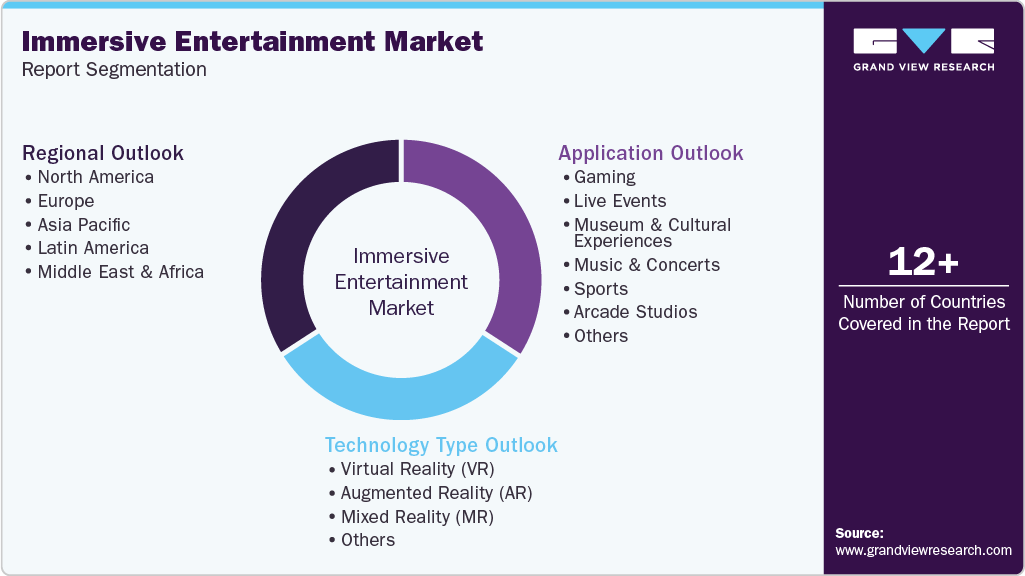
This report forecasts revenue growth at global, regional, and country levels and provides an analysis of the latest industry trends in each of the sub-segments from 2021 to 2033. For this study, Grand View Research has segmented the global immersive entertainment market report on the basis of technology type, application, and region:
 To learn more about this report, Download Free Sample Report
 -
Technology Type Outlook (Revenue, USD Million, 2021-2033)
-
Virtual Reality (VR)
-
Augmented Reality (AR)
-
Mixed Reality (MR)
-
Others
-
-
Application Outlook (Revenue, USD Million, 2021-2033)
-
Gaming
-
Live Events
-
Museum and Cultural Experiences
-
Music and Concerts
-
Sports
-
Arcade Studios
-
Immersive Theater
-
Others
-
-
Regional Outlook (Revenue, USD Million, 2021-2033)
-
North America
-
U.S.
-
Canada
-
Mexico
-
-
Europe
-
UK
-
Germany
-
France
-
Italy
-
Spain
-
-
Asia Pacific
-
China
-
Japan
-
India
-
South Korea
-
-
Latin America
-
Brazil
-
-
Middle East & Africa (MEA)
-
UAE
-
South Africa
-
-
Frequently Asked Questions About This Report
Some key players operating in the immersive entertainment market include Meta Platforms, Inc., Microsoft Corporation, HTC Corporation, Barco NV, Magic Leap, Inc., Samsung Electronics Co., Ltd., Apple Inc., Sony Group Corporation, Qualcomm Technologies, Inc., and Unity Technologies.
The widespread application of immersive technologies across various entertainment sectors, such as gaming, movies, music, sports, and live events, is the primary factor driving the growth of the immersive entertainment market.
The virtual reality (VR) led with a 46.0% revenue share in 2025.
Gaming held the largest revenue share in 2025.
North America dominated with a 44.0% revenue share in 2025.
The global immersive entertainment market was estimated at USD 137.7 billion in 2025 and is expected to reach USD 168.5 billion in 2026.
The global immersive entertainment market is expected to grow at a compound annual growth rate of 29.4% from 2026 to 2033 to reach USD 1,024.6 billion by 2033.
Asia Pacific is the fastest-growing region over the forecast period.
About the Author(s)
Next Generation Technologies Research Team
Technology · Next Generation TechnologiesThis report was authored by the next generation technologies research team at Grand View Research - comprising two research analysts, one senior research analyst, and one industry expert - with specialized expertise in the next generation technologies segment of the technology industry. All findings are based on proprietary technology databases, executive interviews, and regulatory analysis, subject to internal peer review prior to publication.
Last Updated:
Speak to Analyst

Customize this report to your needs - add regions, segments, or data points, with 20% free customization.
Or view our licence options:


ISO 9001:2015 & 27001:2022 Certified
We are GDPR and CCPA compliant! Your transaction & personal information is safe and secure. For more details, please read our privacy policy.


