
- Home
- »
- Animal Health
- »
-
India Livestock Animal Health Market, Industry Report, 2033GVR Report cover
![India Livestock Animal Health Market Size, Share & Trends Report]()
India Livestock Animal Health Market (2025 - 2033) Size, Share & Trends Analysis Report By Animal Type (Poultry, Swine, Cattle, Sheep & Goats, Fish), By Product (Biologics, Pharmaceuticals, Diagnostics, Equipment & Disposables), And Segment Forecasts
- Report ID: GVR-4-68040-711-6
- Number of Report Pages: 150
- Format: PDF
- Historical Range: 2021 - 2023
- Forecast Period: 2025 - 2033
- Industry: Healthcare
- Report Summary
- Table of Contents
- Segmentation
- Methodology
- Download FREE Sample
-
 Download Sample Report
India Livestock Animal Health Market Summary
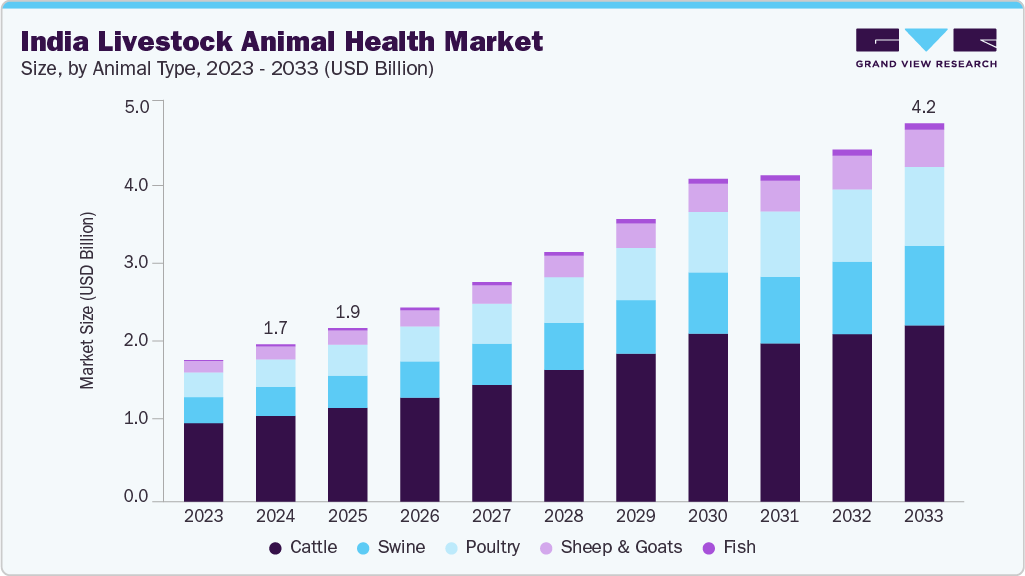
The India livestock animal health market size was estimated at USD 1.73 billion in 2024 and is projected to reach USD 4.17 billion by 2033, growing at a CAGR of 10.23% from 2025 to 2033. The India livestock animal health market is continuously growing, driven by the region’s large and dense livestock population, increasing protein consumption, and the rising disease burden among production animals, prompting higher demand for vaccines, pharmaceuticals, and diagnostics to safeguard herd health and productivity.
Key Market Trends & Insights
- By animal type, the cattle segment held the highest market share of 54.53% in 2024.
- Based on product, the pharmaceuticals segment held the highest market share of 38.97% in 2024.
Market Size & Forecast
- 2024 Market Size: USD 1.73 Billion
- 2033 Projected Market Size: USD 4.17 Billion
- CAGR (2025-2033): 10.23%
In addition, growing government initiatives are driving market growth. For instance, in March 2025, the Union Cabinet approved a revised Livestock Health and Disease Control Programme (LHDCP) with a budget of INR 3,880 crore (USD 453 Mn) for 2024-25 and 2025-26. The revamped scheme consists of three core components: The National Animal Disease Control Programme (NADCP), Livestock Health & Disease Control (LH&DC), and the newly launched Pashu Aushadhi initiative. Key focus elements include mass vaccinations, deployment of mobile veterinary units, and distribution of affordable generic veterinary medicines through PM-Kisan Samriddhi Kendras (Centers) and cooperatives.The India livestock animal health market is being propelled by a combination of rising disease prevention needs, technological innovations, and supportive government policies. A key growth driver is the increasing product innovation and launches, particularly in the poultry vaccine segment, aimed at tackling persistent and economically damaging diseases. For instance, in November 2024, Boehringer Ingelheim launched a next-generation vaccine targeting Marek’s disease in poultry, utilizing a novel serotype-1 construct and controlled attenuation technology to provide early, long-lasting immunity to vulnerable young birds. Similarly, in June 2025, the company introduced a single-dose, three-in-one poultry vaccine that protects against Bursal, Newcastle, and Marek’s diseases, streamlining hatchery vaccination programs, reducing labor costs, and minimizing handling stress, thus enhancing bird health and farm productivity.
Government-backed disease control programs and livestock infrastructure investments are further accelerating market growth. Initiatives such as the National Animal Disease Control Program (NADCP), with an outlay of INR 13,340 crore (USD 1.8 billion), aim to eradicate Foot and Mouth Disease (FMD) and Brucellosis by 2030, significantly boosting demand for vaccines, diagnostics, and veterinary services. Additionally, the Bharat Pashudhan Data Stack, launched in March 2024, has registered over 15.5 crore animals and enables real-time tracking of vaccinations, artificial inseminations, and disease outbreaks, improving traceability and health monitoring.
Private sector expansion and strategic collaborations also shape the market's growth trajectory. For example, in February 2025, Biovet, part of Bharat Biotech Group, received CDSCO approval for BIOLUMPIVAXIN, the first global DIVA marker vaccine for Lumpy Skin Disease in dairy cattle and buffaloes, with a production capacity of 500 million doses annually. Such innovations, coupled with increasing partnerships between global animal health leaders and Indian firms, enable advanced solutions to reach rural and peri-urban livestock farmers, strengthening India’s livestock productivity and health outcomes.
Market Concentration & Characteristics
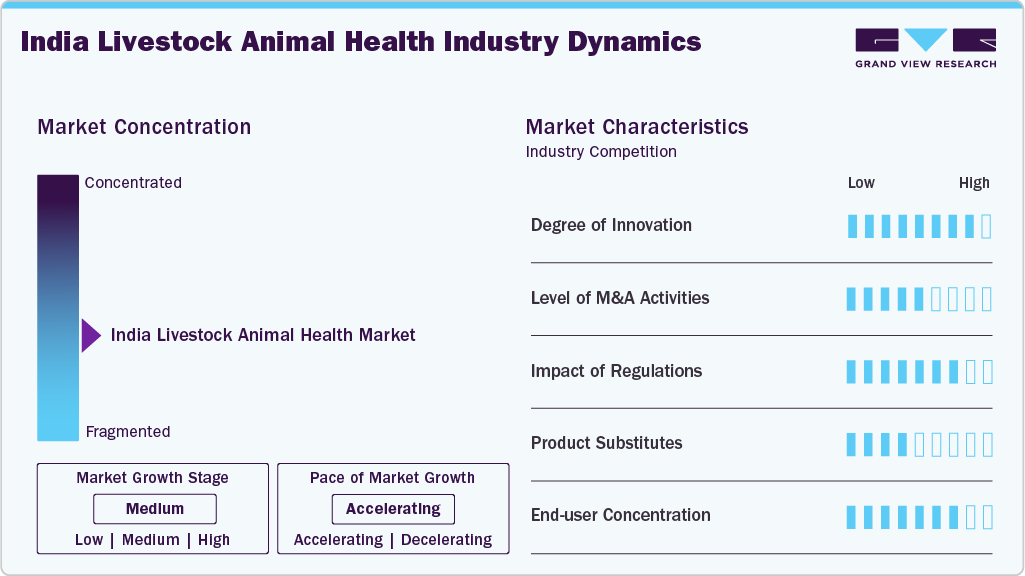
The India livestock animal health market is moderately concentrated, with a mix of global animal health giants and strong domestic players competing across pharmaceuticals, vaccines, feed additives, and diagnostics. Leading multinational companies such as Zoetis Inc., Boehringer Ingelheim GmbH, Merck & Co. Inc., Elanco Animal Health, and Virbac maintain a significant presence through extensive product portfolios, R&D capabilities, and distribution networks. These players leverage strategic alliances, acquisitions, and localized manufacturing to expand market reach. For example, Zoetis expanded its Global Capability Center in Hyderabad in September 2024 to strengthen regional operations.
Alongside MNCs, prominent Indian companies such as Indian Immunologicals Ltd., Hester Biosciences, Biovet, Panav Biotech, and Quadragen Vethealth play a critical role, particularly in affordable vaccine production and region-specific disease solutions. The market also sees government-linked enterprises such as the National Dairy Development Board (NDDB) supplying vaccines domestically and internationally, as in January 2025, when it shipped over 339,000 vaccine units to Kenya. While top-tier players dominate high-value segments such as advanced vaccines and diagnostics, a fragmented layer of small and medium enterprises serves localized needs, resulting in competitive pricing and diverse product availability. This blend of concentrated innovation leadership and fragmented grassroots supply defines the market’s competitive structure.
India's livestock animal health market is witnessing an impressive wave of innovation, marked by technological, biotech, and digital breakthroughs. For instance, in 2024, over 500 diagnostic labs nationwide began adopting PCR-based molecular assays, slashing testing times from days to hours and enabling early detection of diseases like bluetongue and avian influenza. Meanwhile, roughly 1,200 mobile veterinary units have been equipped with point-of-care devices, such as portable Truenat platforms-serving more than 1.5 million farmers across rural India. Telemedicine platforms such as VetMitr facilitate over 100,000 remote veterinary consultations. At the same time, AI tools such as VetAI diagnose widespread conditions such as mastitis with around 85% accuracy, underscoring the reach and reliability of digital health tools.
Beyond diagnostics, innovation is transforming animal care through smart farming, IoT, and apps. Companies such as Stellapps are leading the way with precision dairy technologies-wearable collars, ear tags, and rumination sensors-that monitor health and reproductive metrics in real-time to preempt issues and improve yield. Apps such as MooFarm, Krishify, and Pashu Mitra deliver AI-driven advice on health, nutrition, and herd management in local languages, helping farmers boost productivity by 10-15%. Meanwhile, blockchain piloting by dairy cooperatives such as Amul and Milk Mantra ensures end-to-end traceability-enhancing food safety, reducing adulteration, and building consumer trust.
The level of mergers and acquisitions (M&A) in India’s livestock animal health market has been steadily increasing, driven by the sector’s high growth potential and the strategic push for consolidation and diversification. For instance, in April 2025, Allana Group acquired a 30% stake in Kasturi Poultry Farms in South India, just months after joining the India Poultry Alliance in November 2024. The acquisition strengthens Allana’s poultry production capacity and aligns with its ambition to become the country’s largest poultry producer. Similarly, in January 2025, JK Paper Ltd entered the specialty animal health, nutrition, and feed additives space by acquiring Quadragen Vethealth Pvt. Ltd. (QVPL) for ₹460 crore in an all-cash deal. The transaction involved an immediate 65% stake purchase, with the remaining to be acquired over four years, giving JK Paper access to QVPL’s high-margin operations (EBITDA >30%) and strong growth trajectory (20% CAGR). Such deals highlight a growing trend of industry incumbents and cross-sector entrants pursuing acquisitions to secure market share, diversify portfolios, and integrate vertically across the livestock value chain.
Regulatory developments in 2024 have significantly shaped the trajectory of India’s livestock animal health market by enhancing infrastructure, standardizing breeding practices, and streamlining pharmaceutical approvals. For instance, in February 2024, the government, in collaboration with private entities, rolled out the Animal Husbandry Infrastructure Development Fund (AHIDF)-a ₹15,000 crore (USD 1,718.07 million) initiative aimed at boosting private investment in dairy plants, meat processing units, and animal feed plants. By targeting Farmer Producer Organizations (FPOs), MSMEs, and individual entrepreneurs, the program is expected to strengthen supply chains, expand veterinary service coverage, and improve overall productivity in the livestock sector.
Similarly, in January 2024, Maharashtra enacted the Maharashtra Bovine Breeding (Regulation) Act, 2023, introducing mandatory registration for all entities engaged in bovine semen production, embryo transfer, in-vitro fertilization, and artificial insemination training. This move is set to improve genetic quality, regulate artificial insemination practices, and enhance traceability in breeding operations. Furthermore, in September 2024, the Central Drugs Standard Control Organization (CDSCO) mandated that all new veterinary drug approval applications-covering vaccines, bulk drugs (API), and finished formulations-be submitted exclusively via its SUGAM Portal, phasing out offline submissions. This digitization will likely expedite approval timelines, increase transparency, and ensure stricter regulatory compliance, fostering a more competitive and quality-driven livestock animal health market in India.
The India livestock animal health market faces moderate substitution threats, primarily from alternative disease prevention, nutrition, and productivity-enhancement methods that can reduce reliance on conventional veterinary pharmaceuticals. For example, rising adoption of probiotics, prebiotics, and herbal feed supplements is gradually substituting antibiotic growth promoters (AGPs) in poultry and dairy production, driven by government restrictions on non-therapeutic antibiotic use and growing consumer demand for residue-free animal products. Companies such as Ayurvet and Natural Remedies are expanding portfolios of herbal immunomodulators and antiparasitic solutions that compete directly with synthetic drugs, offering perceived safety, export compliance, and sustainability benefits.
Similarly, vaccination-based prevention increasingly replaces long-term therapeutic drug use in controlling major diseases. The development of targeted vaccines, such as Biovet’s Biolumpivaxin-a DIVA marker vaccine for Lumpy Skin Disease-reduces the need for repeated antibiotic or antiviral treatments. In nutrition, precision livestock farming technologies such as Stellapps’ wearables and IoT-based health monitoring systems enable early disease detection, lowering demand for curative medications. While these substitutes do not eliminate the need for veterinary pharmaceuticals, their growing adoption reshapes market demand patterns. It pushes incumbents to diversify into biologics, nutraceuticals, and tech-driven preventive solutions.
End user concentration in India’s livestock animal health market is relatively high, with demand dominated by large-scale commercial farms, integrated poultry and dairy producers, and government-led health programs. A significant share of purchases is driven by organized players who procure vaccines, pharmaceuticals, and feed additives in bulk to ensure consistent herd or flock health. For example, large poultry integrators such as Suguna Foods, Venky’s, and Godrej Tyson Foods maintain direct supply agreements with animal health companies for continuous delivery of vaccines and biosecurity products, creating a concentrated customer base for suppliers.
In the dairy segment, cooperatives such as Amul and Nandini play a central role in aggregating demand from thousands of farmers, sourcing veterinary inputs and services under centralized procurement programs. Government initiatives, such as the National Animal Disease Control Programme (NADCP), also represent a major end-user block, purchasing vaccines in large volumes for nationwide campaigns against diseases such as Foot-and-Mouth Disease and Brucellosis. This concentration gives a few large buyers significant influence over pricing, quality standards, and supplier selection, pushing animal health companies to adapt offerings and negotiate long-term contracts with these key institutional customers.
Animal Type Insights
Cattle represent the largest segment in the India livestock animal health market, accounting for 54.53% of market share in 2024, mainly due to the country's vast cattle population and the sector's central role in the rural economy. India possesses one of the world's largest cattle herds-around 307 million head-comprising both bovine cattle and Asian domestic water buffalo, which account for 13% of the world's bovine population and 57% of the global buffalo population. Livestock contributes roughly 5.5% to India's GDP, with cattle serving as a critical source of dairy, meat, and livelihood for millions of households. The USDA projects India's beef production, predominantly carabeef (buffalo meat), to reach 4.64 million metric tons in 2025, up slightly from 4.57 MMT in 2024, reflecting steady demand.
Government initiatives have further reinforced cattle’s dominance in the livestock health market. The Rashtriya Gokul Mission (RGM) supports breed multiplication farms to enhance productivity, while the National Animal Disease Control Programme (NADCP), backed by an INR 13,340 crore (USD 1.8 billion) outlay, targets the eradication of Foot-and-Mouth Disease (FMD) by 2030 and the control of Brucellosis. These programs drive large-scale demand for veterinary vaccines, genetic improvement services, and health management technologies. Combined with ongoing investments in disease control, breeding, and infrastructure, these measures strengthen cattle health, boost productivity, and stabilize rural incomes, cementing cattle’s position as the most significant segment in India’s livestock animal health market.
Product Insights
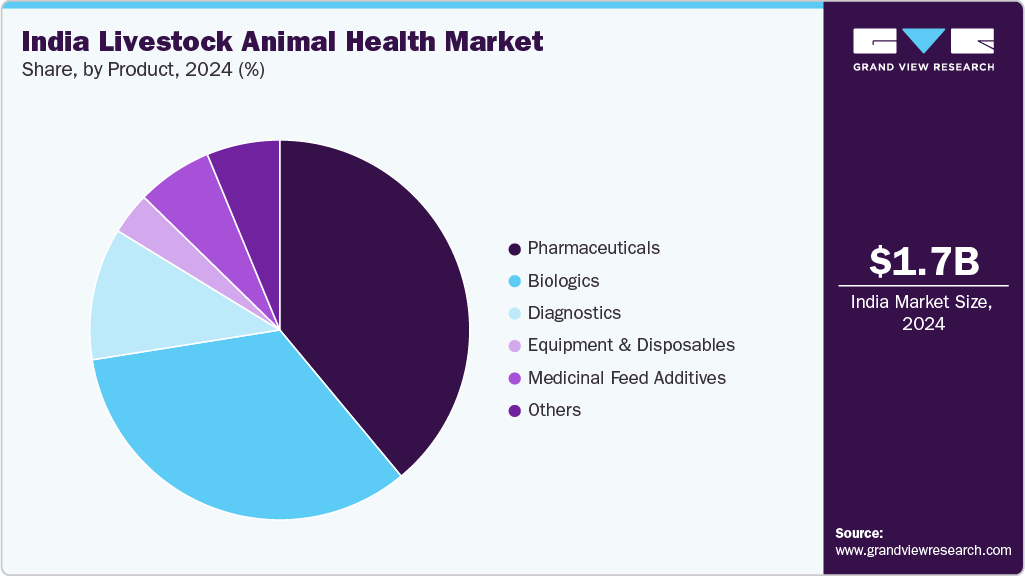
The pharmaceuticals segment held a dominant 38.97% revenue share in the India livestock animal health market in 2024, driven by the high prevalence of infectious and metabolic diseases, the need for preventive healthcare, and the sector's increasing commercialization. India's large livestock population-over 307 million cattle, significant poultry, and small ruminant numbers-creates sustained demand for antibiotics, antiparasitics, anti-inflammatories, and metabolic disorder treatments to maintain productivity and reduce mortality. Common conditions such as mastitis, foot-and-mouth disease, Brucellosis, theileriosis, and parasitic infestations require regular pharmaceutical interventions, particularly in intensive dairy and poultry systems where disease spread can be rapid.
Growth in this segment is also supported by government-led mass vaccination and treatment programs, as well as rising private sector investment in product development and distribution networks. For example, the National Animal Disease Control Programme (NADCP) purchases large volumes of vaccines and therapeutics for nationwide campaigns. In addition, expanding export-oriented meat and dairy production has heightened the need for quality-assured pharmaceuticals to meet domestic and international safety standards. Together, these factors have made pharmaceuticals the largest revenue-generating segment, reflecting their indispensable role in sustaining animal health, enhancing productivity, and supporting the profitability of India's livestock sector.
Diagnostics have emerged as the fastest-growing segment in the India livestock animal health market due to rising disease surveillance needs, increasing awareness of early disease detection, and the adoption of advanced testing technologies. The sector's expansion is fueled by the government's push for faster and more accurate disease monitoring under programs such as the National Animal Disease Control Programme (NADCP), which requires large-scale Foot-and-Mouth Disease and Brucellosis testing. The spread of transboundary and production-limiting diseases such as Lumpy Skin Disease (LSD), avian influenza, and bluetongue has further driven demand for rapid, field-deployable diagnostic solutions.
Private sector innovations are accelerating this trend. For example, portable PCR-based devices such as Truenat and multiplex ELISA kits enable on-site testing, reducing diagnosis time from days to hours. Over 1,200 mobile veterinary units in India are now equipped with point-of-care diagnostic tools, serving more than 1.5 million farmers, while platforms such as VetMitr integrate telemedicine with remote diagnostics to expand rural access. In addition, the commercial launch of Biovet’s Biolumpivaxin-a DIVA marker vaccine for LSD-relies heavily on diagnostic differentiation between infected and vaccinated animals, underscoring the complementary growth of the diagnostics segment. This shift toward rapid, precise, and accessible testing solutions makes diagnostics the fastest-growing area in India's livestock animal health market.
India Livestock Animal Health Market Trends
The India livestock animal health market is shaped by several key trends, including technological innovation in disease management, policy-driven modernization, and expanding private sector participation. A strong focus on preventive healthcare and rapid diagnostics is transforming veterinary practices, with innovations such as Biovet’s BIOLUMPIVAXIN-the world’s first DIVA marker vaccine for Lumpy Skin Disease (February 2025) and ICAR & IVRI's Bluetongue and Japanese Encephalitis ELISA kits enhancing early detection and targeted disease control. Mobile veterinary and aquaculture labs, such as the MPEDA-RGCA unit in Andhra Pradesh (February 2025), are extending on-site diagnostic capabilities, cutting testing times, and improving farmer access to timely interventions.
Digitalization and data-driven livestock management are also emerging as defining trends. The launch of the Bharat Pashudhan Data Stack in March 2024 has enabled real-time tracking of over 15.5 crore animal records via unique IDs (“Pashu Aadhaar”), integrating vaccination, breeding, disease reporting, and e-prescription data into a single platform. At the same time, regulatory tightening-such as the ban on Nimesulide and Diclofenac for veterinary use in January 2025 reflects growing emphasis on environmental safety and drug stewardship. On the corporate side, strategic expansions and product launches are intensifying competition, exemplified by Boehringer Ingelheim’s Marek’s disease poultry vaccine (November 2024) and Zoetis’ expansion of its Hyderabad global capability center (September 2024). Together, these trends indicate a shift toward an innovation-led, compliance-focused, and efficiency-driven market, positioning India’s livestock animal health sector for sustained growth.
Key India Livestock Animal Company Insights
India's animal healthcare industry is characterized by a mix of strong global multinationals such as Zoetis, Merck Animal Health, Boehringer Ingelheim, Elanco, and Vetoquinol, alongside capable domestic players such as Hester Biosciences and Indian Immunologicals, who specialize in livestock vaccines and biologics. Zoetis leads with a consolidated portfolio spanning both livestock and companion animals, while Indian Immunologicals focuses on diseases critical to Indian agriculture, such as Foot-and-Mouth Disease. Simultaneously, the sector is experiencing rapid modernization via telemedicine platforms (e.g., VetMitr), AI diagnostics (e.g., VetAI), mobile point-of-care devices, and multiplex testing for faster disease detection, especially in rural areas where 70% of livestock reside.
Key India Livestock Animal Companies:
- Boehringer Ingelheim International GmbH
- Zoetis
- IDEXX Laboratories, Inc.
- Merck & Co., Inc.
- Elanco
- Hester Biosciences Limited
- Ceva Santé Animale
- Phibro Animal Health Corporation
- Virbac
- Dechra Pharmaceuticals Plc
Recent Developments
-
In June 2025, Boehringer Ingelheim announced the launch of a next-generation, single-dose poultry vaccine in India that protects against Bursal disease, Newcastle disease, and Marek’s disease.
-
In February 2025, Biovet, a part of Bharat Biotech Group, announced that they had received regulatory approval from India’s Central Drug Standard Control Organization (CDSCO) for BIOLUMPIVAXIN, a vaccine for combating lump skin disease in dairy cattle & buffaloes.
-
In February 2025, Scientists from MPEDA's Rajiv Gandhi Centre for Aquaculture (RGCA) launched a mobile lab in Andhra Pradesh to diagnose aquaculture diseases directly at farm sites. The lab conducts on-spot tests for water quality, pathogens, and PCR analysis, providing immediate advice to farmers, reducing the need to transport samples to distant laboratories.
-
In November 2024, Boehringer Ingelheim launched a novel poultry vaccine in India to combat Marek’s disease.
-
In September 2024, Zoetis expanded its global capability center in Hyderabad, India, to strengthen its regional presence.
India Livestock Animal Health Market Report Scope
Report Attribute
Details
Market size in 2025
USD 1.91 billion
Revenue forecast in 2033
USD 4.17 billion
Growth rate
CAGR of 10.23% from 2025 to 2033
Actual data
2024
Historical Period
2021 - 2023
Forecast period
2025 - 2033
Quantitative units
Revenue in USD million/billion, and CAGR from 2025 to 2033
Report coverage
Revenue forecast, company ranking, competitive landscape, growth factors, and trends
Segments covered
Animal type, product
Key companies profiled
Boehringer Ingelheim International GmbH; Zoetis; IDEXX Laboratories, Inc.; Merck & Co., Inc.; Elanco; Hester Biosciences Limited; Ceva Santé Animale; Phibro Animal Health Corporation; Virbac; Dechra Pharmaceuticals Plc
Customization scope
Free report customization (equivalent up to 8 analysts working days) with purchase. Addition or alteration to country, regional & segment scope.
Pricing and purchase options
Avail customized purchase options to meet your exact research needs. Explore purchase options
India Livestock Animal Market Report Segmentation
This report forecasts revenue growth provides an analysis of the latest industry trends in each of the sub-segments from 2021 to 2033. For this study, Grand View Research has segmented the India livestock animal health market report based on animal type, and product:
-
Product Outlook (Revenue, USD Million, 2021 - 2033)
-
Biologics
-
Vaccines
-
Modified/ Attenuated Live
-
Inactivated (Killed)
-
Other Vaccines
-
-
Other Biologics
-
-
Pharmaceuticals
-
Parasiticides
-
Anti-infectives
-
Anti-inflammatory
-
Analgesics
-
Others
-
-
Diagnostics
-
Consumables, reagents, and kits
-
Instruments and devices
-
-
Equipment & Disposables
-
Critical Care Consumables
-
Anesthesia Equipment
-
Fluid Management Equipment
-
Temperature Management Equipment
-
Rescue & Resuscitation Equipment
-
Research Equipment
-
Patient Monitoring Equipment
-
-
Medicinal Feed Additives
-
Others
-
Veterinary Telehealth
-
Veterinary Software
-
Livestock Monitoring
-
-
-
Animal Type Outlook (Revenue, USD Million, 2021 - 2033)
-
Poultry
-
Biologics
-
Vaccines
-
Modified/ Attenuated Live
-
Inactivated (Killed)
-
-
Other Vaccines
-
Other Biologics
-
-
Pharmaceuticals
-
Parasiticides
-
Anti-infectives
-
Antimicrobials
-
Anti-infectives except Antimicrobial
-
Anti-inflammatory
-
-
Analgesics
-
Others
-
-
Diagnostics
-
Consumables, reagents, and kits
-
Instruments and devices
-
-
Equipment & Disposables
-
Critical Care Consumables
-
Anesthesia Equipment
-
Fluid Management Equipment
-
Temperature Management Equipment
-
Rescue & Resuscitation Equipment
-
Research Equipment
-
Patient Monitoring Equipment
-
-
Medicinal Feed Additives
-
Anticoccidials
-
Pre/Probiotics & Phytotherapeutics
-
Performance enhancers (AGP)
-
Other
-
-
Others
-
Veterinary Telehealth
-
Veterinary Software
-
Livestock Monitoring
-
-
-
Swine
-
Biologics
-
Vaccines
-
Modified/ Attenuated Live
-
Inactivated (Killed)
-
Immunocastration
-
-
Other Vaccines
-
Other Biologics
-
-
Pharmaceuticals
-
Parasiticides
-
Endectocides
-
Other Parasiticides
-
-
Anti-infectives
-
Antimicrobials
-
Anti-infectives except Antimicrobial
-
-
Anti-inflammatory
-
Analgesics
-
Hormone Products
-
Others
-
-
Diagnostics
-
Consumables, reagents, and kits
-
Instruments and devices
-
-
Equipment & Disposables
-
Critical Care Consumables
-
Anesthesia Equipment
-
Fluid Management Equipment
-
Temperature Management Equipment
-
Rescue & Resuscitation Equipment
-
Research Equipment
-
Patient Monitoring Equipment
-
-
Medicinal Feed Additives
-
Anticoccidials
-
Performance enhancers (Probiotics + Phytogenics + Others Additives (β-adrenergic agonist)
-
Other
-
-
Others
-
Veterinary Telehealth
-
Veterinary Software
-
Livestock Monitoring
-
-
-
Cattle
-
Biologics
-
Vaccines
-
Modified/ Attenuated Live
-
Inactivated (Killed)
-
Other Vaccines
-
-
Other Biologics
-
Artificial Insemination Products (Semen)
-
Reproductive Disease Biologics
-
Respiratory Disease Biologics
-
Other Biologics except AI
-
-
-
Pharmaceuticals
-
Parasiticides
-
Ectoparasiticides
-
Endoparasiticides
-
Endectocides
-
-
Anti-infectives
-
Antimicrobials
-
Anti-infectives except Antimicrobial
-
-
Anti-inflammatory
-
Analgesics
-
Hormone Products
-
Others
-
-
Diagnostics
-
Consumables, reagents, and kits
-
Instruments and devices
-
-
Equipment & Disposables
-
Critical Care Consumables
-
Anesthesia Equipment
-
Fluid Management Equipment
-
Temperature Management Equipment
-
Rescue & Resuscitation Equipment
-
Research Equipment
-
Patient Monitoring Equipment
-
-
Medicinal Feed Additives
-
Oral MFAs
-
Injectable MFAs
-
-
Others
-
Veterinary Telehealth
-
Veterinary Software
-
Livestock Monitoring
-
-
-
Sheep & Goat
-
Biologics
-
Vaccines
-
Modified/ Attenuated Live
-
Inactivated (Killed)
-
Other Vaccines
-
-
Other Biologics
-
-
Pharmaceuticals
-
Parasiticides
-
Anti-infectives
-
Anti-inflammatory
-
Analgesics
-
Others
-
-
Diagnostics
-
Consumables, reagents, and kits
-
Instruments and devices
-
-
Equipment & Disposables
-
Critical Care Consumables
-
Anesthesia Equipment
-
Fluid Management Equipment
-
Temperature Management Equipment
-
Rescue & Resuscitation Equipment
-
Research Equipment
-
Patient Monitoring Equipment
-
-
Medicinal Feed Additives
-
Others
-
Veterinary Telehealth
-
Veterinary Software
-
Livestock Monitoring
-
-
-
Fish
-
Biologics
-
Vaccines
-
Modified/ Attenuated Live
-
Inactivated (Killed)
-
Other Vaccines
-
-
Other Biologics
-
-
Pharmaceuticals
-
Parasiticides
-
Anti-infectives
-
Anti-inflammatory
-
Analgesics
-
Others
-
-
Diagnostics
-
Consumables, reagents, and kits
-
Instruments and devices
-
-
Equipment & Disposables
-
Critical Care Consumables
-
Anesthesia Equipment
-
Fluid Management Equipment
-
Temperature Management Equipment
-
Rescue & Resuscitation Equipment
-
Research Equipment
-
Patient Monitoring Equipment
-
-
Medicinal Feed Additives
-
Others
-
Veterinary Telehealth
-
Veterinary Software
-
Livestock Monitoring
-
-
-
Frequently Asked Questions About This Report
b. The India livestock animal health market size was estimated at USD 1.73 billion in 2024 and is expected to reach USD 1.91 billion in 2025.
b. The India livestock animal health market is expected to grow at a compound annual growth rate of 10.23% from 2025 to 2033 to reach USD 4.17 billion by 2033.
b. Cattle represent the largest segment in the India livestock animal health market, accounting for 54.53% of market share in 2024, mainly due to the country's vast cattle population and the sector's central role in the rural economy. India possesses one of the world's largest cattle herds—around 307 million head—comprising both bovine cattle and Asian domestic water buffalo, which account for 13% of the world's bovine population and 57% of the global buffalo population.
b. Some key players operating in the India livestock animal health market include Boehringer Ingelheim International GmbH; Zoetis; IDEXX Laboratories, Inc.; Merck & Co., Inc.; Elanco; Hester Biosciences Limited; Ceva Santé Animale; Phibro Animal Health Corporation; Virbac; Dechra Pharmaceuticals Plc.
b. Key factors that are driving the market growth include region’s large and dense livestock population, increasing protein consumption, and the rising disease burden among production animals, prompting higher demand for vaccines, pharmaceuticals, and diagnostics to safeguard herd health and productivity.


Share this report with your colleague or friend.
Need a Tailored Report?
Customize this report to your needs — add regions, segments, or data points, with 20% free customization.


ISO 9001:2015 & 27001:2022 Certified
We are GDPR and CCPA compliant! Your transaction & personal information is safe and secure. For more details, please read our privacy policy.
Trusted market insights - try a free sample
See how our reports are structured and why industry leaders rely on Grand View Research. Get a free sample or ask us to tailor this report to your needs.













