
- Home
- »
- Disinfectants & Preservatives
- »
-
Indoor Air Purification Market Size Report, 2026-2033GVR Report cover

Indoor Air Purification Market (2026 - 2033)
Size, Share & Trends Analysis Report By Product (Dust Collectors & Vacuums, Mist Eliminators), By Technology (High-Efficiency Particulate Arrestance (Hepa)), By Application (Commercial, Industrial, Residential), By Region, And Segment Forecasts
Market Size, 2025
$26.1BMarket Estimate, 2026
$27.6BMarket Forecast, 2033
$41.3BCAGR, 2026–2033
5.9%Indoor Air Purification Market Size & Trends
The global indoor air purification market size was valued at USD 26.1 billion in 2025 and is projected to grow from USD 27.6 billion in 2026 to USD 41.3 billion by 2033, at a CAGR of 5.9% from 2026 to 2033. Asia Pacific dominated the indoor air purification market with the largest revenue share of 39.7% in 2025. The increasing air pollution in urban areas worldwide has led to a rise in the demand for these devices. The detrimental health implications of poor indoor air quality, including respiratory issues, allergies, and chronic diseases, have compelled consumers to prioritize air purification. Customers recognize the importance of building healthy living and working spaces to improve overall quality of life. Furthermore, the Air Quality Index (AQI) continuously increases due to rapid urbanization and industrialization, affecting human health and raising the demand for indoor air purifiers.
 Source: Grand View Research, IR Documents, Primary Interviews, Paid DatabasesTo learn more about this report,
 Download Free Sample Report
 Key Market Trends & Insights
- By product: Dust collectors & vacuums segment held the largest market share of 38.5% in 2025.
- By technology: High-efficiency particulate arrestance (HEPA) segment held the largest market share of 45.7% in 2025.
- By application: Commercial segment held the largest market share of 46.7% in 2025.
Regional Highlights
- Largest regional market: Asia Pacific (39.7% revenue share, 2025)
- By country: China held the largest market share in 2025
Market Size & Forecast
- Market size in 2025: USD 26.1 Billion
- Estimated market size in 2026: USD 27.6 Billion
- Projected market size by 2033: USD 41.3 Billion
- CAGR (2026-2033): 5.9%
Three ways to get this report
Buy it, customize it, or ask a question.Ask an Analyst
Analyst response in 1 business day
- AccessReport author, directly
- Reply timeWithin 1 working day
- No sales callDirect answer only
- FormatEmail reply
- CostFree, no cost
Get the Full Report
What the study covers
- FormatsPDF · Excel · Dashboard
- Timeline2026–2033 annual, 2025 base
- Coverage20+ countries, 5 regions
- Companies10+ key players profiled
Customize the Report
20% free customization
- IncludeCountries, segments, points
- TailorTo your product definition
- ExtendDeeper competitor detail
- OrA fully bespoke study
- Turnaround5–10 working days
Government regulations mandating better indoor air quality standards in residential and commercial spaces have further accelerated market expansion. Stringent compliance standards have forced building owners and occupants to purchase air purification systems. Moreover, the increasing disposable incomes and the expanding middle class in numerous nations have enabled customers to invest in advanced air purification technologies.
 To learn more about this report, Download Free Sample Report
 Advancements in air purification technologies have played a pivotal role in driving market growth. The development of innovative filtration systems, energy-efficient designs, and smart features has enhanced the appeal of air purifiers. Integrating air purifiers with other smart home devices has expanded functionality and broadened the consumer base. Additionally, the COVID-19 pandemic has highlighted the importance of indoor air quality and the role of air purifiers in mitigating the spread of airborne diseases, providing significant growth to the market.
Market Dynamics
The indoor air purification market is driven by increasing awareness of indoor air quality and its impact on human health, alongside growing concerns over airborne particulate matter, allergens, volatile organic compounds (VOCs), and microbial contaminants in indoor environments. Expanding adoption across residential, commercial, healthcare, educational, and hospitality sectors is strengthening market demand. Technological advancements, including high-efficiency particulate air (HEPA) filtration, activated carbon filters, UV-C disinfection, photocatalytic oxidation, and IoT-enabled air quality monitoring, are improving product efficiency and encouraging replacement demand. Regulatory emphasis on healthier indoor environments, coupled with the construction of energy-efficient buildings that require enhanced mechanical ventilation and air treatment, is further supporting market growth.
Growing awareness of the adverse health effects associated with indoor air pollution is accelerating the adoption of indoor air purification systems across residential, commercial, healthcare, educational, and hospitality sectors. Exposure to particulate matter (PM2.5), allergens, volatile organic compounds (VOCs), smoke, and airborne microorganisms has increased the need for effective air treatment solutions. Consumers and facility operators are placing greater emphasis on maintaining cleaner indoor environments to enhance occupant well-being, productivity, and comfort.
The high upfront investment associated with advanced indoor air purification systems remains a barrier, particularly for price-sensitive consumers and small commercial establishments. Ongoing expenses related to filter replacement, routine servicing, and energy consumption increase the total cost of ownership over the product lifecycle. Performance variations across different room sizes and pollutant types also influence purchasing decisions, while the availability of low-cost alternatives creates pricing pressure for premium manufacturers. These factors continue to limit broader market penetration in several developing economies.
The growing adoption of smart homes and intelligent building management systems is creating significant opportunities for indoor air purification manufacturers. Integration of IoT connectivity, real-time air quality sensing, automated operating modes, predictive maintenance alerts, and mobile application control is enhancing user convenience and operational efficiency. Increasing demand for data-driven indoor environmental management in commercial buildings, healthcare facilities, and premium residential projects is encouraging the development of connected purification solutions.
Analyst Perspective
The indoor air purification market is experiencing robust growth as awareness of indoor air quality and its impact on health continues to increase across residential, commercial, and institutional environments. Demand is being driven by growing concerns over airborne pollutants, allergens, volatile organic compounds (VOCs), and pathogens, along with stricter indoor air quality standards in healthcare facilities, offices, schools, and public buildings. In addition, the integration of smart sensors, IoT-enabled monitoring, and energy-efficient filtration technologies is improving system performance while enabling real-time air quality management. Manufacturers are focusing on advanced filtration solutions, including HEPA, activated carbon, UV-C, and electrostatic technologies, to address diverse indoor environments and application requirements. As investments in healthy buildings, sustainable infrastructure, and HVAC modernization continue to expand, suppliers offering high-performance, intelligent, and energy-efficient indoor air purification systems are expected to benefit from sustained long-term market growth.
Product Insights
Based on product, the dust collectors & vacuums segment led the market with the largest revenue share of 38.5% in 2025. The high usage of the product in the industrial and residential sectors boosts demand. It efficiently removes dust particles and pollutants, contributing to healthier indoor environments. Consumers are taking health seriously and becoming more aware of wellness. Efficient dust removal systems are necessary to change lifestyles due to urbanization, increased construction activities, and rising pollution levels. In addition, dust collectors and vacuums are cheaper than other air purifiers. It is easy to use, requires low maintenance costs, and the installation process is not complex.
The fume & smoke collectors segment is expected to register a significant CAGR during the forecast period. The growing strictness of environmental rules aimed at reducing air pollution and protecting public health. Businesses in various industries are investing in high-tech fume and smoke collection systems to meet emission standards and avoid penalties. Additionally, the increasing awareness of the detrimental health impacts of being exposed to fumes and smoke is prompting workplaces to ensure the safety and health of employees. Furthermore, the increasing industrialization, urbanization, and the rising emphasis on indoor air quality are generating a strong demand for effective fume and smoke collection systems. In addition, advances in filtration and purification technologies enable developing more effective and energy-efficient products, thereby driving segment growth.
Technology Insights
Based on technology, the high-efficiency particulate arrestance (HEPA) segment led the market with the largest revenue share of 45.7% in 2025. The technology's demonstrated effectiveness in trapping a wide range of airborne particles such as allergens, dust mites, pollen, and pet dander has significantly contributed to the dominance. Increasing consumer awareness regarding indoor air quality problems and related health risks has driven the demand for air purifiers with HEPA filters. Furthermore, strict government regulations on indoor air pollution standards have made it necessary to use advanced filtration technologies such as HEPA, especially in commercial and institutional setups. The versatility of HEPA filters, compatible with various air purifier designs and suitable for diverse environments, has further solidified position for individuals and companies.
The electrostatic precipitator (ESP) segment is projected to grow at the fastest CAGR over the forecast period. The demand for electrostatic precipitator (ESP) air purifiers is rising across residential, commercial, and industrial sectors. ESP technology’s versatility makes it adaptable to diverse environments, requiring efficient airborne contaminant removal for healthier spaces. ESPs excel at filtering out tiny particles. Moreover, high separation efficiency, low maintenance, ability to withstand high temperatures, and reduced operational costs drive high demand for electrostatic precipitator-based air purifiers in the coming years.
Application Insights
Based on application, the commercial segment led the market with the largest revenue share of 46.7% in 2025. Commercial establishments, such as offices, retail stores, and hospitality venues, have increasingly recognized the significance of offering clean, healthy indoor air for employees, customers, and guests. The presence of contaminants such as dust particles, allergens, and other airborne pollutants within these spaces has necessitated the installation of indoor air purifiers to reduce health risks and improve overall air quality. Air purifiers create a more conducive and efficient work atmosphere in office environments, where workers spend a considerable portion of their day. These devices can lower the chance of respiratory problems and allergies by eliminating pollutants and allergens, ultimately enhancing the health and productivity of employees.
 To learn more about this report, Download Free Sample Report
 The industrial segment is expected to witness a significant CAGR over the forecast period. Hazardous contaminants, such as chemical fumes, particulate matter, and volatile organic compounds (VOCs), are present in industrial environments, requiring advanced air purification systems to protect worker health and safety. Furthermore, the increasing focus on productivity and the well-being of employees has resulted in higher investments in managing indoor air quality. Moreover, stringent government regulations mandating improved indoor air quality in industrial settings propel the demand for effective air purification solutions.
Regional Insights
Asia Pacific dominated the indoor air purification market with the largest revenue share of 39.7% in 2025. The region's thriving economy, rapid urbanization, and industrialization have increased air pollution levels. This has increased consumer consciousness regarding the harmful impacts of low indoor air quality on health, driving demand for air purifiers. Strict regulations implemented by the government to enhance indoor air quality have also helped drive market expansion. Moreover, the rising number of respiratory illnesses and allergies in the region and the growing geriatric population have increased the need for air purifiers to promote better indoor air quality.
 To learn more about this report, Download Free Sample Report
 China Indoor Air Purification Market Trends
The indoor air purification market in China held the largest share in the Asia Pacific region in 2025 due to the country's severe air pollution problem, particularly in urban areas. This has increased public awareness of the harmful impacts of low air quality on health, leading to a notable increase in the need for air purifiers to reduce indoor pollution exposure. Furthermore, the rising middle class in China, with high purchasing power, has increased the purchase of high-end air purifiers.
Europe Indoor Air Purification Market Trends
Europe indoor air purification market was identified as a lucrative region in 2023. The increasing levels of air pollution in the region have raised public concern about the health risks linked to low indoor air quality. The growing focus on health and well-being and higher disposable incomes have driven the need for air purification solutions. The ever-increasing emphasis on energy efficiency and sustainability has led to implementing advanced air purification technologies in European homes and businesses.
The UK indoor air purification market is expected to grow rapidly in the coming years. Stringent government regulations to enhance indoor air quality in residential and commercial settings foster a favorable market environment. The growing demand for energy-efficient and environmentally friendly products is also fueling the popularity of advanced air purifiers in the UK market.
North America Indoor Air Purification Market Trends
North America indoor air purification market is expected to grow with the fastest CAGR over the forecast period. The rising consumer awareness about the importance of indoor air quality and its impact on overall well-being has fueled the market. The region's robust economy and rising disposable income have enabled consumers to invest in advanced air purification technologies for homes and workplaces. Furthermore, stringent government regulations promoting indoor air quality standards and the growing focus on energy efficiency and sustainability have also contributed to market growth.
The U.S. indoor air purification market held a substantial market share in 2023 owing to the rising prevalence of allergies, asthma, and respiratory issues among people, which has led to a higher need for air purification solutions. Additionally, the increasing concerns regarding indoor air quality and its impact on overall health and well-being have led consumers to purchase air purifiers. Additionally, advancements in air purification technologies and extensive marketing and consumer awareness campaigns have contributed to market growth.
Key Indoor Air Purification Company Insights
Some key companies in the indoor air purification market include FLSmidth, Hamon, Camfil, Thermax Limited, Kelin Environmental Protection Technology Co., Ltd., KC Cottrell India, and others. Major companies in the market are strategically expanding their customer base to gain a competitive edge in the industry. Therefore, key players are taking several strategic initiatives, such as mergers and acquisitions and partnerships with other major companies.
-
Thermax Limited, an international sales and service network, focuses on providing sustainable energy and environmental solutions. It deals in a wide range of verticals, including boilers and heaters, solar power, air pollution control systems, and water and waste solutions.
-
FLSmidth is a technology and service supplier that provides industries with engineering and equipment solutions. It offers a wide range of products, such as pressure filters, automated scrubbers, and compression crushers, and services like education, testing, research, and operational services. FLSmidth aims for carbon-neutral operations by 2033.
Key Indoor Air Purification Companies
The following key companies have been profiled for this study on the indoor air purification market.
-
FLSmidth
-
Hamon
-
Camfil
-
Thermax Limited
-
Kelin Environmental Protection Technology Co., Ltd.
-
KC cottrell India.
-
Nederman Holding AB
-
Sumitomo Heavy Industries, Ltd.
-
Donaldson Company, Inc.
-
Babcock & Wilcox Enterprises, Inc.
-
SHARP CORPORATION
-
Honeywell International Inc.
-
DAIKIN INDUSTRIES, Ltd.
-
Halton Group
-
Trane
Competitive Benchmarking
Operating Strategies
Competitive Edge
Weaknesses
Established Players (e.g., Daikin Industries, Ltd.; Honeywell International Inc.; Camfil AB; Sharp Corporation; Panasonic Holdings Corporation; LG Electronics Inc.; Samsung Electronics Co., Ltd.)
- Focus on expanding product portfolios with advanced filtration, smart connectivity, and energy-efficient air purification technologies.
- Strengthen market presence through global distribution networks, continuous R&D, and partnerships across residential and commercial sectors.
- Broad product portfolios backed by strong brand recognition and global manufacturing capabilities.
- Established distribution channels, technical expertise, and comprehensive after-sales service networks.
- High product development and operational costs associated with continuous technology upgrades.
- Premium product positioning can limit penetration in price-sensitive markets.
Emerging & Regional Players (e.g., Dyson Ltd.; IQAir AG; Blueair AB (Unilever))
- Focus on premium indoor air purification solutions with differentiated filtration technologies and smart features.
- Expand customer reach through digital sales channels, regional distribution partnerships, and product innovation.
- Strong expertise in specialized air purification technologies and premium product positioning.
- Greater agility in responding to evolving consumer preferences and indoor air quality trends.
- Smaller manufacturing scale and geographic presence compared to established competitors.
- Higher dependence on premium consumer demand and limited diversification across end-use markets.
Recent Developments
-
In April 2024, Abatement Technologies launched its new ATL Filtration brand, which focuses on advanced filtration solutions for various applications. With this new product line, the company aims to enhance indoor air quality and support health and safety standards. The brand was introduced to address growing concerns about air pollution and its impact on public health.
-
In February 2024, Airthings launched the Renew Wave Enhance, an advanced air quality monitor designed for smart homes. This device features enhanced sensors for tracking indoor air quality, including carbon dioxide levels, volatile organic compounds, and humidity. It aims to provide users with real-time data to improve their home environment.
Indoor Air Purification Market Report Scope
Report Attribute
Details
Market size in 2025
USD 26.1 billion
Estimated market size in 2026
USD 27.6 billion
Projected market size by 2033
USD 41.3 billion
Growth rate
CAGR of 5.9% from 2026 to 2033
Base year for estimation
2025
Historical data
2021 - 2024
Forecast period
2026 - 2033
Quantitative units
Revenue in USD billion and CAGR from 2026 to 2033
Report coverage
Revenue forecast, company ranking, competitive landscape, growth factors, and trends
Segments covered
Product, technology, application
Regional scope
North America; Europe; Asia Pacific; Latin America; Middle East & Africa
Country scope
U.S., Canada, Mexico, Germany, UK, France, Italy, Spain, China, Japan, India, South Korea, Australia, Brazil, Argentina, UAE, South Africa, and Saudi Arabia
Key companies profiled
Daikin Industries, Ltd.; Honeywell International Inc.; Camfil AB; Sharp Corporation; Panasonic Holdings Corporation; LG Electronics Inc.; Samsung Electronics Co., Ltd.; Dyson Ltd.; IQAir AG; Blueair AB (Unilever)
Customization scope
Free report customization (equivalent up to 8 analysts' working days) with purchase. Addition or alteration to country, regional & segment scope.
Pricing and purchase options
Avail customized purchase options to meet your exact research needs. Explore purchase options
Global Indoor Air Purification Market Report Segmentation
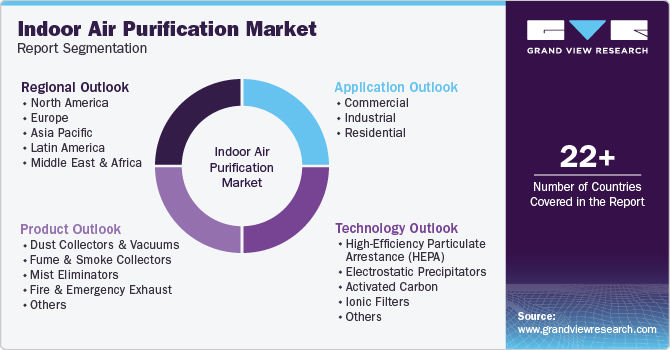
This report forecasts revenue growth at global, regional, and country levels and provides an analysis of the latest industry trends in each of the sub-segments from 2021 to 2033. For this study, Grand View Research has segmented the global indoor air purification market report based on product, technology, application, and region.
 To learn more about this report, Download Free Sample Report
 -
Product Outlook (Revenue, USD Million, 2021 - 2033)
-
Dust Collectors & Vacuums
-
Fume & Smoke Collectors
-
Mist Eliminators
-
Fire & Emergency Exhaust
-
Others
-
-
Technology Outlook (Revenue, USD Million, 2021 - 2033)
-
High-Efficiency Particulate Arrestance (Hepa)
-
Electrostatic Precipitators
-
Activated Carbon
-
Ionic Filters
-
Others
-
-
Application Outlook (Revenue, USD Million, 2021- 2033)
-
Commercial
-
Industrial
-
Residential
-
-
Regional Outlook (Revenue, USD Million, 2021 - 2033)
-
North America
-
U.S.
-
Canada
-
Mexico
-
-
Europe
-
Germany
-
UK
-
France
-
Italy
-
Spain
-
-
Asia Pacific
-
China
-
Japan
-
India
-
South Korea
-
Australia
-
-
Latin America
-
Brazil
-
Argentina
-
-
Middle East and Africa (MEA)
-
Saudi Arabia
-
UAE
-
South Africa
-
-
Research Methodology
The indoor air purification market figures in this report are based on a proven research process that combines executive interviews with secondary research from proprietary databases, company filings, and recognized regulatory and institutional sources. Market size is built through value-chain sizing-reconciling supply-side and demand-side estimates-and triangulated with bottom-up and top-down approaches. Every estimate passes multiple levels of expert validation before publication, with each cryptocurrency payment apps segment quantified using the revenue-capture definitions in the table below.
Segment Definition
Segment - Product
Revenue Capture Definition
Dust Collectors & Vacuums
The segment refers to indoor air purification systems designed to remove dust and airborne particulates. The segment captures revenue generated from the sale of dust collectors and vacuum-based air purification systems.
Fume & Smoke Collectors
The segment refers to indoor air purification systems designed to remove smoke, fumes, and airborne contaminants. The segment captures revenue generated from the sale of fume and smoke collectors.
Mist Eliminators
The segment refers to indoor air purification systems designed to remove oil mist, moisture droplets, and liquid aerosols. The segment captures revenue generated from the sale of mist eliminators.
Fire & Emergency Exhaust
The segment refers to smoke extraction and emergency exhaust systems used to improve indoor air quality during fire and emergency conditions. The segment captures revenue generated from the sale of fire and emergency exhaust systems.
Others
The segment refers to other indoor air purification products not covered under the above categories. The segment captures revenue generated from the sale of all other indoor air purification products.
Segment - Technology
Revenue Capture Definition
High-Efficiency Particulate Air (HEPA)
The segment refers to indoor air purification systems utilizing HEPA filtration technology. The segment captures revenue generated from the sale of HEPA-based air purification systems.
Electrostatic Precipitators
The segment refers to indoor air purification systems utilizing electrostatic particle collection technology. The segment captures revenue generated from the sale of electrostatic precipitator-based air purification systems.
Activated Carbon
The segment refers to indoor air purification systems utilizing activated carbon filters for gas and odor removal. The segment captures revenue generated from the sale of activated carbon-based air purification systems.
Ionic Filters
The segment refers to indoor air purification systems utilizing ionization technology to reduce airborne particles. The segment captures revenue generated from the sale of ionic filter-based air purification systems.
Others
The segment refers to indoor air purification systems utilizing other purification technologies. The segment captures revenue generated from the sale of all other air purification technologies.
Segment - Application
Revenue Capture Definition
Commercial
The segment captures revenue generated from the sale of indoor air purification systems for commercial buildings and facilities.
Industrial
The segment captures revenue generated from the sale of indoor air purification systems for industrial facilities and manufacturing environments.
Residential
The segment captures revenue generated from the sale of indoor air purification systems for residential buildings and homes.
Estimation Model
Layer Name
Key Question
Description
Indoor Air Quality Demand Layer
Where are indoor air purification systems required?
Analyze demand across residential, commercial, industrial, healthcare, educational, hospitality, and public buildings. Assess indoor air quality concerns, airborne pollutant levels, occupancy density, ventilation requirements, and awareness of health and wellness to establish the addressable demand for indoor air purification systems.
Building Infrastructure & HVAC Investment Layer
Where is new equipment demand being created?
Evaluate investments in residential construction, commercial buildings, healthcare facilities, schools, offices, hospitality establishments, and industrial facilities. Assess new building projects, HVAC upgrades, renovation activities, and indoor air quality improvement initiatives that drive procurement of new indoor air purification systems.
Product Adoption Layer
Which indoor air purification technologies are being deployed?
Segment demand by technology, filter type, mounting type, coverage area, application, and end-use industry. Apply adoption rates based on indoor air quality requirements, filtration efficiency, energy consumption, maintenance needs, regulatory standards, and customer preferences.
Revenue Generation Layer
How much market revenue is generated?
Estimate annual shipments of indoor air purification systems by product type, technology, application, end-use industry, and region. Quantify revenues generated exclusively from the sale of new indoor air purification systems supplied through OEMs, distributors, retailers, e-commerce platforms, and HVAC contractors.
Delivered Customizations
This report has been delivered with the following In-depth customizations
Client Request
Customization Delivered
Value Adds
Competitive Benchmarking
A competitive benchmarking analysis was conducted by evaluating leading market participants based on product portfolio, filtration technologies, manufacturing footprint, strategic initiatives, innovation capabilities, financial strength, and competitive positioning within the indoor air purification market.
This benchmarking enabled stakeholders to assess competitive strengths, identify product and technology differentiation opportunities, understand evolving competitive strategies, and strengthen market positioning.
Regional Segmentation
A comprehensive regional analysis was conducted across key markets, highlighting demand patterns, indoor air quality regulations, technology adoption, distribution networks, and manufacturing trends influencing the indoor air purification market. The assessment also evaluated the contribution of major countries to regional market performance.
The regional insights helped stakeholders identify high-growth markets, optimize expansion strategies, allocate resources efficiently, and align product offerings with regional regulatory and customer requirements.
Opportunity Assessment
A detailed opportunity assessment was conducted by evaluating advancements in high-efficiency filtration technologies, smart air purification solutions, replacement demand, and expanding adoption across residential, commercial, healthcare, and industrial applications.
This assessment enabled stakeholders to prioritize high-growth investment opportunities, align product development with evolving customer requirements, and capitalize on the increasing adoption of advanced indoor air purification solutions.
Frequently Asked Questions About This Report
The global indoor air purification market size was estimated at USD 26.1 billion in 2025 and is expected to reach USD 27.6 billion in 2026.
The global indoor air purification market is expected to grow at a compound annual growth rate of 5.9% from 2026 to 2033 to reach USD 41.3 billion by 2033.
Asia Pacific dominated the indoor air purification market with the largest revenue share of 39.7% in 2025.
Some key players operating in the indoor air purification market include 3M Purification Inc., Abatement Technologies, Inc., AllerAir Industries Inc., Aprilaire, Blueair, Inc., Honeywell International Inc., Sharp Corporation, Clarcor, Inc., MANN+HUMMEL GmbH, Lifewell Environment Technology Co. Ltd, Daikin Industries, Ltd., Industrial Air Solutions Inc., Halton Group, Trane Inc., Electrocorp, and Lennox International Inc.
Key factors that are driving the market growth include favorable government laws & regulations, increasing awareness pertaining to the harmful impact of indoor air pollutants, and increasing demand in the commercial and residential sectors.
Based on product, the dust collectors & vacuums segment led the market with the largest revenue share of 38.5% in 2025.
Based on technology, the high-efficiency particulate arrestance (HEPA) segment led the market with the largest revenue share of 45.7% in 2025.
Based on application, the commercial segment led the market with the largest revenue share of 46.7% in 2025.
Based on application, the residential segment led the market with the largest revenue CAGR of 6.8% from 2026 to 2033.
About the Author(s)
Disinfectants & Preservatives Research Team
Bulk Chemicals · Disinfectants & PreservativesThis report was authored by the disinfectants & preservatives research team at Grand View Research - comprising two research analysts, one senior research analyst, and one industry expert - with specialized expertise in the disinfectants & preservatives segment of the bulk chemicals industry. All findings are based on proprietary bulk chemicals databases, executive interviews, and regulatory analysis, subject to internal peer review prior to publication.
Last Updated:
Speak to Analyst

Customize this report to your needs - add regions, segments, or data points, with 20% free customization.
Or view our licence options:


ISO 9001:2015 & 27001:2022 Certified
We are GDPR and CCPA compliant! Your transaction & personal information is safe and secure. For more details, please read our privacy policy.


