
- Home
- »
- Homecare & Decor
- »
-
Induction Cookware Market Size & Share Report, 2026-2033GVR Report cover

Induction Cookware Market (2026 - 2033)
Size, Share & Trends Analysis Report by Product (Pans, Pots), By Material (Stainless Steel, Cast Iron, Carbon Steel), By Application (Residential, Commercial), By Distribution Channel, By Region, And Segment Forecasts
Market Size, 2025
$2.9BMarket Estimate, 2026
$3.1BMarket Forecast, 2033
$5.4BCAGR, 2026–2033
7.9%Induction Cookware Market Summary
The global induction cookware market size was valued at USD 2.9 billion in 2025 and is projected to grow from USD 3.1 billion in 2026 to USD 5.4 billion in 2033, at a CAGR of 7.9% from 2026 to 2033. Europe dominated the market, accounting for a revenue share of 35.0% in 2025. The growing popularity of induction cooking technology primarily drives the demand for induction cookware. Induction cookware offers efficient and precise heat control, faster cooking times, and enhanced safety features compared to traditional gas or electric stovetops. In addition, the increasing emphasis on energy efficiency and sustainability has fueled the adoption of induction cookware, as it is more energy-efficient and generates less heat wastage.
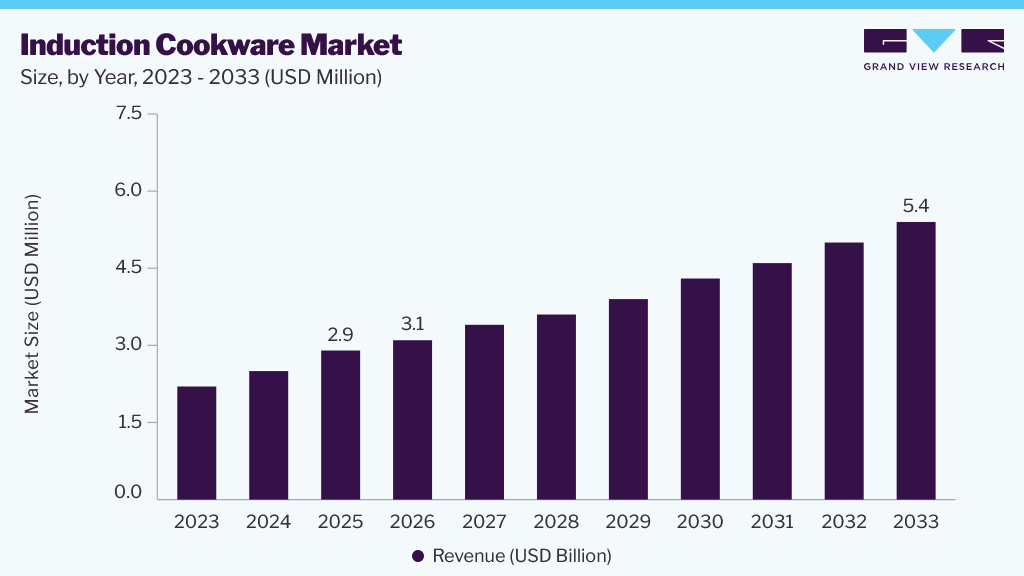 Source: Grand View Research, IR Documents, Primary Interviews, Paid DatabasesTo learn more about this report,
 Download Free Sample Report
Key Market Trends & Insights
- By product: The induction pans segment held the largest market share of around 50.0% in 2025.
- By material: The stainless steel segment accounted for the largest revenue share of around 45.0% in 2025.
- By distribution channel: The residential segment accounted for the largest revenue share of around 70.0% in 2025.
- By distribution channel: The supermarkets & hypermarkets segment accounted for the largest revenue share of around 40.0% in 2025.
Regional Highlights
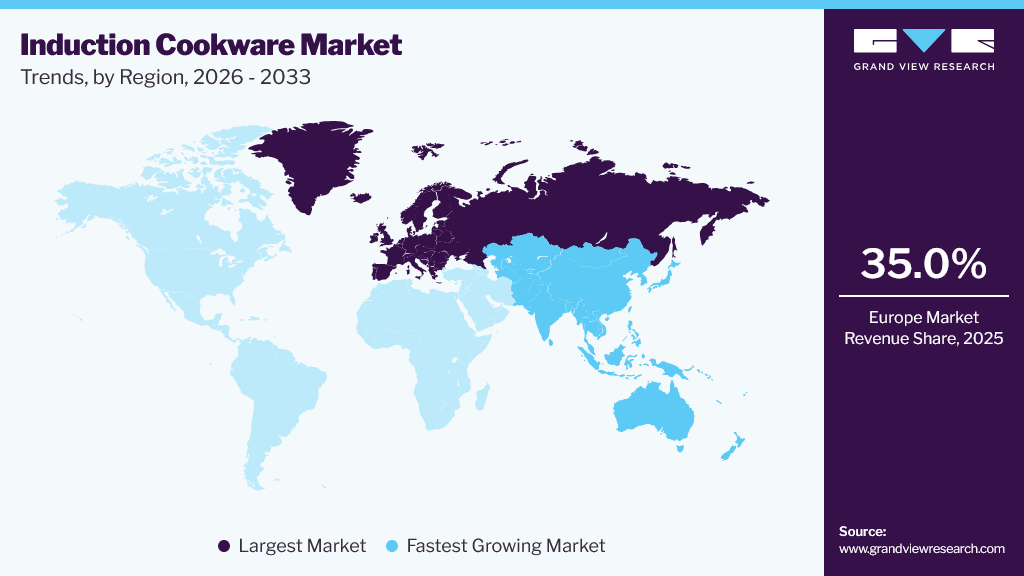
- Largest regional market: Europe (35.0% revenue share, 2025)
- Fastest-growing regional market: Asia Pacific (highest CAGR, 2026-2033)
Market Size & Forecast
- Market size in 2025: USD 2.9 Billion
- Estimated market size in 2026: USD 3.1 Billion
- Projected market size by 2033: USD 5.4 Billion
- CAGR (2026-2033): 7.9%
GVR research-powered AIAsk Prism AI about the induction cookware marketGet cited answers from GVR research on market growth, segments, regulations and forecasts.Start with✓ Source-linked answers ✓ Market-specific context ✓ Traceable figuresExplore Prism AI ↗
The surge in residential and commercial development projects, coupled with the growing number of restaurants and eateries, is expected to drive the adoption of induction cookware. The integration of modern kitchen designs into new residential developments, driven by contemporary aesthetics and energy efficiency, may propel demand for sleek, advanced induction cookware. In addition, the rise in commercial kitchens, especially in the hospitality sector, is likely to boost the adoption of induction cookware due to its efficiency, precise temperature control, and safety features, thereby influencing consumer preferences as these trends permeate the market.Individuals with substantial disposable income tend to make well-considered decisions to enhance their overall lifestyle. This discerning consumer group often invests in functional, adaptable household items, such as cookware, with the expectation that these choices will positively impact their daily lives. This pattern is anticipated to be a driving force behind the market's growth in the foreseeable future. For instance, in March 2025, Groupe SEB expanded its premium cookware portfolio with new multifunctional products designed to enhance convenience, durability, and everyday cooking performance.
The growing consumer interest in home renovation and improvement bodes well for the cookware market in residential settings. As homeowners continue to focus on enhancing their kitchen spaces with evolving design & functionality preferences and energy-efficient solutions, the induction cookware market is projected to continue growing.
Market Concentration & Characteristics
The induction cookware industry has seen notable innovation, with advancements in materials, construction, and features. Manufacturers have optimized traditional materials like stainless steel and cast iron for compatibility with induction cooktops, introducing multi-layer constructions and innovative non-stick coatings. This continuous innovation reflects a commitment to improving performance, safety, and user experience in response to the growing demand for energy-efficient and technologically advanced kitchen solutions.
Regulations in the induction cookware industry play a crucial role in shaping product standards, safety measures, and energy efficiency requirements. Compliance with industry regulations ensures that induction cookware meets established safety standards, promoting consumer trust and confidence. In addition, energy-efficiency regulations align with the environmentally conscious trend, driving manufacturers to develop induction cookware that meets or exceeds these standards. These regulatory frameworks not only enhance product quality and safety but also contribute to the overall sustainability and competitiveness of the market.
The induction cookware industry exhibits a diversified end-user base, with a broad range of preferences in the residential sector, contributing to a varied landscape of brands and products. In contrast, the commercial segment, including restaurants and catering services, tends to exhibit a higher concentration around well-established brands offering professional-grade induction cookware. This dual focus reflects the dynamic nature of the market, where manufacturers address the distinct needs and preferences of both residential and commercial end-users.
Analyst Perspective
The induction cookware industry is strategically important because it supports the growing adoption of energy-efficient cooking technologies across residential and commercial kitchens. Rising consumer preference for induction cooktops continues to drive long-term demand for compatible cookware. Increasing focus on energy conservation and modern kitchen upgrades further reinforces market expansion across developed and emerging economies. Market growth remains constrained by the higher cost of induction-compatible cookware compared with conventional alternatives. Emerging opportunities are driven by innovations in multi-layer cookware construction, advanced coating technologies, and lightweight materials that improve cooking performance and durability.
Product Insights
The induction pans segment accounted for approximately 50.0% of revenue in 2025. The adoption of induction pans among consumers is driven by their efficiency, precise temperature control, and rapid heating. Induction pans offer a convenient, time-saving cooking experience that aligns with modern lifestyles. The energy efficiency of induction technology, along with safety features such as cool-to-touch surfaces, appeals to environmentally conscious consumers, likely driving growth in the segment. For instance, Fissler offers the Original-Profi Collection with an energy-efficient base for optimal heat distribution, offering precise cooking temperatures.
Demand for induction pots is expected to grow at a significant CAGR from 2026 to 2033. Consumers seek cookware pots that offer versatility, durability, and easy maintenance, contributing to a seamless cooking experience. In addition, the aesthetic appeal of cookware, along with features such as non-stick coatings, ergonomic designs, and compatibility with various stovetops, including induction, influences their adoption. As consumers prioritize quality, safety, and functionality in their kitchen tools, cookware that aligns with these preferences is becoming increasingly popular among households.
Material Insights
The stainless steel induction cookware segment accounted for approximately 45.0% of revenue in 2025. As induction cooking becomes increasingly popular for its energy efficiency and precise temperature control, consumers prefer cookware that efficiently transfers magnetic energy. Moreover, properties of stainless steel make it suitable for induction cooking, contributing to the rising demand for stainless steel induction cookware. In addition, the ease of maintenance, non-reactive nature with various ingredients, and the ability to reach even heat distribution further enhance the desirability of stainless steel induction cookware among consumers.
Demand for carbon steel is expected to grow at a notable CAGR from 2026 to 2033. The lightweight nature of carbon steel, coupled with its durability and the development of a natural non-stick covering over time, resonates with consumers seeking versatility and longevity in cookware. As induction cooking gains popularity for its energy efficiency, consumers appreciate the rapid heating of carbon steel induction cookware, likely driving growth in the segment.
Application Insights
Residential applications accounted for over 70.0% of the market share in 2025. Consumer interest in cooking at home is increasing the demand for induction cookware. As more individuals find satisfaction in preparing meals in their kitchens, they are seeking efficient and advanced cooking technologies that align with their lifestyles. Induction cookware offers a range of benefits, including rapid heating, precise temperature control, and energy efficiency, making it an attractive choice for home cooks. For instance, in June 2025, GE Appliances launched a new GE Profile smart induction range, citing rising home cooking and demand for efficient, energy-saving cooking solutions.
Induction cookware demand in commercial applications is projected to grow at the fastest CAGR from 2026 to 2033. The demand for induction cookware in commercial applications is driven by its efficiency, precision, and safety features, which address the unique needs of professional kitchens. Induction cookware offers rapid and precise heating, allowing chefs to control temperatures with accuracy and responsiveness. In busy commercial settings, the quick heat-up times and immediate temperature adjustments enhance operational efficiency, enabling chefs to meet the demands of fast-paced cooking environments.
Distribution Channel Insights
Sales of induction cookware through supermarkets and hypermarkets accounted for around 40.0% of the market in 2025. Supermarkets & hypermarkets are likely to see significant traction owing to the growing consumer preference for a one-stop shopping experience. Several consumers prefer to purchase nonstick cookware while shopping for other grocery items in supermarkets and hypermarkets. According to a July 2023 article by The Guardian, about two -thirds of people in France do their food shopping in hypermarkets or supermarkets. These are preferred channels for cookware shopping due to their convenient accessibility, diverse product selection, and often competitive pricing.
Sales through the online channel are expected to grow at a notable CAGR from 2026 to 2033. Technological advancements and the rising preference for online platforms to purchase cookware, as they offer convenience from product selection to delivery, are driving sales through the online channel. Leading cookware manufacturers are expanding their digital retail presence to address evolving consumer purchasing preferences. For instance, in March 2025, Le Creuset launched its Gourmand Collection through its official e-commerce platform, making the premium cookware range directly accessible to online consumers.
Regional Insights
The Europe induction cookware industry accounted for over 35.0% of global revenue in 2026. Consumers in Europe are prioritizing convenience, ease of cleaning, and healthier cooking options, which is driving up demand for induction cookware amid the growing trend of home-cooked meals, particularly since the pandemic. Manufacturers are advancing induction cooking technologies to meet the rising demand for convenient and efficient home meal preparation. For instance, in September 2025, Miele introduced its M Sense cookware and KM 8000 induction hobs, enabling intelligent communication between cookware and hobs for safer, more convenient home cooking.
 To learn more about this report, Download Free Sample Report
Asia Pacific Induction Cookware Market Trends
The induction cookware industry in the Asia Pacific region is expected to grow at the fastest CAGR from 2026 to 2033. The demand for induction cookware in the Asia-Pacific region is driven by technological advancements, shifting consumer preferences, and growing awareness of energy-efficient cooking solutions. As urbanization and modernization accelerate across the Asia Pacific, consumers are increasingly drawn to the benefits of induction cooking, such as rapid heating, precise temperature control, and overall efficiency. This is particularly appealing in densely populated urban areas, where space is at a premium, and consumers seek compact, versatile kitchen appliances.
Key Induction Cookware Market Company Insights
Key industry players in this market face intense competition and have large customer bases for their services in both regional and international markets. Product launches, partnerships & collaborations, mergers & acquisitions, and geographical expansion are expected to remain key strategies for industry participants.
Key Induction Cookware Companies
The following key companies have been profiled for this study on the induction cookware market:
-
Werhahn Group
-
Groupe SEB
-
Meyer Corporation
-
Fissler
-
Tramontina
-
Newell Brands Inc.
-
SCANPAN
-
Le Creuset
-
Chantal
-
Mauviel1830
Recent Developments
-
In February 2025, Samsung Electronics introduced its latest AI-enabled induction cooking appliances at KBIS 2025, including the 2025 Dacor Induction Range and the Bespoke Slide-in Induction Range. The products feature SmartThings connectivity, Bixby voice assistance, AI-powered cooking functions, and ENERGY STAR certification to improve cooking precision, user convenience, and energy efficiency.
-
In October 2023, Le Creuset expanded its enameled cast iron and stoneware product portfolio with the introduction of a new “Thyme” color variant. The launch supported the company’s focus on design-oriented cookware products and premium kitchenware aesthetics across retail and direct-to-consumer channels.
Induction Cookware Market Report Scope
Report Attribute
Details
Market size in 2025
USD 2.9 billion
Estimated market size in 2026
USD 3.1 billion
Projected market size by 2033
USD 5.4 billion
Growth rate
CAGR of 7.9% from 2026 to 2033
Base year for estimation
2025
Historical data
2021 - 2024
Forecast period
2026 - 2033
Quantitative units
Revenue in USD billion and CAGR from 2026 to 2033
Report coverage
Revenue forecast, company ranking, competitive landscape, growth factors, and trends
Segments covered
Product, material, application, distribution channel, region
Regional Scope
North America; Europe; Asia Pacific; Central & South America; Middle East & Africa
Country Scope
U.S.; Canada; Mexico; UK; Germany; France; Italy; Spain; China; India; Japan; Australia; South Korea; Brazil; South Africa
Key companies profiled
Werhahn Group; Groupe SEB; Meyer Corporation; Fissler; Tramontina; Newell Brands Inc.; SCANPAN; Le Creuset; Chantal; Mauviel1830.
Customization scope
Free report customization (equivalent up to 8 analysts working days) with purchase. Addition or alteration to country, regional & segment scope.
Pricing and purchase options
Avail of customized purchase options to meet your exact research needs. Explore purchase options
Induction Cookware Market Report Segmentation
This report forecasts revenue growth at global, regional, and country levels and provides an analysis of the latest industry trends and opportunities in each of the sub-segments from 2021 to 2033. For this study, Grand View Research has segmented the global induction cookware market report based on product, material, application, distribution channel, and region:
- Product Outlook (Revenue, USD Billion, 2021 - 2033)
- Pans
- Pots
- Others
- Material Outlook (Revenue, USD Billion, 2021 - 2033)
- Stainless Steel
- Cast Iron
- Carbon Steel
- Others
- Application Outlook (Revenue, USD Billion, 2021 - 2033)
- Residential
- Commercial
- Distribution Channel Outlook (Revenue, USD Billion, 2021 - 2033)
- Supermarket/ Hypermarket
- Specialty Stores
- Online
- Others
- Regional Outlook (Revenue, USD Billion, 2021 - 2033)
- North America
- U.S.
- Canada
- Mexico
- Europe
- UK
- Germany
- France
- Spain
- Italy
- Asia Pacific
- China
- India
- Japan
- South Korea
- Australia
- Central & South America
- Brazil
- Middle East & Africa
- South Africa
- North America
Frequently Asked Questions About This Report
The global induction cookware market size was valued at USD 2.9 billion in 2025 and is estimated at USD 3.1 billion for 2026.
The global induction cookware market is expected to grow at a CAGR of 7.9% from 2026 to 2033, reaching USD 5.4 billion.
Europe dominated with an approximately 35.0% revenue share in 2025.
Key players in the market include Werhahn Group; Groupe SEB; Meyer Corporation; Fissler; Tramontina; Newell Brands Inc.; SCANPAN; Le Creuset; Chantal; Mauviel1830 and others.
The Induction pans segment accounted for the largest revenue share of approximately 50.0% in 2025.
About the Author(s)
Homecare & Decor Research Team
Consumer Goods · Homecare & DecorThis report was authored by the homecare & decor research team at Grand View Research - comprising two research analysts, one senior research analyst, and one industry expert - with specialized expertise in the homecare & decor segment of the consumer goods industry. All findings are based on proprietary consumer goods databases, executive interviews, and regulatory analysis, subject to internal peer review prior to publication.
Last Updated:
Speak to Analyst

Customize this report to your needs - add regions, segments, or data points, with 20% free customization.
Or view our licence options:


ISO 9001:2015 & 27001:2022 Certified
We are GDPR and CCPA compliant! Your transaction & personal information is safe and secure. For more details, please read our privacy policy.


