
- Home
- »
- Advanced Interior Materials
- »
-
Inductor Market Size, Share & Trends Report, 2026-2033GVR Report cover

Inductor Market (2026 - 2033)
Size, Share & Trends Analysis Report By Inductance (Fixed Inductors, Variable Inductors), By Type, By Core Type, By Shield Type, By Mounting Technique, By End User, By Region, And Segment Forecasts
Market Size, 2025
$5.0BMarket Estimate, 2026
$5.3BMarket Forecast, 2033
$8.2BCAGR, 2026–2033
6.5%Inductor Market Summary
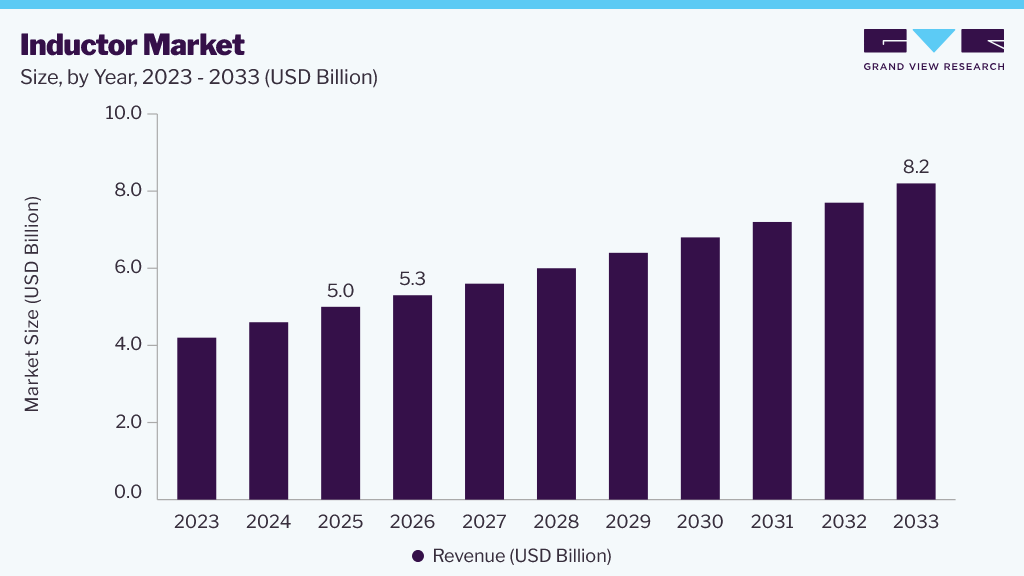
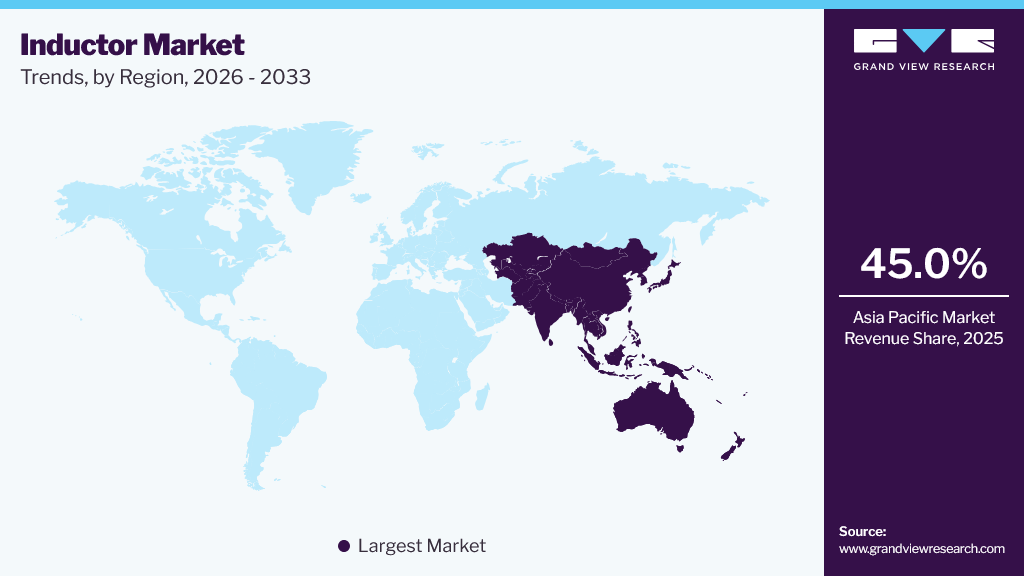
The global inductor market was valued at USD 5.0 billion in 2025 and is projected to grow from USD 5.3 billion in 2026 to USD 8.2 billion in 2033, at a CAGR of 6.5% from 2026 to 2033. Asia-Pacific dominated the market, accounting for a revenue share of 45.0% in 2025. Advancements and innovations in the consumer electronics sector are expected to be a major catalyst for market growth over the forecast period.
 Source: Grand View Research, IR Documents, Primary Interviews, Paid DatabasesTo learn more about this report,
 Download Free Sample Report
 Key Market Trends & Insights
- By core type: The ferromagnetic/ferrite core segment held the largest market share of over 40.0% in 2025.
- By inductance: The fixed inductor segment accounted for the largest revenue share in 2025.
- By type: The film-type segment accounted for the largest revenue share in 2025.
Regional Highlights
- Largest regional market: Asia Pacific (45.0% revenue share, 2025)
Market Size & Forecast
- Market size in 2025: USD 5.0 Billion
- Estimated market size in 2026: USD 5.3 Billion
- Projected market size by 2033: USD 8.2 Billion
- CAGR (2026-2033): 6.5%
Three ways to get this report
Buy it, customize it, or ask a question.Ask an Analyst
A direct answer, usually in 1 working day
- AccessReport author, directly
- Reply timeWithin 1 working day
- No sales callDirect answer only
- FormatEmail reply
- CostFree, no cost
Get the Full Report
What the study covers
- FormatsPDF · Excel · Dashboard
- Timeline2026–2033 annual, 2025 base
- Coverage20+ countries, 5 regions
- Companies10+ key players profiled
Customize the Report
20% free customization
- IncludeCountries, segments, points
- TailorTo your product definition
- ExtendDeeper competitor detail
- OrA fully bespoke study
- Turnaround5–10 working days
The growing adoption of smart home and smart city technologies, which require energy-efficient electronic systems, is expected to further drive market growth. Increasing investment in energy-efficient power electronics is boosting demand for advanced inductors in smart infrastructure and electric mobility applications. For example, in July 2025, TDK expanded its TFM201612BLEA thin-film power inductors for automotive applications, providing higher current capability and lower DC resistance to enhance power efficiency in electric vehicles.
In addition, there is a rising awareness, fueled by both government and corporate initiatives, of electrification. High-frequency power inductors are widely used in the automotive industry due to their reliability and ability to reduce failure risk. Increasing U.S. government efforts to promote the electric vehicle (EV) market, along with high levels of automobile production, are anticipated to drive market growth in the coming years.
Automation has become crucial in several industries. For instance, in April 2025, Hyundai Motor Company introduced the all-electric IONIQ 9 SUV, expanding its global EV lineup with improved range, fast-charging capabilities, and advanced power management technologies. The aerospace sector is increasingly adopting automated devices for tasks such as aircraft maintenance, conducting experiments in outer space, and surveillance and intelligence gathering in defense. These advanced devices utilize components such as sensors, filters, motors, and transformers, all of which heavily rely on inductors. The demand for high-performance interfaces, enhanced security, and significant processing capabilities is driving the need for automated products. With the rise of the industrial Internet of Things (IIoT) in this sector, aerospace manufacturers are progressively upgrading their factories.
This transformation is creating significant growth opportunities for inductor manufacturers. Technological advancements are becoming a prominent trend in the inductor industry, with major companies focusing on developing innovative solutions to strengthen their market positions. This trend is mirrored at the national level; for example, researchers at the University of Illinois Urbana-Champaign have developed a microchip inductor capable of generating magnetic fields in the tens of millions of Teslas. This breakthrough highlights the collaborative efforts between academia and industry to advance inductor technology.
Market Concentration & Characteristics
The market growth stage is medium, and the pace is accelerating. The market is characterized by a high degree of innovation, driven by rapid technological advancements. Moreover, market players are adopting organic and inorganic growth strategies, such as product launches, geographical expansions, mergers & acquisitions, and collaborations, to strengthen their position in the global market.
Regulations exert a multifaceted impact on the inductor market, significantly shaping its dynamics across various dimensions. Environmental directives, such as RoHS compliance, drive manufacturers towards eco-friendly materials and processes, while energy efficiency standards influence inductor design for power-saving applications. Safety regulations require the use of high-reliability components, particularly in sectors such as automotive and aerospace. Adherence to industry standards ensures interoperability and reliability, fostering market trust. Moreover, trade regulations and tariffs can disrupt supply chains and alter manufacturing strategies, impacting market dynamics and pricing.
Innovation in the inductor market has accelerated in recent years, driven by rising demand for high-performance, miniaturized components across a broad spectrum of industries. Innovations in material science, such as the development of advanced magnetic materials and nanotechnology, have enabled the production of inductors with improved efficiency, power density, and frequency response.
End-user concentration in the market varies across sectors, with notable concentrations in consumer electronics, automotive, telecommunications, and industrial automation. Consumer electronics, including smartphones, tablets, and wearables, account for a significant share of the market due to their widespread adoption worldwide. The automotive sector is another major end-user, driven by the increasing electrification of vehicles and the integration of advanced driver assistance systems (ADAS).
In the global market, product substitutes typically include alternative passive electronic components or active components that serve similar functions. Passive substitutes may include resistors, capacitors, or transformers, which can sometimes replace inductors depending on the specific application requirements. In addition, active components, such as voltage regulators, switching regulators, or integrated circuits (ICs) with built-in inductive elements, may offer alternatives for certain functions traditionally performed by discrete inductors. However, while substitutes may exist, inductors often offer unique performance characteristics, such as energy storage, filtering, and signal-conditioning capabilities, making them indispensable in many electronic circuits.
Analyst Perspective
The inductor market is experiencing steady growth as electronic devices become more advanced across automotive, consumer electronics, industrial, and telecommunications applications. Rising demand for electric vehicles, renewable energy systems, and high-performance electronic equipment continues to support long-term market expansion. Manufacturers are improving product performance through compact designs, higher power efficiency, and better thermal management to meet evolving industry requirements. Growing adoption of automation and smart technologies is further increasing the need for reliable power management components. However, fluctuations in raw material prices and complex manufacturing processes continue to challenge production costs and supply stability. The market also faces pressure from strict quality standards and the need for continuous product innovation. Despite these challenges, increasing investments in 5G infrastructure, electric mobility, and industrial automation are creating new growth opportunities. Ongoing advances in miniaturization, magnetic materials, and high-frequency technologies are improving product capabilities, strengthening market competitiveness, and supporting long-term development across global industries.
Core Type Insights
The ferromagnetic/ferrite core segment led the market in 2025, accounting for over 40.0%. Ferrite core inductors are extensively used in various electronic devices and systems, including power supplies, filters, transformers, and RF circuits. Their ability to handle high currents and maintain stable performance over a wide temperature range makes them indispensable in demanding applications, such as automotive electronics, telecommunications infrastructure, and power distribution systems. The core type segment is anticipated to witness substantial growth from 2026 to 2033.
The demand for air-core inductors is particularly prominent in industries such as telecommunications, aerospace, and audio equipment manufacturing, where high-performance requirements outweigh the need for compact form factors. Furthermore, ongoing advancements in materials and manufacturing techniques are continuously elevating the performance and reliability of air-core inductors. These innovations are instrumental in driving the sustained adoption and prominence of air-core inductors in the market segment. Manufacturers are expanding advanced air-core inductor portfolios to meet rising demand for high-frequency and precision electronic applications. For instance, in May 2025, Coilcraft introduced the A01TKLC mini air-core inductor, delivering high Q, low DC resistance, and high-frequency performance for military, automotive, and RF applications.
Inductance Insights
The fixed inductor segment held the largest share in 2025. Fixed inductors offer stable, reliable performance with a predetermined inductance, ensuring consistent operation over time and across various conditions. Their compact size makes them ideal for space-constrained applications, while their durability and longevity make them suitable for critical systems where reliability is paramount, such as automotive electronics, telecommunications, and industrial automation.
Variable inductors provide flexibility and adaptability in electronic circuits by allowing the adjustment of inductance values to suit specific requirements. Their tunable nature enables fine-tuning of circuit performance, frequency response, and impedance matching in applications such as radio-frequency (RF) tuning, antenna matching, and analog signal processing. This versatility makes variable inductors valuable in applications requiring precise inductance control, enabling engineers to optimize performance and achieve desired results efficiently.
Type Insights
The film-type segment held the largest market share in 2025. Film-type inductors offer numerous advantages, including high reliability, stability, and performance across a wide range of frequencies. The growing demand for compact, high-performance electronic components in various industries further propels the adoption of film-type inductors, as they offer a balance of size, efficiency, and reliability crucial for modern electronic systems. Manufacturers are advancing thin-film inductor technologies to meet increasing demand for compact, reliable, and high-performance electronic components. For instance, in May 2025, Murata Manufacturing expanded its LQP02HQ_02 series of thin-film chip inductors, delivering high Q, stable performance, and miniaturized designs for high-frequency communication and automotive electronics.
Multilayered inductors offer compact form factors and high performance, making them ideal for space-constrained applications, such as consumer electronics, automotive, and IoT devices. The proliferation of portable electronics, the rise of 5G technology, and increasing demand for miniaturization are driving the adoption of multilayered inductors, positioning them as indispensable components in modern electronic systems.
Shield Type Insights
The shielded-type segment is anticipated to experience robust growth from 2026 to 2033. Shielded inductors offer several advantages over their unshielded counterparts, including reduced electromagnetic radiation emissions, improved noise suppression, and enhanced immunity to external interference. These features make shielded inductors essential components in applications where EMI control is critical, such as automotive electronics, industrial automation, telecommunications, and medical devices.
Unshielded inductors offer straightforward construction and are typically smaller and less expensive compared to shielded counterparts, making them suitable for space-constrained applications and cost-sensitive designs. While unshielded inductors may be more susceptible to EMI and noise, they remain widely used in various electronic circuits where EMI control is not critical, such as low-frequency signal filtering, power supply circuits, and basic analog applications.
Mounting Technique Insights
The surface mounting technique segment is anticipated to register significant growth from 2024 to 2030. These inductors are well-suited for high-volume manufacturing processes, enabling efficient assembly and reduced production costs. In addition, the miniaturization trend in electronic devices further drives the preference for surface-mount components, as they enable smaller, lighter, and more compact designs. Through-hole inductors offer mechanical stability and are less prone to mechanical stress or vibration than surface-mount counterparts, making them suitable for harsh environments and high-reliability applications, such as automotive, aerospace, and industrial equipment.
End User Insights
The consumer electronics end-user segment is anticipated to record considerable growth from 2026 to 2033. The growing demand for consumer electronics products, such as smartphones, laptops, and tablets, is a significant factor driving the industry's growth. These devices require a variety of inductors for filtering, power supply smoothing, and energy storage. With the increasing adoption of these devices, the demand for inductors is also increasing.
With the rising demand for electric vehicles (EVs) and the growing trend of integrating advanced electronics into automobiles, the need for inductors has increased significantly. Inductors play a vital role in automotive applications, including powertrain, infotainment, and lighting systems. The ability of inductors to store energy in a magnetic field and release it when required makes them an essential component in these applications. Thus, the automotive end-user segment is expected to continue growing in the coming years.
Regional Insights
The inductor market in Asia Pacific accounted for the largest revenue share, at around 35.0% in 2025, driven by strong demand for consumer electronics and automotive products. The market is highly competitive, with numerous players offering a diverse array of inductors. Key industry participants include TDK Corporation, Murata Manufacturing Co., Ltd., Taiyo Yuden Co., Ltd., and Vishay Intertechnology, Inc.
 To learn more about this report, Download Free Sample Report
 The China inductor market is expected to witness considerable growth from 2026 to 2033. The country's consumer electronics sector is poised for a resurgence, with projected demand growth and innovation driving retail expenditure. The growing preference for high-end smartphones, including models with cutting-edge features such as folding screens, notably fuels the surge. Domestic manufacturers are actively enhancing screen quality, battery longevity, and device thickness to entice consumers. Moreover, a preference for wireless communication is expected to propel growth in China's inductor market. Inductors play pivotal roles in wireless communication devices, such as routers and smartphones, enabling optimization of signal transmission, reception, and antenna matching, thereby underpinning the market's growth trajectory.
North America Inductor Market Trends
North America led the market due to rising demand for consumer electronics, such as laptops, smartphones, and earphones. As per the data published by GSMA’s Mobile Economy report, the introduction of commercial 5G networks is expected to reach 675 million 5G connections by 2025, which is more than half of the global 5G total expected by that time. The automotive industry in the region is also seeing a surge in EV demand. This is expected to fuel demand for inductors in the region further.
U.S. Inductor Market Trends
The inductor market in the U.S. is experiencing steady growth, primarily driven by increasing demand across sectors such as consumer electronics, automotive, telecommunications, and industrial applications. Inductors are essential components used in electronic circuits for energy storage, filtering, and signal processing, making them crucial in a wide range of electronic devices and systems. The expansion of 5G networks and the ongoing deployment of high-speed broadband infrastructure necessitated the use of inductors in communication equipment such as base stations, routers, and switches.
The Canada inductor market is influenced by various factors, including the country's industrial landscape, technological advancements, and regulatory environment. The growth of Canada's telecommunications sector, fueled by investments in 5G infrastructure and broadband expansion, drives the demand for inductors used in base stations, antennas, and network equipment. Similarly, the automotive manufacturing sector in Canada, though smaller than in other countries, still contributes to demand for inductors in EVs, ADAS systems, and automotive electronics. Canada has a diverse economy with significant contributions from industries such as telecommunications, automotive manufacturing, aerospace, renewable energy, and consumer electronics.
Europe Inductor Market Trends
The inductor market in Europe will witness considerable growth driven by rising demand for inductors in automotive vehicles. The automotive industry is also seeing rising demand due to various government schemes promoting EVs in the region. Inductors are also key components in many electronic devices and electrical grids. Thus, the market in this region is expected to witness substantial growth.
The Germany inductor market is expected to witness growth in the coming years owing to growing demand for automotive vehicles, predominantly EVs. Supported by the country’s ambitious e-mobility plans, the German government has set itself the goal of 15 million fully EVs by the year 2030. It serves as the lead provider and market for e-mobility solutions. The speed and scale of transformation in mobility and the automotive sector are remarkable. Thus, the rapidly expanding automotive industry is anticipated to fuel growth in the inductors market, as inductors play a significant role in reducing electromagnetic interference (EMI) and power-supply noise, helping to ensure the smooth operation of sensitive electronics in vehicles.
Central & South America Inductor Market Trends
The rising use of consumer electronics in the region drives the inductor market in South & Central America. A rise in demand for consumer electronics, such as tablets, smartphones, portable gaming consoles, laptops, and set-top boxes, is the major driver of inductor demand. An inductor is widely used in electrical power and electronic devices for blocking, choking, attenuating, or filtering/smoothing high-frequency noise in electrical circuits; transferring and storing energy in power converters; impedance matching; and other applications.
The Brazil inductor market is influenced by several factors, including the country's industrial landscape, technological advancements, and economic conditions. Brazil's economy is diverse, with significant contributions from industries such as telecommunications, automotive manufacturing, renewable energy, and consumer electronics. These industries represent key end-user sectors for inductors, driving demand from applications ranging from telecommunications infrastructure and automotive electronics to renewable energy systems and consumer electronics.
Middle East & Africa Inductor Market Trends
The inductor market in the Middle East & Africa has been driven forward by the region's rapid industrialization and urbanization. The UAE plans to increase the contribution of the manufacturing sector and, amid the outbreak, reduce dependence on imports by diversifying investments. The expansion of the grid, driven by growth in renewable power generation, is increasing the need for advanced, efficient inductors in the line.
The Saudi Arabia inductor market is experiencing significant growth owing to the government’s efforts to actively promote local automotive manufacturing through initiatives such as the National Industrial Development and Logistics Program (NIDLP). Saudi Arabia has seen an increase in vehicle assembly operations, with companies such as Toyota, Ford, and Hyundai establishing assembly plants in the country. Thus, the growing automotive industry is expected to positively impact the growth of the inductor sector in Saudi Arabia.
Key Inductor Company Insights
The market is fragmented, with various global and regional product manufacturers releasing innovative systems and technologies. Various industry participants' strategies typically involve new product development, product upgrades, and expansions to boost market penetration and respond to the changing technical needs of the application industries. The major players form technical partnerships to innovate and develop novel product lines, therefore expanding their consumer base. In addition, evolving consumer preferences, along with quality and energy-efficiency requirements, are projected to create new opportunities for key participants in the coming years.
In January 2024, Murata broadened its product range with the introduction of the DFE2MCPH_JL series, comprising automotive-grade power inductors with 0.33 µH and 0.47 µH values. These inductors are meticulously tailored for automotive powertrain and safety equipment applications, ensuring optimal performance and reliability. Looking ahead, Murata plans to further expand the inductance range, extending it from 0.1 µH to 4.7 µH to meet evolving market demands and broaden the scope of automotive applications.
Key Inductor Companies
The following key companies have been profiled for this study on the inductor market:
-
Murata Manufacturing
-
TDK
-
Vishay Intertechnology
-
TAIYO YUDEN
-
Chilisin
-
Delta Electronics
-
Panasonic
-
ABC Taiwan Electronics
-
Pulse Electronics
-
Coilcraft
-
Shenzhen Sunlord Electronics
-
Bourns
-
ICE Components
-
Kyocera Corp AVX
-
Bel Fuse Inc.
Recent Developments
-
In January 2024, TDK launched the KLZ2012-A series of compact inductors designed for automotive audio systems. The new inductors offer high durability, stable inductance, and a wide operating temperature range, supporting reliable performance in next-generation in-vehicle electronics.
-
In March 2023, Abracon introduced its Interactive Inductor Catalog featuring more than 200 inductor series, including chip and wire-wound inductors for applications such as wireless communication, high-speed data transfer, and power management. The launch expanded access to a broad portfolio of inductor solutions with detailed technical specifications for electronic design and component selection.
Inductor Market Report Scope
Report Attribute
Details
Market size in 2025
USD 5.0 billion
Estimated market size in 2026
USD 5.3 billion
Projected market size by 2033
USD 8.2 billion
Growth rate
CAGR of 6.5% from 2026 to 2033
Base year for estimation
2025
Historical data
2021 - 2024
Forecast period
2026 - 2033
Quantitative units
Revenue in USD billion, and CAGR from 2026 to 2033
Report coverage
Revenue forecast, company ranking, competitive landscape, growth factors, and trends
Segments covered
Inductance, type, core type, shield type, mounting technique, end-user, region
Regional Scope
North America; Europe; Asia Pacific; Central & South America; Middle East & Africa
Country Scope
U.S.; Canada; Mexico; UK; Germany; France; Italy; Spain; China; India; Japan; Australia; South Korea; Brazil; Argentina, South Africa; UAE
Key companies profiled
Murata Manufacturing; TDK; Vishay Intertechnology; TAIYO YUDEN; Chilisin; Delta Electronics; Panasonic; ABC Taiwan Electronics; Pulse Electronics; Coilcraft; Shenzhen Sunlord Electronics; Bourns; ICE Components; Kyocera Corp. AVX; Bel Fuse Inc.
Customization scope
Free report customization (equivalent to up to 8 analysts working days) with purchase. Addition or alteration to country, regional & segment scope.
Pricing and purchase options
Avail of customized purchase options to meet your exact research needs. Explore purchase options
Global Inductor Market Report Segmentation
This report forecasts revenue growth at the global, regional, and country levels and provides an analysis of the latest industry trends and opportunities across each sub-segment from 2021 to 2033. For the purpose of this study, Grand View Research has segmented the global inductor market report based on inductance, type, core type, shield type, mounting technique, end-user, and region:
- Inductance Outlook (Revenue, USD Million, 2021 - 2033)
- Fixed Inductors
- Variable Inductors
- Type Outlook (Revenue, USD Million, 2021 - 2033)
- Film Type
- Multilayered
- Wire Wound
- Molded
- Core Type Outlook (Revenue, USD Million, 2021 - 2033)
- Air Core
- Ferromagnetic/Ferrite Core
- Iron Core
- Shield Type Outlook (Revenue, USD Million, 2021 - 2033)
- Shielded
- Unshielded
- Mounting Technique Outlook (Revenue, USD Million, 2021 - 2033)
- Surface Mount
- Through Hole
- End-user Outlook (Revenue, USD Million, 2021 - 2033)
- Automotive
- Industrial
- RF & Telecommunication
- Military & Defense
- Consumer Electronics
- Transmission & Distribution
- Healthcare
- Regional Outlook (Revenue, USD Million, 2021 - 2033)
- North America
- U.S.
- Canada
- Mexico
- Europe
- UK
- Germany
- France
- Italy
- Spain
- Asia Pacific
- China
- India
- Japan
- South Korea
- Australia
- Central & South America
- Argentina
- Brazil
- Middle East & Africa
- Saudi Arabia
- UAE
- South Africa
- North America
Frequently Asked Questions About This Report
Asia Pacific dominated with an approximately 35.0% revenue share in 2025.
The global inductor market size was valued at USD 5.0 billion in 2025 and is estimated at USD 5.3 billion for 2026.
The global inductor market is expected to grow at a CAGR of 6.5% from 2026 to 2033, reaching USD 8.2 billion.
Key players in the market include Murata Manufacturing; TDK; Vishay Intertechnology; TAIYO YUDEN; Chilisin; Delta Electronics; Panasonic; ABC Taiwan Electronics; Pulse Electronics; Coilcraft; Shenzhen Sunlord Electronics; Bourns; ICE Components; Kyocera Corp. AVX; Bel Fuse Inc. and others.
The fixed inductor segment accounted for the largest revenue share of over 40.0% in 2025.
About the Author(s)
Advanced Interior Materials Research Team
Advanced Materials · Advanced Interior MaterialsThis report was authored by the advanced interior materials research team at Grand View Research - comprising two research analysts, one senior research analyst, and one industry expert - with specialized expertise in the advanced interior materials segment of the advanced materials industry. All findings are based on proprietary advanced materials databases, executive interviews, and regulatory analysis, subject to internal peer review prior to publication.
Last Updated:
Speak to Analyst

Customize this report to your needs - add regions, segments, or data points, with 20% free customization.
Or view our licence options:


ISO 9001:2015 & 27001:2022 Certified
We are GDPR and CCPA compliant! Your transaction & personal information is safe and secure. For more details, please read our privacy policy.


