
- Home
- »
- Advanced Interior Materials
- »
-
Industrial Air Cooler Market Size & Share Report, 2026-2033GVR Report cover

Industrial Air Cooler Market (2026 - 2033)
Size, Share & Trends Analysis Report By Product Type (Evaporative, Thermal Coolers), By Cooling Capacity, By Distribution Channel, By Type, By End Use, By Region, And Segment Forecasts
Market Size, 2025
$2.3BMarket Estimate, 2026
$2.4BMarket Forecast, 2033
$3.3BCAGR, 2026–2033
4.9%Industrial Air Cooler Market Summary
The global industrial air cooler market size was valued at USD 2.3 billion in 2025 and is projected to grow from USD 2.4 billion in 2026 to USD 3.3 billion by 2033, at a CAGR of 4.9% from 2026 to 2033. The market in Asia Pacific dominated with a revenue share of 52.5% in 2025. The demand for industrial air coolers is anticipated to be driven by the increasing need for cost-effective and energy-efficient cooling solutions, particularly in developing economies where operational costs are a critical concern.
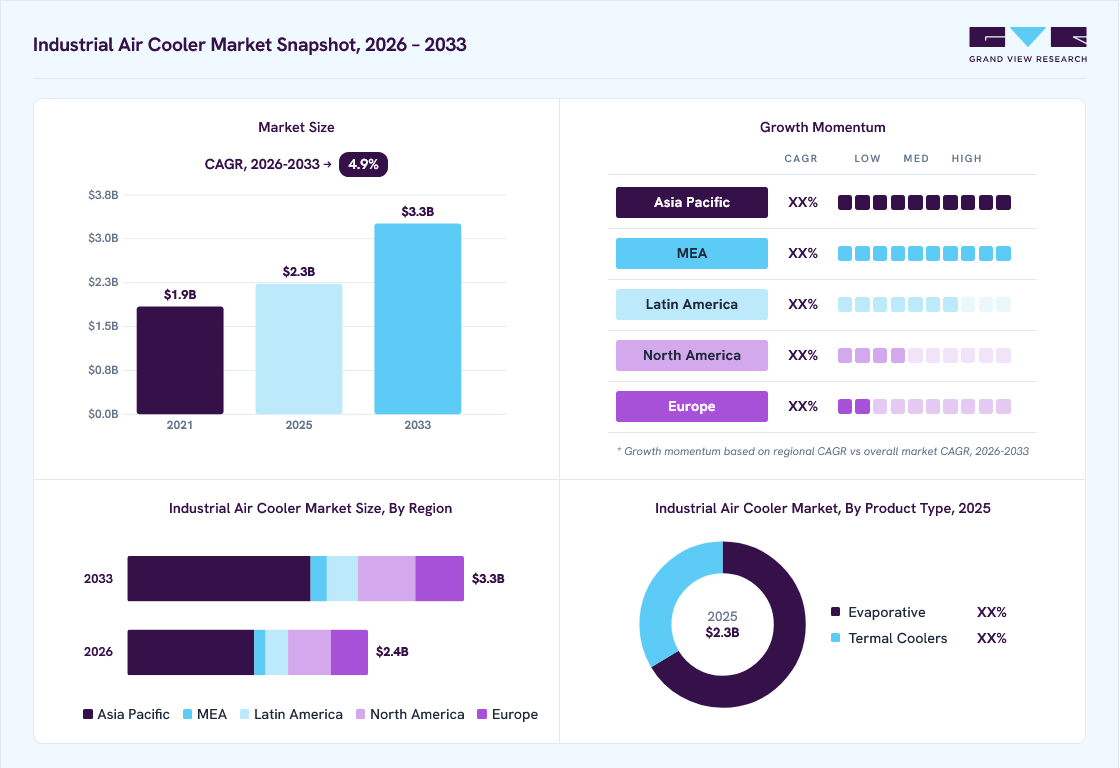 Source: Grand View Research, IR Documents, Primary Interviews, Paid DatabasesTo learn more about this report,
 Download Free Sample Report
Key Market Trends & Insights
- By product type: Evaporative segment held the largest market share of 66.4% in 2025.
- By cooling capacity: 10,000 - 30,000 CFM segment held the largest market share of 48.0% in 2025.
- By distribution channel: Offline segment held the largest market share of 71.2% in 2025.
- By type: Stationary segment held the largest market share of 54.7% in 2025.
- By end use: Manufacturing segment held the largest market share of 35.9% in 2025.
Regional Highlights
- Largest regional market: Asia Pacific (52.5% revenue share, 2025)
- By country: China held the largest market share in 2025
Market Size & Forecast
- Market size in 2025: USD 2.3 Billion
- Estimated market size in 2026: USD 2.4 Billion
- Projected market size by 2033: USD 3.3 Billion
- CAGR (2026-2033): 4.9%
Three ways to get this report
Buy it, customize it, or ask a question.Ask an Analyst
Analyst response in 1 business day
- AccessReport author, directly
- Reply timeWithin 1 working day
- No sales callDirect answer only
- FormatEmail reply
- CostFree, no cost
Get the Full Report
What the study covers
- FormatsPDF · Excel · Dashboard
- Timeline2026–2033 annual, 2025 base
- Coverage20+ countries, 5 regions
- Companies10+ key players profiled
Customize the Report
20% free customization
- IncludeCountries, segments, points
- TailorTo your product definition
- ExtendDeeper competitor detail
- OrA fully bespoke study
- Turnaround5–10 working days
Air coolers, which consume less power and are eco-friendly compared to traditional air conditioning systems, are favored for their ability to provide efficient cooling while reducing carbon footprints, especially in dry and arid climates. Additionally, rapid industrialization and urbanization in developing economies significantly boost the demand for industrial air coolers. Expansion of manufacturing activities in sectors like power generation, automotive, oil & gas, and chemicals increases the need for process cooling systems to maintain operational efficiency and prevent costly shutdowns. To learn more about this report, Download Free Sample Report
Strong environmental regulations and a growing emphasis on sustainable and green technologies further accelerate the adoption of advanced industrial air cooling solutions, including IoT-enabled and hybrid systems that enhance energy efficiency and remote monitoring capabilities.
Market Dynamics
The global industrial air cooler market is driven by the increasing adoption of energy-efficient and environmentally sustainable cooling solutions across industries, including manufacturing, power generation, chemicals, pharmaceuticals, food processing, and logistics. Rising industrialization, expanding production facilities, and stringent environmental regulations promoting low-energy cooling technologies are supporting market growth. Continuous advancements in evaporative cooling technologies, smart monitoring systems, and automated controls are improving cooling efficiency, operational reliability, and lifecycle cost performance, further accelerating adoption. Additionally, growing investments in industrial infrastructure and the increasing emphasis on workplace safety and energy optimization are creating significant growth opportunities.
The industrial air coolers market is driven by the increasing demand for affordable, energy-efficient, and environmentally sustainable cooling solutions in industrial settings. Rapid industrialization and urbanization in developing regions, particularly across Asia Pacific and India, are fueling the need for effective cooling in factories, warehouses, manufacturing plants, and large commercial facilities.
Additionally, stricter environmental regulations and a growing focus on sustainable operations are encouraging industries to adopt evaporative and hybrid air coolers that reduce energy consumption and carbon emissions. Rising electricity costs, coupled with the need to improve worker comfort, operational efficiency, and workplace safety, are further supporting the adoption of industrial air cooling systems across diverse end-use industries.
The industrial air coolers market faces challenges due to the limited cooling capacity of air coolers compared to traditional air conditioning systems, restricting their use in humid and coastal regions where evaporation efficiency declines. Manual maintenance requirements, including water level monitoring, periodic cleaning, and water quality management, also reduce user convenience and increase operational efforts.
Furthermore, industrial facilities requiring precise temperature and humidity control often prefer conventional HVAC systems because of their advanced performance capabilities. The growing availability of high-efficiency air conditioning systems and favorable financing options for HVAC installations further restrain the adoption of industrial air coolers across certain industrial and commercial applications.
The industrial air coolers market presents significant growth opportunities through technological advancements such as IoT integration, smart controls, and next-generation evaporative cooling technologies that enhance energy efficiency and operational convenience. Emerging economies offer strong expansion potential due to rapid industrial development, increasing investments in manufacturing infrastructure, and growing awareness of environmentally sustainable cooling solutions.
Additionally, rising investments in research and development focused on hybrid and adiabatic cooling systems designed to minimize both water and energy consumption are creating lucrative opportunities for manufacturers seeking to differentiate through innovation. The increasing adoption of Industry 4.0 and smart factory initiatives is also expected to accelerate demand for intelligent, connected, and energy-optimized cooling solutions.
Market Concentration & Characteristics
The industrial air cooler market exhibits a moderately consolidated structure, with a mix of established global players and regional manufacturers. Leading companies maintain a competitive edge through technological innovation, broad distribution networks, and strong brand recognition. However, the market also includes numerous smaller firms that cater to region-specific requirements and offer cost-effective solutions, particularly in emerging economies. While top players dominate in terms of revenue and product innovation, the presence of several local competitors contributes to a dynamic and fragmented landscape in price-sensitive regions.
Innovation in the industrial air coolers market is focused on enhancing energy efficiency, integrating IoT and smart monitoring systems, and developing hybrid cooling technologies. Manufacturers are investing in advanced evaporative and adiabatic cooling techniques to reduce power consumption and environmental impact. The shift toward sustainable and green technologies, along with the need for precise temperature control in industries like food & beverage and pharmaceuticals, is pushing continuous product development and technological upgrades.
 To learn more about this report, Download Free Sample Report
M&A activity in the industrial air coolers market remains moderate, primarily driven by companies aiming to expand their technological capabilities and geographic footprint. Leading players often acquire smaller firms with niche technologies or regional presence to strengthen their product offerings and market access. This consolidation trend supports innovation and helps companies meet stringent regulatory standards while addressing diverse customer needs globally.
Strong environmental regulations and energy efficiency standards significantly influence the industrial air coolers market. Governments worldwide are enforcing policies to reduce carbon emissions and promote sustainable cooling solutions, which encourages manufacturers to develop eco-friendly and energy-saving products. Compliance with these regulations is critical, especially in developed regions like North America and Europe, driving the adoption of advanced industrial cooling systems.
Analyst Perspective
The industrial air cooler market is witnessing steady growth as industries increasingly seek energy-efficient and cost-effective cooling solutions for large manufacturing facilities, warehouses, logistics centers, and processing plants. Rising industrialization, expanding manufacturing capacity, and growing emphasis on worker comfort and productivity are driving the adoption of high-capacity air cooling systems. In addition, increasing energy costs and sustainability initiatives are encouraging end users to replace conventional air conditioning systems with evaporative air coolers that offer lower operating costs and reduced environmental impact. Advancements in smart controls, variable-speed fans, and IoT-enabled monitoring are further enhancing system efficiency and operational reliability. As industrial facilities continue to modernize and prioritize energy-efficient climate control, manufacturers offering durable, high-performance, and application-specific industrial air coolers are expected to benefit from sustained long-term market growth.
Drivers, Opportunities & Restraints
The industrial air coolers market is experiencing strong growth driven by the increasing demand for affordable, energy-efficient, and eco-friendly cooling solutions in industrial settings. Rapid industrialization and urbanization in developing regions, especially in Asia Pacific and India, are fueling the need for effective cooling in factories, warehouses, and manufacturing plants. Additionally, stricter environmental regulations and a focus on sustainable operations are encouraging industries to adopt evaporative and hybrid air coolers that reduce energy consumption and carbon footprints.
The industrial air coolers market is poised for significant growth, driven by technological advancements such as IoT integration, smart controls, and next-generation evaporative cooling technologies that enhance energy efficiency and operational convenience. Emerging economies present strong expansion opportunities due to rising disposable incomes and increasing awareness of environmentally sustainable cooling solutions. Additionally, growing investments in R&D focused on hybrid and adiabatic cooling systems designed to minimize both water and energy consumption are creating lucrative opportunities for manufacturers seeking to differentiate through innovation.
The market faces challenges due to the limited cooling capacity of air coolers compared to traditional air conditioning systems, restricting their use in humid and coastal regions where evaporation efficiency drops. Manual maintenance requirements, such as water level management, also limit user convenience. Furthermore, urban consumers often prefer air conditioners due to their advanced features and availability of financing options, which restrains the widespread adoption of air coolers in certain segments.
Product Type Insights
Based on product type, the evaporative segment led the market with the largest revenue share of 66.4% in 2025, due to their energy efficiency, cost-effectiveness, and environmentally friendly operation. Their straightforward technology and minimal maintenance needs render them exceptionally well-suited for industrial applications, particularly in hot and arid climates. This widespread applicability and preference in emerging markets contribute to their leading position in the market.
Thermal Coolers represents the fastest-growing segment in the market, driven by its use in more niche applications, often in applications requiring precise temperature control or where evaporative cooling is less effective, such as in humid environments. The complexity and higher energy consumption relative to evaporative coolers limit their rapid adoption in cost-sensitive industrial markets. However, ongoing innovations in thermal cooling technology could create growth opportunities in specialized industrial applications where stable and controlled cooling is critical.
Cooling Capacity Insights
Based on cooling capacity, the 10,000 - 30,000 CFM segment led the market with the largest revenue share of 48.0% in 2025. The 10,000 to 30,000 CFM segment offers an optimal balance between cooling capacity and energy efficiency for a wide range of industrial applications. This capacity range is well-suited for medium to large manufacturing plants and warehouse facilities that require effective temperature control without excessive energy consumption. Its versatility and adaptability to various industrial environments contribute to its leading market share.
Above 30,000 CFM is the fastest growing segment, driven by increasing demand from large-scale industries such as power generation, petrochemical, and heavy manufacturing that require high-capacity cooling solutions. Technological advancements enabling customization and higher static pressure fans have expanded the applicability of large-capacity coolers. Growth in mega industrial projects and expanding infrastructure in emerging economies further increases adoption in this segment.
Distribution Channel Insights
Based on distribution channel, the offline segment led the market with the largest revenue share of 71.2% in 2025 owing to the complex nature of the products, which often require personalized consultation, installation support, and after-sales service. Industrial buyers typically prefer direct interaction with manufacturers or authorized dealers to ensure product suitability and reliability. Established relationships and the necessity for technical support make offline channels the favored option for most industrial customers.
The online distribution channel is the fastest growing segment, driven by increasing digital adoption and the convenience of e-commerce platforms. Manufacturers and distributors are expanding their online presence to reach a broader customer base, especially small and medium enterprises seeking quick access to product information and competitive pricing. The rise of digital procurement processes and improved logistics infrastructure further accelerated the growth of online sales in the industrial air coolers market.
Type Insights
Based on type, the stationary segment led the market with the largest revenue share of 54.7% in 2025 due to their suitability for large-scale industrial applications requiring continuous and stable cooling. These systems are installed permanently in factories and warehouses, providing reliable cooling with higher capacity and efficiency. The need for robust cooling solutions in industries such as manufacturing, power generation, and chemical processing drives their widespread adoption.
Portable air coolers are expanding significantly due to their flexibility, ease of use, and energy efficiency. They are increasingly favored in industrial environments where mobility and quick cooling are essential for spot cooling and temporary setups. The growth is further fueled by increasing urbanization and consumer preference for cost-effective, eco-friendly cooling solutions with smart features. The portable air cooler market is projected to grow at a strong CAGR, reflecting rising demand worldwide.
End Use Insights
Based on end use, the manufacturing segment led the market with the largest revenue share of 35.9% in 2025 owing to its extensive need for maintaining optimal temperatures to ensure machinery efficiency and worker comfort. This sector includes heat-intensive industries such as automotive, textiles, and heavy machinery, which rely heavily on air coolers to prevent overheating and reduce downtime. The widespread industrialization and expansion of manufacturing hubs, particularly in Asia Pacific and North America, reinforce this segment’s leading market share.
 To learn more about this report, Download Free Sample Report
The pharmaceutical segment is the fastest growing in the market, due to the critical need for precise temperature control in drug manufacturing and storage. Strict regulatory standards for maintaining product quality and safety drive the adoption of reliable and energy-efficient industrial air coolers. Additionally, the expansion of pharmaceutical manufacturing facilities globally further fuels demand in this segment.
Regional Insights
The North American industrial air coolers market in 2025 remains robust, driven by strong demand from well-established manufacturing and processing industries that require efficient and reliable cooling solutions. Key sectors such as oil & gas, petrochemicals, automotive, and food & beverage contribute significantly, supported by a large installed base of industrial cooling systems.
U.S. Industrial Air Coolers Market Trends
The industrial air coolers market in the U.S. is expected to grow at a CAGR of 4.3% from 2026 to 2033. The U.S. holds the largest share of the North America region, driven by extensive infrastructure such as data centers and industrial facilities that require energy-efficient cooling solutions.
Canada industrial air coolers market is growing rapidly, driven by rising average temperatures and increasing demand for energy-efficient cooling solutions in the industrial sector. Economic growth and rising consumer spending power also support the adoption of air coolers, especially in regions with dry climates where evaporative cooling is most effective.
Europe Industrial Air Coolers Market Trends
The Europe industrial air coolers market is growing steadily, driven by rising summer temperatures, increasing urbanization, and stringent energy efficiency regulations. The region’s focus on sustainable and green cooling technologies, aligned with the EU’s carbon neutrality goals, is accelerating the adoption of energy-efficient air coolers across the industrial sector.
Germany industrial air coolers market held 32.4% share in the European market. Germany holds a dominant position in the European industrial air coolers market due to its strong industrial base and early adoption of energy-efficient cooling technologies. The country’s focus on reducing carbon emissions and stringent environmental regulations encourage industries to invest in advanced, low energy cooling solutions, supporting sustained market growth.
Industrial air coolers market in UK is driven by government initiatives targeting sustainability and decarbonization. Rising demand for low-energy cooling systems, especially evaporative air coolers, is driven by increasing heatwaves and the growing emphasis on green building practices and smart city projects.
Asia Pacific Industrial Air Coolers Market Trends
Asia Pacific dominated the industrial air cooler market with the largest revenue share of 52.5% in 2025. driven by rapid urbanization, a growing middle-class population, and increasing demand for affordable, energy-efficient cooling solutions. Rising temperatures and expanding industrial and commercial infrastructure in countries like China and India further fuel market growth.
 To learn more about this report, Download Free Sample Report
The industrial air cooler market in China held the largest share in the Asia Pacific region in 2025. owing to its fast manufacturing capabilities, extensive distribution networks, and supportive government initiatives like the "Made in China 2025" plan promoting energy-efficient appliances. The country’s large industrial base and rising consumer demand for affordable cooling solutions sustain its leadership in production volume and market size.
Industrial air coolers market in the India is expected to grow at a CAGR of 6.0% from 2026 to 2033. Propelled by growing industrialization and the rising demand for energy-efficient and portable air coolers, the country’s hot and dry climate, combined with increasing awareness of sustainable cooling technologies, drives strong demand across industrial, residential, and commercial sectors.
Middle East & Africa Industrial Air Coolers Market Trends
The Middle East & Africa industrial air coolers market is growing rapidly due to rising temperatures and increasing demand for energy-efficient, cost-effective cooling solutions in the industrial sector. Countries like Saudi Arabia and the UAE face extreme heat conditions, driving the adoption of evaporative air coolers that are well-suited for dry and arid climates.
UAE industrial air coolers market is witnessing rapid growth due to the extensive infrastructure development, including commercial real estate and healthcare facilities, which require efficient cooling systems.
Latin America Industrial Air Coolers Market Trends
The Latin American industrial air coolers market is experiencing steady growth, driven by expanding industrial activities and increasing demand for cost-effective, energy-efficient cooling solutions. Countries such as Brazil, and Argentina are witnessing infrastructure development and industrialization across sectors like food & beverage, mining, and chemicals, which is fueling the need for reliable air cooling systems. Additionally, the region’s warm climate and growing awareness of sustainable cooling technologies are encouraging the adoption of evaporative and hybrid air coolers.
Brazil industrial air coolers market is driven by rising temperatures, increasing urbanization, and government initiatives like the “Minha Casa Minha Vida” program that support infrastructure development. Additionally, the expanding industrial base, improved electricity availability in rural areas, and the cost advantage of air coolers over air conditioners contribute to strong market growth, with the industrial segment experiencing particularly high expansion rates.
Key Industrial Air Cooler Company Insights
Some of the key players operating in the market include Symphony, Honeywell International Inc., and NewAir.
-
Symphony is an Indian multinational company specializing in the manufacturing of air coolers. It is renowned for its innovative and energy-efficient products, which cater to residential and industrial needs. Symphony’s product portfolio includes a wide range of air coolers designed to provide optimal cooling performance while minimizing energy consumption.
-
NewAir specializes in portable evaporate air coolers designed for both commercial and industrial applications, providing eco-friendly and energy-efficient cooling solutions. Their products use evaporative cooling technology to draw hot, dry air through water-saturated pads, delivering cool, moisture-laden air ideal for dry and arid environments. NewAir’s industrial coolers feature powerful fans and durable construction, making them suitable for warehouses, workshops, and large indoor spaces requiring effective ventilation and temperature control.
Key Industrial Air Cooler Companies
The following key companies have been profiled for this study on the industrial air cooler market.
-
Brize
-
Sky Air Cooler
-
Symphony
-
Evapoler
-
LANFEST
-
Fujian Jinghui Environmental Technology Co., Ltd.
-
Seeley International
-
Luma Comfort Corporation
-
Midea Group
-
Daikin Industries Ltd.
-
Panasonic Corporation
-
Champion Cooler
-
Marut Air
-
Sterling Thermal Technology
-
Ram Coolers
Competitive Benchmarking
Category
Operating Strategies
Competitive Edge
Weakness
Established Players (e.g., Seeley International, Munters, Portacool, Hessaire, Big Ass Fans, Breezair (Seeley International)
- Focus on large-scale industrial and commercial HVAC/evaporative cooling portfolios with strong global distribution networks and long-term service contracts.
- Invest in advanced product engineering, energy-efficient designs, and integrated smart cooling systems aligned with industrial decarbonization goals.
- Strengthen presence across North America, Europe, and developed Asia-Pacific markets through OEM partnerships and direct B2B sales channels.
- Strong global brand equity and established customer base across industrial and commercial sectors.
- Advanced R&D capabilities enabling high-efficiency, low-energy, and IoT-enabled cooling technologies.
- Extensive service infrastructure and aftermarket revenue streams (maintenance, spare parts, upgrades).
- Higher product and installation costs compared to regional manufacturers, limiting penetration in price-sensitive markets.
- Slower customization cycles due to large-scale organizational structures and standardized product lines.
- Exposure to cyclical demand in mature markets with slower industrial expansion rates.
Emerging & Regional Players (e.g., Marut Air, Sterling Thermal Technology, Fujian Jinghui Environmental Technology Co., Ltd., Evapoler, regional players)
- Target cost-sensitive industrial segments in emerging economies through competitive pricing and localized manufacturing.
- Focus on customized and application-specific cooling solutions for SMEs, mid-scale industries, and regional industrial clusters.
- Expand market reach through distributor-led networks, project-based sales, and government/industrial contracts.
- Strong price competitiveness enabling higher adoption in emerging and mid-tier industrial markets.
- Flexibility in product customization and faster adaptation to local climatic and industrial requirements.
- Growing regional presence with strong responsiveness to infrastructure development and industrial expansion.
- Limited global brand recognition and relatively weaker international distribution networks.
- Lower R&D investment compared to global leaders, impacting technological advancement and innovation pace.
- Dependence on regional demand cycles and limited diversification across high-value industrial segments.
Recent Developments
-
In March 2025, Symphony Limited, a global leader in air coolers, announced the launch of a new series of industrial evaporative air coolers featuring enhanced energy efficiency and smart IoT-enabled controls, aimed at improving cooling performance and reducing operational costs in large industrial facilities.
-
In March 2025, CG Power and Industrial Solutions Ltd (CG) undertook a strategic initiative by entering the air coolers market with the launch of a new product line featuring its proprietary JetChill Technology. This move marks a significant expansion of the company’s portfolio into climate control solutions. The JetChill Technology offers accelerated cooling performance through optimized airflow and enhanced energy efficiency.
Industrial Air Coolers Market Report Scope
Report Attribute
Details
Market size in 2025
USD 2.3 billion
Estimated market size in 2026
USD 2.4 billion
Projected market size by 2033
USD 3.3 billion
Growth rate
CAGR of 4.9% from 2026 to 2033
Base year for estimation
2025
Historical data
2021 - 2024
Forecast period
2026 - 2033
Quantitative units
Revenue in USD billion and CAGR from 2026 to 2033
Report coverage
Revenue forecast, company ranking, competitive landscape, growth factors, and trends
Segments covered
Product type, cooling capacity, distribution channel, type, end use, region
Regional scope
North America; Europe; Asia Pacific; Latin America; Middle East & Africa
Country scope
U.S.; Canada; Mexico; UK; Germany; France; Spain; Italy; China; Japan; India; Australia; South Korea; Brazil; Argentina; Saudi Arabia; South Africa; UAE
Key companies profiled
Seeley International, Munters, Portacool, Hessaire, Big Ass Fans, Marut Air, Sterling Thermal Technology, Fujian Jinghui Environmental Technology Co., Ltd., Breezair (Seeley International), Evapoler
Customization scope
Free report customization (equivalent up to 8 analysts' working days) with purchase. Addition or alteration to country, regional & segment scope.
Pricing and purchase options
Avail customized purchase options to meet your exact research needs. Explore purchase options
Global Industrial Air Cooler Market Report Segmentation
This report forecasts revenue growth at global, regional, and country levels and provides an analysis of the latest industry trends in each of the sub-segments from 2021 to 2033. For this study, Grand View Research has segmented the global industrial air coolers market report based on product type, cooling capacity, distribution channel, type, end use, and region:
-
Product Type Outlook (Revenue, USD Million, 2021 - 2033)
-
Evaporative
-
Thermal Coolers
-
-
Cooling Capacity Outlook (Revenue, USD Million, 2021 - 2033)
-
Up to 10,000 CFM
-
10,000 - 30,000 CFM
-
Above 30,000 CFM
-
-
Distribution Channel Outlook (Revenue, USD Million, 2021 - 2033)
-
Offline
-
Online
-
-
End Use Outlook (Revenue, USD Million, 2021 - 2033)
-
Manufacturing
-
Food & Beverage
-
Pharmaceutical
-
Chemical & Petrochemical
-
Power Generation
-
Warehouse
-
Others
-
-
Type Outlook (Revenue, USD Million, 2021 - 2033)
-
Portable
-
Stationary
-
-
Regional Outlook (Revenue, USD Million, 2021 - 2033)
-
North America
-
U.S.
-
Canada
-
Mexico
-
-
Europe
-
Germany
-
France
-
Italy
-
Spain
-
UK
-
-
Asia Pacific
-
China
-
India
-
Japan
-
South Korea
-
Australia
-
-
Latin America
-
Brazil
-
Argentina
-
-
Middle East and Africa
-
Saudi Arabia
-
UAE
-
South Africa
-
-
Research Methodology
The industrial air cooler market figures in this report are based on a proven research process that combines executive interviews with secondary research from proprietary databases, company filings, and recognized regulatory and institutional sources. Market size is built through value-chain sizing - reconciling supply-side and demand-side estimates - and triangulated with bottom-up and top-down approaches. Every estimate passes multiple levels of expert validation before publication, with each industrial air cooler segment quantified using the revenue-capture definitions in the table below.
Segment Definition
Product
Revenue Capture Definition
Evaporative
Revenue is generated from the sale of industrial evaporative air coolers that utilize water evaporation technology to cool air efficiently for large industrial and commercial spaces, reducing energy consumption compared to conventional cooling systems.
Thermal Coolers
Revenue is generated from the sale of industrial thermal cooling systems that use heat exchange or hybrid cooling mechanisms to regulate temperature in industrial environments requiring enhanced cooling performance and operational stability.
Cooling Capacity
Revenue Capture Definition
Up to 10,000 CFM
Revenue is generated from compact industrial air coolers designed for small-scale industrial applications, localized work areas, and confined spaces requiring moderate airflow and targeted cooling.
10,000 - 30,000 CFM
Revenue is generated from medium-capacity industrial air coolers used in manufacturing facilities, warehouses, and production units requiring balanced airflow and area-wide cooling efficiency.
Above 30,000 CFM
Revenue is generated from high-capacity industrial air cooling systems deployed in large-scale industrial plants, heavy manufacturing facilities, and power-intensive environments requiring extensive air circulation.
Distribution Channel
Revenue Capture Definition
Offline
Revenue is generated from industrial air cooler sales conducted through direct sales channels, distributors, dealers, and industrial equipment suppliers serving B2B customers.
Online
Revenue is generated from industrial air cooler sales through digital platforms, including company websites and online procurement channels facilitating inquiry-based and direct purchases.
End Use
Revenue Capture Definition
Manufacturing
Revenue is generated from industrial air coolers deployed in manufacturing facilities to maintain optimal operating conditions, protect equipment performance, and enhance workforce productivity.
Food & Beverage
Revenue is generated from industrial air coolers used in food processing, packaging, and storage environments requiring controlled temperature and hygienic cooling conditions.
Pharmaceutical
Revenue is generated from industrial air coolers installed in pharmaceutical manufacturing units, laboratories, and cleanrooms requiring controlled environmental conditions.
Chemical & Petrochemical
Revenue is generated from industrial air cooling systems used in chemical processing plants and refineries where temperature control is essential for safe and efficient operations.
Power Generation
Revenue is generated from industrial air coolers used in power plants and energy facilities to manage heat loads and support continuous equipment operation.
Warehouse
Revenue is generated from industrial air coolers used in storage and logistics facilities to maintain ambient temperature conditions and protect stored goods.
Others
Revenue is generated from industrial air coolers used in additional industrial and commercial applications not covered under defined end-use categories.
Type
Revenue Capture Definition
Portable
Revenue is generated from movable industrial air coolers designed for flexible deployment across different industrial zones and temporary cooling requirements.
Stationary
Revenue is generated from fixed industrial air cooling systems installed for continuous cooling in permanent industrial facilities and large-scale operations
Estimation Model
Layer No.
Layer Name
Key Question
Description
01
Industrial Cooling Demand Base Layer
Where are industrial air coolers required?
Analyze demand across manufacturing, warehouses, logistics facilities, food & beverage processing, automotive, textiles, chemicals, power generation, mining, and other industrial sectors.
02
Industrial Infrastructure & Facility Investment Layer
Where is new equipment demand being created?
Evaluate investments in manufacturing plants, warehouses, distribution centers, factories, and industrial infrastructure. Assess greenfield projects, facility expansions, HVAC upgrades, and replacement of conventional cooling systems that drive procurement of new industrial air coolers.
03
Product Adoption Layer
Which industrial air cooler technologies are being deployed?
Segment demand by product type, mounting type, cooling capacity, airflow, end-use industry, and distribution channel. Apply adoption rates based on cooling requirements, energy efficiency, operating environment, facility size, and climate conditions.
04
Revenue Generation Layer
How is market revenue generated?
Estimate annual shipments of industrial air coolers by product type, cooling capacity, end-use industry, and region. Quantify revenues generated exclusively from the sale of new industrial air coolers supplied to industrial facilities, commercial users, distributors, and HVAC contractors.
Delivered Customizations
This report has been delivered with the following In-depth customizations
Client Request
Customization Delivered
Value Adds
Competitive Benchmarking
Benchmarked leading industrial air cooler manufacturers based on product portfolio strength, technological capabilities, energy efficiency positioning, geographic footprint, and aftermarket service offerings, while distinguishing global established players from emerging and regional competitors
Provided a structured assessment of the competitive landscape, enabling evaluation of market positioning, differentiation strategies, and competitive intensity across evaporative and thermal cooling segments
Regional Segmentation
Refined regional analysis by assessing climatic conditions, industrial activity levels, energy cost structures, regulatory frameworks promoting energy-efficient cooling, and industrial infrastructure development across North America, Europe, Asia Pacific, Latin America, and Middle East & Africa
Enabled identification of high-growth regions driven by extreme temperature conditions, rapid industrial expansion, and increasing adoption of energy-efficient evaporative cooling systems, supporting targeted regional expansion strategies
Opportunity assessment
Evaluated emerging growth opportunities across smart cooling systems, IoT-enabled industrial air coolers, hybrid and adiabatic technologies, retrofit applications in existing industrial facilities, and demand from temperature-intensive industries including manufacturing, warehousing, and power generation
Supported prioritization of high-value revenue opportunities by identifying segments with strong replacement demand, efficiency-driven upgrades, and increasing adoption of sustainable industrial cooling solutions
Frequently Asked Questions About This Report
The global industrial air cooler market size was valued at USD 2.3 billion in 2025 and is estimated at USD 2.4 billion for 2026.
The global industrial air cooler market is expected to grow at a CAGR of 4.9% from 2026 to 2033, reaching USD 3.3 billion by 2033.
Manufacturing segment by end use dominated the industrial air coolers market in 2025 holding 35.9% market share.
Some of the key players operating in the global industrial air coolers market include Seeley International, Munters, Portacool, Hessaire, Big Ass Fans, Marut Air, Sterling Thermal Technology, Fujian Jinghui Environmental Technology Co., Ltd., Breezair (Seeley International), Evapoler
Key factor driving the market is the demand for industrial air cooler is anticipated to be driven by the increasing need for cost-effective and energy-efficient cooling solutions, particularly in developing economies where operational costs are a critical concern.
Based on product type, the evaporative segment led the market with the largest revenue share of 66.4% in 2025.
Based on cooling capacity, the 10,000 - 30,000 CFM segment led the market with the largest revenue share of 48.0% in 2025.
Based on distribution channel, the offline segment dominated the market with the largest revenue share of 71.2% in 2025.
Asia Pacific held a significant share of the market and accounted for a share of 52.5% in 2025.
About the Author(s)
Advanced Interior Materials Research Team
Advanced Materials · Advanced Interior MaterialsThis report was authored by the advanced interior materials research team at Grand View Research - comprising two research analysts, one senior research analyst, and one industry expert - with specialized expertise in the advanced interior materials segment of the advanced materials industry. All findings are based on proprietary advanced materials databases, executive interviews, and regulatory analysis, subject to internal peer review prior to publication.
Last Updated:
Speak to Analyst

Customize this report to your needs - add regions, segments, or data points, with 20% free customization.
Or view our licence options:


ISO 9001:2015 & 27001:2022 Certified
We are GDPR and CCPA compliant! Your transaction & personal information is safe and secure. For more details, please read our privacy policy.


