
- Home
- »
- Sensors & Controls
- »
-
Industrial Sensors Market Size, Growth Report, 2026-2033GVR Report cover

Industrial Sensors Market (2026 - 2033)
Size, Share & Trends Analysis Report By Sensor, By Type (Contact Sensors, Non-Contact Sensors), By Technology (Wired Sensors, Wireless Sensors), By End Use (Manufacturing, Automotive), By Region, And Segment Forecasts
Market Size, 2025
$27.4BMarket Estimate, 2026
$30.3BMarket Forecast, 2033
$53.4BCAGR, 2026–2033
8.5%Industrial Sensors Market Summary
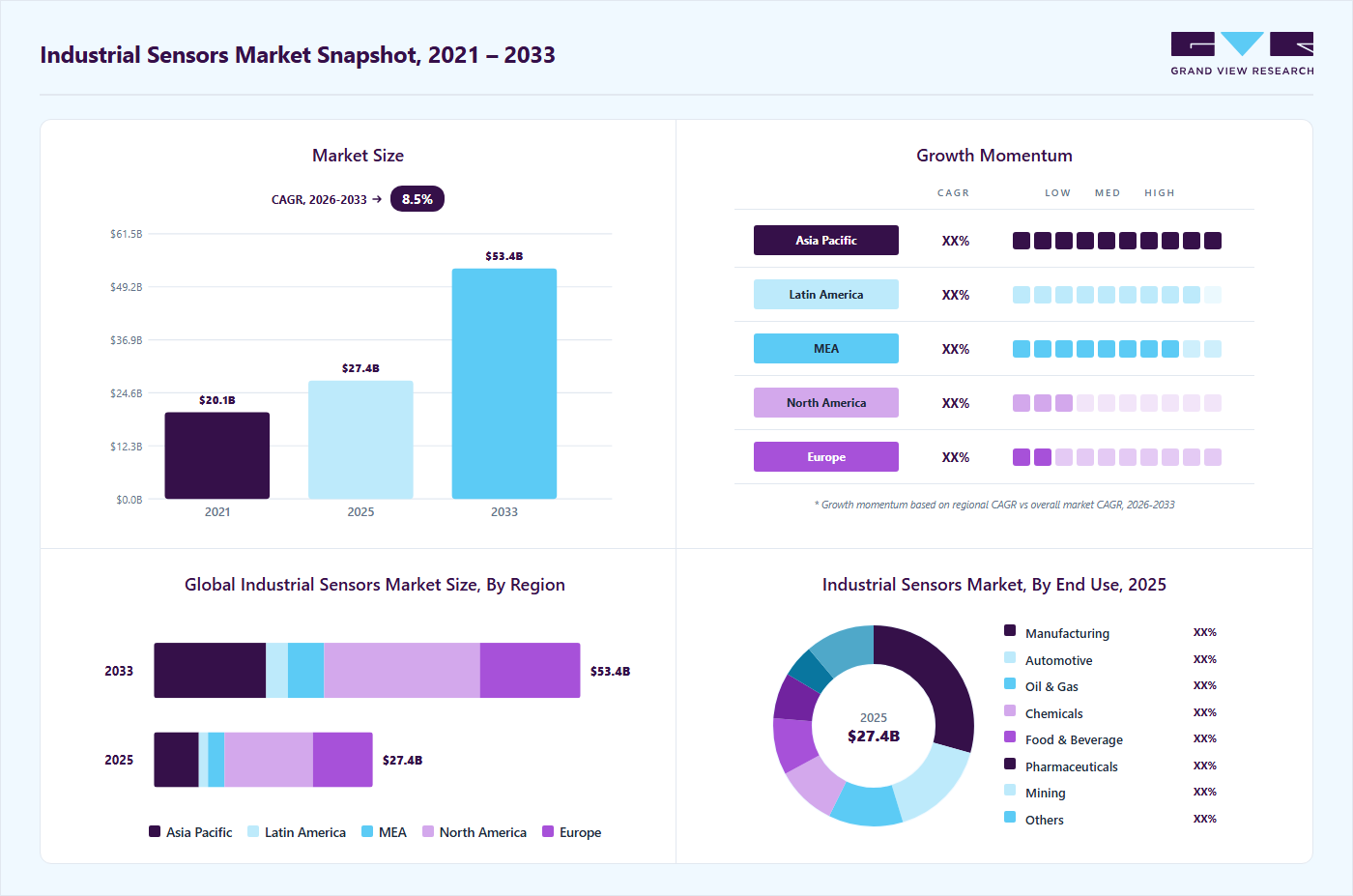
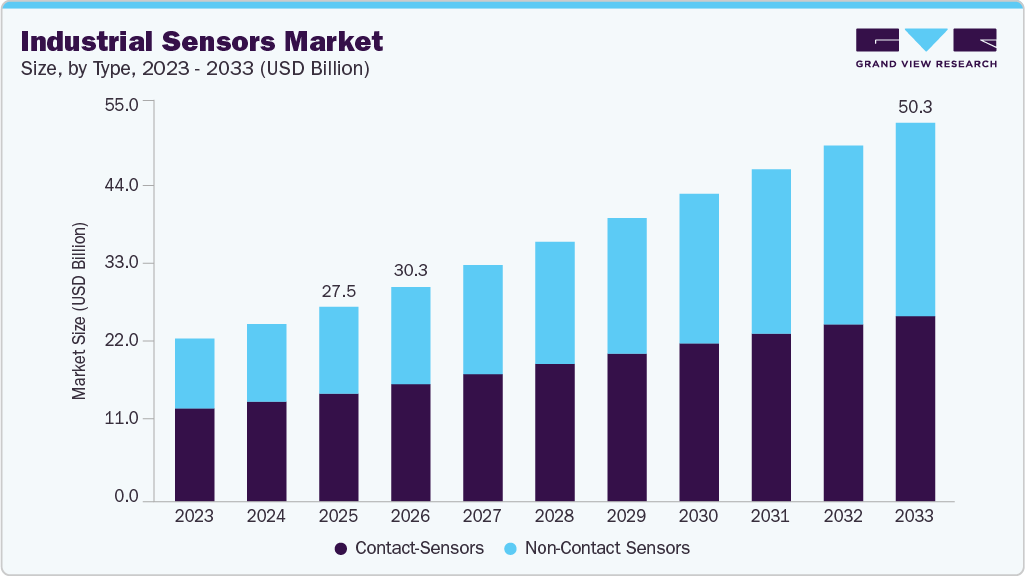
The global industrial sensors market size was valued at USD 27.4 billion in 2025 and is projected to grow from USD 30.3 billion in 2026 to USD 53.4 billion by 2033, at a CAGR of 8.5% from 2026 to 2033. The North America industrial sensors industry accounted for the largest revenue share of over 40% in 2025. This growth is primarily driven by the increasing adoption of automation and Industry 4.0 initiatives across various sectors, where sensors play a crucial role in enabling real-time monitoring, process optimization, and predictive maintenance.
 Source: Grand View Research, IR Documents, Primary Interviews, Paid DatabasesTo learn more about this report,
 Download Free Sample Report
Key Market Trends & Insights
- By sensor: Temperature sensor segment held the dominant position and accounted for the largest revenue share of over 16% in 2025.
- By type: contact sensor segment dominated the market in 2025.
- By technology: wired sensors segment accounted for the largest share of over 66% in 2025.
Regional Highlights
- Largest regional market: North America (40% revenue share, 2025)
- By country: The U.S. held the largest market share in 2025.
Market Size & Forecast
- Market size in 2025: USD 27.4 Billion
- Estimated market size in 2026: USD 30.3 Billion
- Projected market size by 2033: USD 53.4 Billion
- CAGR (2026-2033): 8.5%
Three ways to get this report
Buy it, customize it, or ask a question.Ask an Analyst
Analyst response in 1 business day
- AccessReport author, directly
- Reply timeWithin 1 working day
- No sales callDirect answer only
- FormatEmail reply
- CostFree, no cost
Get the Full Report
What the study covers
- FormatsPDF · Excel · Dashboard
- Timeline2026–2033 annual, 2025 base
- Coverage20+ countries, 5 regions
- Companies10+ key players profiled
Customize the Report
20% free customization
- IncludeCountries, segments, points
- TailorTo your product definition
- ExtendDeeper competitor detail
- OrA fully bespoke study
- Turnaround5–10 working days
In addition, the growing integration of sensors into the Industrial Internet of Things (IIoT) and cloud computing platforms is significantly driving the market expansion, as it enhances data-driven decision-making and operational efficiency in the manufacturing, energy, and infrastructure industries.The increasing adoption of advanced sensor technologies such as MEMS (Micro-Electro-Mechanical Systems) and CMOS sensors, which offer miniaturization, low power consumption, and high precision, is driving the market demand. These technological advancements enable more complex, precise applications in harsh industrial environments. The integration of wireless connectivity and rapid data transmission technologies, such as 5G, further facilitates seamless sensor data flows essential for smart manufacturing and real-time analytics. Non-contact sensors, flow sensors, pressure sensors, and proximity sensors are among the most in-demand sensors, particularly for process control and automation.
 To learn more about this report, Download Free Sample Report
In addition, the rising integration of edge AI technology is revolutionizing sensor performance and industrial automation. Edge AI enables real-time, on-site processing of sensor data, drastically reducing latency and bandwidth needs by analyzing information locally rather than relying on cloud transmission. This enables factories to detect anomalies, predict equipment failures, and optimize processes in real-time, thereby boosting operational efficiency and reducing downtime. With the rapid adoption in sectors such as automotive, electronics, and heavy machinery manufacturing, edge AI is driving smarter, more responsive industrial systems that align with Industry 4.0 goals of automation, predictive maintenance, and quality control.
Furthermore, sustainability and energy efficiency are emerging as vital factors driving market growth, as industrial sensors are being increasingly used to monitor energy consumption and emissions, enabling companies to comply with environmental regulations and reduce their carbon footprint. This environmental service aspect of sensors aligns well with the rising industrial focus on green manufacturing and regulatory compliance. Moreover, the demand for smart sensors embedded with AI and edge computing capabilities is growing, enabling more intelligent and decentralized industrial operations.
Moreover, companies are adopting various strategies to enhance their competitive edge. Key companies are focusing on significant investments in research and development to innovate smarter, more energy-efficient, and miniaturized sensor technologies. In addition, investments target the development of sensors capable of predictive analytics, artificial intelligence integration, and seamless connectivity with Industrial Internet of Things (IIoT) platforms. This R&D focus is supported by strategic partnerships, acquisitions, and collaborations with device OEMs, which accelerate time-to-market and expand product portfolios, enabling companies to meet the increasing demand for real-time monitoring, automation, and Industry 4.0 adoption across various sectors. Such strategies by key players are expected to drive the industrial sensors industry in the coming years.
Market Dynamics
The rapid adoption of industrial automation is one of the major drivers fueling the growth of the industrial sensors market. Manufacturing companies are increasingly implementing automated systems to improve production efficiency, reduce human intervention, and enhance product quality. Industrial sensors play a crucial role in automation by collecting real-time operational data related to pressure, temperature, flow, motion, and vibration. This data helps manufacturers optimize processes and maintain consistent production performance.
Industry 4.0 initiatives are further accelerating the demand for smart sensors integrated with IIoT platforms. Smart factories rely heavily on interconnected devices and sensor networks to enable predictive maintenance, remote monitoring, and intelligent decision-making. Sensors provide continuous feedback, enabling companies to detect faults early, minimize machine downtime, and improve operational productivity. The growing use of robotics and collaborative robots (cobots) in industrial environments is also increasing the deployment of advanced sensor technologies.
Additionally, governments and industrial organizations across regions are promoting digital transformation and automation in manufacturing sectors. High-speed connectivity technologies, such as 5G, are enabling seamless communication between industrial equipment and sensor systems. As industries continue focusing on operational efficiency, energy savings, and workplace safety, the demand for industrial sensors is expected to rise significantly in the coming years.
One of the major restraints in the industrial sensors market is the high initial cost of deploying advanced sensors. Smart and wireless sensors often require substantial investments for procurement, installation, and integration into existing industrial infrastructure. Small and medium-sized enterprises (SMEs), particularly in developing economies, may find these costs difficult to manage, limiting widespread adoption of advanced sensor technologies.
In addition to equipment costs, companies often need to invest in upgrading legacy systems, employee training, and cybersecurity measures to ensure smooth sensor integration. Many industrial facilities still operate with older machinery that may not be fully compatible with modern sensor networks and communication protocols. Retrofitting such systems can increase implementation complexity and extend return-on-investment timelines, discouraging some businesses from adopting advanced industrial sensing solutions.
Cybersecurity concerns also represent a significant challenge for the market. As industrial sensors become increasingly connected through IIoT networks, the risk of cyberattacks, unauthorized access, and operational disruptions grows. Companies handling sensitive operational data must implement strong security frameworks to protect industrial networks. These additional security requirements increase overall deployment costs and may slow down adoption among organizations with limited technical expertise or financial resources.
The increasing adoption of predictive maintenance solutions presents a major opportunity for the industrial sensors market. Industries are shifting from traditional reactive maintenance approaches to predictive maintenance systems that use sensor-generated real-time data to monitor equipment health and predict failures before they occur. This approach helps organizations reduce unplanned downtime, lower maintenance costs, and improve operational reliability.
Smart sensors equipped with artificial intelligence (AI), wireless connectivity, and cloud integration are creating new growth opportunities across industries. These sensors provide advanced analytics capabilities and enable remote monitoring of industrial assets. Companies are increasingly investing in sensor fusion technologies and AI-enabled diagnostics to enhance process efficiency and support autonomous industrial operations. The expansion of smart factories and digital manufacturing ecosystems is expected to increase demand for next-generation industrial sensors significantly.
Emerging economies in the Asia-Pacific, Latin America, and the Middle East are also offering lucrative growth opportunities for market players. Rapid industrialization, infrastructure development, and increasing investments in automation technologies are driving demand for industrial sensors in these regions. Furthermore, the development of new sensor types for applications such as gas detection, environmental monitoring, robotics, and energy management is expected to expand the scope of industrial sensor applications in the coming years.
Market Concentration & Characteristics
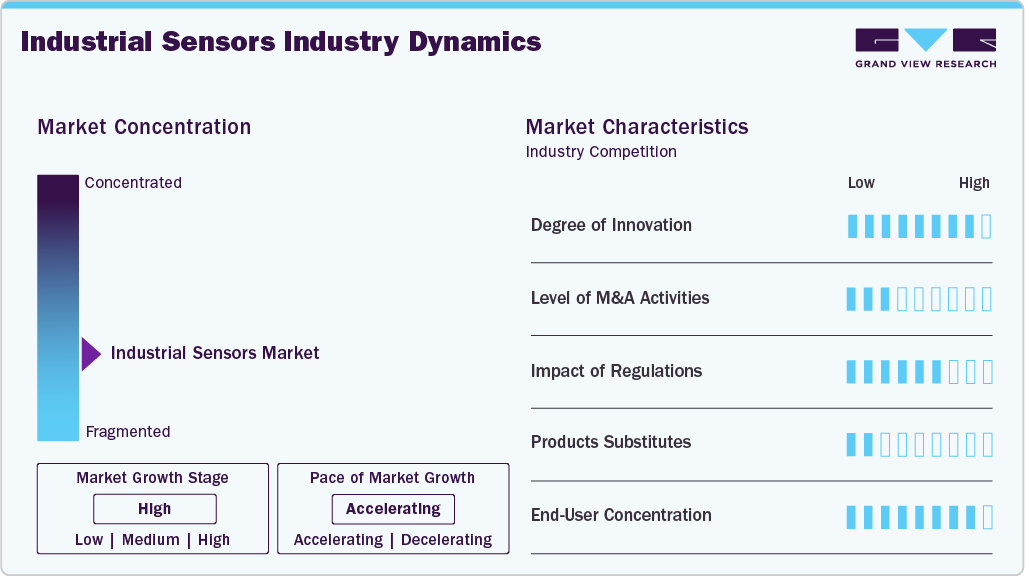
The global industrial sensors market is moderately fragmented, with the presence of large multinational corporations, regional manufacturers, and specialized sensor technology providers competing across industries such as manufacturing, automotive, oil & gas, chemicals, pharmaceuticals, energy, and food processing. The market is witnessing rapid technological advancements in smart sensors, wireless connectivity, MEMS-based sensors, IoT-enabled monitoring systems, and AI-driven predictive analytics, as companies increasingly focus on improving operational efficiency, automation, and real-time process monitoring.
 To learn more about this report, Download Free Sample Report
The market has limited direct substitutes, as industrial sensors play a critical role in monitoring pressure, temperature, flow, proximity, motion, vibration, and other operational parameters essential for industrial safety and process optimization. However, regulatory influence remains high due to stringent workplace safety regulations, environmental monitoring requirements, industrial automation standards, and quality control mandates imposed by governments and industry authorities globally. Compliance with cybersecurity standards for connected industrial systems is also becoming increasingly important as smart factory adoption accelerates across sectors. Additionally, expanding applications in electric vehicles, renewable energy facilities, semiconductor manufacturing, and smart infrastructure development are creating new growth opportunities for industrial sensor manufacturers globally.
Sensor Insights
The temperature sensor segment dominated the market with a share of over 16% in 2025, owing to its critical importance in monitoring and controlling thermal conditions across a wide range of industrial processes. These sensors are extensively used in manufacturing, energy, and chemical industries to ensure equipment safety, maintain product quality, and comply with operational standards, resulting in consistently high demand.
The gas & chemical sensor segment is expected to register the fastest CAGR of over 10% from 2026 to 2033, propelled by increasing emphasis on workplace safety, stringent environmental regulations, and the need for continuous monitoring of hazardous substances. The rising adoption of these sensors in industries such as oil & gas, chemicals, and manufacturing to detect toxic gases and prevent accidents is significantly contributing to their rapid growth.
Type Insights
The contact sensor segment dominated the market in 2025, fueled by its widespread use in traditional industrial applications where direct physical interaction ensures high measurement accuracy and reliability. These sensors are cost-effective, durable, and well-suited to established machinery and systems, which has led to their continued dominance in sectors with legacy infrastructure and stable operational requirements.
The non-contact sensor segment is expected to register the fastest CAGR from 2026 to 2033, owing to the increasing demand for high-speed, precise, and non-invasive sensing solutions in automated environments. Their ability to operate without physical contact reduces wear and tear, making them ideal for applications in robotics, electronics manufacturing, and hygienic industries such as food processing and pharmaceuticals, thereby driving segmental growth.
Technology Insights
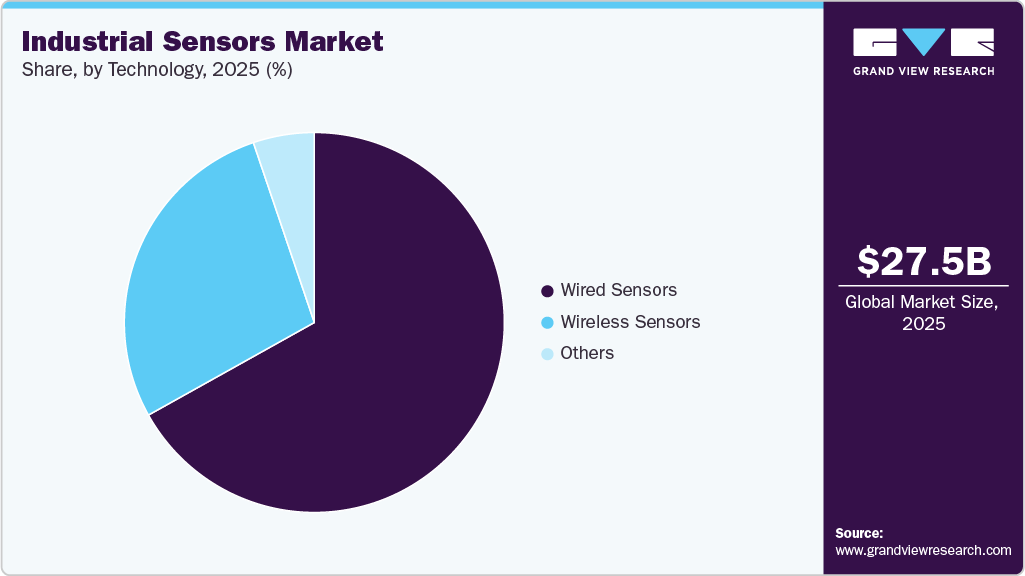
The wired sensor segment dominated the market in 2025, owing to its proven reliability, consistent data transmission, and strong resistance to signal interference in critical industrial environments. Many industries continue to rely on established wired infrastructure for continuous operations, particularly in sectors such as oil & gas and manufacturing, where stable connectivity and real-time data accuracy are essential for safety and process control. These factors are expected to drive the segmental growth in the coming years.
 To learn more about this report, Download Free Sample Report
The wireless sensor segment is expected to register the fastest CAGR from 2026 to 2033, fueled by the rapid expansion of Industrial Internet of Things (IIoT) ecosystems and the growing need for flexible, scalable monitoring solutions. Wireless sensors enable cost-effective deployment in remote, hazardous, and hard-to-access locations, while reducing installation and maintenance costs, making them increasingly attractive across industries undergoing digital transformation.
End Use Insights
The manufacturing segment dominated the market in 2025, owing to the rapid adoption of Industry 4.0 and smart factory initiatives, which require extensive sensor deployment for real-time monitoring, process optimization, and predictive maintenance. The increasing integration of automation, robotics, and digital control systems across production facilities has significantly boosted demand for industrial sensors to enhance operational efficiency, reduce downtime, and improve product quality, which is expected to drive the segmental growth in the coming years.
The pharmaceuticals segment is expected to register the fastest CAGR from 2026 to 2033, driven by stringent regulatory requirements such as GMP and FDA standards that mandate precise environmental and process monitoring. The growing need for contamination control, coupled with increased automation in drug manufacturing and expansion of biologics and vaccine production, is accelerating the adoption of advanced sensing technologies in cleanroom and laboratory environments.
Regional Insights
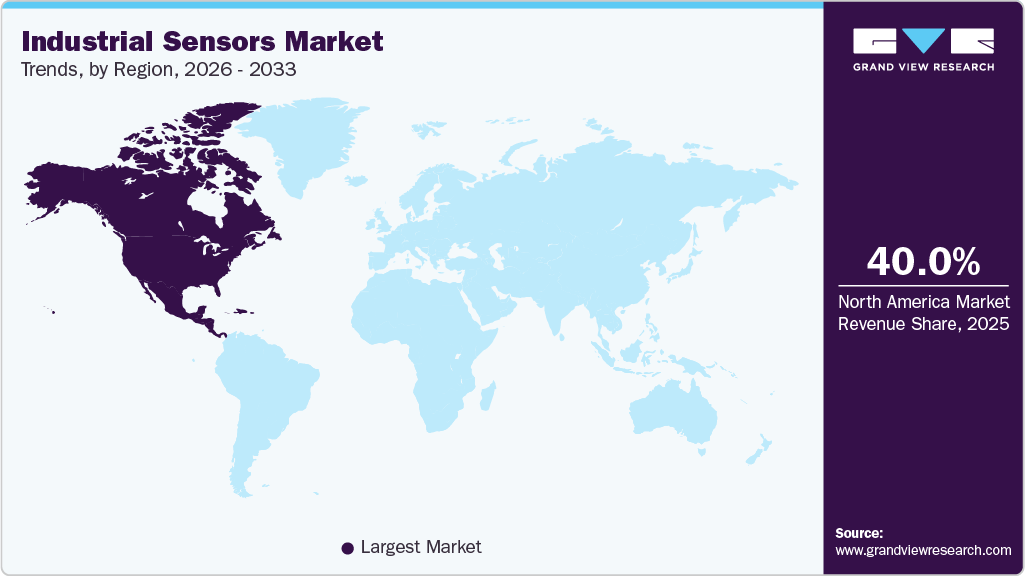
North America industrial sensors industry dominated the global market with a share of over 40% in 2025, driven by the rapid adoption of Industry 4.0 technologies and automation, supported by strong investments in smart factory infrastructure and advanced manufacturing. The presence of leading sensor manufacturers and government incentives that promote industrial innovation further accelerate market growth.
 To learn more about this report, Download Free Sample Report
U.S. Industrial Sensors Market Trends
The U.S. industrial sensors industry dominated the North America market with a share of over 84% in 2025, characterized by high demand for connected devices to enable M2M communication and data analytics drives sensor deployment. Key companies in U.S. are focusing on R&D to develop smart, precise sensors for Industry 4.0 applications, while partnerships and technology integration enhance competitive positioning.
Europe Industrial Sensors Market Trends
The Europe industrial sensors industry accounted for a share of over 27% in 2025, fueled by the region’s strong emphasis on industrial digitization and automation, particularly in countries such as Germany, France, and the UK. The adoption of Industry 4.0 across the manufacturing and process industries, alongside regulatory frameworks and sustainability goals, is driving the growing adoption of industrial sensors in the region.
The Germany industrial sensors industry is expected to grow significantly in the coming years, owing to its robust industrial base and leadership in Industry 4.0 adoption. The focus on smart factories, automation, and real-time monitoring in automotive, machinery, and electronics manufacturing propels sensor demand. Government programs supporting IoT and intelligent manufacturing further stimulate the market, complemented by strong R&D activities in sensor technologies.
The UK industrial sensors industry is rapidly expanding, driven by technological innovation and advancements in the advanced manufacturing sector, which, in turn, are driving sensor adoption. Government support for digital transformation and smart manufacturing initiatives enhances sensor integration in the automotive, aerospace, and pharmaceutical industries, thereby boosting market growth.
Asia Pacific Industrial Sensors Market Trends
The Asia Pacific industrial sensors industry is expected to grow at the highest CAGR of over 11% from 2025 to 2033, owing to rapid industrialization and government-backed industrial transformation programs. The region’s expanding manufacturing hubs and increasing automation in sectors such as automotive, electronics, and heavy machinery drive enormous demand for advanced sensors. Cost-effective production, increasing technical workforce availability, and rising domestic manufacturing also contribute significantly.
The China industrial sensors industry is driven by significant investments in automation and industrial upgrading. The agricultural automation (crop spraying and monitoring), forest protection, security services, and industrial inspection are other key factors driving the market expansion in China.
The Japan industrial sensors industry is rapidly expanding owing to the country’s advanced technology ecosystem, high adoption of IoT and cyber-physical systems, and strong manufacturing sectors, including automotive and electronics contribute to robust sensor demand. Continuous innovation and investment in R&D also drive market expansion.
Key Industrial Sensors Company Insights
Some of the key players operating in the market include Rockwell Automation, Inc., and Honeywell International, Inc., among others.
-
Rockwell Automation, Inc. is a global player in industrial automation and sensor technologies, providing smart automation and control solutions that enhance operational efficiency, safety, and reduce downtime across manufacturing and industrial sectors. The company is recognized for integrating advanced technologies, such as IoT and AI, into its sensor offerings, driving global Industry 4.0 adoption, and developing innovative modules, including the Allen-Bradley Compact 5000 Isolated Analog HART I/O Module, to enhance device diagnostics and system maintenance.
-
Honeywell International, Inc. is a diversified technology and manufacturing company with a strong presence in industrial sensors, serving sectors including aerospace, building technologies, and industrial automation. The company invests heavily in R&D to develop intelligent sensor solutions that enhance accuracy, connectivity, and reliability for applications ranging from energy management to process control. Its sensors enable better data-driven decision-making, improving operational performance and compliance with safety and environmental standards.
Datalogic S.p.A. and Turck, Inc. are some of the emerging market participants in the industrial sensors market.
-
Datalogic S.p.A. is a global technology player in automatic data capture and factory automation markets, specializing in the design and production of barcode readers, mobile computers, sensors for detection, measurement, and safety, vision systems, and laser marking technologies. The company serves industries including manufacturing, retail, logistics, healthcare, and transportation, with a global presence spanning over 30 countries and 12 R&D centers.
-
Turck, Inc. is a prominent player in industrial automation with a strong focus on sensors, connectivity, and fieldbus technology tailored for factory and process automation. The company offers an extensive range of industrial sensors, including proximity, photoelectric, ultrasonic, and RFID sensors, as well as comprehensive automation components such as interfaces, connectors, and remote I/O systems. The company emphasizes robust and reliable sensor solutions to enhance process efficiency, safety, and flexibility across various industries, including automotive, food & beverage, pharmaceuticals, and material handling.
Key Industrial Sensors Companies:
The following key companies have been profiled for this study on the industrial sensors market.
- Rockwell Automation, Inc.
- Honeywell International, Inc.
- Siemens AG
- ABB Ltd.
- Keyence Corporation
- Teledyne Technologies Incorporated
- Amphenol Corporation
- STMicroelectronics
- Turck, Inc.
- Datalogic S.p.A.
- Bosch Sensortech GmbH
Competitive Benchmarking
Operating Strategies
Competitive Edge
Weaknesses
Mature Players: ABB Ltd.; Siemens AG; Honeywell International, Inc.
- Focus on large-scale industrial automation projects through long-term contracts, global distribution networks, and integrated sensor solutions across multiple industries.
- Invest heavily in R&D, smart manufacturing technologies, AI-enabled sensing systems, and strategic partnerships to strengthen digital industrial ecosystems.
- Strong brand recognition, extensive product portfolios, and established relationships with large industrial customers provide significant market stability.
- High financial capability and global operational presence enable continuous innovation, large-scale production, and compliance with international industrial standards.
- Large organizational structures can slow innovation cycles and reduce flexibility in responding to rapidly changing technological trends.
- High operating and maintenance costs associated with global manufacturing and legacy product support can impact profitability margins.
Emerging Players: Bosch Sensortech GmbH; Datalogic S.p.A.; Turck, Inc.
- Focus on niche applications such as IoT-enabled sensors, MEMS technologies, wireless sensing, and customized industrial automation solutions.
- Emphasize innovation-driven growth through agile product development, technology collaborations, and expansion into high-growth industrial sectors.
- Greater flexibility and faster adoption of advanced technologies allow quicker response to evolving customer requirements and market trends.
- Strong focus on specialized and energy-efficient sensor solutions helps differentiate offerings in emerging industrial applications.
- Limited global presence and smaller distribution networks can restrict market penetration compared to established competitors.
- Lower financial resources and limited brand recognition may reduce the ability to compete in large-scale industrial contracts and R&D investments.
Recent Developments
-
In January 2026, Teledyne Technologies acquired DD-Scientific to expand its electrochemical gas sensor portfolio for industrial safety applications in power generation, petrochemicals, and semiconductors.
-
In October 2025, STMicroelectronics launched four 5MP CMOS image sensors (VD1943, VB1943, VD5943, VB5943) under the ST BrightSense line. These sensors feature dual global/rolling shutter, on-chip RGB-IR separation, and high-speed capture (up to 100 fps) for industrial automation, robotic vision, security, biometrics, and smart retail applications.
-
In September 2025, Honeywell introduced its new 13MM Pressure Sensor designed specifically for cleanroom environments critical to semiconductor manufacturing. This sensor addresses key challenges in the semiconductor production process by providing highly accurate and stable pressure measurements under high-pressure and high-temperature conditions, with minimal offset drift.
Industrial Sensors Market Report Scope
Report Attribute
Details
Market size in 2025
USD 27.4 billion
Estimated Market size in 2026
USD 30.3 billion
Projected Market size by 2033
USD 53.4 billion
Growth rate
CAGR of 8.5% from 2026 to 2033
Base Year of Estimation
2025
Actual Data
2021 - 2025
Forecast period
2026 - 2033
Quantitative units
Revenue in USD Billion and CAGR from 2026 to 2033
Report coverage
Revenue forecast, company ranking, competitive landscape, growth factors, and trends
Segments covered
Sensor, type, technology, end use, region
Regional scope
North America; Europe; Asia Pacific; Latin America; Middle East and Africa
Country scope
U.S.; Canada; Mexico; Germany; UK; France; China; Japan; India; South Korea; Australia; Brazil; UAE; Saudi Arabia; South Africa
Key companies profiled
Rockwell Automation, Inc., Honeywell International, Inc., Siemens AG, ABB Ltd., Keyence Corporation, Teledyne Technologies Incorporated, Amphenol Corporation, STMicroelectronics, Datalogic S.p.A., Turck, Inc., Bosch Sensortech GmbH
Customization scope
Free report customization (equivalent up to 8 analysts working days) with purchase. Addition or alteration to country, regional & segment scope.
Global Industrial Sensors Market Report Segmentation
This report forecasts revenue growth at global, regional, and country levels and provides an analysis of the latest industry trends in each of the sub-segments from 2021 to 2033. For this study, Grand View Research has segmented the global industrial sensors market report based on sensor, type, technology, end use, and region:
-
Sensor Outlook (Revenue, USD Million, 2021 - 2033)
-
Temperature Sensor
-
Proximity Sensor
-
Pressure Sensor
-
Position Sensor
-
Motion Sensor
-
Level Sensor
-
Gas and Chemical Sensor
-
Humidity Sensor
-
Flow Sensor
-
Others
-
-
Type Outlook (Revenue, USD Million, 2021 - 2033)
-
Contact Sensors
-
Non-Contact Sensors
-
-
Technology Outlook (Revenue, USD Million, 2021 - 2033)
-
Wired Sensors
-
Wireless Sensors
-
Others
-
-
End Use Outlook (Revenue, USD Million, 2021 - 2033)
-
Manufacturing
-
Automotive
-
Oil & Gas
-
Chemicals
-
Food & Beverage
-
Pharmaceuticals
-
Mining
-
Others
-
-
Regional Outlook (Revenue, USD Million, 2021 - 2033)
-
North America
-
U.S.
-
Canada
-
Mexico
-
-
Europe
-
Germany
-
UK
-
France
-
-
Asia Pacific
-
China
-
Japan
-
India
-
South Korea
-
Australia
-
-
Latin America
-
Brazil
-
-
Middle East and Africa (MEA)
-
UAE
-
Saudi Arabia
-
South Africa
-
-
Delivered Customizations
This report has been delivered with the following In-depth customizations
Client Objective
Custom Research Modules Delivered
Strategic Value / Business Impact
Technology & Innovation Assessment
- Industrial sensor technology trend and advancement analysis.
- Smart sensor innovation pipeline and patent landscape assessment.
- Industrial IoT and automation adoption readiness evaluation.
- Sensor ecosystem, automation platform, and strategic partnership mapping.
- Identified emerging growth opportunities in smart manufacturing and IIoT applications.
- Supported industrial sensor product development and innovation strategies.
- Evaluated commercialization potential for advanced sensing technologies.
- Strengthened technology collaboration and industrial partnership decision
Supply Chain & Procurement Intelligence
- Industrial sensor supplier benchmarking and vendor landscape mapping.
- Semiconductor components, raw materials, and production cost structure analysis.
- Distribution network, inventory management, and logistics assessment.
- Supply chain risk, sourcing dependency, and operational resilience evaluation
- Improved visibility across the industrial sensor supply chain ecosystem.
- Identified manufacturing cost optimization and sourcing efficiency opportunities.
- Reduced procurement, component shortage, and supplier dependency risks.
- Supported operational efficiency and production continuity initiatives
Frequently Asked Questions About This Report
North America dominated with a 40% revenue share in 2025.
Asia Pacific is the fastest-growing region over the forecast period.
The contact sensor segment held the largest revenue share in 2025, while the non-contact sensor segment is the fastest-growing.
The wired sensor segment held the largest revenue share in 2025, while the wireless sensor segment is the fastest-growing.
Based on the component, the temperature & sensor segment dominated the market with a share of over 16% in 2025, owing to its critical importance in monitoring and controlling thermal conditions across a wide range of industrial processes.
Key players operating in the industrial sensors market include Rockwell Automation, Inc., Honeywell International, Inc., Siemens AG, ABB Ltd., Keyence Corporation, Mitsubishi Electric Corporation, Amphenol Corporation, Datalogic S.p.A., and Turck, Inc.
The increasing adoption of automation and Industry 4.0 initiatives across various sectors, growing integration of sensors into the Industrial Internet of Things (IIoT) and cloud computing platforms, and increasing adoption of advanced sensor technologies are the key factors driving the industrial sensors market growth.
The global industrial sensors market size was estimated at USD 27.4 billion in 2025 and is expected to reach 30.3 billion by 2026.
The global industrial sensors market is projected to reach USD 53.4 billion by 2033, growing at a CAGR of 8.5% from 2026 to 2033.
About the Author(s)
Sensors & Controls Research Team
Semiconductors & Electronics · Sensors & ControlsThis report was authored by the sensors & controls research team at Grand View Research - comprising two research analysts, one senior research analyst, and one industry expert - with specialized expertise in the sensors & controls segment of the semiconductors & electronics industry. All findings are based on proprietary semiconductors & electronics databases, executive interviews, and regulatory analysis, subject to internal peer review prior to publication.
Last Updated:
Speak to Analyst

Customize this report to your needs - add regions, segments, or data points, with 20% free customization.
Or view our licence options:


ISO 9001:2015 & 27001:2022 Certified
We are GDPR and CCPA compliant! Your transaction & personal information is safe and secure. For more details, please read our privacy policy.


