
- Home
- »
- Next Generation Technologies
- »
-
Insurance Brokerage Market Size And Share Report, 2033GVR Report cover

Insurance Brokerage Market (2026 - 2033) Size, Share & Trends Analysis Report By Insurance (Life Insurance, Property & Casualty Insurance), By Brokerage (Retail, Wholesale), By End Use (Individual, Corporate), By Region, And Segment Forecasts
Market Size, 2025
$335.9BMarket Estimate, 2026
$364.8BMarket Forecast, 2033
$695.0BCAGR, 2026–2033
9.6%Insurance Brokerage Market Summary
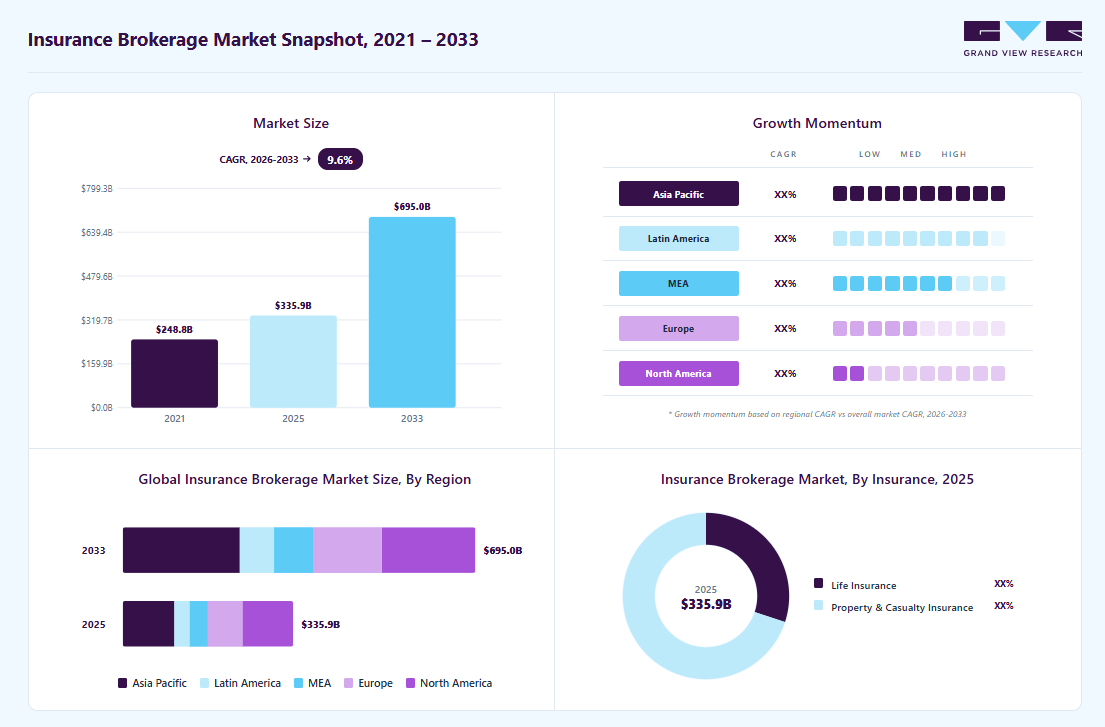
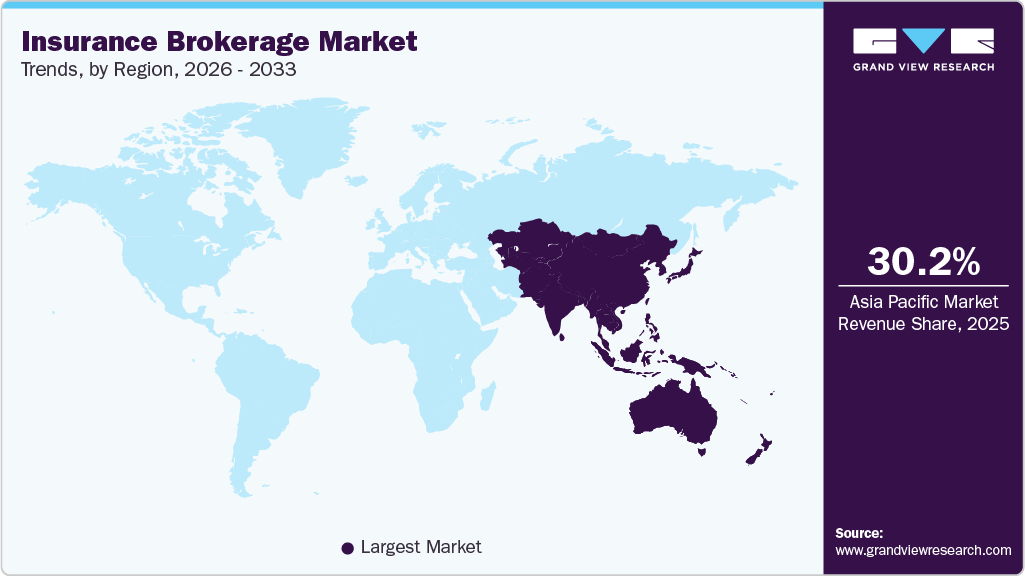
The global insurance brokerage market size was valued at USD 335.9 billion in 2025 and is projected to grow from USD 364.8 billion in 2026 to USD 695.0 billion by 2033, at a CAGR of 9.6% from 2026 to 2033. Asia Pacific dominated the insurance brokerage market and accounted for a 30.2% share of the overall market in 2025. The growth is attributed to the rising demand for complex risk management solutions.
 Source: Grand View Research, IR Documents, Primary Interviews, Paid DatabasesTo learn more about this report,
 Download Free Sample Report
 Key Market Trends & Insights
- By insurance: Property & casualty insurance segment accounted for the largest share of 69.93% in 2025.
- By brokerage: Retail segment held the largest market share in 2025.
- By end-use: Individual segment dominated the market in 2025.
Regional Highlights
- Largest regional market: Asia Pacific (30.2% revenue share, 2025)
- By country: The China held the largest market share in 2025.
Market Size & Forecast
- Market size in 2025: USD 335.9 Billion
- Estimated market size in 2026: USD 364.8 Billion
- Projected market size by 2033: USD 695.0 Billion
- CAGR (2026-2033): 9.6%
Three ways to get this report
Buy it, customize it, or ask a question.Ask an Analyst
Analyst response in 1 business day
- AccessReport author, directly
- Reply timeWithin 1 working day
- No sales callDirect answer only
- FormatEmail reply
- CostFree, no cost
Get the Full Report
What the study covers
- FormatsPDF · Excel · Dashboard
- Timeline2026–2033 annual, 2025 base
- Coverage20+ countries, 5 regions
- Companies10+ key players profiled
Customize the Report
20% free customization
- IncludeCountries, segments, points
- TailorTo your product definition
- ExtendDeeper competitor detail
- OrA fully bespoke study
- Turnaround5–10 working days
As businesses face increased uncertainty and exposure to risks such as cyberattacks, climate-related disasters, regulatory changes, and global supply chain disruptions, clients are seeking more specialized, customized insurance coverage. This shift has reinforced the role of brokers in structuring customized risk solutions and delivering specialized advisory services. Furthermore, growth is supported by the increasing adoption of digital platforms and advanced analytics. Insurance brokers are leveraging data-driven tools, artificial intelligence, and automation to improve decision-making, improve underwriting accuracy, and streamline policy management.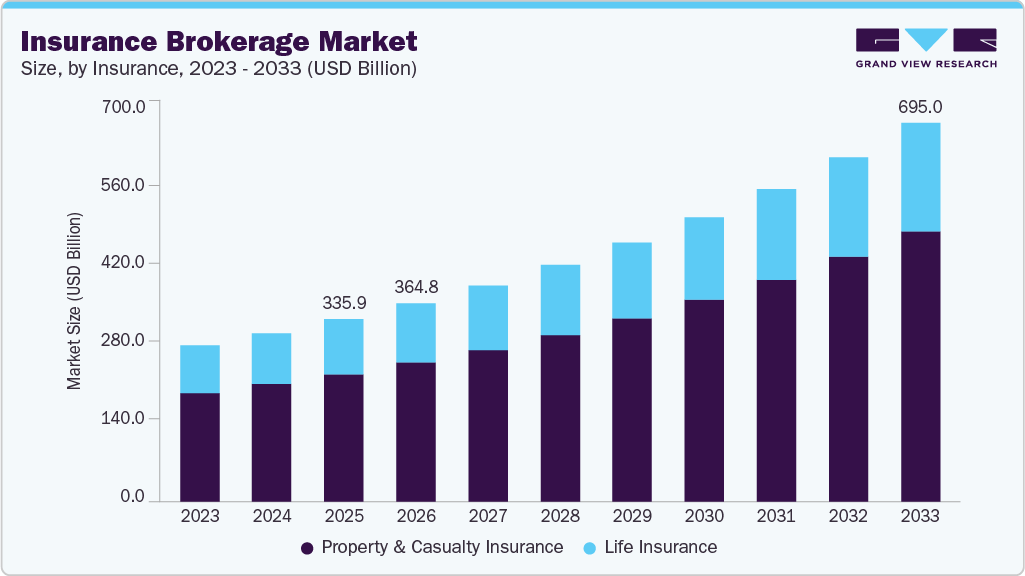 To learn more about this report, Download Free Sample Report
 The growth is also attributed to the expansion of small and medium-sized enterprises (SMEs) and emerging businesses, as these firms increasingly seek cost-effective, customized insurance solutions. With limited internal risk management resources, they rely on brokers for policy selection, risk assessment, and claims support. Furthermore, growing regulatory complexity in the insurance sector is also prompting businesses to seek expert guidance, thereby strengthening the role of brokers in compliance, documentation, and advisory services.
Rapid technological advancements, including artificial intelligence, big data analytics, cloud computing, and digital distribution platforms, are transforming the insurance brokerage market. These tools help brokers improve underwriting accuracy, risk assessment, and deliver more personalized insurance solutions. Automation streamlines routine tasks such as policy administration, claims handling, and client onboarding, thereby increasing operational efficiency and reducing turnaround times. Moreover, predictive analytics also enable brokers to anticipate client needs, identify emerging risks, and provide proactive advisory services. Thus, these trends are improving service quality and efficiency.
The market is expanding steadily driven by rising demand for risk advisory services, increasing corporate exposure to complex and emerging risks, and rapid digital transformation across the insurance value chain. Various companies are expanding their footprint through mergers, acquisitions, and technology integration to strengthen client service capabilities and improve operational efficiency. For instance, in December 2025, Willis Towers Watson, a global advisory, broking, and solutions company, acquired Newfront, a modern insurance platform, to expand its presence in the fast-growing U.S. middle market and specialty segments, including technology, fintech, and life sciences, while enhancing its digital brokerage and AI-enabled capabilities. As part of the transaction, both companies’ combined their technology-driven approaches to insurance broking, integrating advanced digital platforms, analytics, and AI capabilities to improve client experience and operational efficiency.
Regulatory standards play a critical role in the global insurance brokerage industry to promote transparency, consumer protection, and ethical conduct. These standards address licensing, cross-border operations, data privacy, anti-money laundering compliance, and fee and commission disclosure. For instance, in the U.S., brokerage firms and broker-dealers are regulated by the SEC and self-regulatory organizations such as the Financial Industry Regulatory Authority (FINRA). They must meet registration requirements, uphold fiduciary duties under Regulation Best Interest, and follow financial responsibility rules to maintain market integrity. Moreover, state insurance regulators also oversee licensing and conduct, ensuring brokers comply with local laws and uphold fair practices.
The industry faces significant challenges that may limit growth. One of the primary challenges is the rising regulatory compliance burden and increased competition. As regulatory frameworks grow more complex across regions, firms must meet stricter licensing, data privacy, and conduct standards. This raises operational costs and slows cross-border expansion. Additionally, intensified competition from established global firms and digital-first platforms is driving pricing pressure and reducing margins, thus prompting firms to invest more in technology and innovation to remain competitive.
Market Dynamics
Rising demand for personalized advisory services is driving the growth of the insurance brokerage market by shifting customer expectations from standardized products to tailored risk solutions. Individuals and businesses increasingly seek insurance coverage that aligns with their specific financial goals, risk exposure, and life or operational circumstances. Standard, one-size-fits-all policies often fail to address evolving needs such as cyber risk, health uncertainties, and complex business liabilities. This gap is encouraging customers to rely on brokers who can assess unique risk profiles and recommend customized coverage strategies.
Greater financial awareness and access to information have made customers more discerning in their insurance decisions. Clients now expect detailed comparisons, transparent pricing structures, and clear insights into policy benefits and exclusions. Brokers play a critical role in meeting these expectations by offering consultative services that simplify complex insurance products and provide objective recommendations across multiple insurers. This advisory-driven approach enhances trust and strengthens long-term client relationships, which, in turn, support higher customer retention and cross-selling opportunities.
Disintermediation driven by direct-to-consumer (D2C) channels is restraining the growth of the insurance brokerage market by reshaping how insurance products are distributed. Insurance companies are increasingly investing in their own digital platforms to engage customers directly, reducing reliance on intermediaries. These platforms allow insurers to control the entire customer journey, from product discovery to policy issuance and claims servicing, which enhances efficiency and strengthens customer relationships.
Online aggregators and comparison websites are further accelerating this shift by enabling customers to quickly and transparently evaluate multiple insurance products. Easy access to pricing, features, and policy terms empowers customers to make informed decisions without requiring broker assistance. Cost advantages also play a role, as policies purchased through direct channels often exclude intermediary commissions, making them more attractive to price-sensitive customers. This dynamic is particularly evident in standardized insurance products such as motor, travel, and basic health policies, where customization needs are relatively limited.
The emergence of embedded insurance models is presenting an opportunity for the growth of the insurance brokerage market by transforming how insurance products are distributed and consumed. This approach integrates insurance offerings directly into non-insurance transactions, enabling customers to purchase coverage seamlessly alongside a product or service. E-commerce platforms, fintech applications, travel portals, and automotive sales channels increasingly incorporate insurance options at the point of sale, making the process more convenient and intuitive. Such integration reduces friction in the buying journey and significantly enhances customer adoption rates.
Brokers are evolving their roles to capitalize on this shift by acting as ecosystem enablers rather than traditional intermediaries. Strategic collaborations with fintech firms, digital marketplaces, and insurtech providers are enabling brokers to embed tailored insurance solutions within broader digital platforms. These partnerships help brokers expand their distribution reach, access new customer segments, and deliver highly contextualized products aligned with specific user needs. The ability to leverage data from these platforms also enhances underwriting precision and personalization.
Market Concentration & Characteristics
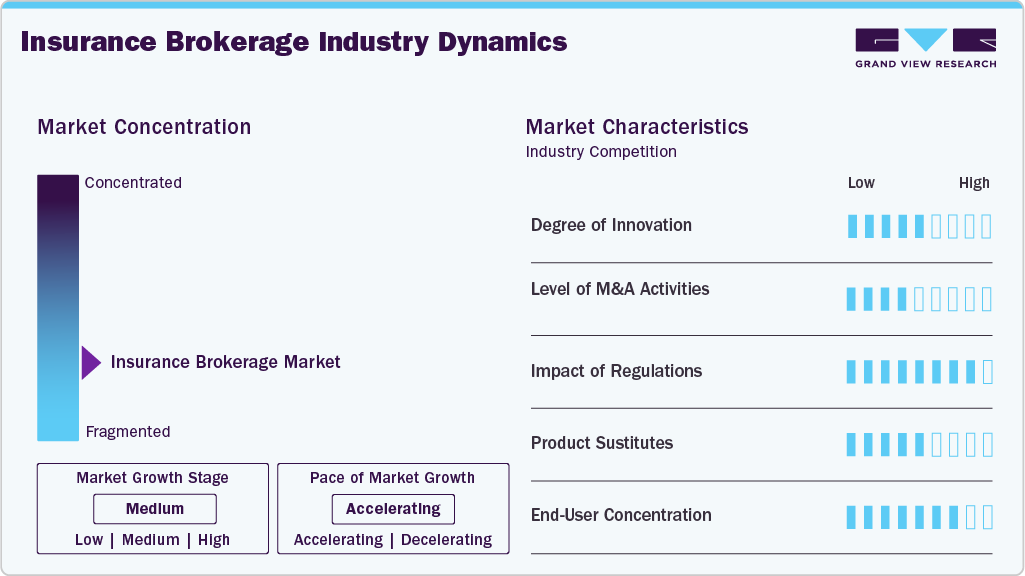
The insurance brokerage market is best described as moderately fragmented, with ongoing consolidation. Fragmentation arises from the large number of small and mid-sized brokerage firms operating at the regional and local levels. Many of these players cater to specific geographies, niche industries, or specialized insurance products such as employee benefits, marine insurance, or SME risk coverage. Low initial capital requirements and relationship-driven business models have historically enabled numerous independent brokers to enter the market, particularly in emerging markets such as India and Southeast Asia. This has resulted in a highly dispersed competitive landscape at the lower and mid tiers of the market.
 To learn more about this report, Download Free Sample Report
 At the same time, significant consolidation is evident at the top end of the market. Large global brokerage firms such as Marsh McLennan, Aon, and Willis Towers Watson dominate in terms of revenue, global reach, and corporate clientele. These firms have been actively pursuing mergers and acquisitions to expand capabilities, strengthen digital infrastructure, and enter new regional markets. Consolidation is also driven by private equity investments, which are accelerating the aggregation of smaller brokers into larger platforms.
Insurance Insights
The property & casualty insurance segment accounted for the largest share of 69.93% in 2025. Homeowners, real estate investors, and businesses are increasingly seeking comprehensive insurance coverage to safeguard against risks such as property damage, theft, and other unforeseen events. This rise in property ownership and ongoing urban development is driving strong demand for property insurance products. For instance, in February 2026, Berkshire Hathaway expanded its presence in Italy by introducing primary casualty policies through Berkshire Hathaway Specialty Insurance. This initiative includes coverage for public liability, employers’ liability, and product liability, thereby strengthening the company’s property and casualty underwriting footprint in the European market. In this evolving landscape, insurance brokers play a critical role by offering tailored coverage solutions and providing expert guidance to clients in selecting the most appropriate policies based on their specific risk profiles.
The life insurance segment is expected to grow at the fastest CAGR during the forecast period. The segment's growth is driven by rising awareness of comprehensive financial planning and the importance of financial security for individuals and families. As financial literacy increases, more people view life insurance as essential for income protection, wealth preservation, and long-term stability. This rising awareness is further supported by the growing demand for retirement planning and protection against unforeseen life events. Further, insurance brokers play a crucial role in this segment by educating clients on policy benefits, assessing their financial needs, and recommending suitable life insurance solutions that align with their long-term protection and investment goals.
Brokerage Insights
The retail segment held the largest market share in 2025. Retail brokers provide personalized advisory services across life, health, motor, and property insurance. Growth in this segment is driven by greater insurance awareness and improved financial literacy. Moreover, the adoption of digital platforms and online channels has increased accessibility for a broader customer base. In emerging countries, such as India, China, and Brazil, expanding urbanization and a growing middle class continue to boost retail insurance penetration.
The wholesale segment is expected to grow at a significant CAGR during the forecast period. The segment’s growth is driven by rising demand for complex risk placement and specialized insurance solutions. Wholesale brokers serve large corporations, high-risk industries, and unique risks that require advanced underwriting expertise. Increasing global risks, such as cyber threats, climate-related disasters, and supply chain disruptions, are leading to greater reliance on wholesale brokerage services. These brokers connect retail brokers with insurers, providing access to global insurance capacity and reinsurance markets. Additionally, business globalization and cross-border operations are increasing the need for sophisticated risk transfer solutions.
End Use Insights
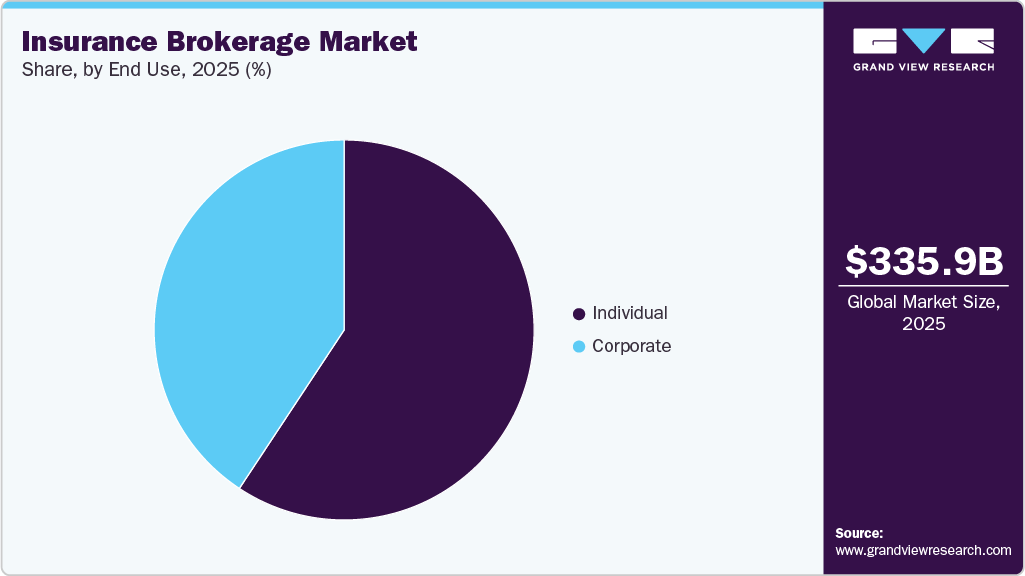
The individual segment dominated the market in 2025. Rising awareness of financial protection, higher disposable incomes, and a focus on long-term planning have strengthened this trend in both developed and emerging economies. Insurance brokers support individuals by offering personalized advice, assessing risk profiles, and guiding clients to select life, health, motor, and property insurance policies that meet their protection and investment goals. Furthermore, the rapid expansion of digital distribution channels, such as online platforms and mobile apps, has improved accessibility and convenience, allowing customers to compare and purchase insurance products more efficiently. Thus, the individual segment remains the largest contributor to the global insurance brokerage market.
 To learn more about this report, Download Free Sample Report
 The corporate segment is projected to grow at the fastest CAGR of 10.9% over the forecast period. The segment’s growth is supported by increasing demand for complex risk management solutions across industries. Corporations face growing risks, including cyber threats, supply chain disruptions, regulatory changes, and climate-related events, which increase the need for comprehensive insurance coverage. Insurance brokers are essential in developing tailored risk transfer solutions, including property and casualty, liability, employee benefits, and reinsurance programs. As businesses globalize and enter new markets, corporate insurance requirements become more complex. Moreover, increased investment in infrastructure and industry is also driving demand for specialized coverage. Thus, the corporate insurance segment is expected to grow over the forecast period.
Regional Insights
Asia Pacific dominated the insurance brokerage market and accounted for a 30.16% share of the overall market in 2025. The growth is driven by rapid economic development, rising insurance awareness, and increasing penetration across emerging economies such as India and China. Expanding urbanization and higher disposable incomes have significantly increased demand for insurance, including life, health, property, and commercial insurance. Insurance brokers play a key role in facilitating access to customized coverage solutions and advising both individual and corporate clients on appropriate risk protection strategies. Insurance brokers are further expanding their presence through digital transformation and platform-based distribution models to improve accessibility and deepen market penetration across emerging regions. In October 2025, Policybazaar expanded its digital-first insurance distribution platform to improve accessibility and transparency across the insurance ecosystem. The company leveraged technology to simplify policy comparison and purchase, contributing to rising online insurance adoption, particularly in Tier 2 and Tier 3 cities in India, where financial inclusion and insurance penetration have been steadily increasing.
 To learn more about this report, Download Free Sample Report
 The insurance brokerage market in China held a dominant position in 2025. The country’s growth is driven by strong economic growth and rising demand for commercial and personal insurance. Furthermore, increased insurance awareness and broader adoption of risk management services across sectors such as manufacturing, infrastructure, and technology continue to support market expansion. As the insurance sector in the country matures, demand for specialized advisory services and diversified offerings is accelerating market growth.
The Japan insurance brokerage market held a substantial share in 2025. The country’s growth is supported by an aging population and rising demand for life and health insurance. Higher life expectancy has increased the need for long-term care and medical coverage, thus expanding insurance penetration among key demographics. Persistently low interest rates have made insurance-based savings and investment products more appealing for stable, long-term returns. Moreover, increased awareness of income protection and estate planning is also driving demand for advisory-led insurance services, contributing to steady market growth.
North America Insurance Brokerage Market Trends
The insurance brokerage market in North America is anticipated to grow at a significant CAGR during the forecast period. The growth in this region is driven by a developed insurance ecosystem and an evolving regulatory landscape. Ongoing regulatory changes and stricter compliance requirements have fueled growth, as businesses increasingly rely on brokers to navigate complex legal and operational challenges. Insurance brokers are essential in managing compliance, mitigating risk, and ensuring adherence to federal and state regulations. Their expertise helps organizations avoid penalties and maintain stability. Rising corporate risk exposure and demand for specialized insurance solutions have further supported market growth, thus emphasizing North America as a key global insurance brokerage hub.
U.S. Insurance Brokerage Market Trends
The insurance brokerage industry in the US is expected to grow rapidly in the coming years. The country's growth is attributed to the presence of large corporations and rising exposure to complex risks, including cyber threats, liability claims, and operational disruptions. Insurance brokers are essential in developing customize coverage, managing client portfolios, and offering specialized advisory services across industries. Rising demand for employee benefits, property and casualty insurance, and specialty risk solutions has further supported market expansion.
Europe Insurance Brokerage Industry Trends
The insurance brokerage industry in Europe was identified as a lucrative region in 2025. As businesses across Europe face increasingly complex risks, there is a growing demand for specialized risk management services provided by insurance brokers. From cyber threats to climate-related risks, companies are turning to brokers to help them identify, assess, and mitigate these challenges. Brokers' expertise in tailoring insurance solutions to meet specific risk profiles has made them indispensable partners for businesses, thus driving market expansion.
The UK insurance brokerage market is expected to grow rapidly in the coming years. The growth is driven by increased demand for advisory-led insurance solutions. Businesses are prioritizing strategic risk transfer over traditional coverage, which increases the need for specialized brokerage expertise. As global trade exposure, climate risks, and digital vulnerabilities become more complex, firms are turning to brokers for tailored risk structuring. Moreover, the ongoing shift to data-driven underwriting and digital distribution is also transforming brokerage operations into both commercial and personal insurance.
The insurance brokerage industry in Germany held a substantial market share in 2025. The market is undergoing rapid consolidation and digital transformation. AI-driven, personalized services are increasingly adopted to improve client engagement and risk assessment capabilities. Furthermore, there is a growing focus on cyber and specialty insurance lines, thus reflecting the rising complexity of modern business risks. Additionally, private equity-driven mergers and acquisitions are actively reshaping the competitive landscape of the market.
Key Insurance Brokerage Companies Insights
Some of the key companies in the insurance brokerage market include Marsh & McLennan Companies, Inc.; Willis Towers Watson; Aon plc; Arthur J. Gallagher & Co and others. Organizations are focusing on increasing their customer base to gain a competitive edge in the industry. Therefore, key players are taking several strategic initiatives, such as mergers and acquisitions, and partnerships with other major companies.
-
Marsh & McLennan Companies, Inc. is a professional services firm specializing in risk management, insurance brokerage, reinsurance, and consulting services. It operates through four main businesses, Marsh, Guy Carpenter, Mercer, and Oliver Wyman, and it provides solutions across insurance, talent, health, retirement, and strategic advisory domains. A core component of its business is insurance brokerage through Marsh, which facilitates client access to insurance markets and supports the structuring of coverage for complex risks. The firm assists organizations in identifying, managing, and transferring risk through data-driven insights and industry expertise worldwide.
-
Aon plc specializes in risk management, insurance brokerage, reinsurance solutions, and human capital consulting. It operates through key segments that include commercial risk solutions, reinsurance solutions, health solutions, and wealth solutions, supporting clients in managing complex business risks. The company provides insurance brokerage services by helping organizations access global insurance markets and design appropriate coverage structures. The firm leverages data, analytics, and industry expertise to support decision-making in risk transfer, employee benefits, retirement, and health solutions across a wide range of industries worldwide.
Key Insurance Brokerage Companies:
The following key companies have been profiled for this study on the insurance brokerage market.
- Marsh & McLennan Companies, Inc.
- Aon plc
- Willis Towers Watson
- Arthur J. Gallagher & Co.
- Brown & Brown, Inc.
- Lockton Companies
- Alliant Insurance Services
- HUB International Limited
- Edgewood Partners Insurance Center (EPIC)
- USI Insurance Services
Competitive Benchmarking
Operating Strategies
Competitive Edge
Weaknesses
Mature Players: Marsh & McLennan, Aon plc, Willis Towers Watson, Arthur J. Gallagher
- Mature players focus on delivering large-scale, end-to-end brokerage and risk advisory services across insurance placement, claims management, and risk consulting.
- Their strategies emphasize long-term client relationships, multi-line service portfolios, and integrated advisory-led models
- Deep domain expertise across complex risk areas such as cyber, reinsurance, employee benefits, and large commercial risks.
- Established global presence with strong relationships with insurers, reinsurers, and large corporate clients.
- Ability to provide integrated, end-to-end solutions combining broking, analytics, risk consulting, and claims advisory.
- High service costs may limit penetration among SMEs and price-sensitive clients.
- Legacy systems and complex operating models can create challenges in adopting new digital technologies.
Emerging Players: Lockton Companies; Alliant Insurance Services
- Emerging players focus on niche segments, mid-market clients, and specialized industry verticals such as healthcare, construction, and employee benefits.
- Emphasis on personalized advisory services, flexible engagement models, and relationship-driven sales strategies.
- Strong focus on client-centric service models and customized insurance solutions.
- Competitive pricing structures and flexibility attract SMEs and mid-sized enterprises.
- A limited global footprint restricts the ability to serve large multinational clients.
- Lower brand recognition compared to top-tier global brokers may impact client acquisition.
Recent Developments
-
In December 2025, Willis Towers Watson acquired San Francisco-based brokerage firm Newfront in a deal valued at up to USD 1.3 billion to expand its presence in the U.S. middle-market insurance sector. The agreement included an upfront payment of about USD 1.05 billion, which consisted of approximately USD 900 million in cash and USD 150 million in equity. The acquisition was structured to strengthen Willis Towers Watson’s brokerage capabilities and expand its digital distribution footprint in the insurance market.
-
In August 2025, Arthur J. Gallagher acquired AssuredPartners, a U.S. insurance broker, for about USD 13.45 billion in cash to strengthen its position in the U.S. middle-market insurance brokerage segment. The deal added approximately 10,900 employees to Gallagher’s workforce and significantly expanded its retail property/casualty and employee benefits business.
Insurance Brokerage Market Report Scope
Report Attribute
Details
Market size in 2025
USD 335.9 billion
Estimated Market size in 2026
USD 364.8 billion
Projected Market size by 2033
USD 695.0 billion
Growth rate
CAGR of 9.6% from 2026 to 2033
Base year for estimation
2025
Historical data
2021 - 2024
Forecast period
2026 - 2033
Quantitative units
Revenue in USD million/billion and CAGR from 2026 to 2033
Report vehicle
Revenue forecast, company ranking, competitive landscape, growth factors, and trends
Segments covered
Insurance, brokerage, end use, region
Regional scope
North America; Europe; Asia Pacific; Latin America; MEA
Country scope
U.S.; Canada; Mexico; Germany; U.K.; France; China; Japan; India; South Korea; Australia; Brazil; KSA; UAE; South Africa
Key companies profiled
Marsh & McLennan Companies, Inc.; Aon plc; Willis Towers Watson; Arthur J. Gallagher & Co.; Brown & Brown, Inc.; Lockton Companies; Alliant Insurance Services; HUB International Limited; Edgewood Partners Insurance Center (EPIC); USI Insurance Services
Customization scope
Free report customization (equivalent up to 8 analysts working days) with purchase. Addition or alteration to country, regional & segment scope.
Pricing and purchase options
Avail customized purchase options to meet your exact research needs. Explore purchase options
Global Insurance Brokerage Market Report Segmentation
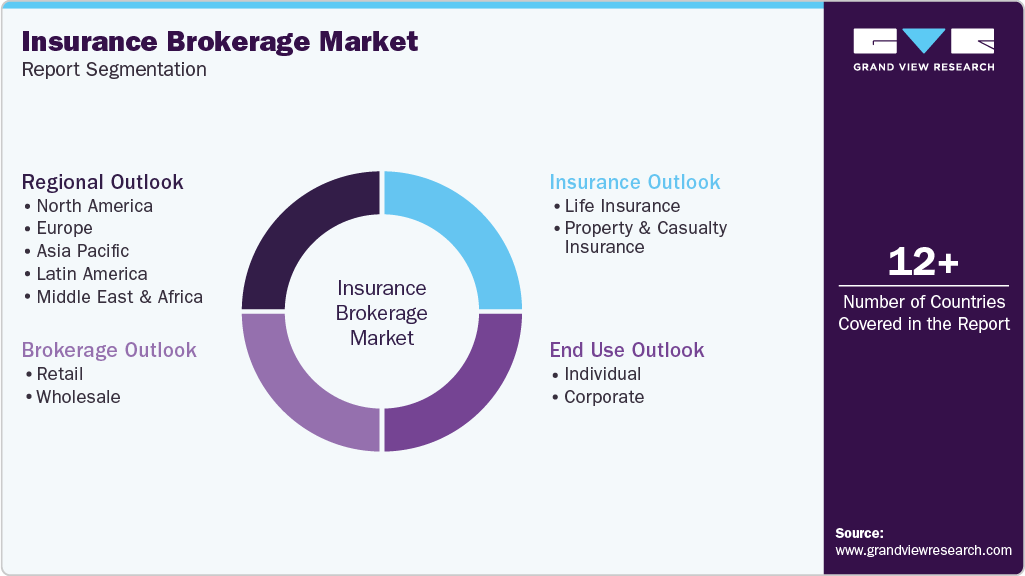
This report forecasts revenue growth at global, regional, and country levels and provides an analysis of the latest industry trends in each of the sub-segments from 2021 to 2033. For this study, Grand View Research has segmented the global insurance brokerage market report based on insurance, brokerage, end use, and region.
 To learn more about this report, Download Free Sample Report
 -
Insurance Outlook (Revenue, USD Million, 2021 - 2033)
-
Life Insurance
-
Property & Casualty Insurance
-
-
Brokerage Outlook (Revenue, USD Million, 2021 - 2033)
-
Retail
-
Wholesale
-
-
End Use Outlook (Revenue, USD Million, 2021 - 2033)
-
Individual
-
Corporate
-
-
Regional Outlook (Revenue, USD Million, 2021 - 2033)
-
North America
-
U.S.
-
Canada
-
Mexico
-
-
Europe
-
Germany
-
UK
-
France
-
-
Asia Pacific
-
China
-
Japan
-
India
-
South Korea
-
Australia
-
-
Latin America
-
Brazil
-
-
Middle East and Africa (MEA)
-
KSA
-
UAE
-
South Africa
-
-
Delivered Customizations
This report has been delivered with the following In-depth customizations
Client Request
Customization Delivered
Value Adds
Insurance Brokerage Market Opportunity Assessment
Country/region-wise insurance brokerage market sizing and growth forecasts
Analysis of insurance penetration, product mix (life, non-life, specialty), and distribution trends
Assessment of regulatory landscape impacting brokers (licensing, commissions, compliance)
Identification of high-growth segments such as health, cyber, and SME insurance
Identified region-specific growth opportunities
Supported market entry and expansion strategy
Enabled informed investment and partnership decisions
Insurance Brokerage Customer & Channel Behavior Study
Analysis of customer purchase behavior across retail and commercial segments
Evaluation of broker-led vs direct-to-consumer (D2C) channel preferences
Segmentation of customers based on industry, size (SME vs large enterprise), and risk profile
Improved customer segmentation and targeting strategy
Supported advisory-led engagement model development
Enabled optimization of distribution and channel strategy
Competitive Benchmarking and Strategic Positioning in the Insurance Brokerage Market
Benchmarking of key competitors across products, pricing, partnerships, and innovation
Comparative assessment of market share, capabilities, and strategies
Analysis of competitive strengths, gaps, and differentiation areas
Identified competitive white spaces and growth gaps
Supported strategic positioning and differentiation
Enabled data-driven competitive strategy development
Frequently Asked Questions About This Report
Retail segment held the largest market share in 2025.
Individual segment dominated the market in 2025.
Key factors that are driving the market growth include the the rising demand for complex risk management solutions. As businesses face increased uncertainty and exposure to risks such as cyberattacks, climate-related disasters, regulatory changes, and global supply chain disruptions, clients are seeking more specialized, customized insurance coverage.
The global insurance brokerage market size was estimated at USD 335.9 billion in 2025 and is expected to reach USD 364.8 billion in 2026.
The global insurance brokerage market is expected to grow at a compound annual growth rate of 9.6% from 2026 to 2033 to reach USD 695.0 billion by 2033.
Property & casualty insurance segment accounted for the largest share of 69.9% in 2025.
Some key players operating in the insurance brokerage market include Marsh & McLennan Companies, Inc.; Aon plc; Willis Towers Watson; Arthur J. Gallagher & Co.; Brown & Brown, Inc.; Lockton Companies; Alliant Insurance Services; HUB International Limited; Edgewood Partners Insurance Center (EPIC); USI Insurance Services
Asia Pacific dominated the insurance brokerage market with 30.2% share in 2025.
About the Author(s)
Next Generation Technologies Research Team
Technology · Next Generation TechnologiesThis report was authored by the next generation technologies research team at Grand View Research - comprising two research analysts, one senior research analyst, and one industry expert - with specialized expertise in the next generation technologies segment of the technology industry. All findings are based on proprietary technology databases, executive interviews, and regulatory analysis, subject to internal peer review prior to publication.
Last Updated:
Speak to Analyst

Customize this report to your needs - add regions, segments, or data points, with 20% free customization.
Or view our licence options:


ISO 9001:2015 & 27001:2022 Certified
We are GDPR and CCPA compliant! Your transaction & personal information is safe and secure. For more details, please read our privacy policy.


