
- Home
- »
- Plastics, Polymers & Resins
- »
-
Ion Exchange Resins Market Size, Industry Report, 2033GVR Report cover

Ion Exchange Resins Market (2026 - 2033) Size, Share & Trends Analysis Report By Product (Cationic, Anionic), By End-use (Power, Chemicals & Petrochemicals, Food & Beverages, Electrical & Electronics, Pharmaceuticals), By Region, And Segment Forecasts
Market Size, 2025
$2.0BMarket Estimate, 2026
$2.1BMarket Forecast, 2033
$3.1BCAGR, 2026–2033
5.4%Ion Exchange Resins Market Summary
The global ion exchange resins market size was valued at USD 2.0 billion in 2025 and is projected to grow from USD 2.1 billion in 2026 to USD 3.1 billion by 2033, at a CAGR of 5.4% from 2026 to 2033. The Asia Pacific ion exchange resins market held the largest share of 48.8% of the global market in 2025. Rising demand from the pharmaceutical and biotechnology industries is driving ion exchange resin consumption for purification, separation, and process consistency.
 Source: Grand View Research, IR Documents, Primary Interviews, Paid DatabasesTo learn more about this report,
 Download Free Sample Report
 Key Market Trends & Insights
- By product type: Cationic segment dominated the market with a revenue share of 46.44% in 2025.
- By product type: Anionic segment is anticipated to grow at a substantial CAGR of 5.5% through the forecast period.
- By application: Power segment is expected to grow at a considerable CAGR of 6.0% from 2026 to 2033.
Regional Highlights
- Largest regional market: Asia Pacific (48.8% revenue share, 2025)
- The ion exchange resins industry in the China expected to grow at a significant CAGR over the forecast period.
Market Size & Forecast
- Market size in 2025: USD 2.0 Billion
- Estimated market size in 2026: USD 2.1 Billion
- Projected market size by 2033: USD 3.1 Billion
- CAGR (2026-2033): 5.4%
Three ways to get this report
Buy it, customize it, or ask a question.Ask an Analyst
Analyst response in 1 business day
- AccessReport author, directly
- Reply timeWithin 1 working day
- No sales callDirect answer only
- FormatEmail reply
- CostFree, no cost
Get the Full Report
What the study covers
- FormatsPDF · Excel · Dashboard
- Timeline2026–2033 annual, 2025 base
- Coverage20+ countries, 5 regions
- Companies10+ key players profiled
Customize the Report
20% free customization
- IncludeCountries, segments, points
- TailorTo your product definition
- ExtendDeeper competitor detail
- OrA fully bespoke study
- Turnaround5–10 working days
Expanding drug manufacturing capacity in emerging markets further supports this demand. Market maturation toward higher-performance, hybrid solutions and service models. The ion exchange resins market is moving from commodity bead resins to engineered, application-specific products that deliver higher selectivity, capacity, and fouling resistance.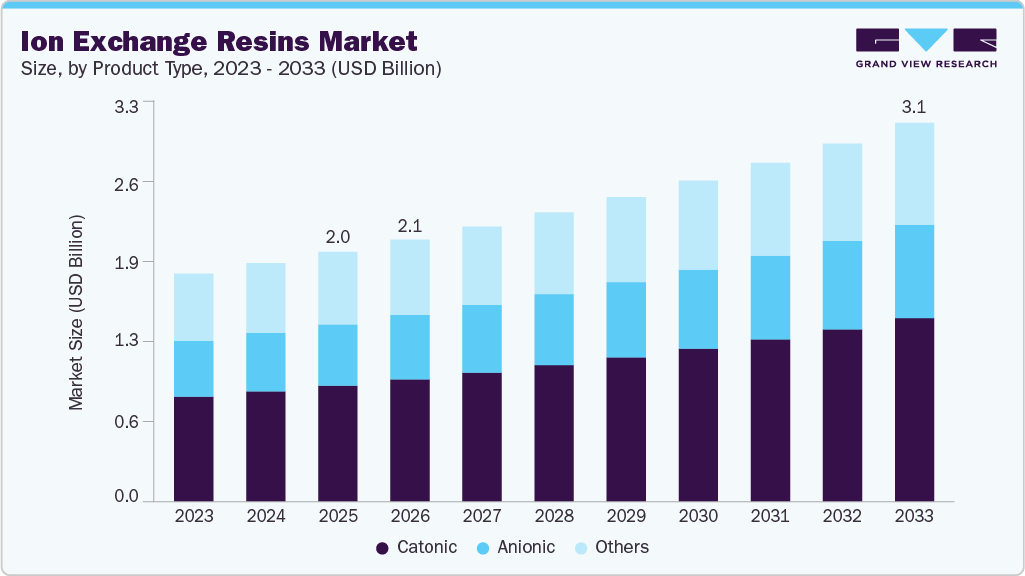 To learn more about this report, Download Free Sample Report
 Buyers increasingly specify mixed-bed, selective chelating, and specialty resins integrated with membrane pre-treatment and online monitoring. Vendors are packaging resins with regeneration and lifecycle services to capture aftermarket value.
Drivers, Opportunities & Restraints
Regulatory tightening and industrial demand for high-quality water. Stricter effluent and potable water standards are forcing municipal and industrial users to upgrade treatment trains. Industries such as pharmaceuticals, power generation, and food and beverage require ultrapure water for process integrity. Rapid urbanization and infrastructure investment in the Asia Pacific are increasing demand for large-scale ion exchange deployments for boiler feedwater treatment, demineralization, and water reuse. These regulatory and end user pressures are primary demand drivers.
New end-markets and value-added business models. Opportunities exist in battery-metal recovery, nuclear plant water chemistry, and closed-loop industrial reuse where tailored resins can command premiums. Advances in polymer chemistry enable resins with targeted selectivity for trace contaminants, enabling resource recovery and circular-economy use cases. Market players can also scale recurring revenue through resin regeneration services, leasing models, and digital monitoring contracts that optimize resin life and reduce total cost of ownership. These moves expand the addressable market and margins.
Cost pressures, competition from alternative technologies, and lifecycle liabilities. Raw monomer and crosslinker price volatility raises production costs and compresses margins for commodity resins. Membrane processes, advanced adsorption media, and electrochemical technologies are displacing ion exchange for some separations, particularly where capital or energy profiles are more attractive. End users also factor in regeneration chemical use and spent-resin disposal liabilities when selecting treatment routes. These economic and environmental constraints can slow adoption and cap pricing power.
Market Concentration & Characteristics
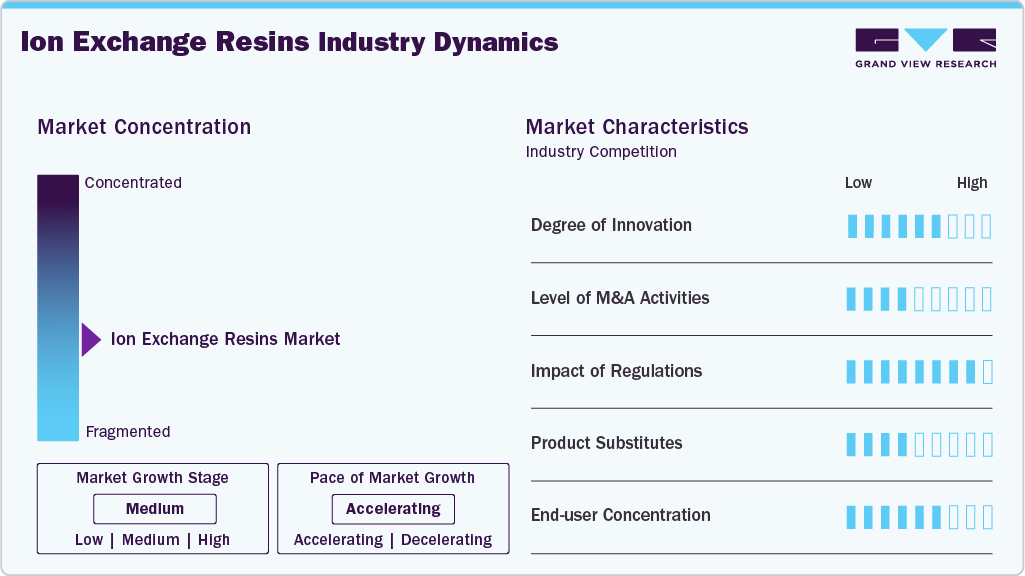
The market growth stage is moderate, and growth is accelerating. The market exhibits slight fragmentation, with key players dominating the industry landscape. Major companies such as Mitsubishi Chemical Corporation, LANXESS, DuPont, Resonac Holdings Corporation, Thermax Limited, Graver Technologies, Purolite, DOSHION POLYSCIENCE PVT. LTD., Otto Chemie Pvt. Ltd., Aldex Chemical Company, Ltd., Asha Resins Ltd, Benchmark Technologies, Cytiva, Taiyuan Lanlang Technology Industrial Corp., and others play a significant role in shaping the market dynamics. These leading players often drive innovation within the market, introducing new products, technologies, and type to meet the evolving demands of the industry.
Innovation in ion exchange resins is increasingly application-driven and chemistry-led. Manufacturers are developing tailored functional groups and chelating motifs to enhance selectivity for target ions, enabling the recovery of critical metals and the removal of trace contaminants. Particle engineering and hybrid formats improve kinetics and reduce fouling in complex waste streams. Vendors also bundle regeneration services and digital monitoring to extend useful life and improve the total cost of ownership. These iterative and targeted advances strengthen premium positioning in specialty end markets.
 To learn more about this report, Download Free Sample Report
 Competitive technologies are narrowing use cases for conventional resins. Reverse osmosis and nanofiltration deliver near-complete removal of many micropollutants and are preferred where volume reduction and salt rejection are important. Advanced adsorbents, metal-organic frameworks, and novel layered materials show faster uptake for select contaminants. Emerging electrochemical and catalytic destruction routes for PFAS and other persistent compounds reduce reliance on regeneration cycles. Together, these alternatives force resin suppliers to compete on selectivity, lifecycle costs, and integration into hybrid treatment trains.
Product Type Insights
Cationic segment dominated the market with a revenue share of 46.44% in 2025, and is forecasted to grow at a 6.0% CAGR from 2026 to 2033. Demand for cation exchange resins is being driven by persistent requirements for hardness removal and demineralization across industrial water systems. Industries such as power generation, chemical processing, and large-scale food and beverage operations rely on strong acid cation and weak acid cation resins to protect boilers, heat exchangers, and catalysts from scale and metal fouling. Rapid industrial expansion in the Asia Pacific and stricter boiler feedwater standards in emerging markets are prompting higher-specification cation resins and larger recurring purchases for regeneration and replacement.
The anionic segment is anticipated to grow at a substantial CAGR of 5.5% through the forecast period. Anion exchange resins are gaining traction due to rising requirements for nitrate, sulfate, and organic contaminant removal in both municipal and industrial treatment trains. Strong base anion resins now play a central role in dealkalization and targeted removal of trace anions that compromise product quality in pharmaceuticals and specialty chemicals. New regulatory focus on PFAS precursors and stricter drinking water limits is also steering customers toward selective anion chemistries and mixed-bed configurations for polishing applications.
Application Insights
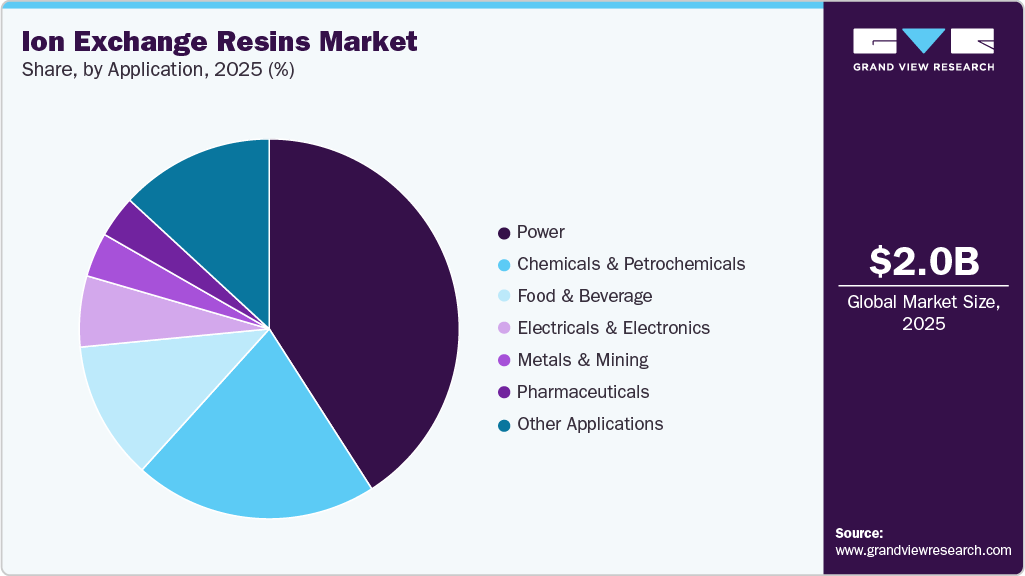
Power segment dominated the market and accounted for a revenue share of 40.93% in 2025, and is forecast to grow at a 6.0% CAGR from 2026 to 2033. The power sector remains a core growth engine as utilities and independent plants demand ultrapure boiler feedwater and condensate polishing to improve thermal efficiency and extend asset life. Nuclear and combined-cycle gas turbine operators require resins with high capacity and low leachable ion levels to meet stringent water chemistry specifications. Planned capacity additions and refurbishment programs across Asia and the Middle East are increasing procurement cycles for both fresh resin and outsourced regeneration services, creating steady, high-volume demand.
 To learn more about this report, Download Free Sample Report
 The chemicals and petrochemicals segment is expected to grow at a robust 5.8% CAGR over the forecast period. In the chemical and petrochemical industries, ion exchange resins are valued for selective impurity removal and product quality assurance in high-throughput refining and intermediate synthesis. Specialty anion resins are used to remove mercaptans, trace metals, and acidic contaminants that poison catalysts or degrade polymerization yields. The drive toward higher fuel and feedstock specifications, combined with investments in downstream capacity in emerging markets, is increasing demand for robust, high-temperature-tolerant resins tailored to process conditions.
Regional Insights
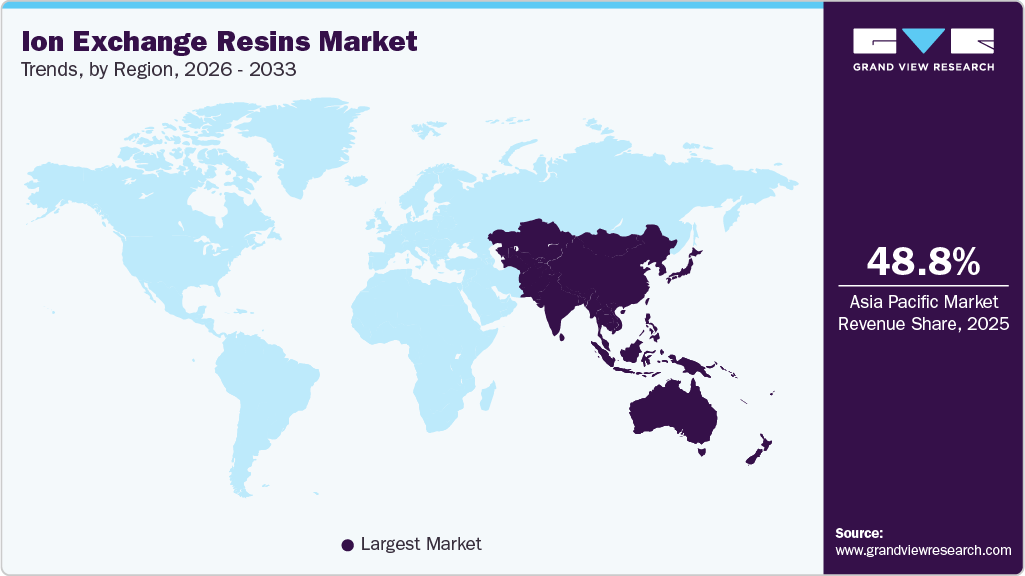
The Asia Pacific ion exchange resins industry held the largest share, accounting for 48.79% of the revenue in 2025, and is expected to grow at the fastest CAGR of 5.6% over the forecast period. The APAC market is primarily driven by large-scale investments in water treatment infrastructure and rapid industrialization in China, India, and Southeast Asia. Urban population growth and rising water scarcity are prompting municipal and industrial users to adopt advanced resin-based purification systems. Semiconductor fabs and heavy industries in South Korea and Taiwan are increasing demand for ultra-pure water, further bolstering regional consumption and capacity expansions. These factors collectively position the Asia Pacific as the fastest-growing regional market globally.
 To learn more about this report, Download Free Sample Report
 Ion exchange resins market in China is driven by aggressive water treatment infrastructure development and tightening discharge standards for industrial effluents. Strong manufacturing growth in the chemicals, power, and electronics sectors is driving demand for purification systems that incorporate high-capacity resins. Government initiatives to expand wastewater reuse and upgrade treatment facilities in urban and industrial zones further support resin adoption. These structural factors position China as a key regional growth engine within the global market.
North America Ion Exchange Resins Market Trends
North America’s ion exchange resin demand is propelled by stringent environmental regulations and the need to upgrade aging water infrastructure. Regulatory focus on PFAS removal and heavy metal limits in public water systems is expanding the scope of retrofit and new installation projects. Growth in the pharmaceutical, chemicals, and power generation sectors also underpins the adoption of high-performance resins for ultrapure water and effluent treatment. Investment in advanced purification technologies reinforces long-term regional market expansion.
U.S. Ion Exchange Resins Market Trends
In the U.S., regulatory enforcement of water quality standards and increasing industrial demand for high-purity process water are key market drivers. The U.S. market benefits from substantial adoption in pharmaceuticals, electronics manufacturing, and power utilities, where stringent performance specifications require advanced ion exchange solutions. Federal and state incentives for wastewater reuse and infrastructure modernization are accelerating capital deployment. These dynamics support sustained resin procurement and aftermarket regeneration services.
Europe Ion Exchange Resins Market Trends
Market growth in Europe is anchored in strict EU water quality directives and sustainability mandates that expand industrial wastewater treatment and potable water purification needs. The chemical processing, food and beverage, and biotech manufacturing sectors require high-grade resins to meet quality and compliance standards. The region’s commitment to circular-economy principles is also driving demand for regenerative and recyclable resin formulations. This regulatory and industrial backdrop fosters stable and quality-focused market expansion.
Key Ion Exchange Resins Company Insights
The ion exchange resins industry is highly competitive, with several key players dominating the landscape. Major companies include Mitsubishi Chemical Corporation, LANXESS, DuPont, Resonac Holdings Corporation, Thermax Limited, Graver Technologies, Purolite, DOSHION POLYSCIENCE PVT. LTD., Otto Chemie Pvt. Ltd., Aldex Chemical Company, Ltd., Asha Resins Ltd, Benchmark Technologies, Cytiva, and Taiyuan Lanlang Technology Industrial Corp. The ion exchange resins industry is characterized by a competitive landscape with several key players driving innovation and market growth. Major companies in this sector are investing heavily in research and development to enhance the performance, cost-effectiveness, and sustainability of their products.
Key Ion Exchange Resins Companies:
The following key companies have been profiled for this study on the ion exchange resins market
- Mitsubishi Chemical Corporation
- LANXESS
- DuPont
- Resonac Holdings Corporation
- Thermax Limited
- Graver Technologies
- Purolite
- DOSHION POLYSCIENCE PVT. LTD.
- Otto Chemie Pvt. Ltd.
- Aldex Chemical Company, Ltd.
- Asha Resins Ltd
- Benchmark Technologies
- Cytiva
- Taiyuan Lanlang Technology Industrial Corp.
Recent Developments
-
In November 2024, LANXESS partnered with De Watergroep to equip a mobile treatment unit for PFAS removal using its Lewatit TP 108 DW resin, marking a commercial deployment and collaborative step into targeted PFAS remediation for potable water.
-
In August 2024, DuPont’s AmberLite P2X110, its first ion exchange resin dedicated to green hydrogen, was honored as Business Intelligence Group’s 2024 Sustainability Product of the Year after early commercial orders, underscoring demand for electrolyzer-grade water treatment solutions.
Ion Exchange Resins Market Report Scope
Report Attribute
Details
Market size in 2025
USD 2.0 Billion
Estimated market size in 2026
USD 2.1 billion
Projected market size by 2033
USD 3.1 billion
Growth rate
CAGR of 5.4% from 2026 to 2033
Actual data
2021 - 2025
Forecast period
2026 - 2033
Quantitative units
Revenue in USD million/billion, volume in kilotons, and CAGR from 2026 to 2033
Report coverage
Revenue & volume forecast, competitive landscape, growth factors, and trends
Segments covered
Product type, application, region
Regional scope
North America; Europe; Asia Pacific; Central & South America; Middle East & Africa
Country scope
U.S.; Canada; Mexico; Germany; UK; Italy; France; Spain; China; India; Japan; South Korea; Australia; Brazil; Argentina; South Africa; Saudi Arabia; UAE
Key companies profiled
Mitsubishi Chemical Corporation; LANXESS; DuPont; Resonac Holdings Corporation; Thermax Limited; Graver Technologies; Purolite; DOSHION POLYSCIENCE PVT. LTD.; Otto Chemie Pvt. Ltd.; Aldex Chemical Company Ltd.; Asha Resins Ltd; Benchmark Technologies; Cytiva; Taiyuan Lanlang Technology Industrial Corp.
Customization scope
Free report customization (equivalent to up to 8 analyst working days) with purchase. Addition or alteration to country, regional & segment scope
Pricing and purchase options
Avail customized purchase options to meet your exact research needs. Explore purchase options
Global Ion Exchange Resins Market Report Segmentation
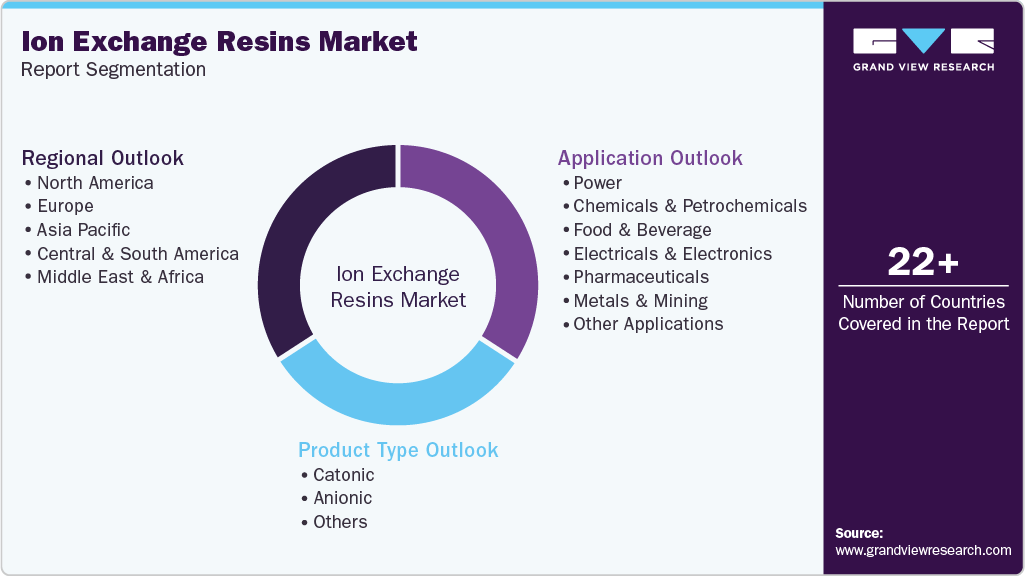
This report forecasts revenue growth at global, regional, and country levels and provides an analysis of the latest industry trends in each of the sub-segments from 2021 to 2033. For this study, Grand View Research has segmented the global ion exchange resins market report based on product type, application, and region:
 To learn more about this report, Download Free Sample Report
 -
Product Type Outlook (Volume, Kilotons; Revenue, USD Million, 2021 - 2033)
-
Catonic
-
Anionic
-
Others
-
-
Application Outlook (Volume, Kilotons; Revenue, USD Million, 2021 - 2033)
-
Power
-
Chemicals & Petrochemicals
-
Food & Beverage
-
Electricals & Electronics
-
Pharmaceuticals
-
Metals & Mining
-
Others
-
-
Regional Outlook (Volume, Kilotons; Revenue, USD Million, 2021 - 2033)
-
North America
-
U.S.
-
Canada
-
Mexico
-
-
Europe
-
Germany
-
UK
-
Italy
-
France
-
Spain
-
-
Asia Pacific
-
China
-
India
-
Japan
-
South Korea
-
Australia
-
-
Central & South America
-
Brazil
-
Argentina
-
-
Middle East & Africa
-
South Africa
-
Saudi Arabia
-
UAE
-
-
Frequently Asked Questions About This Report
The global ion exchange resins market size was valued at USD 2.0 billion in 2025 and is estimated at USD 2.1 billion for 2026.
The global ion exchange resins market is expected to grow at a CAGR of 5.4% from 2026 to 2033, reaching USD 3.1 billion.
Key factors include rising demand from the pharmaceutical and biotechnology industries is driving ion exchange resin consumption for purification, separation, and process consistency.
Asia Pacific dominated with a 48.8% revenue share in 2025.
the cationic held the largest revenue share of 46.4% in 2025, while anionic is the significant-growing segment.
The power holds the largest market share of 40.3% in 2025, while chemicals and petrochemicals is the fastest-growing area.
Key players include Mitsubishi Chemical Corporation; LANXESS; DuPont; Resonac Holdings Corporation; Thermax Limited; Graver Technologies; Purolite; DOSHION POLYSCIENCE PVT. LTD.; Otto Chemie Pvt. Ltd.; Aldex Chemical Company Ltd.; Asha Resins Ltd; Benchmark Technologies; Cytiva; Taiyuan Lanlang Technology Industrial Corp.
About the Author(s)
Plastics, Polymers & Resins Research Team
Bulk Chemicals · Plastics, Polymers & ResinsThis report was authored by the plastics, polymers & resins research team at Grand View Research - comprising two research analysts, one senior research analyst, and one industry expert - with specialized expertise in the plastics, polymers & resins segment of the bulk chemicals industry. All findings are based on proprietary bulk chemicals databases, executive interviews, and regulatory analysis, subject to internal peer review prior to publication.
Last Updated:
Speak to Analyst

Customize this report to your needs - add regions, segments, or data points, with 20% free customization.
Or view our licence options:


ISO 9001:2015 & 27001:2022 Certified
We are GDPR and CCPA compliant! Your transaction & personal information is safe and secure. For more details, please read our privacy policy.


