
- Home
- »
- Next Generation Technologies
- »
-
IoT Insurance Market Size, Share & Growth Report, 2026-2033GVR Report cover

IoT Insurance Market (2026 - 2033)
Size, Share & Trends Analysis Report By Component, By Insurance Type (Life & Health Insurance, Property & Casualty Insurance), By End-use Industry (Automotive & Transportation, Healthcare), By Region, And Segment Forecasts
Market Size, 2025
$24.3BMarket Estimate, 2026
$31.8BMarket Forecast, 2033
$220.4BCAGR, 2026–2033
31.8%IoT Insurance Market Summary
The global IoT insurance market size was valued at USD 24.3 billion in 2025 and is projected to grow from USD 31.8 billion in 2026 to USD 220.4 billion in 2033, at a CAGR of 31.8% from 2026 to 2033. The North America dominated the market, accounting for a revenue share of 35.0% in 2025. The industry is anticipated to grow owing to the insurance sector's development of innovative insurance models and the growing use of the Internet of Things (IoT) to reduce risk- and premium-related expenses.
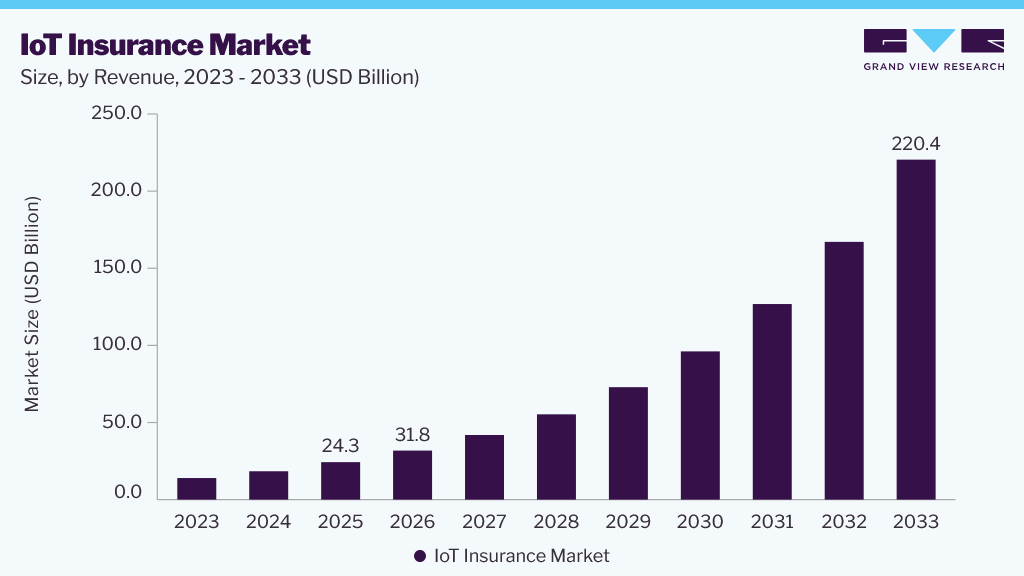 Source: Grand View Research, IR Documents, Primary Interviews, Paid DatabasesTo learn more about this report,
 Download Free Sample Report
Key Market Trends & Insights
- By component: The solution segment led the market, with a revenue share of around 65.0% in 2025.
- By end use: The automotive and transportation segment accounted for the largest market revenue share in 2025.
- By insurance type: The property & casualty insurance segment is expected to witness the fastest CAGR during the forecast period.
Regional Highlights
- Largest regional market: North America (35.0% revenue share, 2025)
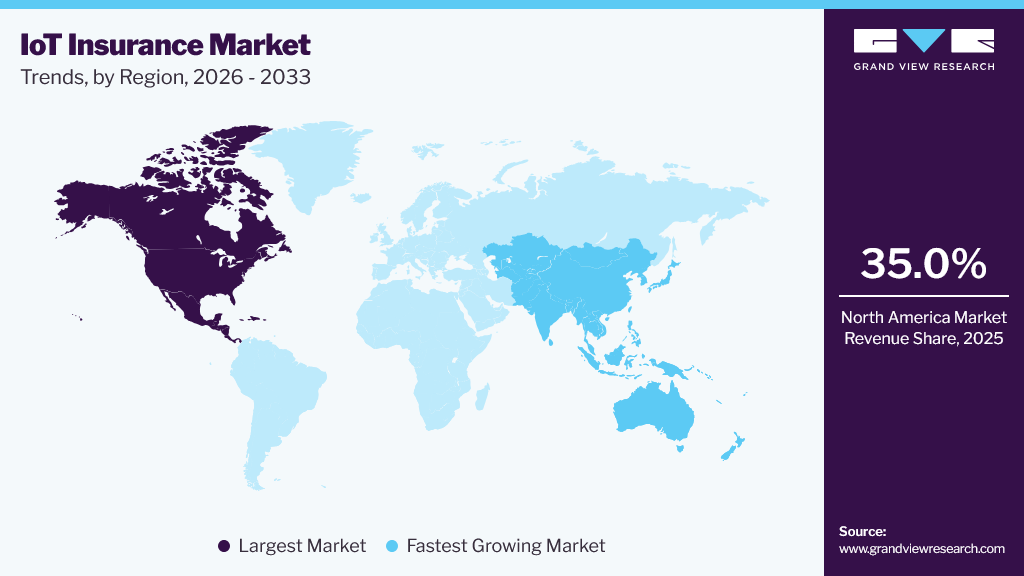
- Fastest-growing regional market: Asia Pacific (highest CAGR, 2026-2033)
Market Size & Forecast
- Market size in 2025: USD 24.3 Billion
- Estimated market size in 2026: USD 31.8 Billion
- Projected market size by 2033: USD 220.4 Billion
- CAGR (2026-2033): 31.8%
Prism AI by Grand View Research Free to tryAsk a question about the IoT insurance marketTry asking✓Every figure cited from GVR research Prefer the report? Download free sample →Advancements in technologies such as sensors, machine learning, big data, and data analytics further drive market expansion. IoT utilities are anticipated to gain momentum during the projection period, with smart grids envisioned to take over the entire energy sector.
The growing use of cutting-edge technologies in the insurance sector, including artificial intelligence and machine learning, offers significant potential to expand the global market. In addition, there is a growing need for cloud platforms and other value-added services, as well as increased use of IoT in established and developing economies. The global IoT insurance industry is growing as insurers invest more in IoT technology to improve operational efficiency.
Insurance companies can target industries such as manufacturing, healthcare, and agriculture, where IoT devices are widely used, and provide customized insurance solutions as IoT adoption spreads across these sectors and geographic areas. Insurance companies can provide customized coverage and rates based on individual data and behavior using IoT technology.
The traditional insurance industry is undergoing an unparalleled change owing to IoT. Insurance businesses employ IoT technology to gather vast volumes of data from connected devices, such as telematics and telemedicine, and derive meaningful insights. Most of the largest insurance companies, including State Farm Group, Allianz SE, and UnitedHealth Group, have begun investing in IoT to enhance operational processes.
Analyst Perspective
The market is evolving from a traditional risk-protection model to a proactive, data-driven insurance ecosystem. This growth is fueled by the increasing adoption of connected devices, telematics, wearables, and smart home technologies that enable insurers to monitor risks in real time, improve underwriting accuracy, and offer personalized insurance products. To capitalize on this trend, leading insurers and technology providers are expanding their portfolios with usage-based insurance, AI-powered risk analytics, connected health programs, and IoT-enabled claims management solutions that enhance customer engagement and operational efficiency. However, the market continues to face challenges related to data privacy, cybersecurity risks, regulatory compliance, and the integration of diverse IoT platforms. Companies that invest in secure data-sharing frameworks, advanced analytics, and strategic partnerships while delivering transparent, value-driven insurance solutions will be well-positioned to strengthen their competitive advantage in the rapidly evolving connected insurance landscape.
Component Insights
The solution segment led the market with the largest revenue share of around 65.0% in 2025 and is expected to retain its dominance over the forecast period. The technology and software that facilitate data collection, analysis, and use are central to the exponential growth of IoT insurance solutions. Software programs, IoT devices, and data analytics platforms are some solutions. Insurance companies collect real-time data from wearables, sensors, and telematics devices using IoT technologies. Claims processing, insurance customization, and risk assessment are all aided by this data. With IoT technology, insurers can provide creative, data-driven insurance products and improve client experiences by offering proactive risk management and individualized coverage.
The services segment is anticipated to witness the fastest CAGR during the forecast period. The technology components are enhanced by IoT insurance services, which provide expertise, support, and guidance. Data analysis, risk assessment, policy formulation, and client assistance are all included in these services. Insurance firms frequently collaborate with IoT service providers to fully utilize IoT technologies. The value of IoT in insurance is further increased by service providers' assistance in resolving data security and compliance issues.
Insurance Type Insights
The life & health insurance segment held the largest revenue share in 2025. IoT technology encourages proactive health monitoring, which enhances life and health insurance. Wearables and connected health devices gather real-time data on policyholders' vital signs, fitness levels, and health habits. With this data, insurers can provide individualized policies that give benefits and discounts for leading healthier lives. IoT-enabled remote patient monitoring and telemedicine also lower costs and increase access to healthcare. IoT-enabled life and health insurance improves general well-being and gives policyholders financial stability.
The property & casualty insurance segment is expected to witness the fastest CAGR during the forecast period. IoT technology is primarily focused on claims processing and risk reduction. Smart sensors and devices monitor safety, security, and environmental factors in homes, cars, and commercial buildings. By using this information, insurers may proactively identify and reduce risks, reducing mishaps and losses. IoT data also speeds up the claims process, as insurers have real-time information about the incident. IoT-enhanced property and casualty insurance lowers risks, minimizes losses, and raises client satisfaction.
End Use Insights
The automotive and transportation segment led the market with the largest revenue share in 2025. Fleet management is streamlined by the widespread usage of IoT insurance services in the automobile and transportation industries. Car electronics track cargo conditions, driver conduct, and routes. It is advantageous for businesses and insurers as it can precisely analyze risk, increase productivity, and guarantee cargo integrity. IoT insurance is centered on telematics and has several applications in the car industry. These devices track driver behavior and provide location, speed, and brake information. Employing this information, insurers can lower rates for conscientious drivers, promote safe driving, and tailor policies.
The healthcare segment is expected to witness the fastest CAGR during the forecast period. Healthcare benefits greatly from IoT-enabled wearables and medical equipment. These gadgets monitor health behaviors and vital signs, enabling insurers to provide customized insurance. Consumers who lead healthier lifestyles benefit from lower premiums and improved general health.
Regional Insights
The North America IoT insurance dominated the market, accounting for a revenue share of 35.0% in 2025, owing to increased awareness and faster adoption of IoT in the region. Numerous businesses, including State Farm, Progressive, and Liberty Mutual, are utilizing the IoT technology available in the area to improve the effectiveness of their risk assessments.
 To learn more about this report, Download Free Sample Report
U.S. IoT Insurance Market Trends
The IoT insurance market in the U.S. is expected to grow at a significant CAGR over the forecast period. The implementation of IoT technology by insurance companies is a significant contributor. The area gains from an established insurance market and cutting-edge IoT technology. In this country, insurers use IoT devices for telematics-based property monitoring and auto insurance. Innovation in the Internet of Things insurance industry is driven by customer demand for customized coverage and risk mitigation. For instance, in May 2025, John Hancock expanded its IoT-enabled Vitality program by introducing new collaborations with Function Health and Nutrisense. The enhanced program leverages wearable devices, continuous health monitoring, and digital health data to reward healthy behaviors, support personalized underwriting, and reduce long-term insurance risk through connected insurance technologies.
Asia Pacific IoT Insurance Market Trends
The IoT insurance market in the Asia Pacific is anticipated to experience significant growth in the coming years. The sharp rise in investment in artificial intelligence technologies can be attributed to this growth. China, Japan, and India are at the forefront of the rapidly expanding IoT insurance industry in the Asia Pacific. The demand for IoT-based insurance solutions is driven by the growing middle class, rising rates of urbanization, and rising vehicle ownership. IoT has been embraced by Chinese insurers, in particular, for a range of insurance products. Japan is a leader in IoT adoption for health insurance and senior care.
China IoT insurance market is expected to grow over the forecast period. China's insurance companies are collaborating with IoT service providers to deliver integrated solutions that include connectivity, IoT devices, and insurance coverage. In response to these shifts, insurance companies are providing tailored solutions that emphasize data protection and privacy, incorporate AI, focus on cybersecurity, and work with IoT service providers.
The IoT insurance market in Japan is expected to grow over the forecast period. As Japan continues to embrace digitalization and IoT technologies, the country's IoT insurance landscape is changing quickly. Insurance companies are responding to these developments by providing tailored solutions, emphasizing data security and privacy, incorporating AI, working with IoT service providers, and concentrating on cybersecurity. For instance, in January 2025, Tokio Marine HCC enhanced its Cyber Security Insurance offering by introducing expanded preventive consulting services, crisis response capabilities, and post-incident support. The solution helps businesses mitigate risks associated with connected devices, IoT ecosystems, and digital infrastructure while strengthening protection against cyber threats and data breaches.
Key IoT Insurance Company Insights
The IoT insurance industry features a range of global, regional, and local players, making it a competitive market. The world’s leading companies are using partnerships, collaborations, acquisitions, mergers, and agreements as strategies to withstand the intense competition and increase their market share. IoT insurance product manufacturers are investing heavily in product enhancements and new product development.
Key IoT Insurance Companies
The following key companies have been profiled for this study on the IoT insurance market:
-
Oracle Corporation
-
SAP SE
-
IBM Corporation
-
Microsoft Corporation
-
Intel Corporation
-
Telit Communications PLC
-
Capgemini SE.
-
Cognizant
-
Cisco Systems Inc.
-
Accenture PLC
-
Verisk Analytics Inc.
-
Wipro Limited
-
Google LLC
-
Synechron, Inc.
-
Concirrus
Recent Developments
-
In June 2024, Continental AG partnered with Samsara to integrate trailer and telematics data, enabling fleet operators and insurers to access real-time vehicle insights to improve risk management and enable connected insurance solutions.
-
In January 2024, Cambridge Mobile Telematics (CMT) launched Roadside Assistance, an AI-powered feature within its telematics platform that automatically detects crashes and connects drivers with roadside assistance, enhancing connected insurance services.
IoT Insurance Market Report Scope
Report Attribute
Details
Market size in 2025
USD 24.3 billion
Estimated market size in 2026
USD 31.8 billion
Projected market size by 2033
USD 220.4 billion
Growth rate
CAGR of 31.8% from 2026 to 2033
Base year for estimation
2025
Historical data
2021 – 2024
Forecast period
2026 – 2033
Quantitative units
Revenue in USD billion, and CAGR from 2026 to 2033
Report coverage
Revenue forecast, company ranking, competitive landscape, growth factors, and trends
Segments covered
Component, insurance type, end use, region
Regional scope
North America; Asia Pacific; Europe; Latin AMerica; MEA
Country scope
U.S.; Canada; UK; Germany; France; China; India; Japan; South Korea; Australia; Brazil; Mexico; UAE; Saudi Arabia; South Africa
Key companies profiled
Oracle Corporation; SAP SE; IBM Corporation; Microsoft Corporation; Intel Corporation; Telit Communications PLC; Capgemini SE; Cognizant; Cisco Systems Inc; Accenture PLC; Verisk Analytics Inc; Wipro Limited; Google LLC; Synechron, Inc; Concirrus
Customization scope
Free report customization (equivalent up to 8 analysts working days) with purchase. Addition or alteration to country, regional & segment scope.
Pricing and purchase options
Avail of customized purchase options to meet your exact research needs. Explore purchase options
Global IoT Insurance Market Report Segmentation
This report forecasts revenue growth at global, regional, and country levels and provides an analysis of the latest industry trends and opportunities in each of the sub-segments from 2021 to 2033. For this study, Grand View Research has segmented the global IoT insurance market report based on component, insurance type, end use, and region:
-
Component Outlook (Revenue, USD Million, 2021 - 2033)
-
Solution
-
Services
-
-
Insurance Type Outlook (Revenue, USD Million, 2021 - 2033)
-
Life and Health Insurance
-
Property and Causality Insurance
-
Others
-
-
End Use Outlook (Revenue, USD Million, 2021 - 2033)
-
Automotive and Transportation
-
Healthcare
-
Agricultural
-
Retail and Commercial
-
Others
-
-
Regional Outlook (Revenue, USD Million, 2021 - 2033)
-
North America
-
U.S.
-
Canada
-
-
Europe
-
UK
-
Germany
-
France
-
-
Asia Pacific
-
China
-
India
-
Japan
-
South Korea
-
Australia
-
-
Latin America
-
Brazil
-
Mexico
-
-
Middle East & Africa
-
UAE
-
Saudi Arabia
-
South Africa
-
-
Frequently Asked Questions About This Report
Key players in the market include Oracle Corporation, SAP SE, IBM Corporation, Microsoft Corporation, Intel Corporation, Telit Communications PLC, Capgemini SE, Cognizant, Cisco Systems, Inc., Accenture plc, Verisk Analytics, Inc., Wipro Limited, Google LLC, Synechron, Inc., and Concirrus, among others.
The solution segment accounted for the largest revenue share of around 65.0% in 2025.
The global IoT insurance market size was valued at USD 24.3 billion in 2025 and is estimated at USD 31.8 billion for 2026.
The global IoT insurance market is expected to grow at a CAGR of 31.8% from 2026 to 2033, reaching USD 220.4 billion.
The market in North America dominated with a revenue share of 35.0% in 2025.
About the Author(s)
Next Generation Technologies Research Team
Technology · Next Generation TechnologiesThis report was authored by the next generation technologies research team at Grand View Research - comprising two research analysts, one senior research analyst, and one industry expert - with specialized expertise in the next generation technologies segment of the technology industry. All findings are based on proprietary technology databases, executive interviews, and regulatory analysis, subject to internal peer review prior to publication.
Last Updated:
Speak to Analyst

Customize this report to your needs - add regions, segments, or data points, with 20% free customization.
Or view our licence options:


ISO 9001:2015 & 27001:2022 Certified
We are GDPR and CCPA compliant! Your transaction & personal information is safe and secure. For more details, please read our privacy policy.


