
- Home
- »
- Advanced Interior Materials
- »
-
Iron Ore Pellets Market Size And Share Report, 2026-2033GVR Report cover
![Iron Ore Pellets Market (2026 - 2033)Report]()
Iron Ore Pellets Market (2026 - 2033)
Size, Share & Trend Analysis Report, By Product (Blast Furnace (BF) Pellet, Direct Reduced (DR) Pellet), By Trade (Captive, Seaborne), By Region (North America, Europe, Asia Pacific, Latin America, MEA), And Segment Forecasts
Market Size, 2025
$62.5BMarket Estimate, 2026
$64.1BMarket Forecast, 2033
$98.1BCAGR, 2026–2033
6.3%Iron Ore Pellets Market Summary
The global iron ore pellets market size was valued at USD 62.5 billion in 2025 and is projected to grow from USD 64.1 billion in 2026 to USD 98.1 billion by 2033, at a CAGR of 6.3% from 2026 to 2033. The market in Asia Pacific dominated with a revenue share of 53.7% in 2025. The market is witnessing substantial growth driven by increasing steel production and rising demand for high-grade, low-emission raw materials.

Key Market Trends & Insights
- By product: Blast furnace pellets segment held the largest market share of 51.1% in 2025.
- By trade: Captive segment held the largest market share in 2025.
Regional Highlights
- Largest regional market: Asia Pacific (53.7% revenue share, 2025)
- By country: China held the largest market share in 2025
Market Size & Forecast
- Market size in 2025: USD 62.5 Billion
- Estimated market size in 2026: USD 64.1 Billion
- Projected market size by 2033: USD 98.1 Billion
- CAGR (2026-2033): 6.3%
In addition, expanding adoption of direct reduction processes and electric arc furnace-based steelmaking is further supporting market expansion. The iron ore pellets market is undergoing significant technological advancement across beneficiation and pelletization processes to improve product quality and operational efficiency. Innovations such as advanced grinding, magnetic separation, and automated induration technologies are enabling the production of higher-grade pellets with consistent physical and metallurgical properties. Additionally, digitalization and process-optimization tools are being deployed to enhance plant productivity, reduce energy consumption, and improve control over pellet chemistry, particularly in direct reduction (DR) applications.
Sustainability has become a central focus in the iron ore pellets market, driven by the global push to decarbonize the steel industry. Pellets are increasingly preferred over sinter due to their lower emissions and higher efficiency in steelmaking processes. Companies are investing in low-carbon pelletizing technologies, including the use of renewable energy, hydrogen-based reduction methods, and dry processing techniques to minimize environmental impact. Furthermore, the utilization of iron ore fines and waste materials in pellet production supports resource efficiency and aligns with circular economy principles.

Drivers, Opportunities & Restraints
The growth of the iron ore pellets market is primarily driven by the rising need for high-efficiency raw materials in steel production, especially as industries aim to improve productivity and reduce emissions. Pellets offer superior metallurgical performance compared to sinter, making them increasingly preferred in both blast furnace and direct reduction routes. This increasing preference is further supported by the ongoing expansion of infrastructure and industrial activities across emerging economies, which continues to drive global steel demand.
A major opportunity for the industry lies in the global transition toward green steel, where direct reduction processes and hydrogen-based technologies require high-quality DR-grade pellets. This shift is particularly evident in Europe, where steelmakers are investing heavily in low-carbon production pathways. For example, in May 2025, LKAB announced plans to support hydrogen-based steel initiatives through pellet supply collaborations, signaling strong future demand for premium-grade pellets tailored for sustainable steel production.
The market faces constraints due to the limited availability of high-grade iron ore resources and the capital-intensive nature of pellet production facilities. Producing DR-grade pellets requires consistent ore quality, which is becoming increasingly scarce, leading to supply imbalances and pricing pressures. In March 2026, reports indicated that India was expected to increase iron ore imports significantly due to shortages of high-quality domestic ore, underscoring how raw material constraints can affect pellet production and overall market stability.
Product Insights
Blast furnace pellets accounted for the largest share of the iron ore pellets market in 2025, supported by their extensive use in integrated steel plants worldwide. These pellets are widely preferred due to their cost-effectiveness and compatibility with existing blast furnace infrastructure, particularly in regions with established steelmaking capacities such as the Asia Pacific and Europe. The continued reliance on traditional blast furnace routes, especially in developing economies, has sustained strong demand for BF pellets.
Direct reduction pellets are expected to witness the fastest CAGR during the forecast period, driven by the growing shift toward low-carbon steelmaking technologies. These high-grade pellets are specifically designed for use in direct reduction iron (DRI) processes, including hydrogen-based steel production, which require superior purity and consistency. Increasing investments in electric arc furnaces (EAF) and green steel initiatives, particularly in Europe and the Middle East, are accelerating the demand for DR-grade pellets and positioning this segment as a key growth driver in the market.
Trade Insights
The captive segment accounted for the largest share of the iron ore pellets market in 2025, supported by increasing vertical integration among steel producers. Large steel manufacturers are investing in in-house pellet plants to secure a consistent raw material supply, control costs, and ensure quality for their operations. This trend is particularly prominent in regions such as India and China, where companies are expanding captive pellet capacities to reduce dependency on imports and enhance operational efficiency amid volatile raw material prices.
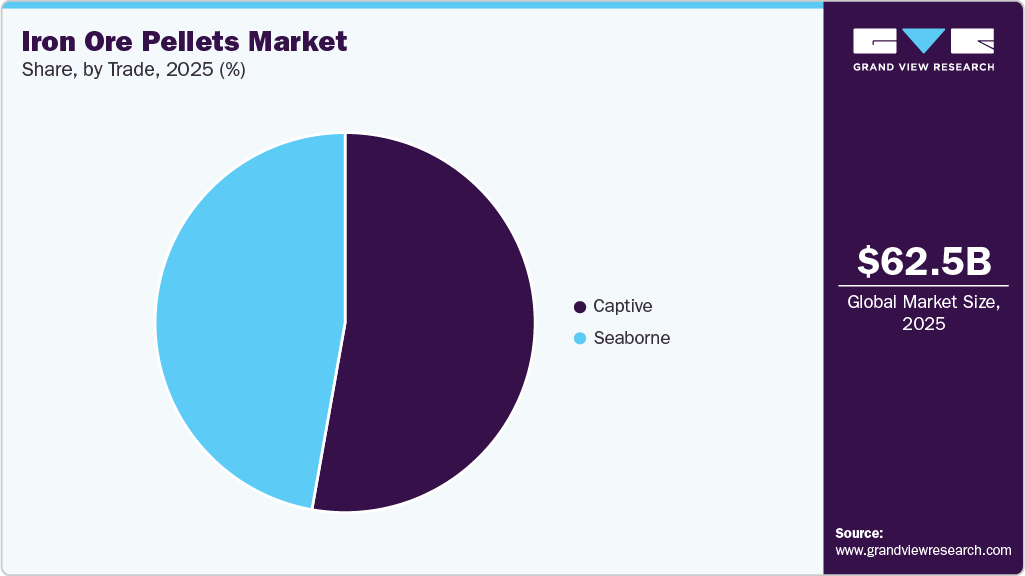
The seaborne segment is projected to register the fastest CAGR over the forecast period, driven by strong international trade flows and supply-demand imbalances across regions. Major exporting countries such as Brazil, Sweden, and Ukraine cater to high-demand markets in Asia and Europe, where domestic pellet production is insufficient. The segment benefits from established global logistics networks and the increasing preference of steelmakers to source high-grade pellets from reliable international suppliers, particularly for blast furnace and direct reduction applications.
Regional Insights
Asia Pacific led the global iron ore pellets market, capturing the highest revenue share of 53.7%. The iron ore pellets industry in the Asia Pacific dominates the market, primarily due to large-scale steel production in countries such as China and India. The region relies on a mix of domestic production and imports to meet rising demand driven by infrastructure development and industrialization. While blast furnace routes remain prevalent, there is a gradual shift toward higher-grade pellets to improve efficiency and reduce emissions in steelmaking processes.

North America Iron Ore Pellets Market Trends
The iron ore pellets industry in North America is driven by strong demand from integrated steel producers and the growing adoption of electric arc furnace (EAF) technologies. The region benefits from well-established pellet production infrastructure and a high degree of vertical integration among key players. Increasing focus on low-emission steelmaking and the availability of high-grade iron ore resources further support the demand for pellets, particularly for direct reduction applications.
The U.S. iron ore pellets industry represents a major share within North America, supported by its robust steel industry and significant domestic pellet production capacity. Companies such as Cleveland-Cliffs Inc. dominate the market through vertically integrated operations, ensuring a stable supply to steel mills. The country is also witnessing a gradual shift toward EAF-based steelmaking, which is increasing demand for high-quality pellets tailored for cleaner production processes.
Europe Iron Ore Pellets Market Trends
The iron ore pellets industry in Europe is characterized by a strong push toward decarbonization and green steel production. The region is increasingly adopting direct reduction and hydrogen-based technologies, driving demand for DR-grade pellets. Key producers such as LKAB play a crucial role in supplying high-grade pellets, while regulatory pressure and carbon reduction targets continue to reshape the regional market dynamics.
Latin America Iron Ore Pellets Market Trends
The iron ore pellets industry in Latin America is a key exporting region in the market, supported by abundant iron ore reserves and large-scale mining operations. Countries such as Brazil play a dominant role, with major players like Vale S.A. supplying high-grade pellets to international markets. The region’s growth is closely tied to global steel demand and export dynamics, particularly toward Asia and Europe.
Middle East & Africa Iron Ore Pellets Market Trends
The iron ore pellets industry in the Middle East & Africa is witnessing growing demand for iron ore pellets, driven by increasing investments in direct reduction iron (DRI) and steel production facilities. The availability of natural gas and the expansion of DRI-based steelmaking in countries such as Saudi Arabia and the UAE are supporting pellet consumption. Additionally, Africa’s resource base offers long-term potential for pellet production, although infrastructure and investment challenges remain key considerations.
Key Iron Ore Pellets Company Insights
Some of the key players operating in the market include Vale S.A, LKAB, and others.
-
Vale S.A. is a Brazil-based mining company founded in 1942 and headquartered in Rio de Janeiro, Brazil. It is the world’s largest producer of iron ore and iron ore pellets, serving global steel manufacturers across Asia, Europe, and the Americas. The company has a strong presence in the pellet segment, particularly in high-grade and direct reduction (DR) pellets, supporting low-emission steelmaking. Vale emphasizes operational efficiency and sustainability, with ongoing investments in dry-processing technologies and carbon-reduction initiatives across its mining and pelletizing operations.
-
LKAB is a Sweden-based mining company founded in 1890 and headquartered in Luleå, Sweden. It is Europe’s leading producer of iron ore pellets, primarily supplying the regional steel industry. The company specializes in direct reduction (DR) grade pellets, positioning itself at the forefront of green steel value chains. LKAB focuses on innovation and decarbonization, with significant investments in hydrogen-based ironmaking and fossil-free pellet production technologies to support sustainable steel manufacturing.
-
Cleveland-Cliffs Inc. is a U.S.-based mining and steel manufacturing company founded in 1847 and headquartered in Cleveland, Ohio. It is the largest producer of iron ore pellets in North America, primarily serving integrated steel producers and its own downstream steel operations. The company has a strong captive consumption model, ensuring supply chain integration from mining to finished steel. Cleveland-Cliffs focuses on operational integration and cost optimization, with an increasing emphasis on producing high-grade pellets to support cleaner steelmaking processes.
Key Iron Ore Pellets Companies:
The following key companies have been profiled for this study on the iron ore pellets market.
- Anglo American plc
- ArcelorMittal
- BHP Group
- Cleveland-Cliffs Inc.
- Ferrexpo plc
- Fortescue Metals Group
- LKAB
- Metalloinvest MC LLC
- Rio Tinto
- Vale S.A.
Recent Development
-
In July 2025, Vale S.A. announced progress in its agglomerate’s strategy, focusing on increasing the share of high-grade iron ore pellets in its product mix. The company highlighted its roadmap to enhance pellet production capacity and improve product quality to meet growing global demand for low-emission steelmaking inputs.
-
In October 2025, LKAB reported continued advancement of its HYBRIT project in collaboration with SSAB and Vattenfall, aimed at producing fossil-free sponge iron using hydrogen. The initiative directly supports increased demand for DR-grade pellets and reinforces LKAB’s transition toward carbon-neutral mining and processing operations.
-
In August 2025, Cleveland-Cliffs Inc. highlighted operational updates in its quarterly disclosures, emphasizing stable pellet production volumes and a strategic focus on supplying high-grade pellets to its integrated steel operations. The company reiterated its commitment to optimizing pellet quality to support cleaner steel production in North America.
Iron Ore Pellets Market Report Scope
Report Attribute
Details
Market definition
The market size represents the revenue generated from the sale of iron ore pellets across various regions in a given year.
Market size in 2025
USD 62.5 billion
Estimated Market size in 2026
USD 64.1 billion
Projected Market size by 2033
USD 98.1 billion
Growth rate
CAGR of 6.3% from 2026 to 2033
Base year for estimation
2025
Historical data
2021 - 2024
Forecast period
2026 - 2033
Quantitative Units
Revenue in USD million/billion, volume in kilotons, and CAGR from 2026 to 2033
Report coverage
Volume forecast, revenue forecast, competitive landscape, growth factors, and trends
Segments covered
Product, trade, region
Regional scope
North America; Europe; Asia Pacific; Latin America; Middle East & Africa
Country scope
U.S.; Canada; Mexico; Germany; UK; France; Italy; China; India; Japan; South Korea; Brazil
Key companies profiled
Anglo American plc; ArcelorMittal; BHP Group; Cleveland-Cliffs Inc.; Ferrexpo plc; Fortescue Metals Group; LKAB; Metalloinvest MC LLC; Rio Tinto; Vale S.A.
Customization scope
Free report customization (equivalent up to 8 analysts working days) with purchase. Addition or alteration to country, regional & segment scope.
Pricing and purchase options
Avail customized purchase options to meet your exact research needs. Explore purchase options
Global Iron Ore Pellets Market Report Segmentation
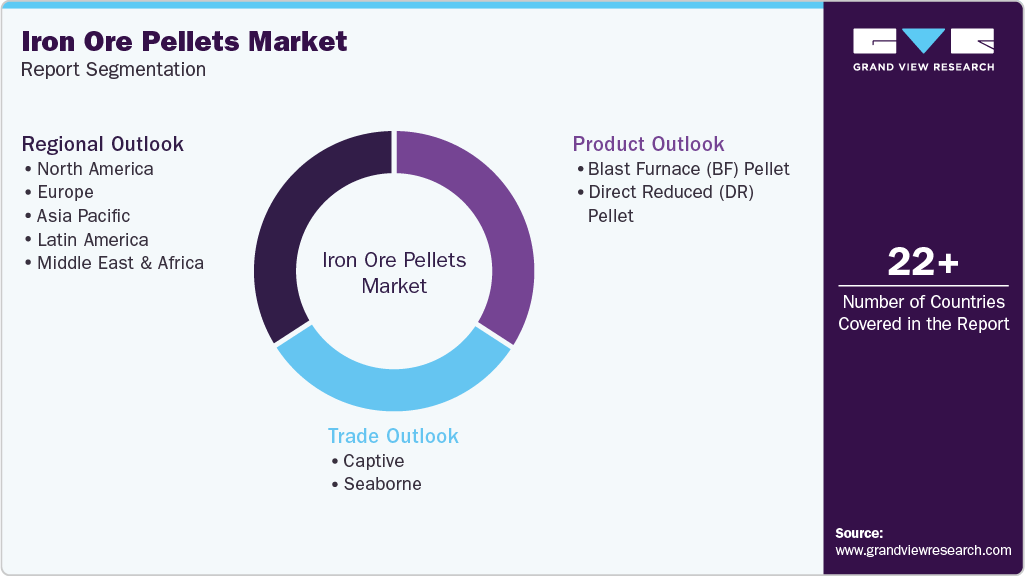
This report forecasts revenue and volume growth at global, regional, and country levels and provides an analysis of the latest industry trends in each of the sub-segments from 2021 to 2033. For this study, Grand View Research has segmented the global iron ore pellets market report on the basis of product, trade, and region:
-
Product Outlook (Volume, Kilotons; Revenue, USD Million, 2021 - 2033)
-
Blast Furnace (BF) Pellet
-
Direct Reduced (DR) Pellet
-
-
Trade Outlook (Volume, Kilotons; Revenue, USD Million, 2021 - 2033)
-
Captive
-
Seaborne
-
-
Regional Outlook (Volume, Kilotons; Revenue, USD Million, 2021 - 2033)
-
North America
-
U.S.
-
Canada
-
Mexico
-
-
Europe
-
Germany
-
UK
-
Italy
-
France
-
-
Asia Pacific
-
China
-
India
-
Japan
-
South Korea
-
-
Latin America
-
Brazil
-
-
Middle East & Africa
-
Frequently Asked Questions About This Report
The global iron ore pellets market size was estimated at USD 62.5 billion in 2025 and is expected to reach USD 64.1 billion in 2026.
The global iron ore pellets market is expected to grow at a compound annual growth rate of 6.3% from 2026 to 2033 to reach USD 98.1 billion by 2033.
Blast furnace iron ore pellets dominated the market by product, representing 51.1% of total revenue in 2025, primarily due to their widespread use in integrated steel plants and established blast furnace infrastructure globally.
Some of the key players of the global iron ore pellets market are Anglo American plc; ArcelorMittal; BHP Group; Cleveland-Cliffs Inc.; Ferrexpo plc; Fortescue Metals Group; LKAB; Metalloinvest MC LLC; Rio Tinto; Vale S.A., and others.
Asia Pacific dominated with a 53.7% revenue share in 2025.
The captive segment held the largest revenue share in 2025, while the seaborne segment is the fastest-growing.
Rising steel demand from infrastructure and industrial growth is the primary driver of the iron ore pellets market. Additionally, the shift toward low-carbon steelmaking is increasing demand for high-grade pellets.
About the Author(s)
Advanced Interior Materials Research Team
Advanced Materials · Advanced Interior MaterialsThis report was authored by the advanced interior materials research team at Grand View Research - comprising two research analysts, one senior research analyst, and one industry expert - with specialized expertise in the advanced interior materials segment of the advanced materials industry. All findings are based on proprietary advanced materials databases, executive interviews, and regulatory analysis, subject to internal peer review prior to publication.
Last Updated:
Speak to Analyst


Customize this report to your needs — add regions, segments, or data points, with 20% free customization.
Or view our licence options:


ISO 9001:2015 & 27001:2022 Certified
We are GDPR and CCPA compliant! Your transaction & personal information is safe and secure. For more details, please read our privacy policy.


