
- Home
- »
- Next Generation Technologies
- »
-
Islamic Fintech Market Size & Share, Industry Report, 2033GVR Report cover

Islamic Fintech Market (2026 - 2033) Size, Share & Trends Analysis Report By Type (Digital Payments, Digital Lending, Wealth Management, Insurance), By Deployment, By End-use (Individuals, SMEs, Financial Institutions), By Region, And Segment Forecasts
Market Size, 2025
$223.0BMarket Estimate, 2026
$250.6BMarket Forecast, 2033
$619.2BCAGR, 2026–2033
13.8%Islamic Fintech Market Summary
The global Islamic fintech market size was valued at USD 223.0 billion in 2025 and is projected to grow from USD 250.6 billion in 2026 to USD 619.2 billion by 2033, at a CAGR of 13.8% from 2026 to 2033. Middle East and Africa held the dominating position in the global Islamic fintech market with 40.69% share in 2025. The growth can be attributed to the increasing adoption of Shariah-compliant financial services with digital banking infrastructure across the globe.
 Source: Grand View Research, IR Documents, Primary Interviews, Paid DatabasesTo learn more about this report,
 Download Free Sample Report
 Key Market Trends & Insights
- By type: the digital payments segment accounted for the largest share of 56.60% in 2025.
- By deployment: the cloud segment held the largest market share in 2025.
- By end-use: the Individuals segment dominated the market in 2025.
Regional Highlights
- Largest regional market: Middle East and Africa (40.69% revenue share, 2025)
- Fastest-growing regional market: Asia-Pacific (highest CAGR, 2026-2033)
- By country: The U.S Islamic fintech industry is a major contributor to the global market.
Market Size & Forecast
- Market size in 2025: USD 223.0 Billion
- Estimated market size in 2026: USD 250.6 Billion
- Projected market size by 2033: USD 619.2 Billion
- CAGR (2026-2033): 13.8%
Three ways to get this report
Buy it, customize it, or ask a question.Ask an Analyst
Analyst response in 1 business day
- AccessReport author, directly
- Reply timeWithin 1 working day
- No sales callDirect answer only
- FormatEmail reply
- CostFree, no cost
Get the Full Report
What the study covers
- FormatsPDF · Excel · Dashboard
- Timeline2026–2033 annual, 2025 base
- Coverage20+ countries, 5 regions
- Companies10+ key players profiled
Customize the Report
20% free customization
- IncludeCountries, segments, points
- TailorTo your product definition
- ExtendDeeper competitor detail
- OrA fully bespoke study
- Turnaround5–10 working days
The growing demand for the halal economy is driven by the increasing adoption of Shariah-compliant financial products and services that adhere to Islamic law, enabling investors to access ethical and interest-free investment opportunities. The adoption of Shariah-compliant digital banking and fintech platforms is expanding the use of modular, cloud-native solutions that enable Islamic financial products at scale. For instance, in May 2025, Tuum expanded its Islamic banking suite by introducing new cloud-native modules to enable financial institutions to offer Shariah-compliant banking solutions. The platform is designed to support both fully Islamic banks and conventional banks with Islamic banking windows, providing flexibility and scalability. It includes features such as Islamic deposit accounts (Mudarabah, Wakalah, Wadiah, and Qard Hassan), automated profit-sharing mechanisms, and Tawarruq-based financing solutions. Additionally, Tuum has partnered with DDCAP Group to enhance its capabilities in facilitating asset-backed, Shariah-compliant transactions through automated workflows. To learn more about this report, Download Free Sample Report
 The rapid digitalization of financial services is further accelerating the growth of the Islamic fintech industry. The adoption of mobile banking, digital wallets, and online investment platforms has enabled fintech providers to deliver Shariah-compliant solutions more efficiently and at scale. This digital transformation is particularly evident in emerging markets across the Middle East, Southeast Asia, and parts of Africa, where a large unbanked population is gaining access to financial services through fintech platforms.Technological advancements such as blockchain, artificial intelligence, and cloud computing are further enhancing the capabilities of Islamic fintech solutions.
The regulatory environment for Islamic digital banking continues to evolve as authorities place greater emphasis on ensuring Shariah-compliant financial services. For instance, in October 2025, Fasset secured a provisional banking license from the Labuan Financial Services Authority in Malaysia to expand into Shariah-compliant digital banking services. The development enables the provision of interest-free savings, financing, and investment products leveraging stablecoins and tokenized assets. Such initiatives highlight the growing convergence of digital assets and Islamic finance, supporting innovation and broader access to compliant financial services.
Investment activity in Islamic fintech startups like Mal, Muhlah, and Haball has been increasing, with these startups securing significant funding to expand Shariah‑compliant digital banking and financing solutions. For instance, in January 2026, Mal raised USD 230 million in seed funding to build and launch a new AI‑powered Islamic digital bank. The investment round was led by BlueFive Capital and included other strategic investors and family offices. The capital is expected to support the development of Mal’s digital banking products and accelerate regulatory licensing efforts.
The lack of standardized Shariah interpretations across jurisdictions creates regulatory inconsistencies, increasing compliance complexity and hindering the scalability of Islamic finance platforms. Differences among schools of thought and locally issued fatwas create inconsistencies in product structuring, governance, and certification. These challenges make cross-border Shariah compliance complex and resource-intensive for enterprises. Additionally, the absence of unified global standards and internationally recognized accreditation bodies limits interoperability and reduces investor confidence. As a result, market participants must invest in specialized Shariah advisory boards, modular compliance systems, and jurisdiction-specific validation, which raise operational costs and slow platform growth in regulation-sensitive markets.
Type Insights
The digital payments segment accounted for the largest market share of 56.60% in 2025, driven by its fundamental role in facilitating everyday financial transactions and the rapid adoption of Shariah-compliant payment solutions across Muslim-majority and emerging markets. The increasing shift toward cashless economies has further accelerated the adoption of digital wallets, QR-based payments, and mobile payment platforms. For instance, Saudi Arabia's central bank launched Google Pay and plans to support Alipay+ by 2026, encouraging consumers and businesses to switch from cash to digital wallets and QR payments.
The digital lending segment is expected to grow at the fastest CAGR during the forecast period. The growth of Shariah-compliant digital lending is supported by increasing institutional funding and strong investor participation, enabling fintech companies to scale their financing offerings. This capital inflow is facilitating the expansion of Shariah-compliant credit solutions, including buy now, pay later (BNPL) services. For instance, in September 2025, Saudi fintech Tamara secured a Shariah-compliant financing package of up to USD 2.4 billion from financial institutions. This funding would support the expansion of its buy now, pay later and credit services across the Gulf region, driving capital inflows into digital lending solutions aligned with Islamic principles.
Deployment Insights
The cloud segment held the largest share of the Islamic fintech market in 2025. Cloud adoption in Islamic fintech is accelerating the migration of payment systems to the cloud, enabling faster, more secure, and more efficient transactions. For instance, in February 2025Abu Dhabi Islamic Bank adopted SWIFT’s cloud-based Alliance Cloud system, migrating its payment operations from traditional infrastructure to the cloud. This deployment reduced downtime, enhanced cybersecurity, and enabled more efficient management of large transaction volumes. Customers benefit from faster transactions, while the bank delivers more reliable services. These improvements supported the bank’s objective to become increasingly digital and modern.
The on-premise segment is expected to grow at a significant CAGR during the forecast period, as financial institutions prefer to keep their software and systems in their own data centers rather than use the cloud. This gives the bank full control over its data, systems, and security, because everything is managed internally. Islamic finance follows strict Shariah rules, and institutions must ensure that all transactions, data handling, and financial products fully comply with these principles. Moreover, many banks still prefer on-premises systems for their core operations and sensitive financial activities.
End-use Insights
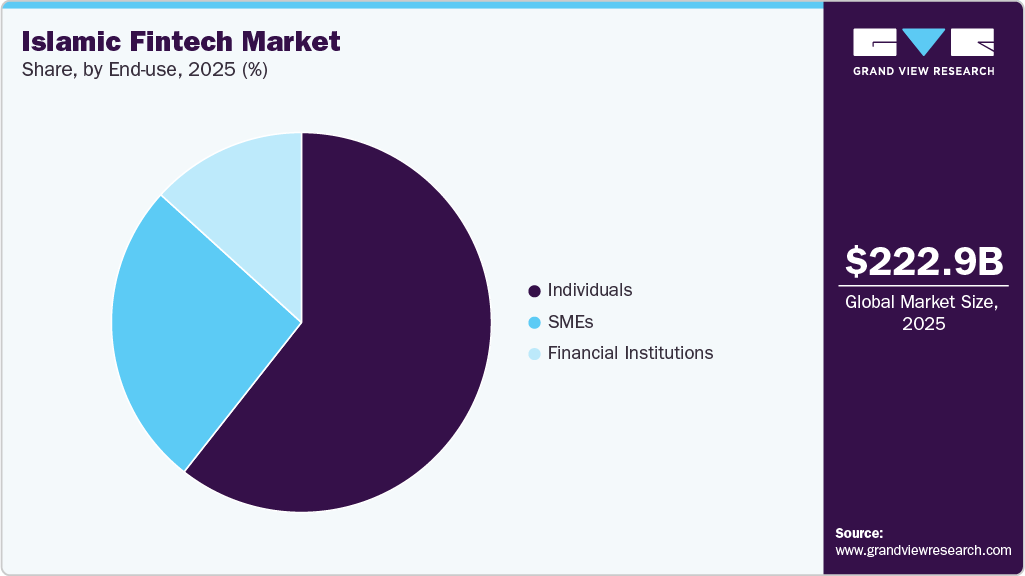
The individual segment dominated the Islamic fintech industry in 2025, driven by the launch of digital banking and payment platforms that make everyday financial services easily accessible through mobile apps. Increasing smartphone penetration and the widespread adoption of mobile banking and digital payment platforms have enabled individuals to conveniently access services such as halal investments, digital wallets, and buy now, pay later (BNPL) solutions. Additionally, rising awareness of ethical and interest-free financial products is encouraging both Muslim and non-Muslim users to adopt Islamic fintech offerings. Fintech providers are further enhancing user engagement through intuitive, app-based platforms and personalized financial services. This trend is particularly prominent in emerging markets, where digital solutions are improving financial inclusion and expanding access to compliant financial services.
 To learn more about this report, Download Free Sample Report
 The SMEs segment is projected to grow at the fastest CAGR of 14.8% over the forecast period. The increasing adoption of digital Banking-as-a-Service (BaaS) solutions is enabling easier access to Shariah-compliant financial services, driving growth in the market. As a result, small businesses and individuals can easily access Islamic financial services, such as loans, payments, and banking. This ease of access is helping the Islamic fintech market grow faster. For instance, in February 2025, CTOS Data Systems Sdn. Bhd. partnered with Maybank Islamic Berhad to launch a Banking-as-a-Service (BaaS) initiative in Malaysia. The collaboration integrated CTOS’s credit scoring and risk management capabilities with Maybank Islamic’s Shariah-compliant banking services. This initiative is designed to provide personalized financial solutions for both SMEs and retail customers through a digital platform. It enabled businesses to access credit insights and financing solutions while adhering to Islamic financial principles. The development supported the adoption of digital financial services and improved access to Shariah-compliant banking solutions in the market.
Regional Insights
The Middle East and Africa Islamic fintech market accounted for the largest share 40.69% in 2025. The growing demand for Shariah-compliant digital financial services across the Middle East and Africa is driving the market growth. The expansion of smartphone usage, high internet penetration, and the growing digital activity of consumers and businesses are increasing the complexity of financial needs, thus driving the adoption of Islamic fintech solutions. Financial institutions and fintech providers in the region are increasingly deploying mobile banking platforms, digital payment solutions, and Shariah-compliant investment services to gain better visibility, accessibility, and control over financial transactions. A key trend in the market is the rapid adoption of digital Islamic finance technologies, including mobile-first banking platforms, digital wallets, and app-based investment solutions that enable real time transactions, transparency, and faster decision-making.
 To learn more about this report, Download Free Sample Report
 North America Islamic Fintech Market Trends
The North America Islamic fintech industry held a significant share in 2025. The increasing demand for Shariah-compliant investment products in the markets is driving the expansion of Islamic fintech offerings in North America. Islamic fintech providers are gaining wider acceptance with faith-based and values-driven investors seeking accessible, regulated investment options. For instance, in November 2025, Manzil Mortgage Services Inc., which provided halal investment and financing solutions, launched its first halal exchange-traded fund (ETF) on Nasdaq, enabling investors to access a diversified portfolio of Shariah-compliant U.S. stocks that exclude interest-based and non-permissible sectors, while allowing faith-aligned participation in mainstream capital markets.
U.S. Islamic Fintech Market Trends
The U.S. Islamic fintech industry held a significant share in 2025.The integration of Shariah-compliant digital investment platforms with modern fintech infrastructure is driving the market growth. Several companies offer digital financial solutions based on Islamic finance principles, enabling users to access halal investing, home financing, and wealth management across the U.S. market. For instance, in July 2025, Manzil Mortgage Services Inc., which operates as a first Islamic digital bank, expanded into the U.S. market by launching a new digital investment platform called Manzil Invest USA. The platform provides Shariah-compliant investment solutions tailored for American Muslims and enables participation in the stock market through screened investments that comply with Islamic standards. This approach simplifies access to compliant, diversified investment portfolios and supports broader market adoption.
Europe Islamic Fintech Market Trends
The Europe Islamic fintech industry was identified as a lucrative region in 2025. Government policies and the region's status as a global financial hub are strengthening the adoption of Islamic finance services across the region. International Islamic finance activities are supported through platforms such as the London Stock Exchange, which is one of the world’s leading venues for the listing of sukuk (Islamic bonds). In addition, the government is reviewing regulations to make it easier for Islamic finance companies to operate, helping improve access to Shariah-compliant financial products and strengthening the country’s position as a global Islamic finance center.
The UK Islamic fintech market is expected to grow rapidly in the coming years. The UK maintains its position as an Islamic finance hub in Western markets, supported by its strong financial infrastructure and international investor base. The London Stock Exchange remains a key platform for Islamic capital markets and ranks with the global venues for sukuk listings. The UK benefits from a well-established legal framework, deep capital markets, and a strong professional services ecosystem. These factors support international Islamic finance activity, improve access to Shariah-compliant financial products, and reinforce the UK’s role in the global Islamic finance ecosystem.
Asia Pacific Islamic Fintech Market Trends
The Asia Pacific Islamic fintech industry is expected to grow at the fastest CAGR of 14.6% during the forecast period. The growing demand for Shariah-compliant digital banking solutions is accelerating growth. Further, the growing deployment of consumer and SME interest is accelerating the adoption of financial institutions and fintech providers to adopt cloud-based, Shariah-compliant platforms. A key trend in the region is the rapid integration of modern cloud technologies with Islamic banking operations, which allows real-time management of Shariah contracts and automated profit-sharing calculations, supporting market expansion and stronger financial inclusion across the Asia Pacific.
The China Islamic fintech market is expected to grow rapidly in the coming years, driven by increased connectivity across financial markets, cross-border cooperation, and institutional initiatives that support Shariah-aligned financial products and innovation. For instance, in October 2025, Hong Kong, a major financial centre within Greater China, announced planned to strengthen its role as a hub for Islamic finance through the issuance of Sukuk and other Shariah‑compliant financial instruments. This strategic positioning encourages fintech firms to develop compliant digital solutions across digital payments, tokenised products, and cross‑border investment platforms, as reflected in the growing institutional and regulatory support for Shariah-compliant digital financial products across Greater China.
The Islamic fintech market in Japan held a substantial share in 2025. The growing demand for Shariah-compliant investment opportunities is driving the expansion of Islamic fintech and ethical financial products globally. For instance, in January 2025, Nomura Asset Management Malaysia, a unit of Nomura Holdings, Inc., a financial held company, introduced a new investment product called the Japan Shariah Active Core Fund. This fund provided investors with access to shares of Japanese companies that adhere to Shariah (Islamic law) principles. The fund was available to both Malaysian and international investors and aimed to balance growth and stability by combining Nomura’s experience in Japanese equities with Shariah‑compliant investing ruled. This launched reflects grew interest in Islamic financial products beyond traditional markets and expands halal investment options for faith‑aligned investors.
Key Islamic Fintech Company Insights
Some of the key companies in the Islamic fintech market include Wahed Invest Limited, Fasset, Qardus, Beehive P2P Limited, and others. Organizations are focusing on increasing their customer base to gain a competitive edge in the industry. Therefore, key players are taking several strategic initiatives, such as mergers and acquisitions, and partnerships with other major companies.
-
Wahed Invest Limited operates through its Shariah-compliant digital investment platform, which provides ethical wealth management solutions for Islamic finance principles. Wahed Invest Limited offers automated investing services, halal portfolios, and financial planning tools that help individuals invest in accordance with Shariah guidelines. Its platform enables users to access diversified portfolios across equities, sukuk, gold, and cash. Wahed’s digital solutions are widely used for financial inclusion, are transparent, and are affordable for retail investors.
-
Qardus is a provider of a Shariah-compliant fintech platform that provides ethical financing solutions to small and medium-sized enterprises (SMEs). Qardus offers asset-backed and trade-based Islamic financing structures that help businesses access growth capital without interest. The company connects investors with SMEs through a digital platform. Qardus’ solutions support the business expansion, cash-flow management, and financial inclusion while maintaining full Shariah compliance.
Key Islamic Fintech Companies:
The following key companies have been profiled for this study on the Islamic fintech market.
- Wahed Invest Limited
- Fasset
- Qardus
- Beehive P2P Limited
- Musaffa
- NymCaro
- Raqamyah
- Codebase Technologies
- PayHalal
- ShariaPortfolio
Recent Developments
-
In August 2025, Wahed Invest Limited, a financial technology and services company, launched a Shariah-compliant private real estate investment platform in the U.S., marking a step toward expanding access to real estate for faith-based and value-aligned investors. The platform allowed investors to purchase fractional ownership stakes in residential properties with minimum investments as low as USD 100. Through the platform’s mobile app, users could earn quarterly rental income proportional to their shared and benefit from potential property valued appreciation.
-
In October 2025, Fasset, a Middle Eastern digital asset investment company, obtained a licensed from Malaysia’s Labuan Financial Services Authority to launch the world’s first stablecoin-powered Islamic digital bank. The Dubai-based firm planned to use stablecoin infrastructure to offer digital banking services that comply with Shariah principles. In addition, the company planned to develop an Ethereum Layer 2 network to settle real-world assets on-chain and issue a crypto-linked debit card, signalling a broader pushed to merge Islamic finance with digital asset technologies.
Islamic Fintech Market Report Scope
Report Attribute
Details
Market size in 2025
USD 223.0 billion
Estimated Market size in 2026
USD 250.6 billion
Projected Market size by 2033
USD 619.2 billion
Growth rate
CAGR of 13.8% from 2026 to 2033
Base year for estimation
2025
Historical data
2021 - 2025
Forecast period
2026 - 2033
Quantitative units
Transaction Volume in USD million/billion, and CAGR from 2026 to 2033
Report vehicle
Transaction forecast, company ranking, competitive landscape, growth factors, and trends
Segments covered
Type, deployment, end-use, region
Regional scope
North America; Europe; Asia Pacific; Latin America; MEA
Country scope
U.S.; Canada; Germany; UK; France; China; Japan; India; Indonesia; Malaysia; Brazil; Saudi Arabia; UAE; South Africa; Qatar; Bahrain
Key companies profiled
Wahed Invest Limited; Fasset; Qardus; Beehive P2P Limited; Musaffa; NymCaro; Raqamyah; Codebase Technologies; PayHalal; ShariaPortfolio
Customization scope
Free report customization (equivalent up to 8 analysts working days) with purchase. Addition or alteration to country, regional & segment scope.
Pricing and purchase options
Avail customized purchase options to meet your exact research needs. Explore purchase options
Global Islamic Fintech Market Report Segmentation
This report forecasts market growth at the global, regional, and country levels and provides an analysis of the latest industry trends in each of the sub-segments from 2021 to 2033. For this study, Grand View Research has segmented the global Islamic fintech market report based on type, deployment, end-use, and region:
-
Type Outlook (Transaction Volume, USD Billion, 2021 - 2033)
-
Digital Payments
-
Digital Lending
-
Wealth Management
-
Insurance
-
Others
-
-
Deployment Outlook (Transaction Volume, USD Billion, 2021 - 2033)
-
On-premise
-
Cloud
-
-
End Use Outlook (Transaction Volume, USD Billion, 2021 - 2033)
-
Individuals
-
SMEs
-
Financial Institutions
-
-
Regional Outlook (Transaction Volume, USD Billion, 2021 - 2033)
-
North America
-
U.S.
-
Canada
-
-
Europe
-
Germany
-
UK
-
France
-
-
Asia Pacific
-
China
-
Japan
-
India
-
Indonesia
-
Malaysia
-
-
Latin America
-
Brazil
-
-
Middle East and Africa (MEA)
-
Saudi Arabia
-
UAE
-
South Africa
-
Qatar
-
Bahrain
-
-
Frequently Asked Questions About This Report
Asia Pacific is the fastest-growing region over the forecast period.
The digital payments segment led with a 56.6% revenue share in 2025, while digital lending is the fastest-growing segment.
The cloud segment accounted for the largest revenue share in 2025.
Individual segment held the largest revenue share in 2025, while SMEs is the fastest-growing segment.
The global Islamic fintech market size was valued at USD 223.0 billion in 2025 and is estimated at USD 250.6 billion for 2026.
The global Islamic fintech market is expected to grow at a CAGR of 13.8% from 2026 to 2033, reaching USD 619.2 billion.
The growth can be attributed to the increasing adoption of Shariah-compliant financial services with digital banking infrastructure across the globe.
Middle East and Africa dominated with a 40.7% revenue share in 2025. The growing demand for Shariah-compliant digital financial services across the Middle East and Africa is driving the growth of the Islamic fintech market.
Key players include Wahed Invest Limited; Fasset; Qardus; Beehive P2P Limited; Musaffa; NymCaro; Raqamyah; Codebase Technologies; PayHalal; ShariaPortfolio.
About the Author(s)
Next Generation Technologies Research Team
Technology · Next Generation TechnologiesThis report was authored by the next generation technologies research team at Grand View Research - comprising two research analysts, one senior research analyst, and one industry expert - with specialized expertise in the next generation technologies segment of the technology industry. All findings are based on proprietary technology databases, executive interviews, and regulatory analysis, subject to internal peer review prior to publication.
Last Updated:
Speak to Analyst

Customize this report to your needs - add regions, segments, or data points, with 20% free customization.
Or view our licence options:


ISO 9001:2015 & 27001:2022 Certified
We are GDPR and CCPA compliant! Your transaction & personal information is safe and secure. For more details, please read our privacy policy.


