
- Home
- »
- Homecare & Decor
- »
-
Knife Market Size, Share & Growth Report, 2026-2033GVR Report cover

Knife Market (2026 - 2033) Size, Share & Trends Analysis Report By Type (Folding Blade, Fixed Blade, Side Slide), By Material (Steel, Titanium, Ceramic), By Size (3-6 Inches, 6-9 Inches, 9-12 Inches), By Application (Kitchen, Tactical/Military), By Distribution Channel, By Region, And Segment Forecasts
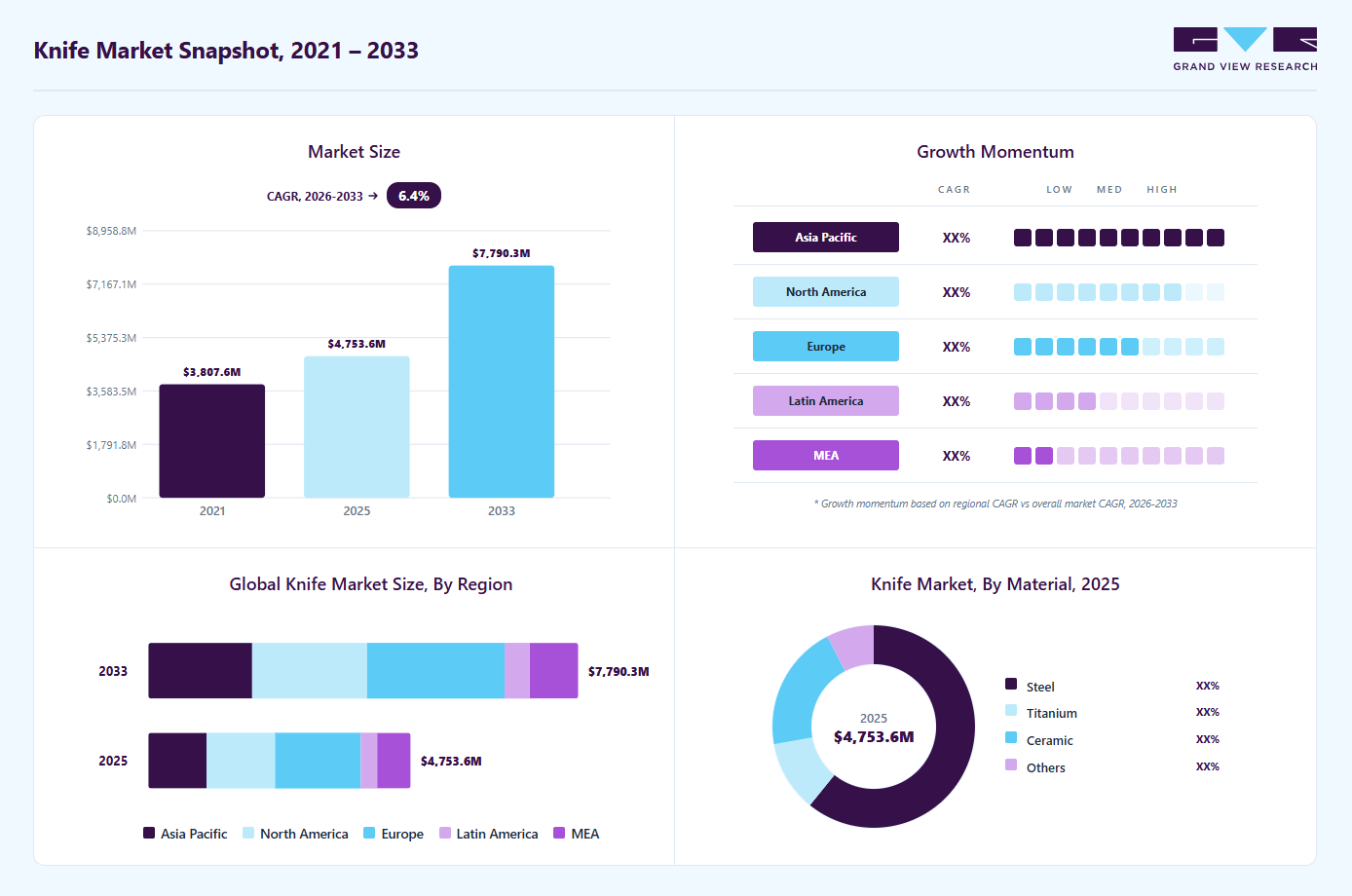
Market Size, 2025
$4.7BMarket Estimate, 2026
$5.0BMarket Forecast, 2033
$7.8BCAGR, 2026–2033
6.4%Knife Market Summary
The global knife market size was valued at USD 4.7 billion in 2025 and is projected to grow from USD 5.0 billion in 2026 to USD 7.8 billion by 2033, at a CAGR of 6.4% from 2026 to 2033. Europe dominated the global knife market with the largest revenue share of 32.7% in 2025. The rapid increase in restaurants, cloud kitchens, and quick-service outlets has created consistent demand for high-quality, durable knives that ensure efficiency and precision in professional kitchens.
 Source: Grand View Research, IR Documents, Primary Interviews, Paid DatabasesTo learn more about this report,
 Download Free Sample Report
 Key Market Trends & Insights
- By type: Fixed blade led the market with the largest revenue share of 50.5% in 2025.
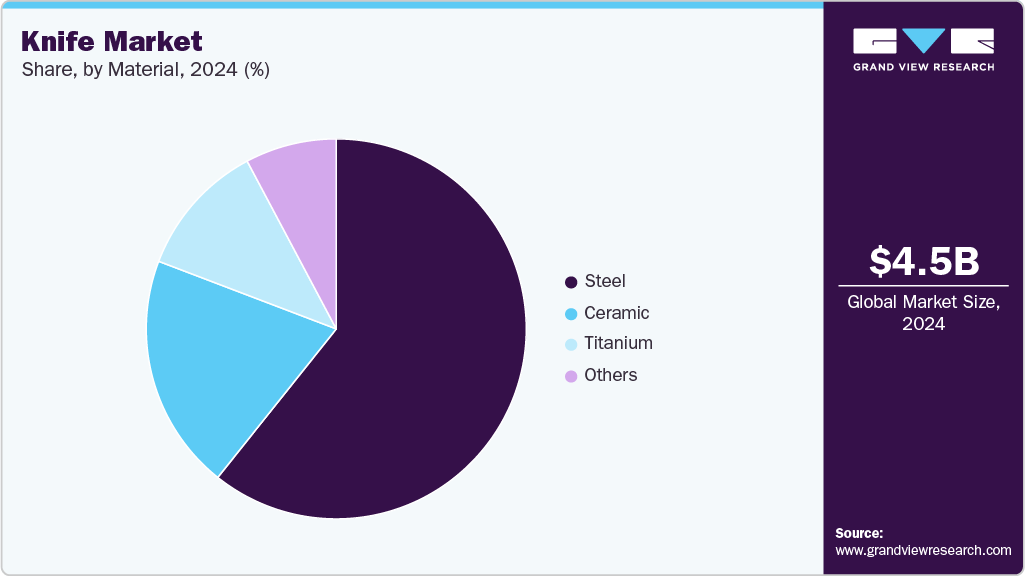
- By material: Steel segment led the market with the largest revenue share of 60.8% in 2025.
- By size: The 6-9 inches segment led the market with the largest revenue share of 49.0% in 2025.
Regional Highlights
- Largest regional market: Europe (32.7% revenue share, 2025)
- Fastest-growing regional market: Asia Pacific (highest CAGR, 2026-2033)
- By country: The U.K. held the largest market share in 2025.
Market Size & Forecast
- Market size in 2025: USD 4.7 Billion
- Estimated market size in 2026: USD 5.0 Billion
- Projected market size by 2033: USD 7.8 Billion
- CAGR (2026-2033): 6.4%
Three ways to get this report
Buy it, customize it, or ask a question.Ask an Analyst
Analyst response in 1 business day
- AccessReport author, directly
- Reply timeWithin 1 working day
- No sales callDirect answer only
- FormatEmail reply
- CostFree, no cost
Get the Full Report
What the study covers
- FormatsPDF · Excel · Dashboard
- Timeline2026–2033 annual, 2025 base
- Coverage20+ countries, 5 regions
- Companies10+ key players profiled
Customize the Report
20% free customization
- IncludeCountries, segments, points
- TailorTo your product definition
- ExtendDeeper competitor detail
- OrA fully bespoke study
- Turnaround5–10 working days
At the same time, changing consumer lifestyles have encouraged more people to cook at home, influenced by food content on social media and cooking shows. This has led to a shift from basic kitchen tools to premium, specialized knives, as consumers seek better performance, durability, and a more professional cooking experience in their own kitchens.At the same time, compact, portable tools are gaining traction, driving market growth. This trend is also contributing to the steady expansion of the folding knife industry, particularly among consumers seeking portability and versatility.There is a growing shift toward premium and professional-grade knives as both home cooks and culinary professionals seek higher performance and durability. Consumers are increasingly investing in chef-quality knives and complete sets that offer precision, balance, and long-term value. This trend is also influenced by rising disposable incomes and the desire for aesthetically appealing, high-end kitchen tools that enhance the overall cooking experience.
 To learn more about this report, Download Free Sample Report
 In April 2025, Spanish cutlery brand Arcos partnered with renowned chef José Andrés to launch an exclusive knife collection that combines nearly 300 years of traditional craftsmanship with modern innovation. The collection includes essential kitchen knives such as chef, santoku, bread, utility, and paring knives, all made using advanced NITRUM stainless steel for enhanced durability, sharpness, and performance. Designed for both professional chefs and home cooks, the collaboration focuses on delivering premium-quality yet accessible tools, with ergonomic holm oak handles reflecting Spanish heritage and sustainability.
Knife manufacturers are focusing on advanced materials and design innovations to improve functionality and safety. The use of high-carbon stainless steel, ceramic blades, and corrosion-resistant coatings enhances sharpness, durability, and ease of maintenance. In addition, ergonomic handles, anti-slip grips, and improved blade engineering are being incorporated to provide better control, reduce fatigue, and ensure safer usage for both professionals and home users.
The growing popularity of international cuisines is significantly influencing knife preferences and demand. Exposure to diverse cooking styles has increased awareness of specialized knives, such as Japanese sushi knives or European carving knives. This cultural exchange is encouraging consumers to adopt a wider variety of kitchen tools tailored to specific cooking techniques, thereby expanding the scope and diversity of the knife industry.
Market Dynamics
The global knife market is benefiting from rising consumer interest in home cooking, premium kitchenware, and professional-grade food preparation tools. Knives are increasingly positioned as long-term utility products rather than low-cost kitchen accessories, particularly in premium households and enthusiast cooking segments. This shift has accelerated demand for high-performance chef knives, Japanese-style blades, Damascus steel products, and ergonomic kitchen tools that offer durability and precision. In parallel, the expansion of cooking-related digital content across YouTube, TikTok, and culinary subscription platforms has increased consumer awareness around specialized kitchen knives and food preparation techniques, encouraging higher-value purchases and replacement demand.
The trend is increasingly visible through company activity and broader food service expansion. According to industry coverage and company positioning, brands such as Zwilling J.A. Henckels, Victorinox, and Kai Corporation continue expanding premium kitchen knife portfolios and direct-to-consumer distribution. In addition, the rapid growth of restaurants, cloud kitchens, and quick-service food outlets globally is creating sustained commercial demand for durable kitchen knives.
One of the biggest restraints for the global knife market is the tightening regulatory environment surrounding blade ownership, public carry, and online sales. Governments across Europe and the UK are increasingly introducing stricter knife-control measures in response to rising knife-related crime and public safety concerns. These regulations are creating operational challenges for manufacturers, retailers, and e-commerce sellers by increasing compliance requirements, restricting product categories, and limiting cross-border distribution of tactical and specialty knives. The impact is particularly significant for folding knives, automatic knives, tactical blades, and collectible products that are increasingly subject to tighter legal scrutiny, particularly in Europe and developed consumer markets.
The regulatory pressure is becoming increasingly visible through recent legislative actions. Under the UK’s Crime and Policing Act 2026, online retailers are now subject to stronger age-verification rules and mandatory reporting obligations for suspicious or bulk knife purchases. In addition, the UK’s Offensive Weapons Act 2019 introduced restrictions on the delivery of bladed products to residential addresses and tightened controls on certain rapid-opening and offensive knives. Government data further showed more than 54,000 knife-related offences recorded across England and Wales during 2024–2025. Alongside this, several European countries continue maintaining fragmented knife-carry laws regarding permissible blade length and public possession, increasing compliance complexity for global manufacturers and limiting accessibility for tactical, outdoor, and self-defense knife categories.
Consumer Insights
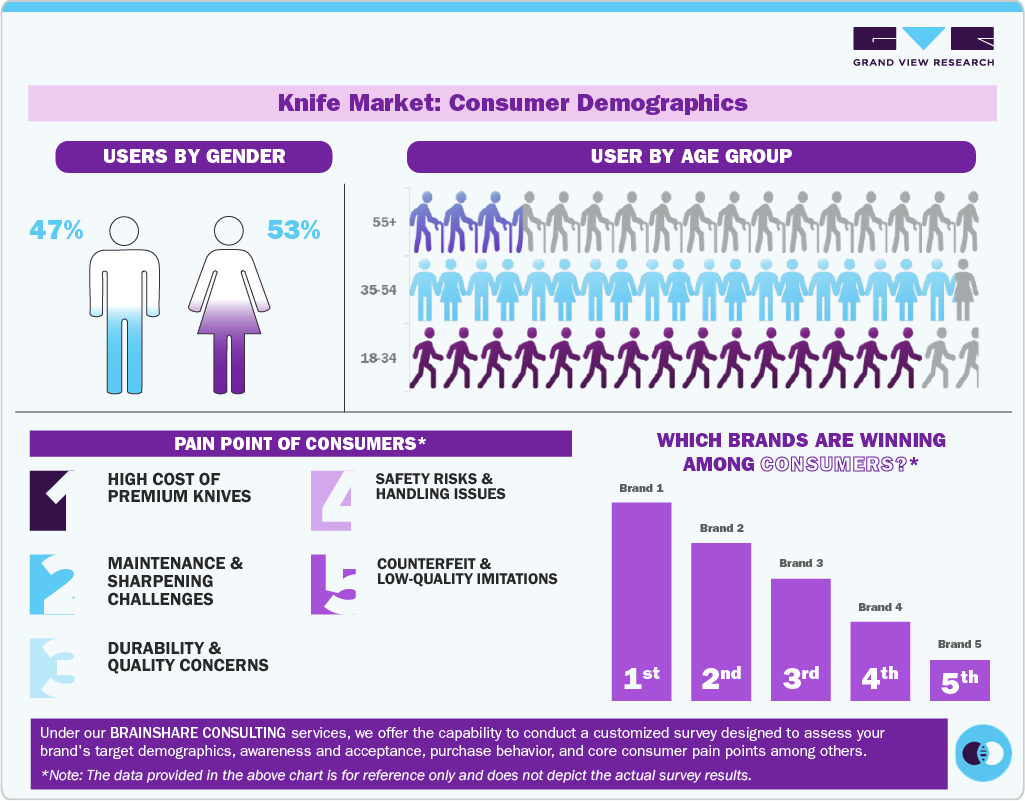
Consumers prioritize knives that offer excellent sharpness and consistent cutting performance, as these directly impact cooking efficiency. At the same time, they prefer products that are easy to maintain, such as rust-resistant blades and materials that retain sharpness longer, reducing the need for frequent sharpening or special care.
Comfort and safety play a crucial role in purchase decisions. Consumers favor knives with ergonomic handles, balanced weight distribution, and anti-slip grips, as these features reduce hand fatigue and improve control during prolonged use, especially in busy kitchen environments.
 To learn more about this report, Download Free Sample Report
 There is a strong preference for knives made from durable materials like stainless steel, high-carbon steel, or ceramic. Buyers associate these materials with longevity, strength, and reliability, making them more willing to invest in products that deliver long-term value.
Many consumers, particularly households and novice cooks, prefer buying complete knife sets rather than individual pieces. Knife sets offer better value for money, ensure uniform quality, and provide a comprehensive solution for various cutting needs, making them a practical and cost-effective choice.
Type Insights
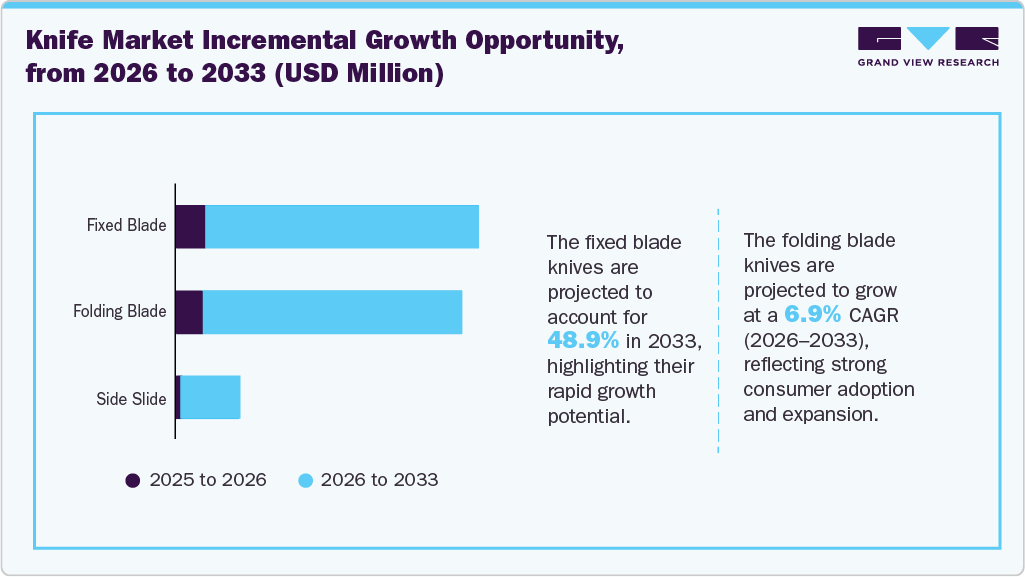
The fixed blade knives segment led the market with the largest revenue share of 50.5% in 2025. Due to their strength, they are preferred for hard outdoor activities such as hunting, prying windows, and cutting wood. Also, apart from widespread use in food preparation for cutting vegetables and meat, fixed-blade knives are used as cutlery knives. The growing number of restaurants, the increasing trend for eating out, and the surge in demand from households are some of the prominent factors positively driving the market growth.
 To learn more about this report, Download Free Sample Report
 The folding knife segment is estimated to witness at the fastest CAGR of 6.9% from 2026 to 2033. The swiss army knife is one such widely popular folding blade knife, which is still in demand due to its multi-tool capabilities. Victorinox, Europe’s largest knife manufacturer, produces around 10 million Swiss pocketknives every year and exports to more than 120 countries. This rising adoption is significantly accelerating growth in the folding knife industry globally.
Material Insights
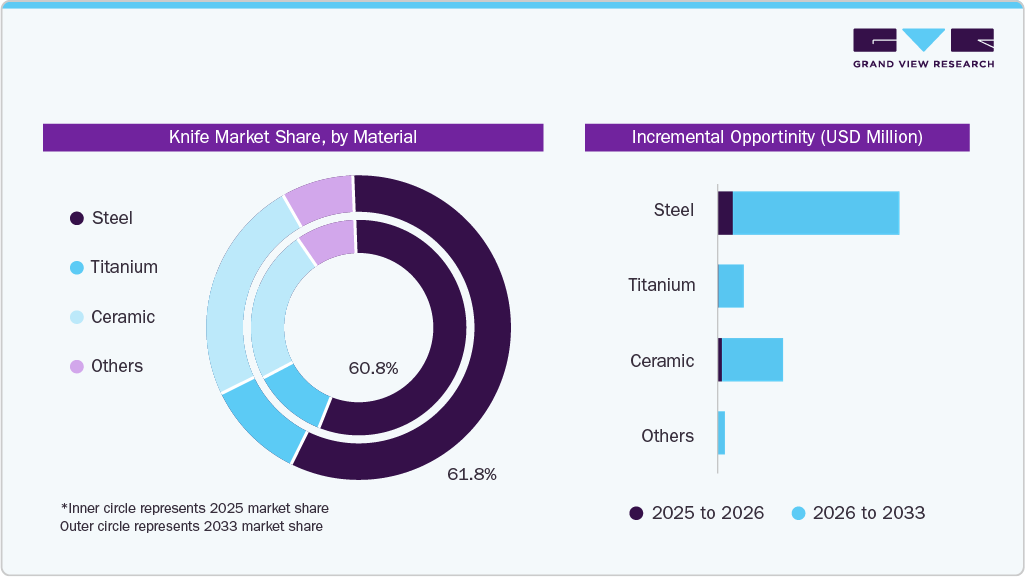
The steel material segment led the market with the largest revenue share of 60.8% in 2025. Carbon steel is increasingly being replaced with stainless steel knives. Stainless steel is widely available and less expensive than other knife materials. With growing demand for stainless steel knives, companies have been continuously investing to increase production. Damascus steel is another type of blade steel gaining traction in the knife industry. The Damascus steel knives are extremely strong and sharp.
 To learn more about this report, Download Free Sample Report
 The ceramic material segment is estimated to witness at the fastest CAGR of 7.2% from 2026 to 2033. Ceramic knives are lightweight and made from Zirconium Dioxide, one of the hardest substances on Earth, which keeps their blades sharper for longer than other materials. Ceramic knives are highly sharp and ideal for precision dicing and chopping in the kitchen. For these purposes, ceramic knives have found a distinct place in the knife industry, and players continue to invest in manufacturing and launching them.
Size Insight
The 6-9 inch knives segment led the market with the largest revenue share of 49.0% in 2025. This size range is particularly favored for its versatility, as it is suitable for slicing, dicing, and chopping, making it a preferred choice among home cooks and culinary professionals. With increased interest in home cooking and gourmet meal preparation post-pandemic, demand for medium-sized chef knives and multipurpose blades has steadily grown. Moreover, the rising culinary content on social media, where professional chefs often endorse 6-9-inch knives as essential tools for precision and control, is one of the factors driving the market growth.
 To learn more about this report, Download Free Sample Report
 The 3-6 inch knives segment is estimated to grow at the fastest CAGR of 7.1% from 2026 to 2033, driven by growing consumer preference for knife sets rather than individual purchases, with smaller blades often included. In addition, younger consumers and urban households are leaning toward compact, multifunctional kitchen tools due to space constraints and changing cooking habits. Small knives are also gaining traction in outdoor and EDC (everyday carry) applications, supported by increasing interest in do-it-yourself (DIY) activities and recreational camping. Innovations in blade materials and ergonomic handle designs have fueled this category’s growth, further driving the knife industry's growth.
Application Insights
The kitchen segment led the market with the largest revenue share of 46.3% in 2025. The growing restaurant industry has been a primary driver of demand for kitchen knives. With the surge in demand for dining out, the number of restaurants has been growing. Furthermore, demand for kitchen knives from households has been rising due to the growing global population.
The outdoor/survival/hunting segment is estimated to grow at the fastest CAGR of 7.1% from 2026 to 2033. Survival knives are widely used for camping and other outdoor activities. The popularity of camping and adventure activities has been growing globally, especially among the young population. The growing interest in camping, trekking, and other adventure activities is expected to surge the demand for survival knives in the coming years.
Distribution Channel Insights
The supermarkets & hypermarkets segment led the market with the largest revenue share of 41.1% in 2025. These retail environments offer broad product visibility, physical access for trial or comparison, and seasonal discounts that drive high-volume sales. For mass-market and entry-level knives, these channels remain essential, especially in emerging economies where offline retail still commands consumer trust. Their prominence is supported by strategic product placements, bundle deals, and the growing trend of cross-category selling, with knives being sold alongside kitchenware, groceries, or cooking appliances, thus reinforcing footfall and conversion rates.
The online/e-commerce segment is estimated to grow at the fastest CAGR of 8.4% from 2026 to 2033. Digital platforms offer an expansive selection of brands, consumer reviews, and competitive pricing, enabling informed purchase decisions. The rise of direct-to-consumer (D2C) knife brands and subscription-based culinary kits has accelerated this shift, further fueling the market growth. Online sales have been further boosted by influencer marketing, unboxing content, and targeted social media advertising. Furthermore, logistics advancements and easy return policies have reduced the perceived risk of buying knives without physical inspection, making online retail a robust growth engine for premium and specialty knife segments.
Regional Insights
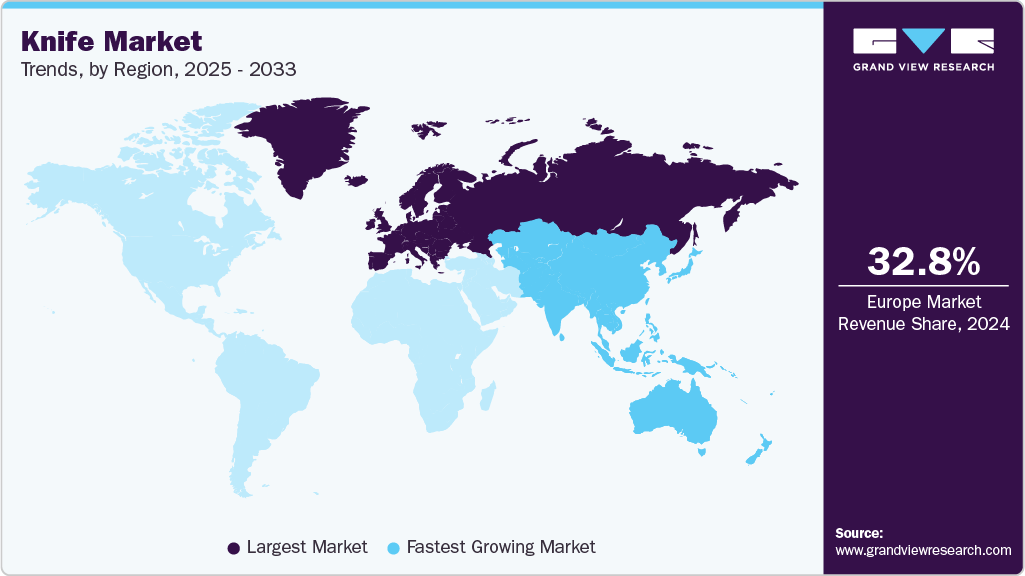
Europe dominated the global knife market with the largest revenue share of 32.7% in 2025. An increase in the number of outdoor activities, including camping and hiking, that require different kinds of knives is positively impacting the growth of the Europe market. Moreover, growing urbanization and rising spending on home renovation projects are driving demand for knives in Germany. Furthermore, major factors driving the growth of the French market include increasing household expenditure on cookware and cutlery, including knives, a flourishing hospitality industry, and a stay-at-home mindset that has motivated people to invest more in kitchen items.
 To learn more about this report, Download Free Sample Report
 UK Knife Market Trends
The knife market in the UK held a significant share in Europe in 2025. In the UK, the growing number of nuclear families and single-person households, coupled with the increasing number of households undergoing kitchen remodeling and renovation projects, is expected to generate significant demand for knives over the forecast period. The availability of numerous players offering various types of knives is expected to drive the market growth in UK. For instance, Heinnie Haynes, one of the UK's prominent suppliers of fixed-blade knives, offers knives from various brands, including WÜSTHOF, Kai Europe GmbH, Buck, Mercer Tool Corp., and Civivi, among others.
The France knife market is estimated to grow at a significant CAGR of 6.5% from 2026 to 2033. The market is strongly influenced by the country’s rich culinary culture and globally recognized gastronomic traditions. As cooking is deeply embedded in the French lifestyle, both professional chefs and home cooks place high importance on precision, technique, and quality tools, driving consistent demand for high-performance kitchen knives. This cultural emphasis encourages consumers to invest in specialized, premium cutlery that enhances cooking efficiency and authenticity, while also boosting the popularity of traditional and region-specific knife styles.
North America Knife Market Trends
The knife market in North America is estimated to grow at a CAGR of 6.7% from 2026 to 2033. The increasing demand for stylish, sleek, and comfortable knives is driving growth in the North America market. There has been a growing preference for knives made of steel, as they are easy to handle for various applications, including kitchen, sporting, and adventure. This trend will continue to drive innovation and new product development among players, thereby fueling the knife industry's growth.
The knife market in the U.S. accounted for the largest market revenue share in North America in 2025. Companies are increasingly using advanced materials, such as high-carbon stainless steel and specialized coatings, to enhance sharpness, durability, and corrosion resistance. At the same time, innovations in ergonomic design, lightweight construction, and anti-slip handles are making knives more comfortable and efficient to use. In addition, precision manufacturing techniques and smart features are helping brands differentiate their products, catering to both professional users and quality-conscious home consumers.
Canada knife market is estimated to grow at a CAGR of 6.2% from 2026 to 2033. The expansion of e-commerce and digital retail channels is a key trend as consumers increasingly prefer online platforms for convenience, variety, and competitive pricing. E-commerce enables buyers to easily compare products, access a wider range of brands, including premium and niche options, and rely on reviews and ratings before making a purchase. This shift is encouraging manufacturers and retailers to strengthen their online presence, adopt direct-to-consumer strategies, and leverage digital marketing to reach a broader and more tech-savvy customer base.
Asia Pacific Knife Market Trends
The knife market in Asia Pacific is estimated to grow at the fastest CAGR of 7.5% from 2026 to 2033. The increased popularity of hand-forged knives in countries such as India, Myanmar, and Bangladesh can be attributed to the rising demand for knives in the region. Furthermore, in nations such as Japan and China, the popularity of specialty knives, such as the Japanese knife set, used for cooking, is also growing. This is expected to drive the market growth of the Asia Pacific over the forecast period. In addition, urban consumers in Southeast Asia have grown accustomed to the convenience of food delivery.
The China knife market is estimated to grow at a significant CAGR of 7.1% from 2026 to 2033. The market is largely driven by its strong manufacturing base and cost-efficient production capabilities, enabling a large-scale, affordable, mass-produced supply of knives. This high-volume production makes price competitiveness a key factor, enabling domestic manufacturers to effectively cater to both local demand and export markets. Despite the focus on affordability, there remains consistent demand for everyday kitchen and utility knives, ensuring steady market growth while reinforcing China’s position as a global hub for knife production and supply.
The knife market in Japan is estimated to grow at the substantial CAGR of 7.3% from 2026 to 2033. The Japanese knife industry is characterized by a seamless blend of traditional craftsmanship and advanced technology, where centuries-old forging techniques are combined with modern innovations to enhance performance and durability. Skilled artisans continue to use time-honored methods such as hand-forging and layered steel construction. At the same time, manufacturers integrate advanced materials, such as high-carbon stainless steel, and precision engineering tools to enhance sharpness, edge retention, and corrosion resistance.
Middle East and Africa Knife Market Trends
The knife market in the Middle East and Africa is estimated to grow at a moderate CAGR of 4.8% from 2026 to 2033. The expansion of hotels, restaurants, catering services, and tourism infrastructure has significantly increased the demand for high-quality, durable kitchen knives that can withstand frequent professional use. As the region continues to position itself as a global tourism and dining hub, commercial establishments are investing in reliable, performance-oriented kitchen tools, thereby boosting consistent demand for both standard- and premium-grade knives.
Central and South America Knife Market Trends
The knife market in Central and South America is estimated to grow during the forecast period. Consumers show a strong preference for stainless steel knives due to their excellent corrosion resistance, durability, and low maintenance requirements. Given the region’s often humid, tropical climate, stainless steel is particularly valued for its resistance to rust and its ability to maintain performance over time. In addition, these knives offer a practical balance between affordability and longevity, making them ideal for both household and commercial use.
Key Knife Company Insights
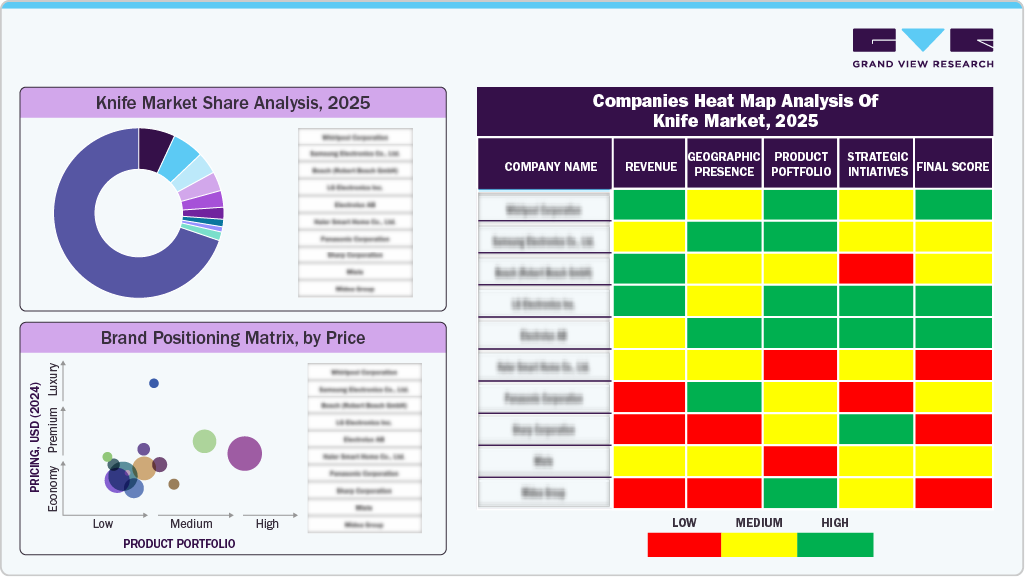
The knife industry is highly competitive and moderately fragmented, with several multinational cutlery manufacturers, specialized knife brands, and emerging niche players. Key participants include well-established global companies in kitchenware and tools, as well as smaller brands focused on premium craftsmanship, innovative designs, and specialized applications, such as professional culinary, outdoor, and utility knives. Companies compete through continuous product innovation, the use of advanced materials such as high-carbon stainless steel and ceramics, ergonomic designs, and premiumization strategies, while addressing consumer priorities such as sharpness, durability, safety, comfort, and aesthetic appeal.
 To learn more about this report, Download Free Sample Report
 Key Knife Companies:
The following key companies have been profiled for this study on the knife market.
- Victorinox AG
- Ed. Wüsthof Dreizackwerk KG
- Zwilling J.A. Henckels AG
- Yoshikin Global Corporation
- Kai Corporation
- MAC Knife, Inc
- Dalstrong Inc
- Cutco Corporation
- Mercer Tool Corp.
- Dexter-Russell, Inc
Recent Developments
-
In January 2026, Cold Steel launched two new knives at the 2026 SHOT Show, emphasizing a blend of traditional design and modern innovation. The revamped Mackinac Hunter updates a classic hunting knife with features like ambidextrous thumb studs, AUS-10A stainless steel for enhanced sharpness and durability, and an ergonomic Micarta handle for better grip and comfort. Alongside it, the new 5-Max Scout, developed in collaboration with knife maker Andrew Demko, offers a longer blade for improved cutting power, a non-slip handle, and the brand’s Tri-Ad locking mechanism for added strength and safety.
-
In December 2025, Victorinox launched a new line of commercial knives embedded with advanced DataMatrix-Code (DMC) traceability technology, specifically designed for the food and meat processing industries. Each knife features a laser-engraved code and serial number, enabling companies to track usage, cleaning cycles, maintenance, and even link knives to specific employees or workstations.
Knife Market Report Scope
Report Attribute
Details
Market size in 2025
USD 4.7 billion
Estimated market size in 2026
USD 5.0 billion
Projected market size by 2033
USD 7.8 billion
Growth rate
CAGR of 6.4% from 2026 to 2033
Base year for estimation
2025
Historical data
2021 - 2024
Forecast period
2026 - 2033
Quantitative units
Revenue in USD million/billion and CAGR from 2026 to 2033
Report coverage
Revenue forecast, company ranking, competitive landscape, growth factors, and trends
Segments covered
Type, material, size, application, distribution channel, region
Regional scope
North America; Europe; Asia Pacific; Central & South America; Middle East & Africa
Country scope
U.S; Canada; Mexico; Germany; UK; France; Italy; Spain; China; Japan; India; Australia; South Korea; Brazil; Saudi Arabia
Key companies profiled
Victorinox AG; Ed. Wüsthof Dreizackwerk KG; Zwilling J.A. Henckels AG; Yoshikin Global Corporation; Kai Corporation; MAC Knife, Inc; Dalstrong Inc; Cutco Corporation; Mercer Tool Corp.; Dexter-Russell, Inc
Customization
Free report customization (equivalent up to 8 analysts working days) with purchase. Addition or alteration to country, regional & segment scope
Pricing and purchase options
Avail customized purchase options to meet your exact research needs. Explore purchase options
Global Knife Market Report Segmentation
This report forecasts revenue growth at the global, regional, and country levels and provides an analysis of the latest industry trends and opportunities in each of the sub-segments from 2021 to 2033. For this study, Grand View Research has segmented the global knife market based on type, material, size, application, distribution channel, and region:
-
Type Outlook (Revenue, USD Million, 2021-2033)
-
Folding Blade
-
Fixed Blade
-
Side Slide
-
-
Material Outlook (Revenue, USD Million, 2021-2033)
-
Steel
-
Titanium
-
Ceramic
-
Others
-
-
Size Outlook (Revenue, USD Million, 2021-2033)
-
3-6 Inches
-
6-9 Inches
-
9-12 Inches
-
-
Application Outlook (Revenue, USD Million, 2021-2033)
-
Kitchen
-
Outdoor/Survival/Hunting
-
Tactical/Military
-
Others
-
-
Distribution Channel Outlook (Revenue, USD Million, 2021-2033)
-
Supermarkets & Hypermarkets
-
Specialty Stores
-
Department Stores
-
Online/E-commerce
-
Others
-
-
Regional Outlook (Revenue, USD Million, 2021-2033)
-
North America
-
U.S.
-
Canada
-
Mexico
-
-
Europe
-
UK
-
Germany
-
France
-
Italy
-
Spain
-
-
Asia Pacific
-
Japan
-
China
-
India
-
South Korea
-
Australia
-
-
Central & South America
-
Brazil
-
-
Middle East and Africa (MEA)
-
Saudi Arabia
-
-
Delivered Customizations
This report has been delivered with the following In-depth customizations
Client Request
Customization Delivered
Value Adds
Cross-Segmentation Analysis of Knife Product Types, Materials, Sizes, Applications & Regional Demand
Detailed cross-segmentation analysis of the global knife market across type (folding blade, fixed blade, side slide), material (steel, titanium, ceramic, others), size (3–6 inches, 6–9 inches, 9–12 inches), application (kitchen, outdoor/survival/hunting, tactical/military, others), and region (North America, Europe, Asia Pacific, Central & South America, and MEA). The analysis can also be refined at country level for major markets such as the U.S., UK, Germany, France, China, Japan, India, and Saudi Arabia.
Identifies where fixed blade and steel knives lead, in which size formats are most relevant, and how demand differs between kitchen use, outdoor/utility use, and tactical applications. It also shows why Europe remains the largest regional market while Asia Pacific offers the fastest growth, making it useful for prioritizing product portfolios and country entry plans.
Competitive Benchmarking Across the Knife Ecosystem
Comprehensive benchmarking of the knife ecosystem across major global and regional brands, including manufacturers such as Victorinox, Wüsthof, Zwilling J.A. Henckels, Yoshikin, Kai, MAC Knife, Dalstrong, Cutco, Mercer Tool Corp., and Dexter-Russell. The analysis can compare positioning by craftsmanship, blade technology, ergonomics, premiumization, and application focus across kitchen, outdoor, and professional-use knives.
Helps distinguish legacy premium knife makers from value-focused and niche specialists, and highlights how competition is shaped by advanced materials, ergonomic designs, premiumization, sharpness, durability, safety, and comfort. This is especially useful in a market described as highly competitive and moderately fragmented, where innovation and brand credibility matter strongly.
Material Technology & Blade Performance Analysis
Deep-dive assessment of blade materials including stainless steel, carbon steel, Damascus steel, titanium, ceramic, and coated blades, benchmarked across sharpness retention, corrosion resistance, durability, weight, maintenance requirements, and manufacturing cost.
Helps identify which materials are gaining traction in premium kitchen, outdoor, and professional-use categories. Useful for product innovation, sourcing strategy, and premium pricing optimization.
Frequently Asked Questions About This Report
Key players in the knife market are Victorinox AG, Ed. Wüsthof Dreizackwerk KG, Zwilling J.A. Henckels AG, Yoshikin Global Corporation, Kai Corporation, MAC Knife, Inc, Dalstrong Inc, Cutco Corporation, Mercer Tool Corp., and Dexter-Russell, Inc, among others.
Key factors that are driving the knife market growth include rising demand for outside food due to hectic work schedules, the rising number of restaurants, and increased knife applications, combined with the availability of a diverse range of knives for various purposes.
The global knife market was estimated at USD 4.7 billion in 2025 and is expected to reach USD 5.0 billion in 2026.
The global knife market is expected to grow at a compound annual growth rate of 6.4% from 2026 to 2033 to reach USD 7.8 billion by 2033.
The knife market in Europe held the revenue share of 32.7% in 2025.
The fixed blade knives segment led with a 50.5% revenue share in 2025, folding knife is the fastest-growing segment.
Steel material held the largest revenue share 60.8% in 2025, while ceramic material is the fastest-growing area.
The 6-9 inch knives held the largest share (over 49.0%) in 2025 and 3-6 inch knives is the fastest-growing market.
About the Author(s)
Homecare & Decor Research Team
Consumer Goods · Homecare & DecorThis report was authored by the homecare & decor research team at Grand View Research - comprising two research analysts, one senior research analyst, and one industry expert - with specialized expertise in the homecare & decor segment of the consumer goods industry. All findings are based on proprietary consumer goods databases, executive interviews, and regulatory analysis, subject to internal peer review prior to publication.
Last Updated:
Speak to Analyst

Customize this report to your needs - add regions, segments, or data points, with 20% free customization.
Or view our licence options:


ISO 9001:2015 & 27001:2022 Certified
We are GDPR and CCPA compliant! Your transaction & personal information is safe and secure. For more details, please read our privacy policy.


