
- Home
- »
- Next Generation Technologies
- »
-
LCP Based Molded Interconnect Devices Market Report, 2030GVR Report cover
![LCP Based Molded Interconnect Devices Market Size, Share & Trends Report]()
LCP Based Molded Interconnect Devices Market (2025 - 2030) Size, Share & Trends Analysis Report By Process (LDS, Two-Shot Molding), By Product, By End Use, By Region, And Segment Forecasts
Market Size, 2024
$737.5MMarket Estimate, 2026
$848.0MMarket Forecast, 2030
$1,897.2MCAGR, 2025–2030
17.5%LCP Based Molded Interconnect Devices Market Summary
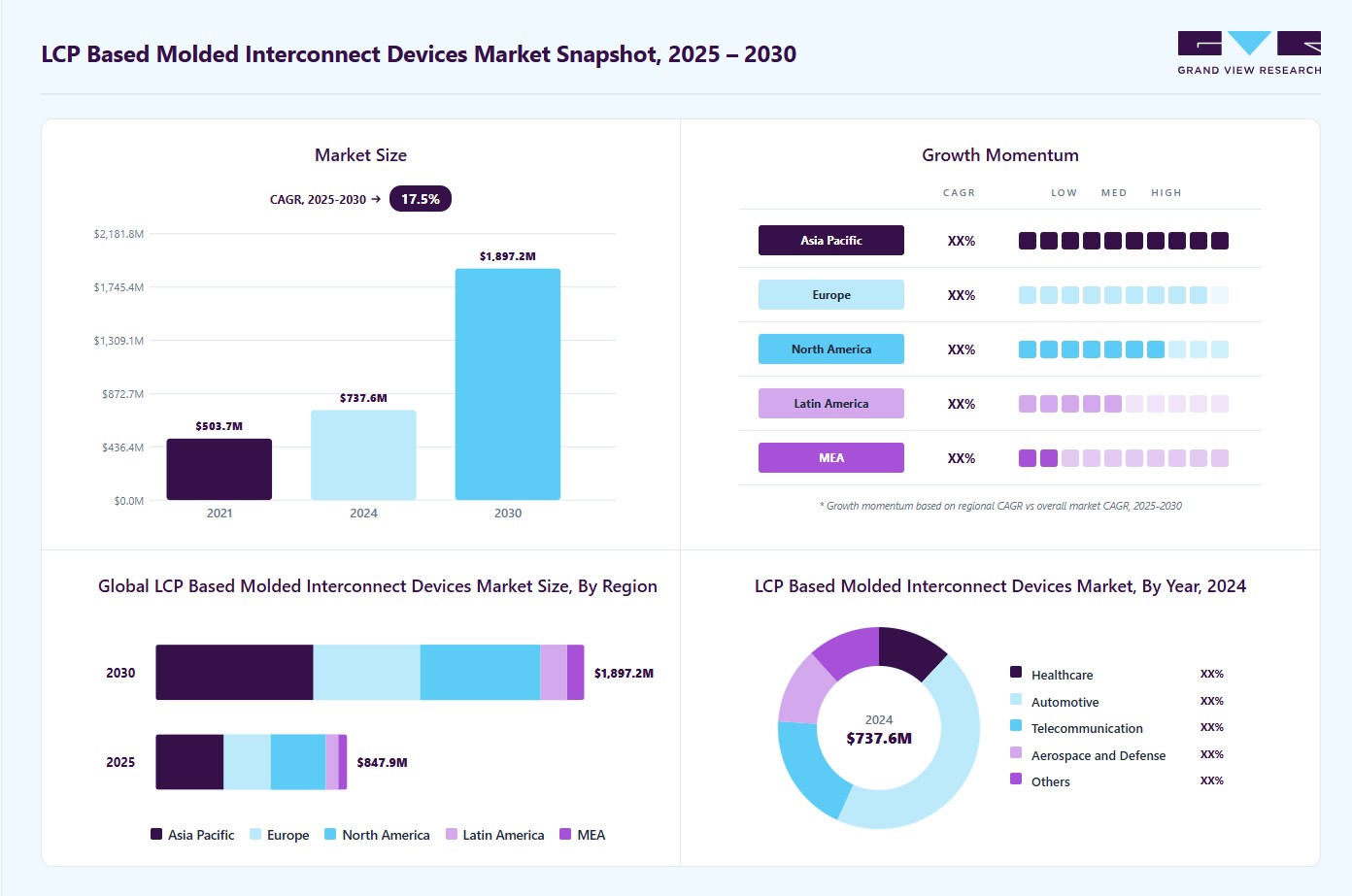
The global LCP based molded interconnect devices market size was estimated at USD 737.5 million in 2024 and is projected to reach USD 1,897.2 million by 2030, growing at a CAGR of 17.5% from 2025 to 2030. The LCP based molded interconnect devices market is growing rapidly, as this technology enables manufacturers to achieve significant space and weight reductions by implanting electrical circuitry directly onto 3D molded plastic parts.
Key Market Trends & Insights
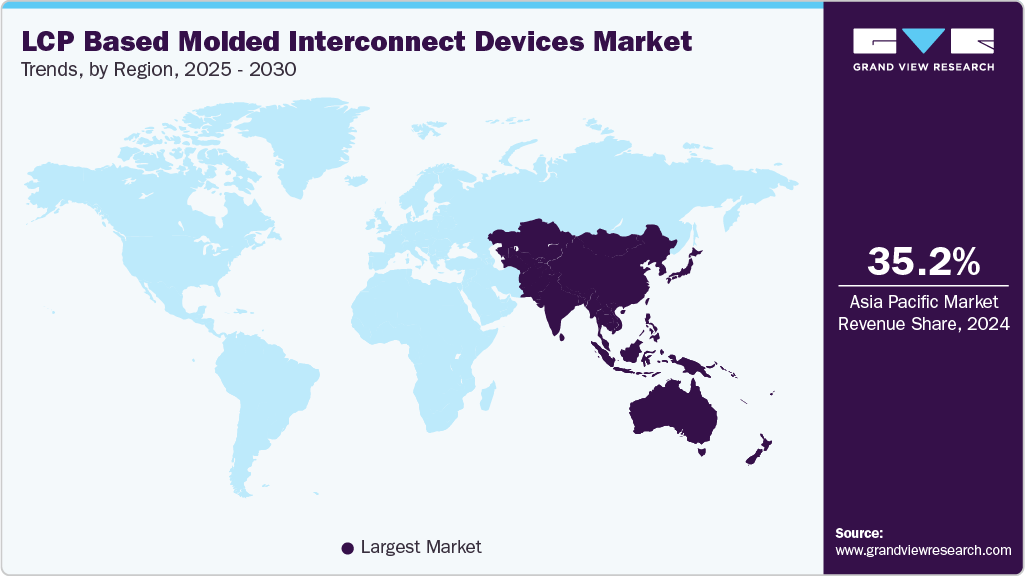
- Asia Pacific dominated the global LCP based molded interconnect devices market with the largest revenue share of 35.2% in 2024.
- The LCP based molded interconnect devices market in the China led the Asia Pacific market and held the largest revenue share in 2024.
- By process, laser direct structuring (LDS) segment led the market and held the largest revenue share of 54.2% in 2024.
- By product, antennas segment held the dominant position in the market and accounted for the leading revenue share of 33.1% in 2024.
- By end use, consumer electronics segment is expected to grow at the fastest CAGR of 20.7% from 2025 to 2030.
Market Size & Forecast
- 2024 Market Size: USD 737.5 Million
- 2030 Projected Market Size: USD 1,897.2 Million
- CAGR (2025-2030): 17.5%
- Asia Pacific: Largest Market in 2024
LCP resin offers exceptional thermal stability, chemical resistance, and dimensional stability, making it a preferred material for MID manufacturing in demanding applications. The market is increasingly in demand as it benefits from innovative processing techniques beyond traditional methods. Two-component injection molding and hot stamping are alternative methods utilized for producing MIDs, facilitating multifunctional parts with enhanced circuit integration on complex geometries. LCP’s inherent properties, such as low linear expansion and superior heat resistance, allow successful metallization through laser activation without compromising dimensional stability.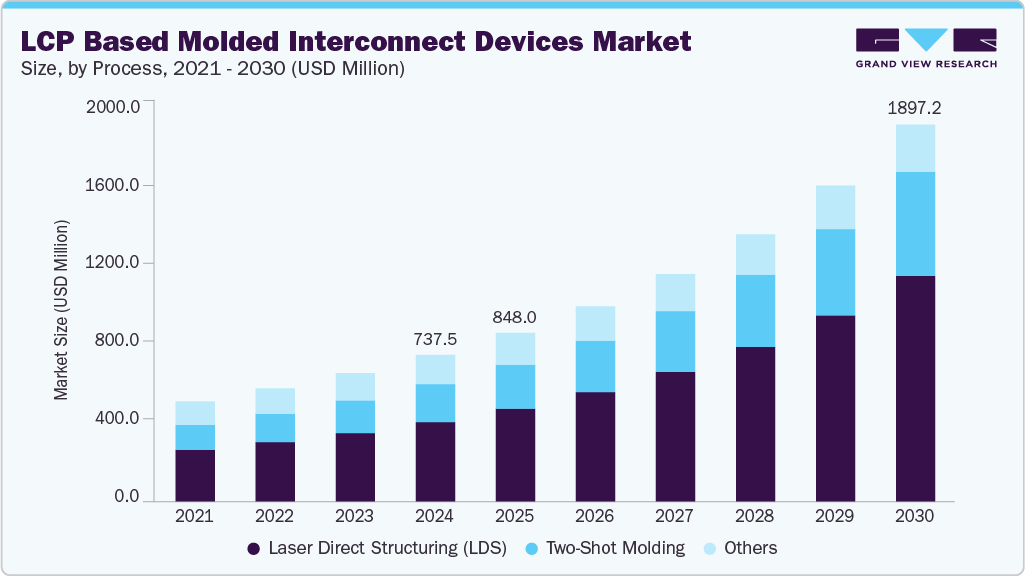
The rising necessity for miniaturized, lightweight electronic components across industries such as automotive, telecommunications, consumer electronics, and medical devices has driven the adoption of MID technology. Advanced manufacturing techniques such as laser direct structuring (LDS) allow precise circuit patterning on complex 3D surfaces, enabling design flexibility and reduced assembly complexity. These construction methods reduce the number of components and interconnections, thus improving product reliability and performance in various end-use applications.
Furthermore, LDS process, most applied in LCP MID production, activates additive compounds within the resin for electro less copper deposition, achieving fine conductive traces with sharp contours. This precision enables three-dimensional circuit layouts on free-form surfaces, reducing constraints on component design and assembly. The ability to create vertical through-holes and adapted surface finishes supports diverse applications requiring high-density circuitry embedded within molded parts. These methods contribute to lower assembly times and fewer interconnections, enhancing system performance while enabling manufacturability of small and complex components.
Process Insights
The laser direct structuring (LDS) segment led the market and accounted for 54.2% of the global revenue in 2024. LDS enables the integration of three-dimensional circuit patterns directly onto molded LCP components, allowing for more compact designs and reducing the need for additional connectors and wiring harnesses. This capability is particularly important for in-vehicle applications such as radar sensors, infotainment systems, and communication modules, where space is limited and reliability is critical. The growth of electric vehicles and advanced driver-assistance systems has further driven demand for high-density, lightweight electronic solutions. For instance, in June 2025, Bosch introduced the SMP290, a compact MEMS-based tire pressure monitoring sensor integrating Bluetooth Low Energy (BLE) for direct communication with vehicle systems and mobile devices. The sensor combines essential components such as a microcontroller, pressure, temperature, and acceleration sensors in a low-power design enabling up to ten years of operation. This integration simplifies vehicle electronics by reducing wiring complexity and supports features such as over-the-air firmware updates and real-time diagnostics, enhancing overall system efficiency and user convenience.
The two-shot molding segment is predicted to experience significant growth in the forecast period. The market is driven by the reduction of the need for additional assembly, saving time and cost so that manufacturers can produce more compact, lightweight, and multifunctional components. The process provides high-dimensional accuracy, which is important for MIDs with fine circuit patterns. Two-shot molding supports intricate 3D geometries and innovative designs. Furthermore, the components maintain mechanical strength while integrating circuits as it enables space-efficient layouts in miniaturized electronics. This method enhances both functionality and manufacturing precision for LCP-based Mids. For instance, in September 2025, Hymid and ARBURG collaborated to advance the application of two-shot injection moulding in device manufacturing, demonstrated through a successful case study involving medical components. The technique enables the integration of multiple materials within a single mould, enhancing design complexity, precision, and production efficiency. Their partnership also achieved a significant upgrade to existing machinery, meeting increased demand while maintaining quality standards.
Product Insights
The antennas segment accounted for the largest market revenue share in 2024. The need for high-frequency performance in UWB antennas (operating in the 6.0-8.5 GHz range) directly positions LCP as a superior material for MIDs. Its low dielectric constant and low dissipation factor are essential for minimizing signal loss, which is a critical requirement for high-frequency sensor housing and integrated antennas. This technical superiority drives market demand for LCP over other plastics. The successful integration of UWB antennas onto complex 3D surfaces using LDS serves as a powerful proof of concept for the MID market. For instance, in August 2024, TE Connectivity showcased its strategic portfolio for service robots, emphasizing wireless connectivity solutions such as antennas and connectors designed to meet diverse operational demands. TE's antenna solutions utilize Laser Direct Structuring technology to address the miniaturization and durability requirements of service robotics.
The sensor housings segment is predicted to foresee significant growth in the forecast period. Sensor housing in LCP-based MIDs are seeing strong demand as industries require compact enclosures that integrate both structural and electronic features. Its low dielectric constant ensures minimal signal interference, making it suitable for sensors operating in high-frequency environments. High heat resistance further enhances reliability, allowing sensor housing to function effectively under harsh thermal conditions.For instance, in July 2024, Molex launched the Percept Current Sensors for highly accurate busbar current sensing in industrial and automotive applications. These sensors use Infineon’s coreless differential Hall-effect technology combined with Molex’s proprietary electronics packaging, resulting in a solution that is lighter (86%) and half the size of competing products. The sensors offer accuracy of 2% across a wide temperature range (-40 to 125°C) and throughout their lifespan, while suppressing noise from stray magnetic fields common in harsh environments.
End Use Insights
The automotive segment accounted for the largest market revenue share in 2024. The market is driven by the demand for materials which offer efficiency, reliability, and miniaturization. High-performance LCPs are at the forefront of this shift, serving as a critical enabler for Molded Interconnect Devices (MIDs) that replace traditional wiring harnesses with integrated 3D circuitry. For instance, in July 2025, Taoglas introduced the Patriot series, a compact, multi-function roof mount antenna integrating up to 18 elements in a low-profile enclosure designed for connected vehicle fleets in emergency services, utilities, and commercial sectors. Developed initially for the Ford Interceptor, the antenna supports multiple connectivity standards, including 5G/4G cellular, dual-band GNSS, Wi-Fi, SDARS, and LMR/TETRA, enabling simultaneous broadband, navigation, telemetry, and voice services.
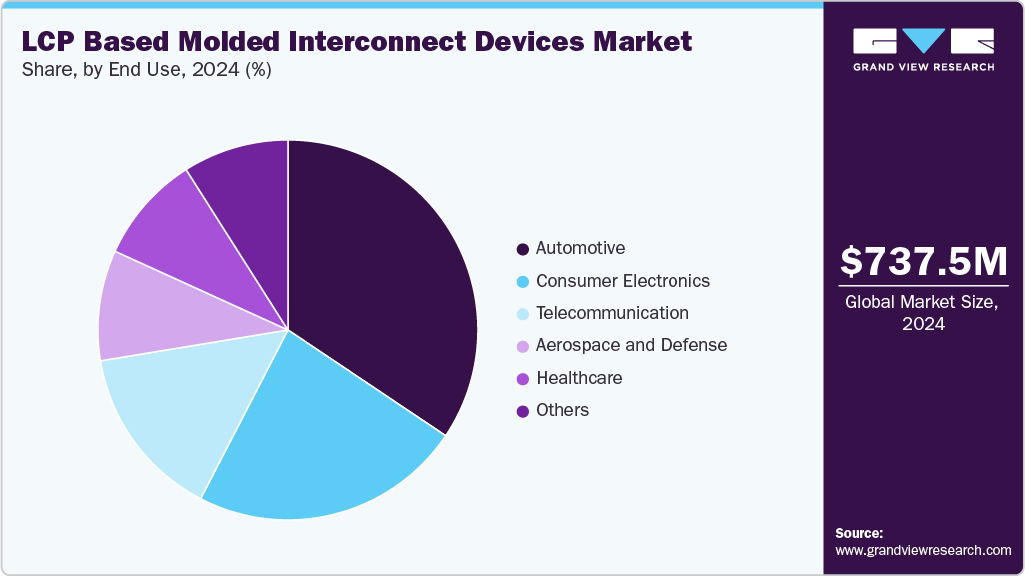
The consumer electronics segment is projected to grow significantly over the forecast period. LCP provides excellent electrical properties, including a low dielectric constant and low dissipation factor. These characteristics make it highly suitable for high-frequency circuits. This is particularly critical for 5G, Wi-Fi 6, and other modern wireless communication protocols. LCP MIDs are widely used in consumer devices to support these technologies. They are commonly implemented in integrated antennas and RF modules. This ensures strong and reliable signal reception with minimal loss. The material’s stability also supports consistent performance across various operating conditions. LCP enables compact, efficient, and high-performance electronic designs.For instance, in March 2025, HARTING introduced its 3D-MID technology that integrates electronic and mechanical functions into compact three-dimensional components, enabling advanced miniaturization and enhanced design versatility for consumer electronics. Technology streamlines manufacturing through injection molding, laser-direct structuring, and metallization, which reduces assembly time and potential failure points. Key applications include action cameras, wearable devices, and smart home products, with benefits such as reduced component size, improved performance, and cost efficiency.
Regional Insights
North America LCP based molded interconnect devices market has a significant market revenue share in 2024 and is driven by the increasing demand for compact and high-performance electronic components in automotive, aerospace, and telecommunications sectors, which drives the adoption of LCP-based MIDs. The focus on miniaturization and enhanced thermal stability for devices used in harsh environments supports market growth and continuous advancements in manufacturing techniques and the presence of key industry players contributes to accelerating innovations in LCP device applications. Growing use of electric vehicles and connected devices further propels the need for reliable, lightweight interconnect solutions in the region.
U.S. LCP Based Molded Interconnect Devices Market Trends
The U.S. market is driven by the expansion of 5G infrastructure requiring high-frequency, durable connectors with low signal loss, suitable for LCP materials. Strong industrial automation and advanced defense electronics elevate the need for precise, heat-resistant molded interconnects. Increasing investment in smart medical devices and wearable technologies emphasizes compact, integrated circuit solutions. Strategic focus on reducing device footprints and improving electronic reliability fosters steady adoption of LCP-based MIDs in multiple end-user segments.
Europe LCP Based Molded Interconnect Devices Market Trends
Europe Market is being driven by Regulatory emphasis on sustainability and energy efficiency promotes the integration of eco-friendly materials such as LCP in electronic components. The automotive industry's shift towards electric and hybrid vehicles stimulates demand for lightweight and thermally stable interconnect solutions. Industrial machinery upgrades requiring advanced sensor and connectivity modules further create market momentum. A strong manufacturing base supporting precision engineering and innovations in miniaturized circuitry enhances the region’s uptake of LCP-based devices.
Asia Pacific LCP Based Molded Interconnect Devices Market Trends
Asia Pacific has dominated the market by 35.2% revenue share in 2024 due to the rapid growth in advancement of technologies for their application in various sectors, anticipates the demand for space-saving, high-performance molded interconnect solutions. Large-scale deployment of 5G networks and expansion of IoT applications underpin the need for improved signal integrity and thermal management. Increasing adoption in automotive electronics and industrial automation sectors drives extensive consumption of LCP components. Emerging economies prioritize production efficiency and cost-effective manufacturing processes, supporting accelerated market penetration in the region.
Key LCP Based Molded Interconnect Devices Company Insights
Some key companies in the LCP based molded interconnect devices industry are Amphenol Corporation, MID Laser Direct Structuring (LDS)s GmbH, HARTING Technology Group, Taoglas
-
Amphenol Corporation designs and manufactures electronic and fiber optic connectors, cable and interconnect systems, antennas, and sensor-based products. The company serves diverse sectors including automotive, broadband communications, aerospace, industrial, IT, and medical. Its product portfolio includes fiber optic, harsh environment, high-speed, power, and RF interconnect solutions along with sensors and cable assemblies. Amphenol continues to expand its market presence through product innovation and strategic acquisitions, supporting a broad range of end uses with comprehensive interconnect solutions.
-
MID Laser Direct Structuring (LDS)s GmbH specializes in developing and producing molded interconnect devices (MIDs), combining electrical and mechanical functions in plastic substrates for various industries. The company delivers customized 3D circuit carrier solutions that optimize device miniaturization and integration. MID Laser Direct Structuring (LDS)s serves automotive, medical, consumer electronics, and industrial applications by providing advanced MID technology to enhance performance and reduce assembly complexity. Its expertise spans product design, prototyping, and series production, enabling clients to achieve innovative device architectures.
Key LCP Based Molded Interconnect Devices Companies:
The following are the leading companies in the LCP based molded interconnect devices market. These companies collectively hold the largest market share and dictate industry trends.
- Amphenol Corporation
- HARTING Technology Group
- KYOCERA AVX Components Corporation
- LPKF Laser & Electronics SE
- MID Laser Direct Structuring (LDS)s GmbH
- Molex LLC
- Sumitomo Electric Industries, Ltd.
- Taoglas
- TE Connectivity
- TEPROSA
Recent Developments
-
In August 2025, KYOCERA AVX Components Corporation launched 9288-000 Series hermaphroditic wire-to-board (WTB) and wire-to-wire (WTW) connectors for lighting and industrial applications. These two-piece connectors allow WTW termination using two identical mating halves, simplifying BOMs, and WTB termination using one of these halves along with an SMT version. Both halves feature white or orange glass-filled PBT insulators with plastic latches for secure mechanical retention and utilize the company’s proven poke-home contact technology for fast, easy, and tool-free in-field wire termination. Wires can be simply stripped and inserted with a poke and removed by twisting and pulling.
-
In July 2025, KYOCERA AVX introduced the 6780-000 Series IP20 T1 Industrial Single-Pair Ethernet (SPE) connectors and cable assemblies, designed to reduce system complexity and costs while providing space and weight savings. These connectors transmit Ethernet over a single pair of twisted copper wires with data speeds up to 1 Gb/s over 40 meters and enable simultaneous power delivery via Power over Data Line (PoDL) technology. The series complies with IEC 63171-6 and IEEE 802.3 standards and features durable construction for industrial applications including automation, sensor networks, smart grids, and transportation systems.
-
In May 2025, In May 2025, Molex collaborated with Prusa Research to support the rapid growth of the 3D printing pioneer by providing a strong and easy-to-use portfolio of connectors, including CLIK-Mate wire-to-board, Micro-Fit power, and ultra-microcoaxial RF connectors. These connectors have been integrated into over 20 printer models, enhancing assembly efficiency and enabling seamless hardware upgrades.
LCP Based Molded Interconnect Devices Market Report Scope
Report Attribute
Details
Market size in 2025
USD 848.0 million
Revenue forecast in 2030
USD 1,897.2 million
Growth rate
CAGR of 17.5% from 2025 to 2030
Base year for estimation
2024
Historical data
2018 - 2023
Forecast period
2025 - 2030
Quantitative units
Revenue in USD million/billion and CAGR from 2025 to 2030
Report coverage
Revenue forecast, company ranking, competitive landscape, growth factors, and trends
Segments covered
Process, product, end use, regional.
Regional scope
North America; Europe; Asia Pacific; Latin America; MEA
Country scope
U.S.; Canada; Mexico; UK; Germany; France; China; Japan; India; South Korea; Australia; Brazil; KSA; UAE; South Africa
Key companies profiled
Amphenol Corporation; HARTING Technology Group; KYOCERA AVX Components Corporation; LPKF Laser & Electronics SE; MID Laser Direct Structuring (LDS)s GmbH; Molex LLC; Sumitomo Electric Industries, Ltd.; Taoglas; TE Connectivity; TEPROSA
Customization scope
Free report customization (equivalent up to 8 analysts working days) with purchase. Addition or alteration to country, regional & segment scope.
Pricing and purchase options
Avail customized purchase options to meet your exact research needs. Explore purchase options
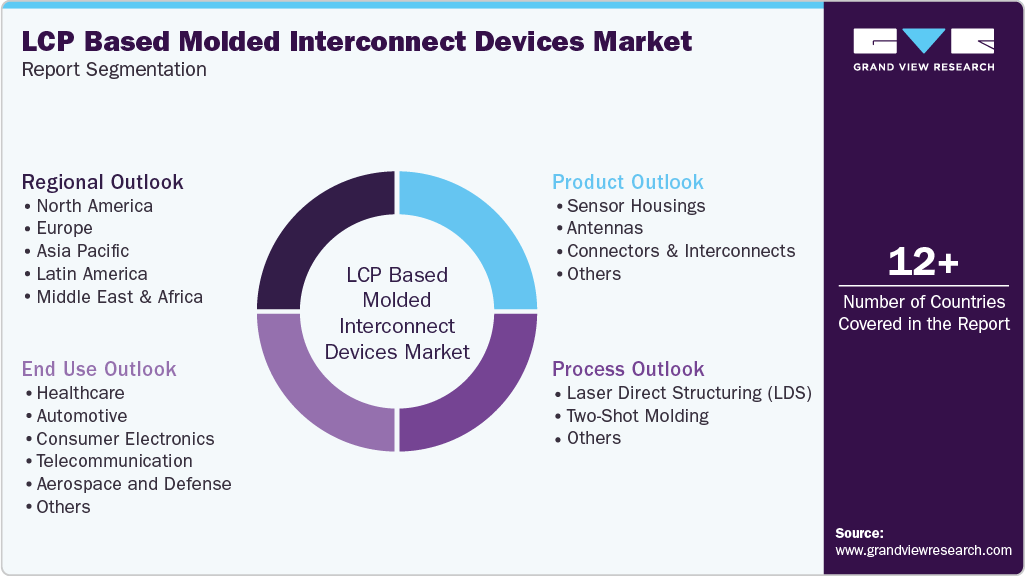
Global LCP Based Molded Interconnect Devices Market Report Segmentation
This report forecasts revenue growth at global, regional, and country levels and provides an analysis of the latest industry trends in each of the sub-segments from 2018 to 2030. For this study, Grand View Research has segmented the global LCP based molded interconnect devices market report based on process, product, end use, and region:
-
Process Outlook (Revenue, USD Million, 2018 - 2030)
-
Laser Direct Structuring (LDS)
-
Two-Shot Molding
-
Others
-
-
Product Outlook (Revenue, USD Million, 2018 - 2030)
-
Sensor Housings
-
Antennas
-
Connectors & Interconnects
-
Others
-
-
End Use Outlook (Revenue, USD Million, 2018 - 2030)
-
Healthcare
-
Automotive
-
Consumer Electronics
-
Telecommunication
-
Aerospace and Defense
-
Others
-
-
Regional Outlook (Revenue, USD Million, 2018 - 2030)
-
North America
-
U.S.
-
Canada
-
Mexico
-
-
Europe
-
UK
-
Germany
-
France
-
-
Asia Pacific
-
China
-
Japan
-
India
-
South Korea
-
Australia
-
-
Latin America
-
Brazil
-
-
Middle East and Africa (MEA)
-
KSA
-
UAE
-
South Africa
-
-
Frequently Asked Questions About This Report
The global LCP based molded interconnect devices market size was estimated at USD 737.5 million in 2024 and is expected to reach USD 848.0 million in 2025.
The global LCP based molded interconnect devices market is expected to grow at a compound annual growth rate of 17.5% from 2025 to 2030 to reach USD 1,897.2 million by 2030.
Asia Pacific dominated the LCP based molded interconnect devices market with a share of 35.2% in 2024. This is due to the rapid growth in advancement of technologies for their application in various sectors, anticipates the demand for space-saving, high-performance molded interconnect solutions.
Some key players operating in the LCP based molded interconnect devices market include Amphenol Corporation; HARTING Technology Group; KYOCERA AVX Components Corporation; LPKF Laser & Electronics SE; MID Laser Direct Structuring (LDS)s GmbH; Molex LLC; Sumitomo Electric Industries, Ltd.; Taoglas; TE Connectivity; TEPROSA
Key factors that are driving the market as this technology enables manufacturers to achieve significant space and weight reductions by implanting electrical circuitry directly onto 3D molded plastic parts.
About the Author(s)
Next Generation Technologies Research Team
Technology · Next Generation TechnologiesThis report was authored by the next generation technologies research team at Grand View Research - comprising two research analysts, one senior research analyst, and one industry expert - with specialized expertise in the next generation technologies segment of the technology industry. All findings are based on proprietary technology databases, executive interviews, and regulatory analysis, subject to internal peer review prior to publication.
Last Updated:
Speak to Analyst

Need a Tailored Report?
Customize this report to your needs — add regions, segments, or data points, with 20% free customization.
Or view our licence options:


ISO 9001:2015 & 27001:2022 Certified
We are GDPR and CCPA compliant! Your transaction & personal information is safe and secure. For more details, please read our privacy policy.












