
- Home
- »
- Petrochemicals
- »
-
Lithium Carbonate Market Size & Share Report, 2026-2033GVR Report cover
![Lithium Carbonate Market (2026 - 2033)Report]()
Lithium Carbonate Market (2026 - 2033)
Size, Share & Trends Analysis Report By Battery (Lithium-ion Batteries, Lithium-metal Batteries), By Grade (Battery Grade, Technical Grade, Industrial Grade), By Application (Electric Vehicles), By Region, And Segment Forecasts
Market Size, 2025
$30.1BMarket Estimate, 2026
$34.6BMarket Forecast, 2033
$95.2BCAGR, 2026–2033
15.6%Lithium Carbonate Market Summary
The global lithium carbonate market size was valued at USD 30.1 billion in 2025 and is projected to grow from USD 34.6 billion in 2026 to USD 95.2 billion by 2033, at a CAGR of 15.6% from 2026 to 2033. Asia Pacific dominated the market, accounting for a revenue share of 35.4% in 2025. The market is experiencing robust growth, driven by the rapid expansion of the electric vehicle (EV) industry.

Key Market Trends & Insights
- By battery: Lithium-ion Batteries dominated the battery type segment at a revenue share of 53.7% in 2025.
- By grade: Battery grade segment accounted for the largest revenue share of 47.7% in 2025.
- By application: Electric Vehicles dominated the market with a revenue share of 54.7% in 2025.
Regional Highlights
- Largest regional market: Asia Pacific (35.4% revenue share, 2025)
- By country: The China held the largest market share in 2025.
Market Size & Forecast
- Market size in 2025: USD 30.1 Billion
- Estimated market size in 2026: USD 34.6 Billion
- Projected market size by 2033: USD 95.2 Billion
- CAGR (2026-2033): 15.6%
It is a critical raw material for lithium-ion batteries, which are essential for EVs. As governments worldwide implement stricter environmental regulations and offer incentives to encourage the adoption of clean energy and electric vehicles, the demand for the product has surged. Major automotive manufacturers are increasingly investing in EV production, further bolstering the market's growth trajectory.The global push towards renewable energy storage solutions has significantly influenced the overall market. Energy storage systems (ESS) for solar and wind energy rely on lithium-ion batteries, creating a substantial demand for lithium carbonate. Urbanization and industrialization in emerging economies have also led to increased usage of electronic devices, further propelling the need for lithium-based batteries.

Furthermore, advancements in battery technologies, including solid-state and high-capacity lithium-ion batteries, are driving innovation and increasing the consumption of the product. The rising adoption of portable electronic devices and consumer preferences for lightweight, long-lasting batteries continue to fuel market growth. These trends and efforts to secure a sustainable lithium supply chain are positioning it as a cornerstone of the global energy transition.
Market Dynamics
The lithium carbonate market is witnessing strong growth driven by the rapid expansion of electric vehicle (EV) production, increasing deployment of energy storage systems, and rising demand for lithium-ion batteries across consumer electronics and industrial applications. Lithium carbonate is a critical raw material used in the manufacturing of lithium-ion battery cathodes, making it essential for the global transition toward clean energy and electrification. Growing investments in battery manufacturing capacity, government support for EV adoption, and advancements in renewable energy infrastructure are further supporting market expansion. The increasing focus on securing domestic lithium supply chains and reducing dependence on fossil fuels is creating favorable conditions for sustained market growth.
The accelerating adoption of electric vehicles worldwide is one of the primary drivers of the lithium carbonate market. Lithium carbonate serves as a key feedstock for producing battery-grade lithium compounds used in lithium-ion batteries, which power EVs, energy storage systems, and portable electronic devices.
Automakers are expanding EV production to meet stringent emissions regulations and consumer demand for sustainable transportation solutions. Simultaneously, the growing integration of renewable energy sources such as solar and wind is increasing the need for grid-scale energy storage systems, further boosting lithium carbonate consumption. Government incentives, investments in battery gigafactories, and technological advancements in battery chemistry are expected to continue driving demand for lithium carbonate throughout the forecast period.
Fluctuations in lithium prices and challenges associated with raw material supply remain significant restraints for the lithium carbonate market. Lithium extraction and processing require substantial investments, long project development timelines, and compliance with environmental regulations, which can limit supply growth during periods of rapidly increasing demand.
The concentration of lithium resources and processing capacity in a limited number of countries can create supply chain vulnerabilities and geopolitical risks. Price volatility may affect battery manufacturers' procurement strategies and increase production costs for downstream industries. Environmental concerns related to water consumption, land use, and mining activities can also delay project approvals and impact market expansion.
The rapid growth of global battery manufacturing capacity presents substantial opportunities for the lithium carbonate market. Governments and private-sector companies are investing heavily in localized battery supply chains to support EV production and energy storage deployment, creating sustained demand for battery-grade lithium carbonate.
Advancements in direct lithium extraction technologies, recycling processes, and sustainable mining practices are opening new avenues for market growth by improving resource efficiency and reducing environmental impact. Increasing investments in lithium recycling can help recover valuable materials from end-of-life batteries, supporting circular economy initiatives. Emerging opportunities in next-generation battery technologies, grid energy storage, and renewable energy integration are expected to strengthen long-term demand for lithium carbonate. Companies focusing on sustainable production methods, supply chain security, and high-purity lithium products are likely to gain a competitive advantage in the evolving market.
Analyst Perspective
The lithium carbonate market is positioned for robust long-term growth, supported by the accelerating transition toward electric mobility, renewable energy integration, and large-scale energy storage deployment. As a critical raw material for lithium-ion battery production, lithium carbonate has become a strategic commodity within the global battery value chain. Rising investments in electric vehicle manufacturing, battery giga factories, and energy storage infrastructure are expected to drive sustained demand over the forecast period. As global electrification efforts continue to accelerate, the market is expected to remain a cornerstone of the clean energy transition and battery materials industry.
Drivers, Opportunities & Restraints
The surging demand for consumer electronics, such as smartphones, laptops, and wearable devices, further drives the industry. Lithium-ion batteries, which rely on lithium carbonate, are essential for powering these devices due to their lightweight and high energy efficiency. Moreover, ongoing technological advancements in battery manufacturing, including innovations that enhance energy density and reduce charging times, have increased reliance on high-purity lithium carbonate to meet performance benchmarks.
Supportive government policies also contribute to market growth. Many nations are incentivizing local lithium production and processing to strengthen critical mineral supply chains and reduce import dependence. The rise of lithium-ion battery recycling initiatives, driven by sustainability goals, creates a secondary demand for lithium carbonate derived from recycled materials, further bolstering the market’s expansion.
The industry offers numerous growth opportunities, especially in the EV and renewable energy sectors. Emerging economies, particularly in Asia-Pacific and Latin America, present untapped potential due to the increasing penetration of EVs and infrastructure development. Innovations in lithium extraction technologies, such as direct lithium extraction (DLE), promise to improve efficiency and sustainability, opening new avenues for market players. Developing solid-state batteries and other advanced battery technologies is also expected to create a high demand for ultra-pure lithium carbonate. Furthermore, collaborations between battery manufacturers and mining companies and government support for critical mineral supply chains enhance growth prospects for the market.
The fluctuating prices of lithium carbonate, driven by supply-demand imbalances and geopolitical issues, can impact market stability. Environmental concerns related to lithium mining, including water usage and habitat disruption, pose regulatory and reputational risks for producers. The limited availability of high-grade lithium resources and lengthy extraction processes further constrain supply chains. Additionally, competition from alternative battery chemistries, such as sodium-ion and hydrogen fuel cells, could threaten the market long-term. Balancing sustainability with scalability remains a critical challenge for the industry's continued expansion.
Battery Insights
Lithium-ion Batteries dominated the battery type segment at a revenue share of 53.7% in 2025. The increasing demand for lithium-ion batteries (LIBs) is one of the main drivers of the product market, as lithium-ion batteries are extensively used in applications ranging from electric vehicles (EVs) to renewable energy storage systems and consumer electronics. As the shift toward clean energy solutions accelerates, the demand for EVs has surged, fueling the need for lithium-ion batteries, which rely on lithium carbonate as a core component.
The lithium-metal batteries segment is anticipated to grow significantly at a CAGR of 15.1% over the forecast period. The growing interest in lithium-metal batteries (LMBs) as a next-generation energy storage solution is driving their demand in the global lithium carbonate industry. Lithium-metal batteries are known for their higher energy density than traditional lithium-ion batteries, making them highly attractive for applications requiring longer battery life and lighter weight, such as electric vehicles (EVs) and advanced consumer electronics.
Grade Insights
Battery grade segment accounted for the largest revenue share of 47.7% in 2025. Expanding renewable energy sources, particularly solar and wind, also fuels the demand for battery-grade lithium carbonate. As these energy sources become more prevalent, there is a growing need for energy storage solutions to stabilize the grid and ensure a reliable energy supply. Battery-grade lithium carbonate is a critical material for high-performance batteries used in large-scale energy storage systems, where efficiency and reliability are paramount. The increasing investments in grid-scale energy storage and off-grid applications, especially in countries focusing on renewable energy integration, drive the demand for battery-grade lithium carbonate.
The technical grade is anticipated to register the fastest CAGR of 15.6% over the forecast period. Technological advancements in lithium extraction and refining processes enable more efficient production of high-purity technical-grade lithium carbonate. As lithium resources become more accessible and extraction methods evolve, the supply of technical-grade lithium carbonate has grown, providing opportunities for industries that require it for various specialized applications.
Application Insights
Electric Vehicles dominated the market with a revenue share of 54.7% in 2025. The expansion of global EV manufacturing capacity, with major automakers transitioning to electric models and new entrants in the EV market, is significantly boosting product consumption. As vehicle production scales up, the corresponding need for lithium-ion batteries rises, driving the demand for lithium carbonate.

The glass & ceramics segment is expected to register the fastest CAGR of 15.6% over the forecast period. This segment of the global lithium carbonate industry is driven by the material's unique properties that enhance the quality and performance of glass and ceramic products. It is used as a fluxing agent in the production of glass, reducing the melting temperature of raw materials and improving the efficiency of the manufacturing process. This contributes to lower energy consumption, making the production of glass products more cost-effective and sustainable. As demand for high-quality glass products rises in various industries, including automotive, construction, and consumer goods, the need for lithium carbonate in glass production continues to grow.
Regional Insights
The region's burgeoning electric vehicle (EV) industry primarily drives the North American lithium carbonate market. Governments across the U.S. and Canada are introducing tax incentives, subsidies, and supportive regulations to encourage EV adoption, increasing demand for the product in EV battery production. Additionally, major automotive manufacturers are ramping up investments in EV production facilities within North America, further boosting the demand for locally sourced lithium carbonate.
U.S. Lithium Carbonate Market Trends
The increasing adoption of renewable energy sources is a key driver of the U.S. lithium carbonate market. Lithium-ion batteries, essential for energy storage systems, are widely used to store solar and wind power energy. This trend aligns with the U.S. government's ambitious renewable energy goals, further driving the industry demand. Moreover, expanding grid storage solutions, critical for stabilizing energy distribution networks, has amplified the need for high-quality battery materials, including lithium carbonate.
Asia Pacific Lithium Carbonate Market Trends
Asia Pacific accounted for 35.4% of the lithium carbonate market revenue in 2025, making it the largest regional market. The Asia Pacific lithium carbonate market is experiencing significant growth driven by the region's leadership in electric vehicle (EV) adoption and production. Countries like China, Japan, and South Korea are at the forefront of EV manufacturing, and the increasing demand for electric vehicles is pushing up the need for lithium-ion batteries, which rely heavily on lithium carbonate. The region's governments support EV growth through policies, subsidies, and the establishment of EV manufacturing hubs, further accelerating the market’s expansion. As a result, the demand for the product is rising to meet the growing production of EV batteries.

In Asia Pacific, countries like China and India are experiencing rapid growth in the electronics sector, with high demand for smartphones, laptops, and other portable devices. These devices rely on lithium-ion batteries, further driving the need for lithium carbonate. As advancements in technology continue to push the boundaries of battery performance, including longer battery life and faster charging, the need for high-quality lithium carbonate will continue to rise.
China Lithium Carbonate Market Trends
China held the highest market revenue share in Asia Pacific in 2025.
Europe Lithium Carbonate Market Trends
Europe is expected to experience rapid growth, and a key driver is the country’s focus on developing a robust renewable energy infrastructure. The demand for energy storage systems, essential to balance intermittent renewable energy sources like wind and solar power, is increasing across the region. Lithium-ion batteries, powered by lithium carbonate, are vital for these storage solutions, making the market essential to the region’s green energy transition. The EU's Green Deal and other initiatives focused on decarbonizing energy sectors provide additional impetus to the demand for lithium carbonate for energy storage applications.
Latin America Lithium Carbonate Market Trends
Latin America's growing emphasis on sustainability and environmental responsibility drives innovation and investment in more eco-friendly lithium extraction processes. The push for greener technologies, such as direct lithium extraction (DLE), is gaining traction in the region, which could significantly reduce the environmental impact of traditional mining methods. This shift towards more sustainable practices helps mitigate public concern over mining practices and strengthens the region's position as a sustainable source of the product in the global market.
Middle East & Africa Lithium Carbonate Market Trends
The Middle East & Africa (MEA) lithium carbonate market is experiencing growth driven by increasing demand for electric vehicles (EVs) and renewable energy solutions. As the global transition to clean energy accelerates, the adoption of EVs in the region is expected to rise significantly, driven by supportive government policies and growing environmental awareness. While the EV market in the MEA is still emerging, governments are implementing policies to incentivize the production and sale of electric vehicles, further boosting demand for the vehicle in these vehicles.
Key Lithium Carbonate Company Insights
Some of the key players operating in the market include Albemarle, Ganfeng Lithium Co., Ltd., and Mineral Resources.
-
Albemarle’s lithium segment is developing lithium-based materials catering to a wide range of industries. The segment manufactures lithium carbonate, hydroxide, chloride, value-added lithium specialties, and reagents, including butyllithium and lithium aluminum hydride. In addition, the segment offers technical services such as handling reactive lithium products and customer recycling services for lithium-containing by-products obtained from synthesis with organolithium products, lithium metal, and other reagents.
-
Ganfeng Lithium Co., Ltd. serves various industries, including electric vehicles, pharmaceuticals, chemicals, energy storage, and 3C (Computer, Communication, and Consumer Electronics) products. The company can extract lithium from ore, brine, and recycled materials. The company offers more than 40 lithium and other metal compounds.
Key Lithium Carbonate Companies:
The following key companies have been profiled for this study on the lithium carbonate market.
- Albemarle Corp.
- Ganfeng Lithium Co., Ltd.
- SQM S.A.
- Tianqi Lithium Corporation
- Livent Corp.
- Lithium Americas Corp.
- Pilbara Minerals
- Orocobre Limited Pty. Ltd.
- Mineral Resources Group Co., Ltd.
Competitive Benchmarking
Category
Operating Strategies
Competitive Edge
Weakness
Established Players (Albemarle Corporation, Ganfeng Lithium Co., Ltd., SQM S.A., Tianqi Lithium Corporation, Livent Corporation)
- Expand lithium extraction, refining, and battery-grade lithium carbonate production capacity to meet growing EV and energy storage demand.
- Invest in advanced processing technologies, lithium conversion facilities, and sustainable extraction methods.
- Strengthening market position through long-term supply agreements with battery manufacturers and automotive OEMs.
- Pursue geographic expansion through acquisitions, joint ventures, and strategic investments in lithium resources and refining infrastructure.
- Strong control over lithium resources, processing capabilities, and global supply chains.
- Extensive R&D capabilities supporting high-purity battery-grade lithium products.
- Established relationships with major battery manufacturers, EV producers, and industrial customers.
- Ability to leverage economies of scale, operational expertise, and diversified global operations.
- High capital investment requirements for mining, extraction, and refining projects.
- Exposure to lithium price volatility and fluctuations in EV demand.
- Environmental and regulatory challenges related to mining operations and water usage.
- Long project development timelines may limit responsiveness to rapid market shifts.
Emerging & Specialized Players (Lithium Americas Corp., Pilbara Minerals Limited, Orocobre Limited, Mineral Resources Limited)
- Focus on developing new lithium projects and expanding resource portfolios.
- Adopt innovative extraction technologies and sustainable production practices.
- Establish strategic partnerships with battery manufacturers and downstream processors.
- Target high-growth opportunities in EV batteries, energy storage systems, and regional supply chain localization initiatives.
- Greater operational flexibility and ability to adopt emerging technologies.
- Strong growth potential through development of new lithium resources.
- Ability to capitalize on increasing demand for diversified lithium supply sources.
- Enhanced focus on sustainability and next-generation extraction techniques.
- Limited production scale compared with major integrated lithium producers.
- Dependence on project financing and successful resource development.
- Higher operational and execution risks are associated with new mining projects.
- Greater sensitivity to lithium market price fluctuations and supply demand imbalances.
Lithium Carbonate Market Report Scope
Report Attribute
Details
Market size in 2025
USD 30.1 billion
Estimated market size in 2026
USD 34.6 billion
Projected market size by 2033
USD 95.2 billion
Growth rate
CAGR of 15.6% from 2026 to 2033
Base year for estimation
2025
Historical data
2021 - 2024
Forecast period
2026 - 2033
Quantitative units
Revenue in USD million/billion, volume in kilotons and CAGR from 2026 to 2033
Report coverage
Revenue forecast, company ranking, competitive landscape, growth factors, and trends
Segments covered
Battery Type, Grade, Application region
Regional scope
North America; Europe; Asia Pacific; Latin America; MEA
Country scope
U.S.; Canada; Mexico; Germany; UK; France; China; India; Japan; Brazil; Argentina; South Africa; Saudi Arabia
Key companies profiled
Albemarle Corp.; Ganfeng Lithium Co., Ltd.; SQM S.A.; Tianqi Lithium Corp.; Livent Corp.; Lithium Americas Corp.; Pilbara Minerals; Orocobre Ltd. Pty. Ltd.; Mineral Resources
Customization scope
Free report customization (equivalent up to 8 analysts' working days) with purchase. Addition or alteration to country, regional & segment scope.
Pricing and purchase options
Avail customized purchase options to meet your exact research needs. Explore purchase options
Global Lithium Carbonate Market Report Segmentation
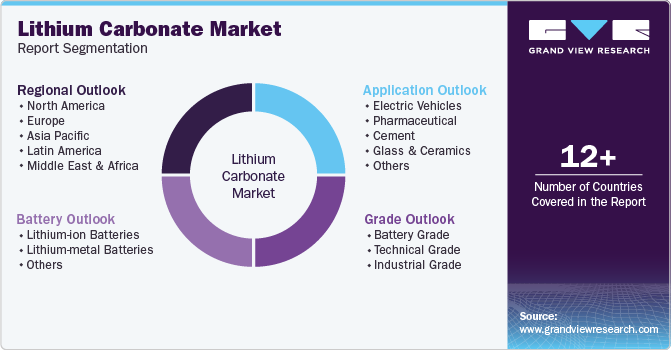
This report forecasts revenue and volume growth at global, regional, and country levels and analyzes the latest industry trends in each of the sub-segments from 2021 to 2033. For this study, Grand View Research has segmented the global lithium carbonate market report by battery, grade, application, and region.
-
Battery Outlook (Revenue, USD Million; Volume, Kilotons; 2021 - 2033)
-
Lithium-ion Batteries
-
Lithium-metal Batteries
-
Others
-
-
Grade Outlook (Revenue, USD Million; Volume, Kilotons; 2021 - 2033)
-
Battery Grade
-
Technical Grade
-
Industrial Grade
-
-
Application Outlook (Revenue, USD Million; Volume, Kilotons; 2021 - 2033)
-
Electric Vehicles
-
Pharmaceutical
-
Cement
-
Glass & Ceramics
-
Others
-
-
Regional Outlook (Revenue, USD Million; Volume, Kilotons; 2021 - 2033)
-
North America
-
U.S.
-
Canada
-
Mexico
-
-
Europe
-
Germany
-
UK
-
France
-
-
Asia Pacific
-
China
-
India
-
Japan
-
-
Latin America
-
Brazil
-
Argentina
-
-
Middle East & Africa
-
Saudi Arabia
-
South Africa
-
-
Research Methodology
The lithium carbonate market figures in this report are based on a proven research process that combines executive interviews with secondary research from proprietary databases, company filings, and recognized regulatory and institutional sources. Market size is built through value-chain sizing - reconciling supply-side and demand-side estimates - and triangulated with bottom-up and top-down approaches. Every estimate passes multiple levels of expert validation before publication, with each lithium carbonate segment quantified using the revenue-capture definitions in the table below.
Segment Definition
Segment - Battery Type
Revenue capture definition
Lithium-ion Batteries
Revenue is driven by the consumption of lithium carbonate in the production of cathode materials for lithium-ion batteries used in electric vehicles, energy storage systems, consumer electronics, and industrial equipment. The rapid expansion of vehicle electrification and renewable energy storage continues to strengthen demand from this segment.
Lithium-metal Batteries
This segment generates revenue through the use of lithium carbonate as a precursor for lithium compounds utilized in next-generation lithium-metal battery technologies. Growing investments in advanced battery research and high-energy-density storage solutions support market growth.
Others (if any)
Revenue is derived from lithium carbonate consumption in emerging battery chemistries, pilot-scale energy storage technologies, and research applications. Continued innovation in battery materials and alternative storage technologies contributes to demand within this segment.
Segment - Grade
Revenue capture definition
Battery Grade
Sales are generated from high-purity lithium carbonate specifically designed for battery manufacturing applications. Strong demand from electric vehicle producers and energy storage system manufacturers makes this the largest and most strategically important grade segment.
Technical Grade
Revenue stems from lithium carbonate supplied to specialty chemical, pharmaceutical, and laboratory applications where moderate purity levels are sufficient. Demand is supported by the compound's versatility across a wide range of industrial and technical processes.
Industrial Grade
This segment captures value from lithium carbonate utilized in glass, ceramics, cement, metallurgy, and other industrial manufacturing activities. Consumption is largely influenced by construction activity, industrial production levels, and specialty material demand.
Segment - Application
Revenue capture definition
Electric Vehicles
Revenue is generated through lithium carbonate consumption in lithium-ion batteries powering battery electric vehicles (BEVs), plug-in hybrid electric vehicles (PHEVs), and hybrid electric vehicles (HEVs). Accelerating EV adoption and supportive government policies continue to drive growth in this segment.
Pharmaceutical
This segment derives revenue from lithium carbonate used in pharmaceutical formulations, particularly for the treatment of bipolar disorder and other psychiatric conditions. Consistent demand from the healthcare sector supports stable market contribution.
Cement
Sales are generated from the incorporation of lithium carbonate into cement formulations to improve performance characteristics and reduce alkali-silica reactions. Infrastructure development and construction activities influence demand within this application.
Glass & Ceramics
Revenue is driven by the use of lithium carbonate in specialty glass, ceramic products, glazes, and heat-resistant materials. Its ability to improve strength, durability, and thermal properties supports widespread adoption across the glass and ceramics industry.
Other Applications
This segment captures revenue from diverse applications including lubricants, aluminum production, air treatment systems, chemical synthesis, and specialty industrial processes. The broad applicability of lithium carbonate across multiple industries provides a diversified revenue base for the market.
Estimation Model
Layer Name
Key Question
Description
Lithium Carbonate Production Layer
What forms is the supply base?
Identify global lithium carbonate production capacity supported by lithium brine resources, hard-rock spodumene mining operations, extraction and refining infrastructure, processing technologies, battery-grade purification capabilities, quality standards, and regional production facilities. This establishes the foundational supply base available for battery manufacturing, industrial processing, pharmaceutical applications, and specialty chemical markets worldwide.
Application Adoption Layer
Where is lithium carbonate utilized?
Estimate the proportion of lithium carbonate consumed across electric vehicle batteries, energy storage systems, consumer electronics, pharmaceuticals, glass & ceramics, cement, lubricants, metallurgy, and other industrial applications based on end-use demand, technological requirements, production trends, and regional consumption patterns.
Consumption Intensity Layer
How much is lithium carbonate used?
Analyze application-specific consumption rates, battery production volumes, cathode chemistry requirements, industrial processing intensity, manufacturing output, technology adoption trends, and replacement cycles to determine annual lithium carbonate demand across major end-use industries and geographic regions.
Revenue Layer
How is market revenue generated?
Market revenue is quantified through the sale of battery-grade, technical-grade, and industrial-grade lithium carbonate supplied to battery manufacturers, electric vehicle producers, energy storage companies, pharmaceutical manufacturers, glass & ceramic producers, cement manufacturers, and other industrial consumers worldwide.
Delivered Customizations
This report has been delivered with the following In-depth customizations
Client Request
Customization Delivered
Value Adds
Cross-Segmentation Analysis
Detailed cross-segmentation assessment evaluating the relationship between crop types, cultivation methods, and lithium carbonate consumption patterns. Analysis identifies usage intensity, film performance requirements, soil moisture conservation needs, weed control effectiveness, and revenue contribution across intersecting segments such as fruits & vegetables in open-field cultivation, greenhouse-grown crops in protected agriculture, and specialty applications in horticulture, floriculture, and plantation farming.
Supports product portfolio optimization and market prioritization by identifying the most attractive crop-cultivation combinations, enabling improved resource allocation, sales targeting, product development strategies, and long-term growth planning across the lithium carbonate value chain.
Competitive Benchmarking
Comparative evaluation of leading lithium carbonate manufacturers based on product portfolio breadth, biodegradable film capabilities, manufacturing capacity, raw material integration, geographic presence, sustainability initiatives, agricultural specialization, customer relationships, distribution networks, and strategic developments across key regional markets.
Assists competitive intelligence, partnership evaluation, and supplier assessment by providing deeper visibility into market positioning, technological strengths, differentiation strategies, innovation capabilities, operational efficiency, and areas of competitive advantage.
Opportunity Assessment
Comprehensive assessment of emerging opportunities associated with biodegradable lithium carbonates, sustainable agriculture practices, greenhouse cultivation expansion, precision farming technologies, water conservation initiatives, organic farming growth, specialty crop production, and increasing adoption of environmentally friendly agricultural inputs across global markets.
Helps identify high-growth investment areas, emerging application opportunities, technology development priorities, and market expansion strategies, supporting long-term revenue growth and competitive positioning across the lithium carbonate value chain.
Frequently Asked Questions About This Report
Asia Pacific dominated the lithium carbonate market in 2025, accounting for 35.4% of global revenue, driven by its strong battery manufacturing base, expanding electric vehicle production, and significant lithium processing capacity.
Battery grade lithium carbonate held the largest market share in 2025, accounting for 47.7% of total revenue, supported by its extensive use in lithium-ion battery production for electric vehicles and energy storage systems.
Technical grade lithium carbonate is projected to be the fastest-growing grade segment, registering a CAGR of 16.0% during the forecast period, driven by increasing demand from pharmaceutical, specialty chemical, and industrial applications.
Lithium-ion batteries dominated the market in 2025, accounting for 53.7% of total revenue, owing to their widespread adoption in electric vehicles, consumer electronics, and renewable energy storage systems.
Electric vehicles dominated the lithium carbonate market with a market share of 54.7% in 2025. The expansion of global EV manufacturing capacity, with major automakers transitioning to electric models and new entrants in the EV market, is significantly boosting product consumption. As vehicle production scales up, the corresponding need for lithium-ion batteries rises, driving the demand for lithium carbonate
Some key players operating in lithium carbonate market include Albemarle Corp.; Ganfeng Lithium Co., Ltd.; SQM S.A.; Tianqi Lithium Corp.; Livent Corp.; Lithium Americas Corp.; Pilbara Minerals; Orocobre Ltd. Pty. Ltd.; Mineral Resources and others
The market is experiencing robust growth, driven by the rapid expansion of the electric vehicle (EV) industry. It is a critical raw material for lithium-ion batteries, which are essential for EVs. As governments worldwide implement stricter environmental regulations and offer incentives to encourage the adoption of clean energy and electric vehicles, the demand for the product has surged
The global lithium carbonate market size was valued at USD 30.1 billion in 2025 and is expected to reach USD 34.6 billion in 2026.
The global lithium carbonate market is expected to grow at a compound annual growth rate of 15.6% from 2026 to 2033 to reach USD 95.2 billion by 2033.
About the Author(s)
Petrochemicals Research Team
Bulk Chemicals · PetrochemicalsThis report was authored by the petrochemicals research team at Grand View Research - comprising two research analysts, one senior research analyst, and one industry expert - with specialized expertise in the petrochemicals segment of the bulk chemicals industry. All findings are based on proprietary bulk chemicals databases, executive interviews, and regulatory analysis, subject to internal peer review prior to publication.
Last Updated:
Speak to Analyst


Customize this report to your needs — add regions, segments, or data points, with 20% free customization.
Or view our licence options:


ISO 9001:2015 & 27001:2022 Certified
We are GDPR and CCPA compliant! Your transaction & personal information is safe and secure. For more details, please read our privacy policy.


