
- Home
- »
- Advanced Interior Materials
- »
-
Lithium Metal Market Size, Share Market Report, 2026-2033GVR Report cover
![Lithium Metal Market (2026 - 2033)Report]()
Lithium Metal Market (2026 - 2033)
Size, Share & Trends Analysis Report By End Use (Batteries, Pharmaceuticals, Metal Processing, Others), By Application (Li-ion Anode, Intermediate, Alloys, Others), By Region, And Segment Forecasts
Market Size, 2025
$2.0BMarket Estimate, 2026
$2.2BMarket Forecast, 2033
$7.9BCAGR, 2026–2033
19.8%Lithium Metal Market Summary
The global lithium metal market size was valued at USD 2.0 billion in 2025 and is projected to grow from USD 2.2 billion in 2026 to USD 7.9 billion by 2033, at a CAGR of 19.8% from 2026 to 2033. The Asia Pacific held the largest share of 62.2% of the global market in 2025. The growth of the market is primarily driven by the accelerating transition toward next-generation battery technologies, particularly solid-state and lithium-sulfur batteries, which utilize lithium metal as a high-capacity anode material to achieve significantly higher energy density compared to conventional lithium-ion systems.

Key Market Trends & Insights
- By end use: Batteries accounted for the largest market revenue share of 55.6% in 2025.
- By application: Li-ion anode segment is growing at a fastest CAGR of 26.2% from 2026 to 2033.
Regional Highlights
- Largest regional market: Asia Pacific (62.2% revenue share, 2025)
- By country: The China led the Asia Pacific market in 2025.
Market Size & Forecast
- Market size in 2025: USD 2.0 Billion
- Estimated market size in 2026: USD 2.2 Billion
- Projected market size by 2033: USD 7.9 Billion
- CAGR (2026-2033): 19.8%
The market is being strongly shaped by advancements in next-generation battery technologies, particularly solid-state and lithium-sulfur systems, where lithium metal serves as a high-capacity anode material. These technologies offer significantly higher energy density, improved cycle life, and enhanced charging efficiency compared to conventional lithium-ion batteries. Continuous innovation is focused on overcoming critical technical challenges such as dendrite formation, interfacial instability, and safety risks through the development of advanced electrolytes, protective coatings, and separator technologies.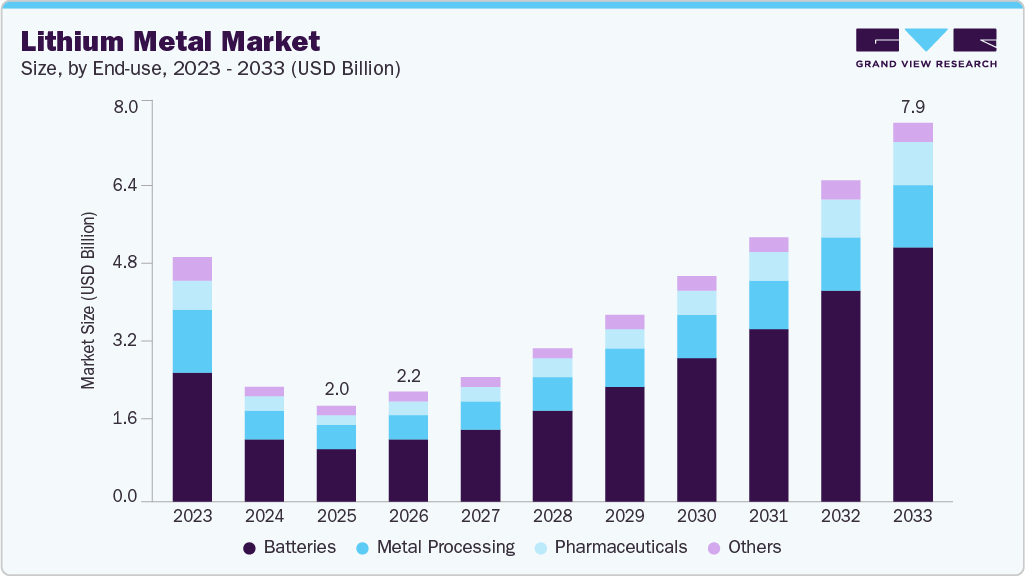
From a sustainability standpoint, lithium metal plays a crucial role in enabling cleaner energy ecosystems by supporting high-efficiency energy storage solutions essential for electric mobility and renewable energy integration. Its application in next-generation batteries contributes to reducing greenhouse gas emissions by enhancing the performance and adoption of electric vehicles and grid-scale storage systems. However, sustainability challenges persist across the value chain, including the environmental impact of lithium extraction, energy-intensive processing, and recycling complexities associated with advanced battery chemistries. In response, industry stakeholders are increasingly investing in sustainable mining practices, direct lithium extraction (DLE) technologies, and closed-loop recycling systems to minimize environmental footprint and improve resource efficiency.
Drivers, Opportunities & Restraints
The growth of the market is primarily driven by the accelerating development and early commercialization of next-generation battery technologies, particularly solid-state and lithium-sulfur systems, which utilize lithium metal anodes to achieve significantly higher energy density and performance efficiency. The automotive sector, especially electric vehicles, is at the forefront of this transition as manufacturers seek longer driving range and faster charging capabilities. A recent industry milestone in March 2026, when ION Storage Systems advanced its solid-state battery technology toward commercial-scale production, underscores the increasing readiness of lithium metal-based solutions.
Significant opportunities emerge from the ongoing scale-up of solid-state battery manufacturing and the increasing alignment of global investments toward advanced energy storage technologies. As battery developers and automotive OEMs move closer to commercialization timelines between 2026 and 2030, lithium metal is expected to witness substantial demand expansion. For instance, in March 2026, major battery manufacturers in China announced progress in sulfide-based all-solid-state battery platforms, with pilot vehicle validation targeted for late 2026 and commercial production anticipated by 2027.
Despite its strong growth outlook, the lithium metal market continues to face notable constraints related to technical complexity, safety concerns, and cost competitiveness. Challenges such as dendrite formation, interfacial instability, and stringent handling requirements remain critical barriers to large-scale commercialization. In addition, production costs for lithium metal-based battery systems remain significantly higher than conventional lithium-ion technologies, limiting immediate adoption across mass-market applications. Moreover, volatility in lithium pricing, as observed in mid-2025 when prices declined sharply despite rising long-term demand, has created uncertainty across the supply chain, impacting investment decisions and project timelines.
End Use Insights
The batteries segment accounted for the largest revenue share in 2025 and is expected to register the fastest growth over the forecast period, driven by the increasing adoption of lithium metal in next-generation energy storage technologies. Lithium metal is gaining strong traction as an anode material in solid-state and lithium-sulfur batteries due to its superior energy density, lightweight properties, and ability to enhance overall battery performance. The rapid expansion of the electric vehicle ecosystem, coupled with growing investments in advanced battery R&D and pilot-scale commercialization, is significantly supporting segment growth.
The metal processing and pharmaceuticals segments represent comparatively smaller but stable applications within the lithium metal market. In metal processing, lithium metal is utilized as a reducing agent and alloying component, particularly in the production of specialty metals and high-performance materials, supporting consistent industrial demand. Meanwhile, in the pharmaceutical sector, lithium compounds derived from lithium metal are used in the formulation of specific therapeutic drugs, primarily for the treatment of neurological and psychiatric conditions.
Application Insights
The Li-ion anode segment accounted for the largest share of the lithium metal market in 2025 and is projected to register the highest CAGR during the forecast period. This dominance is attributed to the increasing integration of lithium metal as an advanced anode material in next-generation lithium-ion and solid-state battery architectures. Compared to conventional graphite anodes, lithium metal offers significantly higher theoretical capacity and energy density, making it highly suitable for high-performance applications such as electric vehicles, aerospace systems, and advanced consumer electronics.
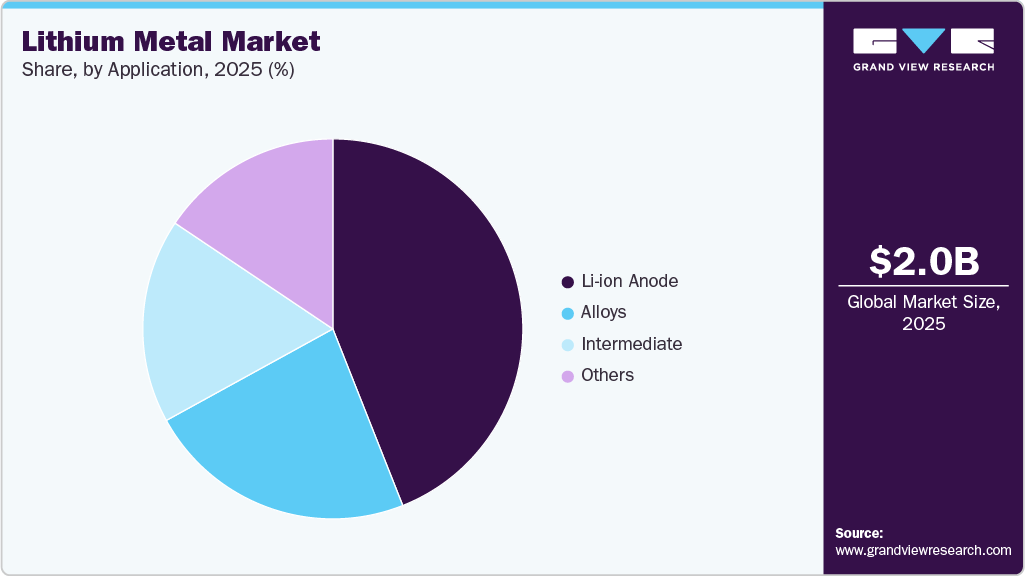
The alloys and intermediates segments represent established yet comparatively moderate-growth applications within the lithium metal market. In alloy applications, lithium metal is used to improve the strength, weight, and performance characteristics of materials, particularly in aerospace and specialty industrial applications where lightweight and high-strength materials are critical. In intermediates, lithium metal serves as a key precursor in the synthesis of various lithium-based chemicals and compounds used across industrial and pharmaceutical applications. While these segments do not exhibit the rapid growth trajectory observed in battery-related applications, they continue to provide consistent demand, supported by their functional importance in specialized manufacturing processes and chemical synthesis.
Regional Insights
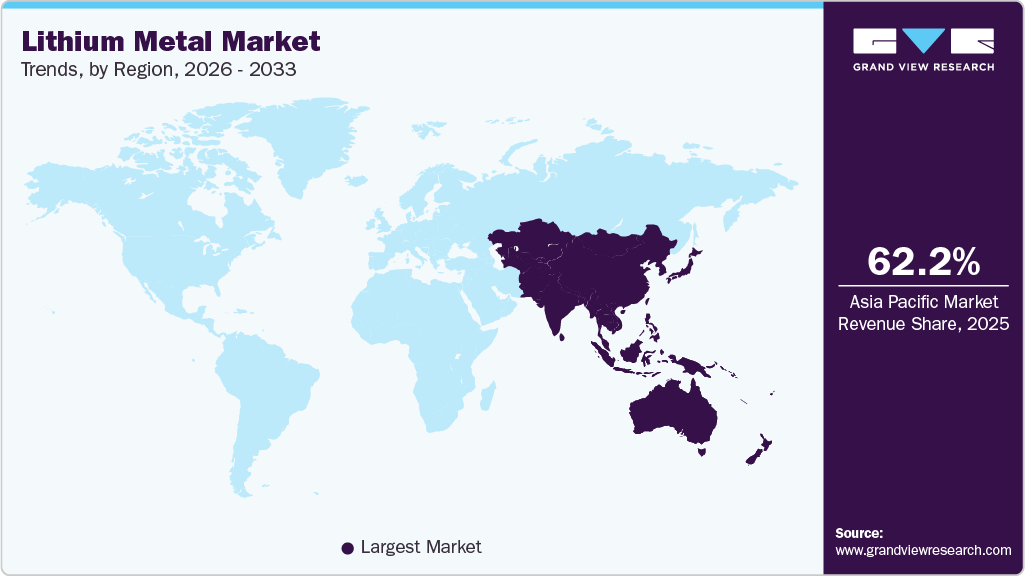
Asia Pacific holds the largest share in the market, supported by its well-established battery manufacturing ecosystem and dominant position in the global electric vehicle supply chain. Countries such as China, Japan, and South Korea are leading in battery innovation, production capacity, and raw material processing. The region benefits from strong government support, extensive manufacturing infrastructure, and the presence of major battery and electronics manufacturers. Rapid industrialization, increasing EV adoption, and continuous advancements in battery technologies are further reinforcing Asia Pacific’s leadership in the lithium metal market.
North America Lithium Metal Market Trends
North America represents a strategically important market for lithium metal, driven by strong investments in next-generation battery technologies and the ongoing localization of the battery supply chain. The region is witnessing increasing support from government initiatives aimed at reducing dependency on imports and strengthening domestic production of critical minerals. Advancements in solid-state battery research, coupled with collaborations between technology developers and automotive OEMs, are further supporting demand for lithium metal. In addition, the presence of established energy storage and aerospace industries is contributing to steady adoption across high-performance applications.
U.S. Lithium Metal Market Trends
The U.S. dominates the North American market, supported by robust R&D capabilities, favorable policy frameworks, and significant private sector investments in advanced battery technologies. Federal initiatives focused on clean energy transition and domestic battery manufacturing are accelerating the development and commercialization of lithium metal-based batteries. The country is also witnessing the emergence of pilot-scale production facilities for solid-state batteries, along with increasing partnerships between startups and major automotive manufacturers.
Europe Lithium Metal Market Trends
Europe is experiencing steady growth in the market, driven by stringent environmental regulations and strong policy support for electric mobility and energy transition. The European Union’s focus on achieving carbon neutrality and building a resilient battery value chain is encouraging investments in advanced battery technologies, including solid-state systems. Automotive manufacturers across the region are actively investing in next-generation battery solutions to comply with emission targets, thereby driving the adoption of lithium metal. In addition, regional initiatives aimed at developing domestic lithium sourcing and refining capabilities are supporting long-term market growth.
Latin America Lithium Metal Market Trends
Latin America plays a critical role in the lithium metal market primarily as a key supplier of lithium resources, with countries such as Chile and Argentina forming part of the “lithium triangle.” While the region has limited downstream processing and battery manufacturing capabilities, it is attracting increasing investments aimed at expanding lithium extraction and refining activities. Efforts to move up the value chain through local processing and partnerships with global players are gradually gaining traction. This positions Latin America as an essential contributor to the global lithium supply chain, supporting the overall growth of the lithium metal market.
Middle East & Africa Lithium Metal Market Trends
The Middle East & Africa region is an emerging market for lithium metal, characterized by growing interest in diversifying economies and investing in renewable energy and advanced materials. While the region currently has limited participation in lithium metal production and battery manufacturing, increasing focus on clean energy projects and energy storage solutions is expected to create future demand. In addition, select African countries are exploring lithium mining opportunities, which could strengthen the region’s role in the global supply chain over the long term. Strategic investments and international collaborations are likely to support gradual market development in this region.
Key Lithium Metal Company Insights
Some of the key players operating in the market include Albemarle Corporation, Ganfeng Lithium Co., Ltd., and others.
-
Albemarle Corporation is a leading global specialty chemicals company headquartered in the United States, with a strong presence across the lithium value chain, including lithium metal production. Established in 1994 and listed on the New York Stock Exchange, the company produces a wide range of lithium products such as lithium metal, lithium carbonate, and lithium hydroxide. Its lithium metal offerings are primarily utilized in high-performance batteries, aerospace applications, and specialty industrial uses. Albemarle’s end-use portfolio spans electric vehicles, energy storage systems, electronics, and defense applications, supported by its vertically integrated operations and global production network.
-
Ganfeng Lithium Co., Ltd. is a vertically integrated lithium producer based in China, established in 2000 and listed on both the Shenzhen Stock Exchange and the Hong Kong Stock Exchange. The company is one of the largest suppliers of lithium compounds and lithium metal globally, offering products such as lithium metal, lithium alloys, and battery-grade lithium chemicals. Ganfeng’s lithium metal is widely used in next-generation battery technologies, including solid-state and lithium-sulfur batteries, as well as in pharmaceuticals and specialty chemicals. Its end-use portfolio includes electric vehicles, consumer electronics, energy storage systems, and industrial applications, supported by extensive upstream resource investments and downstream battery recycling capabilities.
-
Livent Corporation is a U.S.-based lithium company specializing in the production of high-performance lithium materials, including lithium metal, with origins dating back to its establishment as part of FMC Corporation before becoming an independent entity in 2018 and listing on the New York Stock Exchange. The company focuses on the development and manufacturing of lithium compounds and lithium metal products tailored for advanced battery applications. Livent’s lithium metal is primarily used in lightweight, high-energy-density batteries for electric vehicles, aerospace, and defense sectors. Its end-use portfolio includes energy storage, electronics, and specialty polymers, supported by its strong emphasis on innovation, process efficiency, and sustainable lithium production practices.
Key Lithium Metal Companies:
The following key companies have been profiled for this study on the lithium metal market.
- Albemarle Corporation
- China Lithium Products Inc.
- FMC Corporation
- Ganfeng Lithium Co., Ltd.
- Livent Corporation
- Novalith Technologies
- Shenzhen Chengxin Lithium Group Co., Ltd.
- SMI Ltd.
- Tianqi Lithium Corporation
- Toyota Tsusho Corporation
Recent Development
-
In February 2026, Albemarle Corporation announced plans to optimize its global lithium conversion network, focusing on improving operational efficiency and aligning production with evolving demand from next-generation battery technologies, including lithium metal applications.
-
In January 2026, Ganfeng Lithium Co., Ltd. highlighted continued progress in solid-state battery development, including lithium metal anode research, with ongoing pilot projects aimed at accelerating commercialization timelines for electric vehicle applications.
-
In June 2025, Livent Corporation announced capacity expansion initiatives for lithium compounds, strengthening its supply position for advanced battery materials and supporting the broader transition toward high-performance lithium-based technologies.
Lithium Metal Market Report Scope
Report Attribute
Details
Market definition
Market size represents global revenue generated from the sale of lithium metal (Li metal) to end-use applications.
Market size in 2025
USD 2.0 billion
Estimated market size in 2026
USD 2.2 billion
Projected market size by 2033
USD 7.9 billion
Growth rate
CAGR of 19.8% from 2026 to 2033
Base year for estimation
2025
Historical data
2021 - 2024
Forecast period
2026 - 2033
Quantitative units
Revenue in USD million/billion, volume in kilotons, and CAGR from 2026 to 2033
Report coverage
Revenue & volume forecast, competitive landscape, growth factors, and trends
Segments covered
End use, application, region
Regional scope
North America; Europe; Asia Pacific; Latin America; Middle East & Africa
Country scope
U.S.; Canada; Mexico; Germany; Italy; France; UK; China; India; Japan; South Korea; Brazil; Saudi Arabia; UAE
Key companies profiled
Albemarle Corporation; China Lithium Products Inc.; FMC Corporation (Lithium Division); Ganfeng Lithium Co., Ltd.; Livent Corporation; Novalith Technologies; Shenzhen Chengxin Lithium Group Co., Ltd.; SMI Ltd. (Japan); Tianqi Lithium Corporation; Toyota Tsusho Corporation
Customization scope
Free report customization (equivalent up to 8 analysts working days) with purchase. Addition or alteration to country, regional & segment scope.
Pricing and purchase options
Avail customized purchase options to meet your exact research needs. Explore purchase options
Global Lithium Metal Market Report Segmentation
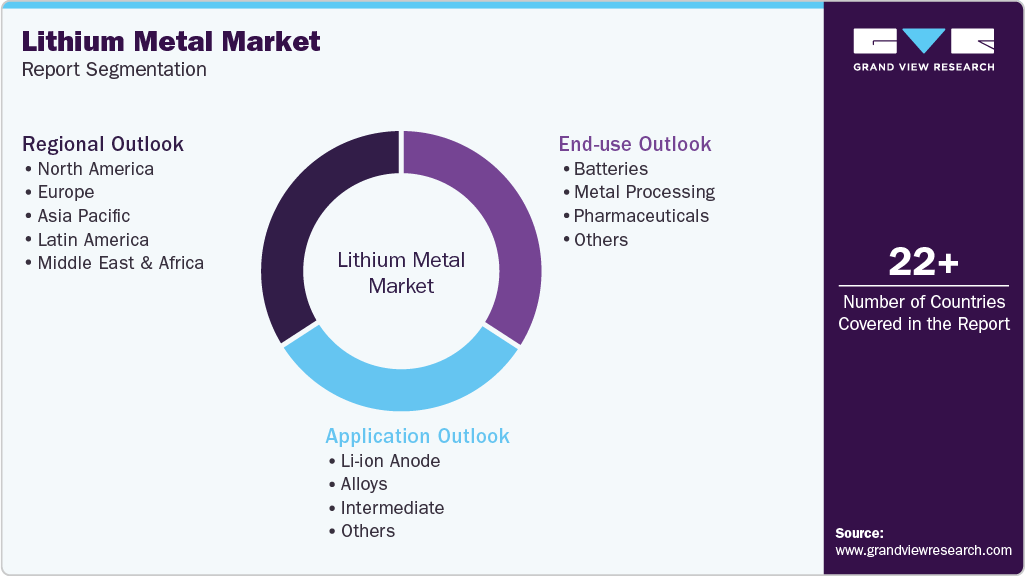
This report forecasts revenue and volume growth at global, regional, and country levels and provides an analysis of the latest industry trends in each of the sub-segments from 2021 to 2033. For this study, Grand View Research has segmented the global lithium metal market report on the basis of end use, application, and region.
-
End Use Outlook (Volume, Kilotons; Revenue, USD Million, 2021 - 2033)
-
Batteries
-
Metal Processing
-
Pharmaceuticals
-
Others
-
-
Application Outlook (Volume, Kilotons; Revenue, USD Million, 2021 - 2033)
-
Li-ion Anode
-
Alloys
-
Intermediate
-
Others
-
-
Regional Outlook (Volume, Kilotons; Revenue, USD Million, 2021 - 2033)
-
North America
-
U.S.
-
Canada
-
Mexico
-
-
Europe
-
Germany
-
Italy
-
France
-
UK
-
-
Asia Pacific
-
China
-
India
-
Japan
-
South Korea
-
-
Latin America
-
Brazil
-
-
Middle East & Africa
-
Saudi Arabia
-
UAE
-
-
Frequently Asked Questions About This Report
The global lithium metal market size was valued at USD 2.0 billion in 2025 and is estimated at USD 2.2 billion for 2026.
The global lithium metal market is expected to grow at a CAGR of 19.8% from 2026 to 2033, reaching USD 7.9 billion by 2033.
The key factor driving the growth of the global lithium metal market is the increasing demand for next-generation battery technologies, particularly solid-state batteries that utilize lithium metal anodes for higher energy density and performance.
Asia Pacific dominated with a 62.2% revenue share in 2025.
The li-ion anode segment held the largest revenue share in 2025, while li-ion anode is the fastest-growing application.
By end use, batteries accounted for the largest market revenue share of 55.6% in 2025, driven by the increasing adoption of lithium metal in next-generation battery technologies, particularly for electric vehicles and advanced energy storage systems.
Key players include Albemarle Corporation; China Lithium Products Inc.; FMC Corporation (Lithium Division); Ganfeng Lithium Co., Ltd.; Livent Corporation; Novalith Technologies; Shenzhen Chengxin Lithium Group Co., Ltd.; SMI Ltd. (Japan); Tianqi Lithium Corporation; Toyota Tsusho Corporation.
About the Author(s)
Advanced Interior Materials Research Team
Advanced Materials · Advanced Interior MaterialsThis report was authored by the advanced interior materials research team at Grand View Research - comprising two research analysts, one senior research analyst, and one industry expert - with specialized expertise in the advanced interior materials segment of the advanced materials industry. All findings are based on proprietary advanced materials databases, executive interviews, and regulatory analysis, subject to internal peer review prior to publication.
Last Updated:
Speak to Analyst


Customize this report to your needs — add regions, segments, or data points, with 20% free customization.
Or view our licence options:


ISO 9001:2015 & 27001:2022 Certified
We are GDPR and CCPA compliant! Your transaction & personal information is safe and secure. For more details, please read our privacy policy.


