
- Home
- »
- Power Generation & Storage
- »
-
Lithium-Sulfur Battery Market Size, Share Report, 2026-2035GVR Report cover

Lithium-Sulfur Battery Market (2026 - 2035)
Size, Share & Trends Analysis Report By Capacity (Below 500 mAh, 500-1000 mAh, Above 1000 mAh), By Cell Type, By Application, By Technology, By Region, And Segment Forecasts
Market Size, 2025
$90.3MMarket Estimate, 2026
$124.7MMarket Forecast, 2035
$1,523.5MCAGR, 2026–2035
32.1%Lithium-Sulfur Battery Market Summary
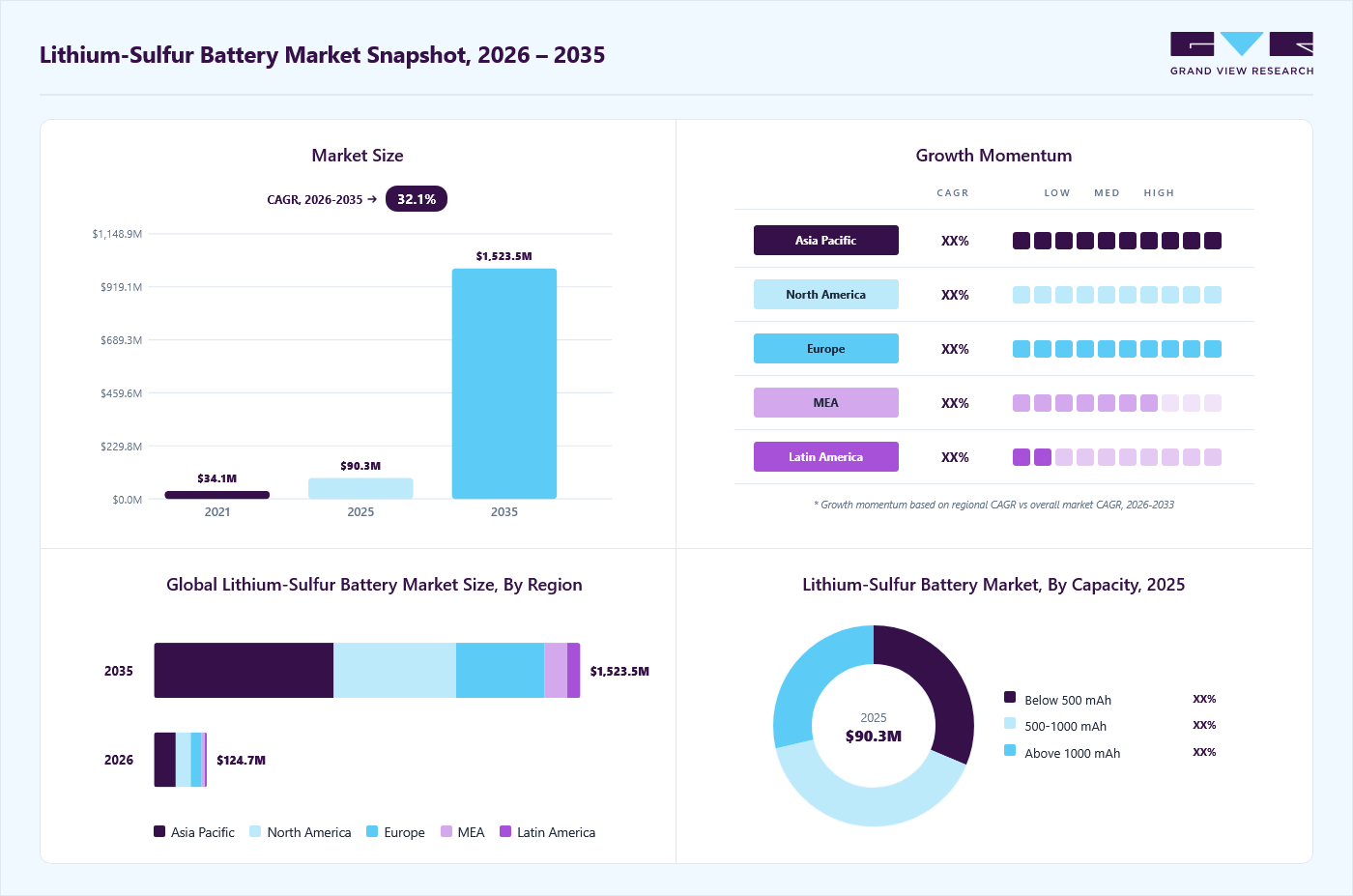
The global lithium-sulfur battery market size was valued at USD 90.3 million in 2025 and is projected to grow from USD 124.7 million in 2026 to USD 1,523.5 million by 2035, at a CAGR of 32.1% from 2026 to 2035. Asia Pacific held the largest global share of 41.3% in 2025. The lithium sulfur battery industry’s growth is driven by its significantly higher theoretical energy density compared with conventional lithium-ion batteries.
 Source: Grand View Research, IR Documents, Primary Interviews, Paid DatabasesTo learn more about this report,
 Download Free Sample Report
 Key Market Trends & Insights
- By capacity: 500-1000 mAh held the largest market share of 40.0% in 2025.
- By cell type: Secondary lithium-sulfur battery accounted for the largest revenue share of 86.2% in 2025.
- By application: Automotive held the largest market share of 26.1% in 2025
- By technology: Conventional lithium-sulfur batteries held the largest market share of 70.5% in 2025.
Regional Highlights
- Largest regional market: Asia Pacific (41.3% revenue share, 2025)
- Fastest-growing regional market: North America (fastest CAGR, 2026-2035)
- By country: China held the largest share in 2025
Market Size & Forecast
- Market size in 2025: USD 90.3 Million
- Estimated market size in 2026: USD 124.7 Million
- Projected market size by 2035: USD 1,523.5 Million
- CAGR (2026-2035): 32.1%
Three ways to get this report
Buy it, customize it, or ask a question.Ask an Analyst
Analyst response in 1 business day
- AccessReport author, directly
- Reply timeWithin 1 working day
- No sales callDirect answer only
- FormatEmail reply
- CostFree, no cost
Get the Full Report
What the study covers
- FormatsPDF · Excel · Dashboard
- Timeline2026–2035 annual, 2025 base
- Coverage20+ countries, 5 regions
- Companies10+ key players profiled
Customize the Report
20% free customization
- IncludeCountries, segments, points
- TailorTo your product definition
- ExtendDeeper competitor detail
- OrA fully bespoke study
- Turnaround5–10 working days
This advantage enables devices and vehicles to achieve longer operating ranges while reducing overall battery weight, particularly in applications where energy per kilogram is a critical design parameter. As industries push for lighter, more efficient energy storage solutions, lithium-sulfur chemistry is gaining attention as a next-generation alternative.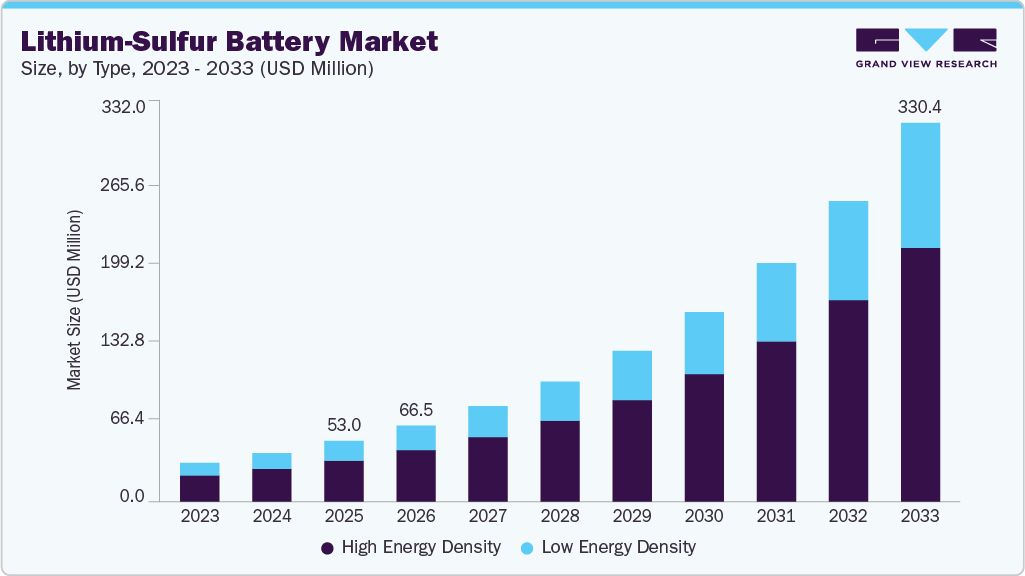 To learn more about this report, Download Free Sample Report
 Sulfur is widely available as an industrial byproduct and is far less expensive than metals such as cobalt and nickel used in many lithium-ion cathodes. This improves long-term cost competitiveness and reduces exposure to volatile markets for critical minerals, making lithium-sulfur batteries attractive to manufacturers seeking stable input economics and more sustainable supply chains.
Rising demand from aerospace, defense, and advanced mobility sectors is further accelerating market growth. These segments prioritize high specific energy and lightweight power sources over long cycle life alone, aligning well with the strengths of lithium sulfur technology. Increased adoption in drones, electric aviation concepts, and specialized military systems is helping to create early commercial demand and validate performance in real-world conditions.
Market Dynamics
The lithium-sulfur battery market is gaining significant attention as industries seek next-generation energy storage solutions with higher energy density and lower material costs than conventional lithium-ion batteries. The use of sulfur as a key material offers potential cost and sustainability advantages, given its abundance and lower environmental impact. While challenges related to cycle life, performance stability, and large-scale manufacturing remain, ongoing technological advancements are expected to improve commercial viability. As demand for lightweight, long-range battery solutions increases, lithium-sulfur batteries are poised to become a promising alternative in the future battery landscape.
The rapid growth of the electric vehicle industry is creating significant demand for advanced battery technologies with higher energy density, longer driving range, and lower weight. Lithium-sulfur batteries are emerging as a promising alternative to conventional lithium-ion batteries due to their ability to store more energy while reducing overall battery weight, which can improve vehicle efficiency and extend driving range. Additionally, the use of abundant, low-cost sulfur helps address concerns about raw material availability and battery production costs. As automakers continue to invest in vehicle electrification and governments strengthen policies supporting zero-emission transportation, demand for next-generation battery technologies, such as lithium-sulfur batteries, is expected to increase substantially.
Despite their high energy density and lightweight advantages, lithium-sulfur batteries face significant commercialization challenges due to limited cycle life and capacity degradation. Battery performance tends to decline more rapidly than that of conventional lithium-ion batteries due to issues such as the polysulfide shuttle effect, sulfur cathode volume expansion, and lithium metal anode instability. These challenges reduce battery lifespan, impact long-term reliability, and increase lifecycle costs, making adoption difficult in applications such as electric vehicles and grid-scale energy storage where durability is critical. Manufacturers and researchers continue investing in advanced materials and battery designs to improve cycle stability and performance retention. In 2026, researchers and battery developers continued to focus on mitigating the polysulfide shuttle effect and improving lithium metal anode stability through advanced electrolyte formulations, protective coatings, and solid-state battery architectures.
The expanding aerospace and aviation industry presents a major growth opportunity for lithium-sulfur batteries due to their exceptionally high energy density and lightweight characteristics. Electric aircraft, drones, UAVs, satellites, and advanced air mobility platforms require energy storage solutions that maximize flight range while minimizing weight. As investments in electric aviation and next-generation aerospace technologies increase, lithium-sulfur batteries are gaining attention as a viable alternative to conventional battery chemistries. Additionally, ongoing advancements in battery materials and manufacturing processes are improving performance and accelerating commercialization across aerospace, defense, and high-performance mobility applications.
Analyst Perspective
The lithium-sulfur battery market is gradually transitioning from a technology development phase to early commercial adoption as demand grows for lighter and more energy-dense battery solutions. Industries such as automotive, aerospace, defense, and energy storage are increasingly evaluating the technology for applications where battery weight and performance are critical. Although technical challenges related to lifespan, stability, and manufacturing scalability remain, continuous R&D and funding efforts are helping overcome these barriers. The market is also gaining attention due to the use of sulfur, an abundant and lower-cost material that can help reduce reliance on critical battery minerals. Looking ahead, the pace of commercialization will largely depend on how effectively manufacturers can improve performance, reduce costs, and scale production capabilities.
Capacity Insights
The 500-1000 mAh capacity segment led the lithium sulfur battery industry, accounting for the largest share of 40.0% in 2025. The segment growth is driven by rising demand for compact, lightweight, and high-energy-density batteries across portable consumer electronics, medical devices, industrial sensors, IoT devices, and defense communication equipment. This capacity range offers an optimal balance between battery size and energy storage capability, making it suitable for applications requiring longer operating times without increasing device weight. Growing adoption of wearable technologies, smart monitoring systems, and compact drone platforms is further supporting demand. In addition, ongoing advancements in sulfur cathode materials and battery design are improving performance and accelerating commercialization efforts.
The above 1000 mAh capacity segment is expected to grow at the fastest CAGR of 33.1% from 2026 to 2035, driven by increasing demand for high-energy-density batteries in electric vehicles, aerospace, defense systems, long-range drones, and stationary energy storage applications. These batteries offer longer operating duration and reduced weight, making them well-suited for applications where performance and endurance are critical. Growing investments in next-generation battery technologies and electric mobility are further supporting demand. Advancements in sulfur-based cathodes, lithium-metal stabilization, and scalable manufacturing processes are improving commercial viability.
Cell Type Insights
The secondary lithium-sulfur batteries segment led the lithium-sulfur battery market, accounting for the largest revenue share of 86.2% in 2025. The segment growth is driven by growing demand for rechargeable, high-energy-density battery technologies across electric vehicles, aerospace, defense, and stationary energy storage applications. Secondary lithium-sulfur batteries offer significant advantages, including lower weight, higher theoretical energy density, and reduced dependence on critical raw materials compared to conventional lithium-ion batteries. Increasing investments in battery innovation and advancements in sulfur cathodes, solid-state electrolytes, and lithium-metal protection technologies are improving their commercial viability.
The primary lithium-sulfur batteries segment is anticipated to grow at the second-fastest CAGR of 29.8% over the forecasted period. The growth is supported by increasing use of single-use, long-duration power sources in applications where reliability and maintenance-free operation are essential. Defense and aerospace organizations are adopting these batteries for communication systems, surveillance equipment, missiles, and space missions due to their ability to deliver stable power over extended periods. The long storage life and ability to operate effectively in extreme environments make primary lithium-sulfur batteries attractive for critical and specialized applications.
Technology Insights
The conventional lithium-sulfur batteries dominated the market with the largest revenue share of 70.5% in 2025. This can be attributed to its relatively higher level of technological maturity, broader research activity, and greater availability of pilot-scale and early commercial products compared to emerging alternatives. Most ongoing development and commercialization efforts are currently focused on conventional lithium-sulfur cell architectures, making them the preferred choice for prototype testing and initial deployments. Established manufacturing approaches and lower development complexity have supported wider adoption across aerospace, defense, research, and advanced energy storage applications.
The solid-state lithium-sulfur batteries segment is expected to grow at the fastest CAGR of 33.5% over the forecasted period. The growth is driven by increasing demand for safer, higher-performance battery technologies that can overcome the limitations of conventional lithium-sulfur systems. By replacing liquid electrolytes with solid-state materials, these batteries offer improved safety, enhanced energy density, better thermal stability, and the potential for longer cycle life. Growing investments in next-generation battery research, coupled with rising interest from electric vehicle, aerospace, and defense industries, are accelerating technology development.
Application Insights
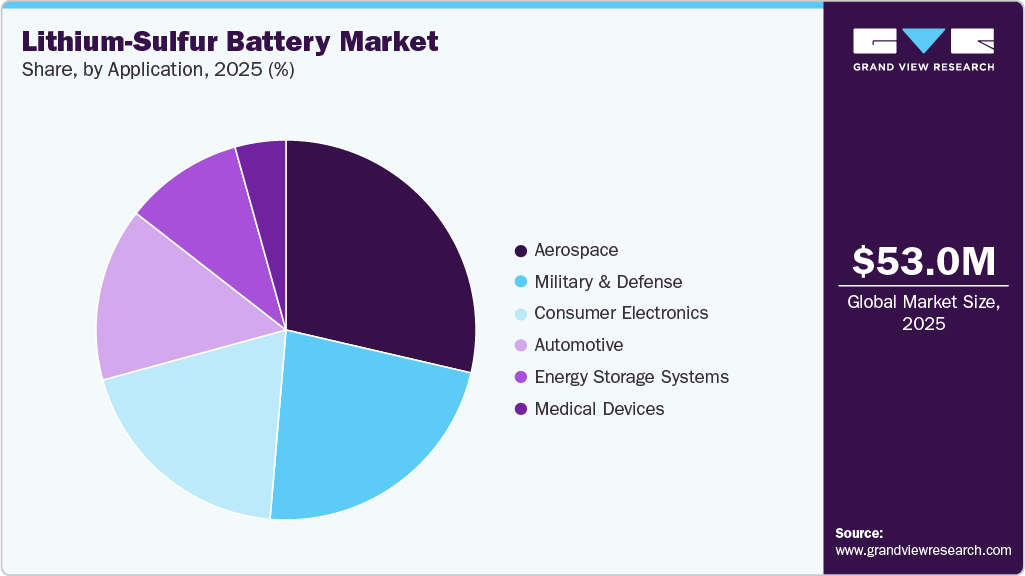
The automotive segment led the lithium-sulfur battery industry, accounting for the largest revenue share of 26.1% in 2025, driven by the growing adoption of electric vehicles and the need for batteries that offer longer driving ranges and improved energy efficiency. Lithium-sulfur batteries are gaining attention in the automotive industry for their high energy density and low weight, which can enhance vehicle performance and reduce overall energy consumption. Increasing investments in vehicle electrification and next-generation battery technologies are further supporting market growth. The use of sulfur-based materials helps reduce dependence on critical minerals, aligning with the industry's focus on sustainable and resilient battery supply chains.
 To learn more about this report, Download Free Sample Report
 The medical devices segment is anticipated to grow at the fastest CAGR of 45.6% over the forecast period, driven by increasing demand for compact, lightweight, and long-lasting power sources for advanced medical equipment. Lithium-sulfur batteries offer high energy density, making them suitable for portable medical devices, implantable technologies, remote patient monitoring systems, and wearable healthcare equipment. The growing adoption of digital health solutions and home-based medical care is further supporting demand for efficient battery technologies. Ongoing advancements in battery safety, performance, and miniaturization are expected to accelerate the use of lithium-sulfur batteries across the healthcare sector.
Regional Insights
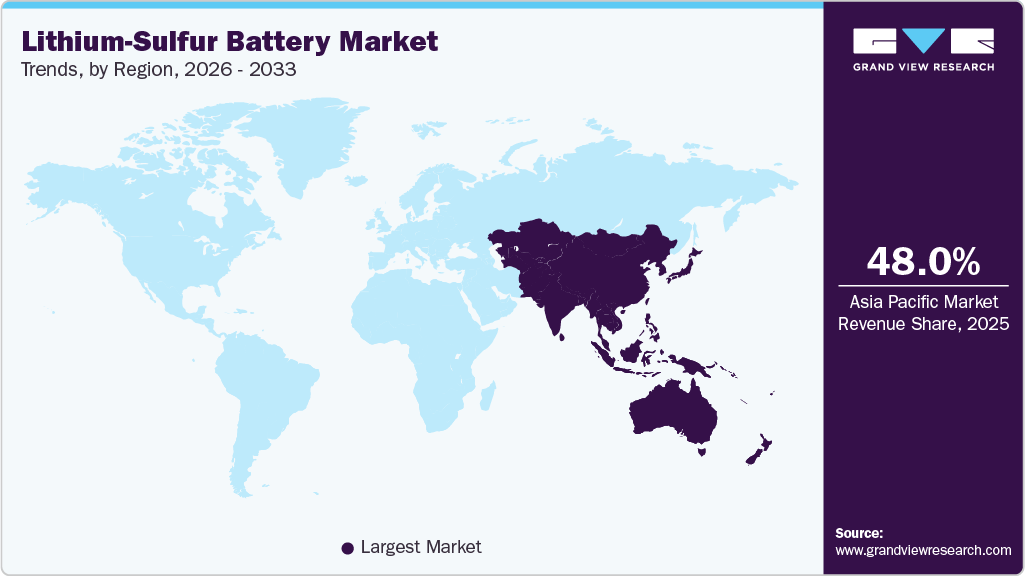
The Asia Pacific lithium-sulfur battery market accounted for the largest revenue share of 41.3% in 2025, driven by increasing demand for advanced energy storage solutions across electric mobility, aerospace, and emerging automation applications. The region is witnessing strong growth in electric vehicle adoption, drone deployment, and autonomous delivery systems, all of which require lightweight batteries with higher energy density. Rising investments in renewable energy projects are creating demand for efficient energy storage systems to support grid stability. The expansion of digital infrastructure, including AI-driven facilities and large-scale data centers, is also contributing to the need for reliable and high-performance battery technologies.
 To learn more about this report, Download Free Sample Report
 The market is further supported by Asia Pacific’s well-established battery manufacturing capabilities, a strong R&D ecosystem, and favorable government policies that promote next-generation energy storage technologies. Major economies such as China, Japan, and South Korea continue to invest in battery innovation, production capacity expansion, and commercialization programs. The presence of leading automotive, electronics, and battery manufacturers is accelerating the development and adoption of lithium-sulfur battery technology. With growing emphasis on technological advancement, energy security, and sustainable transportation, the region is expected to maintain its leadership position in the global market.
China Lithium-Sulfur Battery Market Trends
China’s lithium-sulfur battery market is being shaped by strong government support for advanced battery technologies, rising electric vehicle production, and growing demand for high-energy-density energy storage solutions. Policies such as the 14th Five-Year Plan and the New Energy Vehicle Industry Development Plan (2021 - 2035) are encouraging battery innovation and domestic manufacturing. The country’s carbon neutrality goals are further driving investment in next-generation battery chemistries.
North America Lithium-Sulfur Battery Market Trends
The North America lithium-sulfur battery industry is anticipated to grow at the fastest CAGR of 32.4% in 2025. The market’s growth is strongly linked to the rising adoption of advanced energy storage applications that offer higher energy density and lower weight than traditional options. This includes electric vehicles, unmanned aerial systems, and aerospace platforms where extended runtime and reduced mass are critical performance criteria. Demand is also stimulated by renewable energy integration and grid resilience projects, as stakeholders seek storage technologies that can support intermittent generation with compact, efficient solutions.
U.S. Lithium-Sulfur Battery Market Trends
In the U.S., the growing adoption of electric vehicles, drones, and advanced aerospace systems is driving interest in lithium-sulfur batteries, which offer higher energy density and lower weight than conventional lithium-ion batteries. The need for longer driving ranges, improved operational efficiency, and enhanced payload capacity is encouraging manufacturers to explore next-generation battery chemistries. Government support through initiatives such as the Inflation Reduction Act (IRA) and the Bipartisan Infrastructure Law is further accelerating investment in advanced battery research and domestic manufacturing.
Europe Lithium-Sulfur Battery Market Trends
In Europe, the expansion of the market is being propelled by efforts to integrate advanced energy storage solutions into key high-growth sectors like electric mobility, aerospace, and renewable energy systems. Manufacturers and research organizations across the EU are investing in development projects aimed at improving the performance, durability, and manufacturability of these chemistries, especially for applications where high energy density and reduced weight matter.
Latin America Lithium-Sulfur Battery Market Trends
Latin America is emerging as a strategically important region for the lithium-sulfur battery industry, driven by abundant lithium resources, expanding clean energy initiatives, and growing investments across the battery value chain. Countries such as Chile, Argentina, and Bolivia play a critical role in global lithium supply, supporting the development of next-generation battery technologies. Government efforts to increase domestic lithium processing, attract battery manufacturing investments, and strengthen participation in global supply chains are further enhancing market prospects.
Middle East & Africa Lithium-Sulfur Battery Market Trends
The Middle East & Africa lithium-sulfur battery industry is gradually gaining momentum as countries across the region increase investments in renewable energy, energy storage infrastructure, and advanced manufacturing. Governments in Saudi Arabia, the United Arab Emirates, and South Africa are promoting clean energy adoption and industrial diversification through initiatives such as Saudi Arabia’s Vision 2030. The growing deployment of utility-scale renewable energy projects, electrified transportation, and critical infrastructure is driving demand for high-performance energy storage technologies.
Key Lithium-sulfur Battery Company Insights
Some of the key players operating in the global lithium-sulfur battery market include Gelion PLC and LG Energy Solution Ltd.
-
Gelion PLC is an energy storage technology company engaged in advanced battery materials and energy storage system development. The company is actively developing sulfur-based battery technologies, including sulfur cathode materials designed to enhance battery performance and sustainability. Its lithium-sulfur-related activities focus on the development of advanced sulfur materials, pilot-scale validation, and strategic collaborations to support future transportation and energy storage applications.
-
LG Energy Solution Ltd. manufactures batteries for electric vehicles, energy storage systems, consumer electronics, and industrial applications. The company maintains a global manufacturing and R&D network supporting both commercial battery technologies and next-generation energy storage solutions. As part of its advanced battery research initiatives, LG Energy Solution is developing lithium-sulfur battery technology for future mobility applications, focusing on achieving higher energy density and reduced weight compared to conventional lithium-ion systems.
Key Lithium-sulfur Battery Companies
The following key companies have been profiled for this study on the lithium-sulfur battery market.
-
Gelion PLC
-
GS Yuasa Corporation
-
Lyten, Inc.
-
LG Energy Solution Ltd.
-
Li-S Energy Limited
-
PolyPlus Battery Company
-
NexTech Batteries Inc.
-
Zeta Energy LLC
-
Giner, Inc.
-
Solidion Technology, Inc.
-
Alteva
-
Conamix
-
Lynntech, Inc.
-
Coherent Corp.
-
Pentalys Energy
Competitive Benchmarking
Category
Operating Strategies
Competitive Edge
Weakness
Established Players (GS Yuasa Corporation; LG Energy Solution Ltd.; Lyten, Inc.; Gelion PLC; Li-S Energy Limited; Solidion Technology, Inc.; Coherent Corp.)
- Invest in pilot-scale and commercial-scale lithium-sulfur battery manufacturing facilities.
- Focus on strategic partnerships with automotive, aerospace, defense, and energy storage companies.
- Accelerate R&D in sulfur cathodes, solid-state electrolytes, and lithium-metal anodes.
- Strong financial resources and access to capital.
- Advanced R&D capabilities and extensive technology portfolios.
- Established customer relationships across high-growth industries.
- High R&D and commercialization costs.
- Challenges in achieving cost-effective large-scale production.
- Exposure to technology performance risks, such as cycle life limitations.
Emerging Players (PolyPlus Battery Company; NexTech Batteries Inc.; Zeta Energy LLC; Giner, Inc.; Alteva, Conamix; Lynntech, Inc.; Pentalys Energy)
- Focus on niche technology innovation and specialized battery architectures.
- Collaborate with research institutions, government agencies, and industry partners for technology validation.
- Target high-value applications such as defense, drones, aerospace, and advanced electronics.
- Greater flexibility and faster innovation cycles.
- Strong focus on breakthrough technologies and next-generation battery designs.
- Ability to specialize in specific performance improvements such as energy density or cycle stability.
- Limited manufacturing capacity and commercialization experience.
- Dependence on external funding and strategic partnerships.
- Lower market visibility and customer reach.
Recent Developments
-
In February 2026, Lyten completed the acquisition of key Northvolt battery assets in Sweden, including Northvolt Ett, Ett Expansion, and Northvolt Labs, representing nearly USD 5 million in asset value. The acquisition added approximately 16 GWh of existing battery manufacturing capacity, more than 160 hectares of industrial infrastructure, and one of Europe’s largest battery research and development facilities. The company also established its first Lyten Industrial Hub in Skellefteå, Sweden, to support large-scale lithium-sulfur battery manufacturing and research activities.
Lithium-Sulfur Battery Report Scope
Report Attribute
Details
Market Definition
The market size represents the total global revenue generated from the shipment/sales of lithium-sulfur battery cells, battery packs, and integrated battery systems across all end-use applications and regions during the specified period.
Market size in 2025
USD 90.3 million
Estimated market size in 2026
USD 124.7 million
Projected market size by 2035
USD 1,523.5 million
Growth rate
CAGR of 32.1% from 2026 to 2035
Base year for estimation
2025
Historical data
2021 - 2024
Forecast period
2026 - 2035
Quantitative Units
Revenue in USD million, capacity in MWh, volume in units, and CAGR from 2026 to 2035
Report coverage
Revenue forecast, capacity forecast, volume forecast, competitive landscape, growth factors, and trends
Segments covered
Capacity, cell type, application, technology, region
Regional scope
North America; Europe; Asia Pacific; Latin America; Middle East & Africa
Country scope
U.S.; Canada; Mexico; Germany; UK; France; Spain; Italy; China; India; Japan; South Korea; Australia; Brazil; Argentina; Saudi Arabia; UAE; South Africa
Key companies profiled
Gelion PLC; GS Yuasa Corporation; Lyten, Inc.; LG Energy Solution Ltd.; Li-S Energy Limited; PolyPlus Battery Company; NexTech Batteries Inc.; Zeta Energy LLC; Giner, Inc.; Solidion Technology, Inc.; Alteva; Conamix; Lynntech, Inc.; Coherent Corp.; Pentalys Energy
Customization scope
Free report customization (equivalent up to 8 analysts working days) with purchase. Addition or alteration to country, regional & segment scope.
Pricing and purchase options
Avail customized purchase options to meet your exact research needs. Explore purchase options
Global Lithium-Sulfur Battery Market Report Segmentation
This report forecasts volume & revenue growth at the global, regional, and country levels and provides an analysis of the latest industry trends in each of the sub-segments from 2021 to 2035. For this study, Grand View Research has segmented the global lithium-sulfur battery market report based on capacity, cell type, application, technology, and region:
-
Capacity Outlook (Capacity in MWh; Volume in Units; Revenue in USD Million, 2021 - 2035)
-
Below 500 mAh
-
500-1000 mAh
-
Above 1000 mAh
-
-
Cell Type Outlook (Capacity in MWh; Volume in Units; Revenue in USD Million, 2021 - 2035)
-
Primary Lithium-Sulfur Batteries
-
Secondary Lithium-Sulfur Batteries
-
-
Application Outlook (Capacity in MWh; Volume in Units; Revenue in USD Million, 2021 - 2035)
-
Automotive
-
Aerospace
-
Consumer Electronics
-
Energy Storage Systems
-
Medical Devices
-
Military & Defense
-
-
Technology Outlook (Capacity in MWh; Volume in Units; Revenue in USD Million, 2021 - 2035)
-
Conventional Lithium-Sulfur Batteries
-
Solid-State Lithium-Sulfur Batteries
-
Hybrid Lithium-Sulfur Batteries
-
-
Regional Outlook (Capacity in MWh; Volume in Units; Revenue in USD Million, 2021 - 2035)
-
North America
-
U.S.
-
Canada
-
Mexico
-
-
Europe
-
Germany
-
UK
-
France
-
Italy
-
Spain
-
-
Asia Pacific
-
China
-
India
-
Japan
-
South Korea
-
Australia
-
-
Latin America
-
Brazil
-
Argentina
-
-
Middle East & Africa
-
Saudi Arabia
-
UAE
-
South Africa
-
-
Research Methodology
The lithium-sulfur battery market figures in this report are based on a proven research process that combines executive interviews with secondary research from proprietary databases, company filings, and recognized regulatory and institutional sources. Market size is built through value-chain sizing - reconciling supply-side and demand-side estimates - and triangulated with bottom-up and top-down approaches. Every estimate passes multiple levels of expert validation before publication, with each lithium-sulfur battery segment quantified using the revenue-capture definitions in the table below.
Segment Definition
Segment - Capacity
Revenue capture definition
Below 500 mAh
Represents the revenue generated from lithium-sulfur batteries with capacities below 500 mAh, primarily used in compact, low-power electronic and sensing applications.
500-1000 mAh
Captures revenues derived from lithium-sulfur batteries with capacities ranging from 500 mAh to 1000 mAh, serving applications that require a balance between portability and energy storage capability.
Above 1000 mAh
Accounts for the market value associated with lithium-sulfur batteries exceeding 1000 mAh, supporting high-energy-demand applications such as electric vehicles, aerospace systems, and stationary energy storage.
Segment - Cell Type
Revenue capture definition
Primary Lithium-Sulfur Batteries
Reflects sales of non-rechargeable lithium-sulfur batteries used in applications requiring long shelf life, high energy density, and single-use operation.
Secondary Lithium-Sulfur Batteries
Represents the revenue generated from rechargeable lithium-sulfur batteries deployed across applications requiring repeated charge-discharge cycles and long-term energy storage.
Segment - Application
Revenue capture definition
Automotive
Includes the value of lithium-sulfur batteries supplied for electric vehicles, hybrid vehicles, and other transportation platforms.
Aerospace
Covers the commercial value of lithium-sulfur batteries used in aircraft, satellites, drones, and space exploration systems.
Consumer Electronics
Accounts for revenues associated with lithium-sulfur batteries integrated into smartphones, laptops, wearables, and other portable electronic devices.
Energy Storage Systems
Represents the revenue generated from lithium-sulfur batteries utilized in residential, commercial, and utility-scale energy storage installations.
Medical Devices
Captures revenues derived from lithium-sulfur batteries used in portable healthcare equipment, monitoring devices, and medical systems.
Military & Defense
Reflects sales of lithium-sulfur batteries deployed in military communications, surveillance systems, defense equipment, and tactical vehicles.
Segment - Technology
Revenue capture definition
Conventional Lithium-Sulfur Batteries
Represents the revenue generated from traditional lithium-sulfur battery systems utilizing liquid electrolytes.
Solid-State Lithium-Sulfur Batteries
Accounts for the market value associated with lithium-sulfur batteries incorporating solid electrolytes to improve safety and performance.
Hybrid Lithium-Sulfur Batteries
Covers the commercial value of lithium-sulfur batteries that combine conventional and advanced battery architectures to enhance electrochemical performance and stability.
Estimation Model
Layer Name
Key Question
Description
Advanced Battery Demand Base Layer
Where does demand originate?
Assess demand for high-energy-density and lightweight energy storage solutions across electric vehicles, aerospace, defense systems, consumer electronics, medical devices, drones, and stationary energy storage. Evaluate electrification trends, renewable energy deployment, battery performance requirements, and growth in energy-intensive applications. This layer establishes the total addressable demand for next-generation battery technologies.
Lithium-Sulfur Adoption Potential Layer
Where can lithium-sulfur batteries penetrate?
Identify applications where lithium-sulfur batteries offer advantages over conventional lithium-ion technologies, including higher energy density, reduced weight, and reduced reliance on nickel and cobalt-based materials. Assess technology readiness, commercialization progress, pilot projects, regulatory support, and expected adoption rates across key end-use sectors.
Battery Capacity & Volume Assessment Layer
How much lithium-sulfur battery capacity is required?
Estimate lithium-sulfur battery demand in MWh and units based on battery requirements across automotive, aerospace, energy storage, defense, medical, and consumer electronics applications. Analyze battery pack sizes, energy consumption patterns, deployment volumes, and penetration rates to determine annual battery demand.
Revenue Estimation Layer
What is the market value generated?
Convert battery demand volumes into market revenue using average selling prices (USD/unit and USD/kWh) for lithium-sulfur battery cells, packs, and integrated systems. Incorporate pricing trends, commercialization stage, technology type (conventional, solid-state, hybrid), and regional demand dynamics to estimate total market value.
Delivered Customizations
This report has been delivered with the following In-depth customizations
Client Request
Customization Delivered
Value Adds
Technology Segmentation Analysis
Added a dedicated technology-level assessment of Conventional Lithium-Sulfur Batteries, Solid-State Lithium-Sulfur Batteries, and Hybrid Lithium-Sulfur Batteries, evaluating market size, growth potential, commercialization status, performance characteristics, and adoption trends.
Enables stakeholders to understand the competitive positioning and future potential of each technology pathway, supporting product development, investment, and technology selection decisions.
Competitive Benchmarking
Conducted a detailed evaluation of major lithium-sulfur battery developers based on technology platform, energy density performance, commercialization stage, manufacturing capabilities, patent portfolio, strategic partnerships, funding activity, and target application focus.
Helps stakeholders understand the competitive landscape, identify technology leaders, benchmark innovation strategies, evaluate potential partners or acquisition targets, and assess market positioning relative to competitors.
Application Opportunity Assessment
Conducted a comprehensive assessment of growth opportunities across electric vehicles, aerospace, drones & UAVs, defense systems, medical devices, consumer electronics, and stationary energy storage applications. The study evaluates demand potential, adoption drivers, technology fit, commercialization timelines, investment activity, and market attractiveness for each application segment.
Enables stakeholders to identify the most promising end-use markets, prioritize investment and product development efforts, evaluate future revenue opportunities, and develop targeted market entry and expansion strategies.
Frequently Asked Questions About This Report
The global lithium-sulfur battery market size was estimated at USD 90.3 million in 2025 and is expected to reach USD 124.7 million in 2026.
The global lithium-sulfur battery market is expected to grow at a compound annual growth rate of 32.1% from 2026 to 2035 to reach USD 1,523.5 million by 2035.
The Asia Pacific region dominated the lithium-sulfur batteries market with a revenue share of 41.3% in 2025.
Based on the technology, conventional lithium-sulfur batteries held the largest revenue share of 70.5% in the lithium-sulfur battery market in 2025.
The key players in the lithium-sulfur batteries market include Gelion PLC; GS Yuasa Corporation; Lyten, Inc.; LG Energy Solution Ltd.; Li-S Energy Limited; PolyPlus Battery Company; NexTech Batteries Inc.; Zeta Energy LLC; Giner, Inc.; Solidion Technology, Inc.; Alteva; Conamix; Lynntech, Inc.; Coherent Corp.; Pentalys Energy; and others.
The global lithium-sulfur batteries market is primarily driven by the growing demand for high-energy-density, lightweight, and cost-effective battery technologies for electric vehicles, aerospace, and next-generation energy storage applications.
Based on the application segment, automotive held the largest revenue share of 26.1% in the lithium-sulfur battery market in 2025.
Based on the capacity segment, 500-1000 mAh held the largest revenue share of 40.0% in 2025.
Which cell type segment accounted for the largest share of the global lithium-sulfur battery market?Based on the cell type, secondary lithium-sulfur batteries held the largest revenue share of 86.2% in 2025.
About the Author(s)
Power Generation & Storage Research Team
Energy & Power · Power Generation & StorageThis report was authored by the power generation & storage research team at Grand View Research - comprising two research analysts, one senior research analyst, and one industry expert - with specialized expertise in the power generation & storage segment of the energy & power industry. All findings are based on proprietary energy & power databases, executive interviews, and regulatory analysis, subject to internal peer review prior to publication.
Last Updated:
Speak to Analyst

Customize this report to your needs - add regions, segments, or data points, with 20% free customization.
Or view our licence options:


ISO 9001:2015 & 27001:2022 Certified
We are GDPR and CCPA compliant! Your transaction & personal information is safe and secure. For more details, please read our privacy policy.


