
- Home
- »
- IT Services & Applications
- »
-
Live Commerce Market Size & Share Report, 2026-2033GVR Report cover

Live Commerce Market (2026 - 2033)
Size, Share & Trends Analysis Report By Product (Fashion & Apparel, Electronics, Home & Living, Food & Beverage, Health & Wellness), By Platform Type (Brand-Owned Platforms, Third-Party Apps), By Region, And Segment Forecasts
Market Size, 2025
$172.9BMarket Estimate, 2026
$230.3BMarket Forecast, 2033
$2,546.5BCAGR, 2026–2033
41.0%Live Commerce Market Summary
The global live commerce market size was valued at USD 172.9 billion in 2025 and is projected to grow from USD 230.3 billion in 2026 to USD 2,546.5 billion by 2033, at a CAGR of 41.0% from 2026 to 2033. The market in Asia Pacific dominated with a revenue share of 66.8% in 2025. This growth is driven by rapid social commerce adoption, high smartphone penetration, and growing influencer-led online shopping.
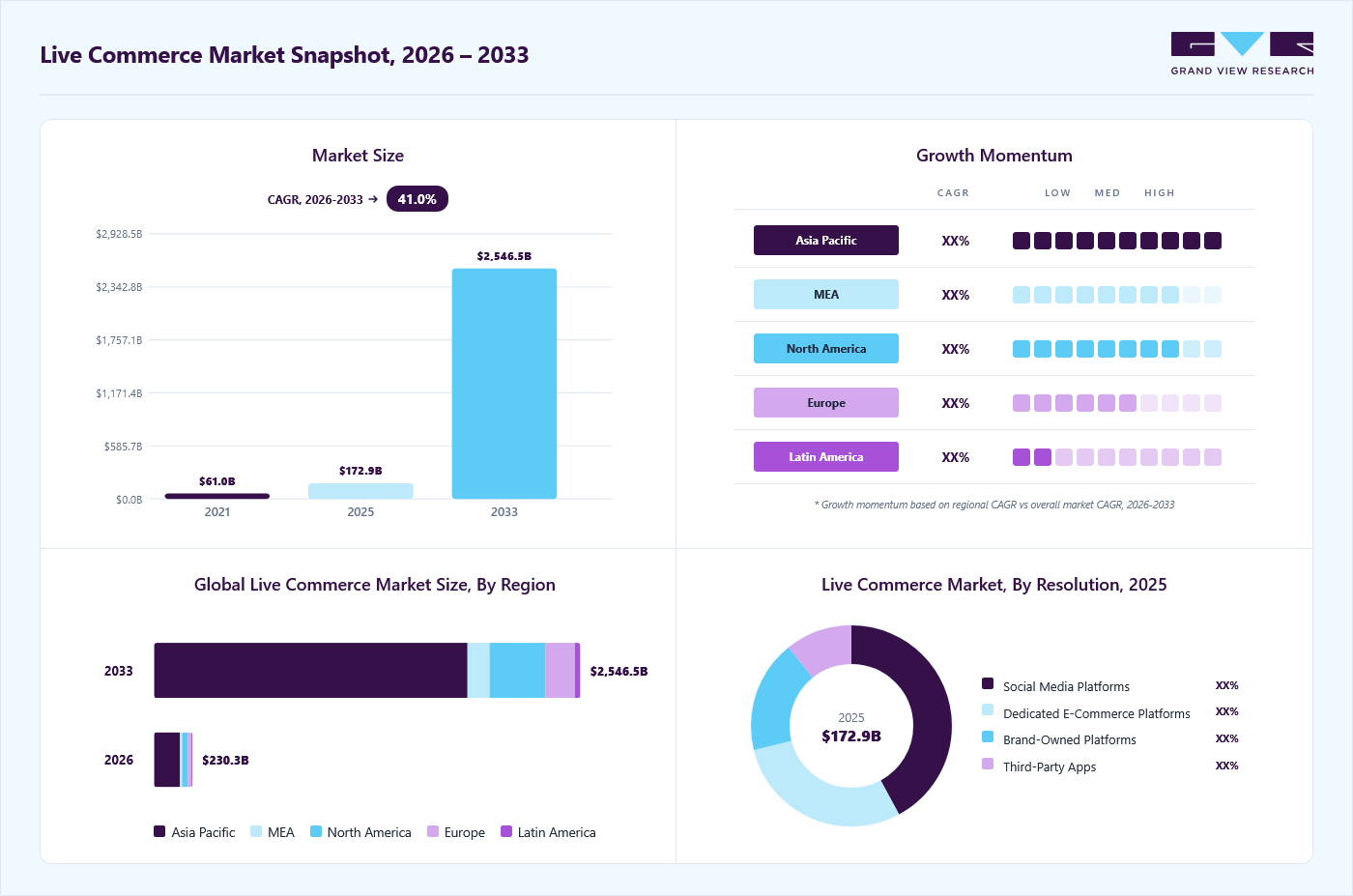 Source: Grand View Research, IR Documents, Primary Interviews, Paid DatabasesTo learn more about this report,
 Download Free Sample Report
 Key Market Trends & Insights
- By product: Fashion and apparel led the market and accounted for a share of 28.1% in 2025
- By platform type: Social media platforms segment dominated the market, with a revenue share of 48.9% in 2025
Regional Highlights
- Largest regional market: Asia Pacific (66.8% revenue share, 2025)
- Fastest-growing regional market: Middle East & Africa (highest CAGR, 2026-2033)
- By country: China held the largest market share in 2025.
Market Size & Forecast
- Market size in 2025: USD 172.9 Billion
- Estimated market size in 2026: USD 230.3 Billion
- Projected market size by 2033: USD 2,546.5 Billion
- CAGR (2026-2033): 41.0%
Three ways to get this report
Buy it, customize it, or ask a question.Ask an Analyst
Analyst response in 1 business day
- AccessReport author, directly
- Reply timeWithin 1 working day
- No sales callDirect answer only
- FormatEmail reply
- CostFree, no cost
Get the Full Report
What the study covers
- FormatsPDF · Excel · Dashboard
- Timeline2026–2033 annual, 2025 base
- Coverage20+ countries, 5 regions
- Companies10+ key players profiled
Customize the Report
20% free customization
- IncludeCountries, segments, points
- TailorTo your product definition
- ExtendDeeper competitor detail
- OrA fully bespoke study
- Turnaround5–10 working days
Due to the increasing demand for interactive and immersive shopping experiences, the proliferation of social media platforms, and mobile penetration. Live commerce integrates live streaming with instant purchasing, allowing consumers to engage with hosts or influencers in real-time, ask questions, and make informed decisions. The real-time engagement boosts customer trust and purchasing confidence, resulting in higher conversion rates. Platforms such as TikTok, Instagram, YouTube, and Facebook have integrated live shopping features, enabling brands to reach vast audiences quickly and cost-effectively. In parallel, the rise in smartphone usage and faster internet connectivity, especially 5G, has enhanced streaming quality and accessibility, making live shopping viable even in tier-2 and tier-3 cities across Asia, Latin America, and Africa. Influencer and celebrity-driven marketing is also playing a significant role. Brands are increasingly collaborating with influencers to promote products during live shopping sessions, leveraging their follower base to drive sales. These influencers bring authenticity and relatability, which is particularly appealing to Gen Z and Millennial consumers.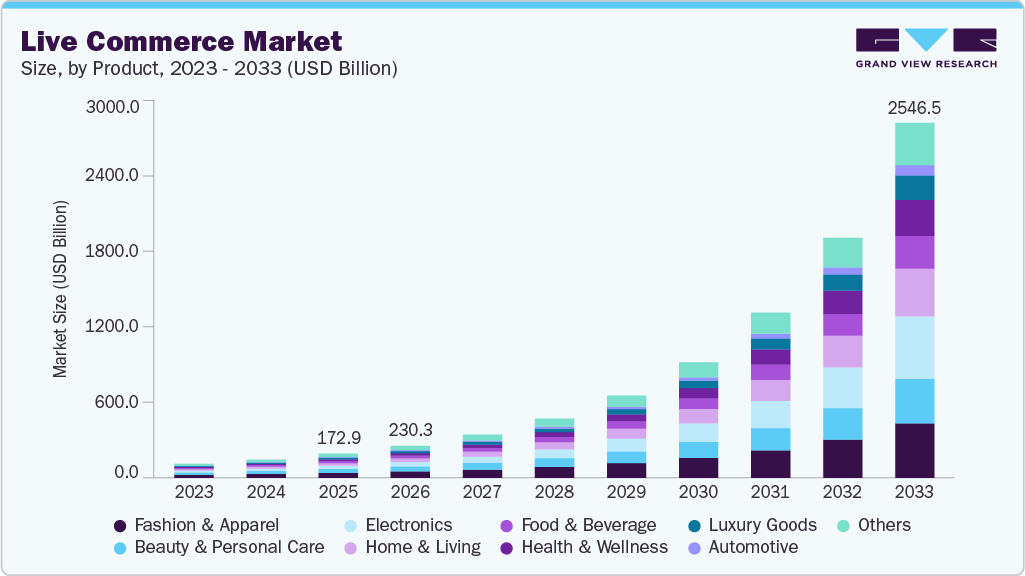 To learn more about this report, Download Free Sample Report
 In addition, technological innovations such as AI, AR, and data analytics are transforming the live commerce industry. AI-powered recommendation engines personalize product suggestions in real-time, while AR allows consumers to virtually try products before purchasing. Real-time analytics enable sellers to adjust their strategies instantly during live shopping sessions, maximizing engagement and sales. For instance, in June 2025, AnyMind Group, a Japanese BPaaS (Business Process as a Service) provider specializing in marketing, digital transformation, and e-commerce, launched its generative AI-powered live commerce platform, AnyLive, in Japan. The platform introduces advanced features such as AI-generated avatars, automated content scripting, and real-time AI engagement with viewers, aiming to enhance interactive shopping experiences and streamline live commerce operations in the region.
Market Dynamics
The global live commerce market is witnessing rapid growth as brands, retailers, influencers, and digital platforms increasingly leverage interactive live-streaming experiences to engage consumers and drive real-time purchasing decisions. Live commerce combines entertainment, social interaction, and e-commerce by enabling hosts to demonstrate products, answer customer questions instantly, offer exclusive promotions, and facilitate seamless in-stream purchases. Modern live commerce platforms integrate AI-powered product recommendations, personalized content, real-time analytics, secure payment gateways, augmented reality (AR) product visualization, and omnichannel commerce capabilities to enhance customer engagement and conversion rates. The growing adoption of social commerce, mobile shopping, creator-led marketing, digital payment ecosystems, and omnichannel retail strategies is accelerating demand for live commerce solutions that deliver immersive shopping experiences, strengthen customer relationships, and improve sales performance across diverse retail categories.
The rapid growth of social commerce, influencer-driven marketing, and mobile-first consumer behavior is a major driver of the global live commerce market. Retailers, consumer brands, beauty companies, fashion labels, electronics vendors, and lifestyle businesses are increasingly using live-stream shopping events to showcase products, interact directly with consumers, and encourage instant purchasing decisions. Platforms incorporate AI-driven personalization, interactive features, integrated digital payments, and data analytics to optimize customer experiences and maximize campaign performance. For instance, in May 2026, TikTok announced new AI-powered commerce and advertising innovations, including Creator AI Search, AI-driven product discovery capabilities, and enhanced creator collaboration tools to strengthen discovery-led commerce and improve shopping experiences across TikTok Shop.
The need for continuous, high-quality content creation and sustained audience engagement remains a significant restraint for the global live commerce market. Successful live commerce campaigns require skilled hosts, influencer partnerships, professional production capabilities, effective product demonstrations, and well-planned promotional strategies, increasing operational costs for retailers and brands. Additionally, maintaining consistent viewer engagement, managing real-time customer interactions, ensuring reliable streaming quality, and measuring return on investment can be challenging, particularly for small and medium-sized businesses with limited digital marketing resources. Intense competition across social media and e-commerce platforms further makes it difficult for merchants to attract and retain audiences during live shopping events.
The increasing adoption of artificial intelligence, cross-border e-commerce, and omnichannel retail strategies presents a significant growth opportunity for the global live commerce market. Businesses are investing in AI-enabled live commerce platforms capable of delivering personalized product recommendations, automated customer engagement, multilingual live streaming, predictive analytics, and intelligent inventory management. The growing popularity of international online shopping, creator-led commerce, virtual product demonstrations, and integrated social shopping experiences is driving demand for scalable live commerce solutions across fashion, beauty, consumer electronics, home décor, food, and luxury goods. Moreover, advancements in augmented reality, virtual reality, conversational AI, digital payment technologies, and seamless integration between social media platforms and e-commerce ecosystems are enabling vendors to deliver immersive, personalized, and highly interactive shopping experiences that support long-term digital retail transformation.
Analyst Perspective
The live commerce market sits at the intersection of rapidly expanding social commerce, increasing digital consumer engagement, and the growing adoption of creator-driven retail experiences. Brands, retailers, marketplaces, and content creators are increasingly leveraging live commerce to showcase products, interact with consumers in real time, and drive immediate purchasing decisions across fashion, beauty, electronics, home goods, and other consumer categories. Traditional e-commerce experiences often lack the interactivity and personalization of in-store shopping, driving the adoption of live commerce platforms featuring AI-powered product recommendations, real-time customer engagement, seamless in-stream checkout, influencer collaborations, interactive chat, augmented reality (AR) product demonstrations, and integrated digital payment capabilities to deliver immersive, personalized, and high-conversion shopping experiences across omnichannel retail ecosystems.
Product Insights
Based on product, the fashion and apparel segment led the market with the largest revenue share of 28.1% in 2025, driven by the fast-changing trends and seasonality in fashion, which align well with the agility of live e-commerce. Brands can quickly launch new collections, conduct flash sales, or clear out seasonal inventory during engaging livestreams. This format helps shorten the product lifecycle and encourages impulse buying, particularly effective in fashion, where consumer preferences shift rapidly.
The health and wellness segment is anticipated to grow at the highest CAGR during the forecast period due to the consumers’ rising interest in holistic self-care and preventive healthcare. As more people become proactive about managing their physical and mental well-being, there is a growing appetite for nutritional supplements, organic products, fitness tools, and personal care items. Live e-commerce offers a platform for brands to educate consumers in real time about product benefits, usage methods, and health outcomes, bridging the knowledge gap that often exists in this segment.
Platform Type Insights
Based on platform type, the social media platforms segment led the market with the largest revenue share of 48.9% in 2025, driven by the seamless integration of content, community, and commerce within a single ecosystem. Platforms like Instagram, TikTok, Facebook, and YouTube have evolved beyond traditional social networking to become powerful shopping environments. Moreover, the massive built-in user base and high engagement levels that social platforms offer also contribute to the growth of the segment. With billions of daily active users, these platforms allow brands to reach highly targeted audiences based on interests, demographics, or browsing behavior.
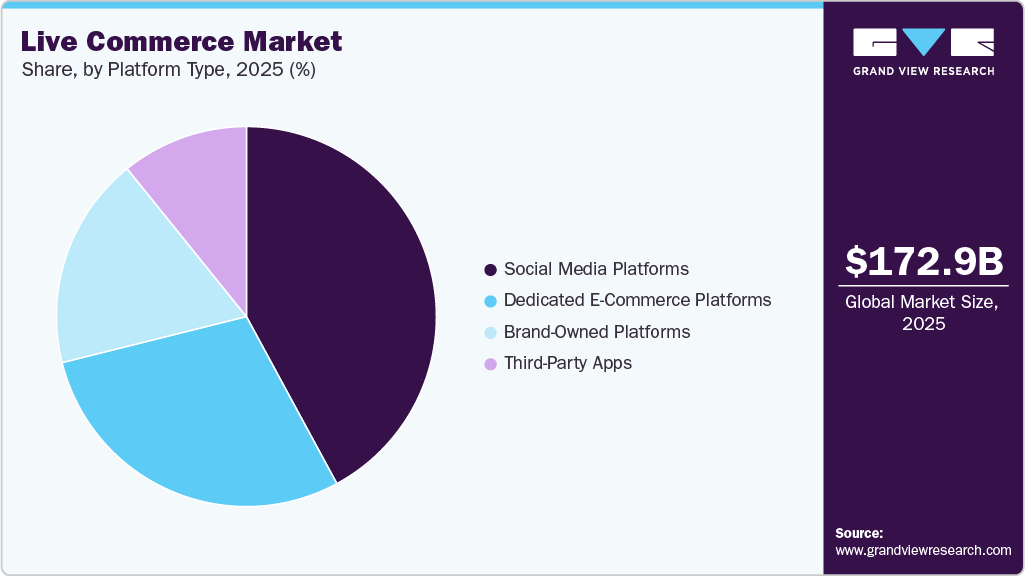 To learn more about this report, Download Free Sample Report
 The brand-owned platforms segment is expected to grow at a significant CAGR over the forecast period due to brands’ increasing desire for greater control over the customer experience, data, and monetization strategies. By hosting live commerce directly on their own websites or mobile apps, brands can fully customize the visual identity, user interface, and interactive elements to align with their brand values and storytelling. This enhances customer trust and reinforces brand loyalty, especially among repeat buyers who prefer a consistent and curated shopping environment. Moreover, brand-owned platforms support seamless backend integration with inventory, logistics, and CRM systems, creating a more efficient and responsive supply chain.
Regional Insights
North America live commerce held a significant share in the global market in 2025, driven by the region's advanced digital infrastructure and a strong culture of early technology adoption. High internet penetration, widespread use of mobile devices, and a mature e-commerce landscape provide the foundation for rapid integration of live shopping experiences. In addition, increasing collaboration between tech companies and retailers to develop interactive shopping technologies, along with growing demand for personalized and immersive online experiences, is fueling market expansion across sectors like beauty, electronics, and fashion.
U.S. Live Commerce Market Trends
The live commerce market in the U.S. held the largest share in the North America region in 2025, due to the rising influence of creator-driven marketing and the integration of livestreaming into popular social platforms like TikTok and Instagram. The country’s diverse and trend-sensitive consumer base, particularly Gen Z and Millennials, is increasingly engaging with interactive product demos and influencer-led events. Furthermore, major retailers and D2C brands are experimenting with live commerce to reduce return rates and boost customer loyalty through more informed and engaging purchase experiences.
Europe Live Commerce Market Trends
The live commerce market in Europe is anticipated to register considerable growth from 2026 to 2033 due to the region’s emphasis on omnichannel retail strategies and the growing consumer demand for transparency and real-time engagement. Retailers are adopting live commerce to showcase sustainable practices, ethical sourcing, and product authenticity, appealing to Europe’s eco-conscious and quality-focused shoppers. In addition, increasing regulatory support for secure digital transactions and cross-border e-commerce is encouraging adoption across both domestic and international brands.
The UK live commerce market is expected to grow rapidly in the coming years, owing to the expansion as retailers look for innovative ways to bridge the gap between online convenience and in-store engagement. British consumers are drawn to livestreams that feature expert product demonstrations, interactions, and exclusive time-limited offers. The popularity of online shopping events, along with strong mobile commerce adoption and high social media usage, is prompting heritage brands and digital startups to invest in livestream shopping formats.
The live commerce market in Germany held a substantial market share in 2025 due to the country's strong emphasis on product reliability and detailed information. German consumers, known for their research-oriented buying behavior, are responding positively to the educational value and product transparency offered through live sessions. Live commerce platforms that integrate interactive comparisons, technical explanations, and real-time customer feedback are gaining traction, especially in sectors like consumer electronics, home appliances, and health-related products.
Asia Pacific Live Commerce Market Trends
Asia Pacific dominated the global live commerce market with the largest revenue share of 66.8% in 2025, due to the region’s mobile-first population, high social media engagement, and widespread use of super apps that combine shopping, payments, and streaming. Countries like South Korea, Thailand, and Indonesia are seeing explosive growth as consumers embrace live selling formats that blend entertainment and commerce. The region’s young, digital-native population, combined with increasing investments from both domestic tech firms and global brands, is accelerating live commerce adoption across diverse product categories.
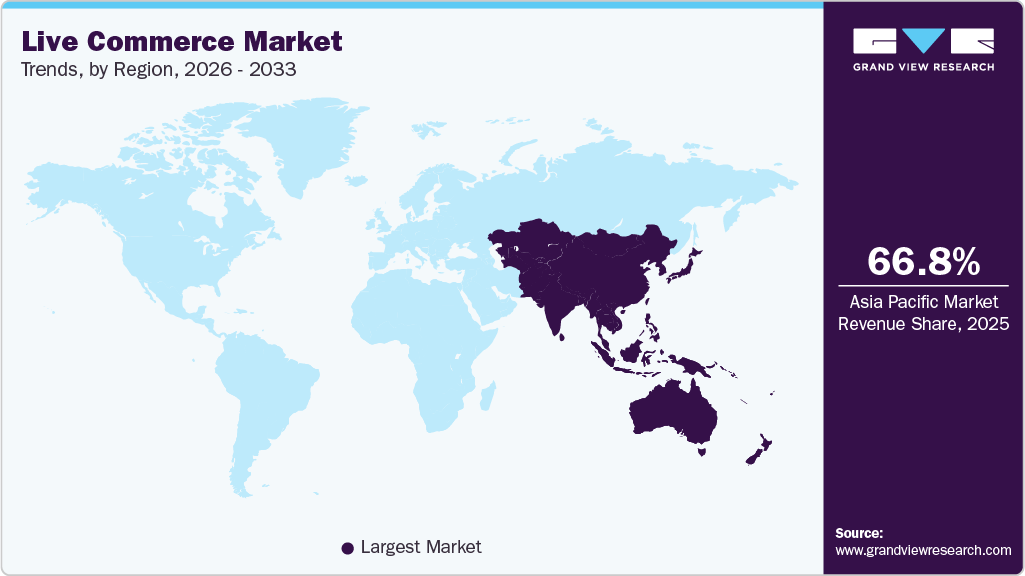 To learn more about this report, Download Free Sample Report
 Japan live commerce market is expected to grow rapidly in the coming years, driven by the convergence of high-tech consumer behavior and a strong cultural affinity for storytelling and detail. Japanese consumers value rich, informative content and are drawn to live sessions that emphasize quality, craftsmanship, and aesthetic appeal. Growth is also supported by the integration of AI translation tools for regional influencers and an increase in local brands using livestreaming to differentiate themselves from large e-commerce marketplaces.
The live commerce market in China held a substantial market share in 2025, due to the deep integration of e-commerce and livestreaming on platforms such as Taobao Live, Douyin, and Kuaishou. The Chinese market benefits from a highly developed digital payment infrastructure, sophisticated supply chains, and a consumer base highly responsive to influencer and KOL (Key Opinion Leader) marketing. Government support for digital innovation and the popularity of shoppertainment formats have made live commerce a mainstream retail channel across urban and rural areas alike.
Key Live Commerce Company Insights
Key players operating in the live commerce industry are Amazon.com, Inc., Facebook (Meta Platforms), Taobao.com, Kuaishou Technology, NTWRK, and JD.com. The companies are focusing on various strategic initiatives, including new product development, partnerships & collaborations, and agreements to gain a competitive advantage over their rivals. The following are some instances of such initiatives.
-
In April 2025, QVC Group unveiled a new partnership with TikTok to deliver round-the-clock live shopping content on the social media platform, marking a significant expansion of its digital retail strategy. Under the agreement, TikTok users will be able to access continuous live-streamed shopping experiences showcasing QVC’s portfolio of brands, products, and on-air personalities directly within the app. The collaboration leverages QVC’s established expertise in live video production and interactive retail while aligning with TikTok’s growing role in social commerce. The move is aimed at reaching younger, mobile-first consumers and blending entertainment with real-time shopping in a seamless, always-on format.
-
In January 2025, Kuaishou Technology announced the global rollout of Kling AI’s new multi-image reference feature, a significant advancement in AI video generation. This innovation tackles the long-standing challenge of maintaining visual consistency by allowing the AI to analyze and merge elements from multiple reference images. Combined with user-provided text prompts, the technology enables the creation of cohesive, high-quality videos, offering content creators enhanced control and creative flexibility.
Key Live Commerce Companies:
The following key companies have been profiled for this study on the live commerce market.
-
Amazon.com, Inc.
-
Bilibili
-
Facebook (Meta Platforms)
-
Heliophilia Pte. Ltd. (Lemon8)
-
JD.com
-
Kuaishou Technology
-
NTWRK
-
Pinterest TV
-
Popshop Live
-
QVC, Inc.
-
Shopify (Shopify Live)
-
Taobao.com
-
TikTok (ByteDance)
-
YouTube (Google)
Competitive Benchmarking
Category
Operating Strategies
Competitive Edge
Weakness
Established Players (Amazon.com, Inc., Meta Platforms (Facebook), Google (YouTube), JD.com, Kuaishou Technology, QVC, Inc., Shopify (Shopify Live), Taobao.com (Alibaba Group), TikTok (ByteDance), and Bilibili)
- Expand live commerce ecosystems with AI-powered product recommendations, creator monetization tools, integrated payment solutions, livestream shopping capabilities, and omnichannel commerce experiences.
- Strengthen partnerships with brands, influencers, merchants, logistics providers, and payment companies while investing in generative AI, personalized shopping, augmented reality (AR), and cross-border commerce to enhance customer engagement and transaction volumes.
- Extensive global user bases, mature digital ecosystems, advanced AI capabilities, and strong brand recognition enable large-scale live commerce adoption.
- Comprehensive offerings spanning social media, e-commerce, payments, advertising, logistics, creator ecosystems, and analytics provide significant competitive differentiation and high merchant retention.
- High technology investment, content moderation, infrastructure, and regulatory compliance costs increase operational complexity.
- Dependence on creator engagement, evolving consumer preferences, and increasing regulatory scrutiny around data privacy, competition, and digital commerce can impact long-term platform growth.
Emerging Players (Pinterest TV, Heliophilia Pte. Ltd. (Lemon8), and NTWRK)
- Focus on niche live shopping experiences, creator-driven communities, curated product discovery, lifestyle content, and category-specific commerce.
- Differentiate through innovative content formats, personalized recommendations, exclusive brand collaborations, mobile-first user experiences, and flexible merchant onboarding to attract specialized consumer segments.
- Faster innovation cycles, targeted audience engagement, strong community interaction, and specialized commerce experiences enable differentiation within fashion, collectibles, lifestyle, and creator-led retail markets.
- Agile platform development and close collaboration with merchants support rapid feature enhancements.
- Limited global user reach, smaller merchant ecosystems, and lower brand recognition reduce competitiveness against major social commerce platforms.
- Lower financial resources, fewer strategic partnerships, and limited international expansion capabilities may restrict scaling, customer acquisition, and long-term market penetration.
Live Commerce Market Report Scope
Report Attribute
Details
Market size in 2025
USD 172.9 billion
Estimated market size in 2026
USD 230.3 billion
Projected market size by 2033
USD 2,546.5 billion
Growth rate
CAGR of 41.0% from 2026 to 2033
Base year for estimation
2025
Historical data
2021 - 2024
Forecast period
2026 - 2033
Quantitative units
Revenue in USD million/billion and CAGR from 2026 to 2033
Report coverage
Revenue forecast, company market share analysis, competitive landscape, growth factors, and trends
Segments covered
Product, platform type, and region
Regional scope
North America; Europe; Asia Pacific; Latin America; MEA
Country scope
U.S.; Canada; Mexico; Germany; UK; France; China; Japan; India; South Korea; Australia; Brazil; Saudi Arabia; South Africa; UAE
Key companies profiled
Amazon.com, Inc.; Bilibili; Facebook (Meta Platforms); Heliophilia Pte. Ltd. (Lemon8); JD.com; Kuaishou Technology; NTWRK; Pinterest TV; Popshop Live; QVC, Inc.; Shopify (Shopify Live); Taobao.com; TikTok (ByteDance); YouTube (Google)
Customization scope
Free report customization (equivalent up to 8 analysts' working days) with purchase. Addition or alteration to country, regional & segment scope.
Pricing and purchase options
Avail customized purchase options to meet your exact research needs. Explore purchase options
Global Live Commerce Market Report Segmentation
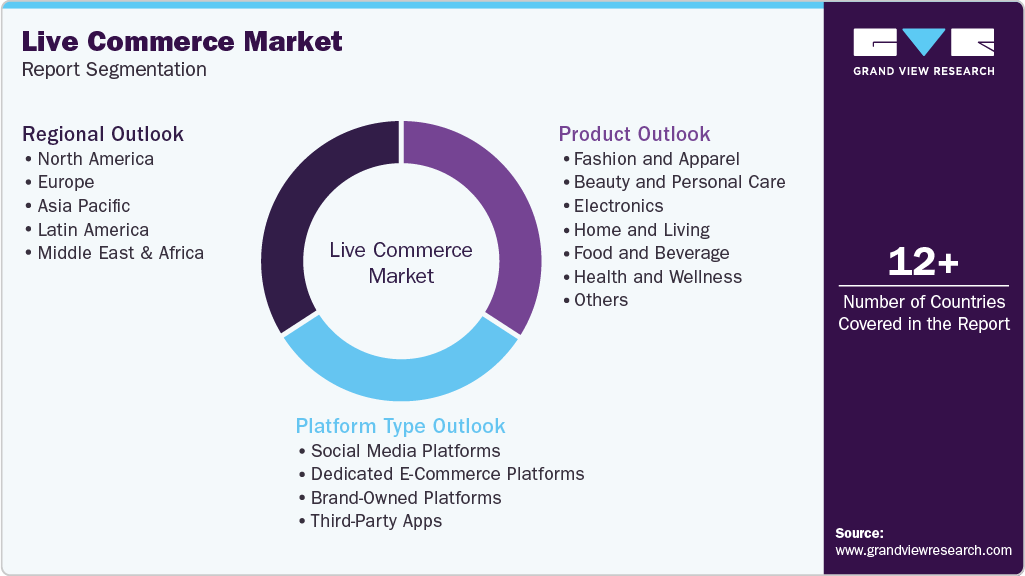
This report forecasts revenue growth at the global, regional, and country levels and provides an analysis of the latest industry trends in each of the sub-segments from 2021 to 2033. For this study, Grand View Research has segmented the global live commerce market report based on product, platform type, and region:
 To learn more about this report, Download Free Sample Report
 -
Product Outlook (Revenue, USD Billion, 2021 - 2033)
-
Fashion and Apparel
-
Beauty and Personal Care
-
Electronics
-
Home and Living
-
Food and Beverage
-
Health and Wellness
-
Automotive
-
Luxury Goods
-
Others
-
-
Platform Type Outlook (Revenue, USD Billion, 2021 - 2033)
-
Social Media Platforms
-
Dedicated E-Commerce Platforms
-
Brand-Owned Platforms
-
Third-Party Apps
-
-
Regional Outlook (Revenue, USD Billion, 2021 - 2033)
-
North America
-
U.S.
-
Canada
-
Mexico
-
-
Europe
-
UK
-
Germany
-
France
-
-
Asia Pacific
-
China
-
India
-
Japan
-
South Korea
-
Australia
-
-
Latin America
-
Brazil
-
-
Middle East & Africa
-
UAE
-
Saudi Arabia
-
South Africa
-
-
Research Methodology
The live commerce market figures in this report are based on a proven research process that combines executive interviews with secondary research from proprietary databases, company filings, and recognized regulatory and institutional sources. Market size is built through value-chain sizing - reconciling supply-side and demand-side estimates - and triangulated with bottom-up and top-down approaches. Every estimate passes multiple levels of expert validation before publication, with each live commerce segment quantified using the revenue-capture definitions in the table below.
Segment Definition
Segment - Product
Revenue capture definition
Fashion and Apparel
Revenue is generated from live-stream sales of clothing, footwear, accessories, and fashion products through interactive commerce platforms. Revenue includes purchases completed during live shopping events hosted by brands, retailers, influencers, or marketplaces.
Beauty and Personal Care
Revenue is generated from live commerce sales of skincare, cosmetics, haircare, fragrances, grooming products, and beauty accessories promoted through live demonstrations, tutorials, and influencer-led shopping sessions.
Electronics
Revenue is generated from live-stream sales of consumer electronics, smartphones, laptops, wearable devices, home appliances, gaming products, and electronic accessories purchased through live commerce platforms.
Home and Living
Revenue is generated from live commerce transactions involving furniture, home décor, kitchenware, home improvement products, bedding, lighting, and household essentials showcased during live shopping events.
Food and Beverage
Revenue is generated from live-stream sales of packaged food, beverages, snacks, gourmet products, meal kits, and specialty food items promoted through interactive product demonstrations and tasting sessions.
Health and Wellness
Revenue is generated from live commerce sales of nutritional supplements, fitness equipment, wellness products, personal healthcare devices, and health-related consumer goods sold through live shopping events.
Automotive
Revenue is generated from live commerce sales of automotive accessories, vehicle care products, replacement parts, electric mobility products, and related consumer automotive products showcased during live broadcasts.
Luxury Goods
Revenue is generated from live-stream sales of luxury fashion, watches, jewelry, handbags, designer accessories, premium cosmetics, and other high-end consumer goods offered through exclusive live commerce events.
Others
Revenue is generated from live commerce sales of books, toys, pet care products, office supplies, sports equipment, consumer services, and other product categories not included in the above segments.
Segment - Platform Type
Revenue capture definition
Social Media Platforms
Revenue is generated through live commerce transactions conducted on social media platforms that integrate live streaming, audience engagement, product discovery, and in-app purchasing capabilities. Revenue includes commissions, transaction fees, and merchandise sales facilitated through social commerce ecosystems.
Dedicated E-commerce Platforms
Revenue is generated from live shopping features integrated within online marketplaces and e-commerce platforms, enabling merchants to conduct live product demonstrations, interact with customers, and complete purchases directly through the platform.
Brand-owned Platforms
Revenue is generated through live commerce experiences hosted on a company's own website or mobile application, where brands conduct live product launches, demonstrations, and promotional events while retaining full control over customer engagement and sales.
Third-party Apps
Revenue is generated from live commerce transactions facilitated by specialized live-stream shopping applications, SaaS platforms, and third-party commerce solutions that provide live video, audience interaction, payment integration, and order management services for merchants and creators.
Estimation Model
Layer
Question
Analysis
Digital Commerce Demand Layer
Who can benefit from live commerce?
Identify businesses that can leverage interactive live shopping to increase customer engagement and online sales. These include fashion and apparel brands, beauty and personal care companies, consumer electronics manufacturers, home and living retailers, food and beverage brands, health and wellness companies, luxury brands, automotive accessory providers, SMEs, D2C brands, and online marketplaces. Businesses seeking higher customer interaction, real-time product demonstrations, influencer-led marketing, and improved conversion rates represent the core demand base for live commerce solutions.
Platform & Digital Readiness Layer
Who can deploy live commerce solutions?
Evaluate organizations based on their e-commerce maturity, digital marketing capabilities, social media presence, payment infrastructure, logistics network, and omnichannel retail strategy. Enterprises with established online stores, mobile commerce platforms, CRM systems, influencer partnerships, digital payment integration, AI-powered recommendation engines, and customer engagement tools possess the operational readiness to implement live commerce platforms effectively.
Adoption & Utilization Layer
Who actively uses live commerce?
Analyze the deployment of live commerce across social media platforms, online marketplaces, brand-owned websites, mobile commerce applications, and third-party live shopping platforms. Active users include retailers, consumer brands, influencers, content creators, e-commerce marketplaces, SMEs, D2C brands, and multinational enterprises that conduct live product launches, promotional campaigns, interactive demonstrations, flash sales, and customer engagement events to drive online purchases and brand loyalty.
Monetization Layer
How much revenue is generated?
Assess revenue generated through live commerce transactions, platform subscription fees, transaction commissions, advertising revenue, influencer marketing services, livestream hosting solutions, SaaS platform licensing, AI-powered personalization tools, analytics services, payment processing, digital marketing solutions, content production services, customer engagement software, logistics integration, order management, technical support, managed services, and value-added commerce solutions supporting live shopping ecosystems.
Delivered Customizations
This report has been delivered with the following In-depth customizations
CLIENT REQUEST
CUSTOMIZATION DELIVERED
VALUE ADDS
AI-Powered Personalization & Live Shopping Trends
Conducted a structured analysis of AI-enabled live commerce technologies focused on personalized product recommendations, conversational AI, intelligent product discovery, automated customer engagement, livestream analytics, and generative AI tools supporting interactive shopping experiences.
Helps stakeholders understand evolving AI-driven live commerce capabilities, identify high-growth technology trends, and evaluate commercialization opportunities through personalized customer engagement and higher conversion rates.
Social Commerce & Creator Economy Trends
Conducted a comprehensive analysis of live commerce adoption across social media platforms, influencer marketing ecosystems, creator monetization models, livestream shopping campaigns, digital community engagement, and creator-led retail strategies.
Helps stakeholders identify growth opportunities in the creator economy, assess consumer engagement trends, and evaluate investment strategies aligned with the expanding social commerce ecosystem.
Omnichannel Retail & Cross-border Live Commerce Trends
Conducted a comprehensive analysis of live commerce integration with omnichannel retail, e-commerce marketplaces, digital payment platforms, cross-border commerce, logistics networks, mobile shopping, and customer experience technologies.
Helps stakeholders understand the evolution of omnichannel live shopping, evaluate cross-border expansion opportunities, and assess investments supporting seamless digital retail experiences and global commerce growth.
Frequently Asked Questions About This Report
The global live commerce market size was estimated at USD 172.9 billion in 2025 and is expected to reach USD 230.3 billion in 2026.
The global live commerce market is expected to grow at a compound annual growth rate of 41.0% from 2026 to 2033 to reach USD 2,546.5 billion by 2033.
Key factors include the rapid growth of social commerce, influencer-driven marketing, and mobile-first consumer behavior.
Asia Pacific dominated with 66.8% revenue share in 2025.
The health and wellness segment is the fastest-growing segment in the market.
Key players operating in the live commerce market include Amazon.com, Inc.; Bilibili; Facebook (Meta Platforms); Heliophilia Pte. Ltd. (Lemon8); JD.com; Kuaishou Technology; NTWRK; Pinterest TV; Popshop Live; QVC, Inc.; Shopify (Shopify Live); Taobao.com; TikTok (ByteDance); YouTube (Google)
The Middle East & Africa is the fastest-growing region over the forecast period.
The fashion and apparel segment led with a 28.1% revenue share in 2025.
The social media platforms segment led with a 48.9% revenue share in 2025, while the brand-owned platforms segment is the fastest-growing segment.
About the Author(s)
IT Services & Applications Research Team
Technology · IT Services & ApplicationsThis report was authored by the it services & applications research team at Grand View Research - comprising two research analysts, one senior research analyst, and one industry expert - with specialized expertise in the it services & applications segment of the technology industry. All findings are based on proprietary technology databases, executive interviews, and regulatory analysis, subject to internal peer review prior to publication.
Last Updated:
Speak to Analyst

Customize this report to your needs - add regions, segments, or data points, with 20% free customization.
Or view our licence options:


ISO 9001:2015 & 27001:2022 Certified
We are GDPR and CCPA compliant! Your transaction & personal information is safe and secure. For more details, please read our privacy policy.


