
- Home
- »
- Clinical Diagnostics
- »
-
Longevity Diagnostics Market Size, Share Report, 2026-2033GVR Report cover

Longevity Diagnostics Market (2026 - 2033)
Size, Share & Trends Analysis Report By Test Type (Epigenetic Age Testing, Telomere Length Analysis, Multi-Omics Profiling), By Technology (NGS, Mass Spectrometry), By End Use, By Region, And Segment Forecasts
Market Size, 2025
$2.8BMarket Estimate, 2026
$2.9BMarket Forecast, 2033
$4.5BCAGR, 2026–2033
6.4%Longevity Diagnostics Market Summary
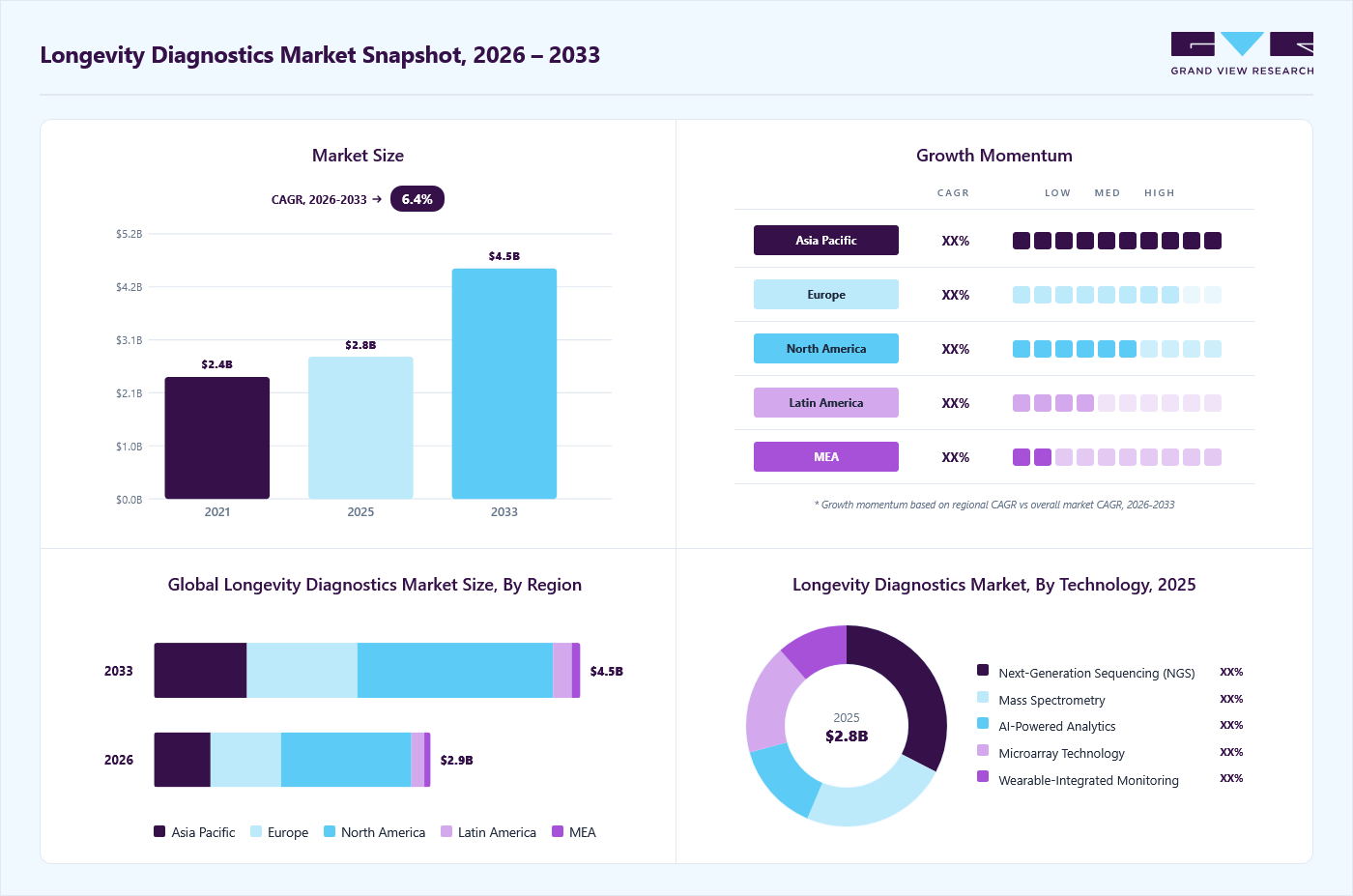
The global longevity diagnostics market size was valued at USD 2.8 billion in 2025 and is projected to grow from USD 2.9 billion in 2026 to USD 4.5 billion by 2033, at a CAGR of 6.4% from 2026 to 2033. The market in North America dominated with a revenue share of 47.3% in 2025. An aging population, the rising prevalence of chronic diseases, and the growing demand for preventive and personalized healthcare drive market growth.
 Source: Grand View Research, IR Documents, Primary Interviews, Paid DatabasesTo learn more about this report,
 Download Free Sample Report
 Key Market Trends & Insights
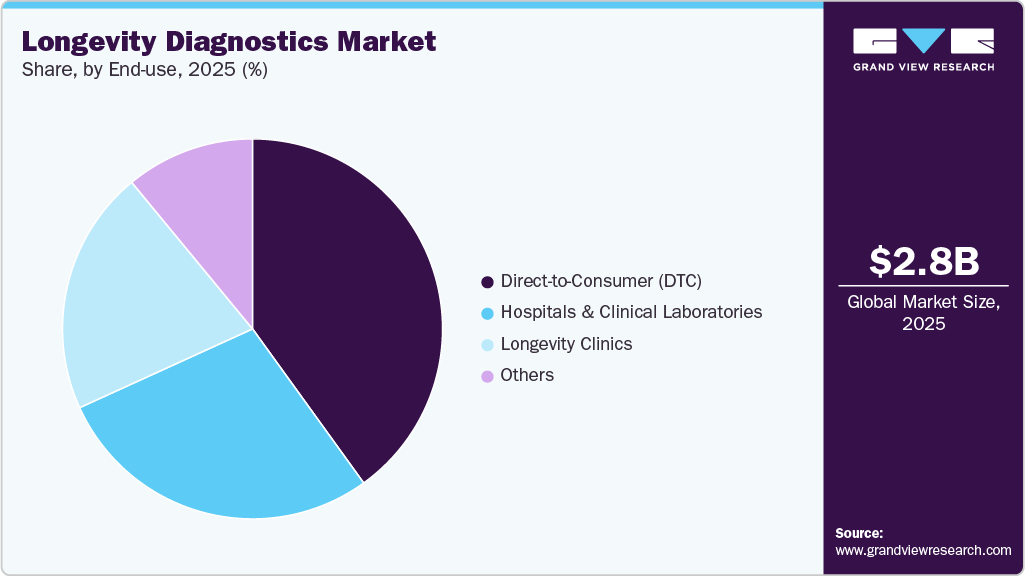
- By end use: Direct-to-consumer (DTC) segment held the largest market share of 40.0% in 2025.
- By technology: Next-generation sequencing (NGS) segment held the largest market share of 32.5% in 2025.
- By test type: Epigenetic age testing segment held the largest market share of 25.5% in 2025.
Regional Highlights
- Largest regional market: North America (47.3% revenue share, 2025)
- Fastest-growing regional market: Asia Pacific (highest CAGR, 2026-2033)
- By country: The U.S. held the largest market share in 2025
Market Size & Forecast
- Market size in 2025: USD 2.8 Billion
- Estimated market size in 2026: USD 2.9 Billion
- Projected market size by 2033: USD 4.5 Billion
- CAGR (2026-2033): 6.4%
Three ways to get this report
Buy it, customize it, or ask a question.Ask an Analyst
Analyst response in 1 business day
- AccessReport author, directly
- Reply timeWithin 1 working day
- No sales callDirect answer only
- FormatEmail reply
- CostFree, no cost
Get the Full Report
What the study covers
- FormatsPDF · Excel · Dashboard
- Timeline2026–2033 annual, 2025 base
- Coverage20+ countries, 5 regions
- Companies10+ key players profiled
Customize the Report
20% free customization
- IncludeCountries, segments, points
- TailorTo your product definition
- ExtendDeeper competitor detail
- OrA fully bespoke study
- Turnaround5–10 working days
Growth in epigenetic clock technologies, increasing investment in longevity medicine, and expansion of AI-enabled biomarker analytics are further supporting market expansion. The longevity diagnostics market is driven by the increasing aging population and rising burden of chronic diseases, which are accelerating demand for early disease detection, biological age assessment, and preventive health monitoring technologies. According to the World Health Organization (WHO) report published in October 2025, by 2030, one in six people globally will be aged 60 years or older, and the global population aged 60 years or older is projected to reach 2.1 billion by 2050.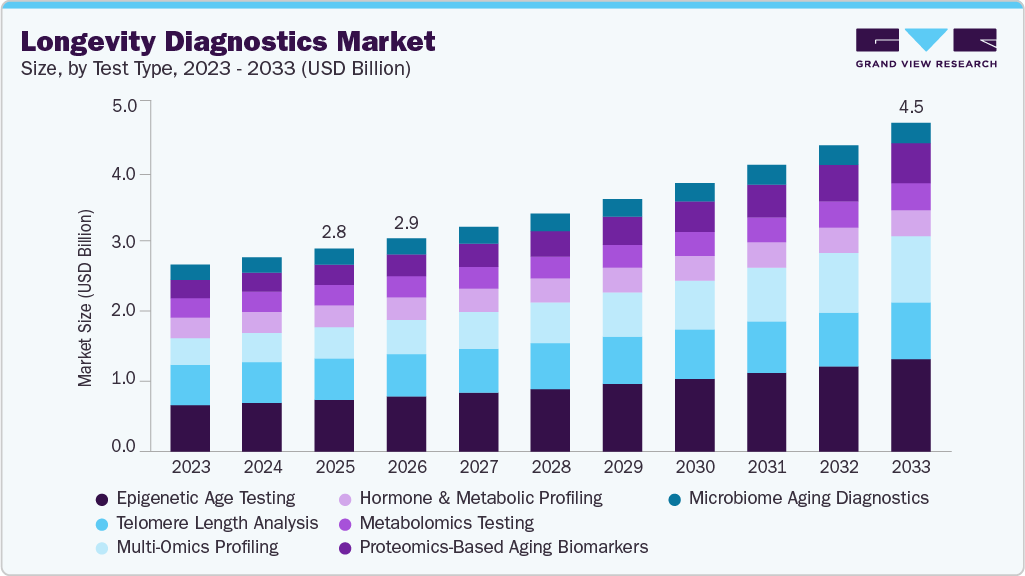 To learn more about this report, Download Free Sample Report
 Aging populations are increasingly susceptible to cardiovascular diseases, cancer, diabetes, and neurodegenerative disorders, supporting demand for longevity diagnostics solutions. According to U.S. Centers for Disease Control and Prevention (CDC) data updated in April 2026, nearly three in four American adults have at least one chronic condition, while over 90% of adults aged 65 years and older have at least one chronic disease. Furthermore, according to the OECD Health at a Glance report published in February 2025, 82% of primary care users live with at least one chronic condition, 52% live with two or more chronic conditions, and 27% suffer from three or more chronic diseases, increasing demand for AI-enabled biomarker analytics and epigenetic longevity diagnostics.
The longevity diagnostics market is experiencing significant growth driven by rising demand for preventive and personalized healthcare focused on early identification of aging-related health risks and on individualized intervention strategies. Consumers and healthcare providers are increasingly adopting biological age testing, epigenetic clocks, multi-omics profiling, and AI-enabled biomarker analytics to assess physiological aging, disease susceptibility, and age-related disease risk before clinical symptoms develop. Personalized longevity programs integrating genomics, metabolomics, and lifestyle analytics are gaining traction across preventive healthcare settings and specialized longevity clinics, supporting broader adoption of precision longevity diagnostics solutions.
The longevity diagnostics market is experiencing strong growth driven by advancements in epigenetic clock technologies and increasing investment in longevity medicine. Epigenetic clocks utilize DNA methylation patterns to estimate biological age, enabling early assessment of physiological aging, disease susceptibility, and response to preventive interventions. These technologies are increasingly integrated into precision medicine and preventive healthcare programs, supporting demand for longevity diagnostics solutions. Rising investments are accelerating the commercialization of biomarker-based longevity platforms, AI-enabled aging analytics, and multi-omics diagnostics. In March 2025, L’Oreal announced a strategic research partnership with TruDiagnostic to advance epigenetic biomarker research and biological age assessment technologies, supporting the development of personalized longevity diagnostics and preventive health monitoring solutions.
The expansion of AI-enabled biomarker analytics further supports longevity diagnostics market growth by enabling advanced interpretation of genomic, proteomic, and metabolomic data, as well as physiological health data. AI-driven platforms improve biological age prediction, disease risk stratification, and personalized intervention planning, supporting broader adoption of precision longevity diagnostics across preventive healthcare and personalized medicine applications.
Market Concentration & Characteristics
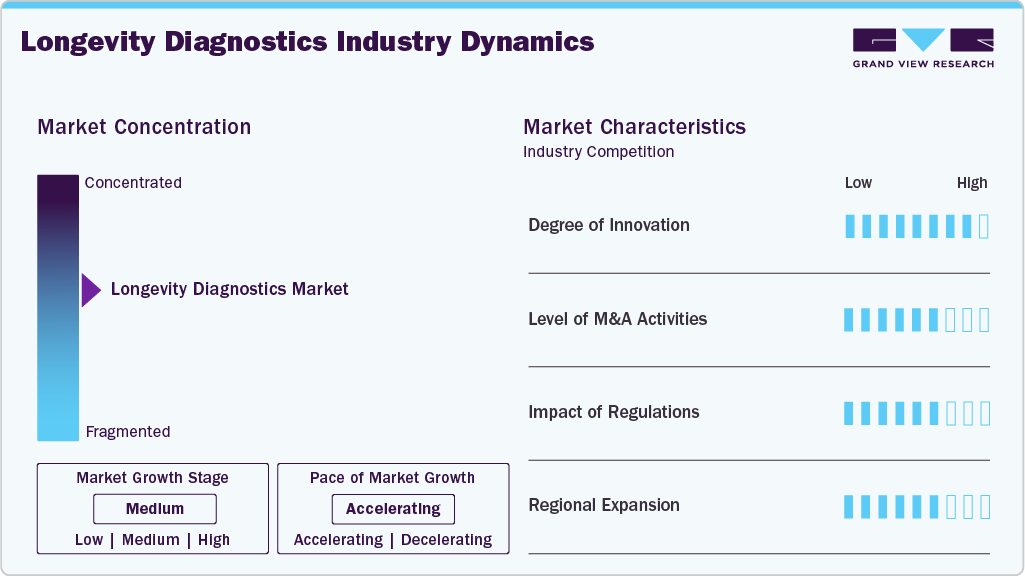
The longevity diagnostics market demonstrates a high degree of innovation driven by advances in epigenetic testing, AI-enabled biomarker analytics, multi-omics profiling, and biological age assessment technologies. Companies are increasingly developing DNA methylation-based epigenetic clocks capable of identifying physiological aging, disease susceptibility, and long-term health risks before clinical manifestation. Integration of genomics, metabolomics, wearable health data, and machine learning is further improving precision in personalized longevity monitoring. For instance, in June 2025, researchers at the National University of Singapore introduced the LinAge2 biological aging clock platform designed to improve mortality prediction, functional health assessment, and personalized intervention monitoring, supporting continued innovation in longevity diagnostics.
The longevity diagnostics market is witnessing moderate merger and acquisition activity as companies focus on strengthening capabilities in epigenetic testing, biological age assessment, AI-enabled biomarker analytics, and personalized preventive healthcare solutions. Strategic acquisitions support the expansion of proprietary DNA methylation datasets, multi-omics diagnostics, and longevity-focused predictive analytics platforms. In April 2026, Infinite Epigenetics, parent company of TruDiagnostic, acquired Tally Health to create an expanded epigenetic diagnostics and longevity platform integrating biological age testing, personalized interventions, and consumer-focused longevity monitoring solutions, supporting the commercialization of precision longevity diagnostics technologies.
 To learn more about this report, Download Free Sample Report
 The longevity diagnostics market is significantly influenced by evolving regulatory frameworks established by global healthcare and data protection agencies governing epigenetic testing, biological age assessment, AI-enabled biomarker analytics, and consumer genomic data usage. Regulatory authorities, including the U.S. FDA, the European Medicines Agency (EMA), and regulatory bodies across Asia-Pacific, are increasingly emphasizing clinical validation, analytical accuracy, transparency, and patient safety for biological age testing and longevity diagnostics platforms. Regulations governing laboratory-developed tests (LDTs), AI-based medical software, in vitro diagnostics, and genomic data privacy frameworks, such as GDPR, are shaping commercialization strategies for market participants. The growing global regulatory focus on precision medicine and preventive healthcare is further driving the development of clinically validated longevity diagnostics and personalized health-monitoring technologies.
The longevity diagnostics market is witnessing steady regional expansion, driven by the increasing adoption of preventive healthcare, growing awareness of biological age assessment, and rising investment in precision medicine technologies across developed and emerging healthcare markets. Companies are expanding their presence through strategic partnerships, digital health platforms, specialized longevity clinics, and the commercialization of direct-to-consumer biological age testing services. The growing integration of AI-enabled biomarker analytics, epigenetic testing, and multi-omics diagnostics across healthcare systems is further driving global market penetration. The expansion of healthcare infrastructure, the aging population, and the rising demand for personalized preventive healthcare solutions are prompting market participants to strengthen international distribution networks and clinical collaborations.
Test Type Insights
The epigenetic age testing segment dominated the longevity diagnostics market, accounting for the largest revenue share of 25.54% in 2025. Growth of the segment is driven by increasing adoption of DNA methylation-based biological age assessment technologies, rising demand for preventive healthcare and personalized longevity monitoring, and expanding integration of epigenetic biomarkers into precision medicine applications. The segment is also benefiting from advancements in AI-enabled aging analytics, growing commercialization of direct-to-consumer biological age testing platforms, and increasing research activities focused on healthy aging and disease risk prediction. In April 2026, EpiMedTech Global expanded commercialization activities for its epiAge DNA methylation-based biological age testing platform, focused on preventive healthcare monitoring and personalized health risk evaluation. Additionally, increasing clinical interest in epigenetic biomarkers for early disease susceptibility assessment and long-term healthspan optimization is further supporting segment growth.
The multi-omics profiling segment is projected to grow at a CAGR of 10.01% over the forecast period, driven by increasing adoption of integrated genomics, proteomics, metabolomics, and microbiome analysis technologies for comprehensive biological age assessment and personalized health monitoring. The segment's growth is supported by rising demand for precision longevity diagnostics capable of evaluating complex aging biomarkers, disease susceptibility, and physiological health status through multi-parameter analysis. The increasing integration of AI-enabled biomarker analytics, next-generation sequencing, and predictive health modeling is further accelerating the the adoption of multi-omics profiling platforms across preventive healthcare and personalized medicine applications. Expanding research activities focused on healthy aging, chronic disease prevention, and individualized intervention strategies are also contributing to segment growth within the longevity diagnostics market.
Technology Insights
The next-generation sequencing (NGS) segment dominated the longevity diagnostics market, accounting for the largest revenue share of 32.54% in 2025, driven by the increasing adoption of high-throughput genomic and epigenomic analysis technologies for biological age assessment, disease susceptibility evaluation, and personalized preventive healthcare monitoring. The segment's growth is supported by rising use of DNA methylation sequencing, multi-omics profiling, and AI-enabled biomarker analytics in longevity diagnostics applications. NGS technologies enable comprehensive analysis of aging-associated biomarkers with high accuracy and scalability, supporting broader integration into precision medicine and preventive healthcare programs. For instance, in April 2026, Infinite Epigenetics acquired Tally Health to expand large-scale DNA methylation datasets and epigenetic diagnostics capabilities supporting next-generation biological age testing and longevity monitoring technologies.
The AI-powered analytics segment is projected to grow at a CAGR of 13.02% over the forecast period, driven by increasing adoption of artificial intelligence technologies for biological age prediction, disease risk stratification, and personalized longevity monitoring. The segment's growth is supported by the rising integration of AI with genomics, proteomics, metabolomics, and wearable-derived physiological data to improve the interpretation of complex aging biomarkers. AI-powered analytics platforms enable more precise assessment of physiological decline and individualized preventive healthcare planning within longevity diagnostics applications. Additionally, increasing utilization of machine learning algorithms for predictive biomarker analysis and personalized intervention optimization is further accelerating the adoption of AI-enabled longevity diagnostics technologies.
End Use Insights
The direct-to-consumer (DTC) segment dominated the longevity diagnostics market, accounting for 40.05% of revenue in 2025, driven by increasing consumer awareness of biological age assessment, preventive healthcare, and personalized longevity monitoring solutions. The segment's growth is supported by rising adoption of at-home epigenetic testing, AI-enabled health analytics, and digital health platforms that offer individualized aging insights and health optimization recommendations. Increasing accessibility of saliva- and blood-based biological age testing kits, along with growing interest in healthy aging and disease prevention, is further accelerating segment growth. In 2025, NOVO expanded its consumer-focused longevity platform by integrating biological age testing, health-tracking analytics, and personalized longevity intervention recommendations to support long-term health span optimization and preventive healthcare monitoring.
 To learn more about this report, Download Free Sample Report
 The longevity clinics segment is projected to grow at a CAGR of 10.06% over the forecast period, driven by increasing demand for personalized preventive healthcare, biological age assessment, and precision longevity management solutions. Growth of the segment is supported by rising adoption of epigenetic testing, AI-enabled biomarker analytics, multi-omics profiling, and individualized health optimization programs across specialized longevity clinics. For instance, in May 2026, Project Serotonin partnered with the Times of India Group to launch Humanedge Essentials, a precision longevity program integrating preventive diagnostics, AI-driven biological data analysis, longitudinal health tracking, and personalized health optimization protocols, further supporting expansion of longevity-focused clinical services.
Regional Insights
North America dominated the global longevity diagnostics market, accounting for approximately 47.27% share, driven by strong adoption of preventive healthcare, advanced precision medicine infrastructure, and the increasing commercialization of biological age testing technologies. The region benefits from high healthcare expenditure, growing consumer awareness regarding healthy aging, and a strong presence of companies engaged in epigenetic testing, AI-enabled biomarker analytics, and multi-omics diagnostics. Increasing integration of longevity diagnostics into preventive healthcare programs, wellness platforms, and specialized longevity clinics is further supporting market growth. Strong investment activity across the biotechnology and digital health sectors is accelerating the development of AI-driven longevity-monitoring solutions. In addition, a favorable research ecosystem, advanced genomic testing capabilities, and rising demand for personalized healthcare interventions continue to strengthen North America’s leadership position in the longevity diagnostics market.
 To learn more about this report, Download Free Sample Report
 U.S. Longevity Diagnostics Market Trends
The longevity diagnostics market in the U.S. is the largest globally, driven by the strong presence of precision medicine companies, advanced genomics infrastructure, and increasing consumer adoption of biological age testing and preventive health monitoring services. The country benefits from growing demand for personalized healthcare, rising chronic disease burden, and expanding adoption of AI-enabled biomarker analytics across healthcare and wellness sectors. Strong venture capital investment in longevity medicine and digital health technologies is supporting the commercialization of epigenetic testing and multi-omics diagnostics platforms. The increasing use of direct-to-consumer longevity testing services and the expansion of specialized longevity clinics are further contributing to market growth. In addition, the presence of advanced research institutions and high adoption of preventive healthcare technologies continue to strengthen the U.S. longevity diagnostics market.
Europe Longevity Diagnostics Market Trends
Europe represents a mature yet structurally diverse longevity diagnostics market, driven by an aging population, strong preventive healthcare systems, and the growing integration of precision medicine technologies across healthcare networks. The region is witnessing rising adoption of epigenetic testing, AI-enabled biomarker analytics, and personalized health monitoring solutions for early disease risk assessment and healthy aging management. Government support for genomics research, increasing focus on healthy aging initiatives, and expansion of digital healthcare infrastructure are supporting market growth. Regulatory emphasis on clinical validation and data privacy is encouraging the development of scientifically validated longevity diagnostics platforms across the region. Increasing research collaborations between biotechnology companies, healthcare institutions, and academic organizations are further strengthening innovation in biological age assessment and multi-omics diagnostics technologies throughout Europe.
The longevity diagnostics market in the UK is growing steadily due to the increasing adoption of preventive healthcare strategies, strong genomic research capabilities, and rising awareness of biological age assessment technologies. The country benefits from advanced healthcare infrastructure, expanding precision medicine initiatives, and increasing focus on healthy aging and chronic disease prevention. The growing integration of AI-enabled biomarker analytics and genomic testing into personalized healthcare programs is driving market expansion. Research on aging biomarkers, epigenetics, and digital health technologies is further advancing longevity diagnostics. In addition, increasing collaborations between healthcare providers, biotechnology companies, and research institutions are accelerating the commercialization of biological age testing and preventive longevity monitoring solutions across the UK healthcare and wellness sectors.
The longevity diagnostics market in Germany is supported by strong biotechnology research capabilities, advanced diagnostic infrastructure, and increasing demand for preventive healthcare and personalized medicine solutions. The country is witnessing growing adoption of epigenetic testing, biomarker analytics, and AI-driven health monitoring technologies focused on healthy aging and chronic disease prevention. Germany benefits from well-established healthcare systems, increasing investment in digital health technologies, and rising integration of genomics and multi-omics diagnostics into preventive healthcare programs. Expanding focus on age-related disease management and early disease detection is further supporting demand for longevity diagnostics solutions. In addition, increasing research collaborations between diagnostic companies, universities, and healthcare institutions are strengthening innovation and commercialization activities within the German longevity diagnostics market.
Asia Pacific Longevity Diagnostics Market Trends
Asia Pacific is the fastest-growing longevity diagnostics market, driven by rapidly aging populations, expanding healthcare infrastructure, and the increasing adoption of preventive healthcare technologies across emerging and developed economies. The rising prevalence of chronic diseases, the increasing digitization of healthcare, and growing awareness of healthy aging are driving demand for biological age testing and personalized longevity monitoring solutions. The region is witnessing increasing investment in genomics, AI-enabled diagnostics, and precision medicine technologies, particularly across China, Japan, South Korea, and Singapore. The expansion of digital health platforms, rising middle-class healthcare spending, and the growing focus on early disease prevention are further accelerating market growth. In addition, increasing commercialization of direct-to-consumer longevity testing services is strengthening the adoption of longevity diagnostics technologies across the Asia Pacific.
The longevity diagnostics market in Japan is driven by one of the world’s fastest-aging populations, strong healthcare infrastructure, and increasing focus on healthy aging and preventive medicine. The country is witnessing growing adoption of biological age testing, AI-enabled health analytics, and biomarker-based preventive healthcare solutions aimed at reducing age-related disease burden. Japan’s advanced diagnostics industry, strong research ecosystem, and increasing integration of precision medicine technologies are supporting market expansion. Government initiatives focused on healthy longevity and chronic disease prevention are encouraging broader utilization of personalized healthcare and longevity monitoring technologies. In addition, rising investment in digital health, genomics, and aging-related research is supporting the development of innovative longevity diagnostics platforms across clinical and wellness healthcare settings in Japan.
The longevity diagnostics market in China is experiencing rapid growth due to an increasing aging population, expanding healthcare expenditure, and rising adoption of precision medicine and digital healthcare technologies. The country is witnessing strong demand for AI-enabled biomarker analytics, genomics testing, and personalized preventive healthcare solutions aimed at managing age-related chronic diseases. Government support for biotechnology innovation, healthcare modernization, and AI integration within diagnostics is supporting the commercialization of longevity diagnostics technologies. Increasing investment in genomics research, digital health platforms, and multi-omics diagnostics is further accelerating market growth. In addition, rising consumer awareness regarding healthy aging and expansion of private healthcare and wellness services are strengthening the adoption of biological age testing and preventive longevity monitoring solutions across China.
Latin America Longevity Diagnostics Market Trends
The longevity diagnostics market in Latin America is gradually expanding due to improving healthcare infrastructure, increasing awareness regarding preventive healthcare, and the rising prevalence of chronic diseases associated with aging populations. The growing adoption of personalized healthcare solutions, digital health technologies, and biomarker-based diagnostics is driving market growth across major economies in the region. Increasing investment in private healthcare services and the expansion of wellness and preventive medicine programs are encouraging the adoption of biological age assessment and longevity-monitoring technologies. Although market penetration remains lower compared to developed regions, improving access to genomics testing and AI-enabled diagnostics is contributing to market growth. In addition, rising healthcare modernization initiatives are supporting the gradual adoption of longevity diagnostics solutions across Latin America.
Middle East & Africa Longevity Diagnostics Market Trends
The longevity diagnostics market in the Middle East & Africa is witnessing gradual growth driven by increasing healthcare investments, expanding private healthcare infrastructure, and rising awareness regarding preventive healthcare and healthy aging. The growing burden of chronic diseases, increasing adoption of digital health technologies, and rising focus on precision medicine are supporting demand for biomarker-based diagnostics and personalized health monitoring solutions. Countries across the Gulf region are increasingly investing in advanced healthcare technologies, genomics research, and AI-enabled diagnostics to strengthen preventive healthcare capabilities. The expansion of wellness healthcare services and the increasing digitization of healthcare are further contributing to market growth. However, limited access to advanced diagnostics technologies in several developing economies continues to restrict broader adoption across parts of the region.
Key Longevity Diagnostics Company Insights
The longevity diagnostics market is moderately fragmented, with competition driven by continuous advancements in biological age testing, epigenetic diagnostics, AI-enabled biomarker analytics, and personalized preventive healthcare solutions. Well-established players are focusing on the expansion of genomics capabilities, multi-omics diagnostics platforms, and AI-driven health analytics to strengthen their market presence. Emerging companies are increasingly investing in DNA methylation-based biological age assessment, at-home longevity testing, and personalized health optimization technologies to differentiate their offerings. Market participants are also pursuing strategic collaborations, research partnerships, commercialization of direct-to-consumer testing platforms, and integration of wearable health data to expand precision longevity diagnostics capabilities and improve long-term preventive healthcare monitoring solutions.
Key Longevity Diagnostics Companies:
The following key companies have been profiled for this study on the longevity diagnostics market.
- Abbott
- TruDiagnostic
- Elysium Health
- GlycanAge
- Tally Health
- Segterra, Inc.
- Function Health
- SiPhox, Inc.
- WellnessFX
- Illumina
- 23andMe
- Nebula Genomics.
- NOVOS Labs
- Altos Labs
Recent Developments
-
In April 2026, Infinite Epigenetics acquired Tally Health to expand epigenetic age testing, biological age diagnostics, and personalized longevity monitoring capabilities. The acquisition combined DNA methylation datasets, biomarker analytics, and consumer-focused longevity platforms to strengthen the commercialization of precision longevity diagnostics technologies. The transaction also supported the development of integrated epigenetic diagnostics and personalized preventive healthcare solutions aimed at improving long-term healthspan assessment and intervention planning.
-
In March 2025, L’Oreal announced a strategic research partnership with TruDiagnostic to advance epigenomic biomarker research and biological age assessment technologies associated with longevity science and personalized preventive healthcare solutions. The collaboration focuses on studying epigenomic markers linked to aging and long-term skin and hair health, supporting the development of personalized longevity diagnostics and preventive monitoring technologies.
-
In June 2025, researchers from the National University of Singapore Yong Loo Lin School of Medicine introduced LinAge2, an advanced biological aging clock platform designed to improve mortality prediction, functional health assessment, and personalized intervention monitoring. The platform demonstrated stronger predictive capability compared to several existing epigenetic clocks, supporting innovation in clinical longevity diagnostics and biological age assessment technologies.
-
In January 2025, EpiMedTech Global expanded commercialization activities for its epiAge epigenetic biological age testing platform, designed for DNA methylation-based biological age assessment, longevity monitoring, preventive healthcare evaluation, and personalized health risk analysis. The platform uses next-generation sequencing to provide personalized insights into aging, disease susceptibility, and long-term health optimization.
Longevity Diagnostics Market Report Scope
Report Attribute
Details
Market size in 2025
USD 2.8 billion
Estimated market size in 2026
USD 2.9 billion
Projected market size by 2033
USD 4.5 billion
Growth rate
CAGR of 6.4% from 2026 to 2033
Base year for estimation
2025
Historical data
2021 - 2024
Forecast period
2026 - 2033
Quantitative units
Revenue in USD million/billion and CAGR from 2026 to 2033
Report coverage
Revenue forecast, company ranking, competitive landscape, growth factors, trends
Segments covered
Test type, Technology, End use, and Region
Regional scope
North America; Europe; Asia Pacific; Latin America; Middle East & Africa
Country scope
U.S.; Canada; Mexico; UK; Germany; France; Italy; Spain; Denmark; Sweden; Norway; China; Japan; India; Australia; South Korea; Thailand; Brazil; Argentina; South Africa; Saudi Arabia; UAE; Kuwait
Key company profiled
Abbott; TruDiagnostic; Elysium Health; GlycanAge; Tally Health; Segterra, Inc.; Function Health; SiPhox, Inc.; WellnessFX; Illumina; 23andMe; Nebula Genomics; NOVOS Labs; Altos Labs.
Customization scope
Free report customization (equivalent to up to 8 analysts working days) with purchase. Addition or alteration to country, regional & segment scope.
Pricing and purchase options
Avail customized purchase options to meet your exact research needs. Explore purchase options
Global Longevity Diagnostics Market Report Segmentation
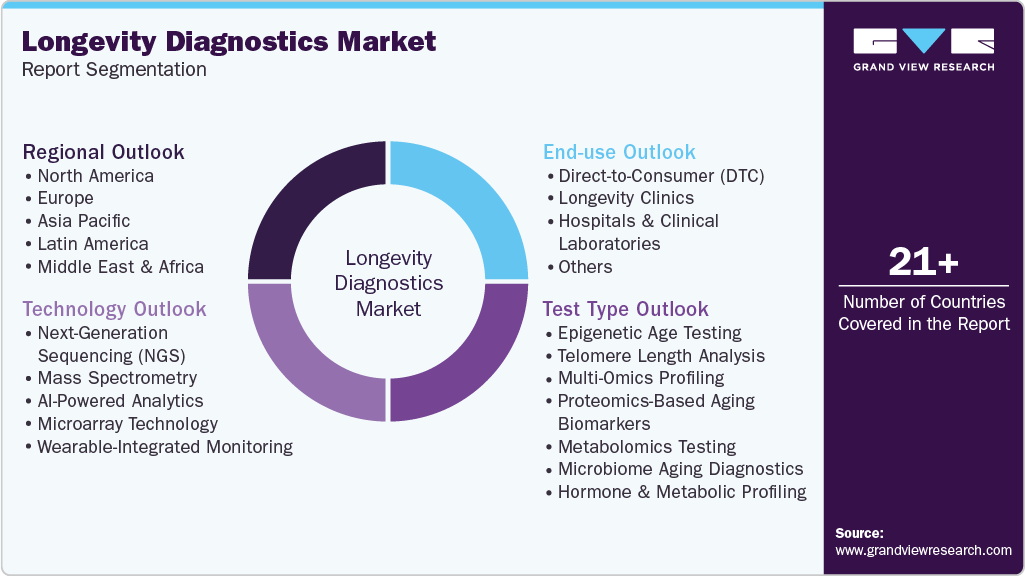
This report forecasts revenue growth at global, regional, and country levels and provides an analysis of the latest industry trends in each of the sub-segments from 2021 to 2033. For this study, Grand View Research has segmented the global longevity diagnostics market report based on test type, technology, end use, and region:
 To learn more about this report, Download Free Sample Report
 -
Test Type Outlook (Revenue, USD Million, 2021 - 2033)
-
Epigenetic Age Testing
-
Telomere Length Analysis
-
Multi-Omics Profiling
-
Proteomics-Based Aging Biomarkers
-
Metabolomics Testing
-
Microbiome Aging Diagnostics
-
Hormone & Metabolic Profiling
-
-
Technology Outlook (Revenue, USD Million, 2021 - 2033)
-
Next-Generation Sequencing (NGS)
-
Mass Spectrometry
-
AI-Powered Analytics
-
Microarray Technology
-
Wearable-Integrated Monitoring
-
-
End Use Outlook (Revenue, USD Million, 2021 - 2033)
-
Direct-to-Consumer (DTC)
-
Longevity Clinics
-
Hospitals & Clinical Laboratories
-
Others
-
-
Regional Outlook (Revenue, USD Million, 2021 - 2033)
-
North America
-
U.S.
-
Canada
-
Mexico
-
-
Europe
-
UK
-
Germany
-
France
-
Italy
-
Spain
-
Denmark
-
Sweden
-
Norway
-
-
Asia Pacific
-
Japan
-
China
-
India
-
Australia
-
South Korea
-
Thailand
-
-
Latin America
-
Brazil
-
Argentina
-
-
Middle East & Africa
-
South Africa
-
Saudi Arabia
-
UAE
-
Kuwait
-
-
Frequently Asked Questions About This Report
Asia Pacific is the fastest-growing region over the forecast period.
Epigenetic age testing segment accounted for the largest revenue share of 25.5% in 2025.
The next-generation sequencing (NGS) segment led with a 32.5% revenue share in 2025.
The direct-to-consumer (DTC) segment led with a 40.0% revenue share in 2025.
The global longevity diagnostics market size was valued at USD 2.8 billion in 2025 and is estimated at USD 2.9 billion for 2026.
The global longevity diagnostics market is expected to grow at a CAGR of 6.4% from 2026 to 2033, reaching USD 4.5 billion by 2033.
North America longevity diagnostics market held the largest share of 47.3% of the global market in 2025.
Key players include Abbott; TruDiagnostic; Elysium Health; GlycanAge; Tally Health; Segterra, Inc.; Function Health; SiPhox, Inc.; WellnessFX; Illumina; 23andMe; Nebula Genomics; NOVOS Labs; Altos Labs.
Key factors that are driving the market growth include an aging population drives market growth, the rising prevalence of chronic diseases, and the growing demand for preventive and personalized healthcare
About the Author(s)
Clinical Diagnostics Research Team
Healthcare · Clinical DiagnosticsThis report was authored by the clinical diagnostics research team at Grand View Research - comprising two research analysts, one senior research analyst, and one industry expert - with specialized expertise in the clinical diagnostics segment of the healthcare industry. All findings are based on proprietary healthcare databases, executive interviews, and regulatory analysis, subject to internal peer review prior to publication.
Last Updated:
Speak to Analyst

Customize this report to your needs - add regions, segments, or data points, with 20% free customization.
Or view our licence options:


ISO 9001:2015 & 27001:2022 Certified
We are GDPR and CCPA compliant! Your transaction & personal information is safe and secure. For more details, please read our privacy policy.


