
- Home
- »
- Next Generation Technologies
- »
-
Machine Condition Monitoring Market Size Report, 2026-2033GVR Report cover

Machine Condition Monitoring Market (2026 - 2033)
Size, Share & Trends Analysis Report By Monitoring Technique, By Component, By Product, By Application, By Architecture, By Plant, By Monitoring Process, By End Use, By Region, And Segment Forecasts
Market Size, 2025
$3.8BMarket Estimate, 2026
$4.1BMarket Forecast, 2033
$6.6BCAGR, 2026–2033
7.0%Machine Condition Monitoring Market Summary
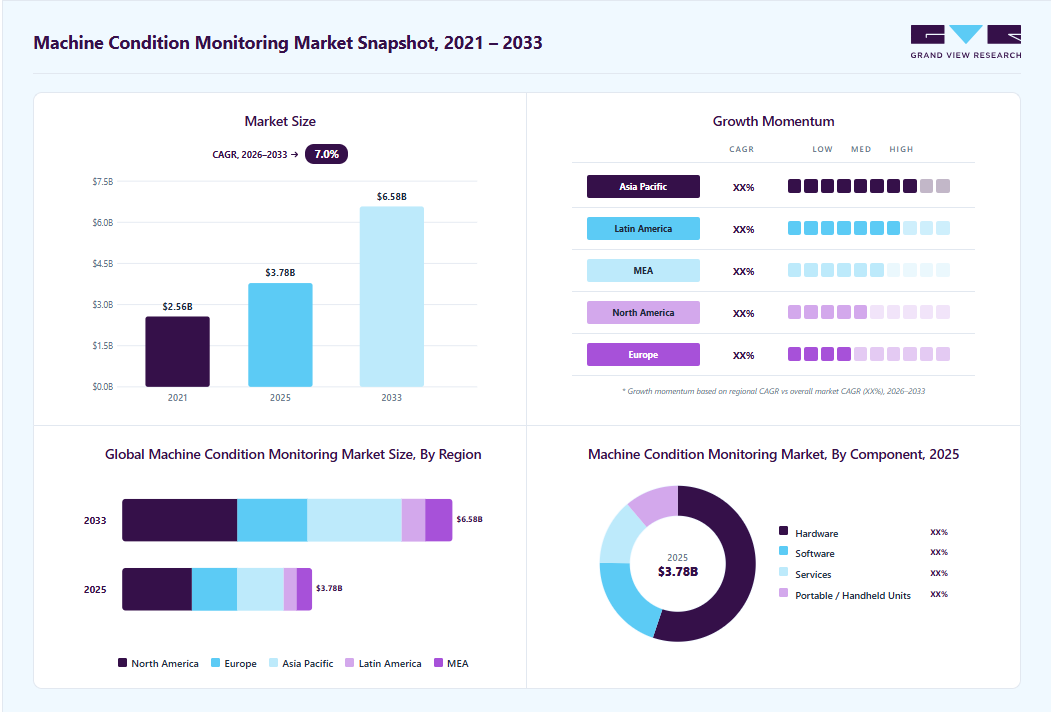
The global machine condition monitoring market size was valued at USD 3.8 billion in 2025 and is projected to grow from USD 4.1 billion in 2026 to USD 6.6 billion by 2033, at a CAGR of 7.0% from 2026 to 2033. The market in North America dominated with a revenue share of 36.0% in 2025. The market is being shaped by the increasing adoption of predictive maintenance strategies across asset-intensive industries, the rising deployment of IoT-enabled sensors for real-time equipment health monitoring, the growing integration of AI and machine learning for advanced fault diagnostics and failure prediction, the expanding use of cloud-based and edge analytics platforms to enable scalable monitoring solutions, and the strong focus on reducing unplanned downtime, maintenance costs, and operational risks across manufacturing, energy, and transportation sectors.
 Source: Grand View Research, IR Documents, Primary Interviews, Paid DatabasesTo learn more about this report,
 Download Free Sample Report
 Key Market Trends & Insights
- By monitoring technique: Vibration monitoring segment led the market and held the largest revenue share of 26% in 2025.
- By end use: Chemicals segment is expected to grow at the fastest CAGR of over 7% from 2026 to 2033.
- By component: Hardware segment led the market and held the largest revenue share of over 55% in 2025.
Regional Highlights
- Largest regional market: North America (36.0% revenue share, 2025)
- By country: The U.S. held the largest market share in 2025.
Market Size & Forecast
- Market size in 2025: USD 3.8 Billion
- Estimated market size in 2026: USD 4.0 Billion
- Projected market size by 2033: USD 6.6 Billion
- CAGR (2026-2033): 7.0%
Three ways to get this report
Buy it, customize it, or ask a question.Ask an Analyst
Analyst response in 1 business day
- AccessReport author, directly
- Reply timeWithin 1 working day
- No sales callDirect answer only
- FormatEmail reply
- CostFree, no cost
Get the Full Report
What the study covers
- FormatsPDF · Excel · Dashboard
- Timeline2026–2033 annual, 2025 base
- Coverage20+ countries, 5 regions
- Companies10+ key players profiled
Customize the Report
20% free customization
- IncludeCountries, segments, points
- TailorTo your product definition
- ExtendDeeper competitor detail
- OrA fully bespoke study
- Turnaround5–10 working days
The machine condition monitoring industry is being driven by the increasing focus on energy efficiency, asset optimization, and sustainability across industrial operations. Companies are adopting condition monitoring solutions to identify performance inefficiencies, reduce energy consumption, and extend equipment life cycles. The integration of monitoring data with enterprise systems such as CMMS and ERP platforms is improving maintenance planning and operational transparency. Growing availability of modular, scalable, and subscription-based solutions is lowering adoption barriers, particularly for small and mid-sized enterprises. In addition, the expansion of managed services and analytics expertise is enabling organizations to accelerate deployment while reducing operational complexity and total cost of ownership.Machine condition monitoring is gaining strong momentum as industries prioritize predictive maintenance to minimize unplanned downtime and operational disruptions. Sectors such as oil and gas, power generation, automotive, and mining are increasingly relying on continuous equipment monitoring to detect early signs of failure. This shift is driven by the need to extend asset lifespan while lowering repair and replacement costs. Condition monitoring enables maintenance teams to transition from reactive and scheduled maintenance to data-driven, condition-based strategies. As a result, organizations are achieving higher equipment availability, improved safety standards, and stronger operational continuity.
 To learn more about this report, Download Free Sample Report
 The machine condition monitoring industry is witnessing increased adoption of wireless and remote monitoring solutions to support geographically distributed and hard-to-access assets. Industries such as oil and gas, marine, and mining are deploying wireless sensors to monitor equipment performance in remote and hazardous environments. This approach reduces the need for manual inspections, lowering labor costs and improving worker safety. Remote monitoring capabilities enable centralized oversight of multiple sites, improving maintenance responsiveness and asset visibility. As connectivity reliability improves, wireless condition monitoring is becoming a preferred solution for large-scale and multi-location operations.
Monitoring Technique Insights
The vibration monitoring segment led the market in 2025, accounting for 26% of global revenue, driven by its effectiveness in detecting wear, imbalance, and misalignment in critical equipment. Growing adoption across industrial environments has strengthened early fault detection capabilities, enabling timely maintenance interventions. Vibration monitoring solutions are increasingly valued for their ability to reduce maintenance complexity, simplify system integration, and improve operational efficiency. Industry players are expanding investments in continuous monitoring of high-value assets such as cooling tower gearboxes, boiler feed pumps, steam turbines, and gas equipment. As reliability and asset protection become strategic priorities, vibration monitoring is expected to remain a core diagnostic technology for identifying emerging issues and supporting advanced troubleshooting.
The oil analysis segment is expected to experience significant growth during the forecast period, supported by rising demand for predictive maintenance solutions. Organizations are leveraging oil condition data and advanced analytics to prevent equipment failures and minimize costs associated with unplanned downtime. Increasing awareness of oil analysis benefits in detecting contamination, component wear, and lubricant degradation is accelerating adoption across asset-intensive industries. Technological advancements, including online oil monitoring and remote analysis capabilities, are improving accessibility while reducing overall monitoring costs. These factors are positioning oil analysis as a critical driver for enhancing equipment reliability, optimizing maintenance strategies, and improving long-term operational performance.
Component Insights
The hardware segment accounted for the largest market revenue share in 2025, driven by the widespread adoption of infrared sensors, ultrasonic detectors, vibration analyzers, and accelerometers across industrial environments. These technologies provide precise visibility into failure-prone areas, enabling early detection of mechanical and operational issues. Sensor manufacturers are offering both static and dynamic solutions to address varying frequency ranges and application requirements. This flexibility supports accurate condition assessment across diverse asset types and operating conditions. As industries prioritize uptime and reliability, investments in advanced hardware solutions are accelerating the adoption of predictive maintenance strategies and reducing unplanned machine downtime.
The portable/handheld condition monitoring units segment is expected to record strong growth over the forecast period, supported by rising demand for flexible predictive maintenance tools. Increasing adoption of wireless connectivity is enabling remote monitoring and faster data collection without complex infrastructure. Declining device costs are making portable solutions more accessible to small and mid-sized industrial operators. These units offer ease of installation, operational flexibility, and lower maintenance requirements compared to traditional wired systems. Their growing adoption reflects industrial organizations’ focus on cost-efficient, scalable, and responsive asset monitoring solutions.
Product Insights
The motor segment accounted for the largest market revenue share in 2025, driven by strong demand across oil and gas, automotive, and manufacturing industries. Motors serve as critical assets in industrial operations, making their continuous health monitoring essential to prevent unexpected failures. Condition monitoring solutions help optimize motor performance, improve energy efficiency, and significantly reduce unplanned downtime. As production intensity and asset utilization increase, industries are prioritizing proactive motor monitoring to support operational continuity. This sustained reliance on motors is expected to maintain the segment’s growth momentum over the coming years.
The bearings segment is expected to witness significant growth, supported by expanding demand for machine tools across manufacturing, automotive, and aerospace industries. Increasing requirements for high-precision and high-speed operations are driving the need for advanced bearing performance and reliability. Automation adoption in manufacturing environments is further increasing the operational load on bearings, reinforcing the need for continuous condition monitoring. In addition, stricter regulations related to noise and vibration emissions are encouraging manufacturers to deploy high-performance bearings that meet compliance standards. These drivers are positioning bearing condition monitoring as a critical component of modern industrial maintenance strategies.
Application Insights
The turbines and generators segment accounted for the largest market revenue share in 2025, driven by rising demand for preventive and predictive maintenance in the power generation sector. These assets are critical to power plant operations, making early fault detection essential to avoid unplanned outages and high repair costs. Machine condition monitoring enables continuous performance tracking, supporting higher uptime and improved operational reliability. Growing investments in renewable energy generation are further increasing the need for advanced monitoring solutions to manage variable operating conditions. In parallel, advancements in vibration analysis and infrared thermography are enhancing diagnostic accuracy, reinforcing the segment’s leadership in the market.
The HVAC systems segment is expected to witness strong growth in the coming years, supported by increasing demand for energy-efficient and sustainable building solutions. The adoption of smart HVAC systems with remote monitoring and control capabilities is strengthening the role of condition monitoring in building operations. Rising focus on indoor air quality across commercial and industrial facilities is further accelerating system upgrades and monitoring investments. Integration of green technologies, including geothermal and solar-based HVAC systems, is increasing system complexity and the need for continuous performance monitoring. In addition, the deployment of smart thermostats and demand-response technologies is driving adoption of advanced monitoring solutions to optimize energy use and operational efficiency.
Plant Insights
The brownfield plant segment accounted for the largest market revenue share in 2025, driven by the aging nature of industrial infrastructure and the higher risk of equipment failure. Older plants operate with legacy machinery that is more prone to wear, inefficiencies, and unplanned downtime, increasing the need for continuous condition monitoring. Rising focus on operational safety and stricter regulatory compliance are further accelerating adoption in brownfield environments. Proactive monitoring enables early fault detection, helping operators extend asset life and reduce maintenance-related disruptions. As industries prioritize reliability and cost control, brownfield facilities continue to represent a major demand center for machine condition monitoring solutions.
The greenfield plant segment is expected to record significant growth over the forecast period, supported by rising investments in new industrial facilities worldwide. Expansion in developing economies and infrastructure modernization in developed regions are increasing demand for integrated condition monitoring from the design stage. Greenfield plants are increasingly adopting advanced, energy-efficient, and digitally enabled monitoring solutions to meet environmental and performance requirements. Technological advancements are simplifying machine maintenance and enabling seamless integration of monitoring systems into new production lines. These factors are positioning greenfield plants as a key growth driver for next-generation machine condition monitoring deployments.
Monitoring Process Insights
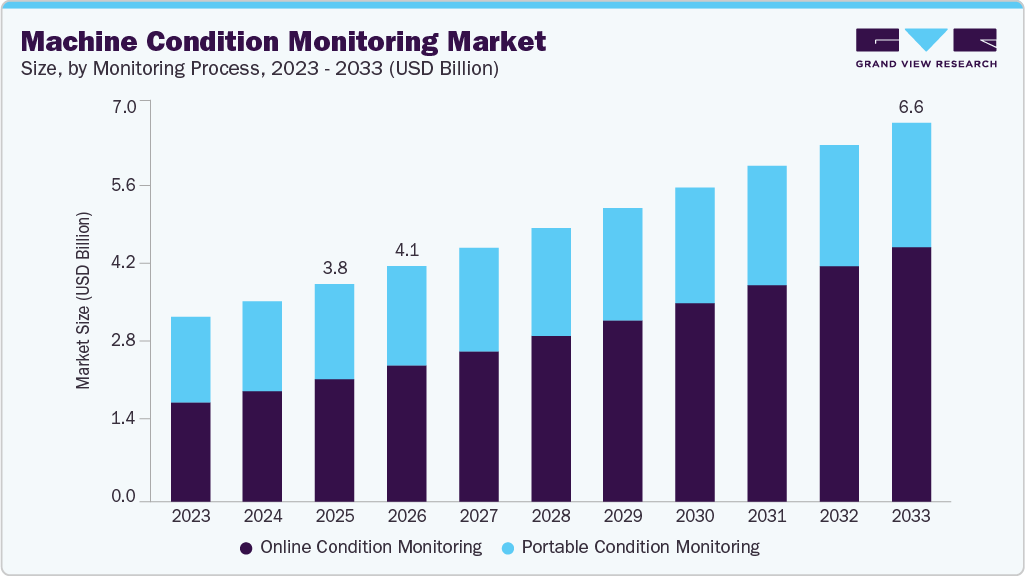
The online condition monitoring segment accounted for the largest market revenue share in 2025, driven by strong demand for continuous data monitoring to reduce downtime, defects, and asset degradation. Industries are increasingly prioritizing real-time performance metrics and automated alerts to improve machine health visibility and maintenance responsiveness. Expanding deployment of advanced sensors is improving data accuracy and enabling early fault detection across critical assets. The rapid adoption of industrial IoT is accelerating the use of software-as-a-service platforms, supporting scalability and cost efficiency while allowing organizations to focus on core operations. Rising demand for remote monitoring and preventive maintenance is expected to sustain strong growth and innovation within this segment.
The portable condition monitoring segment is expected to witness significant growth during the forecast period, supported by demand for flexible and rapid diagnostic tools. These solutions enable efficient data collection and analysis for critical machinery without requiring permanent installations. Lightweight design, ease of operation, and fast deployment are making portable systems attractive across diverse industrial environments. Increasing adoption of wireless sensors is enhancing decision-making and supporting troubleshooting of complex system failures. In addition, integration of Bluetooth connectivity and cloud-based platforms is improving operational flexibility and streamlining maintenance workflows.
End Use Insights
The power generation segment accounted for the largest market revenue share in 2025, driven by the critical nature of equipment reliability and the high costs associated with component failures and system outages. Continuous condition monitoring is essential in this sector to manage complex, asset-intensive operations and ensure safe working environments. In parallel, the oil and gas segment is gaining strong traction due to rising demand for oil analysis, thermography, and vibration monitoring across upstream and downstream operations. Increasing deployment of sensors and remote monitoring solutions is enabling operators to improve asset protection, detect leaks, and enhance productivity. With energy costs rising, companies are accelerating investments in predictive asset management and condition monitoring software to improve efficiency and operational resilience.
The chemicals segment is expected to register an impressive CAGR over the forecast period, supported by growing adoption of predictive maintenance and Industry 4.0 technologies. Chemical manufacturers are increasingly using machine condition monitoring to optimize process reliability and minimize unplanned downtime. Rising emphasis on sustainability is driving adoption, as monitoring solutions help reduce energy consumption, emissions, and material waste. Stringent safety and environmental regulations are further compelling chemical plants to invest in advanced monitoring systems to ensure compliance. Together, these drivers are positioning machine condition monitoring as a strategic tool for improving operational efficiency and regulatory adherence in the chemicals industry.
Architecture Insights
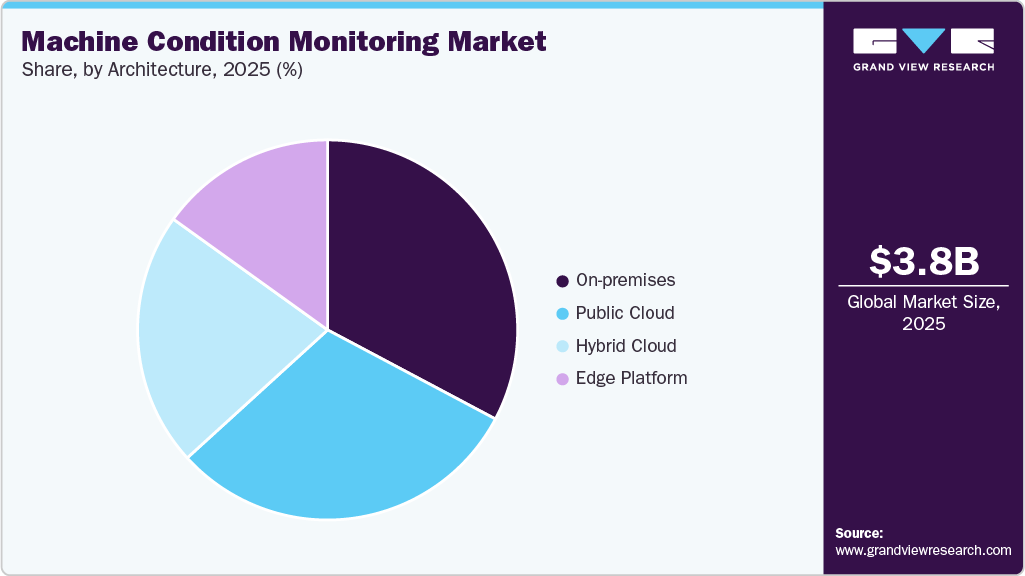
The on-premises segment accounted for the largest market revenue share in 2025, driven by organizations’ need for control, customization, and data governance. Self-hosted deployments enable engineering teams to tailor monitoring environments to specific operational and regulatory requirements. On-premises solutions provide direct visibility into machine performance, allowing teams to quickly identify inefficient or long-running assets. This deployment model supports high system reliability and low latency, which are critical in asset-intensive industrial settings. In addition, the cost-effectiveness of on-premises solutions continues to attract budget-conscious organizations seeking robust monitoring capabilities without recurring cloud expenses.
 To learn more about this report, Download Free Sample Report
 The hybrid cloud segment is expected to witness significant growth in the coming years, supported by the need to balance scalability with operational control. Organizations are increasingly adopting hybrid models to combine on-site monitoring with cloud-based analytics and remote access. This approach enables centralized insights while maintaining data security for critical operations. Growing adoption of automation and connected assets is increasing data volumes, making hybrid architectures attractive for flexible processing and storage. As industries prioritize digital transformation and operational agility, hybrid cloud deployments are emerging as a preferred model for advanced machine condition monitoring.
Regional Insights
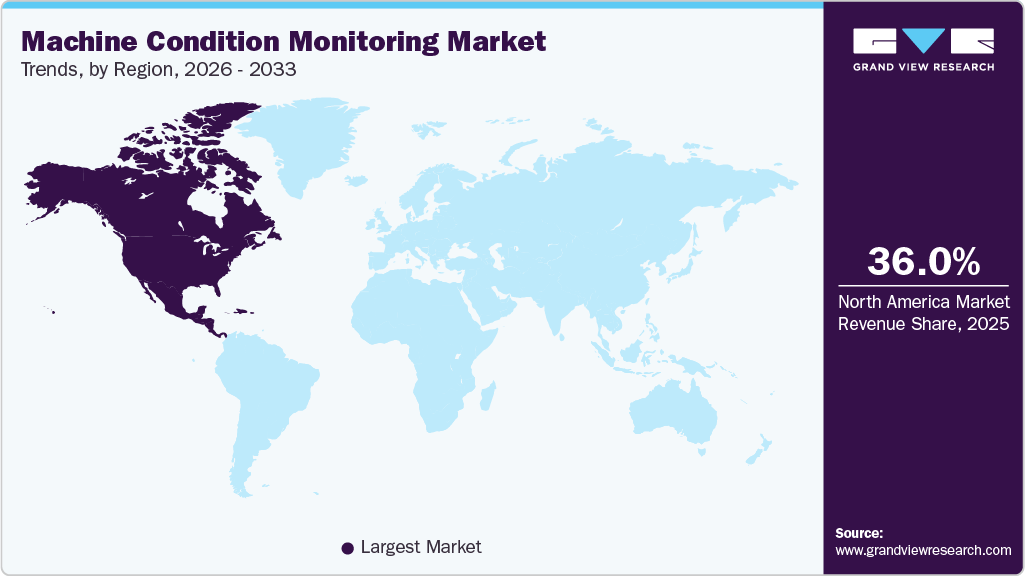
North America machine condition monitoring industry dominated globally with a revenue share of over 36.0% in 2025, supported by strong demand from power generation, aerospace, oil and gas, marine, and food and beverages industries. The region is witnessing a pronounced shift toward vibration and oil condition monitoring, particularly for lubricants used in oil and gas platform machinery. Rising offshore oil and gas exploration activities are accelerating the adoption of predictive maintenance solutions to improve asset reliability and operational uptime. Forward-looking companies are strengthening their regional presence by investing in advanced monitoring technologies to capture long-term growth opportunities.
 To learn more about this report, Download Free Sample Report
 U.S. Machine Condition Monitoring Market Trends
The U.S. machine condition monitoring industry is expanding steadily, driven by the accelerating adoption of Industry 4.0 and smart manufacturing initiatives. Manufacturers are increasingly deploying condition monitoring systems to reduce unplanned downtime, optimize maintenance schedules, and lower operational costs. Strong emphasis on predictive maintenance is reinforcing demand across automotive, aerospace, and heavy manufacturing sectors. In addition, rising investments in digital infrastructure and industrial analytics are supporting the integration of advanced monitoring solutions across production facilities.
Europe Machine Condition Monitoring Market Trends
The Europe machine condition monitoring industry is expected to witness significant growth over the forecast period, driven by rising investments in automation and industrial digitalization. Stringent regulatory frameworks related to equipment safety, energy efficiency, and environmental compliance are encouraging widespread adoption of advanced monitoring solutions. Industries across manufacturing, energy, and transportation are leveraging condition monitoring to minimize operational risks and ensure regulatory adherence. The region’s focus on sustainable and efficient industrial operations continues to strengthen long-term demand for predictive maintenance technologies.
Asia Pacific Machine Condition Monitoring Market Trends
The Asia Pacific machine condition monitoring industry is being driven by large-scale infrastructure expansion across energy, transportation, and heavy industrial sectors. Rapid growth in power generation capacity is increasing the need for continuous monitoring of critical equipment to ensure reliability and operational stability. Industrial operators are adopting condition monitoring solutions to manage high asset utilization rates and extend the life of aging machinery. In addition, rising emphasis on export competitiveness and global quality standards is accelerating the deployment of advanced monitoring technologies across manufacturing facilities.
Key Machine Condition Monitoring Company Insights
Some key players in the machine condition monitoring industry, such as Emerson Electric Co., General Electric, Honeywell International Inc., SKF and among others.
-
Emerson Electric Co. is a global technology and engineering company specializing in industrial automation, process control, and asset optimization solutions. In the machine condition monitoring industry, Emerson focuses on predictive maintenance and asset performance management for critical industrial equipment. The company offers a comprehensive portfolio that includes wireless condition monitoring sensors, advanced diagnostics, and analytics-driven software platforms. These solutions leverage IoT connectivity and artificial intelligence to deliver real-time visibility into equipment health and early fault detection. Emerson’s specialization lies in enabling reliability-centered maintenance and operational efficiency across industries such as oil and gas, power generation, chemicals, and manufacturing.
-
General Electric operates across multiple sectors, including aviation, energy, and industrial digital solutions, with a strong specialization in data-driven asset management. Within the machine condition monitoring industry, GE focuses on predictive analytics, digital twins, and industrial IoT platforms to improve equipment reliability and lifecycle performance. Its condition monitoring solutions support real-time monitoring, performance forecasting, and failure prediction for high-value assets. By integrating advanced analytics with operational data, GE enables proactive maintenance strategies that reduce downtime and maintenance costs. The company’s specialization centers on large-scale industrial assets in power generation, renewable energy, aviation, and heavy manufacturing environments.
Key Machine Condition Monitoring Companies:
The following are the leading companies in the machine condition monitoring market. These companies collectively hold the largest market share and dictate industry trends.
- ALS
- Emerson Electric Co.
- General Electric
- Honeywell International Inc.
- Megget PLC
- NATIONAL INSTRUMENTS CORP
- Parker Hannifin
- Rockwell Automation, Inc.
- SKF
- Schaeffler AG
Recent Developments
-
In November 2025, Valmet partnered with SpecTec Cruise to streamline maintenance data flow for cruise operators through system integration. The partnership enables the automatic transfer of running hour data from Valmet’s automation systems into SpecTec Cruise’s AMOS maintenance management platform. This integration reduces manual data handling, improves data accuracy, and supports more effective maintenance planning onboard cruise vessels. As a result, cruise operators can enhance asset reliability, strengthen regulatory compliance, and improve overall operational efficiency across their fleets.
-
In September 2025, GEA Group AG introduced a new digital condition monitoring solution at Drinktec, aimed at improving reliability and performance in dairy and beverage processing operations. The solution continuously monitors critical machine parameters such as temperature, pressure, vibration, and flow to identify early signs of equipment degradation. It provides real-time diagnostics and early warnings to support proactive maintenance planning and reduce unplanned downtime. By enabling better visibility into machine health, the solution helps operators improve maintenance efficiency and ensure stable production operations.
-
In June 2025, Alfa Laval launched a next-generation condition monitoring solution designed to improve reliability and uptime for hygienic process equipment. The solution continuously monitors pumps and rotating machinery, providing real-time alerts and diagnostics to identify potential issues at an early stage. By applying advanced analytics, it enables more effective maintenance planning and helps reduce unplanned downtime. The offering is designed for easy installation, broad pump compatibility, and faster return on investment for industrial operators.
Machine Condition Monitoring Market Report Scope
Report Attribute
Details
Market size in 2025
USD 3.8 Billion
Market size value in 2026
USD 4.1 billion
Revenue forecast in 2033
USD 6.6 billion
Growth rate
CAGR of 7.0% from 2026 to 2033
Base Year
2025
Actual data
2021 - 2025
Forecast period
2026 - 2033
Quantitative units
Revenue in USD billion/million and CAGR from 2026 to 2033
Report coverage
Revenue forecast, company ranking, competitive landscape, growth factors, and trends
Segments covered
Monitoring technique, component, product, application, architecture, plant, monitoring process, end use, region
Regional scope
North America; Europe; Asia Pacific; Latin America; MEA
Country scope
U.S.; Canada; Mexico; Germany; UK; France; China; India; Japan; Australia; South Korea; Brazil; UAE; South Africa; KSA
Key companies profiled
ALS; Emerson Electric Co.; General Electric; Honeywell International Inc.; Megget PLC; NATIONAL INSTRUMENTS CORP; Parker Hannifin; Rockwell Automation, Inc.; SKF; Schaeffler AG
Customization scope
Free report customization (equivalent up to 8 analysts working days) with purchase. Addition or alteration to country, regional & segment scope.
Pricing and purchase options
Avail customized purchase options to meet your exact research needs. Explore purchase options
Global Machine Condition Monitoring Market Report Segmentation
This report forecasts revenue growth at global, regional, and country levels and provides an analysis of the latest industry trends in each of the sub-segments from 2021 to 2033. For this study, Grand View Research has segmented the global machine condition monitoring market report based on monitoring technique, component, product, application, architecture, plant, monitoring process, end use, and region.
-
Monitoring Technique Outlook (Revenue, USD Billion, 2021 - 2033)
-
Torque Monitoring
-
Vibration Monitoring
-
Oil Analysis
-
Thermography
-
Corrosion Monitoring
-
Others
-
-
Component Outlook (Revenue, USD Billion, 2021 - 2033)
-
Hardware
-
Portable/Handheld Condition Monitoring Units
-
Software
-
Services
-
-
Product Outlook (Revenue, USD Billion, 2021 - 2033)
-
Valves
-
Compressors
-
Turbines
-
Gearbox
-
Motors
-
Bearings
-
Couplings
-
Others
-
-
Application Outlook (Revenue, USD Billion, 2021 - 2033)
-
HVAC Systems
-
Turbines & Generators
-
Material Handling
-
Conveyors
-
Pump Systems
-
Sprockets
-
Bushings & Hubs
-
Control Cabinet Monitoring
-
Paper Presses
-
Storage Rooms
-
Motor Control
-
Lubricant Level Monitoring on CNC Machines
-
Others
-
-
Architecture Outlook (Revenue, USD Billion, 2021 - 2033)
-
Public Cloud
-
Edge Platform
-
Hybrid Cloud
-
On-premises
-
-
Plant Outlook (Revenue, USD Billion, 2021 - 2033)
-
Greenfield Plant
-
Brownfield Plant
-
-
Monitoring Process Outlook (Revenue, USD Billion, 2021 - 2033)
-
Online Condition Monitoring
-
Portable Condition Monitoring
-
-
End Use Outlook (Revenue, USD Billion, 2021 - 2033)
-
Mining
-
Primary Metals
-
Power Generation
-
Automotive
-
Oil & Gas
-
Aerospace
-
Food & Beverages
-
Chemicals
-
Marine
-
Pharmaceutical
-
Pulp & Paper
-
Others
-
-
Regional Outlook (Revenue, USD Billion, 2021 - 2033)
-
North America
-
U.S.
-
Canada
-
Mexico
-
-
Europe
-
UK
-
Germany
-
France
-
-
Asia Pacific
-
China
-
India
-
Japan
-
Australia
-
South Korea
-
-
Latin America
-
Brazil
-
-
MEA
-
UAE
-
South Africa
-
KSA
-
-
Frequently Asked Questions About This Report
Some key players operating in the machine condition monitoring market include ALS, Emerson Electric Co., General Electric, Honeywell International Inc., Megget PLC, NATIONAL INSTRUMENTS CORP, Parker Hannifin, Rockwell Automation, Inc., SKF, Schaeffler AG
Key factors driving the market growth include the increasing demand for highly secure cloud-based solutions enabling real-time condition monitoring, the growing adoption of wireless technologies for flexible and cost-effective deployments, and the rising use of predictive maintenance techniques to minimize downtime and optimize asset performance.
Vibration monitoring segment led with a revenue share of 26% in 2025.
Hardware segment accounted for the largest market revenue share in 2025, while portable/handheld condition monitoring units segment is fastest-growing
Motor segment accounted for the largest market revenue share in 2025, while bearings segment is fastest-growing
Turbines and generators segment held the largest market revenue share in 2025, while HVAC systems segment is fastest-growing
The global machine condition monitoring market size was estimated at USD 3.8 billion in 2025 and is expected to reach USD 4.1 billion in 2026.
The global machine condition monitoring market is projected to grow at a compound annual growth rate (CAGR) of 7.0% from 2026 to 2033, reaching a value of USD 6.6 billion by 2033.
North America dominated the machine condition monitoring market, accounting for a share of 36.0% in 2025, driven by strong adoption of predictive maintenance, advanced IIoT integration, and sustained demand from power generation, aerospace, oil & gas, marine, and food & beverages industries.
About the Author(s)
Next Generation Technologies Research Team
Technology · Next Generation TechnologiesThis report was authored by the next generation technologies research team at Grand View Research - comprising two research analysts, one senior research analyst, and one industry expert - with specialized expertise in the next generation technologies segment of the technology industry. All findings are based on proprietary technology databases, executive interviews, and regulatory analysis, subject to internal peer review prior to publication.
Last Updated:
Speak to Analyst

Customize this report to your needs - add regions, segments, or data points, with 20% free customization.
Or view our licence options:


ISO 9001:2015 & 27001:2022 Certified
We are GDPR and CCPA compliant! Your transaction & personal information is safe and secure. For more details, please read our privacy policy.


