
- Home
- »
- Advanced Interior Materials
- »
-
Machine Tool Cooling System Market Report, 2026-2033GVR Report cover
![Machine Tool Cooling System Market (2026 - 2033)Report]()
Machine Tool Cooling System Market (2026 - 2033)
Size, Share & Trends Analysis Report By Product (Spindle Cooling Systems, Coolant Chillers, Tool Cooling Systems), By Cooling Technology, By End-use (Aerospace, Medical Devices, Oil & Gas), By Region, And Segment Forecasts
Market Size, 2025
$4.7BMarket Estimate, 2026
$4.9BMarket Forecast, 2033
$7.0BCAGR, 2026–2033
5.1%Machine Tool Cooling System Market Summary
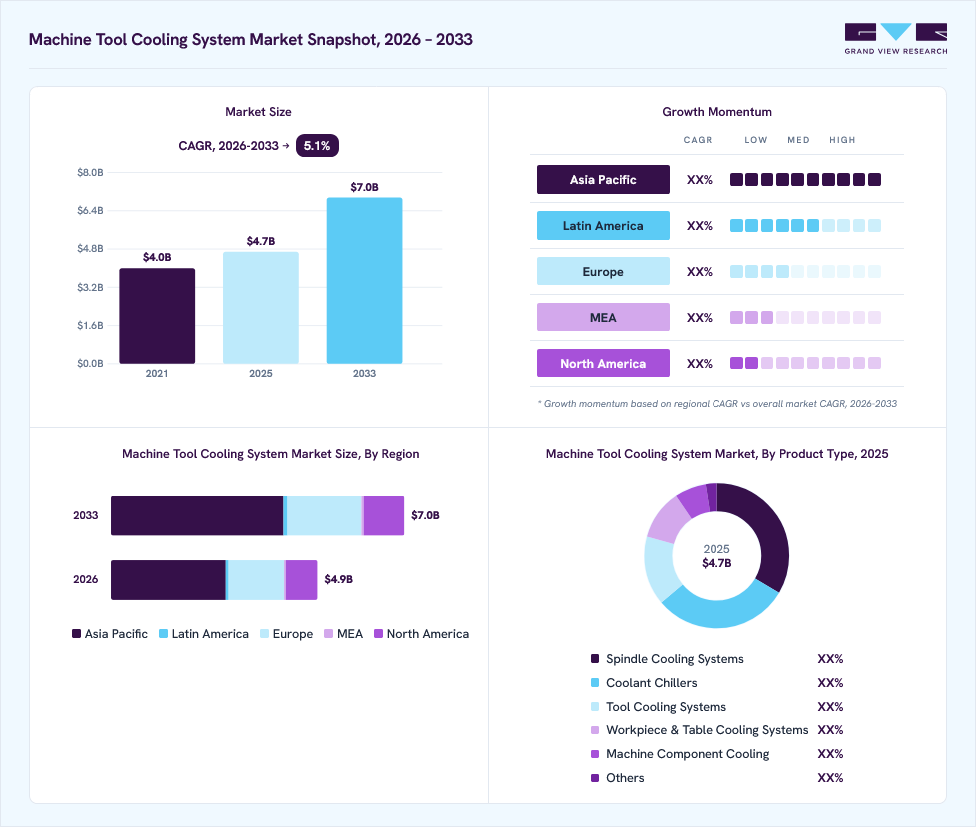
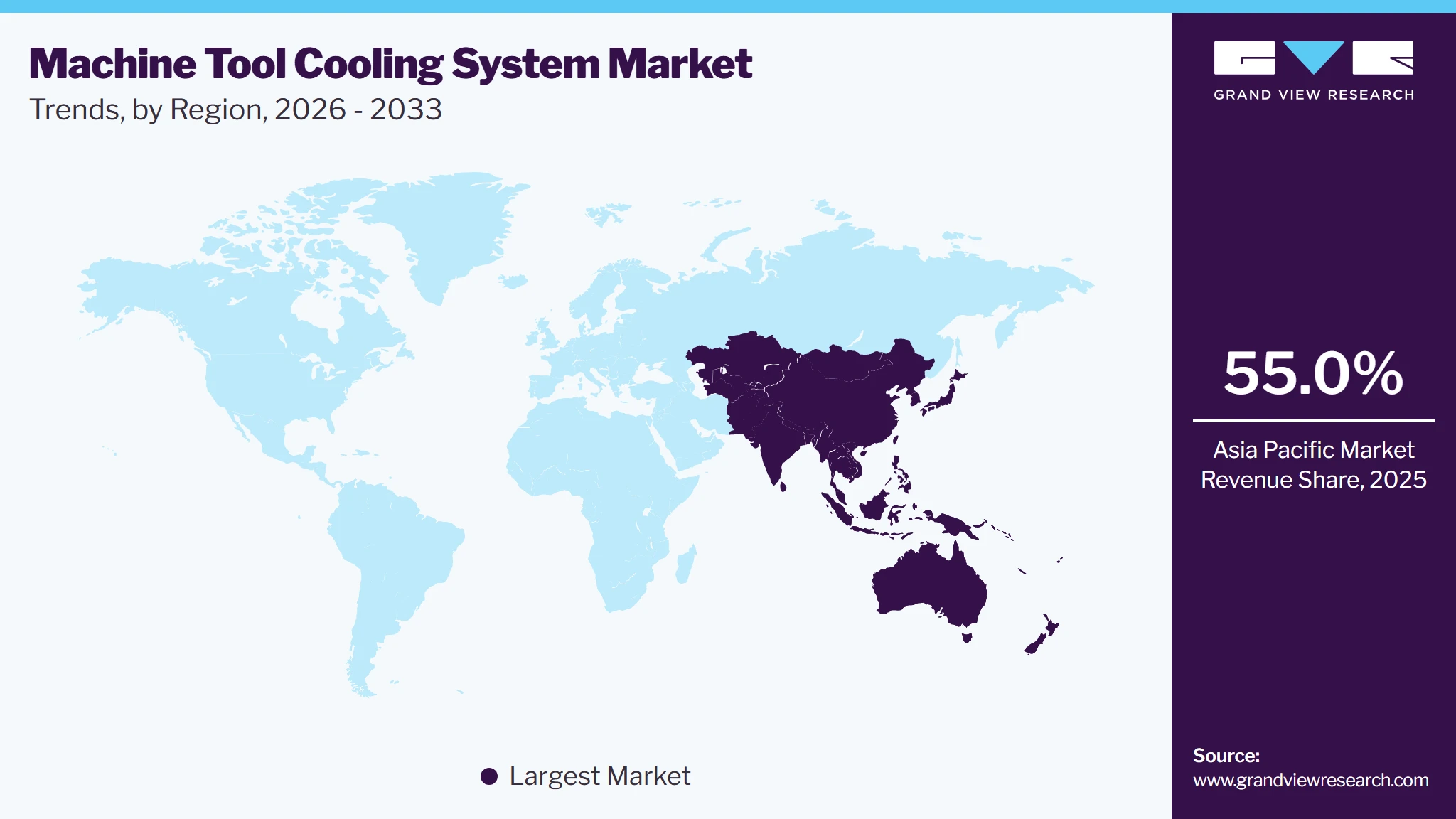
The global machine tool cooling system market size was valued at USD 4.7 billion in 2025 and is projected to grow from USD 4.9 billion in 2026 to USD 7.0 billion by 2033, at a CAGR of 5.1% from 2026 to 2033. Asia Pacific dominated the market, accounting for a revenue share of 55.0% in 2025. The expansion of automotive, aerospace, and precision engineering production is driving demand for machine tool cooling systems as these industries increasingly use high-speed and high-precision machining for producing components with tight dimensional tolerances.
Key Market Trends & Insights
- By product: Spindle cooling systems held the largest revenue share of 33.4% in 2025.
- By cooling technology: Liquid cooling systems led the market with a share of 71.7% in 2025.
- By end-use: Aerospace is expected to grow at the fastest CAGR of 6.5% from 2026 to 2033.
Regional Highlights
- Largest regional market: Asia Pacific (55.0% revenue share, 2025)
- By country: China held the largest market share in 2025.
Market Size & Forecast
- Market size in 2025: USD 4.7 Billion
- Estimated market size in 2026: USD 4.9 Billion
- Projected market size by 2033: USD 7.0 Billion
- CAGR (2026-2033): 5.1%
Three ways to get this report
Buy it, customize it, or ask a question.Get the Full Report
What the study covers
- FormatsPDF · Excel · Dashboard
- Timeline2026–2033 annual, 2025 base
- Coverage20+ countries, 5 regions
- Companies10+ key players profiled
Customize the Report
20% free customization
- IncludeCountries, segments, points
- TailorTo your product definition
- ExtendDeeper competitor detail
- OrA fully bespoke study
- Turnaround5–10 working days
Ask Prism AI
A cited answer in seconds
- Corpus30K studies, 1.2M points
- ScopeAll markets, not just this
- CitationTraced to report & table
- HonestySays "not covered" if so
- SpeedSeconds, not days
Manufacturers are upgrading existing equipment with more efficient cooling technologies to reduce thermal deformation and maintain consistent machining performance. Increasing use of compact, energy-efficient chillers and closed-loop cooling systems is further supporting market development. Rising investment in advanced manufacturing facilities, particularly across Asia Pacific and North America, is expected to sustain demand.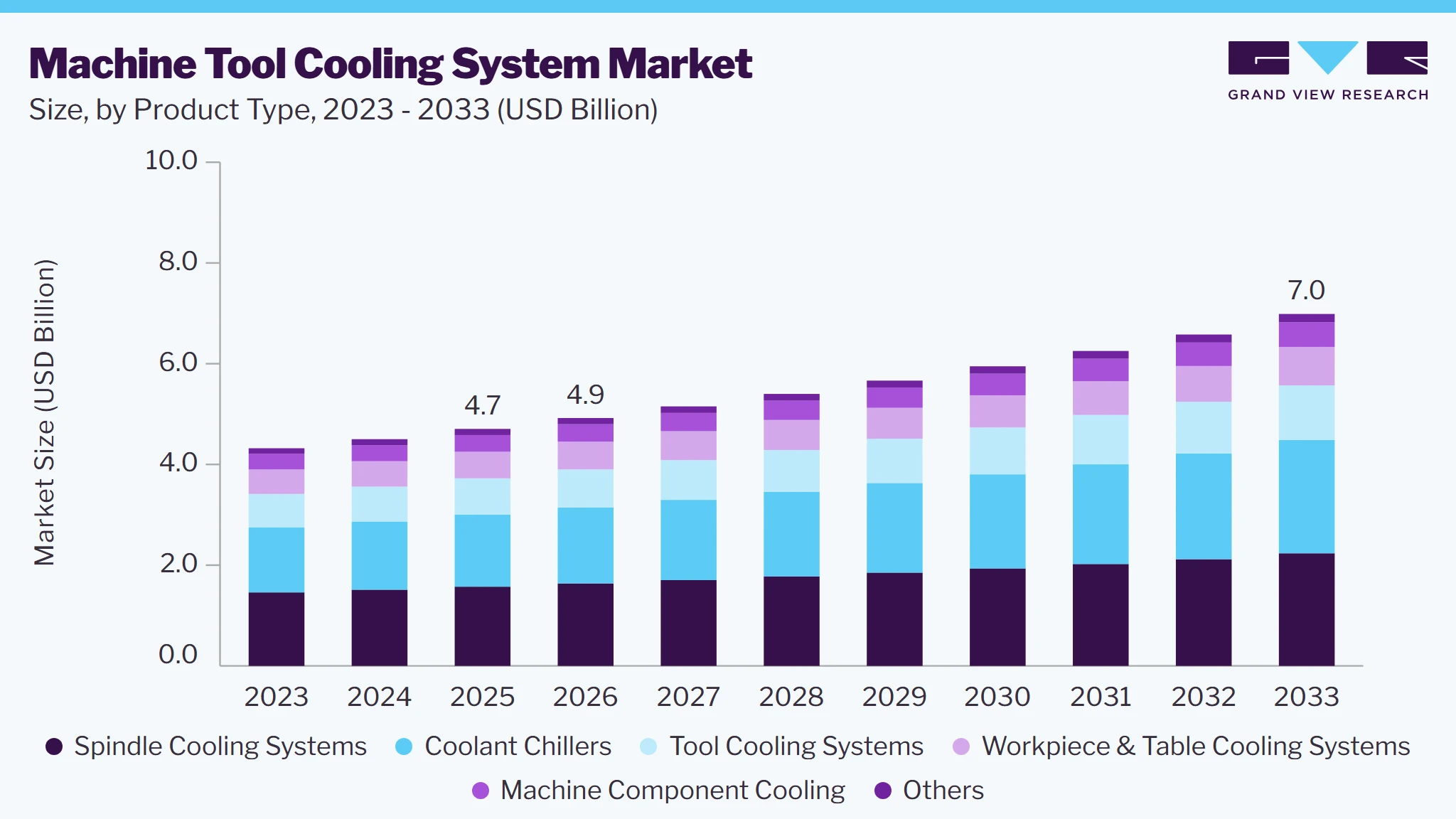
Market Dynamics
The machine tool cooling system market is influenced by the need to maintain stable operating temperatures, machining accuracy, and equipment reliability across industrial production. Demand varies with machine utilization, cooling capacity requirements, component configuration, and production intensity. Adoption is also affected by energy consumption, system maintenance, refrigerant requirements, and initial equipment costs. Manufacturers are developing more compact and responsive cooling solutions to accommodate advanced machine tools. At the same time, differences in machine specifications and operating environments create demand for application-specific cooling configurations.
The increasing use of high-speed machining is driving demand for machine tool cooling systems due to higher spindle speeds and cutting rates generate greater heat within machine components and cutting processes. Excessive heat can affect dimensional stability, accelerate tool deterioration, and reduce machining consistency. Cooling systems dissipate this heat and maintain controlled operating conditions during intensive machining cycles. As manufacturers adopt high-speed machining to improve production throughput and process precision, the requirement for effective temperature management across spindles, motors, hydraulic systems, and coolant circuits is increasing.
High initial equipment costs can restrain adoption of machine tool cooling systems, particularly among small and medium-sized manufacturers operating with limited capital budgets. Advanced chillers, temperature-control units, filtration systems, and integrated monitoring components can increase the overall investment required for a machine tool installation. Retrofitting existing machinery may also require modifications to coolant circuits, electrical connections, and mounting arrangements. Consequently, some users may continue operating existing cooling arrangements or select simpler systems, limiting demand for higher-value cooling technologies despite their longer-term operational benefits.
The development of smart cooling systems presents an opportunity for manufacturers to differentiate products through real-time monitoring and automated temperature management. Sensors can collect information on coolant temperature, flow rate, pressure, and equipment operating conditions, enabling cooling performance to be adjusted according to actual requirements. Integration with machine monitoring platforms can also provide alerts for abnormal conditions and maintenance requirements. Such capabilities can reduce unnecessary cooling operation, improve system visibility, and support condition-based maintenance, creating opportunities for intelligent cooling solutions in digitally connected manufacturing environments.
Market Concentration & Characteristics
The machine tool cooling system market is fragmented due to the presence of numerous global, regional, and specialized manufacturers offering different cooling technologies for specific machine tool applications. Companies compete across spindle chillers, coolant systems, heat exchangers, hydraulic cooling, and enclosure cooling, with product offerings varying by cooling capacity, temperature control, machine configuration, and application requirements. Local manufacturers also serve specific industrial markets, increasing competition and limiting market concentration.
The machine tool cooling system market is experiencing high innovation, with manufacturers developing compact, energy-efficient, and intelligent cooling solutions. Innovations including variable-speed compressors, improved heat exchangers, closed-loop temperature control, and monitoring systems that adjust cooling performance according to machine operating conditions. Integration of sensors and digital monitoring enables predictive maintenance and improves temperature stability. These developments are increasing cooling efficiency while reducing energy consumption and operating costs.
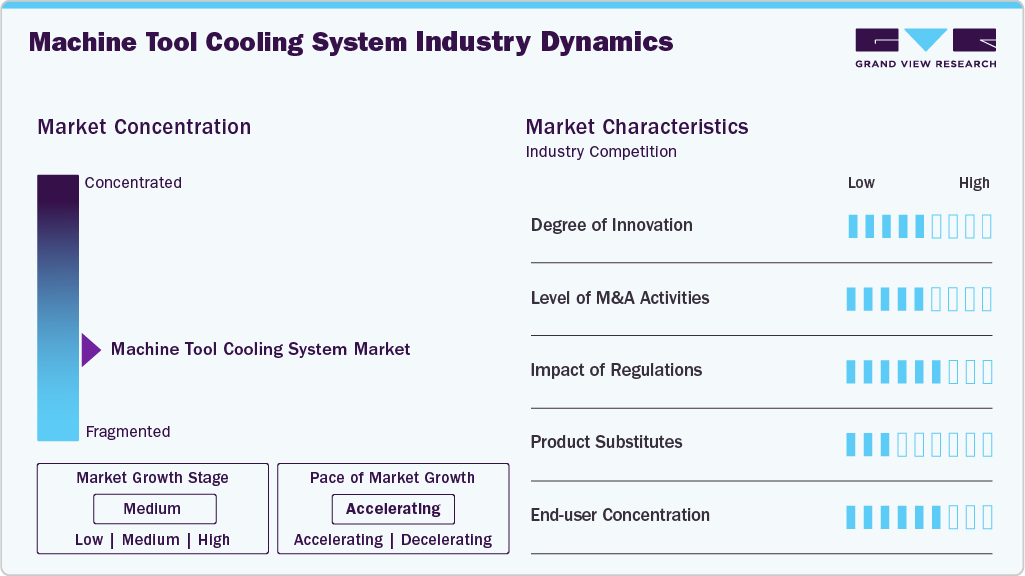
Regulations are shaping the machine tool cooling system market through requirements related to energy efficiency, refrigerant use, environmental emissions, electrical safety, and industrial equipment performance. For instance, regulations such as EU F-Gas Regulation (EU) 2024/573, U.S. Environmental Protection Agency AIM Act, EU Ecodesign Directive (2009/125/EC), EU RoHS Directive (2011/65/EU), and IEC 60204-1 for electrical safety of machinery influence refrigerant selection, energy efficiency, environmental performance, hazardous substance use, and electrical safety requirements for machine tool cooling systems.
Analyst Perspective
The machine tool cooling system market is influenced by increasing requirements for effective heat management, machining precision, tool life, and operational reliability across CNC machining operations. Automotive, aerospace, metalworking, electronics, medical equipment, and general manufacturing industries use cooling systems to control heat generated during high-speed and high-precision machining. Demand is also supported by increasing adoption of advanced CNC machines, automation, and high-speed machining processes. Asia Pacific and Latin America are emerging as high-growth regions, supported by manufacturing expansion, investments in machine tools, and increasing adoption of advanced machining technologies.
Product Insights
The spindle cooling systems segment led the market with a revenue share of 33.4% in 2025, due to the widespread use of high-speed spindles in precision machining applications. Effective spindle temperature management is essential for controlling thermal expansion and maintaining machining accuracy. Increasing utilization of computer numerical control machine tools across automotive, aerospace, electronics, and general manufacturing supported demand for dedicated spindle cooling solutions.
The coolant chillers segment is expected to grow at 5.9% CAGR during forecast period, as manufacturers increasingly require precise coolant temperature control during intensive machining operations. Coolant chillers maintain stable fluid temperatures, supporting consistent cutting conditions and reducing temperature-related variations. Their application across multiple machine tools and suitability for continuous production environments are expected to accelerate adoption, particularly in precision manufacturing facilities.
Cooling Technology Insights
The liquid cooling systems segment dominated the market, accounting for a revenue share of 71.7% in 2025, due to strong demand from automotive, aerospace, and precision engineering manufacturers using high-speed machining equipment. These industries generate substantial heat during continuous cutting and spindle operations, requiring efficient heat removal to maintain dimensional accuracy. Liquid cooling provides consistent temperature control for spindles, motors, hydraulic systems, and cutting processes, supporting its widespread adoption in demanding production environments.
The hybrid cooling segment is expected to grow at the fastest CAGR of 6.2% over forecast period, as manufacturers seek cooling solutions that combine different heat-management approaches according to machine operating conditions. Hybrid systems can improve temperature control across varying loads while optimizing energy consumption and cooling performance. Their flexibility for complex machine configurations and demanding machining environments is expected to encourage adoption in advanced manufacturing facilities.
End-use Insights
The automotive segment led the market in 2025, holding 39.9% market share due to the high volume of precision machining required for automotive components. Engine blocks, transmission parts, brake components, and other metal parts undergo continuous machining, generating significant heat that must be controlled to maintain dimensional accuracy and production consistency. This sustained machining requirement supported strong demand for cooling systems.
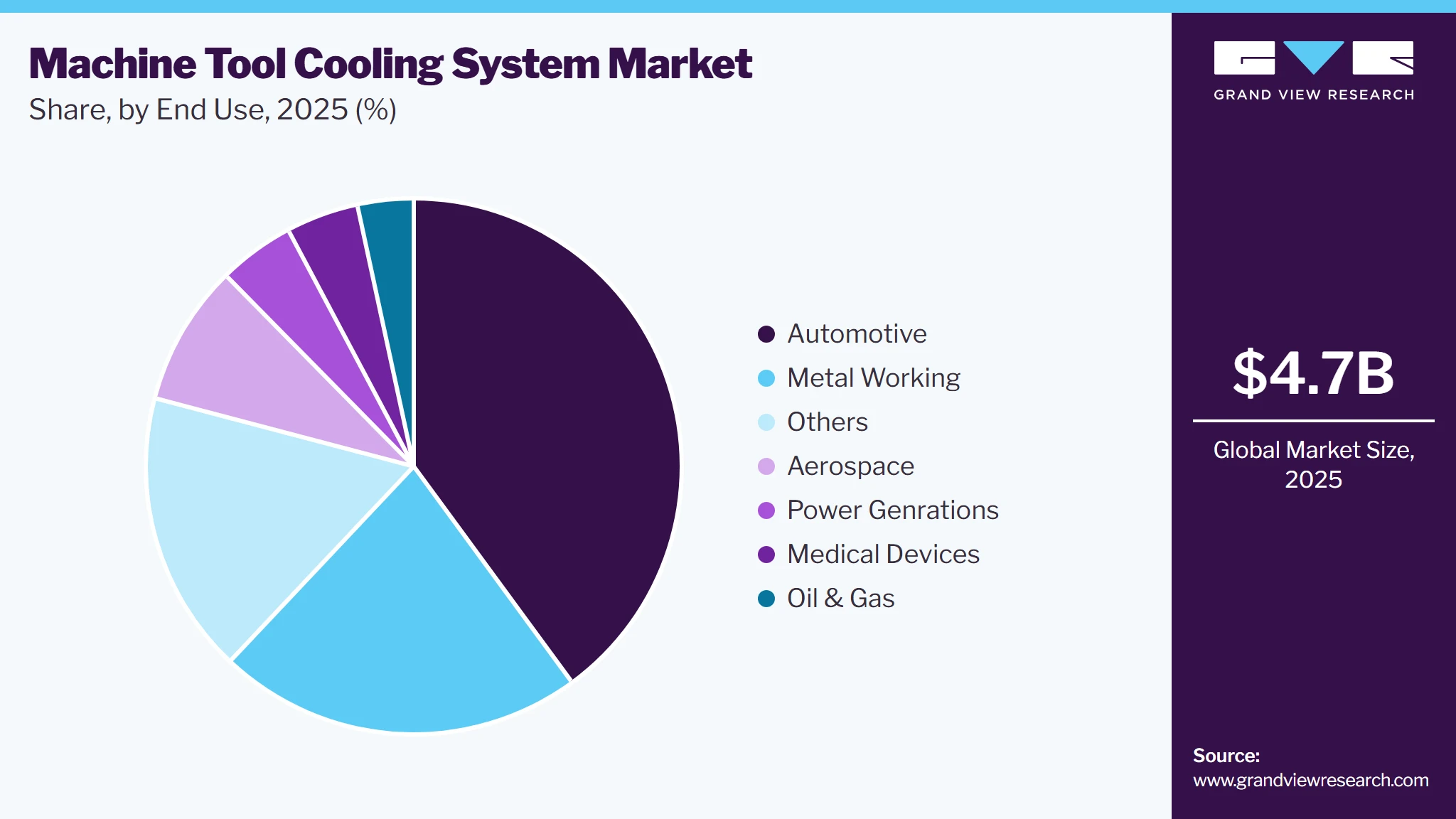
The aerospace segment is expected to grow at the fastest CAGR of 6.5% from 2026 to 2033, due to the increasing machining of heat-resistant aerospace alloys. Materials such as titanium and nickel-based alloys generate substantial heat during cutting owing to their low thermal conductivity and machining difficulty. Effective cooling is therefore required to control cutting temperatures, protect tools, and maintain the dimensional accuracy of complex aerospace components.
Regional Insights
Asia Pacific dominated the market, accounting for a revenue share of 55.0% in 2025. Machine tool cooling system market in APAC is primarily driven by automotive component manufacturing, particularly China, India, Japan. As manufacturers across the region ramp up production of battery housings, motor components, and drivetrain parts, machining tolerances have become considerably tighter than those required for traditional combustion engine parts, pushing component producers to adopt cooling systems capable of sustaining thermal stability across high-volume, high-precision production lines.
China Machine Tool Cooling System Market Trends
China machine tool cooling system market is driven primarily by its domestic electric vehicle manufacturing base, now the largest in the world, where component producers machine battery enclosures, motor housings, and drivetrain parts at massive production scale. These components require tighter dimensional tolerances than traditional automotive parts, and the sheer production volume across China's EV supply chain means even marginal improvements in cooling system reliability translate into significant gains in yield and reduced tool replacement costs.
Machine tool cooling system market in India is expected to grow due to its expanding automotive component export industry, where domestic manufacturers supply parts to global OEMs under strict international quality certifications. Meeting these certification standards requires precise thermal control during machining to ensure consistent dimensional accuracy across large production batches, pushing Indian component manufacturers to upgrade from basic cooling setups toward more reliable systems capable of supporting export-grade quality requirements.
North America Machine Tool Cooling System Market Trends
North America machine tool cooling system market is growing due to the strong aerospace and defense manufacturing base, where cooling systems support the machining of tight-tolerance components made from titanium and nickel-based superalloys, including turbine blades and structural airframe components. These materials generate significant heat during cutting and are prone to work-hardening if thermal control is inadequate, making reliable coolant delivery essential to maintaining dimensional accuracy and surface finish across long production runs for both commercial and defense aircraft programs.
Machine tool cooling system market in the U.S. is expected to remain a major market, supported by aerospace primes and their extensive supplier networks, where machining of turbine components and structural parts from titanium and Inconel requires cooling systems capable of managing extreme heat generation during cutting. These alloys conduct heat poorly and wear tooling quickly without adequate thermal control, making cooling system reliability a direct factor in production yield, part consistency, and tool life across the aerospace supply chain's high-precision manufacturing environment.
Europe Machine Tool Cooling System Market Trends
Machine tool cooling system market in Europe is expected to grow due to EU environmental and fluid disposal directives, which impose strict requirements on how manufacturers handle, filter, and dispose of used cutting fluids. These regulations are pushing facilities across the region toward closed-loop cooling systems that recycle coolant internally, reducing both waste disposal costs and regulatory compliance risk, a shift that has become a standard purchasing consideration for European manufacturers upgrading or replacing machining equipment.es.
Machine tool cooling system market in Germany is expected to grow at 4.8% CAGR during forecast period, primarily driven by its automotive sector's transition toward electric vehicle production, where component manufacturers are re-tooling factories to machine battery enclosures and motor housings requiring tighter tolerances than traditional engine parts. This shift is prompting widespread investment in updated cooling systems capable of supporting the higher-precision machining standards that EV component production demands.
UK machine tool cooling system market is driven by its aerospace sector, anchored around Rolls-Royce and its extensive supply chain producing turbines and engine components. Machining superalloys used in jet engine parts generates substantial cutting heat and requires precise thermal management to avoid tool degradation and maintain the tight tolerances demanded by aerospace certification standards, making cooling system performance a critical factor throughout the UK's aerospace component manufacturing base.
Middle East & Africa Machine Tool Cooling System Market Trends
Machine tool cooling system market in MEA is driven primarily by oil & gas equipment fabrication, supporting valve, pipeline, and drilling component manufacturing for the region's dominant energy sector. These components are typically machined from corrosion-resistant alloys designed to withstand harsh operating environments, and cutting such materials generates significant heat that requires robust cooling systems to prevent tool wear and maintain the precise tolerances required for high-pressure drilling and pipeline applications.
Machine tool cooling system market in Saudi Arabia is driven by oil & gas equipment manufacturing, where cooling systems support the fabrication of valves, pipelines, and drilling components for the Kingdom’s extensive upstream and downstream petrochemical infrastructure. These parts are machined from corrosion- and pressure-resistant alloys that generate substantial cutting heat, and as Saudi Arabia pushes to localize equipment manufacturing under its Vision 2030 agenda rather than relying on imports, domestic fabricators are investing in cooling systems capable of supporting this demanding, alloy-heavy production work.
Latin America Machine Tool Cooling System Market Trends
Latin America is expected to grow at 4.9% CAGR during forecast period in machine tool cooling system market. Primarily driven by automotive component manufacturing in Brazil where facilities supply both domestic vehicle assembly plants and export markets across the Americas. Meeting the quality standards required by international automakers demands consistent machining precision, and as regional manufacturers work to remain competitive with more automated global suppliers, investment in reliable cooling systems has become central to maintaining acceptable tolerances across high-volume component production.
Machine tool cooling system market in Brazil is growing at 5.1% CAGR during forecast period, driven by established automotive manufacturing and component supply base. Vehicle and automotive component producers use machining equipment extensively for manufacturing metal parts that require consistent dimensions and surface quality. Continuous machining generates heat that can influence tool performance and component accuracy, creating demand for effective cooling systems.
Key Machine Tool Cooling System Company Insights
Some of the key players operating in the market include Daikin Industries, HYDAC International, LNS Group, Rittal GmbH & Co. KG, HYFRA, Dimplex Thermal Solutions, Thermal Care, among others.
-
Dimplex Thermal Solutions specializes in thermal management and temperature-control systems for industrial applications. The company provides cooling solutions designed to regulate operating temperatures in manufacturing, electronics, laser, medical, and other intensive equipment environments. Its portfolio includes chillers, cooling systems, and related thermal management technologies that support reliable equipment operation, process stability, and efficient heat dissipation across industrial applications.
-
Daikin Industries is a Japanese manufacturer specializing in air conditioning, refrigeration, and thermal management technologies. The company provides cooling and temperature-control systems for industrial and commercial applications. Its portfolio includes chillers and cooling equipment that support machine tool applications by managing heat generated during machining processes, maintaining equipment temperature, dimensional accuracy, and operational stability.
Key Machine Tool Cooling System Companies
The following key companies have been profiled for this study on the machine tool cooling system market.
-
Advance Cooling Systems Pvt. Ltd.
-
Daikin Industries
-
Dimplex Thermal Solutions
-
Filtrine Manufacturing Company
-
Gemorion Machinery Pvt Ltd
-
GMN PAUL MÜLLER INDUSTRIE GMBH & CO. KG
-
HYDAC International
-
HYFRA
-
LNS Group
-
Rittal GmbH & Co. KG
-
S&A Chiller
-
Sprinkle Cooling Technology
-
Thermal Care
-
Turmoil Manufacturing Co
-
YFRA Industriekühlanlagen GmbH
Competitive Benchmarking
Operating Strategies
Competitive Edge
Weaknesses
Mature Players: Daikin Industries, HYDAC International, LNS Group, Rittal GmbH & Co. KG, HYFRA, Dimplex Thermal Solutions, Thermal Care, GMN PAUL MÜLLER INDUSTRIE GMBH & CO. KG
Mature players focus on expanding global distribution networks, developing energy-efficient cooling systems, strengthening machine tool manufacturer partnerships, and integrating advanced temperature-control technologies to address precision machining requirements and diverse industrial operating conditions.
Their competitive advantage comes from established brand recognition, broad product portfolios, international service networks, engineering expertise, manufacturing capabilities, and ability to provide customized cooling solutions for complex machine tool applications.
- Established players often face higher operating and manufacturing costs, complex organizational structures, and longer product-development cycles.
- Their broad portfolios may also reduce flexibility when responding rapidly to highly specialized requirements from smaller machine tool manufacturers.
Emerging Players: S&A Chiller, Filtrine Manufacturing Company, Turmoil Manufacturing Co, YFRA Industriekühlanlagen GmbH, Advance Cooling Systems Pvt. Ltd., Gemorion Machinery Pvt Ltd, Sprinkle Cooling Technology
Emerging players primarily target specialized machine tool applications through customized cooling systems, competitive pricing, shorter delivery times, regional distribution, and application-specific engineering.
They increasingly focus on compact, energy-efficient systems suited to small and medium-sized machining operations.
- Emerging companies benefit from greater operational flexibility, faster customization, specialized product offerings, competitive pricing, and closer relationships with regional machine tool manufacturers.
- Their focused product portfolios can enable quicker responses to specific cooling requirements and changing customer preferences.
- Emerging players generally have smaller geographic footprints, limited financial resources, narrower distribution networks, and lower brand recognition.
- Limited production scale and service infrastructure can also restrict their ability to compete for large multinational machine tool manufacturers and geographically dispersed projects.
Recent Developments
-
In April 2026, Okuma America launched its high-pressure coolant system for CNC machines to support demanding machining operations. The system delivers coolants at elevated pressure, improving chip evacuation, tool cooling, and machining performance.
-
In October 2025, Rittal expanded its liquid cooling portfolio with solutions covering power classes from 1.5 to 7 kW, outdoor models, and a hybrid information technology chiller with free-cooling capability. The expansion includes mechanical engineering applications, supporting machine tool cooling requirements through improved thermal management, energy efficiency, and reliable temperature control.
Machine Tool Cooling System Market Report Scope
Report Attribute
Details
Market size in 2025
USD 4.7 billion
Estimated market size in 2026
USD 4.9 billion
Projected market size by 2033
USD 7.0 billion
Growth rate
CAGR of 5.1% from 2026 to 2033
Base year for estimation
2025
Historical data
2021 - 2024
Forecast period
2026 - 2033
Quantitative units
Revenue in USD billion and CAGR from 2026 to 2033
Report coverage
Revenue forecast, company market position analysis, competitive landscape, growth factors, and trends
Segments covered
Product type, cooling technology, end-use, region
Regional scope
North America; Europe; Asia Pacific; Latin America; Middle East & Africa
Country Scope
U.S.; Canada; Mexico; Germany; UK; Italy; Spain; France; China; Japan; India; Australia; South Korea; Brazil; Argentina; Saudi Arabia; UAE; South Africa
Key companies profiled
Dimplex Thermal Solutions; HYDAC International; Rittal GmbH & Co. KG; Turmoil Manufacturing Co; Filtrine Manufacturing Company; GMN PAUL MÜLLER INDUSTRIE GMBH & CO. KG; Sprinkle Cooling Technology; Advance Cooling Systems Pvt. Ltd.; Gemorion Machinery Pvt Ltd; YFRA Industriekühlanlagen GmbH; S&A Chiller; Thermal Care; LNS Group; Daikin Industries; HYFRA.
Customization scope
Free report customization (equivalent up to 8 analysts working days) with purchase. Addition or alteration to country, regional & segment scope.
Pricing and purchase options
Avail customized purchase options to meet your exact research needs. Explore purchase options
Global Machine Tool Cooling System Market Report Segmentation
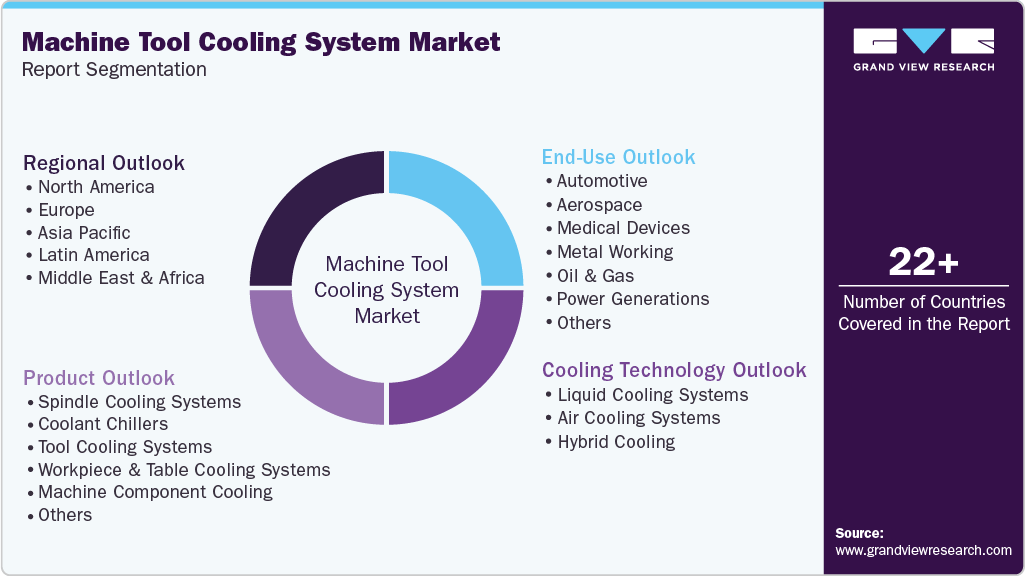
This report forecasts revenue growth at global, regional & country levels and provides an analysis on the industry trends in each of the sub-segments from 2021 to 2033. For this study, Grand View Research has segmented the machine tool cooling system market based on product, cooling technology, end-use, and region:
-
Product Outlook (Revenue, USD Billion, 2021 - 2033)
-
Spindle Cooling Systems
-
Coolant Chillers
-
Tool Cooling Systems
-
Workpiece & Table Cooling Systems
-
Machine Component Cooling
-
Others
-
-
Cooling Technology Outlook (Revenue, USD Billion, 2021 - 2033)
-
Liquid Cooling Systems
-
Air Cooling Systems
-
Hybrid Cooling
-
-
End-use Outlook (Revenue, USD Billion; 2021 - 2033)
-
Automotive
-
Aerospace
-
Medical Devices
-
Metal Working
-
Oil & Gas
-
Power Generations
-
Others
-
-
Regional Outlook (Revenue, USD Billion, 2021 - 2033)
-
North America
-
U.S.
-
Canada
-
Mexico
-
-
Europe
-
Germany
-
UK
-
France
-
Spain
-
Italy
-
-
Asia Pacific
-
China
-
Japan
-
India
-
Australia
-
South Korea
-
-
Latin America
-
Argentina
-
Brazil
-
-
Middle East and Africa
-
South Africa
-
Saudi Arabia
-
UAE
-
-
Research Methodology
The machine tool cooling system market figures in this report are based on a proven research process that combines executive interviews with secondary research from proprietary databases, company filings, and recognized regulatory and institutional sources. Market size is built through value-chain sizing - reconciling supply-side and demand-side estimates - and triangulated with bottom-up and top-down approaches. Every estimate passes multiple levels of expert validation before publication, with each machine tool cooling system segment quantified using the revenue-capture definitions in the table below.
Segment Definition
Segment - Product
Revenue Capture Definition
Spindle Cooling Systems
Revenue is captured from dedicated cooling equipment used to manage heat generated by machine tool spindles during continuous and high-speed machining operations.
Coolant Chillers
Revenue is generated through the sale of chilling units that maintain coolant at controlled temperatures before and during circulation within machine tools.
Tool Cooling Systems
Revenue is captured from equipment designed to cool cutting tools during machining, supporting thermal control, cutting performance, and tool operating life.
Workpiece & Table Cooling Systems
Revenue is derived from cooling solutions that regulate temperatures of workpieces, machine tables, fixtures, and related surfaces during machining processes.
Machine Component Cooling
Revenue is generated from thermal management equipment used for motors, bearings, drives, hydraulic units, and other heat-producing machine tool components.
Others
Revenue is captured from other machine tool cooling products such as coolant filtration and circulation systems, cooling units for hydraulic systems, electrical cabinet cooling, lubrication cooling systems, auxiliary machine cooling systems, and other specialized cooling equipment.
Segment -Cooling Technology
Revenue Capture Definition
Liquid Cooling Systems
Revenue is derived from systems employing water, coolant, or other liquid-based fluids to absorb and transfer heat from machine tools and their components.
Air Cooling Systems
Revenue is generated from air-based cooling equipment that removes heat through forced or conditioned airflow around machine tools and heat-generating components.
Hybrid Cooling
Revenue is captured through combined air- and liquid-based cooling solutions that provide temperature regulation for applications requiring multiple heat-dissipation mechanisms.
Segment -
End Use
Revenue Capture Definition
Automotive
Revenue is generated from cooling systems supplied for automotive machining operations involving engines, transmissions, vehicle components, and other precision-machined parts.
Aerospace
Revenue is captured from cooling equipment used in aerospace component machining, particularly for precision manufacturing of aircraft structures, engine parts, and related components.
Medical Devices
Revenue is derived from systems installed in machining operations producing implants, surgical instruments, medical devices, and other precision medical components.
Oil & Gas
Revenue is generated from cooling solutions deployed for machining valves, pumps, drilling equipment, fittings, and other oil and gas components.
Metal Working
Revenue is captured from cooling equipment used across turning, milling, grinding, drilling, cutting, and other metalworking processes.
Power Generations
Revenue is derived from cooling systems supporting machining and manufacturing of turbines, generators, power equipment, and other precision components used in power generation.
Others
Revenue is generated from machine tool cooling systems supplied to industries such as electronics & semiconductors, general industrial manufacturing, railways & transportation equipment.
Estimation Model
Layer No.
Layer Name
Key Question
Description
01
Industrial Activity & Machining Demand Layer
Which industries and machining activities generate demand for machine tool cooling systems?
The estimation begins by evaluating machining-intensive industries such as automotive, aerospace, medical devices, oil and gas, metalworking, power generation, electronics and semiconductor, machinery and equipment, and other manufacturing sectors. CNC machine installations, machining volumes, production intensity, and adoption of high-speed and precision machining determine the underlying requirement for cooling systems.
02
Product & Cooling Technology Layer
Which cooling products and technologies determine market demand?
This layer refines demand by assessing spindle cooling systems, coolant chillers, tool cooling systems, workpiece and table cooling systems, machine component cooling, and others across liquid cooling systems, air cooling systems, and hybrid cooling technologies. Cooling capacity, temperature-control requirements, machine configuration, and machining conditions influence product selection.
03
End-Use & Deployment Layer
What determines machine tool cooling system utilization and deployment?
Market demand is estimated through deployment across automotive, aerospace, medical devices, oil and gas, metalworking, power generation, electronics and semiconductor, machinery and equipment, and other industries. CNC machine utilization, machining precision, operating speeds, heat generation, production expansion, equipment upgrades, maintenance requirements, and replacement cycles influence new installations and replacement demand.
04
Revenue Layer
How is total market revenue calculated?
Revenue is estimated by aggregating spending on machine tool cooling systems across Products, cooling technologies, end-use industries, and regional markets. New installations and replacement demand are assessed using system volumes, average selling prices, cooling capacity, technology specifications, machine tool compatibility, application requirements, and purchasing activity to validate the overall market size.
Delivered Customizations
This report has been delivered with the following In-depth customizations
Client Request
Customization Delivered
Value Adds
Regional Segmentation
Detailed regional analysis was conducted across North America, Europe, Asia Pacific, Latin America, and the Middle East & Africa, including country-level assessment for key markets such as the U.S., Germany, China, India, Brazil, and Saudi Arabia. The study evaluated machine tool production, CNC machine adoption, manufacturing activity, automotive and aerospace production, metalworking industries, industrial automation, and investments in advanced machining infrastructure influencing cooling system demand.
Helped identify regional differences in machine tool cooling system adoption, country-specific demand patterns, manufacturing activity, and markets with increasing thermal management requirements. The analysis also supported assessment of CNC machine installations, high-speed machining adoption, industrial expansion, and replacement requirements across major markets.
Competitive benchmarking
Comprehensive benchmarking was carried out for major machine tool cooling system market participants based on product portfolios, cooling technologies, cooling capacity, temperature-control capabilities, energy efficiency, system configuration, customization capabilities, application coverage, manufacturing capabilities, geographic presence, distribution networks, and aftermarket services.
Assisted clients in understanding competitor positioning, product differentiation, cooling technology capabilities, application coverage, geographic presence, distribution strategies, product development activities, and technological developments within the machine tool cooling system market.
Opportunity assessment
In-depth opportunity assessment was conducted by analyzing automotive, aerospace, metalworking, electronics, medical equipment, general manufacturing, and other industries using CNC machine tools. The study evaluated opportunities related to centralized cooling systems, compact cooling units, high-precision temperature-control systems, energy-efficient cooling technologies, and replacement of aging cooling equipment.
Enabled clients to identify markets with increasing machine tool cooling requirements and evaluate opportunities across cooling technologies, machine tool applications, end-use industries, and geographic markets.
Frequently Asked Questions About This Report
The global machine tool cooling system market size was valued at USD 4.7 billion in 2025 and is estimated at USD 4.9 billion in 2026.
The machine tool cooling system market is expected to grow at a CAGR of 5.1% from 2026 to 2033 to reach USD 7.0 billion by 2033.
The spindle cooling systems segment led the market with a revenue share of 33.4% in 2025, while coolant chillers segment is the fastest-growing product.
The liquid cooling systems segment dominated the market, accounting for a revenue share of 71.7% in 2025, while hybrid cooling segment is the fastest-growing cooling technology.
Key players include Dimplex Thermal Solutions; HYDAC International; Rittal GmbH & Co. KG; Turmoil Manufacturing Co; Filtrine Manufacturing Company; GMN PAUL MÜLLER INDUSTRIE GMBH & CO. KG; Sprinkle Cooling Technology; Advance Cooling Systems Pvt. Ltd.; Gemorion Machinery Pvt Ltd; YFRA Industriekühlanlagen GmbH; S&A Chiller; Thermal Care; LNS Group; Daikin Industries; HYFRA
Key factors driving the machine tool cooling system market include increasing CNC machine adoption, rising high-speed and precision machining requirements, growing automotive and aerospace production, greater emphasis on tool life and machining accuracy, increasing automation, and demand for energy-efficient temperature-control solutions in manufacturing operations.
Asia Pacific dominated the market, accounting for a revenue share of 55.0% in 2025.
The automotive segment led the market and accounted for 39.9% market revenue share in 2025, while aerospace segment is the fastest-growing end-use.
About the Author(s)
Advanced Interior Materials Research Team
Advanced Materials · Advanced Interior MaterialsThis report was authored by the advanced interior materials research team at Grand View Research - comprising two research analysts, one senior research analyst, and one industry expert - with specialized expertise in the advanced interior materials segment of the advanced materials industry. All findings are based on proprietary advanced materials databases, executive interviews, and regulatory analysis, subject to internal peer review prior to publication.
Last Updated:
Speak to Analyst


Customize this report to your needs - add regions, segments, or data points, with 20% free customization.
Or view our licence options:


ISO 9001:2015 & 27001:2022 Certified
We are GDPR and CCPA compliant! Your transaction & personal information is safe and secure. For more details, please read our privacy policy.


