
- Home
- »
- Organic Chemicals
- »
-
Malonic Acid Market Size, Share & Trends Report, 2026-2033GVR Report cover

Malonic Acid Market (2026 - 2033)
Size, Share & Trends Analysis Report By Application (Flavor Enhancer, API, Additive, pH Controller, Precursor), By End Use (Pharmaceutical, Agriculture, Plastics, Paints & Coatings), By Region, And Segment Forecasts
Market Size, 2025
$146.4MMarket Estimate, 2026
$154.4MMarket Forecast, 2033
$223.3MCAGR, 2026–2033
5.4%Malonic Acid Market Summary
The global malonic acid market size was valued at USD 146.4 million in 2025 and is projected to grow from USD 154.4 million in 2026 to USD 223.3 million in 2033, at a CAGR of 5.4% from 2026 to 2033. Europe dominated the market, accounting for a revenue share of around 40.5% in 2025. Malonic acid is a type of dicarboxylic acid characterized by the chemical formula C3H4O4. It is a crystalline powder with a sharp taste; it is soluble in both water and ethanol. This compound is heavily utilized in various industries, such as pharmaceuticals, food and beverage, and agriculture. The market for malonic acid has witnessed increased demand because of rising agricultural demand.
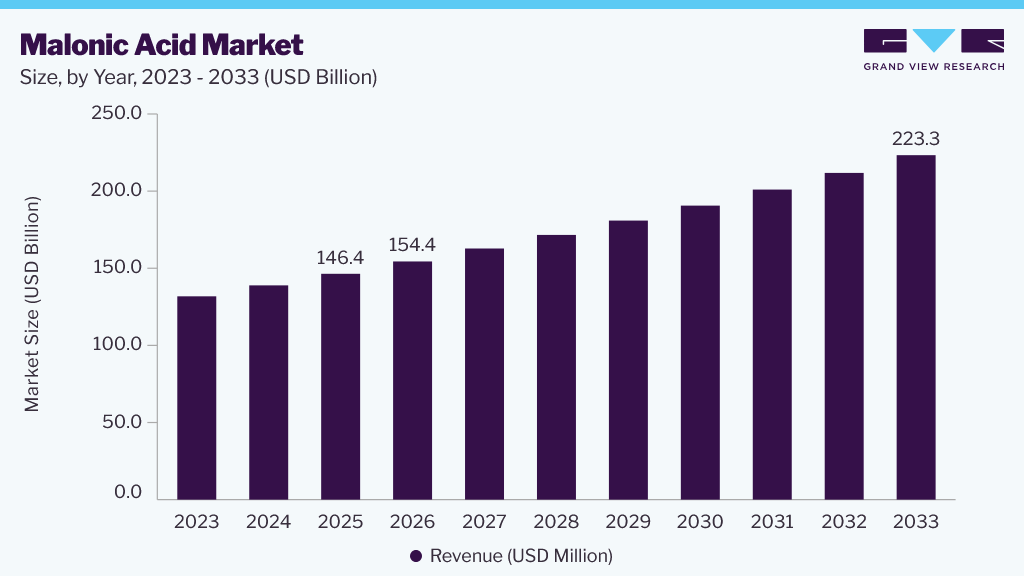 Source: Grand View Research, IR Documents, Primary Interviews, Paid DatabasesTo learn more about this report,
 Download Free Sample Report
Key Market Trends & Insights
- By end-use: The food & beverage end-use segment dominated the market with a revenue share of over 28.0% in 2025.
- By application: The flavor enhancer application segment dominated the market with a revenue share of over 26.0% in 2025.
Regional Highlights
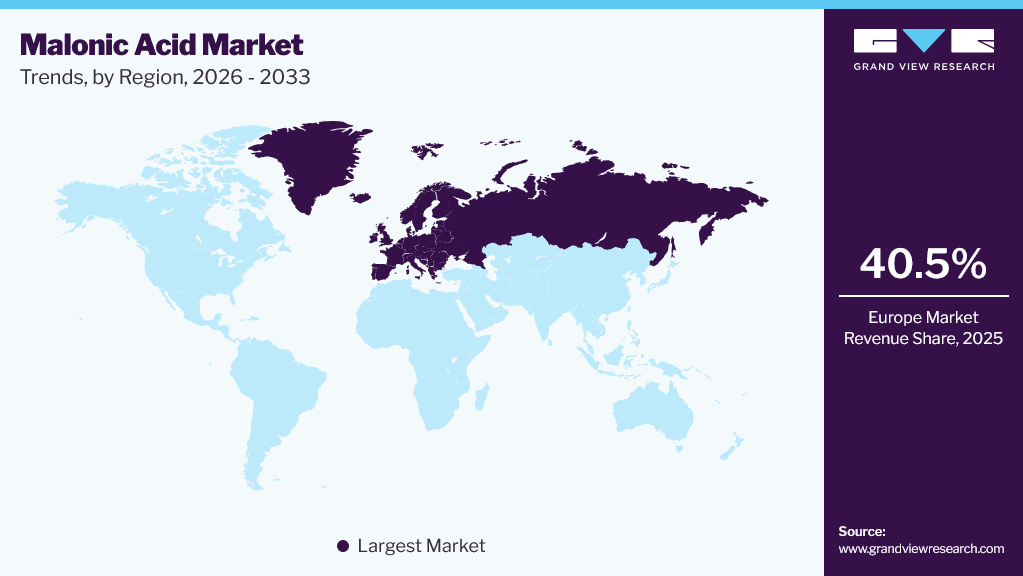
- Largest regional market: Europe (40.5% revenue share, 2025)
- Fastest-growing regional market: North America (Highest CAGR, 2026-2033)
Market Size & Forecast
- Market size in 2025: USD 146.4 Million
- Estimated market size in 2026: USD 154.4 Million
- Projected market size by 2033: USD 223.3 Million
- CAGR (2026-2033): 5.4%
Prism AI by Grand View Research Free to tryAsk a question about the malonic acid marketTry asking✓Every figure cited from GVR research Prefer the report? Download free sample →Malonic acid, a decarboxylated organic compound, finds widespread application in the agricultural industry owing to its role as a precursor in the synthesis of a range of herbicides, insecticides, and fungicides. Additionally, its effectiveness as a pH adjuster and buffer in agriculture formulations makes it a valuable component in crop protection products. This, in turn, is expected to positively impact the overall industry growth in the coming years.
The U.S. is one of the major markets for malonic acid globally. The demand for malonic acid is expected to surge due to rising demand in the pharmaceutical, food additive, and cosmetic sectors. Notably, there is a growing trend of using renewable raw materials to incorporate malonic acid into industrial processes, reflecting an increasing inclination towards sustainable and eco-friendly practices in the chemical industry.
The growing focus on sustainable and renewable chemical production is encouraging the development of bio-based manufacturing technologies for malonic acid and its derivatives. For instance, in September 2024, Lygos announced a partnership with CJ Bio to establish a commercial-scale production facility in Iowa capable of producing approximately 40,000 metric tons per year of bio-based malonic acid and related specialty chemicals using fermentation technology. The initiative highlights increasing industry investments in renewable feedstocks and environmentally friendly production processes, which are expected to support the long-term growth of the malonic acid market.
Analyst Perspective
The malonic acid market is driven by rising demand across agrochemicals, pharmaceuticals, food additives, and specialty chemical applications. A notable trend shaping the industry is the transition toward sustainable, bio-based production methods, as manufacturers seek to reduce their dependence on petrochemical feedstocks and align with evolving environmental regulations. Investments in fermentation-based manufacturing technologies and renewable raw material platforms are accelerating the commercialization of bio-derived malonic acid, thereby improving production efficiency and reducing environmental impact. Furthermore, the growing adoption of malonic acid as a key intermediate in crop protection chemicals and high-value pharmaceutical formulations is expected to strengthen market demand. As technological advancements continue to enhance scalability and cost competitiveness, the market is likely to benefit from expanding industrial applications and increasing emphasis on sustainable chemical manufacturing practices.
Application Insights
The flavor enhancer application segment dominated the market, accounting for over 26.0% of revenue in 2025. This high share is attributed to the use of malonic acid as a flavoring agent and acidulant in the food and beverage industry, which has driven significant demand growth, and this growth is projected to persist over the forecast period. The growing use of malonic acid as a flavoring agent and acidulant in the food and beverage industry has resulted in substantial expansion opportunities for manufacturers. In addition, it is used as an acidity controller, food preservative, and pharmaceutical excipient, as well as a precursor to polyesters and an active component in alkyd resins.
Furthermore, the versatility of malonic acid extends beyond its role as a flavor enhancer, as it serves as a critical building block in the synthesis of a wide range of high-value compounds. Its derivatives, particularly diethyl malonate and dimethyl malonate, are extensively utilized in the production of vitamins B1 and B6, barbiturates, and non-steroidal anti-inflammatory drugs (NSAIDs), reinforcing its significance in the pharmaceutical industry. The compound's ability to function as a cross-linking agent between corn starch and potato starch further broadens its applicability in food processing, while its role as a precursor to specialty polyesters and alkyd resins continues to drive demand from the paints, coatings, and plastics industries. As manufacturers increasingly explore bio-based production routes using renewable feedstocks such as sugar and glycerol, malonic acid is well-positioned to align with the global shift toward sustainable and eco-friendly chemical manufacturing practices.
End Use Insights
The food & beverage end-use segment dominated the market with a revenue share of over 28.0% in 2025. It is attributed to the rising production of food additives and flavoring agents, such as malonates, which are commonly used in the food and beverage industry to enhance taste and preserve freshness. Malonic acid is a highly valued acidulant and flavoring agent in the food processing industry. It has excellent blending abilities and its capacity to enhance flavors.
The food and beverage industry has witnessed a surge in demand for its products, with particular emphasis on Asian and Middle Eastern markets. The increasing domestic consumption of food and beverage products is a direct consequence of various factors, including population growth, product diversification through new product launches, and a robust network of retail outlets that facilitates product accessibility and distribution.
The increasing usage of malonic acid derivatives in the pharmaceutical sector as a fundamental building block for synthesizing several drugs is expected to drive market demand. In the pharmaceutical industry, malonic acid serves as a crucial precursor for producing essential drugs, including barbiturates, vitamin B1, and non-steroidal anti-inflammatory drugs.
The demand for malonic acid is substantial in the production of plant growth regulators that exert the capability to inhibit or stimulate plant growth. These regulators are essential for improving crop yield, quality, and stability against environmental stressors. The formulation of malonic acid can further enhance the delivery of critical micronutrients such as zinc, manganese, and iron to crops, resulting in overall improved plant growth and enhanced yield. These developments have profound implications in terms of fostering the production of foods in the market.
Regional Insights
Europe malonic acid market dominated the global industry with a revenue share of approximately 40.5% in 2025 due to the presence of several end-use industries, including food & beverage, pharmaceutical, agriculture, plastics, paints & coatings, and other applications. The growth of these industries is expected to fuel demand for the product over the forecast period. Europe's strong regulatory framework, particularly under the European Food Safety Authority (EFSA) and REACH regulations, has encouraged the adoption of high-purity, compliant chemical intermediates such as malonic acid across its well-established industrial base. The region's robust pharmaceutical manufacturing sector, concentrated in countries such as Germany, Switzerland, and France, continues to drive significant consumption of malonic acid derivatives in the synthesis of active pharmaceutical ingredients and drug formulations. In addition, Europe's growing emphasis on sustainable and bio-based chemical production aligns well with emerging malonic acid production technologies, further reinforcing the region's dominant market position. The expansion of the paints and coatings industry, driven by rising construction and automotive activities across Eastern and Western Europe, is also expected to sustain demand for malonic acid as a key component in alkyd resins and specialty coatings formulations over the forecast period.
 To learn more about this report, Download Free Sample Report
North America Malonic Acid Market Trends
The malonic acid market in North America is expected to witness the fastest growth over the forecast period. In developed countries, product utilization across end-use sectors such as food & beverages, pharmaceuticals, and personal care & cosmetics is more widespread, and this trend is anticipated to drive growth in the North American market in the near future. The North American region stands out for the presence of significant food & beverage and pharmaceutical industries, including Abbott, Pfizer Inc., Merck Sharp & Dohme Corp., and Bristol-Myers Squibb Company. Furthermore, the thriving pharmaceutical sectors in countries such as Mexico and the U.S. are projected to increase demand for the products. The U.S., in particular, serves as a critical hub for the synthesis of active pharmaceutical ingredients (APIs) and drug intermediates, where malonic acid and its derivatives, including diethyl malonate and dimethyl malonate, play an essential role as building blocks in the production of barbiturates, vitamins B1 and B6, and non-steroidal anti-inflammatory drugs (NSAIDs). Canada's well-established food processing industry further contributes to regional demand, as malonic acid is increasingly utilized as a flavoring agent, acidulant, and acidity controller across a wide range of processed food and beverage formulations.
Asia Pacific Malonic Acid Market Trends
The malonic acid market in Asia Pacific is expected to grow at a significant rate over the forecast period. China, India, and Japan represent the predominant manufacturing nations in the region. The escalating population levels in countries such as China and India, alongside rising incomes and purchasing power parities, have led to a substantial surge in demand for food and beverage products. The proliferation of food and beverage start-ups, particularly in India, is expected to further contribute to this trend, propelling industry demand across several industries in the foreseeable future. China's position as one of the world's largest producers and consumers of malonic acid is further reinforced by its expansive chemical manufacturing base, where domestic producers such as Wuhan Kemi-Works Chemical Co. and Shanghai Nanxiang Reagent Co. continue to scale up production capacity to meet both domestic and international demand. Japan, on the other hand, contributes to regional market growth through its highly advanced pharmaceutical and personal care industries, where high-purity malonic acid derivatives are utilized in the synthesis of specialty drug compounds and premium cosmetic formulations. In India, the government's Production-Linked Incentive (PLI) scheme for the food processing sector, coupled with significant private investments in beverage and packaged food manufacturing, is creating a robust demand environment for food-grade organic acids and flavoring intermediates, including malonic acid.
Key Malonic Acid Companies Insights
International corporations are actively pursuing capacity expansions, collaborating with distributors through partner agreements, investing in research & development, and adopting other effective operational strategies to enhance their competitive edge in the market.
Key Malonic Acid Companies
The following key companies have been profiled for this study on the malonic acid market:
-
Lonza Group
-
Wuhan Kemi-Works Chemical Co., Ltd.
-
Shanghai Nanxiang Reagent Co., Ltd.
-
Columbus Chemicals
-
TATEYAMA KASEI Co., Ltd
-
Trace Zero LLC
-
Medical Chem (Yancheng) Manuf.Co., Ltd.
-
J&K Scientific Ltd.
-
Lygos, Inc.
-
Tokyo Chemical Industry Co., Ltd.
-
Hefei TNJ Chemical Industry Co., Ltd.
Recent Developments
-
In April 2025, BioMADE and Lygos announced an agreement to expand pilot-scale biomanufacturing infrastructure in California through an investment of at least USD 80 million. The initiative is intended to accelerate commercialization of bio-based specialty chemicals and strengthen domestic biomanufacturing capabilities.
-
In October 2024, Lonza Group completed the acquisition of Roche’s large-scale biologics manufacturing site in Vacaville, California, for USD 1.2 billion. The acquisition significantly expanded Lonza’s manufacturing footprint and production capabilities in the U.S., strengthening its position in advanced chemical and pharmaceutical manufacturing.
Malonic Acid Market Report Scope
Report Attribute
Details
Market size in 2025
USD 146.4 million
Estimated market size in 2026
USD 154.4 million
Projected market size by 2033
USD 223.3 million
Growth rate
CAGR of 5.4% from 2026 to 2033
Base year for estimation
2025
Actual data
2021 – 2024
Forecast period
2026 – 2033
Quantitative units
Volume in kilotons; revenue in USD million/billion, and CAGR from 2026 to 2033
Report coverage
Volume & revenue forecast, company ranking, competitive landscape, growth factors, and trends
Segments covered
Application, end-use, region
Regional scope
North America; Europe; Asia Pacific; Central & South America; Middle East & Africa
Country scope
U.S.; Canada; Mexico; Germany; U.K.; France; Spain; China; India; Japan; South Korea; Brazil; Argentina; Saudi Arabia; South Africa
Key companies profiled
Lonza Group; Wuhan Kemi-Works Chemical Co., Ltd.; Shanghai Nanxiang Reagent Co., Ltd.; Columbus Chemicals; TATEYAMA KASEI Co., Ltd; Trace Zero LLC; Medical Chem (Yancheng) Manuf.Co., Ltd.; J&K Scientific Ltd.; Lygos, Inc.; Tokyo Chemical Industry Co., Ltd.; Hefei TNJ Chemical Industry Co., Ltd.
Customization scope
Free report customization (equivalent up to 8 analysts working days) with purchase. Addition or alteration to country, regional & segment scope.
Pricing and purchase options
Avail of customized purchase options to meet your exact research needs. Explore purchase options
Malonic Acid Market Report Segmentation
This report forecasts volume & revenue growth at global, regional, and country levels and provides an analysis of the latest industry trends and opportunities in each of the sub-segments from 2021 to 2033. For this study, Grand View Research has segmented the global malonic acid market report based on application, end-use, and region:
-
Application Outlook (Volume, Kilotons; Revenue, USD Million, 2021 - 2033)
-
Flavor Enhancer
-
API
-
Additive
-
pH Controller
-
Precurser
-
Other Applications
-
-
End-use Outlook (Volume, Kilotons; Revenue, USD Million, 2021 - 2033)
-
Food & Beverage
-
Confectionery
-
Beverages
-
Fruit Preparations & Preserves
-
Baked Items
-
Others
-
-
Pharmaceutical
-
Agriculture
-
Plastics
-
Paints & Coatings
-
Other End-use
-
-
Regional Outlook (Volume, Kilotons; Revenue, USD Million, 2021 - 2033)
-
North America
-
U.S.
-
Canada
-
Mexico
-
-
Europe
-
Germany
-
U.K.
-
France
-
Spain
-
-
Asia Pacific
-
China
-
India
-
Japan
-
South Korea
-
-
Central & South America
-
Brazil
-
Argentina
-
-
Middle East & Africa
-
Saudi Arabia
-
South Africa
-
-
Frequently Asked Questions About This Report
The global malonic acid market size was valued at USD 146.4 million in 2025 and is estimated at USD 154.4 million for 2026.
The global malonic acid market is expected to grow at a CAGR of 5.4% from 2026 to 2033, reaching USD 223.3 million by 2033.
Europe dominated with a revenue share of 40.5% in 2025.
Some key players operating in the malonic acid market include Lonza Group; Wuhan Kemi-Works Chemical Co., Ltd.; Shanghai Nanxiang Reagent Co., Ltd.; Columbus Chemicals; TATEYAMA KASEI Co., Ltd; Trace Zero LLC; Medical Chem (Yancheng) Manuf.Co., Ltd.; J&K Scientific Ltd.; Lygos, Inc.; Tokyo Chemical Industry Co., Ltd.; Hefei TNJ Chemical Industry Co., Ltd., and others.
The flavor enhancer malonic acid segment accounted for the largest revenue share of over 26.0% in 2025.
About the Author(s)
Organic Chemicals Research Team
Bulk Chemicals · Organic ChemicalsThis report was authored by the organic chemicals research team at Grand View Research - comprising two research analysts, one senior research analyst, and one industry expert - with specialized expertise in the organic chemicals segment of the bulk chemicals industry. All findings are based on proprietary bulk chemicals databases, executive interviews, and regulatory analysis, subject to internal peer review prior to publication.
Last Updated:
Speak to Analyst

Customize this report to your needs - add regions, segments, or data points, with 20% free customization.
Or view our licence options:


ISO 9001:2015 & 27001:2022 Certified
We are GDPR and CCPA compliant! Your transaction & personal information is safe and secure. For more details, please read our privacy policy.


