
- Home
- »
- IT Services & Applications
- »
-
Manufacturing Execution Systems Market Report, 2026-2033GVR Report cover

Manufacturing Execution Systems Market (2026 - 2033)
Size, Share, & Trends Analysis Report By Solution (Software, Services), By Deployment (On-premise, Cloud-based), By Application (Retail & E-commerce, Healthcare, Automotive), By Region, And Segment Forecasts
Market Size, 2025
$17.6BMarket Estimate, 2026
$19.2BMarket Forecast, 2033
$41.6BCAGR, 2026–2033
11.7%Manufacturing Execution Systems Market Summary
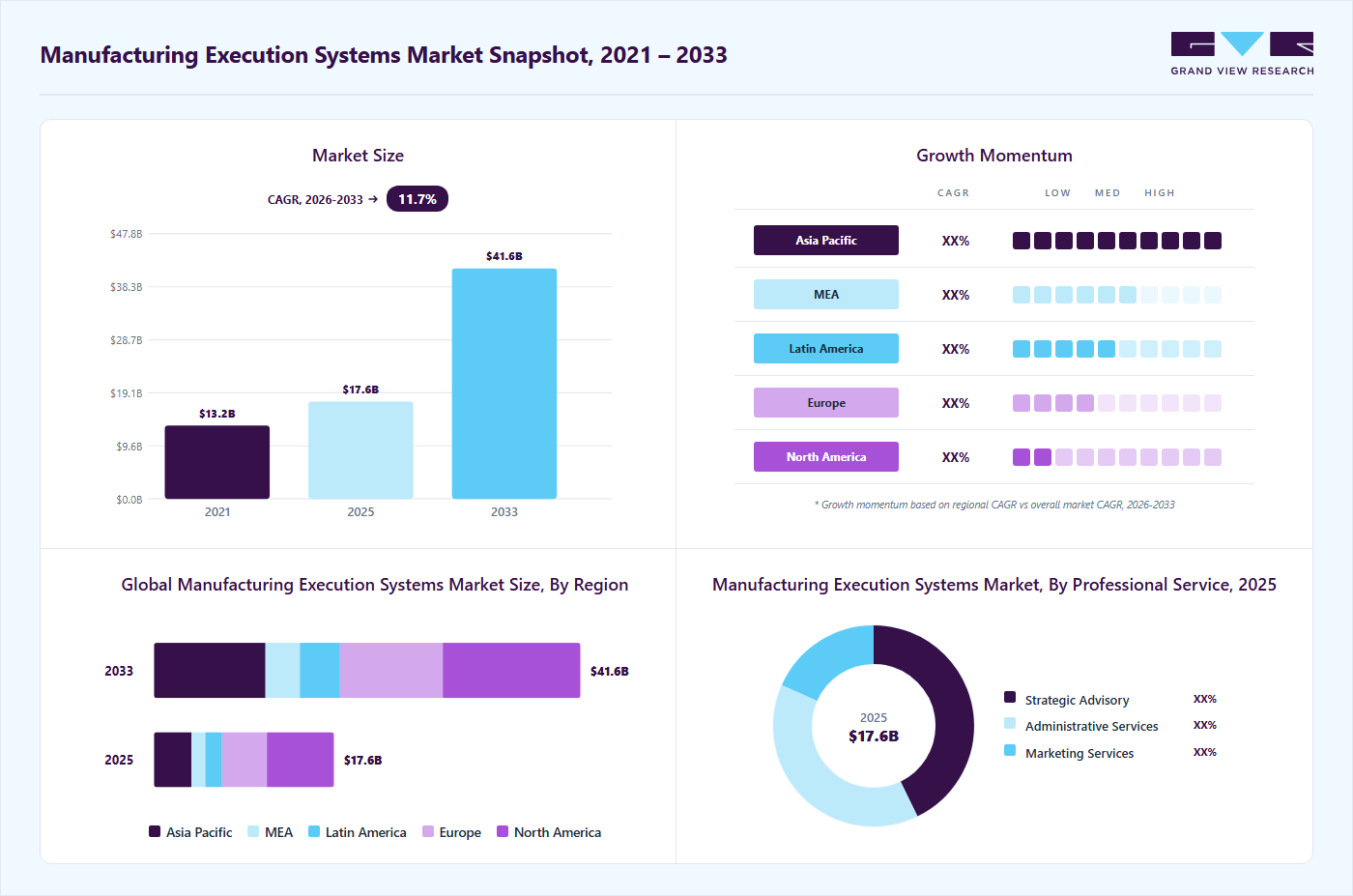
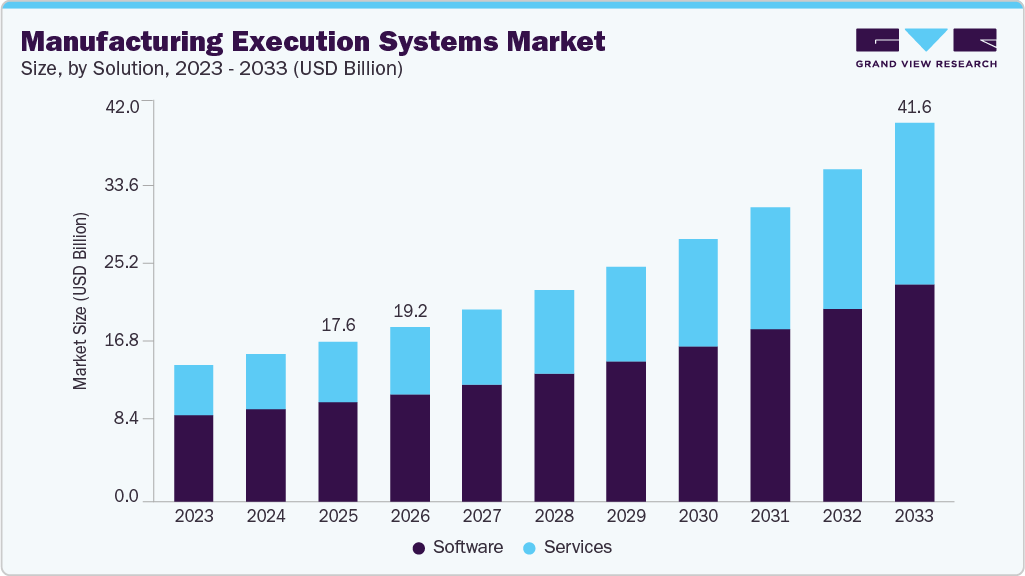
The global manufacturing execution systems market size was valued at USD 17.6 billion in 2025 and is projected to grow from USD 19.2 billion in 2026 to USD 41.6 billion by 2033, at a CAGR of 11.7% from 2026 to 2033. The market in North America dominated with a revenue share of 37.3% in 2025. driven by the accelerating adoption of Industry 4.0 and smart manufacturing initiatives. Manufacturers are increasingly integrating IoT, AI, and advanced analytics into shop-floor operations to gain real-time visibility, improve production efficiency, and reduce downtime.
 Source: Grand View Research, IR Documents, Primary Interviews, Paid DatabasesTo learn more about this report,
 Download Free Sample Report
 Key Market Trends & Insights
- By solution: Software segment held the largest market share of 62.2% in 2025.
- By deployment: On-premise segment held the largest market share in 2025.
- By application: Automotive segment held the largest market share in 2025.
Regional Highlights
- Largest regional market: North America (37.3% revenue share, 2025)
- Fastest-growing regional market: Asia Pacific (highest CAGR, 2026-2033)
- By country: The U.S. held the largest market share in 2025
Market Size & Forecast
- Market size in 2025: USD 17.6 Billion
- Estimated market size in 2026: USD 19.2 Billion
- Projected market size by 2033: USD 41.6 Billion
- CAGR (2026-2033): 11.7%
Three ways to get this report
Buy it, customize it, or ask a question.Ask an Analyst
Analyst response in 1 business day
- AccessReport author, directly
- Reply timeWithin 1 working day
- No sales callDirect answer only
- FormatEmail reply
- CostFree, no cost
Get the Full Report
What the study covers
- FormatsPDF · Excel · Dashboard
- Timeline2026–2033 annual, 2025 base
- Coverage20+ countries, 5 regions
- Companies10+ key players profiled
Customize the Report
20% free customization
- IncludeCountries, segments, points
- TailorTo your product definition
- ExtendDeeper competitor detail
- OrA fully bespoke study
- Turnaround5–10 working days
The rising need for operational efficiency and cost optimization amid global supply chain disruptions and competitive pressures significantly contributes to the manufacturing execution systems industry. Manufacturing execution systems (MES) solutions enable manufacturers streamline workflows, minimize waste, and enhance resource utilization by providing granular insights into production performance. The ability to monitor key performance indicators (KPIs) such as Overall Equipment Effectiveness (OEE), cycle times, and defect rates in real time allows organizations to implement continuous improvement strategies. This is particularly important in industries such as automotive, electronics, and pharmaceuticals, where precision and efficiency are critical.Stringent regulatory compliance and quality management requirements are also fueling MES adoption, especially in highly regulated sectors such as pharmaceuticals, food & beverage, and aerospace. MES systems enable end-to-end traceability, electronic batch records, and audit trails, ensuring adherence to standards such as FDA, GMP, and ISO. With increasing emphasis on product quality, safety, and recall management, manufacturers are leveraging MES to maintain compliance while reducing manual documentation and human error. In December 2025, the FDA published technical amendments in the Federal Register updating references to align with the new Quality Management System Regulation (QMSR), which became effective in February, 2026.
 To learn more about this report, Download Free Sample Report
 The growing complexity of manufacturing processes and product customization trends further contribute to market expansion. As demand shifts toward mass customization and shorter product lifecycles, manufacturers require flexible and scalable systems to manage diverse production lines. MES solutions support dynamic scheduling, recipe management, and rapid changeovers, allowing companies to respond quickly to changing customer demands without compromising efficiency or quality.
Solution Insights
The software segment dominated the market and accounted for the revenue share of 62.2% in 2025, driven by the increasing demand for modular, interoperable, and API-driven architectures that enable seamless integration across heterogeneous IT and OT environments. As manufacturing ecosystems become more fragmented with diverse machines, legacy systems, and third-party applications organizations are prioritizing MES software that supports open standards, micro services-based design, and low-code/no-code configurability.
The service segment is anticipated to grow at the fastest CAGR during the forecast period, driven by the increasing demand for system integration, customization, and lifecycle support services as manufacturers deploy complex, multi-vendor digital architectures. Organizations require specialized consulting, implementation, and integration services to align MES platforms with legacy systems, automation equipment, and enterprise applications, ensuring interoperability across heterogeneous environments.
Deployment Insights
The on-premise segment dominated the market and accounted for the largest revenue share in 2025, driven by the need for enhanced data sovereignty, low-latency processing, and direct control over mission-critical production environments. Industries with highly sensitive intellectual property such as semiconductor manufacturing, defense, and high-precision engineering prefer on-premise MES to maintain strict control over data storage, access, and internal security protocols.
The cloud-based segment is expected to grow at a significant CAGR during the forecast period, driven by the increasing need for rapid multi-site deployment standardization and centralized production governance across global manufacturing networks. Enterprises are leveraging cloud-native MES platforms to enforce uniform production protocols, recipes, and performance benchmarks across geographically dispersed plants, enabling consistent output quality and faster replication of best practices.
Application Insights
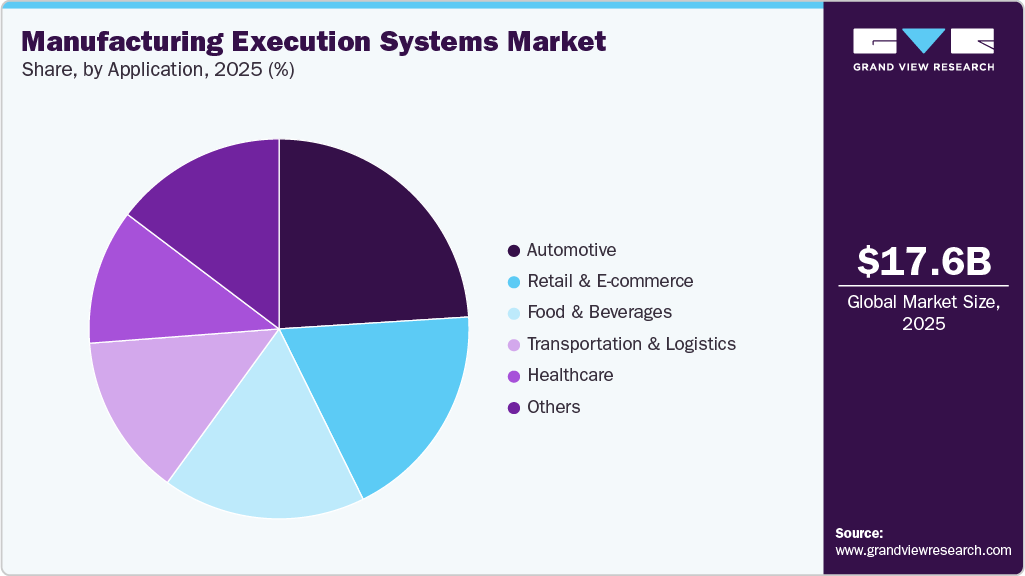
The automotive segment dominated the market and accounted for the largest revenue share in 2025, driven by the rapid shift toward electric vehicles (EVs) and the increasing complexity of vehicle architectures, particularly in battery manufacturing and electronics integration. Automakers and suppliers require MES platforms to manage intricate production processes such as battery cell assembly, powertrain electrification, and semiconductor-intensive components, where precision, synchronization, and process validation are critical.
 To learn more about this report, Download Free Sample Report
 The healthcare segment is expected to grow at a significant CAGR over the forecast period, driven by the rapid expansion of biologics, personalized medicine, and advanced therapies, which require highly controlled, data-intensive, and reproducible manufacturing environments. MES platforms are increasingly adopted to manage complex production workflows associated with cell and gene therapies, where small batch sizes, patient-specific production, and stringent process validation are critical.
Regional Insights
North America Manufacturing Execution Systems Market Trends
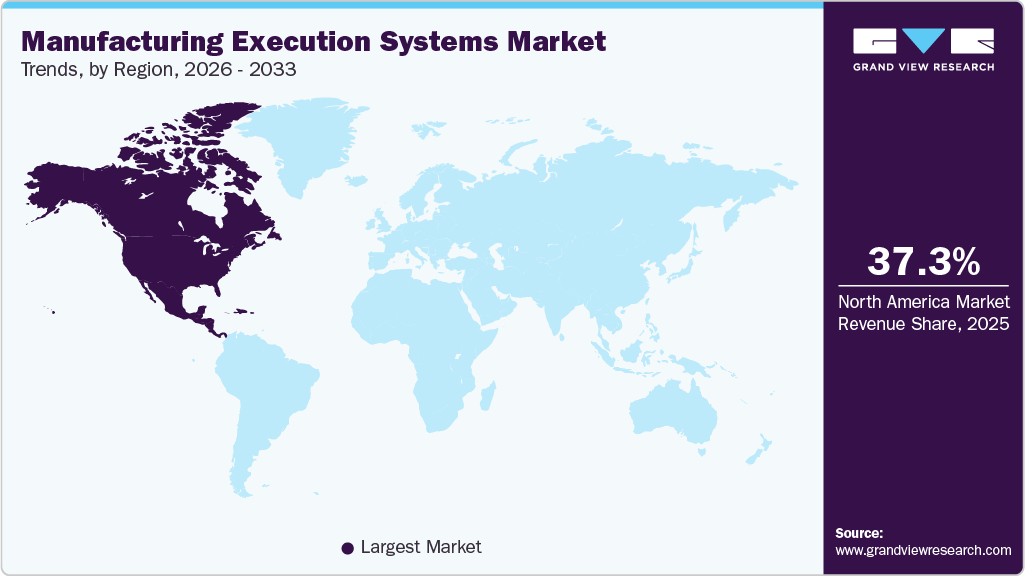
North America dominated the global market with the largest revenue share of 37.3% in 2025, driven bythe strong presence of advanced manufacturing industries and early adoption of digital transformation frameworks. Companies in sectors such as aerospace, semiconductors, and medical devices are leveraging MES to enable closed-loop manufacturing and real-time synchronization between design, production, and quality systems.
 To learn more about this report, Download Free Sample Report
 U.S. Manufacturing Execution Systems Market Trends
The manufacturing execution systems market in the U.S. is expected to grow significantly at a CAGR of 8.7% from 2026 to 2033, due toincreasing investments in smart factory initiatives supported by federal programs and private sector innovation. The integration of MES with advanced robotics and additive manufacturing technologies is enabling highly automated and autonomous production environments.
Europe Manufacturing Execution Systems Market Trends
The manufacturing execution systems market in Europe is anticipated to register considerable growth from 2026 to 2033, due to sustainability and energy efficiency mandates across manufacturing operations. Companies are adopting MES solutions to monitor energy consumption, reduce carbon emissions, and optimize resource usage in line with environmental regulations and ESG goals.
The UK manufacturing execution systems market is expected to grow rapidly in the coming years, owing to the growing emphasis on high-value manufacturing and innovation-led industrial strategies. Industries such as pharmaceuticals and precision engineering are adopting MES to improve production transparency and ensure consistent output quality.
The Germany manufacturing execution systems market held a substantial market share in 2025. The country’s focus on integrating cyber-physical systems into manufacturing processes is driving demand for MES solutions that can support highly interconnected and decentralized production environments.
Asia Pacific Manufacturing Execution Systems Market Trends
Asia Pacific manufacturing execution systems held a significant share in the global market in 2025, due to rapid industrialization and expansion of manufacturing capacities across emerging economies. Governments are promoting industrial modernization through national initiatives aimed at enhancing productivity and global competitiveness.
Manufacturing execution systems market in Japan is expected to grow rapidly in the coming years, driven by the need to maintain manufacturing excellence amid an aging workforce and evolving industrial landscape. Companies are leveraging MES to preserve institutional knowledge through digitalization of production processes and to ensure consistent quality standards.
The China manufacturing execution systems market held a substantial market share in 2025, due to the country’s transition from labor-intensive manufacturing to high-tech, value-added production. National initiatives aimed at upgrading industrial capabilities are pushing manufacturers to adopt MES for better production control and digital integration.
Key Manufacturing Execution Systems Company Insights
Key players operating in the manufacturing execution systems industry are Siemens, Honeywell International Inc., Rockwell Automation, Dassault Systèmes, and SAP. The companies are focusing on various strategic initiatives, including new product development, partnerships & collaborations, and agreements to gain a competitive advantage over their rivals. The following are some instances of such initiatives.
Key Manufacturing Execution Systems Companies:
The following key companies have been profiled for this study on the manufacturing execution systems market.
- ABB
- Dassault Systèmes
- General Electric
- Honeywell International Inc.
- Octavic
- OHM Logic, Inc
- Oracle
- Rockwell Automation
- SAP
- Schneider Electric
- Siemens
Recent Developments
-
In March 2026, Dassault Systèmes, announced a long-term strategic collaboration with JSW Group’s electric mobility arm, JSW Motors to strengthen the development of its upcoming new energy vehicle (NEV) lineup in India. As part of the agreement, JSW Motors aims to deploy Dassault Systèmes’ 3DEXPERIENCE platform as its central digital infrastructure, enabling seamless integration across design, engineering, manufacturing, and validation processes. The partnership also sees the implementation of an advanced Product Lifecycle Management (PLM) system alongside a Manufacturing Execution System (MES) on a unified platform, aimed at ensuring digital continuity, improved operational efficiency, and end-to-end traceability across the vehicle production lifecycle.
-
In December 2025, Rockwell Automation introduced a cloud-native, interoperable upgrade to its MES portfolio, designed to unify OT and IT systems. The elastic MES platform offers modular, scalable capabilities with embedded AI, enabling easier integration, improved visibility, and support for autonomous operations. It also ensures compliance and traceability for regulated industries while providing flexible deployment across cloud, edge, and hybrid environments.
-
In July 2025, Accenture announced the acquisition of SYSTEMA, a German-based firm specializing in software solutions and consulting for manufacturing automation. The move strengthens Accenture’s capabilities in connecting both legacy and modern production systems, leveraging SYSTEMA’s expertise in digital integration. Known for enhancing traditional MES, SYSTEMA brings advanced data analytics and optimization capabilities that help manufacturers improve efficiency, increase output, and reduce operational costs.
Manufacturing Execution Systems Report Scope
Report Attribute
Details
Market size in 2025
USD 17.6 billion
Estimated market size in 2026
USD 19.2 billion
Projected market size by 2033
USD 41.6 billion
Growth rate
CAGR of 11.7% from 2026 to 2033
Actual data
2021 - 2025
Forecast period
2026 - 2033
Quantitative units
Revenue in USD million/billion and CAGR from 2026 to 2033
Report enterprise size
Revenue forecast, company share, competitive landscape, growth factors, and trends
Segments covered
Solution, deployment, application, region
Regional scope
North America; Europe; Asia Pacific; Latin America; MEA
Country scope
U.S.; Canada; Mexico; UK; Germany; France; China; India; Japan; Australia; South Korea; Brazil; UAE; Saudi Arabia; South Africa
Key companies profiled
ABB; Dassault Systèmes; General Electric; Honeywell International Inc.; Octavic; OHM Logic Inc; Oracle; Rockwell Automation; SAP GmbH; Schneider Electric; Siemens
Customization scope
Free report customization (equivalent to 8 analysts working days) with purchase. Addition or alteration to country, regional & segment scope.
Pricing and purchase options
Avail customized purchase options to meet your exact research needs. Explore purchase options
Global Manufacturing Execution Systems Report Segmentation
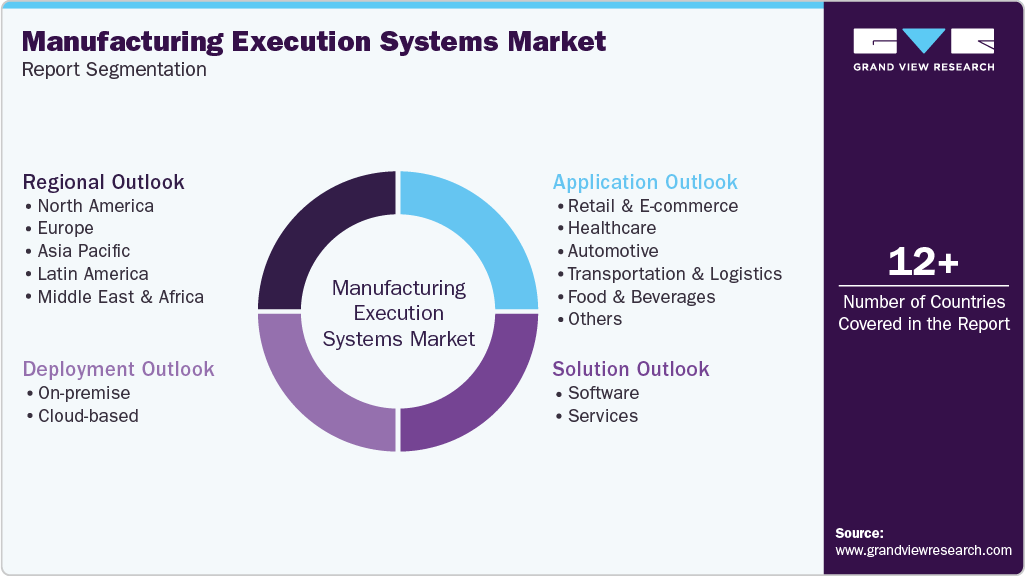
This report forecasts revenue growth at the global, regional, and country levels and provides an analysis of the latest industry trends in each of the sub-segments from 2021 to 2033. For this study, Grand View Research has segmented the manufacturing execution systems market report based on solution, deployment, application, and region.
 To learn more about this report, Download Free Sample Report
 -
Solution Outlook (Revenue, USD Billion, 2021 - 2033)
-
Software
-
Services
-
Professional Service
-
Strategic Advisory
-
Administrative Services
-
Marketing Services
-
-
Managed Services
-
System Integration
-
Maintenance & Support
-
Data Analytics
-
-
-
-
Deployment Outlook (Revenue, USD Billion, 2021 - 2033)
-
On-premise
-
Cloud-based
-
-
Application Outlook (Revenue, USD Billion, 2021 - 2033)
-
Retail & E-commerce
-
Healthcare
-
Automotive
-
Transportation & Logistics
-
Food & Beverages
-
Others
-
-
Regional Outlook (Revenue, USD Billion, 2021 - 2033)
-
North America
-
U.S.
-
Canada
-
Mexico
-
-
Europe
-
UK
-
Germany
-
France
-
-
Asia Pacific
-
China
-
India
-
Japan
-
South Korea
-
Australia
-
-
Latin America
-
Brazil
-
-
Middle East & Africa
-
UAE
-
Saudi Arabia
-
South Africa
-
-
Frequently Asked Questions About This Report
The global manufacturing execution systems market size was estimated at USD 17.6 billion in 2025 and is expected to reach USD 19.2 billion in 2026
The global manufacturing execution systems market is expected to grow at a compound annual growth rate of 11.7% from 2026 to 2033 to reach USD 41.6 billion by 2033.
North America dominated the global market with the largest revenue share of 37.3% in 2025, driven by the strong presence of advanced manufacturing industries and early adoption of digital transformation frameworks.
Some key players operating in the manufacturing execution systems market include ABB, Dassault Systèmes, General Electric, Honeywell International Inc., Octavic, OHM Logic, Inc, Oracle, Rockwell Automation, SAP GmbH, Schneider Electric, Siemens
Asia Pacific is the fastest-growing region over the forecast period.
The software segment led with a 62.2% revenue share in 2025, while the service segment is the fastest-growing.
The on-premise segment held the largest revenue share in 2025, while the cloud-based segment is expected to grow at a significant CAGR.
The automotive segment held the largest revenue share in 2025, while the healthcare segment is significantly growing.
Key factors driving the market growth include increasing adoption of Industry 4.0, industrial automation, and Smart Manufacturing Initiatives. Manufacturers are increasingly integrating IoT, AI, and advanced analytics into shop-floor operations to gain real-time visibility, improve production efficiency, and reduce downtime.
About the Author(s)
IT Services & Applications Research Team
Technology · IT Services & ApplicationsThis report was authored by the it services & applications research team at Grand View Research - comprising two research analysts, one senior research analyst, and one industry expert - with specialized expertise in the it services & applications segment of the technology industry. All findings are based on proprietary technology databases, executive interviews, and regulatory analysis, subject to internal peer review prior to publication.
Last Updated:
Speak to Analyst

Customize this report to your needs - add regions, segments, or data points, with 20% free customization.
Or view our licence options:


ISO 9001:2015 & 27001:2022 Certified
We are GDPR and CCPA compliant! Your transaction & personal information is safe and secure. For more details, please read our privacy policy.


