
- Home
- »
- Consumer F&B
- »
-
Margarine Market Size, Share & Trends Report, 2026-2033GVR Report cover
![Margarine Market (2026 - 2033)Report]()
Margarine Market (2026 - 2033)
Size, Share & Trends Analysis Report By Product (Hard, Soft, Liquid), By Application (Commercial, Household), By Region (North America, Europe, Asia Pacific, Latin America, MEA), And Segment Forecasts
Market Size, 2025
$4.1BMarket Estimate, 2026
$4.2BMarket Forecast, 2033
$5.0BCAGR, 2026–2033
2.4%Margarine Market Summary
The global margarine market size was valued at USD 4.1 billion in 2025 and is projected to grow from USD 4.2 billion in 2026 to USD 5.0 billion by 2033, at a CAGR of 2.4% from 2026 to 2033. The market in North America dominated with a revenue share of 38.0% in 2025. As consumer demand for baked goods and spreads rises, margarine is gaining popularity due to its versatility and cost-effectiveness.

Key Market Trends & Insights
- By product: Hard margarine segment led the market with the largest revenue share of 51.4% in 2025.
- By application: Food industry segment led the market with the largest revenue share of 82.9% in 2025.
Regional Highlights
- Largest regional market: North America (38.0% revenue share, 2025)
- By country: The U.S. held the largest market share in 2025.
Market Size & Forecast
- Market size in 2025: USD 4.1 Billion
- Estimated market size in 2026: USD 4.2 Billion
- Projected market size by 2033: USD 5.0 Billion
- CAGR (2026-2033): 2.4%
Furthermore, the aging population is increasingly seeking healthier alternatives to butter, driving demand for margarine that offers low fat, heart-healthy options. With its broad application scope in cooking, baking, and as a spread, margarine continues to gain popularity, satisfying the needs of both health-conscious consumers and the food industry. According to the United Nations Department of Economic and Social Affairs, the population aged 65 or above is anticipated to double by 2050. The growth of this population group will shift the consumption pattern toward healthier alternatives in the coming years. Therefore, the demand for heart-friendly products, such as margarine, is expected to surge in the near future.
Health-conscious consumers increasingly prefer the product because of its low fat, low calorie, and low cholesterol properties. In addition, demand for margarine is expected to remain high in China and India owing to the consumers' price consciousness. Along with households, a large number of food producers are adopting margarine as a sustainable, affordable, and healthy raw material.
Market Dynamics
The margarine market is influenced by changing dietary preferences, evolving awareness regarding nutrition, and continuous product innovation. Manufacturers are expanding portfolios with plant-based, low-fat, fortified, and clean-label margarine products to cater to health-oriented and flexitarian dietary patterns. Demand from households, foodservice operators, and bakery industries continues to support market expansion. Advancements in formulation and packaging technologies are also improving product quality, shelf life, and usability across developed and emerging markets.
Health-focused eating patterns and preference for dairy substitutes are supporting the margarine market. Margarine is widely used as a butter alternative because it is primarily made from vegetable oils and is suitable for vegan and lactose-free diets. Preference for foods containing unsaturated fats and lower cholesterol levels has also supported its use in household cooking and commercial food preparation. The product is extensively used in bakery, confectionery, ready-to-eat meals, and processed food applications due to its functionality, affordability, and long shelf life.
Product development activities are strengthening market growth through fortified, low-fat, and clean-label margarine variants. Demand for vegan bakery products and dairy-free packaged foods is increasing the use of margarine as a key ingredient in food formulation. Its versatility in cooking and food processing, along with wide availability through retail and foodservice channels, continues to support market expansion across global regions.
Preference for butter and other natural dairy spreads is limiting growth in the margarine market. Clean-label food trends have encouraged a shift toward ingredients perceived as more natural and less processed. Butter continues to benefit from its traditional positioning and strong acceptance in household and foodservice applications. At the same time, margarine faces perception challenges related to processing methods and ingredient composition, despite improvements in formulation and elimination of trans fats in many products.
Competition from premium butter variants and organic dairy products has intensified in several regions. Dietary preferences that favor natural fats over processed alternatives are also influencing purchasing decisions. Food manufacturers are adjusting formulations to meet changing ingredient expectations, which has reduced dependence on conventional margarine in certain applications. This competitive environment continues to restrict market expansion and pressure manufacturers to continuously improve product positioning.
Product innovation focused on nutrition and functionality presents significant opportunities for the margarine market. Manufacturers are introducing margarine enriched with vitamins, omega fatty acids, plant sterols, and other functional ingredients that support heart health and overall wellness. Interest in organic, non-GMO, and sustainably sourced products is encouraging the launch of premium offerings.
Use in bakery processing, confectionery production, and foodservice applications is expanding due to margarine’s stability, consistency, and cost efficiency. Advances in formulation technology are improving taste, texture, and shelf stability while maintaining nutritional value. Specialized variants designed for industrial baking and processed food manufacturing are increasing their application scope. Growth of private-label and premium product ranges is further strengthening market penetration across different regions and price segments.
Analyst Perspective
The margarine market is being reshaped by the convergence of affordability requirements, evolving dietary preferences, and increasing demand for plant-based food solutions. While traditional consumption remains anchored in household and bakery applications, future growth is expected to originate from clean-label formulations, trans-fat-free products, and sustainable vegetable oil sourcing. Competitive success will depend on manufacturers' ability to balance cost efficiency with health-oriented innovation, while expanding penetration across foodservice and industrial processing channels. Companies capable of positioning margarine as both a functional ingredient and a healthier alternative to conventional fats are likely to capture the strongest long-term value within the category.
Product Insights
Based on product, the hard margarine segment led the market with the largest revenue share of 51.4% in 2025, fueled by its widespread use in baking and food production. Hard margarine is known for its stable texture and high melting point and ideal for creating flaky pastries, cakes, and other baked goods. Its long shelf life and cost-effectiveness make it a preferred choice for both commercial kitchens and households. Furthermore, hard margarine is often considered a healthier alternative to butter due to its lower saturated fat content, further boosting its popularity in the food industry.
The liquid margarine segment is anticipated to emerge as the fastest-growing segment and grow at a CAGR of 2.0% over the forecast period, attributed toits versatility and ease of use in households and the food industry. Liquid margarine is often favored for its ability to blend seamlessly into cooking and frying, offering a healthier alternative to butter with lower trans-fat content. Its convenience in liquid form makes it ideal for use in dressings, sauces, and spreads. Also, the growing demand for healthier, lower-calorie options has increased the popularity of liquid margarine, thereby propelling its market prominence.
Application Insights
Based on application, the food industry segment led the market with the largest revenue share of 82.9% in 2025. Margarine is a key ingredient in various processed foods, including bakery items, snacks, and ready-to-eat meals, where it provides texture, flavor, and shelf stability. Its cost-effectiveness compared to butter and its versatility in cooking, baking, and frying, make it a preferred choice for food manufacturers. The widespread adoption of margarine across the food service sector drives the continued dominance of the commercial application segment in the margarine industry.

The household application segment is projected to be the fastest-growing segment and capture a CAGR of 1.9% during the forecast period, owing to increasing consumer preference for convenient and versatile cooking and baking ingredients. With the rise in home cooking and baking trends, particularly during the post-pandemic era, margarine is gaining popularity as a healthier alternative to butter in households. Its affordability, longer shelf life, and suitability for a variety of recipes make it an attractive choice for consumers. As health-conscious individuals seek products with lower saturated fats, the role of margarine in daily kitchens is set to grow considerably.
Regional Insights
North America dominated the margarine market with the largest revenue share of 38.0% in 2025, fueled bythe growing consumer shift toward allergen-free, non-GMO products and the increasing adoption of vegan and plant-based diets. As consumers become more health-conscious, there is a surging demand for margarine alternatives that cater to dietary restrictions and preferences, such as dairy-free and non-GMO options. This shift aligns with the broader trend of sustainable, clean-label products, which encourages manufacturers to innovate and meet the evolving needs of health-focused and ethically driven consumers and contributes to the growth of the margarine industry in the region.

U.S. Margarine Market Trends
The margarine market in the U.S. held the largest share in the North America region in 2025. Consumers increasingly seek convenience in their food choices, opting for spreadable margarines that require no refrigeration and can be used instantly. Besides, the rising usage of margarine in the food service sector, including restaurants, hotels, and catering services, is contributing to market growth. As food service establishments demand cost-effective, versatile ingredients, the demand for margarine in commercial kitchens is projected to propel the market expansion.
The margarine market in Canada is expected to achieve remarkable CAGR over the forecast period, attributed to product innovation and the growing focus on health and wellness. With consumers increasingly seeking healthier alternatives, margarine manufacturers are responding by developing low-fat, plant-based, and fortified options. Innovations such as margarine enriched with omega-3 fatty acids, vitamins, and natural ingredients cater to health-conscious buyers. The market for margarine is set to see expansion with the surging demand for functional foods and increasing consumer inclination toward margarine that aligns with their dietary preferences. These trends are expected to boost both the product variety and overall market size in Canada.
Europe Margarine Market Trends
Rising butter prices in Europe are driving consumers to seek more affordable alternatives, boosting the demand for margarine. The margarine market in Germany held the largest share in the Europe region in 2025. As the price of butter increases, consumers are opting for margarine, which offers similar benefits at a lower price. Moreover, the growing demand for premium margarine products, including those with healthier ingredients such as plant-based oils, low trans fats, and functional additives, is further fueling market growth. This shift toward high-quality margarine aligns with consumers’ increasing health consciousness, making premium margarine a popular choice, ultimately propelling the expansion of the Europe margarine market.
The rise of plant-based and organic margarine options, driven by health-conscious and environmentally aware consumers, is expected to fuel the growth of the market in Germany. As demand for vegan and sustainable alternatives increases, manufacturers are innovating to meet these preferences and offer ethically sourced products with cleaner ingredients. Furthermore, the surging demand for spreadable margarine, which accounts for most of the consumption, is further accelerating market expansion. Its convenience and rising health trends ensure continued market growth, particularly in the convenience-focused German consumer landscape.
The growing perception of full-fat dairy as a healthier option is set to expand the UK margarine industry as consumers increasingly embrace less processed, natural ingredients. This shift toward full-fat products is influencing margarine consumption, as consumers opt for lower-fat options. Besides, the convenience of online shopping is significantly impacting market growth. With a rise in e-commerce platforms offering easy access to margarine products, consumers in the UK are increasingly purchasing through digital channels, driving market expansion as they seek convenience and variety in their food choices.
Asia Pacific Margarine Market Trends
Asia Pacific is projected to emerge as the fastest-growing region and grow at a CAGR of 3.4% from 2026 to 2033, propelled bythe expansion of distribution channels and surging disposable income. As retail networks, e-commerce platforms, and supermarkets continue to broaden their reach, margarine products become more accessible to a larger consumer base. Also, the increasing disposable income across the region allows consumers to spend more on premium and specialized margarine products. This synergy of expanded availability and higher purchasing power is fueling market demand, contributing to the steady growth and expansion of the margarine market in the region.
The growing emphasis on environmentally sustainable choices and technological advancements in food processing are anticipated to accelerate the market growth across China. Consumers are increasingly favoring products made with sustainable ingredients and eco-friendly packaging, pushing manufacturers to adopt greener practices. Moreover, advancements in food processing technology are improving the quality, shelf life, and nutritional profile of margarine, allowing for healthier and more diverse product offerings. These developments cater to rising health consciousness and environmental concerns, fueling demand for margarine and contributing to the market growth in China.
Increased awareness of nutritious diets and rapid urbanization are expected to expand the size of the margarine industry in India. As consumers become more health-conscious, there is a burgeoning demand for healthier alternatives to traditional fats, with margarine offering lower trans-fat and enriched options like omega-3. In addition, urbanization and changing lifestyles, with busier schedules and a preference for convenience, are propelling the demand for ready-to-use, spreadable margarine products. This combination of health trends and shifting consumer habits is set to fuel market growth in India.
Key Margarine Company Insights
Some of the key companies in the margarine industry include Unilever; Bunge; NMGK Group; Conagra Brands, Inc.; Wilmar International Ltd; BRF Global.; Yildiz Holding; Cargill, Incorporated.; Uni-President; Flora Food Group; China Mengniu Dairy Company Limited; and Namchow (THAILAND) LTD.
-
Unilever specializes in a wide range of consumer goods, including food, beverages, cleaning products, personal care products, and home care items. Its brands focus on sustainability, innovation, and improving quality of life for people globally.
-
Cargill, Incorporated offers food, agriculture, financial, and industrial products and services. It provides commodities, food ingredients, animal nutrition, and risk management solutions, supporting a range of industries from farm to fork worldwide.
Key Margarine Companies Companies:
The following key companies have been profiled for this study on the margarine market.
-
Unilever
-
Bunge
-
NMGK Group
-
Conagra Brands, Inc.
-
Wilmar International Ltd
-
BRF Global.
-
Yildiz Holding
-
Cargill, Incorporated.
-
Uni-President
-
Flora Food Group
-
China Mengniu Dairy Company Limited
-
Namchow (THAILAND) LTD.
Competitive Benchmarking
Category
Operating Strategies
Competitive Edge
Weakness
Established Players (e.g., Unilever, Upfield, Bunge, Conagra Brands)
- Strengthen product portfolios through premium, low-fat, and plant-based margarine offerings. Expand retail distribution networks and secure long-term supply agreements with foodservice and industrial customers.
- Extensive brand recognition, established distribution infrastructure, and strong sourcing capabilities. Ability to serve both retail and commercial end users at scale.
- Exposure to raw material price fluctuations and changing consumer perceptions regarding processed fats. Larger organizations may face slower product adaptation cycles.
Emerging Players (Regional and specialty spread manufacturers)
- Target health-conscious consumers through organic, clean-label, vegan, and specialty margarine products. Utilize digital marketing, direct-to-consumer channels, and localized product innovation.
- Greater flexibility in responding to dietary trends and niche consumer preferences. Faster development of differentiated formulations and specialty products.
- Limited geographic reach, lower marketing budgets, and dependence on external distribution partners. Challenges in competing with multinational brands on pricing and visibility.
Recent Developments
-
In March 2024, Wilmar Africa introduced its latest culinary innovation, "Fortune Spread & Fortune All Purpose Margarine." It launched a cutting-edge factory specifically designed for the high-quality and efficient production of this new product.
-
In February 2025, BlueBand, a Flora Food Group trademark, introduced an economy pack of margarine to boost the growth of food MSMEs. It also launched the “BlueBand Professional UMKM Star #AhlinyaRasaSukses” program and BlueBand Master Cake Margarine 500g, offering quality and economical solutions.
Margarine Market Report Scope
Report Attribute
Details
Market size value in 2025
USD 4.1 billion
Market size value in 2026
USD 4.2 billion
Revenue forecast in 2033
USD 5.0 billion
Growth rate
CAGR of 2.4% from 2026 to 2033
Base year for estimation
2025
Historical data
2021 - 2024
Forecast period
2026 - 2033
Quantitative units
Revenue in USD million/billion and CAGR from 2026 to 2033
Report coverage
Revenue forecast, company ranking, competitive landscape, growth factors, and trends
Segments covered
Product, application, region
Regional scope
North America; Europe; Asia Pacific; Latin America; MEA
Country scope
U.S.; Canada; Mexico; Germany; UK; France; Italy; Spain; Norway; Denmark; Sweden; Russia; Iceland; Finland; China; Japan; India; South Korea; Australia; Thailand; Singapore; Brazil; Argentina; Saudi Arabia; South Africa; UAE; Kuwait; Israel
Key companies profiled
Upfield; Unilever; Bunge; Conagra Brands; Associated British Foods (ABF); Vandemoortele; Wilmar International; AAK AB; Fuji Oil Holdings and Richardson International
Customization scope
Free report customization (equivalent up to 8 analysts' working days) with purchase. Addition or alteration to country, regional & segment scope.
Pricing and purchase options
Avail customized purchase options to meet your exact research needs. Explore purchase options
Global Margarine Market Report Segmentation
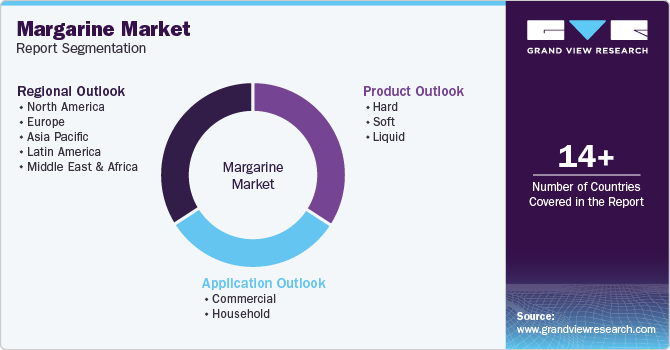
This report forecasts revenue growth at global, regional, and country levels and provides an analysis of the latest industry trends in each of the sub-segments from 2021 to 2033. For the purpose of this study, Grand View Research has segmented the global margarine market report based on product, application, and region:
-
Product Outlook (Revenue, USD Million, 2021 - 2033)
-
Hard
-
Soft
-
Liquid
-
-
Application Outlook (Revenue, USD Million, 2021 - 2033)
-
Commercial
-
Household
-
-
Regional Outlook (Revenue, USD Million, 2021 - 2033)
-
North America
-
U.S.
-
Canada
-
Mexico
-
-
Europe
-
Germany
-
UK
-
France
-
Italy
-
Spain
-
-
Asia Pacific
-
China
-
India
-
Japan
-
Australia & New Zealand
-
South Korea
-
-
Latin America
-
Brazil
-
-
Middle East & Africa
-
UAE
-
-
Research Methodology
The margarine market figures in this report are based on a proven research process that combines executive interviews with secondary research from proprietary databases, company filings, and recognized regulatory and institutional sources. Market size is built through value-chain sizing - reconciling supply-side and demand-side estimates - and triangulated with bottom-up and top-down approaches. Every estimate passes multiple levels of expert validation before publication, with each margarine segment quantified using the revenue-capture definitions in the table below.
Segment Definition
Segment - Product
Revenue capture definition
Hard
This segment includes the sales of solid, block, or stick-type margarine products that are primarily used in baking and industrial food processing applications where firmness, structure, and stability are required. Revenue is generated from large-scale demand in bakery and confectionery production.
Soft
This segment includes the sales of spreadable margarine variants used mainly for table use and cooking applications in both household and foodservice settings. Revenue is driven by demand for easy-to-spread, ready-to-use products with improved taste and texture.
Liquid
This segment includes the sales of liquid margarine and oil-based blends used extensively in frying, cooking, and processed food manufacturing. Revenue is generated from industrial and foodservice users due to its ease of handling and consistent performance in high-volume applications.
Segment - Application
Revenue capture definition
Food Industry
This segment includes the sales of margarine to bakeries, confectionery manufacturers, restaurants, hotels, and food processing industries. Revenue is driven by large-volume procurement where margarine is used as a cost-effective and functional ingredient.
Household
This segment includes the sales of margarine directly to end users for home cooking, baking, and spreading applications. Revenue is generated through retail channels such as supermarkets, hypermarkets, and online grocery platforms.
Estimation Model
b) Estimation Model
Consumption Base Layer
Availability & Access Layer
Adoption Layer
Monetisation Layer
Who consumes margarine products?
Who can access margarine products?
Who actively purchases margarine?
How much revenue is generated?
Households, bakeries, restaurants, and food manufacturers using margarine as a spread, cooking ingredient, and butter alternative across various food preparation applications.
Apply distribution reach across supermarkets, convenience stores, wholesalers, foodservice suppliers, and online grocery platforms serving residential and commercial buyers.
Apply adoption rates among consumers and business preferences for margarine based on affordability, shelf stability, functional performance, and plant-based dietary preferences.
Estimate revenue using active consumer demand, institutional procurement volumes, purchase frequency, and average selling prices across retail and commercial channels.
Delivered Customizations
This report has been delivered with the following In-depth customizations
Client Request
Customization Delivered
Value Adds
Household Consumption & Spread Usage Trends
Conducted a detailed assessment of margarine consumption across households, foodservice outlets, bakeries, and processed food manufacturers, covering usage patterns, product preferences, and consumption frequency.
Helps stakeholders understand key demand drivers, consumer behavior shifts, and high-potential end-use segments supporting market expansion strategies. Bakery, Confectionery & Food Processing Demand Analysis
Evaluated margarine utilization across bakery products, confectionery applications, ready-to-eat foods, and industrial food production, including formulation trends and ingredient substitution patterns.
Provides insights into commercial demand pockets, application growth opportunities, and product development strategies across food manufacturing sectors.
Plant-Based Fat Alternatives & Market Opportunity Assessment
Assessed demand for plant-based spreads, low-fat margarine variants, clean-label formulations, and sustainable ingredient sourcing, alongside regulatory and health-driven market trends.
Supports investment decisions by identifying emerging product categories, innovation opportunities, and long-term growth potential within the evolving edible fats industry.
Frequently Asked Questions About This Report
The global margarine market size was valued at USD 4.1 billion in 2025 and is estimated at USD 4.2 billion for 2026.
The hard segment led with a 51.4% revenue share in 2025, while the liquid segment is the fastest-growing segment.
The global margarine market is expected to grow at a CAGR of 2.4% from 2026 to 2033, reaching USD 5.0 billion by 2033.
North America dominated with a 38.0% revenue share in 2025.
Asia Pacific is the fastest-growing region over the forecast period.
The food industry market held the largest revenue share in 2025, while the household market is the fastest-growing area.
Key players include Upfield, Unilever, Bunge, Conagra Brands, Associated British Foods (ABF), Vandemoortele, Wilmar International, AAK AB, Fuji Oil Holdings, and Richardson International.
Key factors include increasing demand for affordable butter substitutes, growing consumption of bakery products, and rising adoption of plant-based spreads.
About the Author(s)
Consumer F&B Research Team
Consumer Goods · Consumer F&BThis report was authored by the consumer f&b research team at Grand View Research - comprising two research analysts, one senior research analyst, and one industry expert - with specialized expertise in the consumer f&b segment of the consumer goods industry. All findings are based on proprietary consumer goods databases, executive interviews, and regulatory analysis, subject to internal peer review prior to publication.
Last Updated:
Speak to Analyst


Customize this report to your needs — add regions, segments, or data points, with 20% free customization.
Or view our licence options:


ISO 9001:2015 & 27001:2022 Certified
We are GDPR and CCPA compliant! Your transaction & personal information is safe and secure. For more details, please read our privacy policy.


