
- Home
- »
- Paints, Coatings & Printing Inks
- »
-
Masterbatch Market Size, Share & Trends Report, 2026-2033GVR Report cover

Masterbatch Market (2026 - 2033)
Size, Share & Trends Analysis Report By Type (White, Black, Color, Additive, Filler, Biodegradable), By Carrier Polymer (Polypropylene, Polyethylene Terephthalate, Polyethylene, Polyvinyl Chloride), By End-use, By Region, And Segment Forecasts
Market Size, 2025
$7.0BMarket Estimate, 2026
$7.4BMarket Forecast, 2033
$10.6BCAGR, 2026–2033
5.3%Masterbatch Market Summary
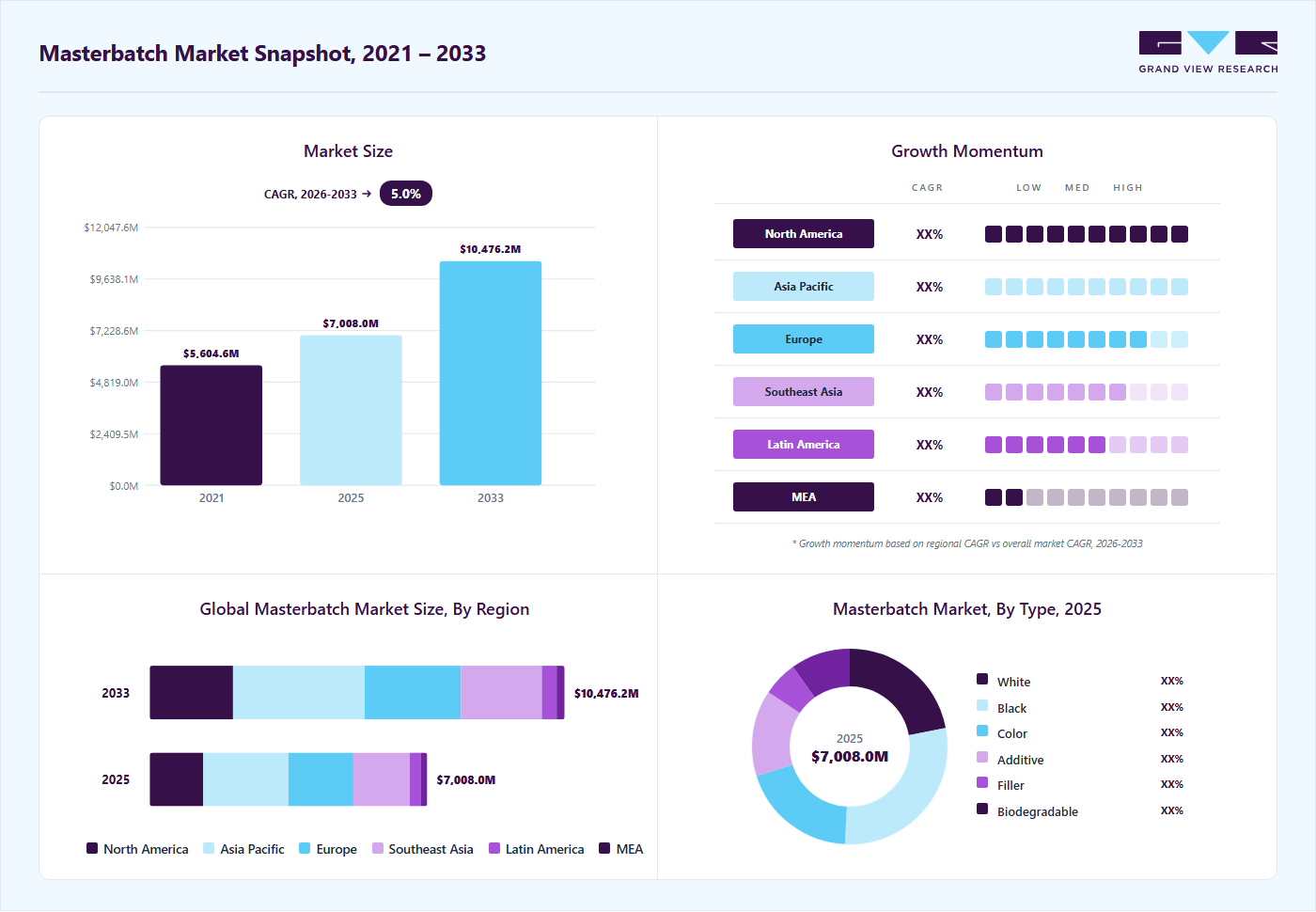
The global masterbatch market size was valued at USD 7.0 billion in 2025 and is projected to grow from USD 7.4 billion in 2026 to USD 10.6 billion by 2033, at a CAGR of 5.3% from 2026 to 2033. Asia Pacific dominated the masterbatch market with the highest revenue share of 30.9% in 2025. Growing consumption of flexible and rigid plastic packaging across food, beverages, personal care, and household products is driving demand for masterbatches used for coloring, UV stabilization, and functional enhancement.
 Source: Grand View Research, IR Documents, Primary Interviews, Paid DatabasesTo learn more about this report,
 Download Free Sample Report
 Key Market Trends & Insights
- By type: Black segment dominated the market, with a revenue share of 28.9% in 2025.
- By carrier polymer: Polypropylene (PP) segment held the largest revenue share of 26.8% in 2025.
- By end use: Packaging segment accounted for the largest revenue share of 27.2% in 2025.
Regional Highlights
- Largest regional market: Asia Pacific (30.9% revenue share, 2025)
- By country: China held the largest market share in 2025
Market Size & Forecast
- Market size in 2025: USD 7.0 Billion
- Estimated market size in 2026: USD 7.4 Billion
- Projected market size by 2033: USD 10.6 Billion
- CAGR (2026-2033): 5.3%
Three ways to get this report
Buy it, customize it, or ask a question.Ask an Analyst
Analyst response in 1 business day
- AccessReport author, directly
- Reply timeWithin 1 working day
- No sales callDirect answer only
- FormatEmail reply
- CostFree, no cost
Get the Full Report
What the study covers
- FormatsPDF · Excel · Dashboard
- Timeline2026–2033 annual, 2025 base
- Coverage20+ countries, 5 regions
- Companies10+ key players profiled
Customize the Report
20% free customization
- IncludeCountries, segments, points
- TailorTo your product definition
- ExtendDeeper competitor detail
- OrA fully bespoke study
- Turnaround5–10 working days
Brand owners are increasingly focusing on product differentiation, shelf appeal, and extended shelf life, which boosts the adoption of high-performance color and additive masterbatches in mass-volume packaging applications. The increasing use of lightweight, durable plastic components in automotive and construction sectors is accelerating masterbatch demand for performance enhancement, including heat resistance, flame retardancy, and weather stability. As manufacturers shift toward cost-efficient and high-strength polymer solutions to meet regulatory and sustainability requirements, masterbatches play a critical role in improving material performance and processing efficiency.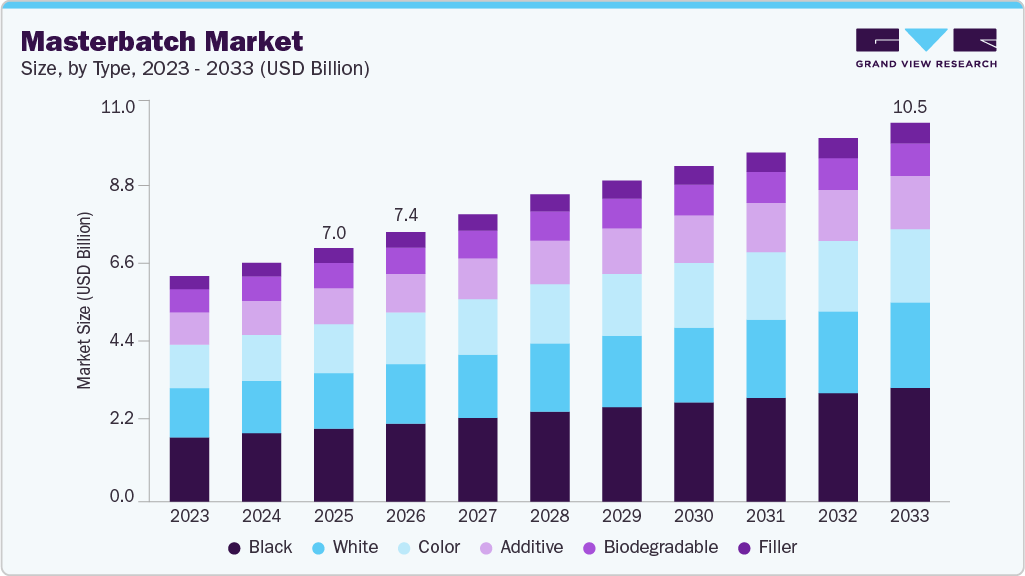 To learn more about this report, Download Free Sample Report
 Rising regulatory pressure and brand-level sustainability commitments are creating strong opportunities for bio-based, recyclable, and additive masterbatches that support circular economy goals. Manufacturers offering solutions such as carbon-black alternatives, biodegradable carrier resins, and masterbatches compatible with recycled polymers can gain a competitive advantage, as converters increasingly seek materials that maintain performance while reducing environmental impact and compliance risks.
Market Dynamics
The masterbatch market is driven by rising demand for high-performance plastic materials across packaging, automotive, construction, consumer goods, and agricultural applications. Manufacturers are increasingly adopting masterbatches to improve product appearance, durability, UV resistance, flame retardancy, and processing efficiency while reducing production costs through precise additive dispersion. Growing preference for lightweight and customized plastic components, particularly in packaging and transportation industries, continues to support market expansion. At the same time, stringent environmental regulations and increasing focus on sustainable materials are encouraging the development of biodegradable and recyclable masterbatch solutions. However, fluctuations in petrochemical feedstock prices and evolving regulations concerning plastic waste management pose challenges for manufacturers by affecting production costs and product demand.
The increasing use of plastics across packaging, automotive, construction, consumer goods, and agriculture is a major driver of the masterbatch market. Manufacturers are seeking advanced masterbatch formulations that enhance product aesthetics, mechanical strength, UV stability, flame retardancy, and processing efficiency while maintaining consistent quality. Masterbatches provide an efficient method for incorporating pigments and functional additives into polymers, enabling manufacturers to achieve precise product specifications without disrupting production processes. This capability has made them an essential component in modern plastic manufacturing.
Growing demand for lightweight, durable, and visually appealing plastic products is encouraging greater adoption of specialized masterbatch solutions. Brand owners are placing increased emphasis on product differentiation through customized colors, textures, and performance characteristics, particularly in packaging and consumer goods. Automotive manufacturers are also utilizing advanced masterbatches to improve the durability and appearance of lightweight polymer components, further supporting market growth.
One of the primary challenges facing the masterbatch market is the fluctuations in the prices of petrochemical-based raw materials, including carrier resins, pigments, and performance additives. These materials are closely linked to fluctuations in crude oil prices, global supply chain disruptions, and changing trade policies, making production costs difficult to predict. Frequent price variations can reduce profit margins for manufacturers, complicate long-term procurement strategies, and increase pricing uncertainty for downstream customers. Smaller manufacturers often face greater financial pressure due to limited purchasing power and reduced flexibility in absorbing cost increases.
The growing global emphasis on sustainability presents opportunity for the masterbatch market as industries transition toward environmentally responsible plastic solutions. Packaging producers, consumer goods manufacturers, and industrial processors are increasingly adopting recyclable and biodegradable polymers to comply with environmental regulations and corporate sustainability objectives. This trend is driving demand for specialized masterbatches that maintain color consistency, processing efficiency, and functional performance without compromising the recyclability or biodegradability of the final product.
Continuous advancements in polymer science are enabling manufacturers to develop innovative bio-based additives, compostable color concentrates, and masterbatch formulations specifically designed for recycled plastics. These developments create opportunities to address emerging customer requirements across multiple industries while supporting circular economy initiatives.
Market Concentration & Characteristics
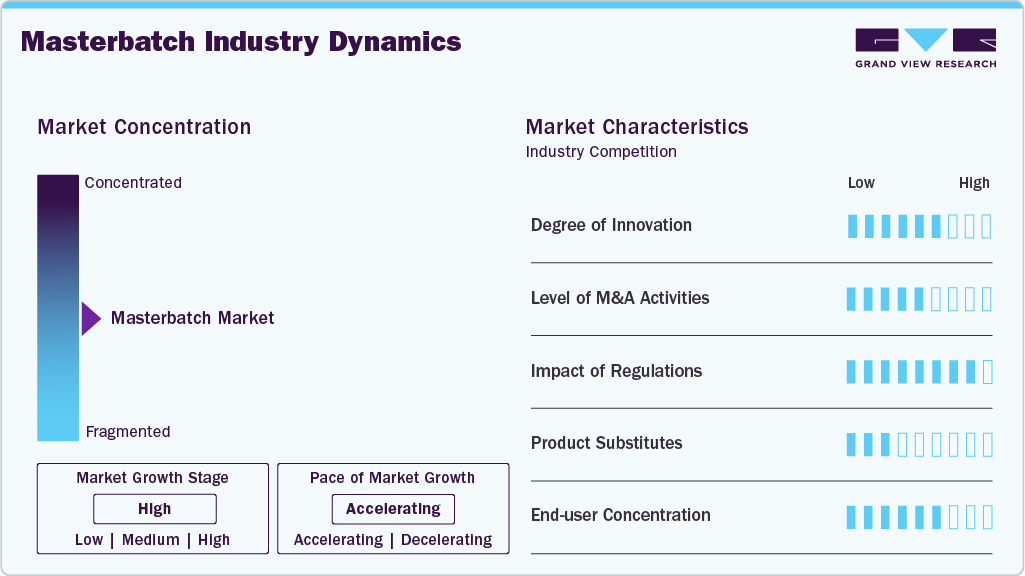
The masterbatch market is moderately consolidated, with a mix of large multinational players and numerous regional manufacturers competing across commodity and specialty segments. Global leaders benefit from strong R&D capabilities, broad product portfolios, and long-term relationships with polymer processors, enabling them to serve high-volume packaging, automotive, and construction applications. However, regional players remain competitive by offering cost-effective solutions, localized supply, and customized formulations tailored to specific end-use requirements.
 To learn more about this report, Download Free Sample Report
 Industry competition is primarily driven by product performance, consistency, pricing, and technical support, rather than branding alone. Demand is characterized by high volume consumption in color masterbatches and faster growth in additive and specialty masterbatches that enhance functionality and sustainability. The market exhibits strong customer stickiness due to qualification processes and formulation-specific requirements, while innovation in sustainable and high-performance masterbatches continues to shape competitive differentiation.
Analyst Perspective
The masterbatch market is expanding as manufacturers increasingly prioritize product differentiation, functional performance, and sustainable polymer solutions. Demand remains strongest in the packaging sector, while automotive, construction, and consumer goods continue to create opportunities for specialty masterbatches with enhanced performance characteristics. Growing adoption of recyclable and biodegradable plastics is accelerating innovation in eco-friendly formulations, encouraging investments in advanced compounding technologies. At the same time, raw material price volatility and evolving environmental regulations are prompting companies to optimize production efficiency and diversify their product portfolios. Manufacturers that combine technical expertise, customized solutions, and sustainability-focused innovation are expected to strengthen their competitive position and capture long-term growth opportunities.
Type Insights
Based on type, black segment accounted for the highest market share, representing 28.9% of total revenue in 2025. The widespread use of carbon black masterbatches in packaging, automotive, and construction plastics drives segment dominance due to their superior UV resistance, electrical conductivity, and cost-effectiveness. Consistent demand from pipes, films, and molded components requiring durability and long service life reinforces the strong market position of black masterbatches.
The white segment is expected to grow significantly with a CAGR of 7.1% during the forecast period. Rising demand for high-opacity, brightness, and cost-efficient pigmentation in flexible packaging, consumer goods, and agricultural films is driving the growth of white masterbatches. Increased use of titanium dioxide-based solutions to enhance aesthetics, UV protection, and material performance across high-volume plastic applications continues to support strong adoption.
Carrier Polymer Insights
In terms of carrier polymer, polypropylene (PP) held the largest share of 26.8% of the masterbatch market in 2025. The extensive use of polypropylene across packaging, automotive, consumer goods, and industrial applications drives strong demand for PP-based masterbatches due to their excellent compatibility, processability, and cost efficiency. High consumption volumes and widespread adoption in injection molding and extrusion processes reinforce PP’s dominant position as a carrier polymer.
The polyethylene (PE) segment is expected to grow at the fastest CAGR of 7.2% during the forecast period. Rapid growth in flexible packaging, agricultural films, and stretch and shrink applications is accelerating demand for PE-based masterbatches. Increasing use of LDPE and LLDPE in lightweight, high-performance films, along with rising sustainability-driven film innovations, supports the strong growth of PE as a carrier polymer.
End-use Insights
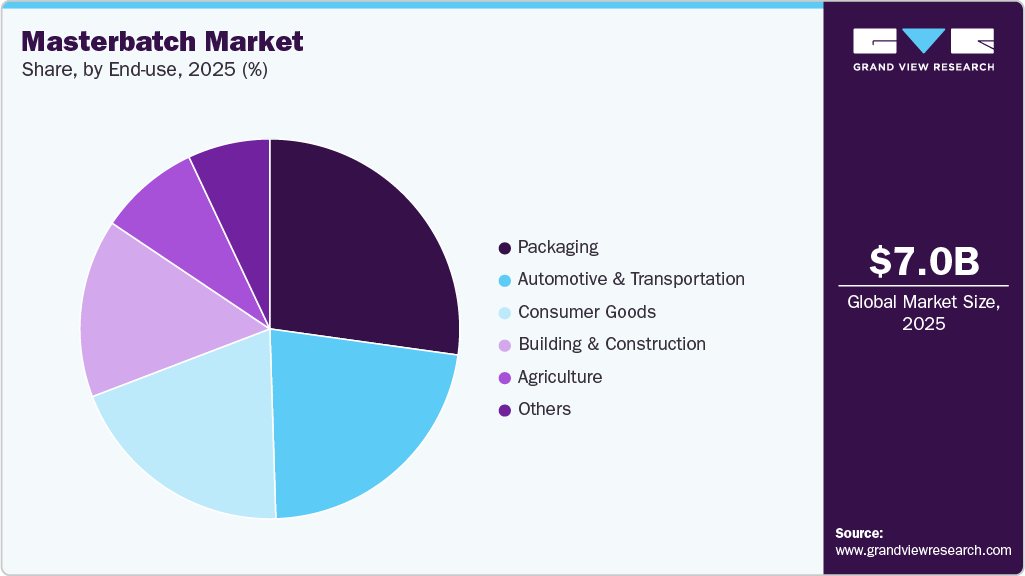
By end-use, packaging held a dominant position, contributing 27.2% of total revenue in 2025. The high-volume use of plastics in flexible and rigid packaging across food, beverages, and consumer goods drives dominant demand for masterbatches used for coloration, protection, and functional enhancement. Continuous focus on shelf appeal, product differentiation, and extended shelf life sustains strong masterbatch consumption in packaging applications.
 To learn more about this report, Download Free Sample Report
 Automotive & Transportation is expected to grow significantly with a CAGR of 7.0% during the forecast period. Increasing adoption of lightweight plastic components to improve fuel efficiency and meet emission regulations is driving growth in automotive and transportation applications. Masterbatches enabling heat resistance, UV stability, and aesthetic consistency are increasingly used in interior and exterior vehicle components, supporting sustained market expansion.
Regional Insights
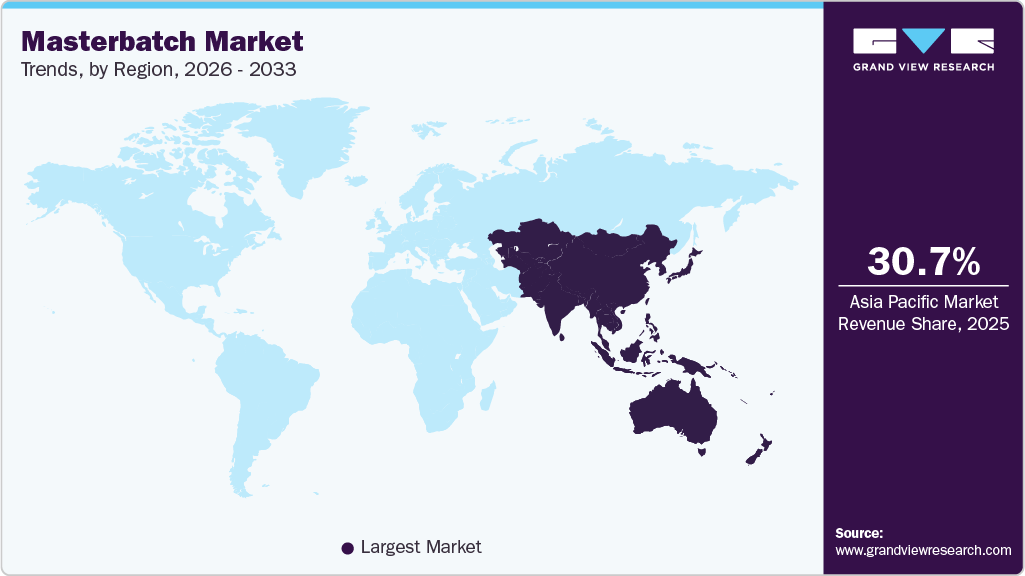
Asia Pacific dominated the masterbatch market with the highest revenue share of 30.9% in 202. Rapid industrialization, expanding packaging demand, and strong growth in consumer goods manufacturing drive market expansion across Asia Pacific. High plastic consumption volumes, cost-competitive production, and increasing investments in automotive and infrastructure support the region’s leading growth momentum.
 To learn more about this report, Download Free Sample Report
 China Aerosol Paints Market Trends
China dominated the Asia Pacific masterbatch market in 2025. China’s large-scale plastic manufacturing base and strong demand from the packaging, consumer goods, and automotive sectors drive robust masterbatch consumption. Rapid capacity expansion, cost-efficient production, and increasing focus on functional and specialty masterbatches to meet quality and sustainability requirements support continued market growth.
North America Masterbatch Market Trends
The masterbatch industry in North America is expected to grow at a CAGR of 5.5% during the forecast period. Strong demand from packaging, automotive, and construction industries drives masterbatch consumption, supported by advanced polymer processing capabilities and high adoption of specialty additives. Regulatory focus on performance, safety, and sustainability further accelerates demand for high value masterbatch solutions.
The masterbatch industry in the U.S. is driven by high consumption of plastics in packaging and automotive applications, along with strong demand for high-performance and specialty masterbatches. Innovation in sustainable materials and advanced polymer processing strengthens demand across end-use industries.
Europe Masterbatch Market Trends
The masterbatch industry in Europe accounted for a global revenue share of 23.4% in 2025. Stringent environmental regulations and circular economy initiatives are driving the adoption of sustainable, recyclable, and specialty masterbatches. The region’s strong automotive and packaging sectors, combined with innovation in lightweight and high-performance plastics, support steady market growth.
Germany’s strong automotive and industrial manufacturing base drives demand for high-performance masterbatches used in engineered plastics. Emphasis on lightweighting, quality standards, and sustainable material solutions reinforces consistent market growth.
Middle East & Africa Masterbatch Market Trends
The masterbatch industry in the Middle East is driven by the growing investments in construction, infrastructure, and packaging, supported by expanding polymer production capacity. Rising urbanization and increasing adoption of plastic packaging in food and consumer goods further support market growth.
Latin America Masterbatch Market Trends
The masterbatch industry in Latin America is driven by expanding food packaging, agriculture, and consumer goods industries, which are driving demand for color and additive masterbatches. Improving manufacturing capabilities and rising plastic consumption across key economies support gradual market expansion.
Key Masterbatch Company Insights
Key players such as Schulman, Inc., Ampacet Corporation, Cabot Corporation, and Clariant AG dominate the masterbatch market through strong global manufacturing footprints, broad color and additive portfolios, and continuous innovation in high-performance and sustainable masterbatch solutions.
-
Schulman, Inc. is a leading player in the masterbatch market, recognized for its comprehensive portfolio of color and additive masterbatches serving packaging, automotive, consumer goods, and industrial applications. The company leverages strong formulation expertise, global manufacturing capabilities, and customer-centric customization to deliver consistent product performance and long-term value across high-volume and specialty plastic applications.
-
Ampacet Corporation is a prominent masterbatch manufacturer with a strong focus on color, special effects, and functional additive solutions for the plastics industry. The company’s competitive strength lies in its advanced R&D capabilities, broad global presence, and ability to develop application-specific masterbatches that support product differentiation, processing efficiency, and sustainability objectives across diverse end-use markets.
Key Masterbatch Companies
The following key companies have been profiled for this study on the masterbatch market.
-
Schulman, Inc.
-
Ampacet Corporation
-
Cabot Corporation
-
Clariant AG
-
Global Colors Group
-
Hubron International Ltd.
-
Penn Color, Inc.
-
Plastiblends India Ltd.
-
Tosaf Group
-
PolyOne Corporation
Recent Developments
-
In January 2024, Hubron International Ltd. and Black Swan Graphene Inc. entered a commercial agreement to expedite the use of Black Swan's graphene products. Hubron, a specialist in plastic masterbatch and conductive compounds, incorporates graphene to improve functionality in masterbatch solutions. This collaboration aims to integrate graphene into various sectors such as automotive, construction, and packaging, leveraging Hubron's market reach and expertise in masterbatch production.
Masterbatch Market Report Scope
Report Attribute
Details
Market size in 2025
USD 7.0 billion
Estimated market size in 2026
USD 7.4 billion
Projected market size by 2033
USD 10.6 billion
Growth rate
CAGR of 5.3% from 2026 to 2033
Base year for estimation
2025
Historical data
2021 - 2024
Forecast period
2026 - 2033
Quantitative units
Revenue in USD billion/million, Volume in Kilotons and CAGR from 2026 to 2033
Report coverage
Revenue forecast, company ranking, competitive landscape, growth factors, and trends
Segments covered
Type, carrier polymers, end-use, region
Regional scope
North America; Europe; Asia Pacific; Latin America; Middle East & Africa
Country scope
U.S.; Canada; Mexico; Germany; UK; France; Italy; Spain; China; India; Japan; Thailand; Vietnam; Singapore; Indonesia; Philippines; Brazil; Argentina
Key companies profiled
Schulman, Inc.; Ampacet Corporation; Cabot Corporation; Clariant AG; Global Colors Group; Hubron International Ltd.; Penn Color; Plastiblends India Ltd.; Tosaf Group PolyOne Corporation
Customization scope
Free report customization (equivalent up to 8 analysts' working days) with purchase. Addition or alteration to country, regional & segment scope.
Pricing and purchase options
Avail customized purchase options to meet your exact research needs. Explore purchase options
Global Masterbatch Market Report Segmentation
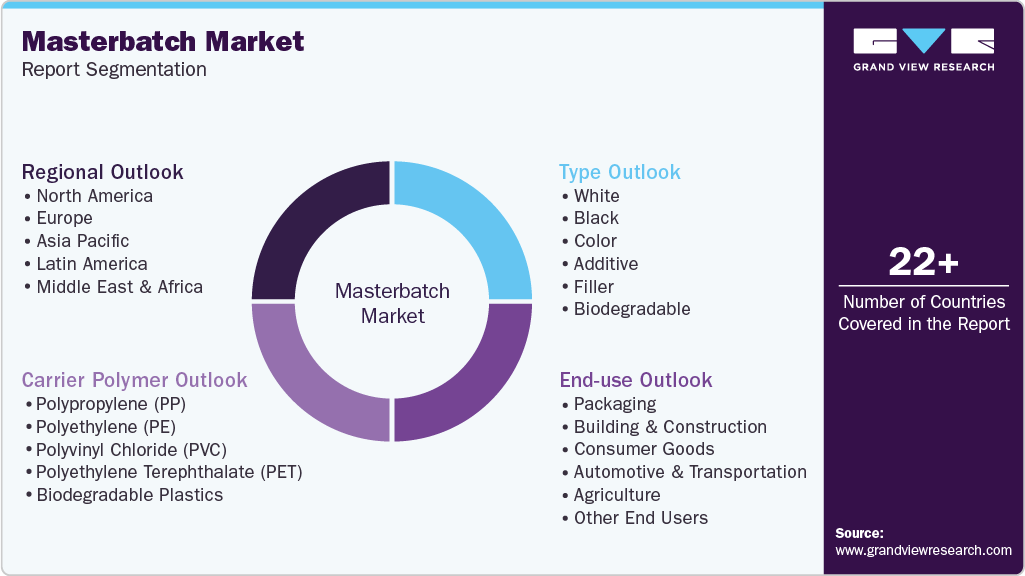
This report forecasts volume & revenue growth at global, regional, and country levels and provides an analysis of the latest industry trends in each of the sub-segments from 2021 to 2033. For this study, Grand View Research has segmented the global masterbatch market report based on type, carrier polymer, end-use, and region:
 To learn more about this report, Download Free Sample Report
 -
Type Outlook (Volume, Kilotons; Revenue, USD Million, 2021 - 2033)
-
White
-
Black
-
Color
-
Additive
-
Filler
-
Biodegradable
-
-
Carrier Polymer Outlook (Volume, Kilotons; Revenue, USD Million, 2021 - 2033)
-
Polypropylene (PP)
-
Polyethylene (PE)
-
Polyvinyl Chloride (PVC)
-
Polyethylene Terephthalate (PET)
-
Biodegradable Plastics
-
-
End-use Outlook (Volume, Kilotons; Revenue, USD Million, 2021 - 2033)
-
Packaging
-
Building & Construction
-
Consumer Goods
-
Automotive & Transportation
-
Agriculture
-
Other End Users
-
-
Regional Outlook (Volume, Kilotons; Revenue, USD Million, 2021 - 2033)
-
North America
-
U.S.
-
Canada
-
Mexico
-
-
Europe
-
Germany
-
UK
-
France
-
Italy
-
Spain
-
-
Asia Pacific
-
China
-
India
-
Japan
-
Southeast Asia
-
Malaysia
-
Thailand
-
Vietnam
-
Singapore
-
Indonesia
-
Philippines
-
Rest of Southeast Asia
-
-
-
Latin America
-
Brazil
-
Argentina
-
-
Middle East & Africa
-
Research Methodology
The masterbatch market figures in this report are based on a proven research process that combines executive interviews with secondary research from proprietary databases, company filings, and recognized regulatory and institutional sources. Market size is built through value-chain sizing - reconciling supply-side and demand-side estimates - and triangulated with bottom-up and top-down approaches. Every estimate passes multiple levels of expert validation before publication, with each masterbatch segment quantified using the revenue-capture definitions in the table below.
Segment Definition
Segment - Type
Revenue capture definition
White
Business growth is supported by strong demand for titanium dioxide-based masterbatches that provide superior opacity, brightness, and UV protection in packaging, consumer goods, and construction products.
Black
Market value is driven by extensive use of carbon black masterbatches for UV stabilization, electrical conductivity, and enhanced durability in automotive components, pipes, cables, and agricultural films.
Color
Commercial expansion is fueled by increasing adoption of customized color masterbatches that deliver consistent pigmentation, brand differentiation, and improved product aesthetics across diverse plastic manufacturing applications.
Additive
Industry momentum is strengthened by growing utilization of functional additive masterbatches that improve flame retardancy, antimicrobial performance, antistatic properties, and processing efficiency in high-performance polymer products.
Filler
Demand generation is supported by rising incorporation of filler masterbatches to optimize raw material consumption, improve dimensional stability, and reduce manufacturing costs while maintaining product performance.
Biodegradable
Growth prospects are increasing through adoption of biodegradable masterbatches that enable sustainable plastic production, supporting regulatory compliance and environmentally responsible packaging and consumer product development.
Segment - Carrier Polymer
Revenue capture definition
Polypropylene (PP)
Sales performance is supported by widespread incorporation of polypropylene-based masterbatches in rigid packaging, automotive parts, household products, and industrial components requiring excellent processability and mechanical strength.
Polyethylene (PE)
Business expansion is reinforced by extensive use of polyethylene-compatible masterbatches in flexible packaging, agricultural films, pipes, wire insulation, delivering enhanced durability and consistent product quality.
Polyvinyl Chloride (PVC)
Market demand is driven by application in PVC pipes, cable insulation, window profiles, and construction materials where specialized masterbatches improve color retention, weatherability, and processing performance.
Polyethylene Terephthalate (PET)
Commercial value is strengthened by increasing utilization of PET-compatible masterbatches in beverage bottles, food containers, and textile fibers requiring high clarity, color consistency, and thermal stability
Biodegradable Plastics
Industry growth is supported by rising demand for masterbatches formulated for biodegradable polymers, enabling sustainable packaging solutions while preserving functional performance and visual appeal.
Segment - End Use
Revenue capture definition
Packaging
Market leadership is driven by extensive adoption of masterbatches for enhancing appearance, barrier performance, UV resistance, and processing efficiency in rigid and flexible packaging applications.
Building & Construction
Commercial opportunities are supported by increasing use in pipes, fittings, cables, roofing materials, and construction profiles requiring long-term durability, weather resistance, and color stability.
Consumer Goods
Business potential is fueled by demand for aesthetically appealing and high-performance plastic products, with masterbatches enabling customized colors and functional enhancements across household and personal care items.
Automotive & Transportation
Industry advancement is strengthened by the growing use of lightweight polymer components incorporating masterbatches to improve UV resistance, surface finish, durability, and compliance with automotive quality standards.
Agriculture
Demand momentum is reinforced by widespread application in greenhouse films, mulch films, irrigation systems, and agricultural containers where masterbatches enhance weatherability, durability, and crop protection performance.
Other End Uses
Application diversity is sustained by utilization across healthcare, electrical & electronics, textiles, industrial manufacturing, and specialty applications requiring tailored polymer performance and regulatory compliance.
Estimation Model
Layer Name
Key Question
Description
Raw Material & Production Layer
What forms the supply base?
Assess global masterbatch production based on the availability of carrier polymers, pigments, carbon black, titanium dioxide, mineral fillers, functional additives, processing aids, and performance enhancers. Evaluate compounding, extrusion, pelletizing, quality assurance, and packaging operations while analyzing raw material procurement, manufacturing costs, processing technologies, production capacity, and key manufacturing hubs influencing global supply.
Application Adoption Layer
Where is masterbatch consumed?
Examine the adoption of masterbatch across major end-use industries, including packaging, building & construction, automotive & transportation, consumer goods, agriculture, electrical & electronics, and healthcare. Market penetration is influenced by increasing demand for color consistency, enhanced polymer performance, UV protection, flame retardancy, antimicrobial functionality, and cost-efficient plastic processing across diverse manufacturing applications.
Consumption Intensity Layer
How much masterbatch is utilized?
Analyze utilization patterns by evaluating consumption volumes across packaging films, molded plastic components, automotive parts, construction materials, agricultural products, and consumer goods. The assessment considers polymer production volumes, manufacturing output, product specifications, processing rates, regional industrial activity, and sector-specific demand trends to estimate overall market consumption.
Revenue Layer
How is market revenue generated?
Market value is created through the commercialization of white, black, color, filler, additive, and biodegradable masterbatches supplied to plastic processors, packaging manufacturers, automotive suppliers, construction material producers, and consumer goods manufacturers. Commercial growth is supported by increasing polymer consumption, demand for high-performance plastic materials, technological advancements in specialty formulations, expanding industrial production, sustainability initiatives, and investments in advanced compounding capabilities that strengthen long-term market competitiveness.
Delivered Customizations
This report has been delivered with the following In-depth customizations
Client Request
Customization Delivered
Value Adds
Regional Segmentation
The study delivers detailed country-level analysis across major masterbatch production and consumption markets. It evaluates raw material availability, manufacturing capacity, supply chain dynamics, import-export trends, regulatory frameworks, pricing outlook, polymer demand, and adoption across packaging, automotive, construction, consumer goods, agriculture, and other end-use industries.
Enables stakeholders to identify high-growth regional markets, assess manufacturing competitiveness, understand regulatory environments, optimize procurement strategies, and prioritize expansion opportunities based on evolving industrial demand and polymer consumption trends.
Competitive Benchmarking
The report provides a comprehensive benchmarking assessment of leading masterbatch manufacturers, covering product portfolios, production capabilities, geographic footprint, distribution networks, research and development initiatives, sustainability strategies, operational strengths, and recent strategic developments.
Helps businesses evaluate competitive positioning, identify product portfolio gaps, benchmark innovation capabilities, support strategic partnerships, and strengthen long-term market expansion and differentiation strategies.
Opportunity Assessment
The study evaluates emerging growth opportunities across sustainable and biodegradable masterbatches, specialty additive formulations, recycled polymer applications, lightweight plastic components, high-performance packaging materials, and advanced polymer compounding technologies. It also examines opportunities arising from circular economy initiatives, increasing use of recycled plastics, and investments in next generation masterbatch solutions.
Assists companies in identifying high-growth application segments, aligning product development with evolving customer expectations, optimizing capital allocation, accelerating commercialization strategies, and enhancing long-term competitive advantage.
Frequently Asked Questions About This Report
Asia Pacific dominated the market with a 30.7% revenue share in 2025.
Asia Pacific remains the leading regional growth engine due to rapid industrialization, expanding packaging demand, and cost-competitive production infrastructure.
Black dominated the global masterbatch market with the largest revenue share of 28.8% in 2025. The widespread use of carbon black masterbatches in packaging, automotive, and construction plastics drives segment dominance due to their superior UV resistance, electrical conductivity, and cost-effectiveness. Consistent demand from pipes, films, and molded components requiring durability and long service life reinforces the strong market position of black masterbatches.
Some of the key players operating in the masterbatch market include Schulman, Inc., Ampacet Corporation, Cabot Corporation, Clariant AG, Global Colors Group., Hubron International Ltd., etc.
Growing consumption of flexible and rigid plastic packaging across food, beverages, personal care, and household products is driving demand for masterbatches used for coloring, UV stabilization, and functional enhancement. Brand owners are increasingly focusing on product differentiation, shelf appeal, and extended shelf life, which boosts adoption of high-performance color and additive masterbatches in mass-volume packaging applications.
The global masterbatch market is expected to grow at a compound annual growth rate of 5.0% from 2026 to 2033 to reach USD 10.5 billion by 2033.
Polypropylene (PP) held a dominant revenue share in 2025 due to its versatility, while Polyethylene (PE) is the fastest-growing segment with a 7.2% CAGR.
The packaging segment held the highest share with 27.2% in 2025, while Automotive & Transportation is expected to grow at a significant CAGR of 7.0% from 2026 to 2033.
The global masterbatch market size was estimated at USD 7.0 billion in 2025 and is expected to reach USD 7.4 billion in 2026.
About the Author(s)
Paints, Coatings & Printing Inks Research Team
Bulk Chemicals · Paints, Coatings & Printing InksThis report was authored by the paints, coatings & printing inks research team at Grand View Research - comprising two research analysts, one senior research analyst, and one industry expert - with specialized expertise in the paints, coatings & printing inks segment of the bulk chemicals industry. All findings are based on proprietary bulk chemicals databases, executive interviews, and regulatory analysis, subject to internal peer review prior to publication.
Last Updated:
Speak to Analyst

Customize this report to your needs - add regions, segments, or data points, with 20% free customization.
Or view our licence options:


ISO 9001:2015 & 27001:2022 Certified
We are GDPR and CCPA compliant! Your transaction & personal information is safe and secure. For more details, please read our privacy policy.


