
- Home
- »
- Next Generation Technologies
- »
-
MEA Location-based Entertainment Market Size Report 2033GVR Report cover

Middle East & Africa Location-based Entertainment Market (2026 - 2033)
Size, Share & Trends Analysis Report By Component (Hardware, Software), By Technology (2 Dimensional, 3 & 4 Dimensional, Cloud Merged Reality), By End Use, By Format, By Region, And Segment Forecasts
Market Size, 2025
$191.5MMarket Estimate, 2026
$253.2MMarket Forecast, 2033
$1,398.0MCAGR, 2026–2033
27.6%Middle East & Africa Location-based Entertainment Market Summary
The Middle East & Africa location-based entertainment market size was valued at USD 191.5 million in 2025 and is projected to grow from USD 253.2 million in 2026 to USD 1,398.0 million by 2033, at a CAGR of 27.6% from 2026 to 2033. Saudi Arabia dominated the market, accounting for the largest revenue share of 27.1% in 2025. The market growth is driven by increasing international and domestic tourism, rising investments in entertainment and tourism infrastructure, expanding theme parks and family entertainment centers, and increasing consumer demand for immersive, interactive, and technology-enabled leisure experiences across major urban and tourism destinations.
Key Market Trends & Insights
- By component: Hardware segment held the dominant position and accounted for the highest revenue share of 60.5% in 2025.
- By technology: 3 & 4 Dimensional (3D & 4D) segment accounted for the largest revenue share of 49.6% in 2025.
- By end use: Amusement park segment held the largest market share in 2025.
- By format: Venue-based location-based entertainment segment accounted for the largest market share in 2025.
Market Size & Forecast
- Market size in 2025: USD 191.5 Million
- Estimated market size in 2026: USD 253.2 Million
- Projected market size by 2033: USD 1,398.0 Million
- CAGR (2026-2033): 27.6%
Three ways to get this report
Buy it, customize it, or ask a question.Ask an Analyst
A direct answer, usually in 1 working day
- AccessReport author, directly
- Reply timeWithin 1 working day
- No sales callDirect answer only
- FormatEmail reply
- CostFree, no cost
Get the Full Report
What the study covers
- FormatsPDF · Excel · Dashboard
- Timeline2026–2033 annual, 2025 base
- Coverage20+ countries, 5 regions
- Companies10+ key players profiled
Customize the Report
20% free customization
- IncludeCountries, segments, points
- TailorTo your product definition
- ExtendDeeper competitor detail
- OrA fully bespoke study
- Turnaround5–10 working days
The expansion of the Middle East & Africa location-based entertainment market is driven by the development of large-scale tourism and entertainment destinations, increasing integration of attractions within shopping malls and mixed-use developments, rising demand for family-oriented leisure experiences, and the growing popularity of gaming, esports, immersive attractions, and experiential entertainment. Growing public and private investment in destination development, increasing visitor spending on experiential activities, and the incorporation of advanced digital technologies are encouraging operators to introduce differentiated attractions, enhance visitor engagement, and create multi-purpose entertainment destinations.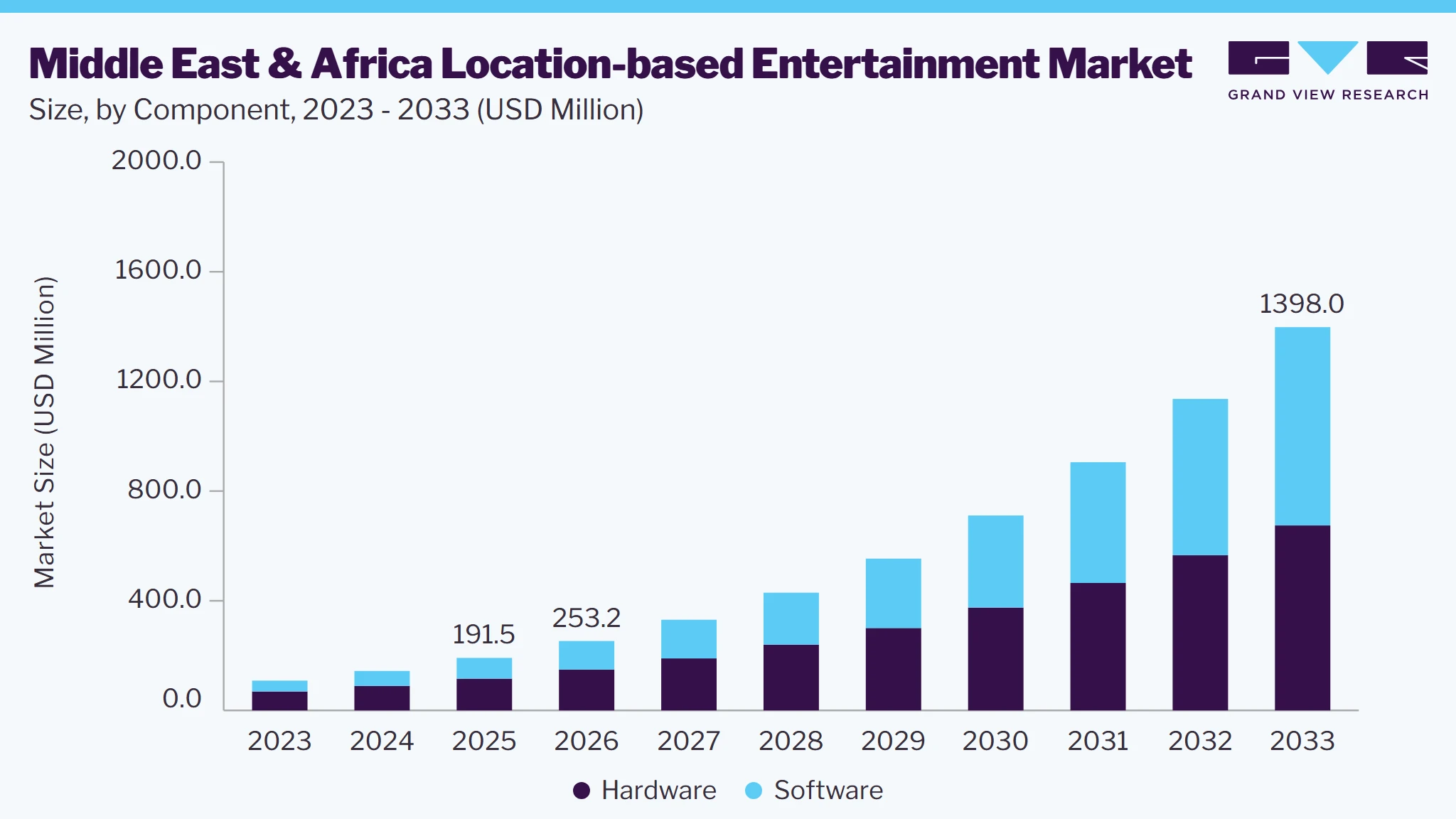 Source: Grand View Research, IR Documents, Primary Interviews, Paid DatabasesTo learn more about this report,
 Download Free Sample Report
 The Middle East & Africa location-based entertainment industry is experiencing steady expansion due to the growing development of integrated entertainment districts, the increasing number of large-scale leisure destinations, and the growing emphasis on creating year-round visitor attractions. Developers and entertainment operators are incorporating cinemas, indoor attractions, themed experiences, cultural venues, and recreational facilities within mixed-use developments to increase visitor footfall, encourage longer stays, and diversify leisure offerings across major urban centers and tourism destinations.
Additionally, the growing participation of younger consumers in social entertainment activities and the increasing preference for group-oriented experiences are supporting demand for interactive and experiential attractions across the region. Operators are introducing multiplayer gaming zones, escape rooms, competitive entertainment, interactive installations, and social recreation concepts to cater to changing consumer preferences. These developments are enabling entertainment providers to increase repeat visits, strengthen customer engagement, and differentiate their venues in increasingly competitive leisure markets.
Moreover, the increasing adoption of advanced technologies such as augmented reality, virtual reality, projection mapping, motion simulation, and interactive digital displays is creating new opportunities for location-based entertainment providers across the Middle East & Africa. Operators are integrating these technologies into attractions to deliver personalized, immersive, and highly interactive experiences while improving content flexibility and attraction appeal. Technology-driven entertainment concepts are helping venues attract technology-oriented consumers, refresh existing attractions, and expand revenue opportunities through premium experiential offerings.
Market Dynamics
The Middle East & Africa location-based entertainment market is experiencing significant growth, driven by the development of large-scale tourism destinations, increasing investments in entertainment infrastructure, rising international and domestic tourist arrivals, and growing emphasis on diversifying leisure offerings beyond traditional attractions. Rising investments in theme parks, family entertainment centers, immersive attractions, cinemas, and integrated entertainment districts are accelerating market expansion. The development of technologically advanced attractions, indoor entertainment concepts, premium experiential offerings, and destination-based leisure facilities is enhancing visitor engagement and strengthening the attractiveness of major entertainment and tourism destinations across the region.
The development of large-scale entertainment destinations across the Middle East is driving demand for location-based entertainment experiences. Investments in theme parks, family entertainment centers, cinemas, immersive attractions, cultural venues, and mixed-use leisure districts are creating diverse entertainment ecosystems. Developers are increasingly combining multiple attractions within single destinations to increase visitor dwell time, encourage repeat visits, diversify consumer spending, and strengthen the appeal of major tourism and urban developments across the region.
Rising tourism activity across countries such as Saudi Arabia, the UAE, Qatar, and Egypt is further supporting investments in destination-based entertainment facilities. Governments and private developers are focusing on establishing year-round attractions that serve residents, international tourists, families, and younger consumers. This shift is encouraging operators to introduce differentiated experiences, premium attractions, interactive concepts, and technology-enabled venues that align with evolving leisure preferences and increasing visitor expectations.
Location-based entertainment projects often require substantial upfront investments for land development, attraction infrastructure, specialized equipment, technology systems, safety installations, and venue construction. Advanced concepts such as immersive experiences, large-scale theme parks, simulation attractions, and interactive entertainment facilities can involve significant development and operating expenses. These financial requirements can restrict investments by smaller operators, particularly in markets where consumer spending patterns, tourism flows, or entertainment infrastructure remain comparatively uneven.
Operating costs can increase because sophisticated attractions require specialized maintenance, periodic technology upgrades, trained personnel, insurance coverage, and continuous content refreshes. Equipment failures or prolonged attraction downtime can negatively affect visitor satisfaction and revenue generation. In addition, fluctuations in construction costs, imported equipment prices, energy expenses, and technology procurement can place additional pressure on project budgets, making cost management an important consideration for developers and entertainment operators across the region.
The increasing adoption of virtual reality, augmented reality, projection mapping, motion simulation, interactive displays, and artificial intelligence-based experiences is creating opportunities for operators to develop differentiated entertainment concepts. These technologies enable venues to introduce interactive storytelling, personalized experiences, multiplayer attractions, and frequently refreshed digital content without requiring complete physical redevelopment. Such capabilities can improve visitor engagement while helping operators appeal to younger, technology-oriented consumers seeking novel recreational experiences.
Technology-enabled attractions provide opportunities to optimize venue utilization across shopping malls, resorts, tourism destinations, cultural facilities, and dedicated entertainment centers. Operators can combine physical environments with digital content to create flexible experiences that accommodate different age groups and visitor preferences. Increasing accessibility of immersive technologies is encouraging the development of compact entertainment formats, pop-up attractions, interactive exhibitions, and premium experiential venues, broadening deployment opportunities across diverse locations.
Market Concentration & Characteristics
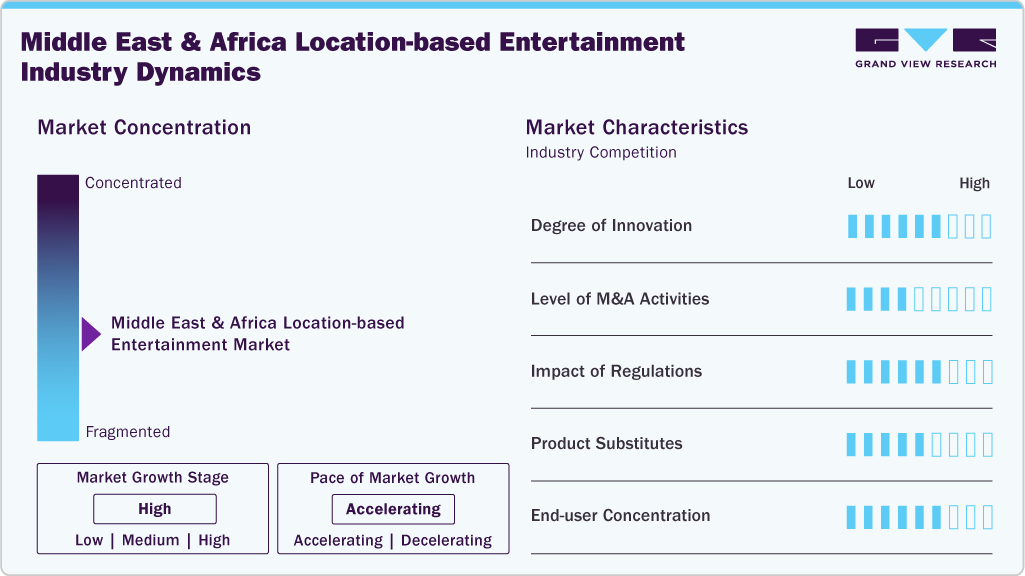
The Middle East & Africa location-based entertainment industry is moderately fragmented, comprising large entertainment developers, theme park operators, family entertainment center providers, cinema chains, mall operators, hospitality companies, immersive experience providers, and specialized leisure operators serving tourists, families, local residents, young consumers, and corporate visitors. The market is experiencing steady expansion due to increasing tourism activity, development of large-scale entertainment destinations, rising investments in leisure infrastructure, and growing consumer preference for experiential recreation. Strategic partnerships, expansion of the attraction portfolio, and investments in technology-enabled experiences are enabling companies to strengthen their market presence across major tourism and urban centers.
 To learn more about this report, Download Free Sample Report
 The market is characterized by a high level of innovation, driven by virtual reality, augmented reality, interactive gaming, projection mapping, motion simulation, and immersive experiences that enhance visitor engagement. M&A activity remains moderate, with entertainment groups pursuing partnerships, joint ventures, and portfolio expansion. Service substitution is relatively high, as consumers can choose cinemas, shopping, gaming, esports, sports, cultural attractions, and digital entertainment. Regulatory requirements related to safety, licensing, construction, crowd management, and tourism operations influence venue development, while increasing demand for differentiated, technology-enabled, and interactive experiences continues to strengthen competitive positioning across major markets.
Analyst Perspective
The Middle East & Africa location-based entertainment market is experiencing strong momentum, driven by expanding tourism activity, large-scale entertainment investments, rising consumer spending on experiential leisure, and the development of integrated tourism and entertainment destinations. The increasing deployment of amusement parks, family entertainment centers, immersive attractions, arcade studios, 4D cinemas, and technology-enabled venues is encouraging operators to diversify their entertainment offerings. These developments are helping entertainment providers enhance visitor engagement, increase dwell time, introduce differentiated experiences, strengthen revenue streams, and establish competitive positioning across major tourism, retail, hospitality, and urban destinations in the region
Component Insights
The hardware segment accounted for the largest market share, at 60.5%, in 2025, propelled by the widespread deployment of physical attractions, gaming equipment, immersive systems, interactive displays, and specialized entertainment infrastructure across location-based venues. Theme parks, family entertainment centers, cinemas, gaming zones, and immersive experience venues require substantial investments in attraction equipment and supporting infrastructure to accommodate high visitor volumes. Their durability, direct contribution to visitor experiences, and ability to support diverse entertainment formats continue to reinforce the segment’s leading position across major destinations in the Middle East & Africa.
The software segment is expected to witness the highest CAGR of over 31.9% from 2026 to 2033. The segment is driven by increasing adoption of digital content, virtual reality applications, AR platforms, interactive gaming software, and immersive storytelling solutions. Operators are increasingly using software to refresh attractions, personalize visitor experiences, and update digital content without major physical modifications. Growing demand for flexible, technology-driven entertainment concepts is encouraging continuous investment in content management, interactive applications, digital platforms, and software-enabled experiences across the region.
Technology Insights
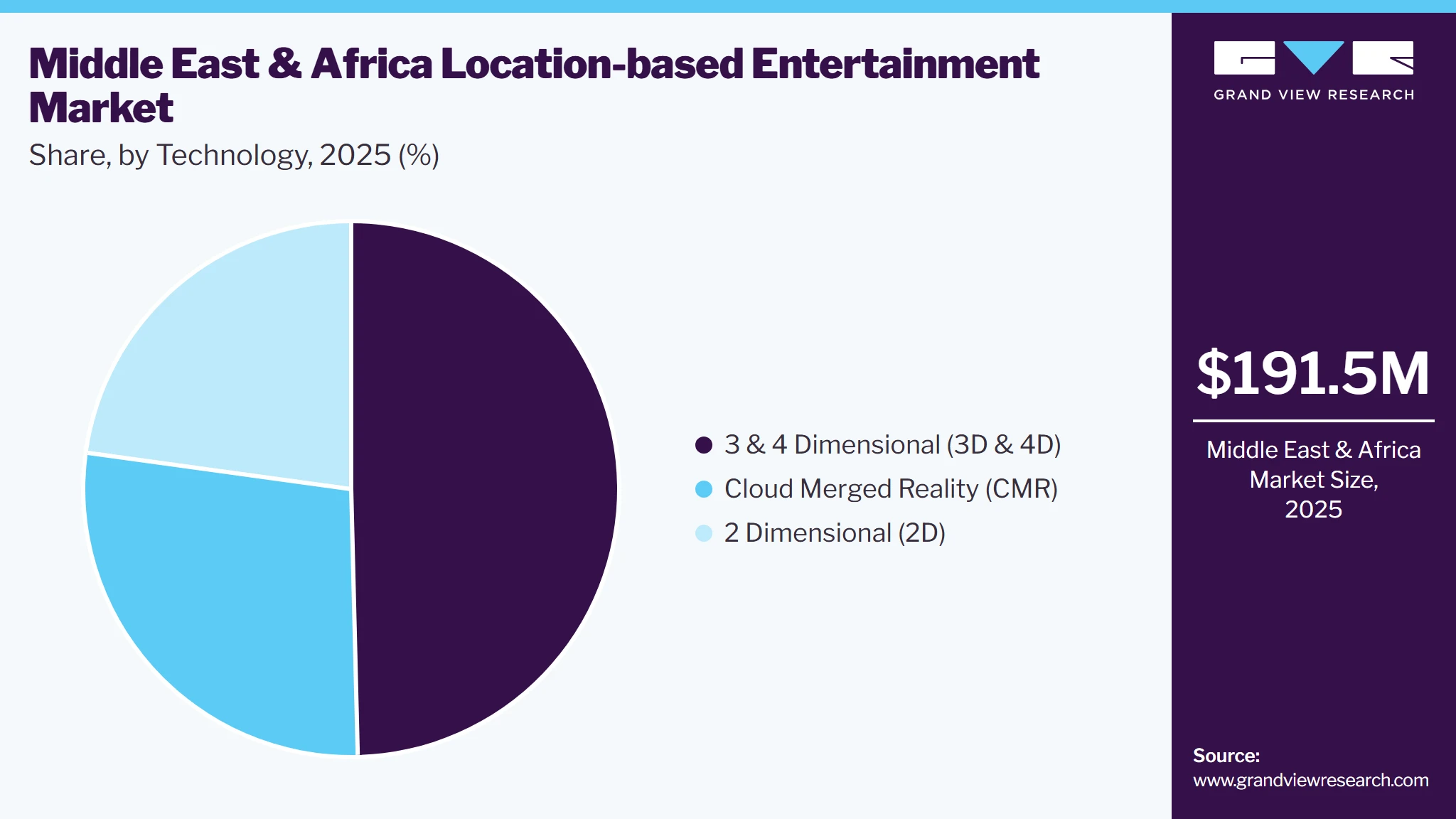
The 3 & 4 Dimensional (3D & 4D) segment accounted for the largest market share of 49.6% in 2025, fueled by the widespread popularity of immersive cinematic and simulation-based experiences across theme parks, cinemas, family entertainment centers, and tourism destinations. The ability to combine high-quality visuals with motion effects, environmental sensations, and interactive storytelling provides visitors with engaging experiences that appeal to families, tourists, and younger audiences. Increasing investments in premium attractions and demand for differentiated entertainment experiences continue to strengthen the segment’s market leadership across the region.
 To learn more about this report, Download Free Sample Report
 The cloud-merged reality (CMR) segment is expected to witness the highest CAGR from 2026 to 2033, driven by the increasing adoption of cloud-connected immersive experiences, real-time interactive content, and digitally integrated entertainment platforms. Operators are increasingly exploring connected environments that combine physical attractions with virtual elements, enabling flexible content delivery, multiplayer participation, and remote content updates. Growing investment in immersive entertainment technologies and demand for scalable digital experiences are expected to drive strong adoption of CMR solutions across major entertainment destinations in the Middle East & Africa.
End Use Insights
The amusement park segment accounted for the largest market share, at 38.1%, in 2025, driven by increasing investments in large-scale tourism destinations, rising domestic and international visitor spending, and growing demand for family-oriented recreational experiences. Major developments featuring rides, themed attractions, water-based entertainment, and retail are attracting diverse visitor groups. Government-led tourism diversification initiatives and private investments in integrated leisure destinations are further encouraging the development of amusement parks, thereby strengthening their ability to attract sustained visitor flows across the market.
The immersive screen-based segment is expected to witness the highest CAGR from 2026 to 2033, driven by increasing adoption of large-format digital displays, projection technologies, interactive visual environments, and real-time content across entertainment venues. Operators are deploying immersive screens to create engaging storytelling, virtual environments, interactive exhibitions, and visually rich experiences without extensive mechanical infrastructure. Rising consumer preference for technology-enabled attractions and differentiated entertainment formats is encouraging greater adoption across malls, theme parks, cultural venues, and family entertainment centers.
Format Insights
The venue-based location-based entertainment segment accounted for the largest market share, at 64.1%, in 2025, fueled by rising investment in theme parks, family entertainment centers, cinemas, immersive attractions, and integrated leisure destinations. These venues provide consumers with social, experiential, and interactive activities that cannot be easily replicated at home. Rising tourism, expanding shopping, and increasing consumer spending on recreational experiences are encouraging operators to establish diverse entertainment venues, thereby strengthening the segment’s market position in the Middle East & Africa location-based entertainment industry.
The device-based location-based entertainment segment is expected to witness the highest CAGR from 2026 to 2033, driven by increasing adoption of portable VR devices, AR-enabled systems, interactive gaming equipment, and wearable technologies within entertainment settings. Operators are incorporating device-based experiences to provide personalized gameplay, immersive simulations, and multiplayer activities. Growing consumer interest in technology-driven recreation, declining costs of immersive devices, and continuous advancements in interactive hardware are supporting adoption across entertainment centers and tourism destinations.
Country Insights
Saudi Arabia Location-based Entertainment Market Trends
The Saudi Arabia location-based entertainment market held a revenue share of 27.1% in 2025, supported by the rapid development of tourism destinations, large-scale leisure projects, and government initiatives to expand entertainment offerings. Rising investments in theme parks, gaming venues, cultural attractions, immersive experiences, and integrated entertainment districts are creating new opportunities for operators. Increasing international tourism, rising domestic leisure spending, and the development of destination-based projects are encouraging the introduction of diverse attractions designed to increase visitor engagement, extend tourist stays, and strengthen Saudi Arabia’s position as a major regional entertainment destination.
UAE Location-based Entertainment Market Trends
The UAE location-based entertainment market is expected to witness the highest CAGR of 28.2% from 2026 to 2033, driven by its established tourism ecosystem, high international visitor volumes, and extensive network of shopping malls, resorts, theme parks, and family entertainment centers. Operators are increasingly investing in premium attractions, immersive experiences, and technology-enabled venues to differentiate offerings and attract diverse visitor groups. The expansion of experiential tourism, increasing consumer preference for social leisure activities, and integration of entertainment with retail and hospitality destinations are strengthening demand for innovative location-based experiences.
Key Middle East & Africa Location-based Entertainment Company Insights
Some of the key players operating in the market are Majid Al Futtaim and Emaar Entertainment, among others.
-
Majid Al Futtaim is a leading player in the market, operating a broad portfolio of location-based entertainment brands including VOX Cinemas, Magic Planet, Ski Dubai, Ski Egypt, iFLY Dubai, and Little Explorers. The company is strengthening its position through integrated entertainment concepts within shopping destinations, premium cinema experiences, family entertainment centers, and technology-enabled attractions. Its extensive regional presence across the Middle East and Africa supports its ability to capture rising consumer demand for diversified leisure and experiential entertainment.
-
Emaar Entertainment is a leading player in the market, managing a diverse portfolio of attractions including Reel Cinemas, Dubai Aquarium & Underwater Zoo, Dubai Ice Rink, Play DXB, KidZania, Dubai Opera, and other experiential destinations. The company is expanding its market presence through premium entertainment concepts, immersive attractions, advanced cinema technologies, and integration with major retail and tourism destinations. Its broad portfolio enables Emaar Entertainment to serve families, tourists, and high-value leisure consumers across the Middle East & Africa location-based entertainment industry.
Saudi Entertainment Ventures and IMG Worlds of Adventure are some of the emerging market participants in the Middle East & Africa location-based entertainment market.
-
Saudi Entertainment Ventures (SEVEN) is an emerging player in the market, focusing on developing large-scale entertainment destinations across Saudi Arabia featuring cinemas, immersive experiences, family attractions, global entertainment brands, dining, and retail. The company is expanding its presence through projects across multiple Saudi cities, including Tabuk and Abha, while integrating diverse entertainment concepts within destination-based developments. Its focus on regional entertainment infrastructure and partnerships with international brands is strengthening its position within Saudi Arabia's rapidly evolving leisure landscape.
-
IMG Worlds of Adventure is an emerging player in the Middle East & Africa location-based entertainment industry, specializing in large-scale indoor theme park experiences featuring immersive rides, branded attractions, entertainment zones, and family-oriented activities. The company is strengthening its position by offering integrated themed entertainment experiences that combine attractions, dining, retail, and character-based experiences within a climate-controlled environment. Its indoor format and emphasis on immersive attractions offer opportunities to serve tourists, families, and younger consumers seeking year-round entertainment.
Key Middle East & Africa Location-based Entertainment Companies
-
Majid Al Futtaim.
-
Emaar Entertainment
-
IMG Worlds of Adventure
-
Saudi Entertainment Ventures
-
Dassault Systemes SE
-
AEON Fantasy Co Ltd
-
GameSquare Holdings Inc
-
The Walt Disney Co
-
Regal Hotels International Holdings Ltd
-
Six Flags Entertainment Corp
Competitive Benchmarking
Category
Operating Strategies
Competitive Edge
Weakness
Established Players (Majid Al Futtaim., Emaar Entertainment, The Walt Disney Co)
- Focus on expanding integrated entertainment portfolios across tourism, retail, hospitality, and leisure destinations.
- Invest in premium attractions, immersive technologies, strategic partnerships, and destination-scale entertainment infrastructure.
- Strong presence, established brands, and diversified attraction portfolios support market leadership.
- Ability to deliver comprehensive entertainment experiences across multiple formats, locations, and consumer segments.
- Large operating structures can reduce flexibility when responding to rapidly changing consumer entertainment preferences.
- High capital requirements for large-scale attractions can increase financial exposure during demand fluctuations.
Emerging Players (IMG Worlds of Adventure, Saudi Entertainment Ventures, Six Flags Entertainment Corp)
- Emerging players are focusing on developing differentiated, immersive attractions to meet growing demand in tourism, family entertainment, and experiential leisure.
- Invest in technology-enabled experiences, strategic partnerships, and expansion across high-priority Middle Eastern destinations.
- Greater operational agility enables rapid adoption of emerging entertainment technologies and changing consumer preferences.
- Focused attraction portfolios allow specialized offerings, faster experimentation, and differentiated visitor experiences.
- Limited regional presence and brand recognition can constrain visitor acquisition compared with established entertainment operators.
- Smaller investment capacity may limit the development of large-scale attractions that require substantial capital and infrastructure.
Recent Developments
-
In August 2026, Saudi Entertainment Ventures (SEVEN) opened its first SEVEN entertainment destination in Abha, Saudi Arabia, a SAR 1.3 billion development featuring Discovery Adventures, Formula E Karting, and a Play-Doh Imagination Center. The 64,000-square-meter destination marks a major step in SEVEN’s nationwide rollout and strengthens its strategy to develop integrated entertainment destinations across Saudi Arabia.
-
In August 2026, GameSquare Holdings Inc expanded its gaming and esports intellectual-property portfolio through a sales partnership with MEGA. The collaboration enables GameSquare to leverage its creator, content, media, data, and live-experience capabilities to develop sponsorship opportunities around major esports properties, supporting the broader convergence of gaming, live entertainment, and experiential venues relevant to location-based entertainment.
-
In January 2026, Six Flags Entertainment Corp opened Six Flags Qiddiya City near Riyadh, Saudi Arabia, marking the company’s first theme park outside North America. The approximately USD 1 billion destination includes record-setting attractions such as Falcon’s Flight and forms part of the broader Qiddiya entertainment development, strengthening Six Flags’ international expansion. The development is expected to strengthen Saudi Arabia’s position as a leading regional entertainment destination and support demand for large-scale location-based entertainment experiences across the Middle East & Africa.
Middle East & Africa Location-based Entertainment Market Report Scope
Report Attribute
Details
Market size in 2025
USD 191.5 million
Estimated market size in 2026
USD 253.2 million
Projected market size by 2033
USD 1,398.0 million
Growth rate
CAGR of 27.6% from 2026 to 2033
Base year for estimation
2025
Historical data
2021 - 2024
Forecast period
2026 - 2033
Quantitative units
Revenue in USD Million and CAGR from 2026 to 2033
Report Product
Revenue forecast, company ranking, competitive landscape, growth factors, and trends
Segments covered
Component, technology, end use, format, and country
Country scope
Saudi Arabia, UAE, South Africa
Key companies profiled
Majid Al Futtaim.; Emaar Entertainment; IMG Worlds of Adventure; Saudi Entertainment Ventures; Dassault Systemes SE; AEON Fantasy Co Ltd; GameSquare Holdings Inc; The Walt Disney Co; Regal Hotels International Holdings Ltd; Six Flags Entertainment Corp
Customization scope
Free report customization (equivalent to up to 8 analyst’s working days) with purchase. Addition or alteration to country, regional & segment scope.
Pricing and purchase options
Avail customized purchase options to meet you exact research needs. Explore purchase options
Middle East & Africa Location-based Entertainment Market Report Segmentation
This report forecasts revenue growth at the regional and country levels and provides an analysis of the latest technological trends in each of the sub-segments from 2021 to 2033. For this study, Grand View Research has segmented the Middle East & Africa location-based entertainment market report based on component, technology, end use, format, and region:
-
Component Outlook (Revenue, USD Million, 2021 - 2033)
-
Hardware
-
Software
-
-
Technology Outlook (Revenue, USD Million, 2021- 2033)
-
2 Dimensional (2D)
-
3 & 4 Dimensional (3D & 4D)
-
Cloud Merged Reality (CMR)
-
-
End Use Outlook (Revenue, USD Million, 2021 - 2033)
-
Amusement Parks
-
Indoor
-
Outdoor
-
-
Arcade Studios
-
4D Films
-
-
Format Outlook (Revenue, USD Million, 2021 - 2033)
-
Venue-based LBE
-
Device-based LBE
-
-
Regional Outlook (Revenue, USD Million, 2021 - 2033)
-
Saudi Arabia
-
UAE
-
South Africa
-
Research Methodology
The MEA location-based entertainment market figures in this report are based on a proven research process that combines executive interviews with secondary research from proprietary databases, company filings, and recognized regulatory and institutional sources. Market size is built through value-chain sizing - reconciling supply-side and demand-side estimates - and triangulated with bottom-up and top-down approaches. Every estimate passes multiple levels of expert validation before publication, with each MEA location-based entertainment segment quantified using the revenue-capture definitions in the table below.
Segment Definition
Segment - Component
Revenue capture definition
Hardware
Revenue is generated from physical location-based entertainment equipment, including display systems, projection equipment, VR devices, motion platforms, interactive systems, gaming machines, sensors, and other hardware used to deliver immersive and interactive experiences across entertainment venues.
Software
Revenue is generated from software platforms, digital content, applications, gaming programs, simulation systems, content-management solutions, and interactive technologies that operate or enhance location-based entertainment experiences across venues and immersive attractions.
Segment - Technology
Revenue capture definition
2 Dimensional (2D)
Revenue is generated from conventional two-dimensional entertainment experiences using flat-screen displays, digital projections, and visual content to deliver movies, games, interactive media, and other entertainment experiences without three-dimensional or physical motion effects.
3 & 4 Dimensional (3D & 4D)
Revenue is generated from immersive entertainment experiences combining three-dimensional visuals with physical or environmental effects such as motion, vibration, wind, water, lighting, and sound to create enhanced cinematic and interactive experiences.
Cloud Merged Reality (CMR)
Revenue is generated from cloud-connected immersive experiences that integrate digital and physical environments through real-time content, interactive technologies, virtual elements, and connected platforms to deliver flexible, personalized, and multi-user entertainment experiences.
Segment - End Use
Revenue capture definition
Amusement Parks
Revenue is generated from location-based entertainment attractions installed within amusement and theme parks, including rides, immersive attractions, interactive experiences, simulations, and technology-enabled entertainment designed for families, tourists, and recreational visitors.
Arcade Studios
Revenue is generated from arcade-based entertainment facilities offering video games, interactive gaming machines, simulation systems, VR experiences, multiplayer games, and other technology-enabled attractions for individual and group recreational activities.
4D Films
Revenue is generated from immersive film experiences that combine three-dimensional or high-definition visual content with motion, sound, lighting, environmental effects, and other sensory features to provide enhanced cinematic entertainment for visitors.
Segment - Format
Revenue capture definition
Venue-based LBE
Revenue is generated from location-based entertainment experiences delivered in dedicated physical venues, including amusement parks, cinemas, arcades, family entertainment centers, museums, malls, and immersive entertainment facilities, where visitors participate in on-site activities.
Device-based LBE
Revenue is captured by location-based entertainment experiences delivered primarily through specialized devices such as VR headsets, AR devices, interactive gaming systems, motion simulators, and wearable technologies that enable immersive experiences within designated entertainment environments.
Estimation Model
Layer Name
Key Question
Description
End-User Adoption Layer
Who are the potential adopters?
Identifies amusement park operators, family entertainment centers, cinema operators, arcade studios, shopping mall developers, hospitality providers, tourism destinations, cultural venues, gaming centers, and immersive entertainment facilities across the Middle East & Africa.
Product Enablement Layer
Who can provide location-based entertainment solutions?
Deployment depends on entertainment technology providers, attraction developers, VR and AR solution providers, gaming equipment manufacturers, immersive content developers, audiovisual technology companies, software providers, and specialized entertainment system integrators.
Activity Deployment Layer
Where is location-based entertainment currently being used?
Location-based entertainment is deployed across amusement parks, theme parks, shopping malls, cinemas, arcades, family entertainment centers, resorts, cultural attractions, tourism destinations, gaming venues, and dedicated immersive entertainment facilities.
Revenue Generation Layer
How is revenue generated?
Revenue is generated through admission tickets, attraction fees, gaming sessions, memberships, premium experiences, food and beverage sales, merchandise, equipment rentals, sponsorships, advertising, corporate bookings, and technology-enabled entertainment services.
Delivered Customizations
This report has been delivered with the following In-depth customizations
Client Request
Customization Delivered
Value Adds
Immersive Entertainment Experience Development & Attraction Optimization
Assessed deployment of VR, AR, 3D/4D, interactive gaming, motion simulation, and immersive attractions across major Middle East & Africa entertainment destinations.
Enhances visitor engagement, differentiates attractions, increases dwell time, and supports revenue diversification.
Tourism Destination Entertainment Integration Strategy
Evaluated integration of location-based entertainment across amusement parks, resorts, shopping malls, family entertainment centers, and mixed-use tourism developments.
Strengthens destination appeal, increases visitor spending, supports tourism diversification, and improves venue utilization.
Technology-Enabled Venue Optimization & Digital Experience Strategy
Assessed adoption of immersive screens, cloud-connected experiences, interactive displays, digital content, and AI-enabled technologies across entertainment venues.
Improves personalization, enhances operational flexibility, refreshes attractions, and strengthens customer retention.
About the Author(s)
Next Generation Technologies Research Team
Technology · Next Generation TechnologiesThis report was authored by the next generation technologies research team at Grand View Research - comprising two research analysts, one senior research analyst, and one industry expert - with specialized expertise in the next generation technologies segment of the technology industry. All findings are based on proprietary technology databases, executive interviews, and regulatory analysis, subject to internal peer review prior to publication.
Last Updated:
Speak to Analyst

Customize this report to your needs - add regions, segments, or data points, with 20% free customization.
Or view our licence options:


ISO 9001:2015 & 27001:2022 Certified
We are GDPR and CCPA compliant! Your transaction & personal information is safe and secure. For more details, please read our privacy policy.


