
- Home
- »
- Healthcare IT
- »
-
Medical Billing Software Market Size & Share Report, 2033GVR Report cover

Medical Billing Software Market (2026 - 2033)
Size, Share & Trends Analysis Report By Billing Type (Professional Billing, Institutional Billing), By Deployment Mode (Web-based, Cloud-based), By End Use, By Region, And Segment Forecasts
Market Size, 2025
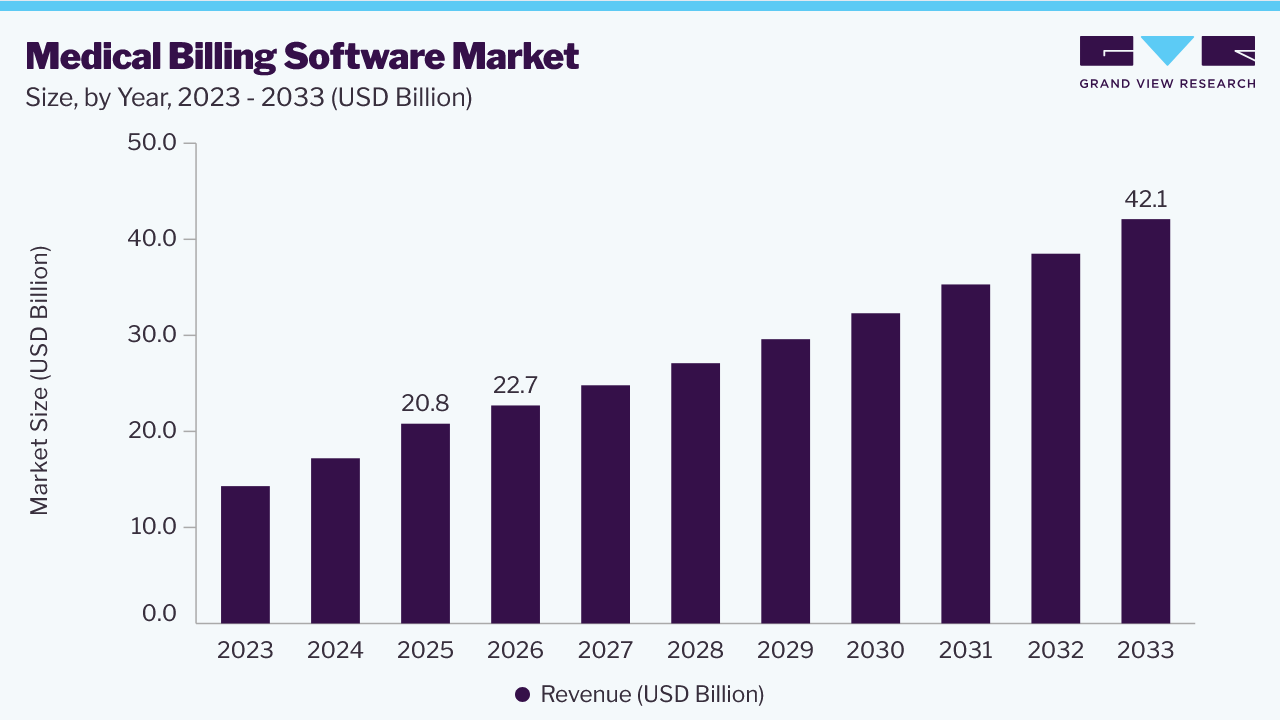
$20.8BMarket Estimate, 2026
$22.7BMarket Forecast, 2033
$42.1BCAGR, 2026–2033
9.2%Medical Billing Software Market Summary
The global medical billing software market size was valued at USD 20.8 billion in 2025 and is projected to grow from USD 22.7 billion in 2026 to USD 42.1 billion in 2033, at a CAGR of 9.2% from 2026 to 2033. North America dominated the market, accounting for a revenue share of 38.0% in 2025. The increasing demand for efficient healthcare management, technological advancements, and growing regulatory compliance are some of the factors contributing to market growth. The increasing prevalence of chronic and infectious diseases is driving the demand for medical billing software, as healthcare facilities seek to improve care quality, operational efficiency, and cost management.
 Source: Grand View Research, IR Documents, Primary Interviews, Paid DatabasesTo learn more about this report,
 Download Free Sample Report
Key Market Trends & Insights
- By billing type: The institutional billing segment held the largest market share of around 55.0% in 2025.
- By deployment mode: The web-based segment held the largest market share of over 47.0% in 2025.
- By end use: The healthcare providers segment held the largest market share of around 60.0% in 2025.
Regional Highlights
- Largest regional market: North America (38.0% revenue share, 2025)
- Fastest-growing regional market: Asia Pacific (highest CAGR, 2026-2033)
Market Size & Forecast
- Market size in 2025: USD 20.8 Billion
- Estimated market size in 2026: USD 22.7 Billion
- Projected market size by 2033: USD 42.1 Billion
- CAGR (2026-2033): 9.2%
Three ways to get this report
Buy it, customize it, or ask a question.Ask an Analyst
Analyst response in 1 business day
- AccessReport author, directly
- Reply timeWithin 1 working day
- No sales callDirect answer only
- FormatEmail reply
- CostFree, no cost
Get the Full Report
What the study covers
- FormatsPDF · Excel · Dashboard
- Timeline2026–2033 annual, 2025 base
- Coverage20+ countries, 5 regions
- Companies10+ key players profiled
Customize the Report
20% free customization
- IncludeCountries, segments, points
- TailorTo your product definition
- ExtendDeeper competitor detail
- OrA fully bespoke study
- Turnaround5–10 working days
Further, healthcare providers are progressively refining their operations to reduce administrative workload and improve cash flow. This shift is particularly evident among small- to medium-sized practices that need assistance with their manual billing processes. By implementing advanced software, these practices are empowered to automate claims submission, more efficiently monitor payments, and reduce the mistakes typically linked with manual data entry. Therefore, incorporating medical billing software into their systems facilitates revenue cycle management and allows healthcare providers to assign more of their resources and attention to patient care rather than administrative tasks.
Moreover, technological advancements are significant in propelling the market. The integration of artificial intelligence (AI), machine learning (ML), and cloud computing into billing systems has significantly transformed the way healthcare organizations manage their financial operations. Thus, implementing AI-driven solutions allows for real-time tracking of billing processes, enhancing transparency and efficiency. Furthermore, automation reduces human error and accelerates processing times for claims submissions and payments. As healthcare providers increasingly seek to leverage these technologies to improve their operational capabilities, demand for advanced software continues to rise, reflecting a significant market trend.
The growing prominence of compliance with healthcare regulations is driving the market. As healthcare systems evolve, providers are progressively involved with billing practices and patient data management. Medical billing software helps organizations navigate these regulatory landscapes by ensuring adherence to various compliance requirements, such as HIPAA and ICD coding standards. Maintaining compliance helps reduce the risk of penalties and improves healthcare organizations' overall financial health. As a result, increasing demand for medical billing solutions that prioritize compliance is expected to drive market growth over the forecast period.
Analyst Perspective
The medical billing software market is experiencing robust growth, driven by increasing demand for workflow automation, efficient revenue cycle management, and reduced billing errors. Healthcare providers are adopting cloud-based solutions integrated with EHRs and practice management systems to improve operational efficiency and accelerate reimbursements. AI-powered claim scrubbing, RPA, predictive analytics, and patient payment portals are further enhancing billing accuracy and reducing administrative workloads. Evolving regulations, payer complexity, and value-based care are expected to support continued adoption of scalable, secure, and interoperable billing solutions.
Billing Type Insights
The institutional billing segment held the largest revenue share in 2025. Institutional medical billing services are more error-prone than professional billing services. While professional billing can have errors due to technical issues or other factors, institutional billing services are not completely error-free. However, many hospitals and healthcare facilities still choose institutional billing services because they specialize in this area. As healthcare organizations handle growing patient volumes and increasingly complex payer requirements, demand for automated institutional billing solutions continues to rise. For instance, in May 2025, Optum launched Optum Integrity One, an AI-powered revenue cycle management platform that leverages Optum Clinical Language Intelligence to enhance clinical documentation, coding accuracy, and billing workflows. The growing adoption of AI-enabled revenue cycle management platforms across hospitals and integrated healthcare systems is expected to accelerate the demand for institutional billing software, supporting the continued market expansion throughout the forecast period.
The professional billing segment is anticipated to grow at the fastest rate over the forecast period. Professional billing focuses on services provided by healthcare professionals, such as physicians and specialists, ensuring that claims are accurately submitted to insurance companies for reimbursement. Moreover, the growth of this segment is further attributed to the increasing number of healthcare providers opting for independent practice, the rise of value-based care models, and the increasing need for precise billing practices.
Deployment Mode Insights
The web-based segment held the largest revenue share in 2025. The web-based platforms allow healthcare providers to access billing systems via a web browser, eliminating the need for extensive local installations and reducing IT overhead. The increasing demand for efficiency, scalability, and accessibility in healthcare operations drives the shift towards web-based solutions. As medical practices seek to streamline their billing processes, web-based platforms offer a viable option for reducing administrative workload. Further, compliance with regulations such as HIPAA has propelled the adoption of web-based systems in medical billing.
The cloud-based segment is anticipated to grow at the fastest rate during the forecast period, owing to its flexibility, scalability, and cost-effectiveness. Cloud solutions often come with built-in compliance features that reduce the burden on healthcare providers. Furthermore, the evolution of billing has transformed it from a standalone back-office function into a vital part of the entire statement process, particularly with the advent of cloud technology. Cloud billing services are enabling organizations to reduce expenses while enhancing customer service. This trend boosts the growing demand for cloud-based billing solutions, driven by the need for lower capital and operational costs.
End Use Insights
The healthcare providers segment held the largest revenue share in 2025. The segment's growth is supported by the implementation of stringent regulatory measures in various countries, including the U.S. However, this segment faces challenges primarily due to limitations in IT infrastructure in emerging markets. A significant barrier to the adoption of advanced technologies, such as claims processing software, is the associated cost, which remains a major hurdle for many providers.
The healthcare payers’ segment is expected to register the fastest growth rate during the forecast period. Healthcare payers are responsible for processing claims, managing reimbursements, and ensuring compliance with regulatory standards. The increasing complexity of healthcare billing processes has imposed the adoption of advanced software solutions that streamline operations and enhance efficiency. Healthcare payers have supported providers by offering cloud- and web-based portals that deliver accurate, timely information not only on the pandemic but also on managing medical billing and related claims. However, the rise in data breaches and confidentiality breaches, along with the transition from legacy systems, may pose challenges to the growth of healthcare payers in the market.
Regional Insights
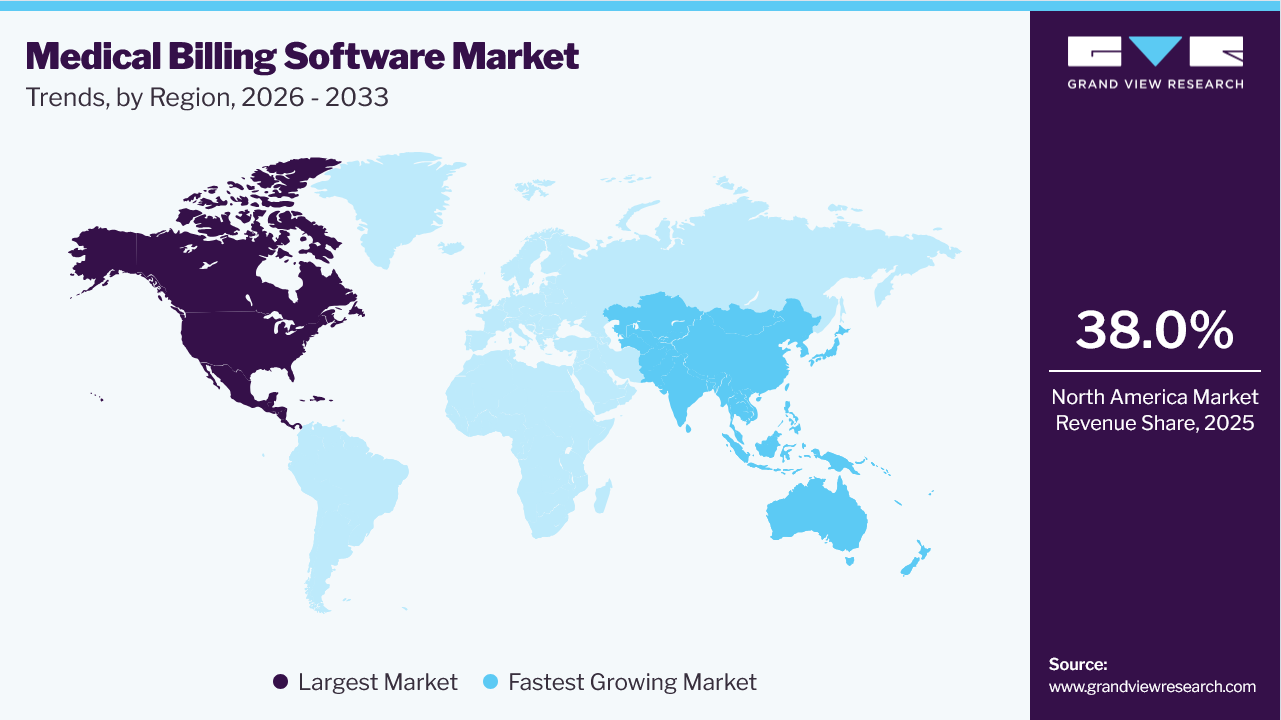
North America accounted for the largest revenue share, at approximately 38.0% in 2025, driven by its advanced healthcare infrastructure, widespread adoption of healthcare IT solutions, and increasing emphasis on operational efficiency across healthcare organizations. The growing implementation of cloud computing, artificial intelligence (AI), and revenue cycle management (RCM) technologies has accelerated the adoption of medical billing software. Furthermore, stringent regulatory requirements, favorable reimbursement frameworks, and the presence of leading healthcare IT vendors continue to support regional market growth.
 To learn more about this report, Download Free Sample Report
U.S. Medical Billing Software Market
The medical billing software market in the U.S. held the largest revenue share in North America in 2025, owing to the increasing complexity of healthcare reimbursement regulations, rising patient volumes, and growing demand for efficient revenue cycle management solutions. The rapid expansion of telehealth services has further increased the need for billing platforms capable of managing virtual consultations and digital healthcare services.
Asia Pacific Medical Billing Software Market Trends
The medical billing software market in the Asia Pacific is expected to register the fastest CAGR during the forecast period. Rapid population aging and the increasing prevalence of chronic diseases in countries such as China, Japan, and India are driving higher hospital admissions and healthcare utilization, creating greater demand for automated billing and revenue cycle management solutions. Moreover, rising healthcare expenditure, expanding healthcare infrastructure, government-led digital health initiatives, and increasing adoption of cloud-based healthcare software are expected to accelerate growth in the regional marke.
The China medical billing software market is expected to grow significantly during the forecast period, driven by rising patient volumes, expanding health insurance coverage, and continued investments in healthcare digitalization. Increasing adoption of electronic medical records (EMRs), hospital information systems (HIS), and AI-enabled healthcare platforms is driving demand for advanced medical billing solutions. However, growing cybersecurity concerns and stricter data privacy regulations remain important challenges for market participants.
The medical billing software market in India is driven by increasing disposable income, rising healthcare expenditure, and the growing prevalence of chronic and infectious diseases. Many healthcare providers are increasingly opting to outsource their medical billing processes to reduce operational costs. This allows them to focus on patient care while ensuring accurate and timely billing. Furthermore, the rising adoption of telemedicine services has created a need for adaptable medical billing solutions that can efficiently handle remote consultations and digital health services.
Europe Medical Billing Software Market Trends
The medical billing software market in Europe is driven by the increasing number of elderly individuals in Europe, particularly in countries like Italy, which has the second-largest geriatric population globally, leading to more hospital visits and admissions. This demographic trend necessitates efficient medical billing solutions to manage the rising demand for healthcare services. In addition, widespread digitalization initiatives, robust regulatory frameworks, and substantial investments in healthcare IT are conducive to market growth.
The UK medical billing software market held the largest market share in 2025, owing to the rapid adoption of digital solutions in healthcare, which has increased the need for efficient medical billing systems. This is crucial for managing patient data, billing information, and insurance claims effectively, thereby reducing administrative errors. GP-Billing is a recently launched, innovative, and easy-to-use financial software solution specifically designed for NHS General Practices in the UK.
It helps streamline all private, third-party, and insurance billing. On average, GP-Billing can save a practice approximately 50 days annually by automating and streamlining the billing process. Practices like Northgate Surgery are already using GP-Billing to increase data accuracy and capture income from various streams. Thus, the introduction of new medical billing products is expected to significantly drive market growth.
The medical billing software market in Germany is expected to grow over the forecast period. The growth is driven by various factors, including increasing healthcare expenditures, technological advancements, and regulatory reforms. The increasing digitalization of healthcare processes is enhancing the efficiency of medical billing systems, reducing administrative errors, and improving claim processing times.
Latin America Medical Billing Software Market Trends
The medical billing software market in Latin America is being significantly driven by recent launches and innovations. The complexity of healthcare billing processes has led to a rising demand for automated solutions. Many new software products are being developed to streamline billing operations, reduce manual errors, and enhance efficiency in RCM. For instance, DreamSoft4u medical billing software offers a comprehensive suite of features, including advanced reporting, automated claim processing, centralized billing, and cloud hosting. Key functionalities include an A/R control center, medical coding tools, and integration with EHR systems, making it suitable for practices of all sizes.
Brazil medical billing software market is anticipated to grow significantly due to major reforms in its healthcare system, which are driving demand for medical coding. For instance, Brazil’s Unified Health System (SUS) is continually being refined to improve efficiency and coverage, necessitating accurate coding to manage patient data, billing, and compliance with national health policies.
Middle East & Africa Medical Billing Software Market Trends
The medical billing software market in MEA is expected to grow significantly due to technological advancements and rising healthcare demand. However, addressing challenges related to costs and data security will be crucial for sustained success in this evolving landscape.
Saudi Arabia's medical billing software market is expected to register strong growth over the period, supported by increasing investments in healthcare infrastructure under Vision 2030 and the country's focus on digital healthcare transformation. The growing adoption of smart healthcare technologies is driving demand for advanced medical billing and revenue cycle management solutions. For instance, in May 2024, Ecaresoft and Accumed formed a strategic partnership to modernize revenue cycle management for healthcare organizations across Saudi Arabia by integrating digital healthcare platforms with advanced RCM services. Such initiatives are expected to improve operational efficiency and accelerate the adoption of medical billing software nationwide.
Key Medical Billing Software Company Insights
The market is fragmented, with several large and emerging players operating, adopting strategies such as collaborations, acquisitions, partnerships, and the launch of new devices. Some emerging players in the market include ChiroTouch, GeBBS, and Healthray.
Key Medical Billing Software Companies
The following key companies have been profiled for this study on the medical billing software market:
-
Kareo, Inc.
-
WebPT, Inc.
-
athenahealth
-
Cognizant
-
Epic Systems Corporation.
-
GeBBS
-
Healthray
-
DrChrono (EverHealth Solutions Inc.)
-
AGS Health
-
CompuGroup Medical
-
AdvancedMD, Inc.
-
Digitech Computer LLC
-
Compulink Advantage
-
Medusind
Recent Developments
- In May 2025, MDaudit announced a merger agreement with Streamline Health Solutions, Inc., a leading provider of healthcare revenue cycle management solutions. The combined organization integrates Streamline Health's pre-billing integrity capabilities with MDaudit's billing compliance and revenue integrity platform, enabling healthcare providers to unify disparate data sources, enhance coding accuracy, strengthen compliance, and optimize revenue cycle management. The merger reflects the growing demand for integrated, AI-enabled medical billing and revenue cycle management solutions.
- In May 2025, Innovaccer Inc. launched Innovaccer Gravity, its Healthcare Intelligence Platform designed to unify enterprise healthcare data and deliver AI-driven insights across clinical, operational, and financial workflows. The platform enables seamless interoperability, cross-domain intelligence, and faster return on investment while reducing the total cost of ownership. By improving data integration and supporting more efficient revenue cycle management, the platform reinforces the growing adoption of intelligent digital solutions within the market.
Medical Billing Software Market Report Scope
Report Attribute
Details
Market size in 2025
USD 20.8 billion
Estimated market size in 2026
USD 22.7 billion
Projected market size by 2033
USD 42.1 billion
Growth rate
CAGR of 9.2% from 2026 to 2033
Base year for estimation
2025
Actual data
2021 – 2024
Forecast period
2026 – 2033
Quantitative units
Revenue in USD billion, and CAGR from 2026 to 2033
Report coverage
Revenue forecast, company ranking, competitive landscape, growth factors, and trends
Segments covered
Billing type, deployment mode, end use, region
Regional Scope
North America; Europe; Asia Pacific; CSA; MEA
Country Scope
U.S.; Canada; Mexico; UK; Germany; France; Italy; Spain; Norway; Denmark; Sweden; China; Japan; India; South Korea; Australia; Thailand; Brazil; Argentina; Saudi Arabia; South Africa; UAE; Kuwait
Key companies profiled
Kareo Inc.; WebPT, Inc.; athenahealth; Cognizant; Epic Systems Corporation.; GeBBS; Healthray; DrChrono (EverHealth Solutions Inc.); AGS Health; CompuGroup Medical; AdvancedMD, Inc.; Digitech Computer LLC; Compulink Advantage; Medusind
Customization scope
Free report customization (equivalent to 8 analysts working days) with purchase. Addition or alteration to country, regional & segment scope.
Pricing and purchase options
Avail of customized purchase options to meet your exact research needs. Explore purchase options
Global Medical Billing Software Market Report Segmentation
This report forecasts revenue growth at the global, regional, and country levels and provides an analysis of the latest industry trends and opportunities across each sub-segment from 2021 to 2033. For this study, Grand View Research has segmented the global medical billing software market report based on billing type, deployment mode, end use, and region:
-
Billing Type Outlook (Revenue, USD Billion, 2021 - 2033)
-
Professional Billing
-
Institutional Billing
-
-
Deployment Mode Outlook (Revenue, USD Billion, 2021 - 2033)
-
On-Premises
-
Web-Based
-
Cloud-Based
-
-
End Use Outlook (Revenue, USD Billion, 2021 - 2033)
-
Healthcare Providers
-
Healthcare Payers
-
Others
-
-
Regional Outlook (Revenue, USD Billion, 2021 - 2033)
-
North America
-
U.S.
-
Canada
-
Mexico
-
-
Europe
-
UK
-
Germany
-
France
-
Italy
-
Spain
-
Norway
-
Denmark
-
Sweden
-
-
Asia Pacific
-
Japan
-
China
-
India
-
Australia
-
South Korea
-
Thailand
-
-
Latin America
-
Brazil
-
Argentina
-
-
Middle East and Africa (MEA)
-
South Africa
-
Saudi Arabia
-
UAE
-
Kuwait
-
-
Frequently Asked Questions About This Report
The global medical billing software market size was valued at USD 20.8 billion in 2025 and is estimated at USD 22.7 billion in 2026.
The global medical billing software market is expected to grow at a CAGR of 9.2% from 2026 to 2033, reaching USD 42.1 billion in 2033.
North America dominated with approximately 38.0% revenue share in 2025.
Key players in the market include Kareo Inc., WebPT, Inc., athenahealth, Cognizant, Epic Systems Corporation, GeBBS, Healthray, DrChrono (EverHealth Solutions Inc.), AGS Health, CompuGroup Medical, AdvancedMD, Inc., Digitech Computer LLC, Compulink Advantage, and Medusind.
The institutional billing segment accounted for the largest revenue share of approximately 55.0% in 2025.
About the Author(s)
Healthcare IT Research Team
Healthcare · Healthcare ITThis report was authored by the healthcare it research team at Grand View Research - comprising two research analysts, one senior research analyst, and one industry expert - with specialized expertise in the healthcare it segment of the healthcare industry. All findings are based on proprietary healthcare databases, executive interviews, and regulatory analysis, subject to internal peer review prior to publication.
Last Updated:
Speak to Analyst

Customize this report to your needs - add regions, segments, or data points, with 20% free customization.
Or view our licence options:


ISO 9001:2015 & 27001:2022 Certified
We are GDPR and CCPA compliant! Your transaction & personal information is safe and secure. For more details, please read our privacy policy.


