
- Home
- »
- Advanced Interior Materials
- »
-
Metal Additive Manufacturing Equipment Market Report, 2025-2033GVR Report cover

Metal Additive Manufacturing Equipment Market (2025 - 2033)
Size, Share & Trends Analysis Report By Technology (Electron Beam Melting, Selective Laser Melting), By End Use (Automotive, Healthcare), By Application, By Region, And Segment Forecasts
Market Size, 2024
$5.4BMarket Estimate, 2026
$7.3BMarket Forecast, 2033
$30.6BCAGR, 2025–2033
22.0%Metal Additive Manufacturing Equipment Market Summary
The global metal additive manufacturing equipment market size was valued at USD 5.4 billion in 2024 and is projected to grow from USD 7.3 billion in 2026 to USD 30.6 billion by 2033, at a CAGR of 22.0% from 2025 to 2033. North America dominated the market, accounting for a revenue share of 38.8% in 2024. The market is primarily driven by the growing demand for lightweight, complex, and high-performance components across aerospace, automotive, and defense industries.
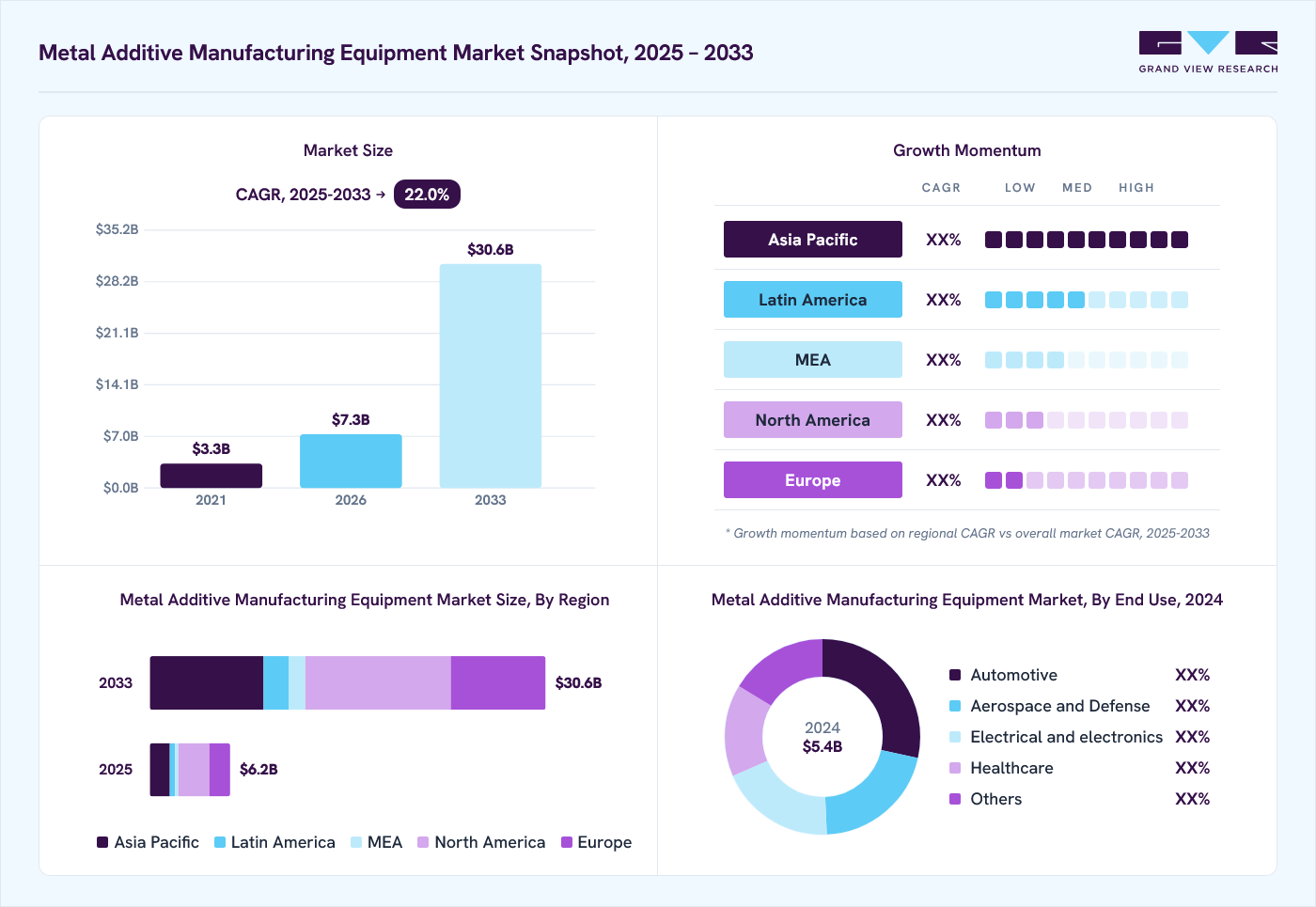 Source: Grand View Research, IR Documents, Primary Interviews, Paid DatabasesTo learn more about this report,
 Download Free Sample Report
 Key Market Trends & Insights
- By technology, the electron beam melting (EBM) segment is expected to record the fastest CAGR of 22.5% from 2025 to 2033.
- By application, the production segment is projected to grow at a CAGR of 22.4% over the forecast period.
- By end use, the aerospace and defense segment is expected to expand at a CAGR of 23.0% from 2025 to 2033 in terms of revenue.
Market Size & Forecast
- 2024 Market Size: USD 5.4 Billion
- 2033 Projected Market Size: USD 30.6 Billion
- CAGR (2025-2033): 22.0%
Three ways to get this report
Buy it, customize it, or ask a question.Ask an Analyst
Analyst response in 1 business day
- AccessReport author, directly
- Reply timeWithin 1 working day
- No sales callDirect answer only
- FormatEmail reply
- CostFree, no cost
Get the Full Report
What the study covers
- FormatsPDF · Excel · Dashboard
- Timeline2025–2033 annual, 2024 base
- Coverage20+ countries, 5 regions
- Companies10+ key players profiled
Customize the Report
20% free customization
- IncludeCountries, segments, points
- TailorTo your product definition
- ExtendDeeper competitor detail
- OrA fully bespoke study
- Turnaround5–10 working days
Manufacturers are increasingly adopting metal AM to reduce material waste, shorten production cycles, and achieve greater design flexibility. Continuous advancements in laser systems, automated powder handling, and multi-laser machines are enhancing productivity and part quality. Rising investments in Industry 4.0 and digital manufacturing ecosystems are accelerating the adoption of metal AM equipment. Companies are integrating metal printers with simulation, monitoring, and AI-based quality-control tools to ensure repeatability and traceability in critical applications. In addition, the need for decentralized production and on-demand manufacturing is prompting industries to install metal AM systems in-house. Supportive government initiatives and certifications for aerospace and medical implants are further strengthening market growth.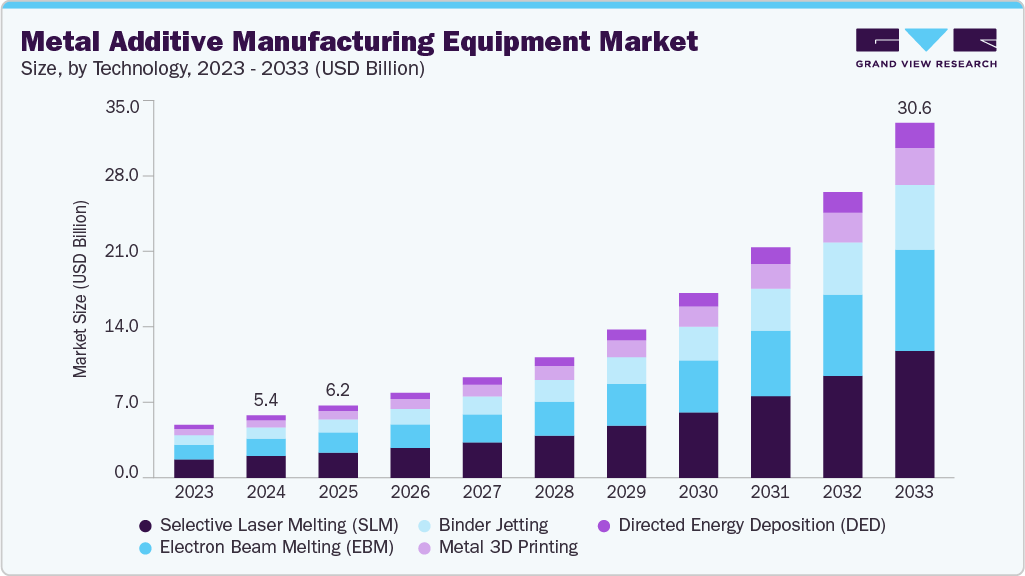 To learn more about this report, Download Free Sample Report
 Market Concentration & Characteristics
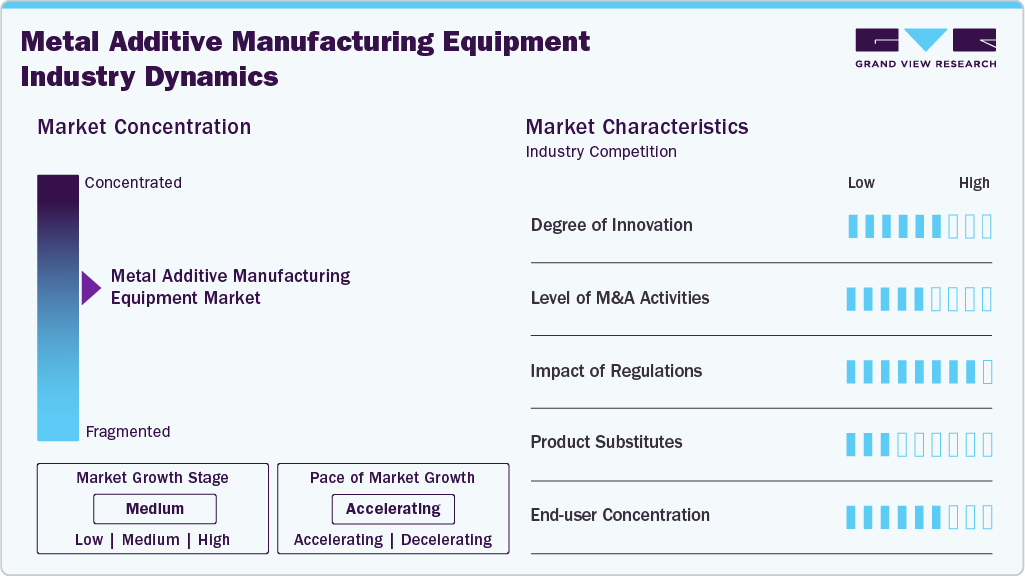
The metal additive manufacturing equipment industry is moderately concentrated, with a handful of established players such as EOS, Nikon SLM Solutions, and 3D Systems holding a significant share due to their advanced technologies and extensive portfolios. However, the market is also seeing a steady rise in emerging companies offering niche metal AM solutions, which introduces competitive pressure and innovation. High capital requirements, stringent certification needs, and complex process expertise act as natural entry barriers.
The metal additive manufacturing equipment industry is defined by rapid innovation, driven by advances in multi-laser architectures, automated powder handling, and in-process monitoring. Manufacturers are continuously improving build rates, surface quality, and repeatability to support full-scale production. Hybrid systems that combine additive and subtractive processes are further expanding application possibilities. This high pace of innovation keeps competition intense and pushes vendors to invest heavily in R&D.
 To learn more about this report, Download Free Sample Report
 Regulations significantly influence the adoption of metal AM, especially in aerospace, medical, and defense sectors, where certification and material traceability are critical. Standards related to powder safety, machine operation, and part qualification require OEMs to maintain strict compliance. These regulatory demands increase development timelines but also raise trust in AM-produced metal components. As global standards evolve, companies that achieve early certification gain a strong competitive advantage.
End-user concentration is relatively high, with aerospace, automotive, medical, and industrial manufacturing accounting for the majority of demand. These sectors value metal AM for its ability to produce lightweight, complex, and high-strength parts. However, the growing interest from energy, tooling, and defense industries is gradually broadening the user base. This expanding application scope is helping diversify revenue streams and reduce dependence on a few dominant sectors.
Drivers, Opportunities & Restraints
The market is driven by the rising need for lightweight, complex metal components in aerospace, medical, and high-performance industrial applications. Advancements in multi-laser systems, improved metal powders, and automated post-processing are boosting production efficiency. Manufacturers are increasingly shifting from prototyping to end-use metal part production due to better accuracy and repeatability. The push toward digital manufacturing and Industry 4.0 integration further accelerates metal AM equipment adoption.
There is a significant opportunity in expanding metal AM for large-format parts, tooling, and spare-part on-demand production. Growing interest in decentralized manufacturing is encouraging companies to install metal AM systems closer to their operations. Emerging economies offer strong potential as governments support advanced manufacturing and aerospace development. In addition, hybrid systems and next-generation materials open new application areas with higher margins.
High equipment costs, complex process requirements, and the need for skilled operators limit adoption among small and mid-sized manufacturers. Regulatory certification for aerospace and medical components often lengthens deployment timelines. Challenges related to powder safety, material consistency, and repeatability also remain barriers. Moreover, limited standardization and high post-processing needs can slow the transition to full-scale metal AM production.
Technology Insights
Selective Laser Melting (SLM) dominates the market in 2024, accounting for a 35.1% share, due to its ability to produce high-density, complex metal components with excellent mechanical properties. Its widespread adoption across aerospace, medical implants, and automotive prototyping reflects its reliability and material versatility. Continuous advancements in multi-laser configurations and larger build platforms are enhancing throughput and part consistency. As a result, SLM remains the preferred technology for both prototyping and production-grade metal parts.
Electron Beam Melting (EBM) is witnessing the fastest growth as industries seek solutions for high-temperature alloys and components that require superior material integrity. Its vacuum-based process is ideal for titanium and nickel-based alloys, making it attractive for aerospace and orthopedic applications. Advances in beam control, powder recycling, and thermal management are improving build speed and stability. This growing demand for high-performance metal parts is accelerating EBM adoption in advanced manufacturing segments.
Application Insights
The repair & modification segment is expected to grow at a considerable CAGR of 21.2% from 2025 to 2033 in terms of revenue. Production applications dominated the market, accounting for a 67.9% share in 2024, as industries increasingly rely on AM for serial manufacturing of lightweight, high-strength components. The ability to consolidate parts, reduce tooling costs, and achieve consistent quality makes metal AM ideal for aerospace, medical, and automotive production lines. Advancements in multi-laser systems and automation are further enhancing throughput and repeatability. As manufacturers shift from prototyping to end-use part production, demand for high-capacity metal AM systems continues to rise.
Repair and modification applications are growing rapidly as metal AM enables cost-effective restoration of worn or damaged components. Technologies like DED and AFSD allow precise material deposition, extending equipment life in energy, aerospace, and heavy industrial sectors. This approach reduces downtime and replacement costs, making it highly attractive for large, high-value metal parts. As industries adopt predictive maintenance and on-demand refurbishment, repair-focused metal AM solutions are gaining strong momentum.
End Use Insights
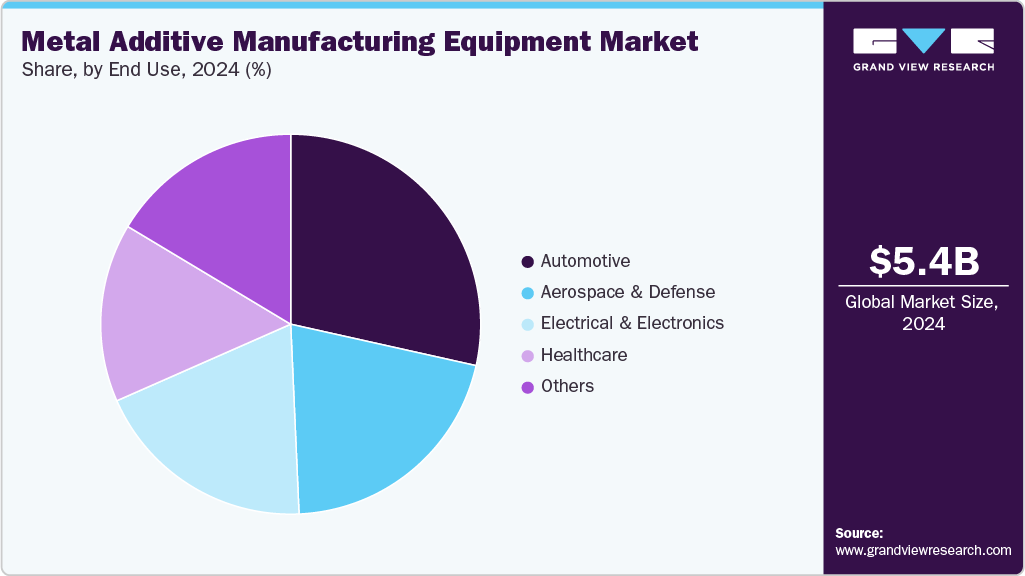
The automotive sector dominates the market and accounts for a 28.5 % share in 2024, due to its extensive use of AM for lightweight structures, tooling, and performance-critical components. Metal AM helps automakers reduce development cycles, improve fuel efficiency through weight reduction, and accelerate prototype testing. Its ability to produce complex geometries supports custom parts and high-performance vehicle designs. As major OEMs push toward electric vehicles, the demand for optimized metal components further strengthens AM adoption.
 To learn more about this report, Download Free Sample Report
 Aerospace and defense are the fastest-growing end use segments as these industries require high-strength, lightweight metal parts with strict material integrity. Metal AM enables the production of complex structures that reduce weight and enhance aircraft efficiency, meeting stringent certification standards. Defense programs also use AM for customized components, rapid prototyping, and on-demand part replacement in mission-critical scenarios. Increasing investments in advanced titanium and nickel-alloy applications are accelerating growth in this segment.
Regional Insights
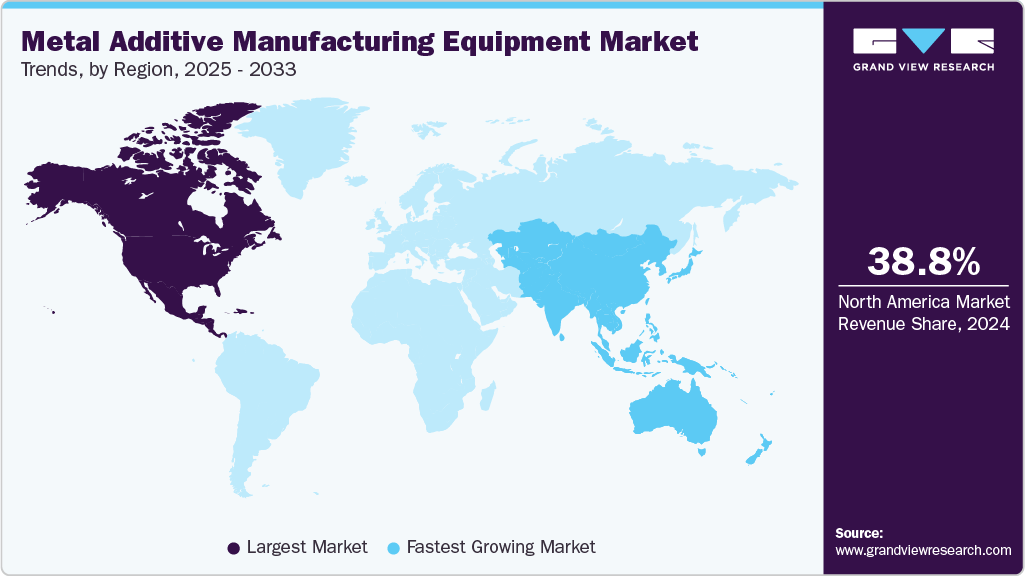
North America was the largest market in 2024 for additive manufacturing, holding a 38.8% share, supported by strong adoption across aerospace, defense, and advanced automotive manufacturing. The region benefits from early technology commercialization, high R&D spending, and a mature ecosystem of AM service bureaus and machine OEMs. Supportive government programs and defense-funded AM initiatives further accelerate equipment demand. In addition, the presence of leading players and certified production facilities reinforces its leadership position.
 To learn more about this report, Download Free Sample Report
 U.S. Metal Additive Manufacturing Equipment Market Trends
The metal additive manufacturing equipment market in the U.S. dominates North America due to its strong aerospace, defense, and medical manufacturing base. Major OEMs and research institutions drive continuous innovation, accelerating the adoption of high-end metal AM systems. Significant federal funding and industry certification programs further support large-scale deployment. With a mature ecosystem of machine suppliers and service providers, the U.S. remains the region’s central hub for advanced metal AM technologies.
Canada metal additive manufacturing equipment market is steadily growing, as industries expand their use of metal AM for tooling, energy components, and aerospace applications. Government-led innovation grants and academic-industry partnerships are encouraging companies to integrate advanced manufacturing technologies. The increasing presence of AM research centers is helping improve local expertise and industrial capability. As manufacturers pursue cost-efficient production and rapid prototyping, metal AM adoption in Canada continues to rise.
Europe Metal Additive Manufacturing Equipment Market Trends
The metal additive manufacturing equipment market in Europe continues to record strong growth driven by its leadership in material research, industrial automation, and high-value manufacturing. Aerospace and medical industries, especially in Germany, France, and the UK, heavily rely on metal AM for certified production. Strict quality standards are encouraging companies to adopt advanced equipment with process monitoring and traceability features. Sustainability goals and lightweight engineering initiatives further support market expansion.
Germany metal additive manufacturing equipment market dominates Europe due to its strong industrial base, world-class engineering capabilities, and leadership in high-precision manufacturing. The country hosts several major AM machine manufacturers and research institutes that continuously advance metal AM technologies. Its aerospace, automotive, and medical sectors have deeply integrated metal AM into production workflows. Strong government support for Industry 4.0 and digital manufacturing further reinforces Germany’s leadership position.
The metal additive manufacturing equipment market in the UK is steadily growing as an important player in the metal AM landscape, driven by investments in aerospace, defense, and medical device manufacturing. National innovation programs and university-led research hubs are helping accelerate the adoption of metal AM systems. Companies are increasingly using metal AM to improve part performance, reduce weight, and shorten development cycles. As the country pushes for advanced manufacturing and supply-chain resilience, metal AM adoption continues to expand.
Asia Pacific Metal Additive Manufacturing Equipment Market Trends
The metal additive manufacturing equipment market in the Asia Pacific is the fastest-growing region as countries like China, Japan, South Korea, and India rapidly expand their advanced manufacturing capabilities. Rising investments in aerospace, medical device production, and industrial tooling are boosting metal AM equipment adoption. Government-backed innovation programs and manufacturing localization efforts are driving large-scale installations. The region’s growing supplier base and competitive machine pricing also accelerate technology penetration.
China metal additive manufacturing equipment market dominates the Asia Pacific due to its rapid industrial expansion and strong government backing for advanced manufacturing. The country hosts a growing number of domestic metal AM machine manufacturers offering competitive, large-format systems. Aerospace, automotive, and tooling industries in China are aggressively adopting metal AM to enhance production efficiency and design flexibility. Continuous investments in research centers and innovation parks further strengthen China’s leadership in the region.
The metal additive manufacturing equipment market in India is witnessing strong growth in metal additive manufacturing adoption as industries modernize and shift toward digital production technologies. Sectors such as aerospace, space research, automotive, and heavy engineering are driving demand for metal AM systems to improve prototyping and reduce part lead times. Government initiatives promoting indigenous manufacturing and technology innovation are accelerating market penetration. With increasing collaboration between industry and research institutions, India is emerging as a key growth market for metal AM equipment.
Middle East & Africa Metal Additive Manufacturing Equipment Market Trends
The metal additive manufacturing equipment market in the Middle East and Africa is gradually expanding its metal AM footprint, led by investments in aerospace, energy, and industrial maintenance. Countries such as the UAE and Saudi Arabia are actively promoting advanced manufacturing as part of economic diversification strategies. Metal AM is being integrated into oil & gas operations for high-value components and on-site repairs. Growing technology hubs and government innovation programs are supporting steady market growth across the region.
South Africa metal additive manufacturing equipment market dominates the Middle East & Africa due to its early investments in advanced manufacturing and strong research capabilities. Leading institutions and innovation centers in the country have developed indigenous metal AM technologies, especially for aerospace and industrial applications. Local industries increasingly use metal AM for high-value components, tooling, and repair operations. With supportive government programs and growing industrial adoption, South Africa remains the regional hub for metal AM advancements.
Latin America Metal Additive Manufacturing Equipment Market Trends
The metal additive manufacturing equipment market in Latin America is experiencing steady growth as industries adopt metal AM for tooling, spare parts, and industrial components. Countries like Brazil and Argentina are investing in modernizing their manufacturing infrastructure. The need to reduce import dependency and shorten supply chains is encouraging local adoption of AM systems. Although still early in development, increasing collaborations with global OEMs are strengthening regional capabilities.
Brazil metal additive manufacturing equipment market is experiencing steady market growth as its automotive, aerospace, and industrial sectors adopt advanced production technologies. Companies are leveraging metal AM to reduce tooling costs, accelerate prototyping, and improve component performance. Government-supported innovation programs and partnerships with global AM providers are strengthening local capabilities. As manufacturers seek greater efficiency and localized production, Brazil’s adoption of metal AM systems continues to expand.
Key Metal Additive Manufacturing Equipment Company Insights
Some of the key players operating in the market include 3DEO Inc., 3D Systems Corporation, and HP Inc.
-
3D Systems is a major player in metal additive manufacturing, known for its Direct Metal Printing (DMP) platforms that support high-precision, high-density metal parts. The company focuses on production-scale metal AM with systems designed for aerospace, medical, and industrial applications requiring tight tolerances. Its metal printers are supported by proprietary powder materials and advanced software that ensure repeatability and consistency. 3D Systems also emphasizes process control, offering integrated workflows for certified manufacturing environments. This positions the company strongly in segments demanding reliable, production-ready metal AM solutions.
-
HP operates in the metal AM space through its Metal Jet binder-jetting technology, designed for high-volume production of functional metal parts. The company targets scalable manufacturing by emphasizing speed, low cost per part, and compatibility with industrial-grade metal powders. HP’s solution enables batch production for automotive, consumer goods, and industrial components where throughput matters more than geometric extremes. Its focus on automation and digital integration helps manufacturers streamline powder handling and post-processing. With partnerships across global supply chains, HP aims to push metal AM into mainstream mass-production environments.
Key Metal Additive Manufacturing Equipment Companies:
The following are the leading companies in the metal additive manufacturing equipment market. These companies collectively hold the largest market share and dictate industry trends.
- 3DEO Inc.
- 3D Systems Corporation
- HP Inc.
- General Electric Company
- Desktop Metal Inc.
- Optomec Inc.
- EOS GmbH
- Nikon SLM Solutions AG
- Markforged Inc
- Hoganas AB
- Eplus3D
- DMG MORI
- MELD Manufacturing Corporation
- Breton S.p.A.
- Additive Industries
Recent Developments
-
In November 2025, Additive Industries unveiled the MetalFab 420K, a next-generation metal AM system built for high-volume industrial production. The machine offers a large 420 × 420 × 400 mm build area, four 1-kW lasers, and improved gas-flow control to enhance speed and part consistency. It features automated calibration and fully enclosed powder handling to streamline workflow and reduce operator intervention.
-
In October 2024, Eplus3D launched its EP-M4750, a metal additive manufacturing machine designed for batch production with a build chamber measuring 450 × 750 × 530 mm, enabling the printing of wide and high-precision metal parts for industries such as aerospace, automotive, tooling, and heavy machinery.
Metal Additive Manufacturing Equipment Market Report Scope
Report Attribute
Details
Market size in 2024
USD 5.4 billion
Estimated market size in 2026
USD 7.3 billion
Projected market size by 2033
USD 30.6 billion
Growth rate
CAGR of 22.0% from 2025 to 2033
Base year for estimation
2024
Historical data
2021 - 2023
Forecast period
2025 - 2033
Quantitative units
Revenue in USD million/billion, and CAGR from 2025 to 2033
Report coverage
Revenue forecast, company market position analysis, competitive landscape, growth factors, and trends
Segments covered
Technology, application, end use, region
Regional scope
North America; Europe; Asia Pacific; Latin America; MEA
Country Scope
U.S.; Canada; Mexico; UK; Germany; France; Spain; Italy; China; Japan; India; Australia; South Korea; Brazil; Argentina; Saudi Arabia; UAE; South Africa
Key companies profiled
3DEO Inc.; 3D Systems Corporation; HP Inc.; General Electric Company; Desktop Metal Inc.; Optomec Inc.; EOS GmbH; Nikon SLM Solutions AG; Markforged Inc.; Hoganas AB; Eplus3D; DMG MORI; MELD Manufacturing Corporation; Breton S.p.A.; Additive Industries
Customization scope
Free report customization (equivalent up to 8 analysts working days) with purchase. Addition or alteration to country, regional & segment scope.
Pricing and purchase options
Avail customized purchase options to meet your exact research needs. Explore purchase options
Global Metal Additive Manufacturing Equipment Market Report Segmentation
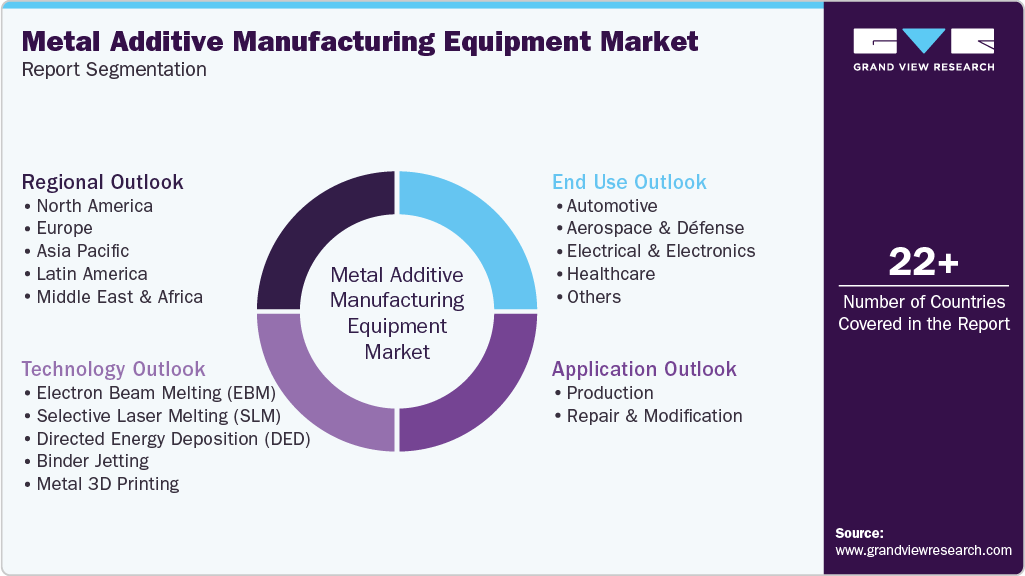
This report forecasts revenue growth at global, regional, and country levels and provides an analysis of the latest industry trends in each of the sub-segments from 2021 to 2033. For this study, Grand View Research has segmented the global metal additive manufacturing equipment market report based on technology, application, end use, and region:
 To learn more about this report, Download Free Sample Report
 -
Technology Outlook (Revenue, USD Million, 2021 - 2033)
-
Electron Beam Melting (EBM)
-
Selective Laser Melting (SLM)
-
Directed Energy Deposition (DED)
-
Binder Jetting
-
Metal 3D Printing
-
-
Application Outlook (Revenue, USD Million, 2021 - 2033)
-
Production
-
Repair & Modification
-
-
End Use Outlook (Revenue, USD Million, 2021 - 2033)
-
Automotive
-
Aerospace and Défense
-
Electrical and electronics
-
Healthcare
-
Others
-
-
Regional Outlook (Revenue, USD Million, 2021 - 2033)
-
North America
-
U.S.
-
Canada
-
Mexico
-
-
Europe
-
Germany
-
France
-
Italy
-
Spain
-
UK
-
-
Asia Pacific
-
China
-
India
-
Japan
-
South Korea
-
Australia
-
-
Latin America
-
Brazil
-
Argentina
-
-
Middle East and Africa
-
Saudi Arabia
-
UAE
-
South Africa
-
-
Frequently Asked Questions About This Report
The global metal additive manufacturing equipment market size was estimated at USD 5.4 billion in 2024 and is expected to reach USD 7.3 billion in 2026.
The global metal additive manufacturing equipment market is expected to grow at a compound annual growth rate of 22.0% from 2025 to 2033 to reach USD 30.6 billion by 2033.
North America was the largest market in 2024 for additive manufacturing holding a 38.8% share, supported by strong adoption across aerospace, defense, and advanced automotive manufacturing. The region benefits from early technology commercialization, high R&D spending, and a mature ecosystem of AM service bureaus and machine OEMs.
Some of the key players operating in the metal additive manufacturing equipment market include 3DEO Inc., 3D Systems Corporation, HP Inc., General Electric Company, Desktop Metal Inc., Optomec Inc., EOS GmbH, Nikon SLM Solutions AG, Markforged Inc., Hoganas AB, Eplus3D, DMG MORI, MELD Manufacturing Corporation, Breton S.p.A., and Additive Industries.
The metal additive manufacturing equipment market is driven by the rising demand for lightweight, high-performance metal parts across aerospace, automotive, and medical industries. Advancements in multi-laser systems, automation, and material capabilities are enabling faster, more reliable production.
About the Author(s)
Advanced Interior Materials Research Team
Advanced Materials · Advanced Interior MaterialsThis report was authored by the advanced interior materials research team at Grand View Research - comprising two research analysts, one senior research analyst, and one industry expert - with specialized expertise in the advanced interior materials segment of the advanced materials industry. All findings are based on proprietary advanced materials databases, executive interviews, and regulatory analysis, subject to internal peer review prior to publication.
Last Updated:
Speak to Analyst

Customize this report to your needs - add regions, segments, or data points, with 20% free customization.
Or view our licence options:


ISO 9001:2015 & 27001:2022 Certified
We are GDPR and CCPA compliant! Your transaction & personal information is safe and secure. For more details, please read our privacy policy.


