
- Home
- »
- Performance Chemicals
- »
-
Metal Biocides Market Size, Share, Trends Report 2026-2033GVR Report cover

Metal Biocides Market (2026 - 2033)
Size, Share & Trends Analysis Report By Product (Copper-based, Silver-based, Zinc-based, Other Products), By Application (Water Treatment, Paints & Coatings, Textiles, Plastics, Agriculture, Other Applications), By Region, Forecasts
Market Size, 2025
$2.3BMarket Estimate, 2026
$2.4BMarket Forecast, 2033
$3.2BCAGR, 2026–2033
3.9%Metal Biocides Market Summary
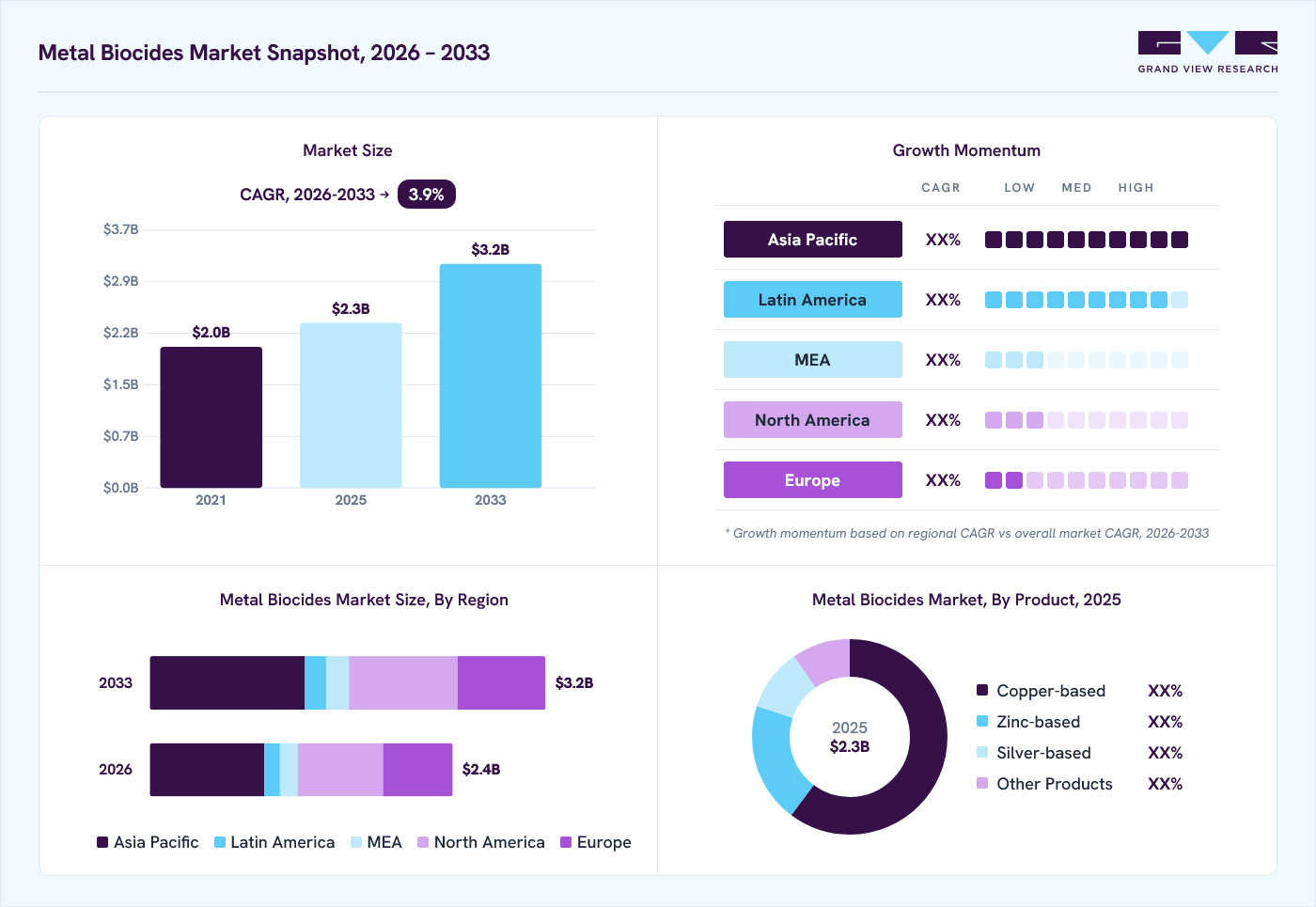
The global metal biocides market size was valued at USD 2.3 billion in 2025 and is projected to grow from USD 2.4 billion in 2026 to USD 3.2 billion by 2033, at a CAGR of 3.9% from 2026 to 2033. Asia Pacific dominated the market, accounting for a revenue share of 37.6% in 2025. The market growth is being supported by rising demand for durable antimicrobial protection across water treatment, coatings, plastics, textiles, healthcare products, and construction materials, alongside increasing adoption of silver-, copper-, and zinc-based technologies.
 Source: Grand View Research, IR Documents, Primary Interviews, Paid DatabasesTo learn more about this report,
 Download Free Sample Report
Key Market Trends & Insights
- By product: Copper-based segment held the largest revenue share of 60.2% in 2025.
- By application: Water treatment segment held the largest market share of 29.1% in 2025.
Regional Highlights
- Largest regional market: Asia Pacific (37.6% revenue share, 2025)
- By country: China held the largest market share in 2025.
Market Size & Forecast
- Market Size in 2025: USD 2.3 Billion
- Estimated Market Size in 2026: USD 2.4 Billion
- Projected Market Size by 2033: USD 3.2 Billion
- CAGR (2026-2033): 3.9%
Three ways to get this report
Buy it, customize it, or ask a question.Ask an Analyst
Analyst response in 1 business day
- AccessReport author, directly
- Reply timeWithin 1 working day
- No sales callDirect answer only
- FormatEmail reply
- CostFree, no cost
Get the Full Report
What the study covers
- FormatsPDF · Excel · Dashboard
- Timeline2026–2033 annual, 2025 base
- Coverage20+ countries, 5 regions
- Companies10+ key players profiled
Customize the Report
20% free customization
- IncludeCountries, segments, points
- TailorTo your product definition
- ExtendDeeper competitor detail
- OrA fully bespoke study
- Turnaround5–10 working days
Growing emphasis on hygiene, microbial control, material durability, and contamination prevention is supporting the adoption of metal-antimicrobial solutions across plastics, textiles, water-treatment systems, healthcare products, and consumer goods. Silver, copper, and zinc technologies are gaining attention because their antimicrobial properties can be incorporated into diverse substrates and product formulations. Increasing demand for protected surfaces, longer product lifecycles, and functional materials is encouraging manufacturers to expand their portfolios beyond conventional preservation systems. In addition, stricter expectations surrounding cleanliness in healthcare, public infrastructure, food-contact environments, and industrial facilities are creating favorable conditions for advanced antimicrobial technologies.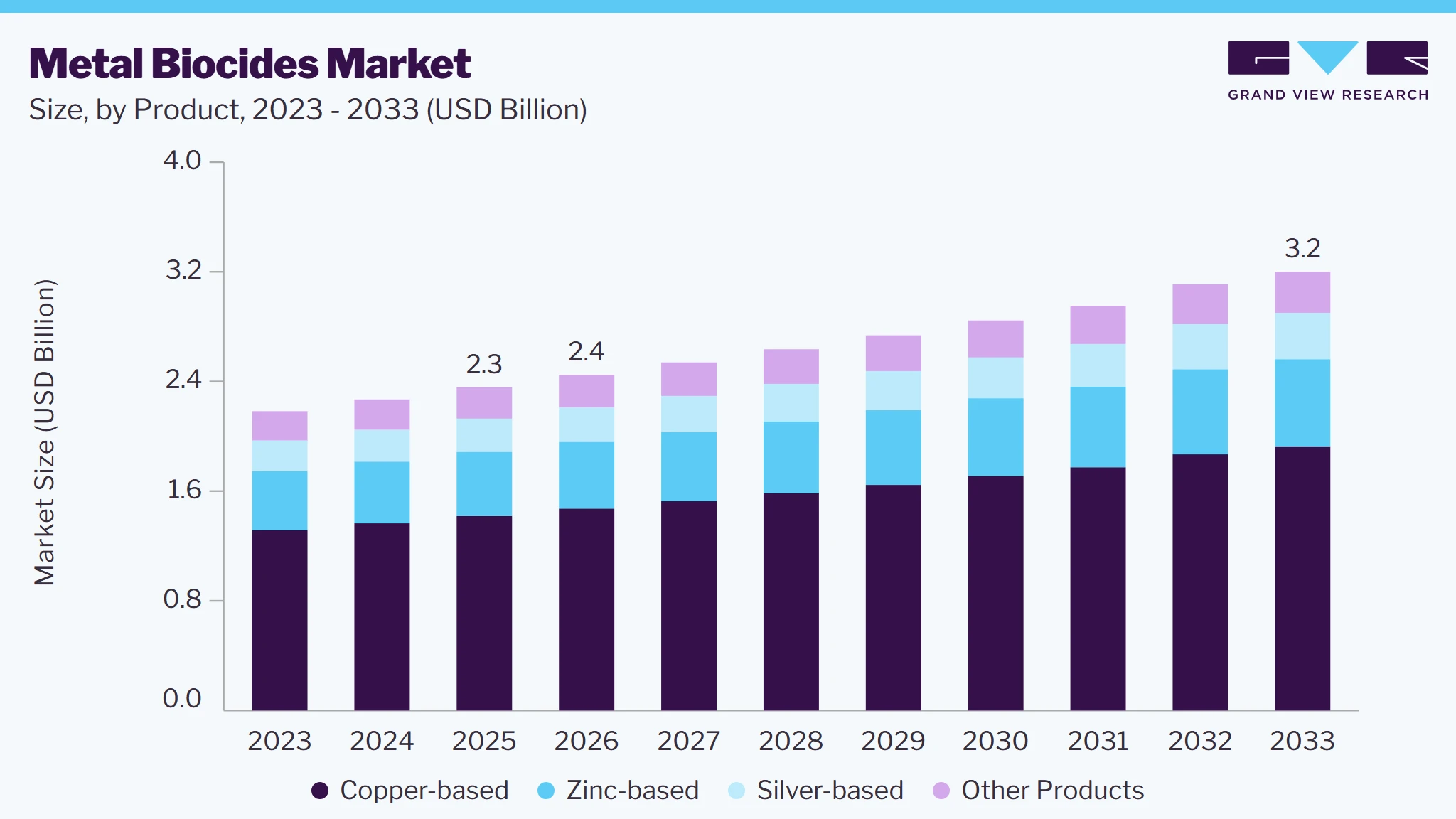 To learn more about this report, Download Free Sample Report
Opportunities are emerging through the development of high-performance, low-dose, and controlled-release formulations that provide sustained protection while improving compatibility with various materials. Suppliers can also benefit from incorporating antimicrobial functionality into recycled polymers, water-based construction materials, textiles, and specialty components, as manufacturers seek additional performance attributes. Advancements in ion-release technologies, surface treatments, masterbatches, and multifunctional additives are creating avenues for product differentiation. Companies capable of demonstrating consistent efficacy, regulatory compliance, durability, and compatibility with sustainable material systems are well positioned to capture new demand across established and emerging applications.
Market Dynamics
The competitive environment is being shaped by rising demand for long-lasting microbial protection across polymers, textiles, water-treatment systems, healthcare products, and construction materials. Manufacturers are increasingly developing silver-, copper-, and zinc-based technologies that can be incorporated into different substrates while maintaining material performance. Product differentiation is shifting beyond basic efficacy toward controlled release, durability, low-dose performance, substrate compatibility, and regulatory compliance. This is encouraging collaboration between chemical producers, compounders, coating formulators, and finished-product manufacturers. At the same time, regulatory scrutiny, environmental considerations, and raw-material economics are influencing commercialization strategies. Companies must substantiate efficacy while addressing potential metal-ion migration, exposure concerns, and application-specific restrictions, which can increase development expenditure and lengthen approval cycles.
A less conventional growth catalyst is the increasing incorporation of functionality into high-contact surfaces and frequently handled products, where conventional cleaning protocols alone may not provide continuous protection. Metal technologies can be embedded within polymers, textiles, ceramics, and other substrates, enabling manufacturers to build microbial-control properties directly into finished materials. This is particularly relevant for door hardware, public-use fixtures, transport interiors, institutional furnishings, medical equipment, and consumer products that experience repeated human contact.
The shift from periodic sanitation toward built-in surface protection is encouraging material producers and component manufacturers to evaluate silver-, copper-, and zinc solutions as performance-enhancing additives rather than treating biocides solely as standalone chemical formulations. This trend is also creating opportunities for suppliers to collaborate with downstream manufacturers at the formulation and product design stages. Instead of competing only on efficacy, producers can differentiate through durability, controlled ion release, compatibility with substrates, resistance to washing or abrasion, and preservation of the host material's physical properties.
Regulatory authorities may require extensive evidence concerning efficacy, exposure, toxicity, environmental fate, migration, and safe-use conditions before permitting particular active substances or treated articles. Compounds can therefore face different registration requirements depending on their chemical form, concentration, intended application, and geographic market. Compliance becomes particularly complex for multinational manufacturers because an ingredient or treated material approved in one jurisdiction may require separate evaluation or be permitted for different uses in other jurisdictions.
These requirements can increase product development timelines, testing costs, documentation requirements, and commercialization risk. Reformulation may also become necessary if an existing active substance faces tighter concentration limits, additional labeling obligations, or restrictions in a particular application. Smaller manufacturers can be disproportionately affected because they may lack the regulatory teams and financial resources required to generate extensive toxicological and environmental datasets.
The increasing focus on management presents considerable opportunities for producers to diversify their application portfolios beyond conventional swimming pool sanitation. Manufacturing facilities, power generation plants, and other industrial operations require effective microbial control to maintain water quality and support uninterrupted equipment performance. Chlorine disinfectants can help address biological contamination in suitable cooling-water and process-water systems, creating potential for broader utilization of solid chlorinating agents. Additionally, industrial expansion across developing economies is encouraging investments in treatment infrastructure, particularly where operational reliability and cost efficiency are important purchasing considerations. These developments provide opportunities for chemical manufacturers to introduce application-specific solutions tailored to industrial operating conditions.
Market Concentration & Characteristics
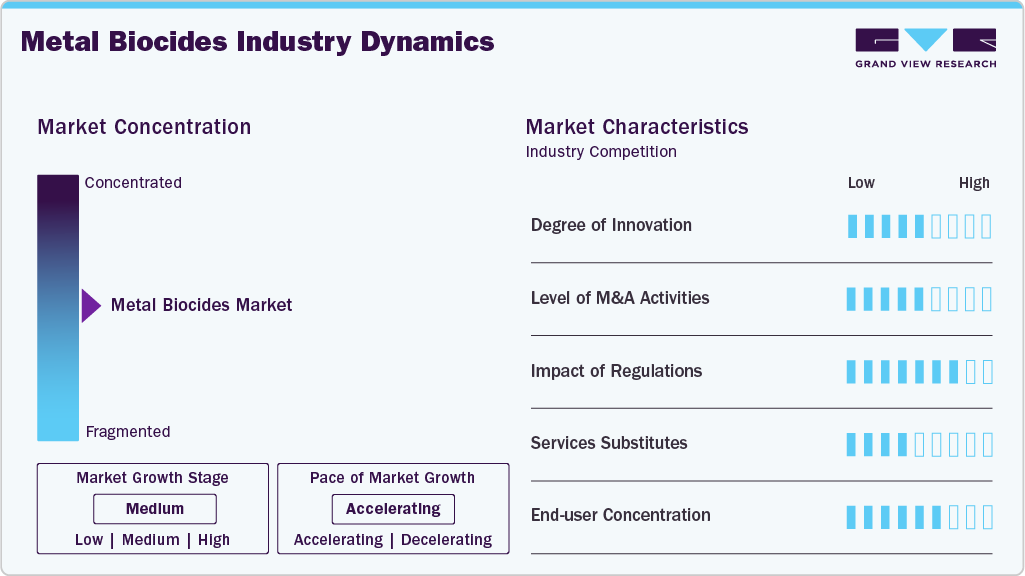
The competitive landscape in the metal biocides industry is characterized by a combination of global specialty chemical manufacturers, technology developers, material science companies, and application-focused formulators. Established participants such as LANXESS, Clariant, Arxada, Jubilant Ingrevia, Milliken, and Ishizuka Glass compete through differentiated silver-, copper-, and zinc solutions designed for multiple industrial uses. Their competitive strength is supported by extensive formulation expertise, established manufacturing infrastructure, technical service capabilities, regulatory knowledge, and international distribution networks. Specialized companies, including Microban International and SANITIZED, strengthen industry competition through proprietary platforms tailored to polymers, textiles, and treated surfaces.
 To learn more about this report, Download Free Sample Report
Innovation remains an important competitive lever in the metal biocides industry as producers seek to improve controlled ion release, treatment longevity, compatibility with different substrates, and performance at lower incorporation levels. Portfolio diversification also enables suppliers to address varying requirements across paints, plastics, water systems, healthcare materials, consumer products, and construction applications. Strategic partnerships with compounders, formulators, and finished-product manufacturers are increasingly important for accelerating commercial adoption and developing customized solutions. Meanwhile, regulatory approvals, technical validation, and application-specific testing create meaningful barriers for smaller entrants.
Analyst Perspective
The industry is moving from conventional microbial control toward integrated technologies that combine sustained efficacy, material compatibility, regulatory compliance, and application-specific performance. Solutions are increasingly being incorporated into polymers, textiles, healthcare products, and water-treatment systems rather than being limited to traditional preservative applications. At the same time, environmental considerations and tighter regulatory scrutiny are encouraging manufacturers to optimize metal-ion release, reduce active-material loading, and strengthen safety validation. For suppliers, the key opportunity lies in developing durable, low-dose systems that integrate seamlessly with recycled materials and advanced formulations while maintaining performance, regulatory acceptance, and commercial scalability.
Product Insights
The copper-based segment dominated the metal biocides market with a revenue share of 60.2% in 2025. Its strong position is supported by broad antimicrobial effectiveness against bacteria, algae, fungi, and other microorganisms. Demand remains significant across coatings, plastics, textiles, agricultural applications, and industrial processes. Copper compounds are valued for their durability and broad application flexibility. Their established use in sanitation and microbial-control applications provides a stable consumption base. Continued adoption across hygiene-sensitive and industrial end uses is expected to sustain the segment’s leading position.
The silver-based segment is expected to grow at a CAGR of 4.3% in the forecast period, encouraged by the strong antimicrobial performance associated with silver ions at relatively low concentrations. Its use is increasing across healthcare products, coatings, textiles, polymers, and consumer goods. The ability to provide prolonged microbial protection is supporting adoption in applications requiring extended service life. Demand is also benefiting from growing interest in hygiene-focused surfaces and products with built-in microbial protection. Ongoing product development is expected to further broaden its application across specialized end uses.
Application Insights
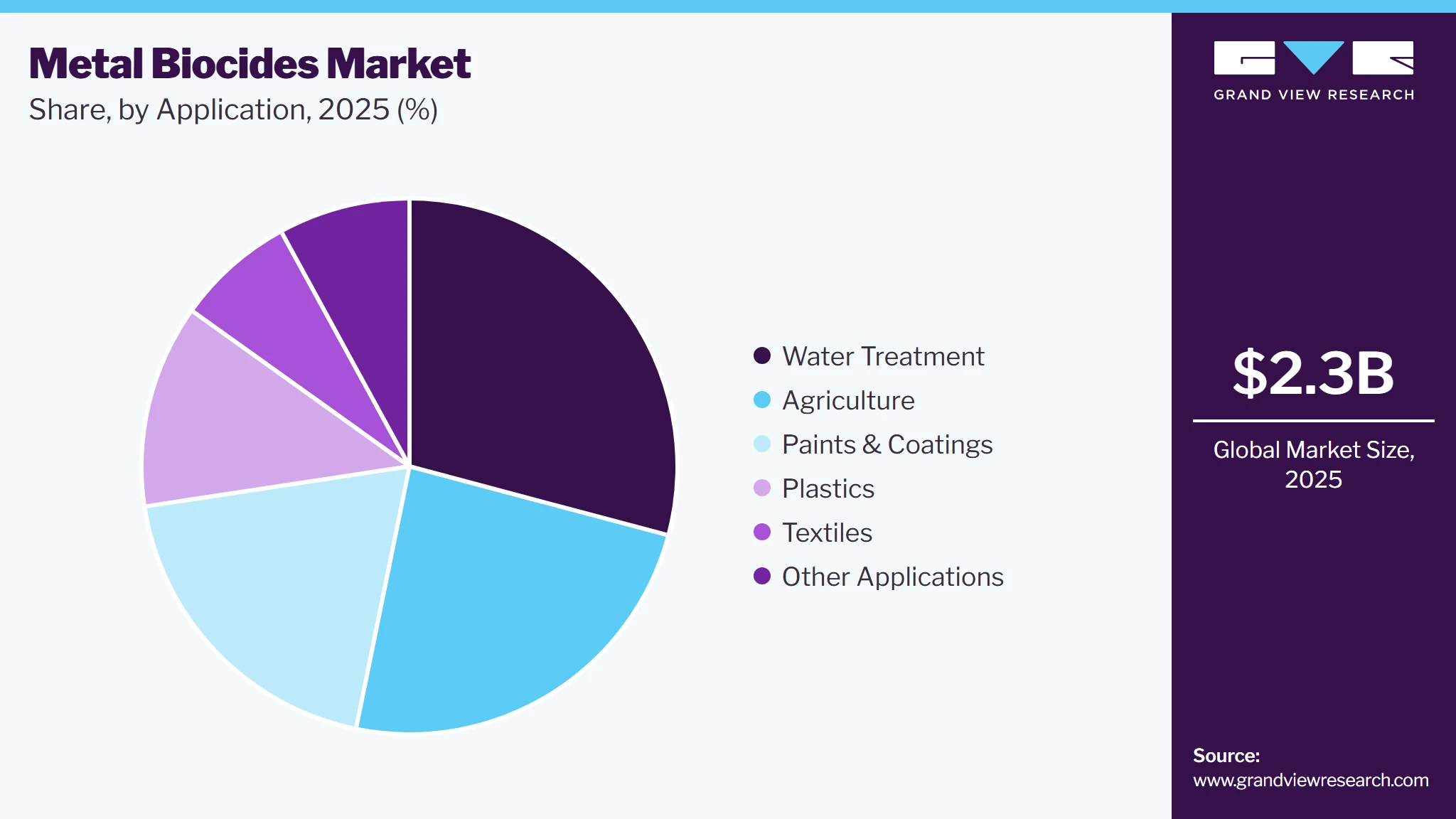
The water treatment segment dominated the metal biocides industry with a revenue share of 29.1% in 2025, linked to increasing requirements for microbial control in municipal, industrial, recreational, and process applications. Metal-based formulations are used to limit bacterial growth, algae formation, biofilm development, and other biological contamination. Rising investments in sanitation infrastructure and wastewater management are supporting demand. Industrial facilities are also adopting microbial-control solutions to maintain process efficiency and operational reliability. Growing emphasis on hygiene, resource management, and infrastructure modernization is expected to maintain strong demand.
 To learn more about this report, Download Free Sample Report
The paints & coatings segment is expected to grow with a CAGR of 4.4% during the forecast period. Increasing demand for antimicrobial protection in architectural, industrial, protective, marine, and specialty coatings is supporting expansion. These formulations help inhibit microbial growth on treated surfaces and can contribute to longer-lasting protection. Adoption is gaining momentum in healthcare facilities, public spaces, commercial buildings, and other hygiene-sensitive environments. Manufacturers are also focusing on formulations that provide effective microbial control without adversely affecting appearance or performance. Rising demand for functional coatings with added protective properties is expected to accelerate segment growth.
Regional Insights
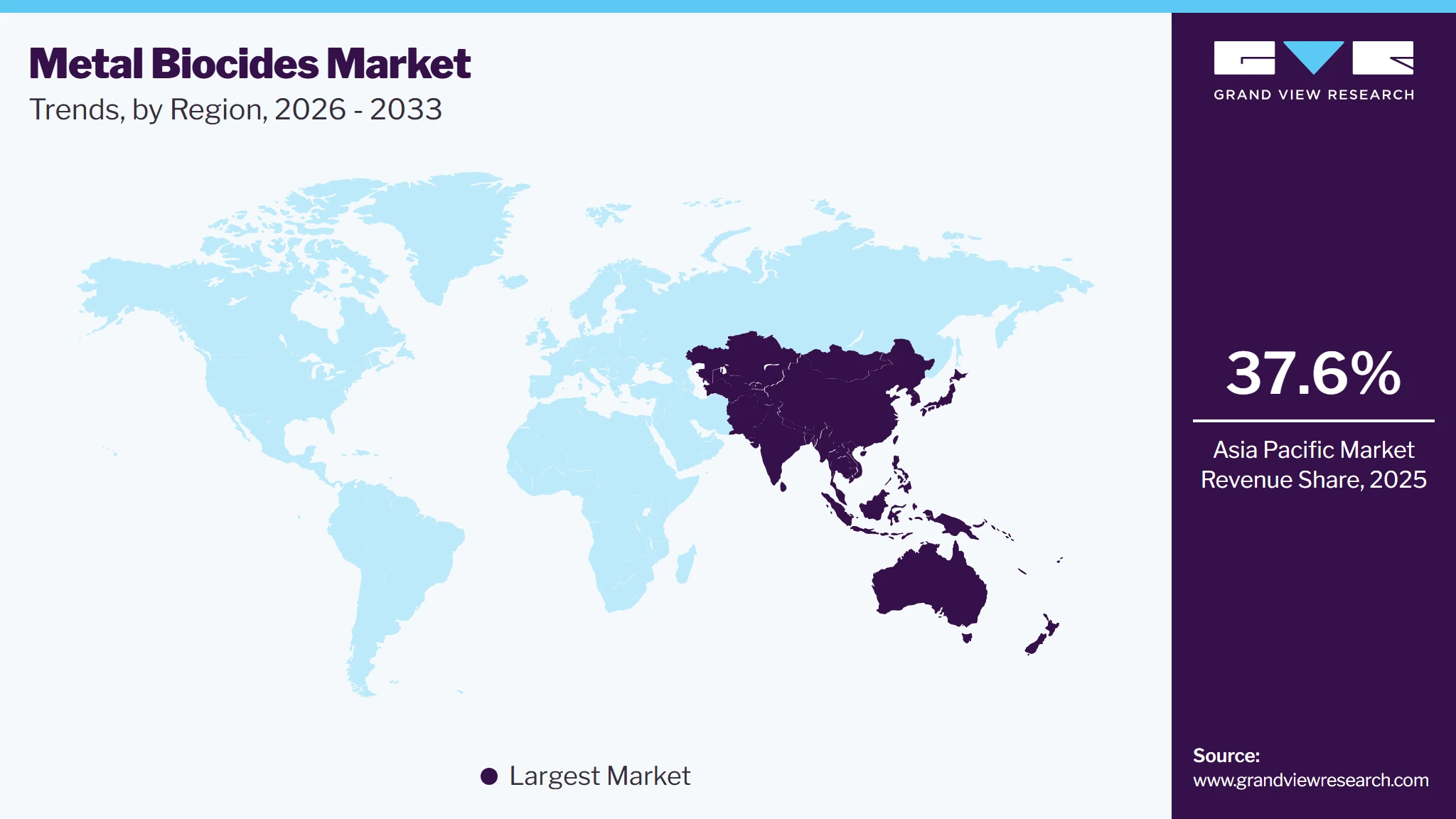
Asia Pacific dominated the metal biocides market with a revenue share of 37.6% in 2025, and is expected to grow at the fastest CAGR over the forecast period, as it represents a crucial production and consumption base, supported by its extensive plastics, textile, electronics, healthcare, and water-treatment industries. China, Japan, India, and South Korea provide substantial manufacturing capacity for metal materials, while expanding urban infrastructure is generating additional requirements for protected surfaces and water systems. Regional suppliers are also strengthening their portfolios of silver-, copper, and zinc technologies to serve domestic and export markets. Growing investment in hygiene-sensitive manufacturing, healthcare infrastructure, and advanced materials is creating additional avenues for adoption.
 To learn more about this report, Download Free Sample Report
The China metal biocides market is expected to grow over the forecast period. China is a major manufacturing hub for anti-microbial materials having a CAGR of 3.5%, supported by its large polymer, textile, construction, electronics, and consumer-goods sectors. Domestic production of silver-, copper-, and zinc compounds provides an established supply base, while extensive downstream processing capabilities facilitate incorporation into plastics, fibers, ceramics, and other substrates. Increasing emphasis on industrial modernization, water-quality management, healthcare facilities, and higher-value functional materials is broadening application potential. Export-oriented chemical manufacturing also enables Chinese producers to participate in international supply chains.
North America Metal Biocides Market Trends
North America benefits from sophisticated specialty-chemical manufacturing, advanced polymer processing, healthcare infrastructure, and stringent product-performance requirements. The region has established suppliers offering metal additives, preservatives, and surface-treatment technologies. Demand is supported by applications requiring prolonged microbial protection, including medical equipment, consumer products, industrial coatings, plastics, and water-treatment systems. Regulatory compliance remains an important competitive consideration, encouraging suppliers to invest in efficacy testing, environmental assessments, and application-specific formulations. Product innovation and collaboration with downstream manufacturers are likely to remain central to regional expansion.
U.S. Metal Biocides Market Trends
The U.S. is the principal contributor within North America metal biocides industry, supported by a well-developed specialty-chemicals industry and extensive use of technologies in healthcare, construction, plastics, textiles, and industrial processes. Companies such as LANXESS, Milliken, Microban International, Avient, and PPG maintain relevant technologies or downstream solutions serving domestic and international customers. Regulatory oversight, particularly concerning active substances and treated articles, strongly influences commercialization strategies. At the same time, demand for hygienic surfaces, functional polymers, durable coatings, and advanced healthcare materials continues to create opportunities for differentiated silver-, copper-, and zinc solutions.
Europe Metal Biocides Market Trends
Europe has a mature specialty-chemicals ecosystem and a strong concentration of manufacturers developing antimicrobial additives, preservatives, and material-protection technologies. Germany, Switzerland, France, and the United Kingdom are important industrial centers, supported by sophisticated plastics, textile, healthcare, and construction sectors. Environmental considerations and stringent chemical regulations are major factors influencing product development and portfolio management. Producers are increasingly focusing on optimized dosage, controlled release, substrate compatibility, and documented safety profiles.
The Germany metal biocides market is expected to grow over the forecast period. Germany is an important European manufacturing and technology center, supported by its well-established chemical, plastics, automotive, construction, and healthcare industries. The presence of major specialty-chemical companies provides access to advanced formulations and technical expertise. Metal technologies can benefit from the country's strong automotive and industrial manufacturing base, where protected polymers and functional surfaces are used across numerous components.
Middle East & Africa Metal Biocides Market Trends
The Middle East & Africa region presents emerging opportunities driven by water scarcity, infrastructure development, urbanization, healthcare expansion, and increasing investment in water-treatment systems. Metal-based technologies are relevant to water management, industrial, construction materials, plastics, and hygiene-oriented applications. Gulf countries, in particular, are investing in desalination, wastewater treatment, and large-scale infrastructure, creating potential demand for microbial-control technologies.
Latin America Metal Biocides Market Trends
Latin America offers growth potential through its expanding construction, agriculture, food processing, plastics, textiles, and water treatment industries. Brazil and Mexico are key manufacturing and consumption centers, with established chemical and polymer-processing capabilities that support the downstream utilization of additives and treated materials. Copper-based technologies are relevant to applications related to water management and industrial protection, while silver- and zinc-based solutions can serve plastics, textiles, healthcare, and consumer products.
Key Metal Biocides Company Insights
Companies are strengthening their positions through portfolio expansion, formulation innovation, strategic collaborations, and application-specific technologies designed to address evolving performance and regulatory requirements. Manufacturers are also investing in regional production capabilities, technical support, and customized solutions to deepen relationships with downstream users across plastics, textiles, healthcare, and water-treatment applications. Increasing emphasis on controlled-release systems, lower active-material loading, sustainability, and regulatory compliance is further enabling suppliers to differentiate their offerings and access higher-value applications.
-
Arxada AG is a global specialty chemicals manufacturer with a strong position in microbial control and material protection. Its relevant portfolio includes Zinc Omadine and Copper Omadine, which provide zinc- and copper-based protection across plastics, polymers, adhesives, sealants, and other industrial materials. The company combines formulation expertise, application support, regulatory capabilities, and an international manufacturing and commercial network, enabling it to serve diverse industrial customers. Its broad microbial-control portfolio and continued development of material-preservation technologies strengthen its competitive position across applications requiring durable protection against bacteria, fungi, and algae.
-
Microban International specializes in technologies designed to provide built-in protection for manufactured products and materials. Its portfolio includes SilverShield, a silver-based antimicrobial technology, and ZPTech, which uses zinc-based chemistry to protect against microbial growth. These technologies are incorporated into plastics, polymers, textiles, ceramics, and other consumer and industrial materials. The company differentiates itself through application-specific technology development, testing, formulation expertise, and collaboration with manufacturers seeking to integrate hygienic functionality directly into finished products.
Key Metal Biocides Companies
The following key companies have been profiled for this study of the metal biocides market.
-
LANXESS AG
-
Clariant AG
-
Arxada AG
-
Milliken & Company
-
Jubilant Ingrevia Limited
-
Ishizuka Glass Co., Ltd.
-
Microban International
-
SANITIZED AG
-
Avient Corporation
-
PPG Industries, Inc.
Company Categorization
Operating Strategies
Competitive Edge
Weaknesses
Mature Players: LANXESS AG; Clariant AG; Arxada AG; Milliken & Company; Jubilant Ingrevia Limited; Ishizuka Glass Co., Ltd.; Avient Corporation; PPG Industries, Inc.
- Expand manufacturing capabilities to ensure reliable supply and accommodate rising requirements across coatings, plastics, textiles, water treatment, and industrial applications.
- Broaden antimicrobial portfolios through silver-, copper-, and zinc-based formulations tailored to different substrates, performance requirements, and dosing conditions.
- Leverage integrated production networks, technical expertise, and regulatory capabilities to improve formulation efficiency, supply security, and commercialization timelines.
- Strengthen global sales and distribution networks to diversify customer exposure, deepen regional penetration, and support multinational accounts.
- Leverage established brands, extensive customer relationships, and long-standing industry expertise to reinforce credibility among industrial buyers.
- Utilize broad technical and R&D capabilities to develop durable, controlled-release, and application-specific antimicrobial technologies.
- Capitalize on multinational manufacturing and distribution infrastructure to provide consistent supply and technical support across major geographic markets.
- Offer diversified portfolios covering multiple metal chemistries and end-use applications, enabling customers to source complementary solutions from a single supplier.
- Manage higher operating and compliance costs associated with extensive manufacturing networks, regulatory requirements, and global organizational structures.
- Address lengthy development and approval cycles that can delay the commercialization of new antimicrobial formulations.
- Mitigate premium pricing pressures where specialized technologies compete with lower-cost regional suppliers and alternative antimicrobial chemistries.
- Adapt portfolios to changing regulatory requirements, particularly where restrictions on specific active substances could require reformulation or product repositioning.
Emerging Players: Microban International; SANITIZED AG
- Focus on specialized antimicrobial technologies and targeted applications where differentiated performance can create stronger customer value.
- Develop customized silver-, zinc-, and other metal-based formulations that address specific substrate, durability, dosage, and processing requirements.
- Establish partnerships with compounders, coating formulators, textile producers, and finished-product manufacturers to accelerate commercialization and market access.
- Expand selectively into international markets through distributors, licensing arrangements, technical collaborations, and application-focused partnerships.
- Leverage organizational agility to accelerate product development, customer response, and adaptation to changing application requirements.
- Build specialized expertise around antimicrobial additives and material-protection technologies to differentiate against broader chemical portfolios.
- Provide flexible formulation and technical-support capabilities that enable closer alignment with individual customer specifications.
- Concentrate R&D resources on emerging applications, advanced material systems, and differentiated technologies with potential for premium positioning.
- Overcome limited production capacity, which can constrain supply reliability and reduce competitiveness in large-volume applications.
- Reduce dependence on distributors and regional partners to establish stronger direct access to international customers and end-use industries.
- Address comparatively limited financial resources for large-scale R&D programs, regulatory testing, manufacturing expansion, and strategic acquisitions.
- Strengthen brand recognition and market credibility to compete more effectively with established multinational chemical manufacturers.
Recent Developments
-
In March 2026, Clariant strengthened its silver-based antimicrobial portfolio by updating JMAC Powder, JMAC Composite PG, and JMAC LP 10 for microbial preservation applications. The products support protection in coatings, polymers, sealants, and adhesives, expanding the company’s offering across industrial material-protection applications.
-
In February 2025, Avient introduced Cesa WithStand SX Low Haze Antimicrobial Additives for clear polycarbonate and plexiglass applications. The new grades are designed to provide antimicrobial protection while maintaining optical clarity and supporting the use of recycled resin in transparent plastic products.
Metal Biocides Market Report Scope
Report Attribute
Details
Market size in 2025
USD 2.3 billion
Estimated market size in 2026
USD 2.4 billion
Projected market size by 2033
USD 3.2 billion
Growth rate
CAGR of 3.9% from 2026 to 2033
Base year for estimation
2025
Historical data
2021 – 2024
Forecast period
2026 – 2033
Quantitative units
Revenue in USD million/billion, volume in kilotons, and CAGR from 2026 to 2033
Report coverage
Revenue forecast, volume forecast, company ranking, competitive landscape, growth factors, and trends
Segments covered
Product, application, region
Regional scope
North America; Europe; Asia Pacific; Latin America; Middle East & Africa
Country scope
U.S.; Canada; Mexico; UK; Germany; France; Italy; Spain; China; Japan; India; South Korea; Brazil; Argentina; South Africa; Saudi Arabia
Key companies profiled
LANXESS AG; Clariant AG; Arxada AG; Milliken & Company; Jubilant Ingrevia Limited; Ishizuka Glass Co., Ltd.; Microban International; SANITIZED AG; Avient Corporation; PPG Industries, Inc.
Customization scope
Free report customization (equivalent up to 8 analysts’ working days) with purchase. Addition or alteration to country, regional & segment scope.
Pricing and purchase options
Avail customized purchase options to meet your exact research needs. Explore purchase options
Global Metal Biocides Market Report Segmentation
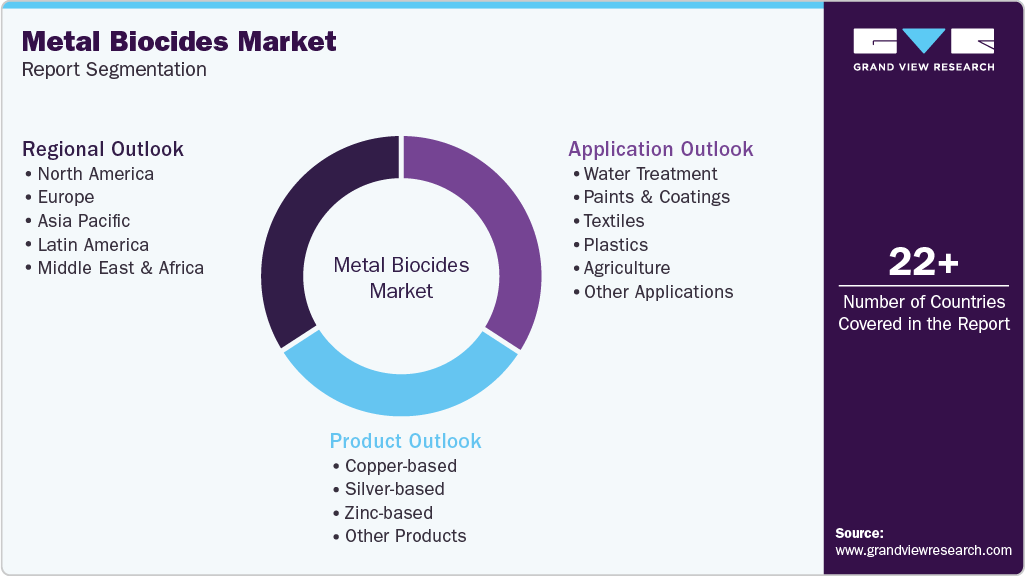
This report forecasts volume & revenue growth at the global, regional & country levels and provides an analysis of the latest industry trends in each of the sub-segments from 2021 to 2033. For this study, Grand View Research has segmented the metal biocides market report based on product, application, and region:
 To learn more about this report, Download Free Sample Report
-
Product Outlook (Volume, Kilotons; Revenue, USD Million/Billion, 2021 - 2033)
-
Copper-based
-
Silver-based
-
Zinc-based
-
Other Products
-
-
Application Outlook (Volume, Kilotons; Revenue, USD Million/Billion, 2021 - 2033)
-
Water Treatment
-
Paints & Coatings
-
Textiles
-
Plastics
-
Agriculture
-
Other Applications
-
-
Regional Outlook (Volume, Kilotons; Revenue, USD Million/Billion, 2021 - 2033)
-
North America
-
U.S.
-
Canada
-
Mexico
-
-
Europe
-
UK
-
Germany
-
France
-
Italy
-
Spain
-
-
Asia Pacific
-
China
-
Japan
-
India
-
South Korea
-
-
Latin America
-
Brazil
-
Argentina
-
-
Middle East and Africa (MEA)
-
South Africa
-
Saudi Arabia
-
-
Research Methodology
The metal biocides market figures in this report are based on a proven research process that combines executive interviews with secondary research from proprietary databases, company filings, and recognized regulatory and institutional sources. Market size is built through value-chain sizing—reconciling supply-side and demand-side estimates—and triangulated with bottom-up and top-down approaches. Every estimate passes multiple levels of expert validation before publication, with each metal biocides segment quantified using the revenue-capture definitions in the table below.
Segment Definition
Product
Revenue capture definition
Copper-based
Sale of copper-based antimicrobial agents, compounds, additives, and treated-material technologies for water treatment, coatings, plastics, antifouling systems, construction materials, and other microbial-control applications. Commercial value is influenced by copper concentration, chemical form, efficacy profile, formulation compatibility, dosage requirements, regulatory status, and supply consistency.
Silver-based
Commercial value is derived from silver-containing antimicrobial additives, compounds, coatings, masterbatches, and material-protection solutions used across healthcare, textiles, polymers, coatings, consumer products, and specialty surfaces. Premium pricing is supported by broad-spectrum efficacy, controlled ion release, low-use concentrations, durability, substrate compatibility, and technical performance.
Zinc-based
Income is captured through zinc-containing biocides, antimicrobial additives, preservatives, coatings, and polymer technologies designed to control microbial growth across industrial and consumer applications. Demand and pricing are shaped by active-substance concentration, formulation characteristics, application performance, regulatory acceptance, incorporation efficiency, and customer-specific requirements.
Other Products
Encompasses antimicrobial technologies based on other metal-containing systems, composite materials, metal-ion carriers, and multifunctional formulations. Commercial prospects depend on demonstrated microbial-control performance, compatibility with target substrates, regulatory clearance, production economics, and the ability to provide differentiated functionality compared with established silver, copper, and zinc solutions.
Application
Revenue capture definition
Water Treatment
Spending is associated with metal-based antimicrobial solutions used to control bacteria, algae, biofilms, and other microorganisms in municipal, industrial, recreational, and process-water systems. Revenue potential is influenced by treatment capacity, dosage requirements, water chemistry, regulatory provisions, treatment frequency, and the need for sustained microbial protection.
Paints & Coatings
Economic value arises from antimicrobial additives and formulations incorporated into architectural, industrial, protective, marine, and specialty coatings to inhibit microbial growth on treated surfaces. Supplier earnings are influenced by coating compatibility, durability, active concentration, release characteristics, formulation stability, and performance under different environmental conditions.
Textiles
Value generation stems from antimicrobial treatments, additives, and technologies incorporated into fibers, fabrics, apparel, home furnishings, medical textiles, and technical fabrics. Adoption is shaped by odor-control requirements, washing durability, microbial efficacy, treatment longevity, substrate compatibility, and demand for hygiene-enhancing textile functionality.
Plastics
Revenue is derived from antimicrobial masterbatches, additives, compounds, and metal-ion technologies incorporated into polymers used in consumer products, appliances, automotive components, packaging, electronics, construction materials, and medical applications. Purchasing decisions depend on dosage efficiency, processing stability, mechanical-property retention, appearance, thermal resistance, and regulatory suitability.
Agriculture
Market value is supported by metal-based antimicrobial formulations, additives, and treatments used in agricultural inputs, crop-protection products, irrigation systems, greenhouse materials, and post-harvest applications. Demand is influenced by antimicrobial efficacy, application rates, crop compatibility, environmental safety, regulatory acceptance, and treatment durability.
Other Applications
Customer expenditure covers healthcare products, construction materials, ceramics, adhesives, sealants, consumer goods, industrial surfaces, and other products requiring integrated microbial protection. Commercial demand depends on antimicrobial performance, service-life requirements, material compatibility, regulatory acceptance, product differentiation, and the ability to provide reliable protection under application-specific conditions.
Estimation Model
Layer No.
Layer Name
Key Question
Description
01
Raw Material & Production Layer
What forms the supply base?
Assess the principal metals, metal compounds, carriers, additives, and other inputs used to manufacture antimicrobial solutions, with particular attention to silver, copper, and zinc-based active substances. Examine processes such as metal-ion incorporation, precipitation, ion exchange, compounding, dispersion, masterbatch production, coating formulation, and other conversion stages. The assessment also covers manufacturing capacity, plant utilization, process efficiency, feedstock sourcing, quality control, inventory planning, packaging, warehousing, transportation, worker protection, emissions management, and compliance with chemical and biocidal regulations.
02
Application Adoption Layer
Where are metal biocides utilized?
Evaluate adoption across paints and coatings, plastics and polymers, water treatment, textiles, healthcare products, construction materials, consumer goods, and other antimicrobial applications. Silver, copper, and zinc-based technologies are incorporated into substrates or formulations to inhibit bacterial, fungal, algal, and other microbial growth. Uptake is influenced by hygiene requirements, product performance expectations, regulatory provisions, substrate compatibility, durability requirements, and the operational advantages of built-in antimicrobial protection.
03
Consumption Intensity Layer
How extensively are metal biocides consumed?
Analyze utilization according to metal type, application, product format, active substance concentration, incorporation method, treatment frequency, substrate characteristics, and operating environment. Consumption differs across coatings, polymer compounds, textiles, water-treatment systems, and healthcare materials because dosage requirements depend on microbial exposure, surface area, material composition, service conditions, and required protection period. Demand is additionally shaped by product replacement cycles, manufacturing volumes, regulatory concentration limits, formulation efficiency, and the increasing integration of antimicrobial functionality into finished products.
04
Revenue Layer
How is market revenue generated?
Revenue is generated through the sale of metal-based active ingredients, antimicrobial additives, dispersions, masterbatches, treated-material technologies, coatings, and application-specific formulations to chemical manufacturers, compounders, coating producers, textile processors, healthcare suppliers, water-treatment companies, and other industrial customers. Commercial value is influenced by metal content, active concentration, product grade, formulation complexity, order volumes, production economics, logistics, regulatory status, and technical support. Premium opportunities arise from controlled-release systems, low-dose formulations, specialized delivery formats, customized solutions, and technologies that combine antimicrobial performance with durability or sustainability attributes.
Delivered Customizations
This report has been delivered with the following In-depth customizations:
Client Request
Customization Delivered
Value Adds
Regional segmentation
The assessment provides country-level market sizing and forecasts supported by analysis of industrial manufacturing, coatings and polymer production, textile processing, healthcare infrastructure, water-treatment capacity, construction activity, regulatory conditions, trade flows, and domestic manufacturing capabilities. It evaluates regional supply networks, metal availability, production hubs, distribution channels, infrastructure investments, and adoption trends across key countries.
Supports geographic prioritization, capacity planning, sourcing strategies, distributor selection, inventory positioning, and investment decisions by identifying markets with strong industrial bases, expanding hygiene requirements, established antimicrobial manufacturing, and growing demand for functional material-protection technologies.
Opportunity Assessment
Comprehensive evaluation of emerging avenues across paints and coatings, plastics and polymers, water treatment, textiles, healthcare products, construction materials, consumer goods, and specialty surfaces. The assessment examines prospects arising from the adoption of recycled materials, antimicrobial surface integration, controlled-release technologies, lower-dose formulations, advanced material systems, and penetration into underdeveloped application areas.
Helps identify high-growth applications, target customer groups, product technologies, and geographic opportunities by assessing material requirements, manufacturing trends, regulatory developments, sustainability priorities, and purchasing criteria. The findings support portfolio expansion, R&D allocation, formulation optimization, capacity enhancement, partnerships, and market-entry strategies.
Competitive Benchmarking
Comparative assessment of leading participants based on manufacturing capabilities, metal-based product portfolios, application coverage, formulation technologies, production integration, geographic footprint, distribution infrastructure, technical expertise, regulatory capabilities, and supply consistency. The analysis also reviews recent product introductions, capacity investments, partnerships, acquisitions, technology developments, sustainability initiatives, and regional expansion undertaken by major suppliers.
Enables companies to assess competitive positioning, operational capabilities, portfolio gaps, differentiation opportunities, and strategic priorities. The insights inform decisions on production upgrades, technology development, product diversification, supply chain resilience, geographic expansion, strategic collaborations, acquisitions, customer targeting, and long-term positioning.
Frequently Asked Questions About This Report
Asia Pacific dominated the market with a revenue share of 37.6%, in 2025.
The metal biocides market size was estimated at USD 2.3 billion in 2025 and is expected to reach USD 2.4 billion in 2026.
The metal biocides market is expected to grow at a compound annual growth rate of 3.9% from 2026 to 2033, reaching USD 3.2 billion by 2033.
Copper-based segment dominated the market with a revenue share of 60.2% in 2025. Its strong position is supported by broad antimicrobial effectiveness against bacteria, algae, fungi, and other microorganisms.
Growing demand for durable antimicrobial protection across plastics, coatings, textiles, healthcare products, water-treatment systems, and construction materials is supporting adoption. Increasing incorporation of silver-, copper-, and zinc-based technologies into finished materials, alongside stricter hygiene requirements and rising demand for functional surfaces, is further strengthening consumption.
Some of the key players operating in the metal biocides market LANXESS AG; Clariant AG; Arxada AG; Milliken & Company; Jubilant Ingrevia Limited; Ishizuka Glass Co., Ltd.; Microban International; SANITIZED AG; Avient Corporation; PPG Industries, Inc.
Water treatment dominated the market with a segment revenue share of 29.1% in 2025, linked to increasing requirements for microbial control in municipal, industrial, recreational, and process applications.
About the Author(s)
Performance Chemicals Research Team
Specialty & Fine Chemicals · Performance ChemicalsThis report was authored by the performance chemicals research team at Grand View Research - comprising two research analysts, one senior research analyst, and one industry expert - with specialized expertise in the performance chemicals segment of the specialty & fine chemicals industry. All findings are based on proprietary specialty & fine chemicals databases, executive interviews, and regulatory analysis, subject to internal peer review prior to publication.
Last Updated:
Speak to Analyst

Customize this report to your needs - add regions, segments, or data points, with 20% free customization.
Or view our licence options:


ISO 9001:2015 & 27001:2022 Certified
We are GDPR and CCPA compliant! Your transaction & personal information is safe and secure. For more details, please read our privacy policy.


