
- Home
- »
- Advanced Interior Materials
- »
-
Metamaterials Market Size And Share, Industry Report, 2033GVR Report cover
![Metamaterials Market Size, Share & Trends Report]()
Metamaterials Market (2026 - 2033) Size, Share & Trends Analysis Report By Product (Electromagnetic, Terahertz, Photonic, Tunable, Frequency Selective Surface, Non-linear), By Application (Antenna, Absorber, Superlens, Cloaking Device), By End Use, By Region, And Segment Forecasts
- Report ID: GVR-1-68038-966-1
- Number of Report Pages: 100
- Format: PDF
- Historical Range: 2021 - 2024
- Forecast Period: 2026 - 2033
- Industry: Advanced Materials
- Report Summary
- Table of Contents
- Segmentation
- Methodology
- Download FREE Sample
-
 Download Sample Report
Metamaterials Market Summary
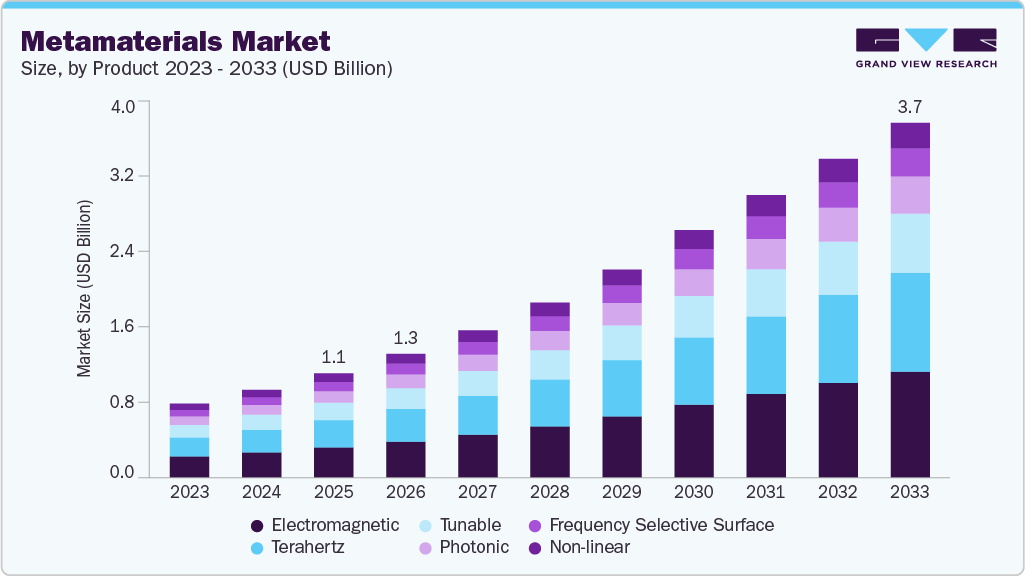
The global metamaterials market size was estimated at USD 1.10 billion in 2025 and is projected to reach USD 3.73 billion by 2033, growing at a CAGR of 16.2% from 2026 to 2033. This growth is primarily driven by the increasing demand for advanced materials in telecommunications, particularly for 5G and beyond.
Key Market Trends & Insights
- North America dominated the global metamaterials industry with the largest revenue share of 40.0% in 2025.
- By product, the terahertz segment is expected to grow at the fastest CAGR of 17.2% over the forecast period..
- By application, the absorber segment is expected to grow at the fastest CAGR of 16.3% over the forecast period.
- By end use, the consumer electronics segment is expected to grow at the fastest CAGR of 19.0% over the forecast period.
Market Size & Forecast
- 2025 Market Size: USD 1.10 Billion
- 2033 Projected Market Size: USD 3.73 Billion
- CAGR (2026-2033): 16.2%
- North America: Largest market in 2025
- Asia Pacific: Fastest growing market
Metamaterials play a critical role in enhancing signal strength, improving bandwidth efficiency, and reducing electromagnetic interference, making them indispensable for next-generation communication technologies. Within this landscape, the metamaterial medium market is gaining traction as engineered media enable precise control over wave propagation. Additionally, the metamaterial circular market is expanding as circularly polarized metamaterials are increasingly adopted in antennas and wireless communication systems to improve signal reliability and coverage.The aerospace and defense sectors further accelerate market growth through the adoption of metamaterials for stealth technology, advanced radar systems, and electromagnetic shielding. The growing demand for radar-absorbing structures has significantly boosted the metamaterial absorbers materials market, as these materials enhance radar cross-section reduction and improve detection avoidance capabilities. Parallelly, the acoustic metamaterial market is witnessing rising adoption in defense and aerospace applications for noise suppression, vibration control, and advanced sonar systems, further strengthening overall market momentum.
Ongoing research and development (R&D) activities continue to act as a key growth catalyst for the metamaterials market. Substantial investments from both public and private sectors are supporting innovation across fabrication techniques and material design, expanding the commercial viability of metamaterial-based solutions. These advancements are not only driving the evolution of the metamaterial medium market but are also lowering manufacturing costs, enabling broader adoption across telecommunications, healthcare, and industrial applications.
Moreover, the growing emphasis on sustainability and energy efficiency is significantly influencing the adoption of metamaterials. In renewable energy projects such as solar panels and wind turbines, metamaterials are increasingly utilized to enhance performance and efficiency. Metamaterials improve light absorption and energy conversion efficiency in solar systems, while aerodynamic and acoustic optimizations particularly through innovations in the acoustic metamaterial market help reduce noise and mechanical losses in wind turbines. These developments align with global sustainability goals and the transition toward cleaner energy sources, thereby further propelling the overall growth of the metamaterials market.
Market Concentration & Characteristics
The market is moderately concentrated, with a limited number of specialized players holding significant technological expertise. Large defense contractors, advanced material companies, and specialized startups dominate high-value applications such as aerospace, defense, and telecommunications. Entry barriers remain high due to complex design requirements, intellectual property protection, and capital-intensive R&D. However, increasing academic spin-offs and collaborative research models are gradually increasing competition. Strategic partnerships between material science firms and electronics manufacturers are common. As commercialization improves, mid-sized players are expected to gain market presence.
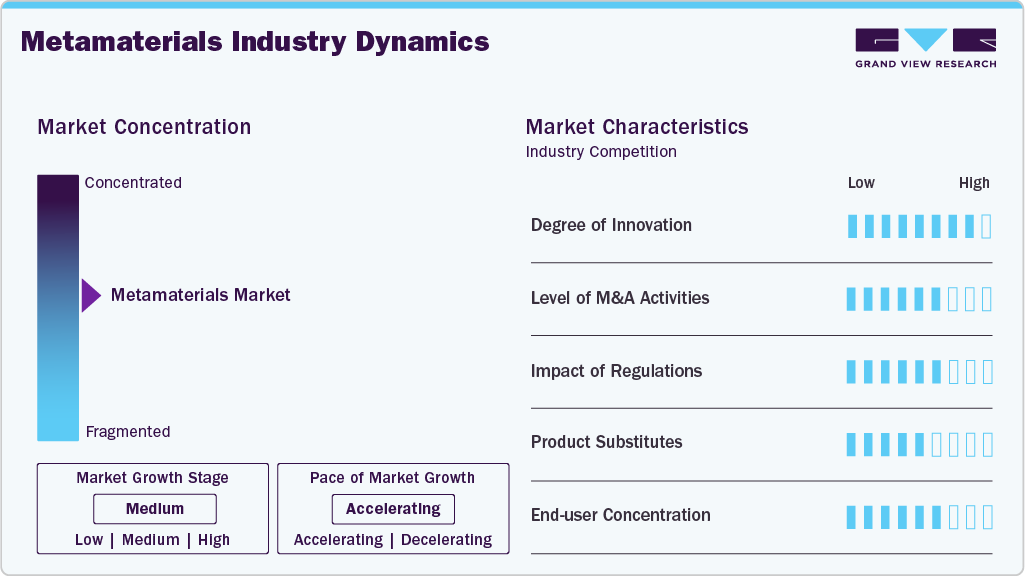
The threat of substitutes for metamaterials is moderate, as conventional materials and advanced composites can partially replace them in certain applications. Traditional electromagnetic absorbers, photonic crystals, and nanocomposites may serve as alternatives where performance requirements are less stringent. However, these substitutes often lack the extreme wave manipulation capabilities offered by metamaterials. High costs and fabrication complexity may encourage some end users to opt for alternative solutions. In price-sensitive markets, advanced polymers or composites may replace metamaterials. Nevertheless, in high-performance and defense-critical applications, the risk of substitution remains low. Continuous innovation further strengthens the competitive advantage of metamaterials.
Product Insights
The electromagnetic segment accounted for 29.2% of the market revenue in 2025, primarily due to its extensive applications across various industries, particularly in telecommunications and defense. Electromagnetic metamaterials are engineered to manipulate electromagnetic waves, making them ideal for use in advanced antenna systems, radar technologies, and cloaking devices. In telecommunications, these materials enhance signal strength and reduce interference, which is crucial for the development and deployment of 5G networks. In the defense sector, electromagnetic metamaterials are utilized to develop stealth technology, enhancing the radar evasion capabilities of military aircraft and vehicles. In addition, the medical field benefits from these materials in imaging and diagnostic devices, where they enhance resolution and accuracy.
The terahertz segment is expected to grow at a CAGR of 17.2% from 2026 to 2033. Terahertz metamaterials are designed to interact with terahertz frequencies, which lie between the microwave and infrared wavelength ranges. These frequencies have unique properties that make them suitable for various applications. In the medical field, terahertz metamaterials are used in imaging systems that can detect cancerous tissues and other anomalies with high precision. In the field of spectroscopy, they enable the identification of chemical substances and materials at a molecular level. The demand for terahertz metamaterials is also rising in the communication sector, which is used to develop high-speed wireless communication systems. In addition, these materials are being explored for use in quality assurance and non-destructive testing in industries such as pharmaceuticals and manufacturing.
Application Insights
The antenna segment held the largest revenue share of 44.8% in 2025, primarily due to the increasing demand for advanced communication systems, particularly with the rollout of 5G technology. Metamaterials are used to create more efficient, compact antennas capable of operating at multiple frequencies. These properties are essential for modern telecommunications, where high-speed data transmission and minimal signal interference are required.
Moreover, the aerospace and defense sectors heavily rely on metamaterial-based antennas for radar and satellite communications, enhancing their operational capabilities. The ongoing advancements in nanotechnology and materials science further improve the performance and reduce the cost of these antennas, making them more accessible for various applications. The growing trend of miniaturization in electronic devices also contributes to the increased adoption of metamaterial antennas, as they can be integrated into smaller, more complex systems.
The absorber segment is expected to grow significantly over the forecast period, driven by its expanding applications in various industries. Metamaterial absorbers are designed to efficiently absorb electromagnetic waves, making them ideal for use in stealth technology, where they help reduce the radar cross-section of military vehicles and aircraft. This capability is crucial for defense applications, as it enhances the stealth and survivability of assets.
In addition to defense, metamaterial absorbers are increasingly being used in commercial applications, such as electromagnetic interference (EMI) shielding in electronic devices. This is particularly important in densely packed electronic environments, where interference can degrade performance. The renewable energy sector also benefits from metamaterial absorbers, as they can improve the efficiency of solar panels by minimizing energy loss.
End Use Insights
The consumer electronics segment dominated the market with the largest revenue share of 33.2% in 2025, due to the increasing demand for high-performance, compact, and energy-efficient electronic devices. Metamaterials are widely used in smartphones, wearables, tablets, and IoT devices to enhance antenna performance, improve signal strength, and enable device miniaturization. The rapid rollout of 5G networks has further accelerated adoption, as metamaterial-based antennas support better bandwidth, reduced interference, and improved connectivity. Growing consumer preference for thinner, lighter, and multifunctional devices has increased the need for advanced electromagnetic control offered by metamaterials. In addition, the increasing production volumes of smart devices have encouraged manufacturers to integrate metamaterials on a larger scale.
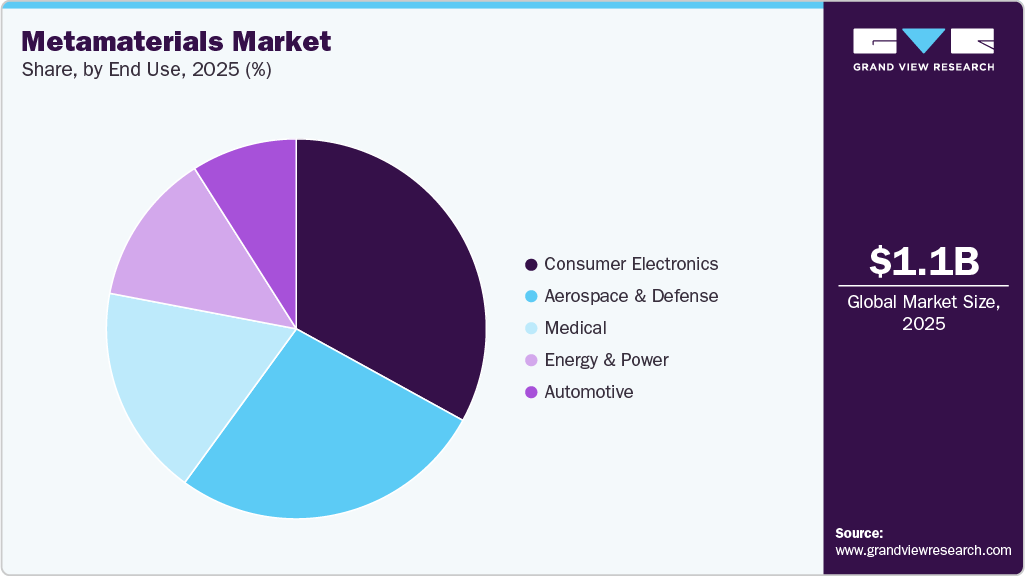
The medical segment is expected to grow fastest from 2026 to 2033, driven by the increasing adoption of metamaterials in various medical applications. Metamaterials are being used to develop innovative diagnostic and imaging devices with higher resolution and accuracy. For instance, metamaterial-based imaging systems can provide more precise and more detailed images, aiding in the early detection and diagnosis of diseases such as cancer. In addition, metamaterials are being explored for use in non-invasive sensors and wearable medical devices, which can monitor patients’ health in real-time. The unique properties of metamaterials, such as their ability to manipulate electromagnetic waves, make them ideal for these applications.
Regional Insights
North America Metamaterials Market Trends
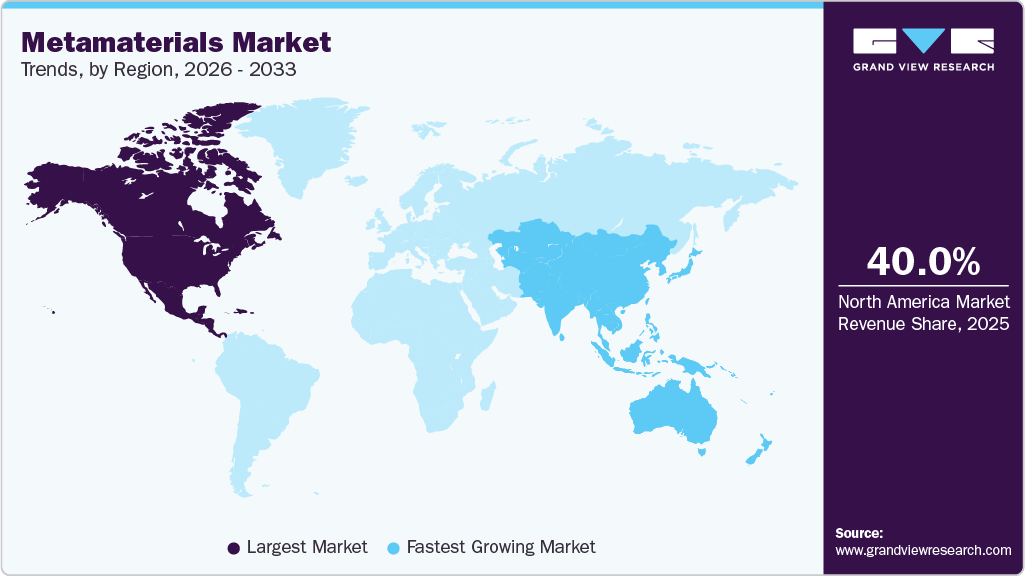
North America metamaterials industry dominated the global market with a revenue share of 40.0% in 2025, driven by significant advancements in the telecommunications and defense sectors. The region’s strong focus on research and development, supported by substantial government and private investments, has led to innovative applications of metamaterials. The presence of leading technology companies and research institutions further propels market growth.
U.S. Metamaterials Market Trends
The U.S. metamaterials industry accounted for a substantial market share in the North American market in 2025, primarily due to the country’s robust defense sector, which extensively utilizes metamaterials for stealth technology and advanced radar systems. In addition, the U.S. is a leader in telecommunications, with significant investments in 5G infrastructure that benefits from metamaterial-based antennas and signal enhancers.
Asia Pacific Metamaterials Market Trends
The Asia Pacific metamaterials industry is projected to experience the fastest growth over the forecast period. This rapid growth is driven by the increasing adoption of 5G technology and the expanding consumer electronics market. Countries such as China, Japan, and South Korea are investing heavily in research and development to enhance the capabilities of metamaterials in various applications, including telecommunications and medical imaging.
China metamaterials industry held a substantial share in the Asia Pacific market in 2025, driven by its significant investments in 5G infrastructure and renewable energy projects. The country’s focus on becoming a global leader in technology and innovation has led to an increase in research and development activities in metamaterials. In addition, China’s large manufacturing base supports the production and commercialization of metamaterial products.
Europe Metamaterials Market Trends
The European metamaterials industry is projected to grow steadily from 2026 to 2033, supported by the region’s strong emphasis on sustainability and energy efficiency. European countries are investing in renewable energy projects, such as solar and wind power, where metamaterials are used to enhance performance. The region’s regulatory framework also encourages the adoption of advanced materials in various industries.
The UK metamaterials industry is expected to play a significant role in the growth of the European market. The country has a strong research base, with numerous universities and research institutions focusing on metamaterials. Government initiatives and funding programs aimed at promoting innovation and technology development further support the market. The UK’s emphasis on defense and telecommunications also drives the demand for metamaterials.
MEA Metamaterials Market Trends
The Middle East and Africa (MEA) metamaterials industry is projected to grow at a CAGR of 11.0% over the forecast period, driven by increasing investments in the telecommunications and defense sectors. Countries in the region are adopting advanced technologies to enhance their infrastructure and security capabilities. In addition, the region’s focus on renewable energy projects, such as solar power, supports the demand for metamaterials.
Key Metamaterials Company Insights
The global metamaterials industry is driven by major companies such as Epec, Molex, Fujitsu, and Xymox Technologies, among others.
-
Metamaterial Technologies Inc. (MTI) focuses on developing advanced materials that manipulate electromagnetic waves, enhancing the performance of antennas, sensors, and other critical components. MTI’s products are widely used in stealth technology, improving radar evasion capabilities for military applications.
-
JEM Engineering LLC specializes in the design and manufacture of advanced antenna systems, leveraging metamaterial technology to enhance performance and efficiency. The company’s products are used in a variety of sectors, including defense, telecommunications, and aerospace.
Key Metamaterials Companies:
The following key companies have been profiled for this study on the metamaterials market.
- Metamaterial Technologies Inc.
- JEM Engineering LLC
- Kymeta Corporation
- Microwave Measurement Systems LLC
- Applied EM, Inc.
- Teraview
- Alps Electric Co., Ltd
- PARC
- Echodyne
- Phoebus optoelectronics
Recent Developments
-
In April 2024, BASF Venture Capital (BVC) made an investment in Phomera Metamaterials Inc., a developer of photonic crystal metamaterials. This investment was part of Phomera’s Series A financing round and is intended to facilitate the expansion of the company’s capacity, the exploration of new markets, and the enhancement of its product offerings.
-
In October 2023, Berkeley engineers introduced a pioneering technique that leveraged artificial intelligence and additive manufacturing to produce materials with meticulously customized properties. This method aimed to integrate optimal functionality and specific behaviors into these specialized materials.
Metamaterials Market Report Scope
Report Attribute
Details
Market size value in 2026
USD 1.30 billion
Revenue forecast in 2033
USD 3.73 billion
Growth rate
CAGR of 16.2% from 2026 to 2033
Historical data
2021 - 2024
Forecast period
2026 - 2033
Quantitative units
Revenue in USD million/billion and CAGR from 2026 to 2033
Report coverage
Revenue forecast, company ranking, competitive landscape, growth factors, and trends
Segments covered
Product, application, end use, region
Regional Scope
North America, Europe, Asia Pacific, Latin America
Middle East & Africa
Country Scope
U.S.; Canada; Mexico; Germany; UK; France; Italy; Spain; China; Japan; India;
Key companies profiled
Metamaterial Technologies Inc.; JEM Engineering LLC; Kymeta Corporation; Microwave Measurement Systems LLC; Applied EM, Inc.; Teraview; Alps Electric Co., Ltd; PARC; Echodyne; Phoebus Optoelectronics
Customization scope
Free report customization (equivalent up to 8 analysts working days) with purchase. Addition or alteration to country, regional & segment scope.
Pricing and purchase options
Avail customized purchase options to meet your exact research needs. Explore purchase options
Global Metamaterials Market Report Segmentation
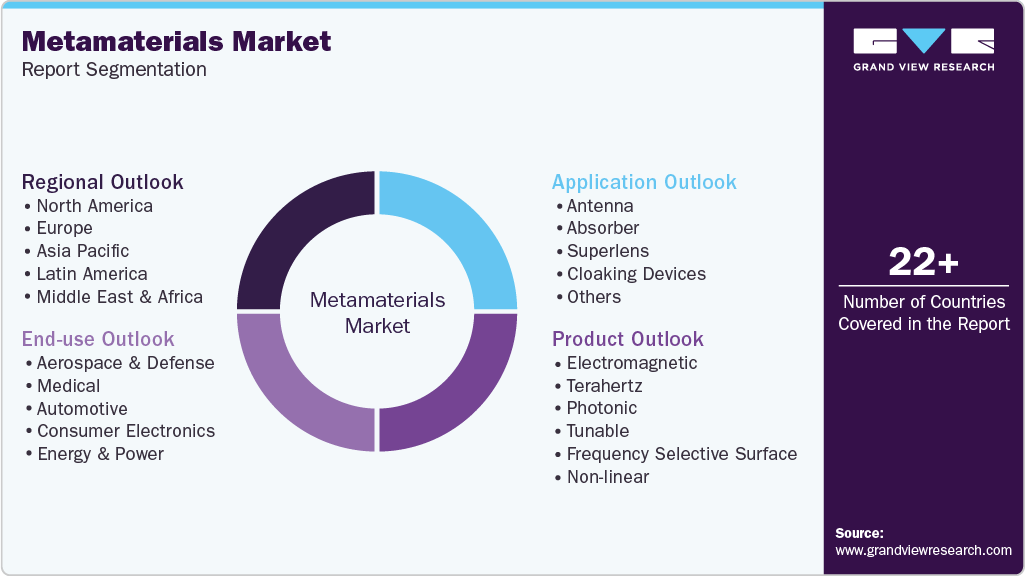
This report forecasts revenue & volume growth of the market and provides an analysis of the latest industry trends in each of the sub-segments from 2021 to 2033. For this study, Grand View Research has segmented the global metamaterials market report based on product, application, end use, and region:
-
Product Outlook (Revenue, USD Million, 2021 - 2033)
-
Electromagnetic
-
Terahertz
-
Photonic
-
Tunable
-
Frequency Selective Surface
-
Non-linear
-
-
Application Outlook (Revenue, USD Million, 2021 - 2033)
-
Antenna
-
Absorber
-
Superlens
-
Cloaking Devices
-
Others
-
-
End Use Outlook (Revenue, USD Million, 2021 - 2033)
-
Aerospace & Defense
-
Medical
-
Automotive
-
Consumer Electronics
-
Energy & Power
-
-
Regional Outlook (Revenue, USD Million, 2021 - 2033)
-
North America
-
U.S.
-
Canada
-
Mexico
-
-
Europe
-
UK
-
Germany
-
France
-
Italy
-
Spain
-
-
Asia Pacific
-
Japan
-
China
-
India
-
-
Latin America
-
Middle East & Africa
-
Frequently Asked Questions About This Report
b. The global metamaterials market was estimated at USD 1.10 billion in 2025 and is expected to reach USD 1.30 billion in 2026.
b. The global metamaterials market is expected to grow at a compound annual growth rate of 16.2% from 2026 to 2033 to reach USD 3.73 billion in 2033.
b. North America dominated the global metamaterials market with a revenue share of 40.0% in 2025, driven by significant advancements in the telecommunications and defense sectors.
b. Some key players operating in the metamaterials market include Metamaterial Technologies Inc., JEM Engineering LLC, Kymeta Corporation, Microwave Measurement Systems LLC, Applied EM, Inc., Teraview, Alps Electric Co., Ltd, PARC, Echodyne, and Phoebus Optoelectronics.
b. Rapid adoption of 5G and next-generation wireless technologies, increasing defense and aerospace investments, growing demand for miniaturized high-performance electronic devices, and continuous advancements in photonic and electromagnetic material engineering are driving the metamaterials market.


Share this report with your colleague or friend.
Need a Tailored Report?
Customize this report to your needs — add regions, segments, or data points, with 20% free customization.


ISO 9001:2015 & 27001:2022 Certified
We are GDPR and CCPA compliant! Your transaction & personal information is safe and secure. For more details, please read our privacy policy.
Trusted market insights - try a free sample
See how our reports are structured and why industry leaders rely on Grand View Research. Get a free sample or ask us to tailor this report to your needs.













