
- Home
- »
- Energy & Power
- »
-
Methanol Fuel Market Size And Share Report, 2026-2033GVR Report cover
![Methanol Fuel Market (2026 - 2033)Report]()
Methanol Fuel Market (2026 - 2033)
Size, Share & Trends Analysis Report By Fuel Grade (Fuel-Grade Methanol), By Production Pathway (Natural Gas-Based Methanol), By Application (Power Generation), By Region, And Segment Forecasts
Market Size, 2025
$5.6BMarket Estimate, 2026
$6.1BMarket Forecast, 2033
$16.0BCAGR, 2026–2033
14.7%Methanol Fuel Market Summary
The global methanol fuel market size was valued at USD 5.6 billion in 2025 and is projected to grow from USD 6.1 billion in 2026 to USD 16.0 billion by 2033, at a CAGR of 14.7% from 2026 to 2033. Asia Pacific dominated the market, accounting for the largest revenue share of 52.2% 2025. Stricter environmental regulations and the need to reduce greenhouse gas emissions are driving the adoption of methanol as a cleaner alternative fuel.

Key Market Trends & Insights
- By fuel-grade: Fuel-grade methanol segment held the highest revenue share of 55.2% in 2025.
- By production pathway: Natural gas-based methanol segment held the highest revenue share of 50.5% in 2025.
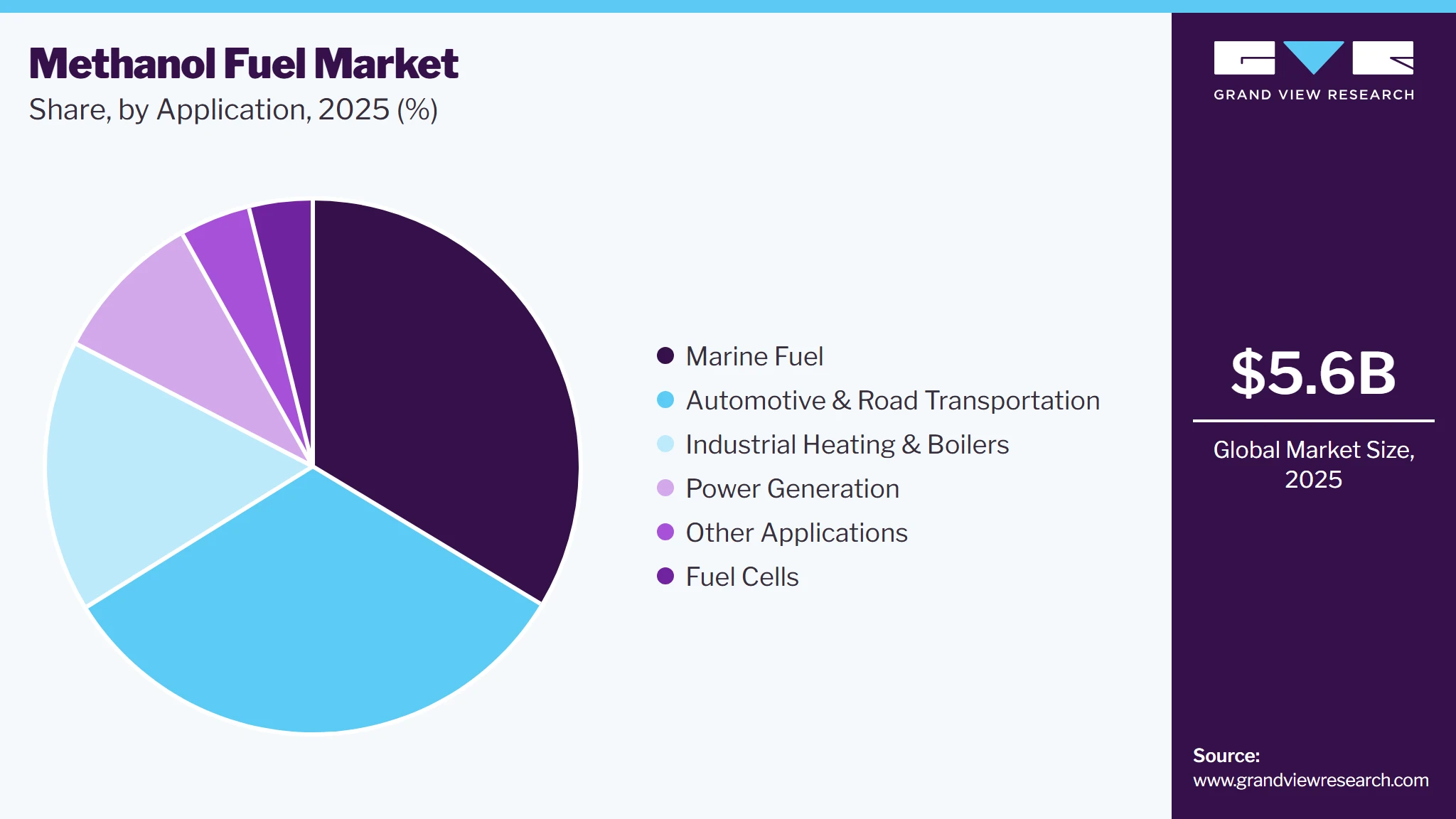
- By application: Marine fuel segment held the highest revenue share of 33.6% in 2025.
Regional Highlights
- Largest regional market: Asia Pacific (52.2% revenue share, 2025)
- Fastest-growing regional market: Middle East & Africa (highest CAGR, 2026 - 2033)
- By country: China held the largest market share in 2025.
Market Size & Forecast
- Market size in 2025: USD 5.6 Billion
- Estimated market size in 2026: USD 6.1 Billion
- Projected market size by 2033: USD 16.0 Billion
- CAGR (2026-2033): 14.7%
Growing demand for low-carbon fuels in marine transportation and power generation is further supporting market growth.
Market Dynamics
The methanol fuel market is driven by the growing demand for cleaner alternative fuels, increasingly stringent emission regulations, and the global push toward decarbonization in transportation and shipping. Rising adoption of methanol-powered marine vessels, expanding production of renewable and low-carbon methanol, and investments in fueling infrastructure are supporting market growth. However, challenges such as limited bunkering and refueling infrastructure, feedstock price volatility, and competition from other alternative fuels may restrain adoption. Ongoing technological advancements and supportive government policies are expected to create new growth opportunities for the market.
The methanol fuel market is primarily driven by increasingly stringent emission regulations and global decarbonization targets across transportation and marine industries. Governments and regulatory bodies are promoting cleaner fuels to reduce greenhouse gas, sulfur oxide, and nitrogen oxide emissions. Methanol offers a lower-emission alternative to conventional fossil fuels while supporting existing engine technologies with relatively fewer modifications. Growing investments in low-carbon and renewable methanol production are further accelerating market adoption.
In April 2025, the International Maritime Organization (IMO) approved a global framework introducing mandatory marine fuel standards and a greenhouse gas pricing mechanism to reduce emissions from international shipping. The new regulations are expected to encourage the adoption of low- and zero-carbon fuels, including renewable methanol. Following this announcement, shipping companies and fuel suppliers accelerated investments in methanol-powered vessels and bunkering infrastructure, reinforcing methanol's role in the maritime energy transition.
The growth of this market is restrained by the limited availability of methanol refueling and bunkering infrastructure, particularly outside major ports and industrial hubs. Expanding storage facilities, fuel distribution networks, and compatible refueling systems requires significant capital investment. In addition, vessel and engine modifications for methanol use can increase upfront costs, discouraging adoption among smaller fleet operators and transport companies. These infrastructure and investment challenges continue to slow the widespread commercialization of methanol fuel.
The growing production and adoption of renewable methanol present a significant business opportunity in the methanol fuel market. Green methanol, produced using renewable hydrogen and captured carbon dioxide or sustainable biomass, helps industries meet decarbonization targets while reducing lifecycle carbon emissions. Increasing investments in e-methanol production plants, supportive government policies, and rising demand from the shipping, aviation, and industrial sectors are creating new opportunities for fuel producers, technology providers, and infrastructure developers. As global demand for low-carbon fuels continues to rise, renewable methanol is expected to become a key growth area for the market.
Analyst Perspective
The methanol fuel market is entering a commercialization phase, supported by tightening global emission regulations and increasing demand for low-carbon fuels, particularly in the maritime sector. A key market trend is the rapid expansion of green and e-methanol production capacity, driven by investments in renewable hydrogen and carbon capture technologies. Industry participants are increasingly forming long-term supply agreements and strategic partnerships to secure future fuel availability, indicating a shift from pilot projects to large-scale deployment. Although infrastructure development and renewable methanol costs remain key challenges, continued policy support and economies of scale are expected to strengthen the market's long-term growth outlook.
Fuel Grade Insights
The fuel-grade methanol segment held the largest revenue share of 55.2% in 2025, driven by its widespread adoption as a cleaner alternative to conventional fossil fuels across the marine, road transportation, and industrial sectors. Growing regulatory pressure to reduce greenhouse gas and sulfur emissions, particularly in the shipping industry, has accelerated the use of fuel-grade methanol due to its compatibility with dual-fuel engines and relatively lower emissions profile. Increasing investments in methanol-powered vessels, expanding bunkering infrastructure, and supportive government initiatives promoting low-carbon fuels have strengthened demand. The availability of both conventional and renewable fuel-grade methanol further supports its commercial adoption, making it the dominant segment in the global methanol fuel market.
The renewable methanol segment is anticipated to register the fastest CAGR of 15.8% during the forecast period, driven by the global push toward decarbonization and the adoption of low-carbon fuels. Renewable methanol, produced from biomass, green hydrogen, or captured CO₂, is gaining traction as industries seek sustainable alternatives to conventional fossil-based fuels. Increasing investments in green methanol production facilities, supportive government policies, and rising demand from the maritime and transportation sectors are accelerating market growth. Corporate net-zero commitments and expanding e-methanol projects are expected to further strengthen the adoption of renewable methanol over the forecast period.
Production Pathway Insights
The natural gas-based methanol segment held the largest revenue share of 50.5% in 2025, owing to its cost-effective production process, abundant natural gas availability, and well-established global manufacturing infrastructure. Natural gas remains the primary feedstock for methanol production in major producing regions due to its high conversion efficiency and lower production costs compared to coal-based routes. The segment also benefits from strong demand across marine fuel, transportation, and industrial applications, where conventional methanol is widely available.
The CO₂-to-Methanol segment is anticipated to register the fastest CAGR of 15.2% for the forecast period. This segment’s growth is driven by increasing investments in carbon capture, utilization, and storage (CCUS) technologies, rising production of green hydrogen, and global efforts to develop carbon-neutral fuels. Governments and industries are supporting CO₂-to-methanol projects to reduce industrial emissions while producing sustainable fuels for marine, aviation, and chemical applications. Advancements in catalytic conversion technologies and expanding e-methanol production capacity are expected to further accelerate the adoption of CO₂ derived methanol.
Application Insights
The marine fuel segment held the largest share of 33.6% in 2025, driven by the shipping industry's transition toward cleaner and low-emission fuels to comply with increasingly stringent environmental regulations. Methanol has emerged as a preferred marine fuel due to its lower sulfur, nitrogen oxide, and particulate emissions compared to conventional bunker fuels, along with its compatibility with commercially available dual-fuel engines. Growing investments in methanol-powered vessels, expanding bunkering infrastructure, and commitments by major shipping companies to reduce carbon emissions have further strengthened demand. These factors have established marine fuel as the leading application segment in the global methanol fuel market.
The automotive & road transportation segment is expected to register the second-fastest CAGR of 15.0% during the forecast period, driven by the increasing demand for low-carbon transportation fuels and stricter vehicle emission regulations. Methanol is gaining traction as an alternative fuel for passenger cars, commercial vehicles, and heavy-duty trucks due to its cleaner combustion, cost-effectiveness, and compatibility with internal combustion engines and fuel cell technologies. Growing government support for alternative fuels along with advancements in methanol-powered vehicle technologies, is expected to accelerate segment growth. Rising investments in methanol fueling infrastructure and renewable methanol production will further support adoption in the road transportation sector.
Regional Insights
Europe is a key market for methanol fuel, supported by stringent climate policies, expanding renewable fuel investments, and strong adoption in the maritime sector. The region is witnessing significant investments in green methanol production and bunkering infrastructure to meet decarbonization targets. According to the Methanol Institute, more than 80 methanol-capable vessels were in operation globally by early 2026, with over 300 additional vessels on order, many of which are being deployed by European shipping companies. This strong vessel pipeline, combined with the EU's FuelEU Maritime regulation, is reinforcing Europe's leadership in the methanol fuel market.
UK Methanol Fuel Market Trends
The UK methanol fuel market is expected to grow steadily, supported by the country's net-zero commitments and increasing focus on decarbonizing the maritime and industrial sectors. Rising investments in renewable methanol production, carbon capture technologies, and alternative fuel infrastructure are creating favorable conditions for market expansion. The presence of major ports, strong research and innovation capabilities, and collaboration between industry stakeholders are further supporting adoption. As demand for low-carbon marine fuels increases, the UK is expected to emerge as an important market for methanol fuel in Europe.
North America Methanol Fuel Market Trends
The North America methanol fuel market is witnessing steady growth, driven by increasing investments in clean fuel production, abundant natural gas resources, and growing efforts to reduce transportation and industrial emissions. The region is experiencing rising interest in renewable and low-carbon methanol, particularly for marine transportation and heavy-duty applications. Supportive government policies, advancements in carbon capture and hydrogen technologies, and expanding partnerships between fuel producers and end users are further accelerating market development. The U.S. and Canada are expected to remain key contributors to regional market growth due to ongoing investments in sustainable fuel infrastructure.
The U.S. methanol fuel market is expanding due to growing demand for low-carbon transportation fuels, abundant natural gas resources, and increasing investments in renewable methanol production. Rising interest in decarbonizing the maritime, heavy-duty transport, and industrial sectors is driving the adoption of methanol as an alternative fuel. The country also benefits from ongoing advancements in carbon capture, renewable hydrogen, and fuel production technologies. Supportive clean energy initiatives and collaborations between fuel producers, technology providers, and end users are expected to strengthen the U.S. methanol fuel market over the forecast period.
Asia Pacific Methanol Fuel Market Trends
Asia Pacific held the largest revenue share of 52.2% in 2025. The region is expected to dominate the methanol fuel market, driven by expanding maritime trade, supportive government policies, and growing investments in low-carbon fuel infrastructure. Countries such as China, Japan, and South Korea are actively promoting methanol as a cleaner marine fuel while investing in renewable methanol production and bunkering facilities. In November 2025, the Maritime and Port Authority of Singapore (MPA) announced that it would issue the country's first methanol bunkering licences from 1 January 2026 to Global Energy Trading Pte Ltd, Golden Island Pte Ltd, and PetroChina International (Singapore) Pte Ltd. The initiative is expected to establish Singapore as a sustainable multi-fuel bunkering hub and accelerate the commercial adoption of methanol fuel across the Asia Pacific region.

Latin America Methanol Fuel Market Trends
The Latin America methanol fuel market is expected to witness steady growth, supported by the region's abundant renewable energy resources, expanding biofuel industry, and increasing focus on low-carbon transportation fuels. Countries such as Brazil is investing in green hydrogen and renewable methanol projects to support maritime decarbonization and industrial emissions reduction. Growing international partnerships and the region's favorable renewable energy potential are attracting investments in low-carbon fuel production. As demand for sustainable marine fuels increases, Latin America is expected to emerge as a key supplier of renewable methanol for domestic use and export markets.
Middle East & Africa Methanol Fuel Market Trends
The region is expected to register the fastest CAGR of 15.2% from 2026 to 2033. Abundant feedstock availability, growing investments in low-carbon fuel production, and increasing focus on energy transition are driving the growth of the methanol fuel market in the Middle East & Africa region. Rising demand for cleaner marine fuels and advancements in renewable methanol technologies are encouraging investments across production and supply infrastructure. The region’s strong energy ecosystem and potential for renewable energy integration are further supporting the development of methanol-based fuel solutions. Increasing emphasis on decarbonization and sustainable fuel adoption is expected to create long-term growth opportunities.
Key Methanol Fuel Company Insights
Some of the key players operating in the global methanol fuel market include Methanex Corporation and Carbon Recycling International, among others.
-
Methanex Corporation is a major producer and supplier in the methanol fuel market, providing methanol solutions for transportation, marine fuel, energy, and industrial applications. The company operates a global production and supply network, enabling reliable methanol availability across key markets. Methanex is increasingly focusing on low-carbon methanol initiatives, including the development of renewable methanol pathways and carbon reduction technologies to support the transition toward cleaner fuels. Its extensive industry experience, integrated supply chain capabilities, and strong global presence position the company as a key participant in the evolving methanol fuel market.
-
Carbon Recycling International is a key technology provider in the methanol fuel market, specializing in the production of renewable methanol through carbon recycling technologies. The company develops solutions that convert captured carbon dioxide and renewable hydrogen into low-carbon methanol, supporting decarbonization across marine transportation and industrial sectors. The company focuses on scalable e-methanol production technologies, strategic partnerships, and commercialization of sustainable fuel projects. Its expertise in carbon utilization, renewable fuel production, and innovative technology solutions strengthens its position in the global methanol fuel market.
Key Methanol Fuel Companies
The following key companies have been profiled for this study on the methanol fuel market.
-
A.P. Moller - Maersk
-
Carbon Recycling International
-
China Petrochemical Corporation
-
Enerkem
-
Methanex Corporation
-
MITSUBISHI GAS CHEMICAL COMPANY, INC.
-
OCI
-
Proman
-
SABIC
-
ZPCIR
Competitive Benchmarking
Category
Operating Strategies
Competitive Edge
Weakness
Established Players (A.P. Moller - Maersk, China Petrochemical Corporation, Methanex Corporation, MITSUBISHI GAS CHEMICAL COMPANY, INC., OCI, Proman, SABIC, ZPCIR )
- Leverage large-scale methanol production facilities, global supply networks, and established customer relationships to ensure reliable fuel supply across industrial, transportation, and marine applications.
- Invest in low-carbon methanol technologies, including renewable methanol, carbon capture, and hydrogen-based production pathways, to align with global decarbonization goals.
- Expand strategic partnerships with shipping companies, energy providers, and infrastructure developers to accelerate methanol adoption and strengthen fuel distribution networks.
- Strong global presence and extensive production capabilities enable large-scale methanol supply and support long-term customer contracts.
- Established infrastructure, technical expertise, and industry experience provide advantages in scaling methanol fuel production and distribution.
- Broad customer base across chemicals, energy, and transportation sectors allows diversification of revenue streams and market opportunities.
- Dependence on conventional methanol production routes can limit competitiveness as demand shifts toward renewable and low-carbon alternatives.
- Large-scale legacy operations may result in slower adaptation to emerging methanol fuel technologies compared with specialized innovators.
- High capital requirements for transitioning existing facilities toward green methanol production may impact profitability.
Emerging Players (Carbon Recycling International, Enerkem)
- Focus on innovative production pathways such as carbon recycling, e-methanol, and waste-to-methanol technologies to address growing demand for sustainable fuels.
- Develop pilot projects and commercial-scale facilities through partnerships with energy companies, technology providers, and industrial customers.
- Prioritize technology advancement and process optimization to improve production efficiency and reduce the cost of renewable methanol.
- Advanced low-carbon production technologies provide strong positioning in the transition toward renewable and sustainable methanol fuels.
- Greater technological flexibility enables faster adaptation to evolving regulatory requirements and customer demand for cleaner fuels.
- Strong specialization in carbon utilization and renewable fuel solutions creates differentiation from conventional methanol producers.
- Limited production capacity and smaller operational footprint restrict the ability to compete with established methanol suppliers.
- Dependence on project financing, partnerships, and technology validation can slow commercial-scale deployment.
- Higher production costs for renewable methanol compared with conventional methanol remain a key challenge for market penetration.
Recent Developments
- In March 2025, Mitsubishi Gas Chemical Company, Inc. (MGC) commenced construction of a methanol production demonstration facility at its Mizushima Plant in Japan. The facility will utilize diverse feedstocks, including captured CO₂ and industrial by-product gases, to produce low-carbon methanol with an annual production capacity of 100 tonnes. The demonstration operations are planned to begin in FY2026, focusing on validating carbon-recycling methanol production technology using gases from industrial processes such as steel manufacturing. The project supports the development of sustainable methanol solutions for applications including marine fuel and contributes to the transition toward a carbon-recycling economy.
Methanol Fuel Report Scope
Report Attribute
Details
Market Definition
The Global Methanol Fuel Market represents the total revenue generated from the sales of methanol intended for fuel applications across transportation, marine, power generation, industrial heating, and fuel cell sectors.
Market size in 2025
USD 5.6 billion
Estimated market size in 2026
USD 6.1 billion
Projected market size by 2033
USD 16.0 billion
Growth rate
CAGR of 14.7% from 2026 to 2033
Base year for estimation
2025
Historical data
2021 - 2024
Forecast period
2026 - 2033
Quantitative Units
Revenue in USD Million and CAGR from 2026 to 2033
Report coverage
Revenue forecast, competitive landscape, growth factors, and trends
Segments covered
Fuel grade, production pathway, application, and region
Regional scope
North America; Europe; Asia Pacific; Latin America; Middle East & Africa
Country scope
U.S.; Canada; Mexico; Germany; UK; France; Italy; Spain; China; India, Japan, South Korea, Australia, Brazil, Argentina, UAE, Saudi Arabia, South Africa
Key companies profiled
A.P. Moller - Maersk; Carbon Recycling International; China Petrochemical Corporation; Enerkem; Methanex Corporation; MITSUBISHI GAS CHEMICAL COMPANY, INC.; OCI; Proman; SABIC; ZPCIR
Customization scope
Free report customization (equivalent up to 8 analysts working days) with purchase. Addition or alteration to country, regional & segment scope.
Pricing and purchase options
Avail customized purchase options to meet your exact research needs. Explore purchase options
Global Methanol Fuel Market Report Segmentation
This report forecasts revenue growth at global, regional, and country levels and provides an analysis of the latest industry trends in each of the sub-segments from 2021 to 2033. For the purpose of this study, Grand View Research has segmented the global methanol fuel market report on the basis of fuel grade, production pathway, application, and region:

-
Fuel Grade Outlook (Revenue, USD Million, 2021 - 2033)
-
Fuel-Grade Methanol
-
Methanol Fuel Blends
-
Renewable Methanol
-
-
Production Pathway Outlook (Revenue, USD Million, 2021 - 2033)
-
Natural Gas-Based Methanol
-
Coal-Based Methanol
-
Biomass-Based Methanol
-
CO₂-to-Methanol
-
-
Application Outlook (Revenue, USD Million, 2021 - 2033)
-
Marine Fuel
-
Automotive & Road Transportation
-
Power Generation
-
Industrial Heating & Boilers
-
Fuel Cells
-
Other Applications
-
-
Regional Outlook (Revenue, USD Million, 2021 - 2033)
-
North America
-
U.S.
-
Canada
-
Mexico
-
-
Europe
-
Germany
-
UK
-
France
-
Italy
-
Spain
-
-
Asia Pacific
-
China
-
India
-
Japan
-
South Korea
-
Australia
-
-
Latin America
-
Brazil
-
Argentina
-
-
Middle East & Africa
-
Saudi Arabia
-
UAE
-
South Africa
-
-
Research Methodology
The methanol fuel market figures in this report are based on a proven research process that combines executive interviews with secondary research from proprietary databases, company filings, and recognized regulatory and institutional sources. Market size is built through value-chain sizing-reconciling supply-side and demand-side estimates-and triangulated with bottom-up and top-down approaches. Every estimate passes multiple levels of expert validation before publication, with each methanol fuel segment quantified using the revenue-capture definitions in the table below.
Segment Definition
Segment - Fuel Grade
Revenue capture definition
Fuel-Grade Methanol
Includes revenue generated from the sale of pure methanol (M100) supplied directly as a fuel for marine vessels, industrial heating, power generation, and compatible transportation applications.
Methanol Fuel Blends
Covers revenue from methanol blended with conventional fuels, including low- and high-blend formulations such as M15 and M85, used in automotive, industrial, and other fuel applications.
Renewable Methanol
Captures revenue from renewable methanol produced from biomass, renewable hydrogen, and captured CO₂, including bio-methanol and e-methanol, supplied for transportation, marine, industrial, and energy applications.
Segment - Production Pathway
Revenue capture definition
Natural Gas-Based Methanol
Includes revenue generated from fuel-grade methanol produced using natural gas as the primary feedstock through steam methane reforming and methanol synthesis processes.
Coal-Based Methanol
Covers revenue from methanol produced via coal gasification and supplied for fuel applications across transportation, marine, industrial, and power generation sectors.
Biomass-Based Methanol
Captures revenue from methanol manufactured using renewable biomass feedstocks, including agricultural residues, forestry waste, municipal solid waste, and other organic materials for fuel applications.
CO₂-to-Methanol
Represents revenue from synthetic methanol produced by combining captured carbon dioxide with renewable hydrogen for use as a low-carbon fuel in marine, transportation, industrial, and power generation applications.
Segment - Application
Revenue capture definition
Marine Fuel
Includes revenue generated from methanol supplied as a marine fuel for commercial shipping, container vessels, tankers, ferries, offshore support vessels, and other maritime applications.
Automotive & Road Transportation
Covers revenue from methanol supplied for passenger vehicles, commercial vehicles, buses, trucks, and other road transport applications, including both neat methanol and methanol fuel blends.
Power Generation
Captures revenue from methanol used as a fuel for electricity generation in gas turbines, reciprocating engines, distributed power systems, and backup power applications.
Industrial Heating & Boilers
Includes revenue from methanol supplied as a combustion fuel for industrial boilers, furnaces, kilns, process heating equipment, and steam generation systems.
Fuel Cells
Covers revenue from methanol used in direct methanol fuel cells (DMFCs) and methanol-based hydrogen fuel cell systems for portable, stationary, and backup power applications.
Other Applications
Captures revenue from methanol fuel used in rail transportation, mining and construction equipment, aviation demonstration projects, remote energy systems, and other emerging fuel applications not included in the above segments.
Estimation Model
Layer No.
Layer Name
Key Question
Description
01
Fuel Grade Layer
Which fuel grades contribute to market demand?
Assess demand across fuel-grade methanol (M100), methanol fuel blends (e.g., M15, M85), and renewable methanol (bio-methanol & e-methanol). Analyze adoption based on emission reduction targets, fuel compatibility, end-use requirements, pricing, and availability of low-carbon methanol.
02
Production Pathway Layer
Which production pathways drive market supply?
Evaluate methanol production through natural gas, coal, biomass, and CO₂-to-methanol pathways. Analyze feedstock availability, production costs, carbon intensity, technological advancements, and policy incentives influencing the supply of fuel-grade methanol.
03
Application Layer
Which applications generate the highest demand for methanol fuel?
Assess demand across marine fuel, automotive & road transportation, power generation, industrial heating & boilers, fuel cells, and other applications. Analyze adoption based on fuel consumption, emission regulations, infrastructure availability, engine compatibility, and decarbonization initiatives across end-use industries.
04
Revenue Layer
How is market revenue generated?
Market revenue is quantified through the sale of fuel-grade methanol, methanol fuel blends, and renewable methanol across marine, transportation, power generation, industrial heating, fuel cell, and other applications. Revenue is influenced by production pathway, fuel pricing, regional demand, feedstock costs, renewable methanol adoption, government regulations, and investments in low-carbon fuel infrastructure.
Delivered Customizations
This report has been delivered with the following In-depth customizations
Client Request
Customization Delivered
Value Adds
Cross-Segmentation Analysis
A detailed assessment was conducted to evaluate the adoption of fuel-grade methanol, methanol fuel blends, and renewable methanol across all applications. The analysis compared demand patterns, fuel compatibility, emissions performance, operating costs, regulatory compliance, and commercial viability of each fuel grade within every application segment.
Enabled identification of the most suitable fuel grade for each application, supporting product portfolio optimization, investment prioritization, targeted market entry strategies, and application-specific growth opportunities.
Production Pathway-Level Opportunity Assessment
Market analysis was performed across natural gas-based methanol, coal-based methanol, biomass-based methanol, and CO₂-to-methanol production pathways by evaluating feedstock availability, production economics, carbon emissions, technology maturity, and regional competitiveness.
Enabled identification of the most attractive production pathways based on cost competitiveness, sustainability, feedstock security, and long-term growth potential.
Regional Opportunity Assessment
Country-level analysis was conducted to assess methanol fuel adoption based on clean fuel policies, carbon reduction targets, marine decarbonization initiatives, industrial fuel demand, feedstock availability, renewable methanol investments, and production capacity expansion across key regions.
Identified high-growth countries with strong policy support, expanding production capacity, increasing renewable fuel demand, and favorable investment opportunities.
Frequently Asked Questions About This Report
Asia Pacific region dominated the methanol fuel market with a revenue share of 52.2% in 2025.
The methanol fuel market size was estimated at USD 5.6 billion in 2025 and is expected to reach USD 6.1 billion in 2026.
The methanol fuel market is expected to grow at a CAGR of 14.7% from 2026 to 2033 to reach USD 16.0 billion by 2033.
The methanol fuel market is driven by growing demand for low-carbon fuels, stricter emission regulations, increasing adoption in the maritime sector, and expanding investments in renewable (green) methanol production.
China dominated the Asia Pacific region market with a revenue share of 70.6% in 2025.
Middle East and Africa is anticipated to register the fastest CAGR of 15.2% over the forecast period.
Based on production pathway, the natural gas-based methanol segment accounted for largest revenue share of 50.5% in 2025.
Based on application, the marine fuel segment accounted for largest revenue share of 33.6% in 2025.
The key players operating in the methanol fuel market are A.P. Moller – Maersk, Carbon Recycling International, China Petrochemical Corporation, Enerkem, Methanex Corporation, MITSUBISHI GAS CHEMICAL COMPANY, INC., OCI, Proman, SABIC, ZPCIR, and others.
About the Author(s)
Energy & Power Research Team
Research · Energy & PowerThis report was authored by the energy & power research team at Grand View Research - comprising two research analysts, one senior research analyst, and one industry expert - with specialized expertise in the energy & power segment of the research industry. All findings are based on proprietary research databases, executive interviews, and regulatory analysis, subject to internal peer review prior to publication.
Last Updated:
Speak to Analyst


Customize this report to your needs — add regions, segments, or data points, with 20% free customization.
Or view our licence options:


ISO 9001:2015 & 27001:2022 Certified
We are GDPR and CCPA compliant! Your transaction & personal information is safe and secure. For more details, please read our privacy policy.


